
Building on the Comprehensive Plan for Redevelopment Best
Building on the Comprehensive Plan for Redevelopment: Best Practices in Revitalization Planning Nov. 16, 2018 Grace Baranowski, Senior Housing Policy Analyst
Comprehensive Plan v. Revitalization Plan Comprehensive plan Sets a long-range vision for the entire jurisdiction Includes multiple elements that contribute to community success Revitalization plan Sets a targeted goal for a specific subarea of the jurisdiction Focuses on only those elements necessary for revitalization
Revitalization Plans build on Comprehensive Plans APA recommends a local government only establish a redevelopment area if: q The local government has first adopted a local comprehensive plan q Redevelopment area plan conforms to comprehensive plan Consistency with the comprehensive plan ensures that the redevelopment plan will help implement the original planning goals and objectives. “Redevelopment should be recognized as a tool a local government can use to implement its comprehensive plan” (APA Policy Guide on Public Redevelopment, 2004)
So what is a Revitalization Plan? Georgia’s legal standard q Urban Redevelopment Plan Third-party planning initiatives q Livable Centers Initiative q HUD Choice Neighborhood Initiative Planning through participation in DCA programs q GICH Housing Plan q Community Transformation Plan Community-driven planning processes
Georgia’s Urban Redevelopment Law
1. Adopting URP Resolution Before anything else can occur, the “local government body must adopt a resolution finding that: q (1) One or more pockets of blight exist in such municipality or county; and q (2) The rehabilitation, conservation, or redevelopment, or a combination thereof, of such area or areas is necessary in the interest of the public health, safety, morals, or welfare of the residents of the municipality or county. ” Note: HB 174 amended the “Urban Redevelopment Law” so as to revise terminology from “slums” to “pockets of blight”
2. Creating the URP Plan preparation q Plan may be prepared by local government or any other person or entity q Public hearing following public notice of opportunity to comment via ad in local newspaper Governing body may approve URP if: 1. Feasible method for relocation of displaced families 2. URP conforms to general/previous planning documents 3. URP “will afford maximum opportunity” for private enterprise redevelopment
3. Implementing the URP A municipality or county shall not acquire real property for an urban redevelopment project unless the local governing body has approved the urban redevelopment plan in accordance with subsection (d) of this Code section. “Pocket of blight clearance and redevelopment” may include: q Land acquisition q Rehabilitation or demotion and removal of buildings and improvements; q Installation, construction of streets, utilities, parks, playgrounds, etc q Making the land available for development or redevelopment by private enterprise or public agencies, including sale, initial leasing, or retention by the municipality or county itself, at its fair value for uses in accordance with the urban redevelopment plan.
Revitalization Plans open doors to DCA program eligibility & funding
DCA programs can… Fight blight and fill vacant lots on Main Street Create a living downtown q Build, rehab, and finance neighboring singlefamily homes q Repurpose existing historical structures as an engine for local economic mobility Consider how DCA programs can layer to best support your downtown!
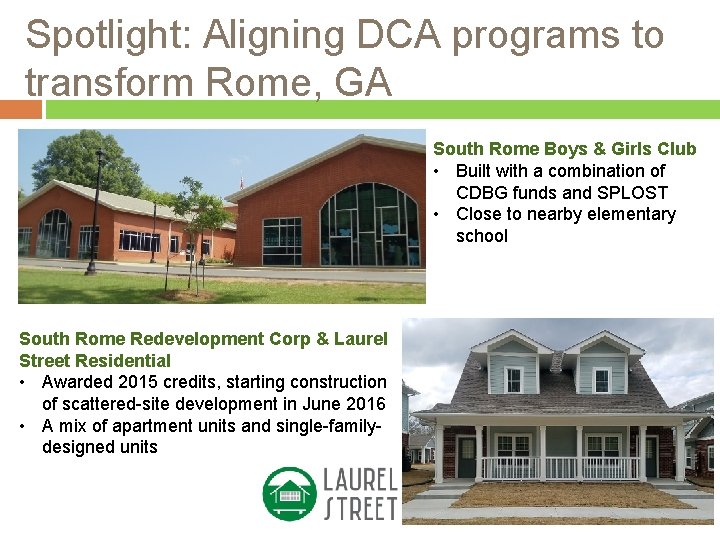
Spotlight: Aligning DCA programs to transform Rome, GA South Rome Boys & Girls Club • Built with a combination of CDBG funds and SPLOST • Close to nearby elementary school South Rome Redevelopment Corp & Laurel Street Residential • Awarded 2015 credits, starting construction of scattered-site development in June 2016 • A mix of apartment units and single-familydesigned units
Strengthen infrastructure with CDBG Public facilities and improvements q Water and sewer facilities, flood and drainage improvements, parking, streets, curbs, gutters, sidewalks, parks, playgrounds Redevelopment Fund q Maximum award: $750, 000/project q Grant assistance: public facilities q Direct loan assistance to private, for-profit to finance fixed assets (land, building, machinery)
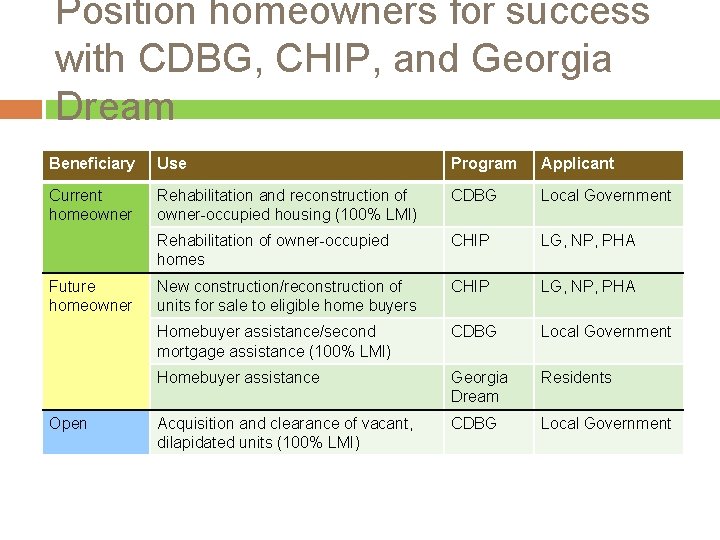
Position homeowners for success with CDBG, CHIP, and Georgia Dream Beneficiary Use Program Applicant Current homeowner Rehabilitation and reconstruction of owner-occupied housing (100% LMI) CDBG Local Government Rehabilitation of owner-occupied homes CHIP LG, NP, PHA New construction/reconstruction of units for sale to eligible home buyers CHIP LG, NP, PHA Homebuyer assistance/second mortgage assistance (100% LMI) CDBG Local Government Homebuyer assistance Georgia Dream Residents Acquisition and clearance of vacant, dilapidated units (100% LMI) CDBG Local Government Future homeowner Open
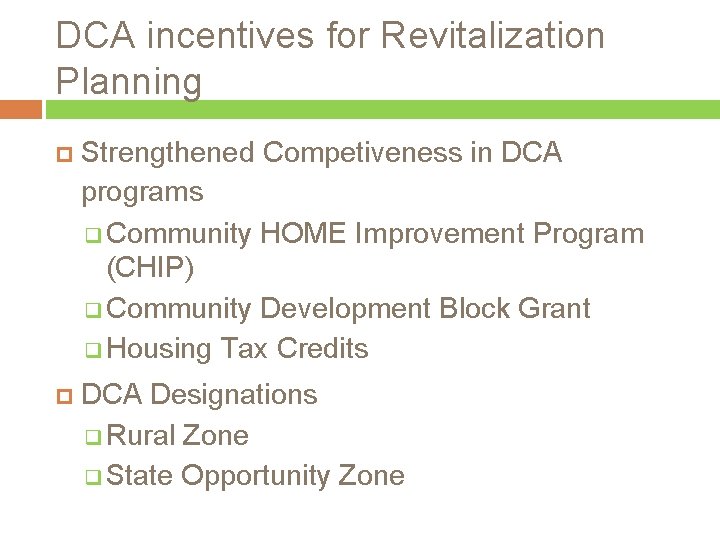
DCA incentives for Revitalization Planning Strengthened Competiveness in DCA programs q Community HOME Improvement Program (CHIP) q Community Development Block Grant q Housing Tax Credits DCA Designations q Rural Zone q State Opportunity Zone
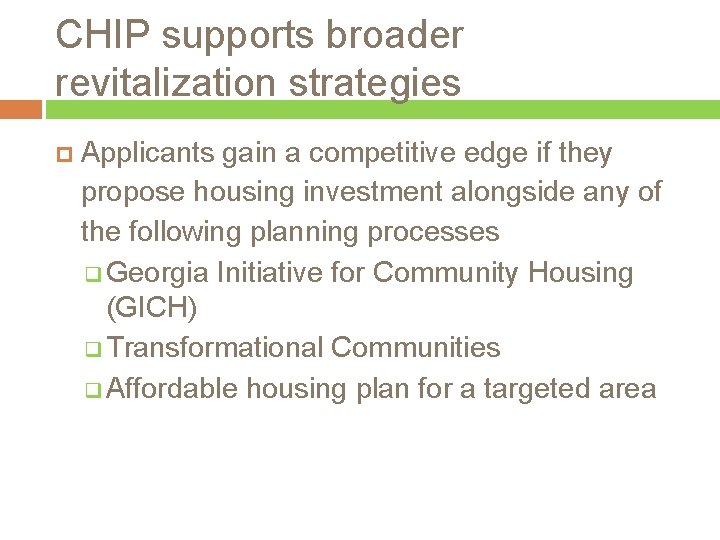
CHIP supports broader revitalization strategies Applicants gain a competitive edge if they propose housing investment alongside any of the following planning processes q Georgia Initiative for Community Housing (GICH) q Transformational Communities q Affordable housing plan for a targeted area
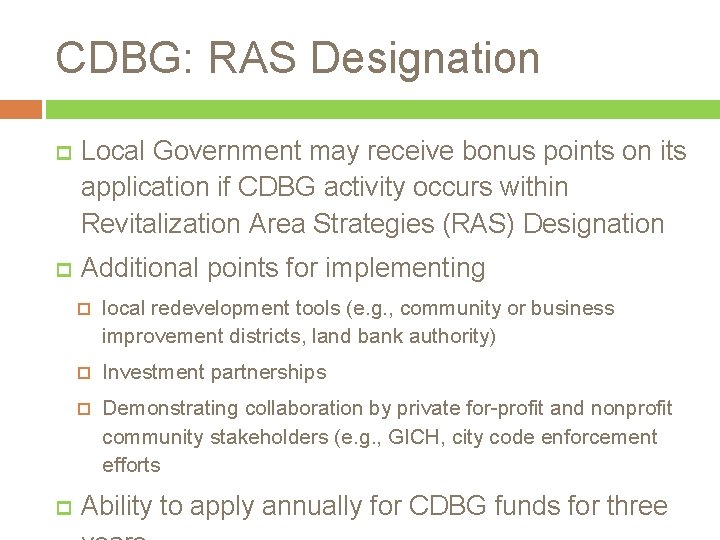
CDBG: RAS Designation Local Government may receive bonus points on its application if CDBG activity occurs within Revitalization Area Strategies (RAS) Designation Additional points for implementing local redevelopment tools (e. g. , community or business improvement districts, land bank authority) Investment partnerships Demonstrating collaboration by private for-profit and nonprofit community stakeholders (e. g. , GICH, city code enforcement efforts Ability to apply annually for CDBG funds for three
Housing Tax Credits: Plan Criteria IRS requires that States give preference in selection to proposed housing “located in Qualified Census Tracts, the development of which contributes to a concerted community revitalization plan” Affordable housing applications with revitalization plans are also eligible for: q Points for an investment of capital that occurs within a 0. 5 mile radius of the proposed site q Participation in Community Transformation planning process
Comparing Revitalization Plan Requirements across DCA Programs
URPs required for some DCA programs CDBG RAS Local Government establishes a local redevelopment area and related Urban Redevelopment Plan q RAS boundaries must be within both the redevelopment area and one or more Census Block Groups with poverty rate of 20% or greater q Opportunity Zone q Can also use an Enterprise Zone, which can be passed by Local Government without plan
Other DCA programs require specific plan components Community HOME Improvement Program Housing Tax Credits Rural Zone
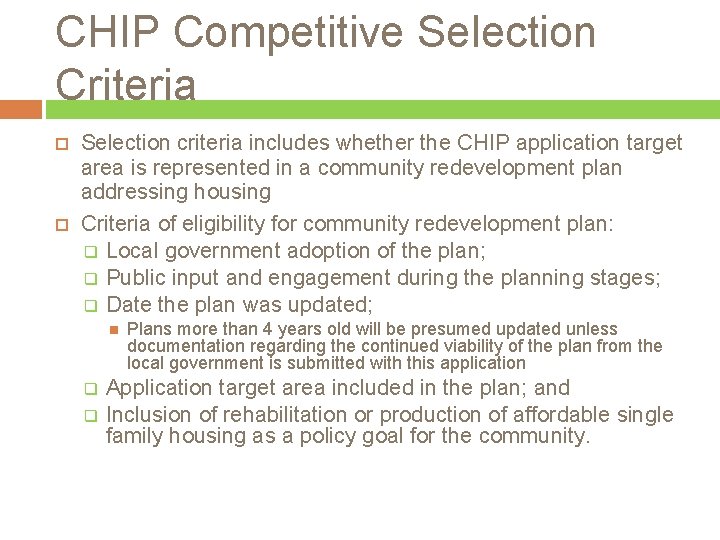
CHIP Competitive Selection Criteria Selection criteria includes whether the CHIP application target area is represented in a community redevelopment plan addressing housing Criteria of eligibility for community redevelopment plan: q Local government adoption of the plan; q Public input and engagement during the planning stages; q Date the plan was updated; q q Plans more than 4 years old will be presumed updated unless documentation regarding the continued viability of the plan from the local government is submitted with this application Application target area included in the plan; and Inclusion of rehabilitation or production of affordable single family housing as a policy goal for the community.
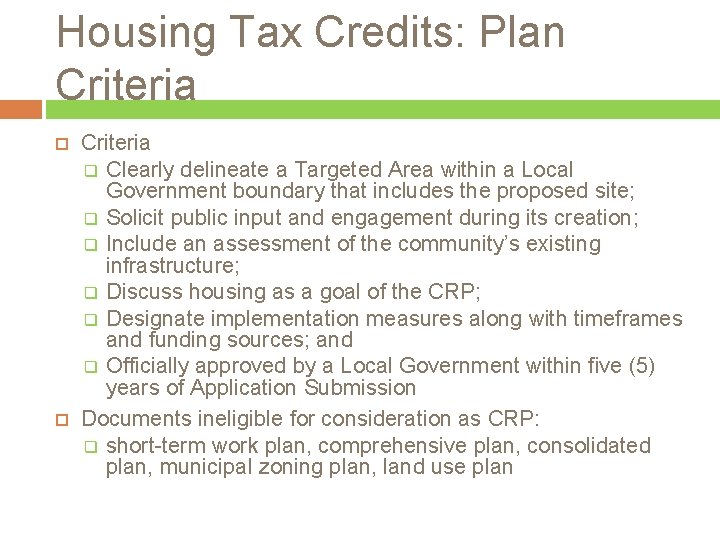
Housing Tax Credits: Plan Criteria q Clearly delineate a Targeted Area within a Local Government boundary that includes the proposed site; q Solicit public input and engagement during its creation; q Include an assessment of the community’s existing infrastructure; q Discuss housing as a goal of the CRP; q Designate implementation measures along with timeframes and funding sources; and q Officially approved by a Local Government within five (5) years of Application Submission Documents ineligible for consideration as CRP: q short-term work plan, comprehensive plan, consolidated plan, municipal zoning plan, land use plan
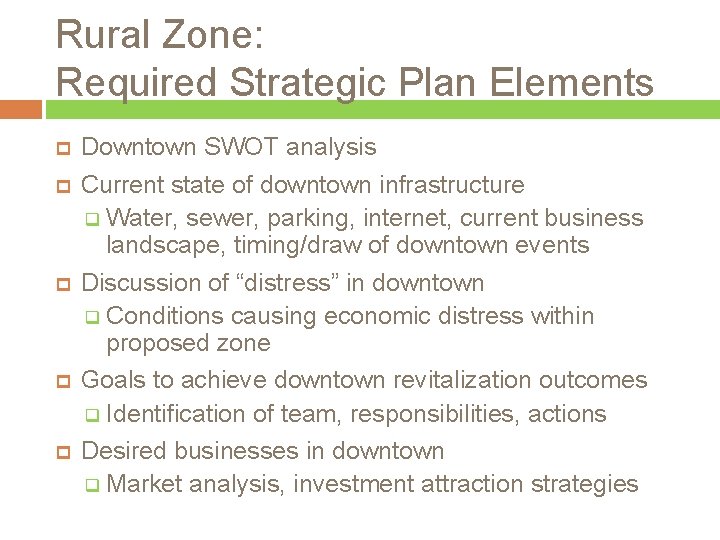
Rural Zone: Required Strategic Plan Elements Downtown SWOT analysis Current state of downtown infrastructure q Water, sewer, parking, internet, current business landscape, timing/draw of downtown events Discussion of “distress” in downtown q Conditions causing economic distress within proposed zone Goals to achieve downtown revitalization outcomes q Identification of team, responsibilities, actions Desired businesses in downtown q Market analysis, investment attraction strategies
Comprehensive Plans as a Foundation for Revitalization
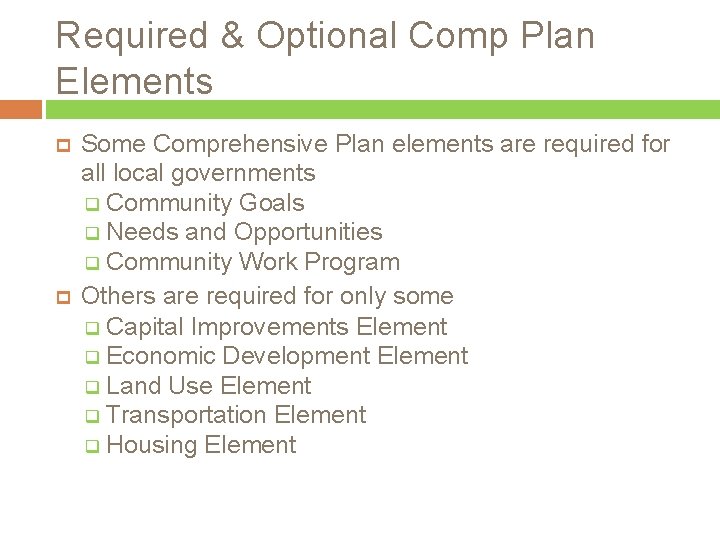
Required & Optional Comp Plan Elements Some Comprehensive Plan elements are required for all local governments q Community Goals q Needs and Opportunities q Community Work Program Others are required for only some q Capital Improvements Element q Economic Development Element q Land Use Element q Transportation Element q Housing Element
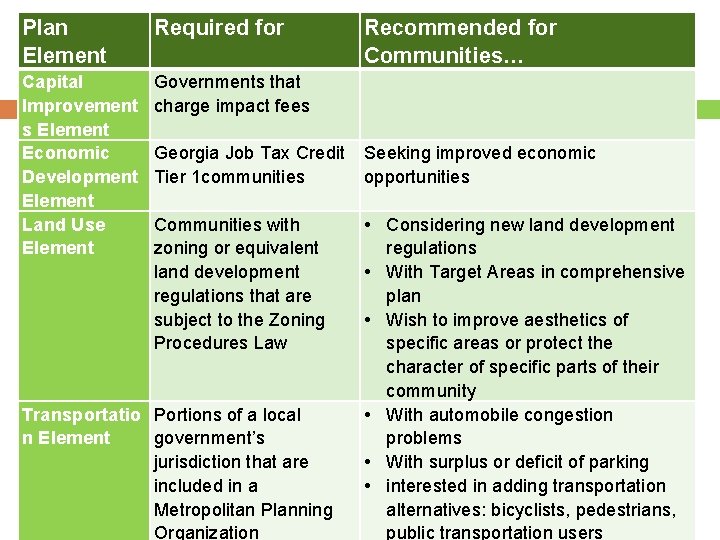
Plan Element Required for Capital Improvement s Element Economic Development Element Land Use Element Governments that charge impact fees Recommended for Communities… Georgia Job Tax Credit Tier 1 communities Seeking improved economic opportunities Communities with zoning or equivalent land development regulations that are subject to the Zoning Procedures Law • Considering new land development regulations • With Target Areas in comprehensive plan • Wish to improve aesthetics of specific areas or protect the character of specific parts of their community • With automobile congestion problems • With surplus or deficit of parking • interested in adding transportation alternatives: bicyclists, pedestrians, public transportation users Transportatio Portions of a local n Element government’s jurisdiction that are included in a Metropolitan Planning Organization
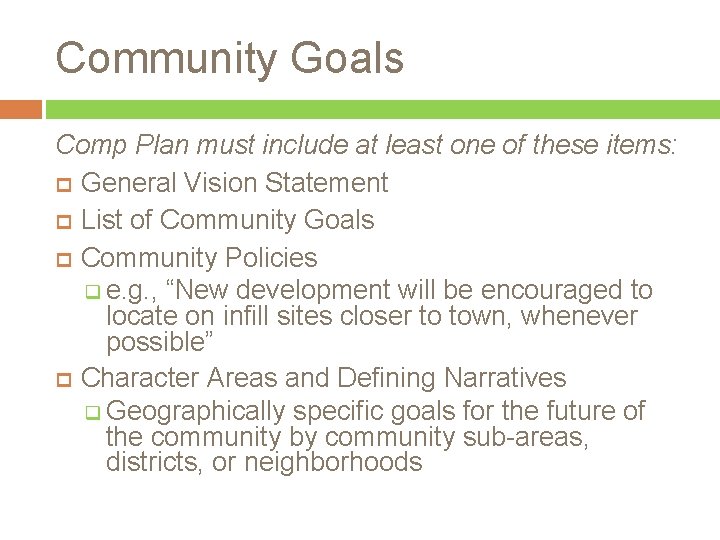
Community Goals Comp Plan must include at least one of these items: General Vision Statement List of Community Goals Community Policies q e. g. , “New development will be encouraged to locate on infill sites closer to town, whenever possible” Character Areas and Defining Narratives q Geographically specific goals for the future of the community by community sub-areas, districts, or neighborhoods
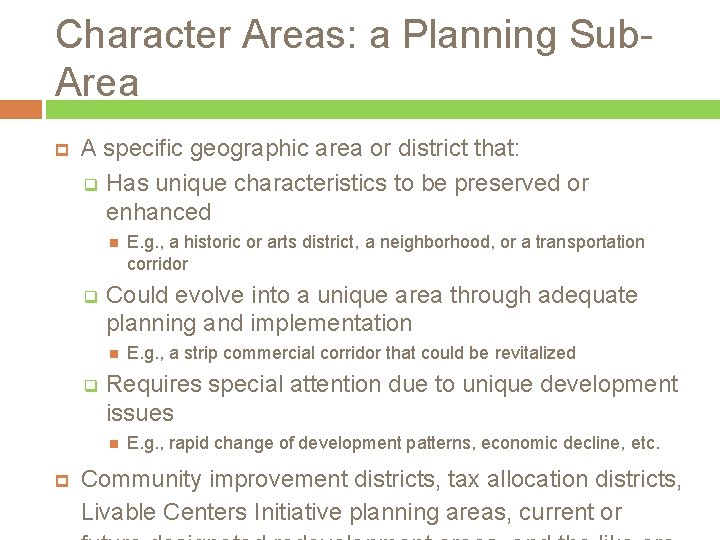
Character Areas: a Planning Sub. Area A specific geographic area or district that: q Has unique characteristics to be preserved or enhanced q Could evolve into a unique area through adequate planning and implementation q E. g. , a strip commercial corridor that could be revitalized Requires special attention due to unique development issues E. g. , a historic or arts district, a neighborhood, or a transportation corridor E. g. , rapid change of development patterns, economic decline, etc. Community improvement districts, tax allocation districts, Livable Centers Initiative planning areas, current or
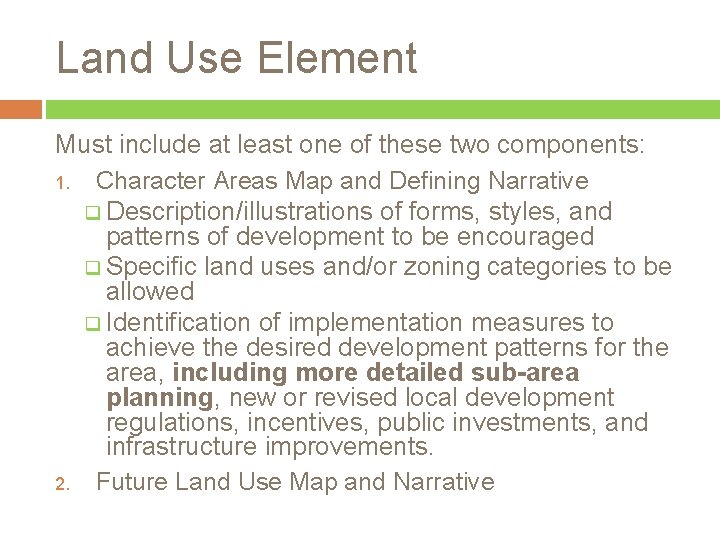
Land Use Element Must include at least one of these two components: 1. Character Areas Map and Defining Narrative q Description/illustrations of forms, styles, and patterns of development to be encouraged q Specific land uses and/or zoning categories to be allowed q Identification of implementation measures to achieve the desired development patterns for the area, including more detailed sub-area planning, new or revised local development regulations, incentives, public investments, and infrastructure improvements. 2. Future Land Use Map and Narrative
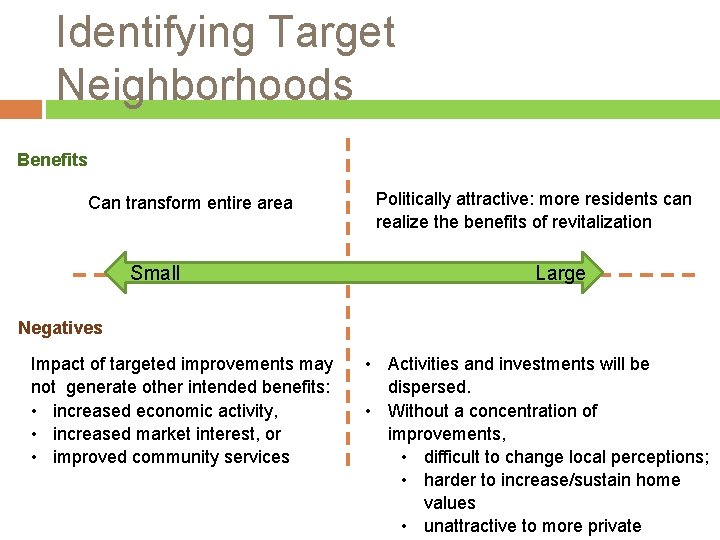
Identifying Target Neighborhoods Benefits Can transform entire area Small Politically attractive: more residents can realize the benefits of revitalization Large Negatives Impact of targeted improvements may not generate other intended benefits: • increased economic activity, • increased market interest, or • improved community services • Activities and investments will be dispersed. • Without a concentration of improvements, • difficult to change local perceptions; • harder to increase/sustain home values • unattractive to more private
Economic Development Element Needs and opportunity assessment: q diversity of the economic base q quality of the local labor force q effectiveness of local economic development agencies, programs, and tools The Comprehensive Economic Development Strategy (CEDS) for the region may be substituted
Housing Element Evaluating the adequacy/suitability of existing housing stock for current/future community needs. Factors to consider include: q housing types and mix; q condition and occupancy; q local cost of housing; q cost-burdened household types and mix; q condition and occupancy; q jobs-housing balance; q housing needs of special populations; and q availability of housing options across the life cycle. The community’s Consolidated Plan may be substituted.
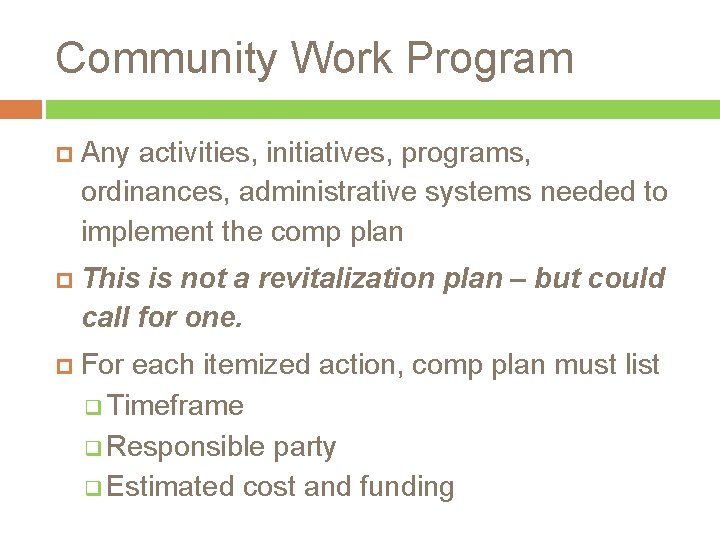
Community Work Program Any activities, initiatives, programs, ordinances, administrative systems needed to implement the comp plan This is not a revitalization plan – but could call for one. For each itemized action, comp plan must list q Timeframe q Responsible party q Estimated cost and funding
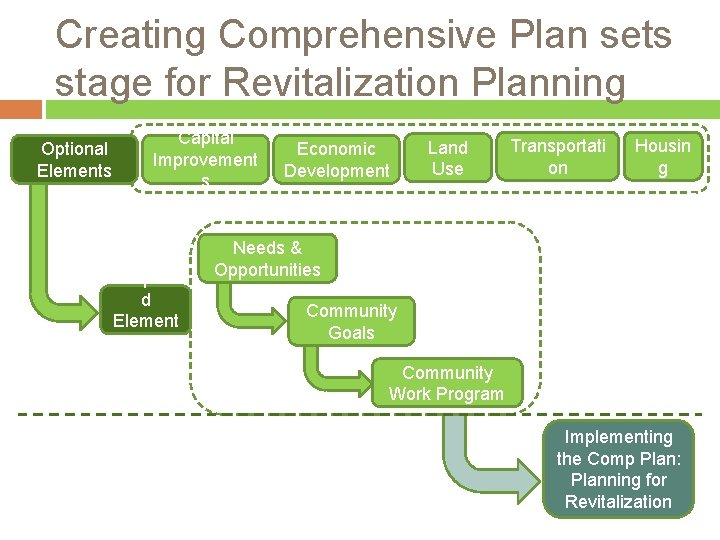
Creating Comprehensive Plan sets stage for Revitalization Planning Optional Elements Capital Improvement s Require d Element s Economic Development Land Use Transportati on Housin g Needs & Opportunities Community Goals Community Work Program Implementing the Comp Plan: Planning for Revitalization
- Slides: 35