
BUILDING OF VIETNAM SOCIOECONOMIC DEVELOPMENT STRATEGY 2021 2030

BUILDING OF VIETNAM SOCIO-ECONOMIC DEVELOPMENT STRATEGY 2021 - 2030, VISION TO 2045 AND IMPACTS ON STATISTICS OPERATION Associate Professor, Dr. Bui Tat Thang Standing Editorial Team of Sub-Committee for Socio-Economic Affairs Hanoi, November 2020 1
CONTENT I. Assessment of starting point (current status) II. Strategic content 2021 -2030 1 Context and perspective of socio-economic development in the 2021 - 2030 period 2 Socio-economic development targets during period 2021 - 2030 3 Strategic breakthroughs, tasks and solutions mainly for socioeconomic development during period 2021 - 2030 III. Impacts on statistics operation in the coming time 2
I. Assessment of starting point (current status) The main tasks of this section are: (1) Review of development resources of the country (2) Evaluate all aspects of national capacity in the correlation with the region and the world, especially in terms of quality. 3
I. Assessment of starting point (current status) 1 Existing country development resources - Population and labor - Natural resources: land, minerals, water sources, forests, seas, etc. - Economic geography and geopolitics 2 Evaluate all aspects of national development capacity -Economic capacity - Natural resources - Social resources - Institutional capacity - National defense, security and foreign affairs capacity 4
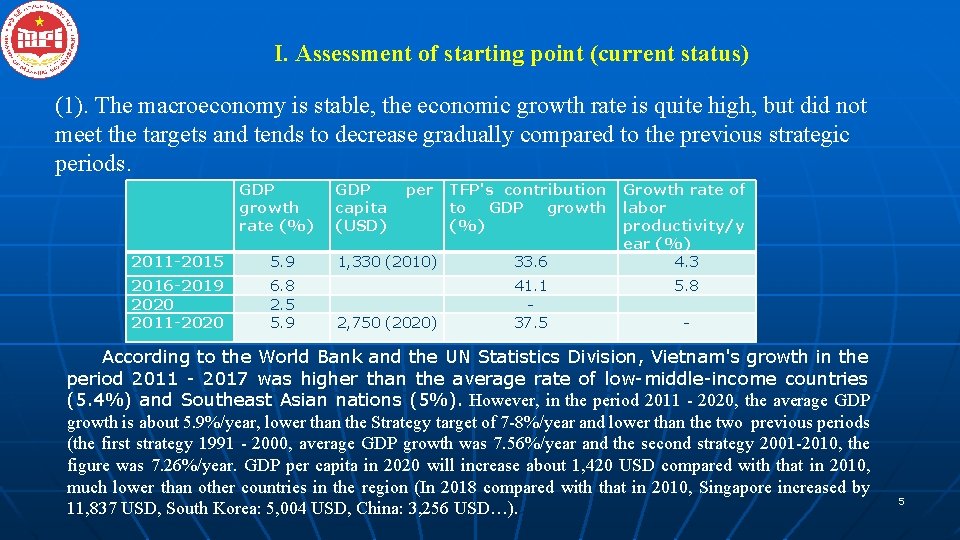
I. Assessment of starting point (current status) (1). The macroeconomy is stable, the economic growth rate is quite high, but did not meet the targets and tends to decrease gradually compared to the previous strategic periods. GDP growth rate (%) 2011 -2015 5. 9 GDP per TFP's contribution Growth rate of capita to GDP growth labor (USD) (%) productivity/y ear (%) 1, 330 (2010) 33. 6 4. 3 2016 -2019 2020 2011 -2020 6. 8 2. 5 5. 9 2, 750 (2020) 41. 1 37. 5 5. 8 - According to the World Bank and the UN Statistics Division, Vietnam's growth in the period 2011 - 2017 was higher than the average rate of low-middle-income countries (5. 4%) and Southeast Asian nations (5%). However, in the period 2011 - 2020, the average GDP growth is about 5. 9%/year, lower than the Strategy target of 7 -8%/year and lower than the two previous periods (the first strategy 1991 - 2000, average GDP growth was 7. 56%/year and the second strategy 2001 -2010, the figure was 7. 26%/year. GDP per capita in 2020 will increase about 1, 420 USD compared with that in 2010, much lower than other countries in the region (In 2018 compared with that in 2010, Singapore increased by 11, 837 USD, South Korea: 5, 004 USD, China: 3, 256 USD…). 5
I. Assessment of starting point (current status) (2). Implementation of economic restructuring associated with the growth model innovation has gained positive results, but slowly while the growth mode has not changed clearly. Science, technology and innovation have not really become the driving force to improve labor productivity, competitiveness, and socio-economic development. (3). The implementation of three strategic breakthroughs (institutions, human resources and infrastructure) has concentrated resources, and witnessed achievements. But looking at the whole picture it is still slow; the task of creating a foundation so that by 2020, Vietnam basically becomes a modern industrial country, which has not yet met the set target. (4). Regional development, marine and urban economy, and new rural development have gained achievements, but there are still many limitations and weaknesses. (5). The implementation of the cultural, social and human development goals recorded a progress but also revealed many limitations. 6
I. Assessment of starting point (current status) (6). Resource management, protection and improvement of environmental quality, proactive response to climate change, natural disaster prevention have been paid more attention; but do not meet the requirements (7). State management, administrative reform, anti-corruption and waste have changed remarkably, but there is still much to be done. (8). The combination of economic development with national defense, security and foreign affairs, international integration is increasing and more effective. (9) Overall assessment, causes and lessons learned 7
II. Strategic content 2021 -2030 The main tasks of this section are: - Clearly identify the main directions of the strategy - Strategic Objectives - Major solutions to achieving the Strategic Objectives 8
II. Strategic content 2021 -2030 1 Context and perspective of socio-economic development in the 2021 - 2030 period a) International background: - Peace, cooperation, association and development are still the main trends - The Covid-19 pandemic has changed complicated, causing global economic crisis and recession - Sustainable development becomes a global trend; digital economy, circular economy, green growth are the development models chosen by many countries - Science, technology, innovation and the 4 th Industrial Revolution are changing rapidly, breaking through, causing a wide and multidimensional impact on a global scale; promote the development of the digital economy and digital society. - The trend of urbanization and development of smart city is increasing. - The Asia-Pacific region continues to be an important driving force of the global economy - The situation of the East Sea is becoming more and more complicated, unpredictable, and seriously 9 threatens the peace and stability of the region and investment and development environment.
II. Strategic content 2021 -2030 b). Domestic background - After nearly 35 years of Doi Moi, our country's position and power has grown much stronger. - Aspiration for a prosperous Vietnam, self-reliant and resilient will is the endogenous strength for the country to develop rapidly and sustainably in the coming time. - However, the economy still faced shortcomings, limitations and potential risks, and the risk of lagging is still great. - The process of urbanization increase rapidly, creating great pressure on the needs of infrastructure development and treatment of environmental pollution. - The Covid-19 pandemic could cause negative impact, lasting into the early years of the Strategy period; the requirement not only to neutralize risks, overcome difficulties and challenges, but also be proactive with new opportunities, while the world economic structure and global governance are reshaped, modes of production, trading, consumption and social life changed after the pandemic. 10
II. Strategic content 2021 -2030 Viewpoint of transformation. 2 Reforming andsocio-economic development in the 2021 - 2030 period 1 Rapid and sustainable development is mainly based on science and technology, innovation and digital improving the quality of a complete, synchronous, modern, socialist-oriented market economy institution, effective and efficient law integration and enforcement is a prerequisite for country development. 3 Arousing aspirations for national development, self-reliance and promoting the strength of the great national solidarity and develop the country. 4 Building an autonomous economy must be based on mastering technology and proactively integrating into and diversifying markets, improving the economy's adaptive capacity. 5 Resolutely and persistently in the fight to protect national independence, sovereignty, unity and territorial integrity; build an orderly, disciplined and safe society, ensure the 11 peaceful and happy life of the people.
II. Strategic content 2021 -2030 2 Socio-economic development targets during period 2021 - 2030 a). Overall objectives Strategy 2021 -2030 Strategy 2011 -2020 By 2030, it will be a developing By 2020, Vietnam country with modern will basically become industries and high average a modern industrial income; By 2045, it will country. become a developed country with high income. Strategy 2001 -2010 Bring our country out of underdevelopment group; to create a foundation for basically a modern industrialized country by 2020. - According to UNIDO: Developing and emerging industrial economies have the following criteria: Manufacturing Value Added per capita (MVA) is from 1, 000 - 2, 500 USD or the value of manufacturing industry accounts for over 0. 5% of the total value of global manufacturing industry. Industrialized economies are considered ‘industrialized’ if its adjusted MVA per capita exceeds 2, 500 international dollars (PPP) or GDP per capita exceeds 20, 0000 international dollars (PPP). In the ASEAN region, the industrial country are Malaysia and Singapore, the industrialized country are Indonesia and Thailand. The MVA per capita of Vietnam is estimated at about 900 USD by 2020, is expected to reach over 2, 000 USD by 2030, and has become an industrial country (in the range of 1, 000 - 2, 500 USD). - According to the World Bank classification applicable to the fiscal year 2020 -2021, the group of middle-income countries has an average income per capita of between 4, 046 USD and 12, 535 USD. The high average income threshold in the past 10 years ranges from 3, 856 USD to 4, 126 USD, 3, 856 USD in 2010, 4, 126 USD in 2015, 3, 996 USD in 2020, and 4, 046 USD in 2021. 12
II. Strategic content 2021 -2030 b). Key indicators a) Economics - The growth rate of gross domestic product (GDP) is about 7%/year on average; GDP per capita at current prices by 2030 will reach about 7, 500 USD. - The proportion of the manufacturing industry will reach about 30% of GDP, the digital economy will reach about 30% of GDP. - The urbanization rate will reach over 50%. - Total investment will reach 33 -35% of GDP; public debt will not exceed 60% of GDP. - The contribution of total factor productivity (TFP) to growth will reach 50%. - The social labor productivity growth rate will reach over 6. 5%/year. - Reduce energy consumption per unit of GDP by 1 - 1. 5%/year. (According to the re-evaluation of the economic size of the General Statistics Office, GDP in 2019 was 332 billion USD, GDP per capita was 3, 442 USD, in 2020 it is expected to reach about 340 billion USD (7. 99 million billion VND) and GDP per capita is about 3, 490 USD. The economic indicators calculated for the socio-economic development strategy 2021 -2030 and the 5 -year socio-economic development 13 direction 2021 -2025 are based on revalued data. )
II. Strategic content 2021 -2030 b). Key indicators (con’t) b) Social aspect - Human development index (HDI) will reach over 0. 7. - Average life expectancy will reach 75 years, in which the minimum life expectancy reaches 68 years. - The rate of trained workers with degrees and certificates will reach 35 -40%. - Labor working in the agricultural sector will decrease to less than 20% of the total labor force of the economy. c) Environment - The forest coverage rate is stable at 42 -43%. - The rate of treatment and reuse of wastewater discharged into the river basin environment will reach over 70%. - Reduce at least 8% of greenhouse gas emissions. - 100% of production and business establishments meet environmental standards. - Increase the area of marine and coastal protected areas to 3 -5% of the national marine area. Compared with normal 14 development scenario (scenario without by deliberate actions to mitigate emissions).
II. Strategic content 2021 -2030 3 Strategic breakthroughs, tasks and solutions mainly for socio-economic development during period 2021 - 2030 a). Strategic Breakthroughs 1 Improve the quality of a complete, synchronous, modern and integrated socialist-oriented market economy institution, focusing on markets for factors of production, especially the market of rights, land use, science and technology. 2 Continue to comprehensively developing human resources, science, technology, innovation associated with arousing aspirations for national development, national pride, self-reliance and promoting cultural values and Vietnamese citizen. 3 Continue to improving synchronous and modern socio-economic infrastructure system, focusing on the development of key infrastructure in transport, energy, information technology, big cities, and infrastructure and respond to climate change. 15
II. Strategic content 2021 -2030 b). Main tasks and solutions of the socio-economic development for 2021 - 2030 1 Focus on improving the quality of the institution of the socialist-oriented market economy, and better settling relations between the State, the market and the society. 2 Strongly develop science, technology and innovation in order to make a breakthrough to improve productivity, quality, efficiency and competitiveness of the economy 3 To develop human resources, education and training to meet the high-quality human resource requirements of the 4 th Industrial Revolution and international integration. 4 To step up industrialization, modernization, and restructure the economy in association with renewing the growth model, ensuring the reality and efficiency; developing the digital economy; promote rapid and sustainable growth on the basis of macroeconomic stability 5 To develop infrastructure, regional economy, marine economy, using urban areas as the 16 driving force for regional development and promoting the a new rural development.
II. Strategic content 2021 -2030 b). Main tasks and solutions of the socio-economic development for 2021 2030(con’t) 6 Development of culture and society, realization of social progress and equity; constantly improve people's material and spiritual life 7 Managing and using resources effectively; enhancing environmental protection and response to climate change, preventing, combating and mitigating natural disasters 8 To consolidate and strengthen national defense, ensure national security, maintain social order and safety; resolutely and persistently in the fight to firmly protect national independence, sovereignty, unity and territorial integrity 9 Improve the efficiency of foreign affairs, integration, and position and reputation of Vietnam in the international arena 10 Continue to building the socialist rule-of-law State, development, integrity and action; to step up the prevention and fight against corruption, saving practice, fight wastefulness, 17 and create a breakthrough in administrative reform
III. Impacts on statistics work in the coming time 1 Reviewing the statistical activities serving the policy-making work of the Party and the State, the administration of the Government in general and the development of strategies in particular. - Advantages: better at providing complete, accurate, timely and comparable data - Social expectations: better (stable, systematic, comparable, modern) 18
III. Impacts on statistics work in the coming time 2 Requirements of building strategies in the new situation - Two 100 -year milestones + 2030: 100 years of establishment of the Vietnamese Communist Party + 2045: 100 years of the founding of the Democratic Republic of Vietnam, now is the Socialist Republic of Vietnam - Higher requirements on development quality metrics. Sustainable development, inclusion…. 19
III. Impacts on statistics work in the coming time 3 Some issues raised for the work of statistics in general and the development of the Vietnam Statistical Strategy in particular in the coming time - Continue to publishing the defined statistical indicators but not yet announced: Green GDP, HDI, etc. - Research to publish some NEW statistical indicators that need to be identified, measured, for example: + Green economy + Circular economy + Digital economy + Happiness Index +. . . 20
Thank you. Thangbt. vids@mpi. gov. vn 0912215478 21
- Slides: 21