
Building Models by Coloring Diagrams Joel Rosenberg Museum
Building Models by Coloring Diagrams ▲▼▲▼▲▼ ▲▼▲▼▲ Joel Rosenberg Museum of Science, Boston jrose@alum. mit. edu

Problem Color-coding History Theory Evaluation Problem ▲▼▲▼▲ Color-coding ▼▲▼▲▼ History ▲▼▲▼▲ Theory ▼▲▼▲▼ Evaluation ▲▼▲▼▲
Problem Color-coding History Theory Evaluation Students don’t notice what is not obvious: * Ambient temperature * Atmospheric pressure * Electric potential
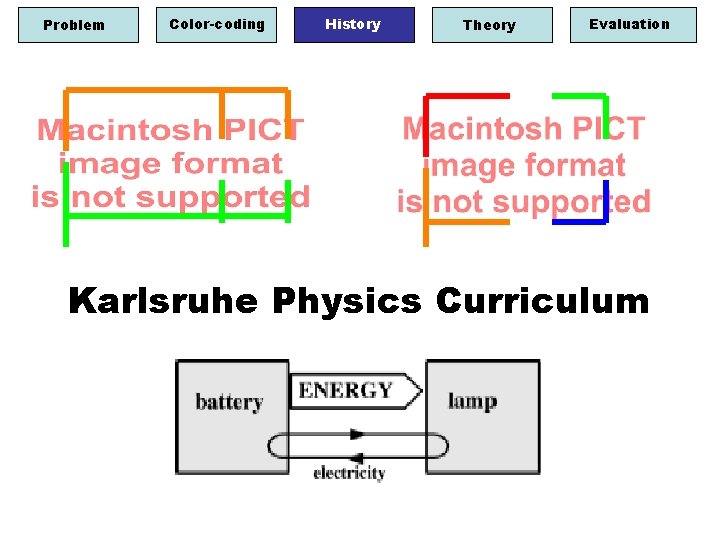
Problem Color-coding History Theory Evaluation Students don’t notice what is not obvious: * Ambient temperature * Atmospheric pressure * Electric potential Students think causes are linear: * Cold is caused by “cold” * Vacuums “suck” * “Electricity” flows one-way, from battery to bulb
Problem Color-coding History Theory Evaluation Students don’t notice what is not obvious: * Ambient temperature * Atmospheric pressure * Electric potential Students think causes are linear: * Cold is caused by “cold” * Vacuums “suck” * “Electricity” flows one-way, from battery to bulb Students also: * don’t differentiate heat and temperature * think of pressure as acting in a direction * fail to understand much about electric circuits
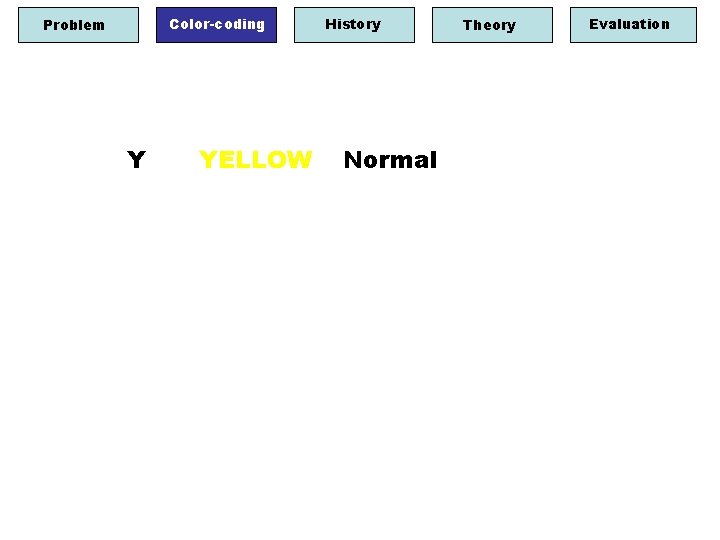
Color-coding Problem Y YELLOW History Normal Theory Evaluation
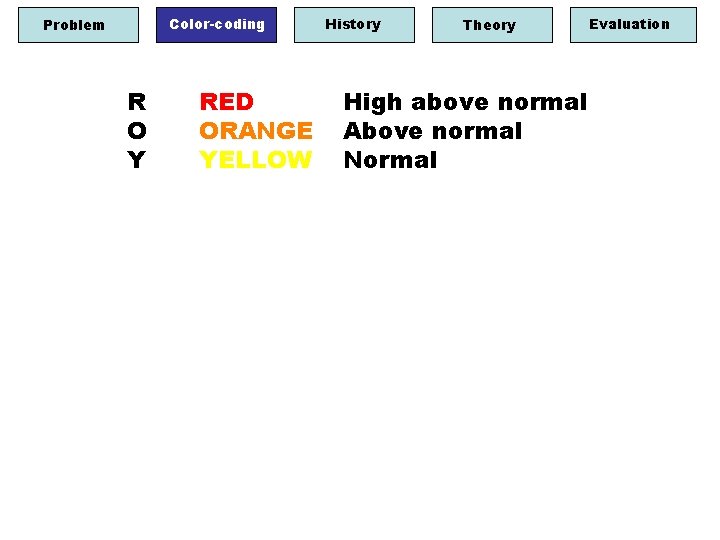
Color-coding Problem R O Y RED ORANGE YELLOW History Theory High above normal Above normal Normal Evaluation
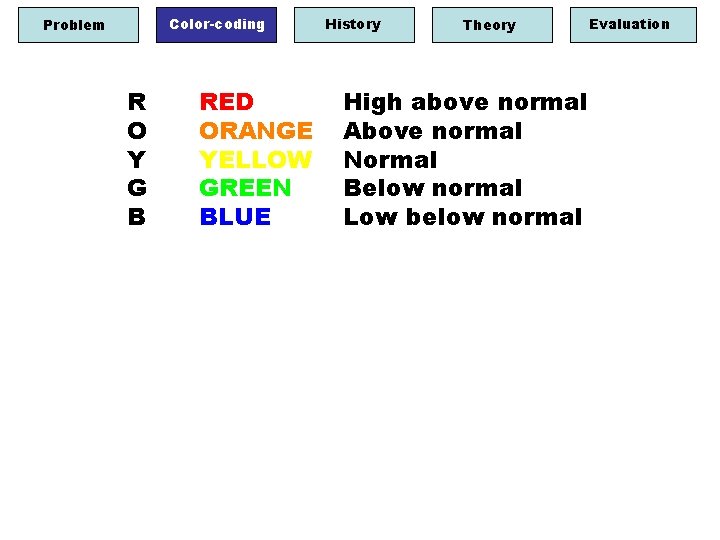
Color-coding Problem R O Y G B RED ORANGE YELLOW GREEN BLUE History Theory High above normal Above normal Normal Below normal Low below normal Evaluation
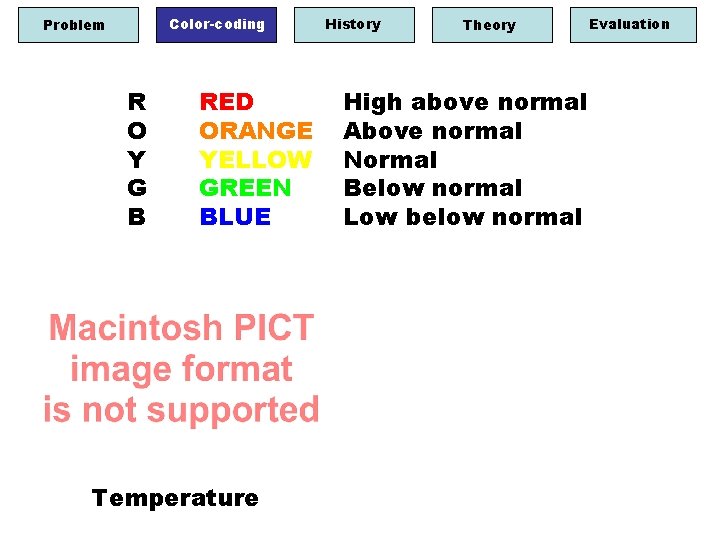
Color-coding Problem R O Y G B RED ORANGE YELLOW GREEN BLUE Temperature History Theory High above normal Above normal Normal Below normal Low below normal Evaluation
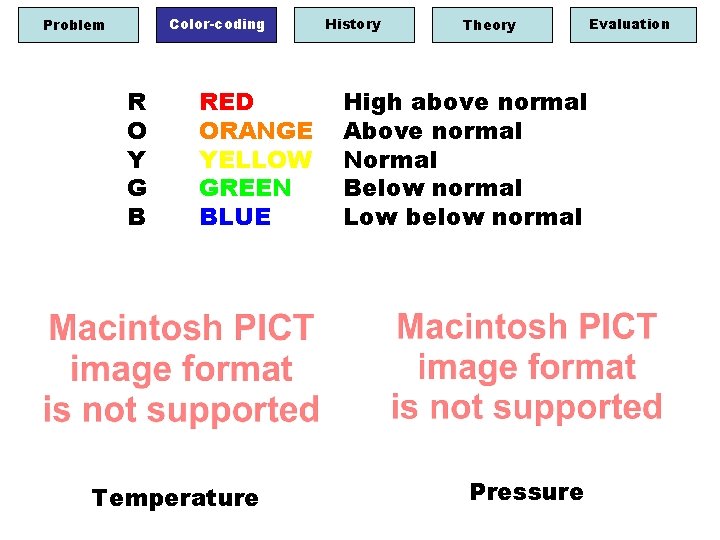
Color-coding Problem R O Y G B RED ORANGE YELLOW GREEN BLUE Temperature History Theory High above normal Above normal Normal Below normal Low below normal Pressure Evaluation
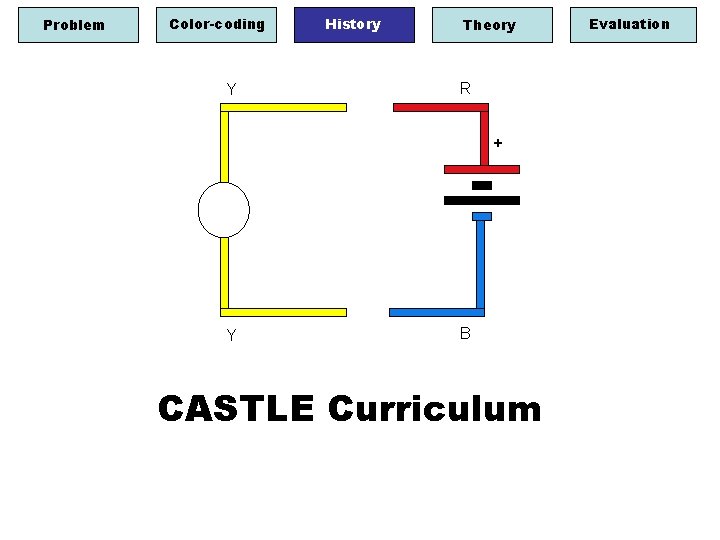
Problem Color-coding Y History Theory R + Y B CASTLE Curriculum Evaluation
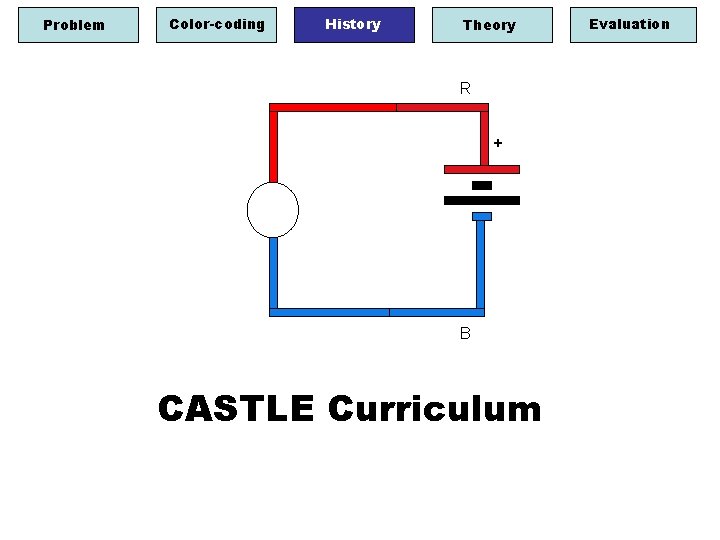
Problem Color-coding History Theory R + B CASTLE Curriculum Evaluation
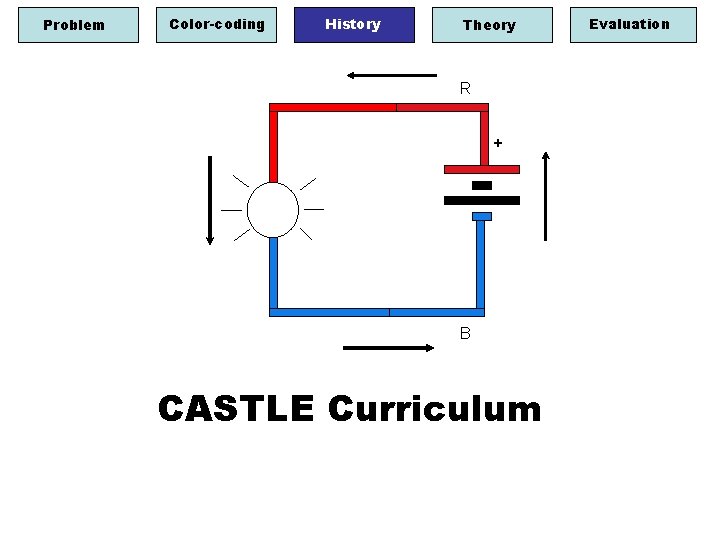
Problem Color-coding History Theory R + B CASTLE Curriculum Evaluation
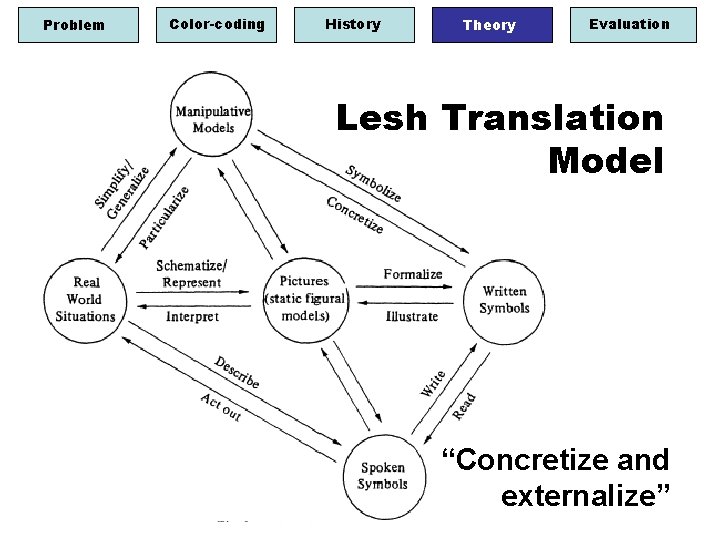
Problem Color-coding History Theory Evaluation Lesh Translation Model “Concretize and externalize”
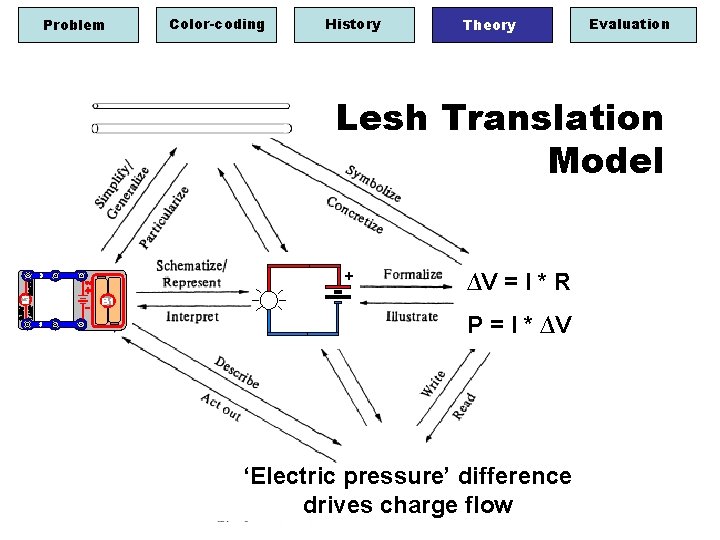
Problem Color-coding History Theory Evaluation Lesh Translation Model + ∆V = I * R P = I * ∆V ‘Electric pressure’ difference drives charge flow
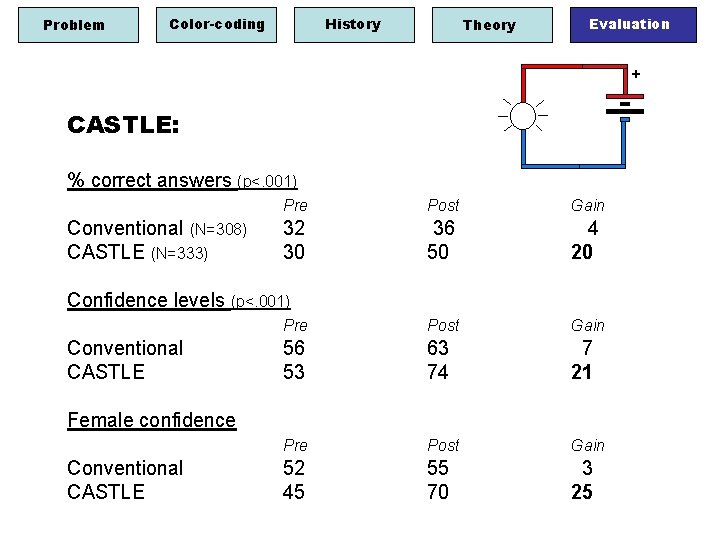
Problem Color-coding History Theory Evaluation + CASTLE: % correct answers (p<. 001) Conventional (N=308) CASTLE (N=333) Pre Post Gain 32 30 36 50 4 20 Pre Post Gain 56 53 63 74 7 21 Pre Post Gain 52 45 55 70 3 25 Confidence levels (p<. 001) Conventional CASTLE Female confidence Conventional CASTLE
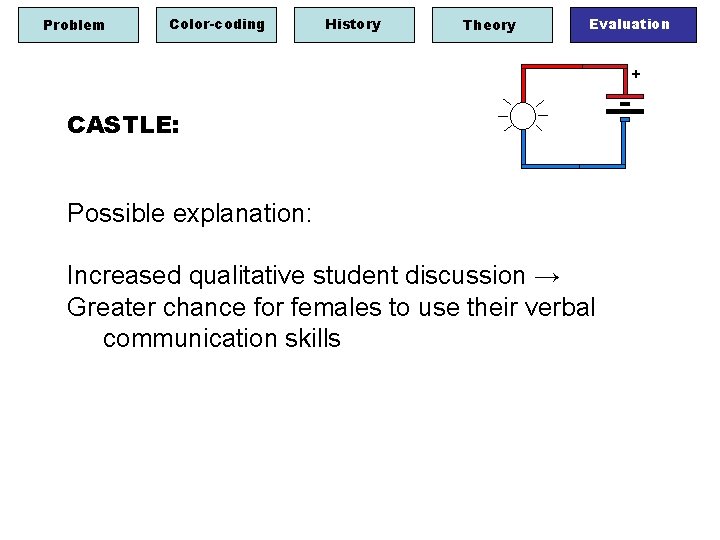
Problem Color-coding History Theory Evaluation + CASTLE: Possible explanation: Increased qualitative student discussion → Greater chance for females to use their verbal communication skills
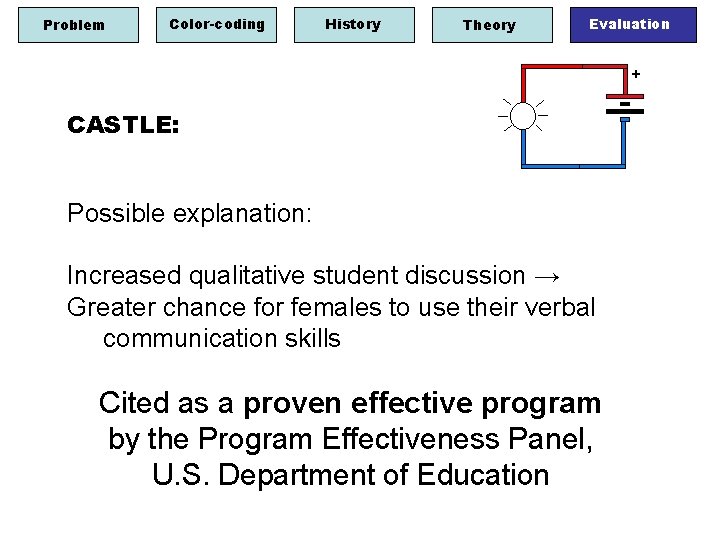
Problem Color-coding History Theory Evaluation + CASTLE: Possible explanation: Increased qualitative student discussion → Greater chance for females to use their verbal communication skills Cited as a proven effective program by the Program Effectiveness Panel, U. S. Department of Education
Problem Color-coding History Theory Evaluation Karlsruhe Physics Curriculum
Problem Color-coding History Theory Evaluation Karlsruhe Physics Curriculum
Problem Color-coding History Theory Evaluation Karlsruhe Physics Curriculum
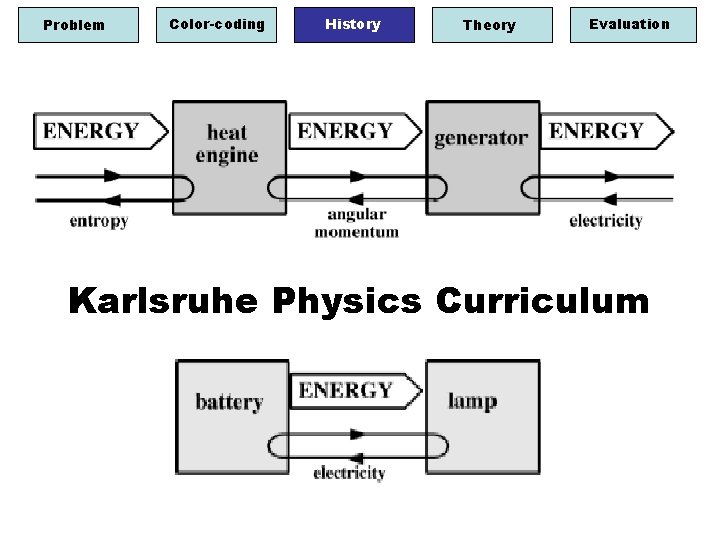
Problem Color-coding History Theory Evaluation Karlsruhe Physics Curriculum
Problem Color-coding History Theory Evaluation Karlsruhe Physics Course: “Neither KPC students nor traditional students developed adequate physical concepts about elementary electric circuits. ”
Problem Color-coding History Theory Evaluation Karlsruhe Physics Course: “Neither KPC students nor traditional students developed adequate physical concepts about elementary electric circuits. ”
Problem Color-coding History Theory Evaluation Karlsruhe Physics Course: “Neither KPC students nor traditional students developed adequate physical concepts about elementary electric circuits. ” * Higher self-efficacy for KPC girls * KPC students better at explaining thermal systems
Problem Color-coding History Theory Energy and Change Evaluation
Problem Color-coding History Theory Energy and Change “A difference drives change, and the difference disappears” Evaluation
Problem Color-coding History Theory Energy and Change “A difference drives change, and the difference disappears” “You need a difference to create a difference” Evaluation
Problem Color-coding History Theory Energy and Change “A difference drives change, and the difference disappears” “You need a difference to create a difference” Evaluation
Problem Color-coding History Theory Evaluation Energy and Change: Hot = high concentration of energy (for some students Hot = a LOT of energy) “The main difficulty…was distinguishing between the intensive quantity of temperature and the extensive quantity of energy; these abstract pictures did not seem to help them in that respect. ”
Problem Color-coding History Theory Evaluation Harvard Understanding of Consequences Project
Problem Color-coding History Theory Evaluation Harvard Understanding of Consequences Project
Problem Color-coding History Theory Evaluation Harvard Understanding of Consequences Project Pressure
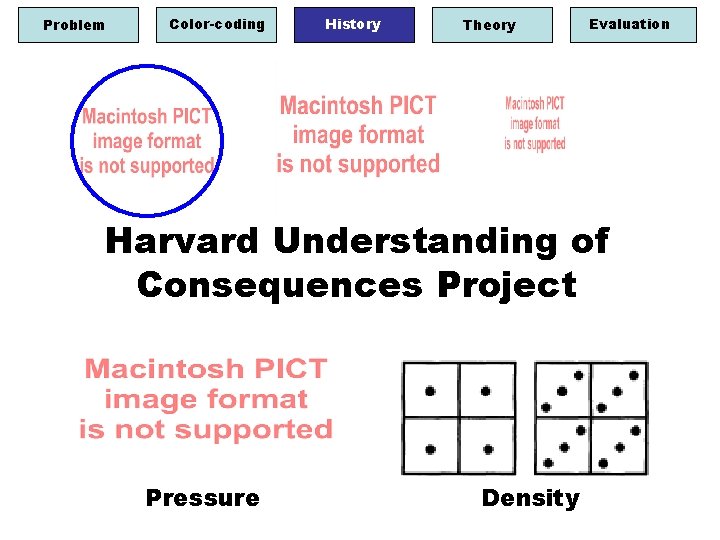
Problem Color-coding History Theory Evaluation Harvard Understanding of Consequences Project Pressure Density
Problem Color-coding History Theory Evaluation Understandings of Consequence: Causal puzzles clearly help students “Students…may construct more complex models but with incorrect scientific reasoning. ”
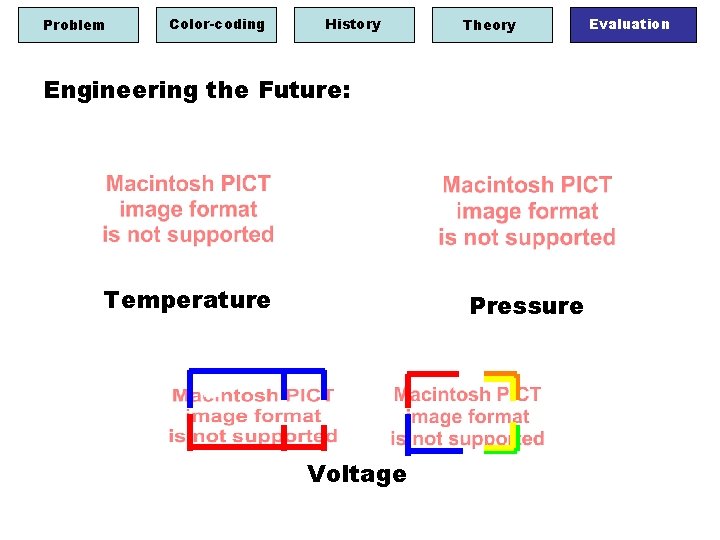
Problem Color-coding History Theory Engineering the Future: Temperature Pressure Voltage Evaluation
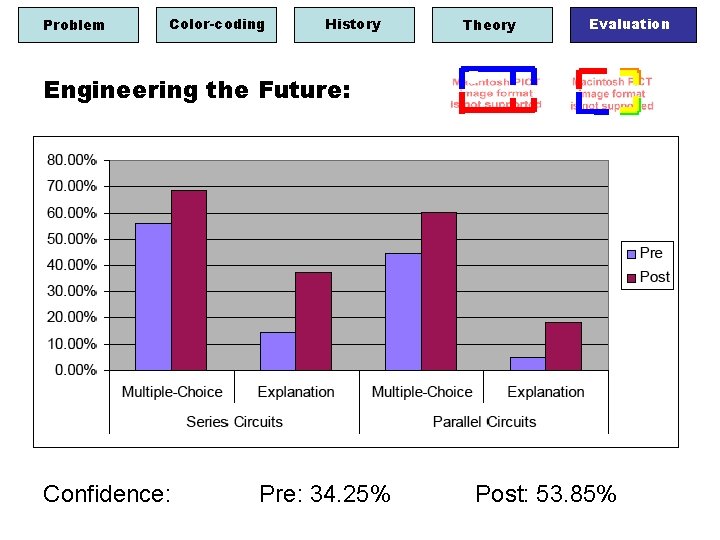
Problem Color-coding History Theory Evaluation Engineering the Future: Confidence: Pre: 34. 25% Post: 53. 85%
Vielen dank! ▲▼▲▼▲▼ ▲▼▲▼▲ Joel Rosenberg Museum of Science, Boston jrose@alum. mit. edu
- Slides: 38