
BUILDING MATERIAL AND CONSTRUCTION TECHNOLOGY NOMENCLATURE OF BUILDING
BUILDING MATERIAL AND CONSTRUCTION TECHNOLOGY NOMENCLATURE OF BUILDING PARTS Submitted by: Ar. Smriti Jain Er. Alisha Goel
CONTETNTS 1. 2. 3. 4. 5. 6. 7. 8. 9. 10. 11. 12. 13. 14. 15. What is a building? Parts of building Sub structure Foundation Superstructure Plinth Wall Column Floor Openings a) b) Door Window and ventilator a) b) Stairs Ramps, lift and escalators Vertical transport structures Roof structures Building finishes Building services References
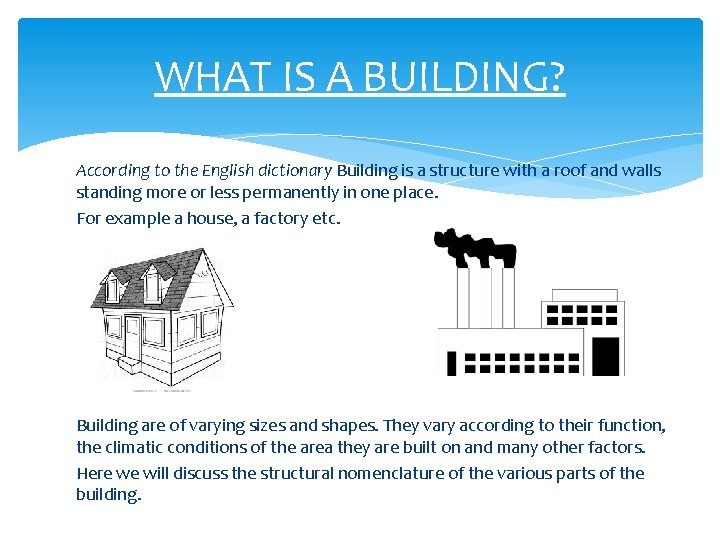
WHAT IS A BUILDING? According to the English dictionary Building is a structure with a roof and walls standing more or less permanently in one place. For example a house, a factory etc. Building are of varying sizes and shapes. They vary according to their function, the climatic conditions of the area they are built on and many other factors. Here we will discuss the structural nomenclature of the various parts of the building.
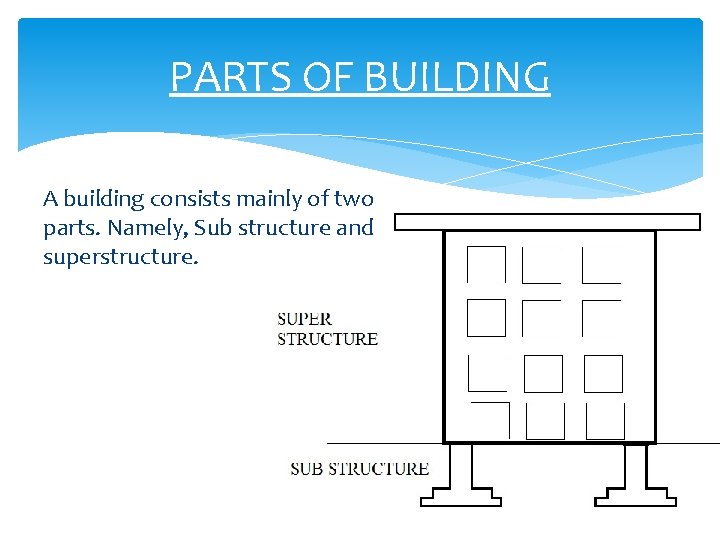
PARTS OF BUILDING A building consists mainly of two parts. Namely, Sub structure and superstructure.
SUB STRUCTURE Substructure is the lower part of the building that is located below the ground level. The substructure consists of foundation; the load of the super structure is transmitted to the soil through foundation. The sub structure is the part that is in direct contact with the soil. Sub structure includes Foundation.
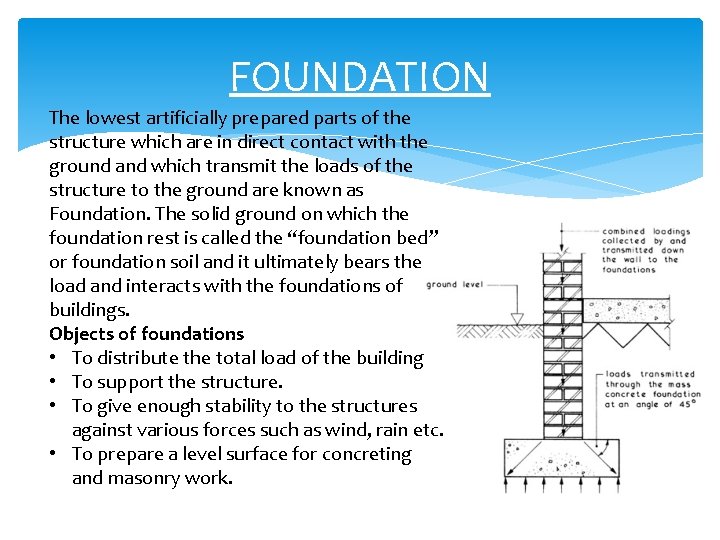
FOUNDATION The lowest artificially prepared parts of the structure which are in direct contact with the ground and which transmit the loads of the structure to the ground are known as Foundation. The solid ground on which the foundation rest is called the “foundation bed” or foundation soil and it ultimately bears the load and interacts with the foundations of buildings. Objects of foundations • To distribute the total load of the building • To support the structure. • To give enough stability to the structures against various forces such as wind, rain etc. • To prepare a level surface for concreting and masonry work.
SUPER STRUCTURE Superstructure is that part of the structure which is above ground level, and which serves the purpose of its intended use. The super structure consists of plinth, walls, columns, floors, openings, vertical transport structures, roof structures, building finishes and building services.
PLINTH A part of the super structure, located between the ground level and the floor level is known as plinth. Plinth is defined as the portion of the structure between the surface of the surrounding ground and surface of the floor, immediately above the ground. The level of the floor is usually known as the plinth level. The height of the plinth should not be less then 450 mm. Usually coping, plinth beam and damp proof course are provided at the top of the plinth.
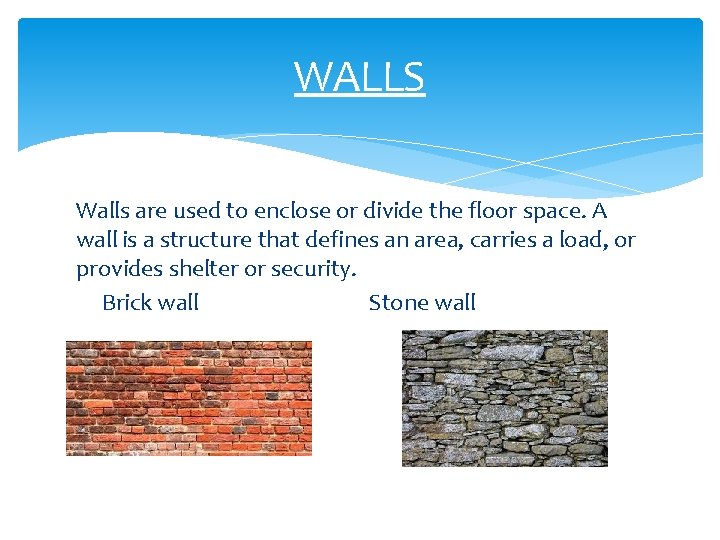
WALLS Walls are used to enclose or divide the floor space. A wall is a structure that defines an area, carries a load, or provides shelter or security. Brick wall Stone wall
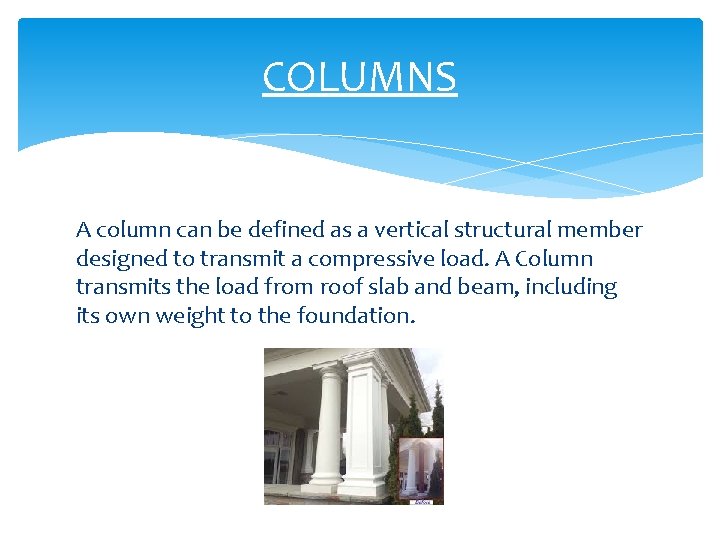
COLUMNS A column can be defined as a vertical structural member designed to transmit a compressive load. A Column transmits the load from roof slab and beam, including its own weight to the foundation.
FLOORS Floors are the horizontal elements which divide the building into different levels for the purpose of creating more accommodation within a restricted space one above the other and provide support for the occupants, furniture, fixtures and equipment of a building. The floor of a building immediately above the ground is known as ground floor. All other floors which are above the ground floor are known as the upper floors. The floor below the ground level is known as basement floor.
Every floor has two components: 1. Sub floor: it is a structural component of the building which imparts strength and stability to support the super-imposed loads, durability, damp prevention, heat and sound insulation and fire protection. 2. Flooring: it consists of suitable floor finish which imparts clean, smooth, durable and wear resisting surface.
OPENINGS Openings provide light, ventilation and climate control for a building. At the same time, they are essential functional and design elements of facades, enabling communication between indoor and outdoor spaces. There are three types of openings in a building. Namely, Doors Windows and Ventilators
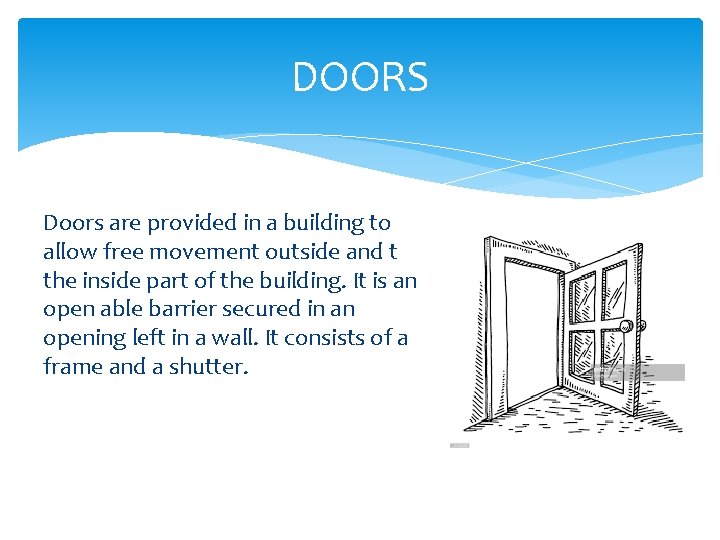
DOORS Doors are provided in a building to allow free movement outside and t the inside part of the building. It is an open able barrier secured in an opening left in a wall. It consists of a frame and a shutter.
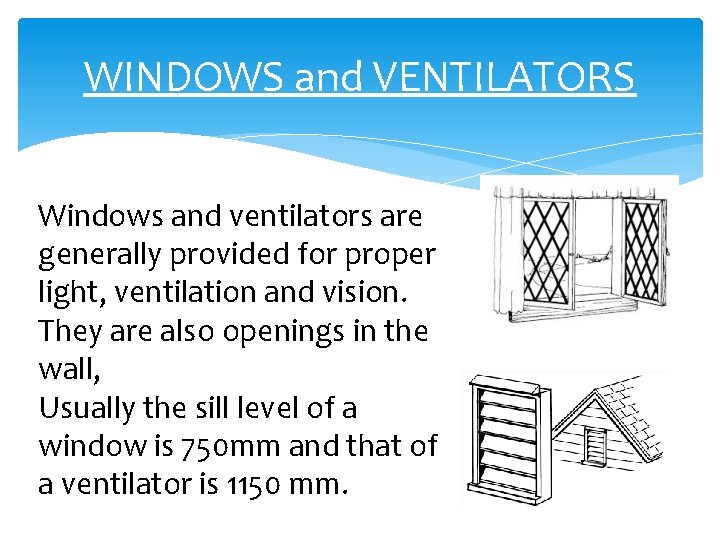
WINDOWS and VENTILATORS Windows and ventilators are generally provided for proper light, ventilation and vision. They are also openings in the wall, Usually the sill level of a window is 750 mm and that of a ventilator is 1150 mm.
VERTICAL TRANSPORT STRUCTURES Vertical transport structures are building components that provide access between various floors. They are stairs, ramps, lifts, escalators etc. Out of these stairs is the most common. Lifts and escalators are electrically operated. Basically escalators are electrically operated stairs.
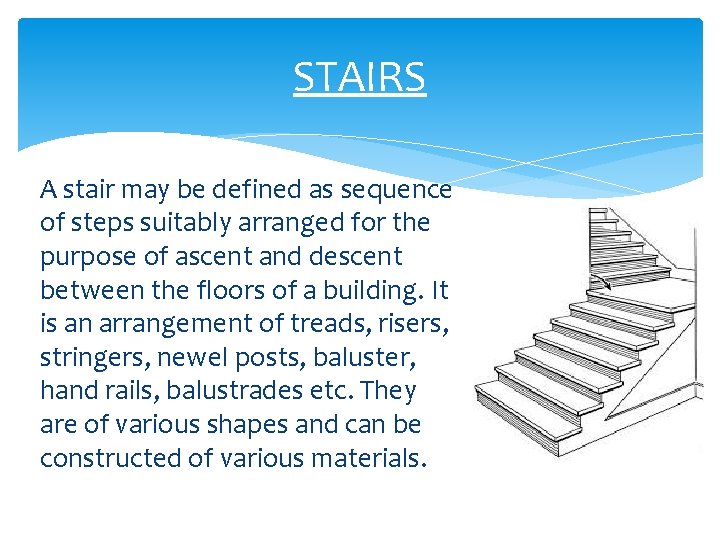
STAIRS A stair may be defined as sequence of steps suitably arranged for the purpose of ascent and descent between the floors of a building. It is an arrangement of treads, risers, stringers, newel posts, baluster, hand rails, balustrades etc. They are of various shapes and can be constructed of various materials.
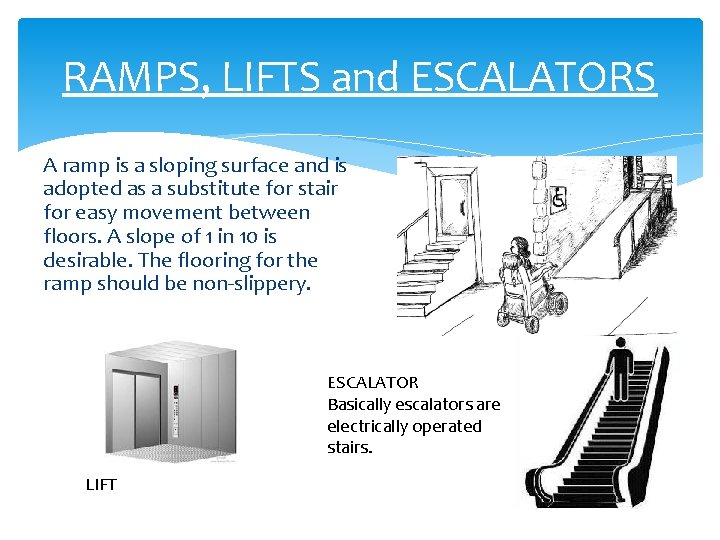
RAMPS, LIFTS and ESCALATORS A ramp is a sloping surface and is adopted as a substitute for stair for easy movement between floors. A slope of 1 in 10 is desirable. The flooring for the ramp should be non-slippery. ESCALATOR Basically escalators are electrically operated stairs. LIFT
ROOF STRUCTURES Roof structures are used to give protection to the building from rain, snow, sun etc. A roof is the upper most part of a building. a roof consists of two components : 1. The roof decking: it is a structural component which supports the roof covering. It may be either flat, sloping, dome, truss, etc. 2. The roof covering: it is provided on the roof deck to protect the building against sun, wind, snow etc. These may be in the form of tiles, thatch covering, slates, etc.
BUILDING FINISHES To protect the exposed surface 0 f the walls and floors fro the atmospheric actions, building finishes are used. They improve the appearance of the structure as a whole and give a smooth surface. They also rectify defective workmanship or conceal inferior materials. Building finishes consists of many items like, Plastering, Pointing, Painting, Varnishing, polishing, White washing, Distempering, Colour washing, flooring etc.
BUILDING SERVICES Building services are the systems installed in buildings to make them comfortable, functional, efficient and safe. They include water supply, drainage, electricity, acoustics, heating, air conditioning, fire detection, fire control, etc.
REFERENCE Building construction by Rangawala, Charotar publishing house Building construction by Mckay Images form Google images. www. google. co. in

Thank you
- Slides: 23