
Building local resilience through community composting Heather Williams
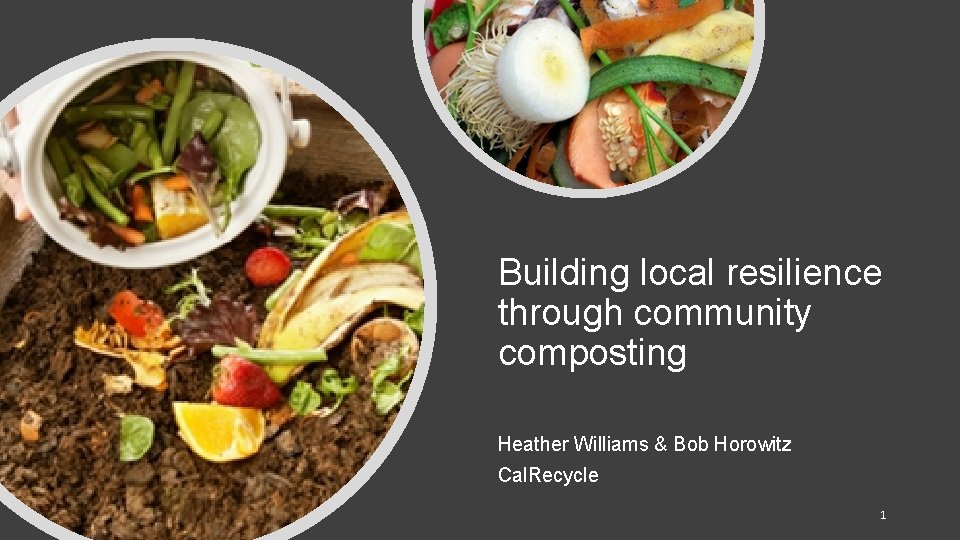
Building local resilience through community composting Heather Williams & Bob Horowitz Cal. Recycle 1
Cal. Recycle’s vision is to inspire and challenge Californians to achieve the highest waste reduction, recycling and reuse goals in the nation. Cal. Recycle administers a range of • Carpet programs: • Paint • Organics management • Mattresses • Food-scrap composting • Rigid plastic containers • Beverage container • Newsprint • Electronic-waste recycling • Construction and demolition debris • Used tires • Medical sharps waste • Used motor oil • Household hazardous waste 2
CA Organics Policy Drivers Integrated Waste Management Act: AB 939 (1989) • Defined composting as recycling. All cities and counties must divert half of all solid waste away from landfills. Mandatory Commercial Recycling (2011) • Statewide goal of 75% recycling, composting, source reduction Mandatory Commercial Organics Recycling (2014) • Businesses generating specified amounts of organic waste must arrange for recycling services Green Material Used as Alternative Daily Cover (2014) • Green materials used to cover landfill face at the end of the day no longer counts as diversion after Jan. 1, 2020. Short-Lived Climate Pollutants (SLCP): Organic Waste Methane Emissions Reductions, (2015) • Reduce man made methane emissions 40% by 2030. • Reduce organic materials going to landfills by 75% by 2025. • Rescue 20% of currently disposed edible food for human consumption by 2025. Must double existing organics infrastructure to attain these goals. 3
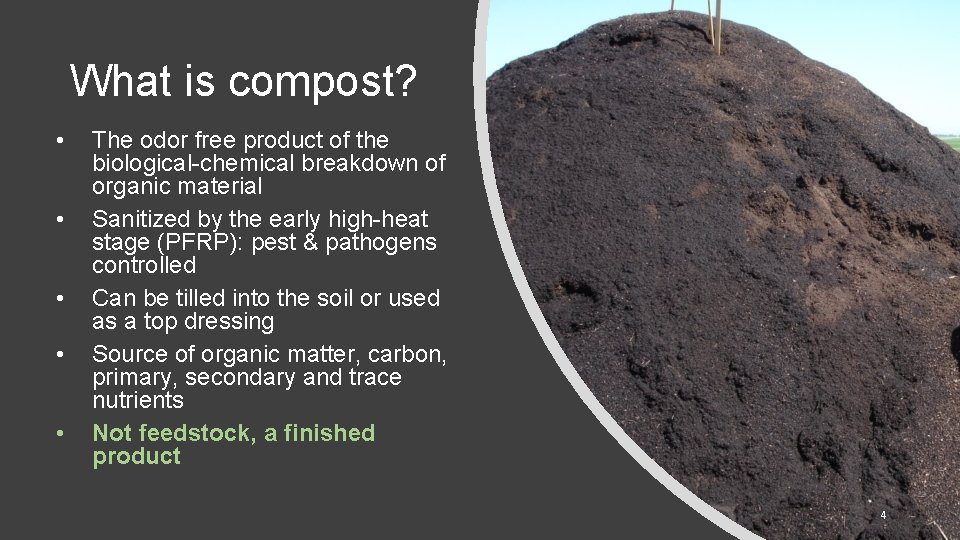
What is compost? • • • The odor free product of the biological-chemical breakdown of organic material Sanitized by the early high-heat stage (PFRP): pest & pathogens controlled Can be tilled into the soil or used as a top dressing Source of organic matter, carbon, primary, secondary and trace nutrients Not feedstock, a finished product 4
New Research out of UC Davis Tautges, et al. , (2019) • Tracked soil carbon changes throughout surface and subsoil layers in an agricultural system. • Gains in Soil Organic Carbon over the 19 -year period translated to a rate of. 66% increase in soil Carbon per year, exceeding the target of the 4 -per-1000 initiative • Substantial increases in soil Carbon are achievable even in semi-arid climates. • Soil Organic Carbon losses observed in plots with winter cover crops and no compost application. • Supports importance of recording soil Carbon data on deep soil profile. 5
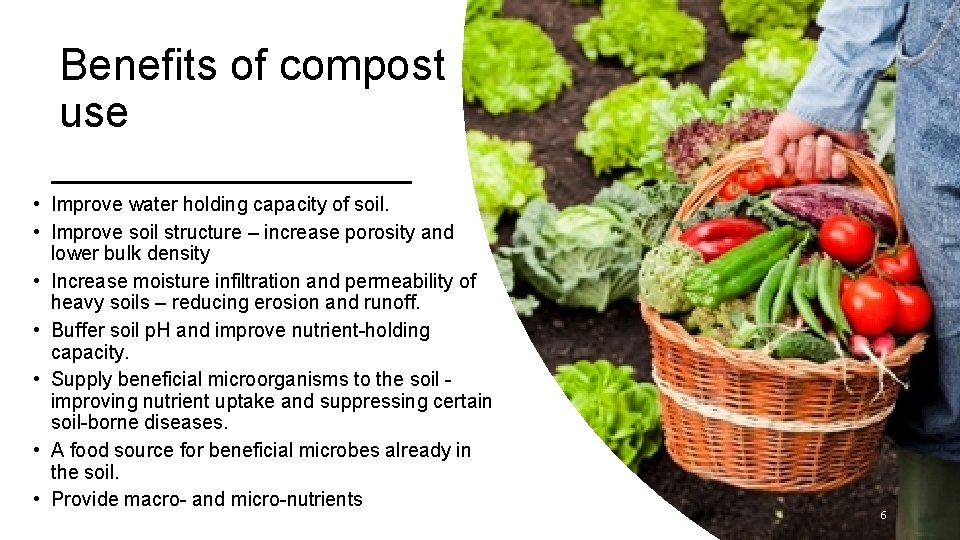
Benefits of compost use • Improve water holding capacity of soil. • Improve soil structure – increase porosity and lower bulk density • Increase moisture infiltration and permeability of heavy soils – reducing erosion and runoff. • Buffer soil p. H and improve nutrient-holding capacity. • Supply beneficial microorganisms to the soil improving nutrient uptake and suppressing certain soil-borne diseases. • A food source for beneficial microbes already in the soil. • Provide macro- and micro-nutrients 6
Environmental Justice Cal. Recycle is working to increase protection of public health and safety, and the environment, within disadvantaged communities, while minimizing or mitigating the impacts of solid waste infrastructure on disadvantaged communities. 7
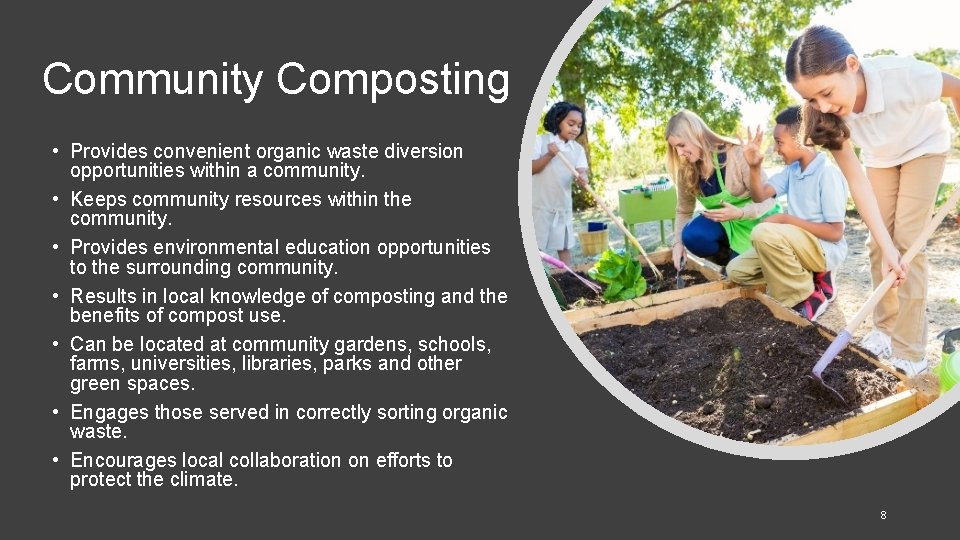
Community Composting • Provides convenient organic waste diversion opportunities within a community. • Keeps community resources within the community. • Provides environmental education opportunities to the surrounding community. • Results in local knowledge of composting and the benefits of compost use. • Can be located at community gardens, schools, farms, universities, libraries, parks and other green spaces. • Engages those served in correctly sorting organic waste. • Encourages local collaboration on efforts to protect the climate. 8
Site permitting: Excluded sites Does not need solid waste permit, might need other types of permits • Less than 100 cubic yards/750 sq. ft of materials on site at any time • Vermicomposting • Agricultural exemption • Check in with your Local Enforcement Agency for assistance and guidance • LEA is usually city or county environmental health department • You cannot create a nuisance (odors, varmints) CA Code of Regulations (Title 17, Div. 7, Ch. 3. 1, Article 2) 9
Community Composting for Green Spaces Grant Program • The program is currently in development and will provide funding from the Greenhouse Gas Reduction Fund (GGRF) to assist community groups statewide with composting. • This program is part of California Climate Investments, a statewide program that puts billions of Cap-and-Trade dollars to work reducing greenhouse gas emissions, strengthening the economy and improving public health and the environment— particularly in disadvantaged communities. The Cap-and. Trade program also creates a financial incentive for industries to invest in clean technologies and develop innovative ways to reduce pollution. At least 35 percent of these investments are made in disadvantaged and low-income communities. For more information, visit California Climate Investments. 10
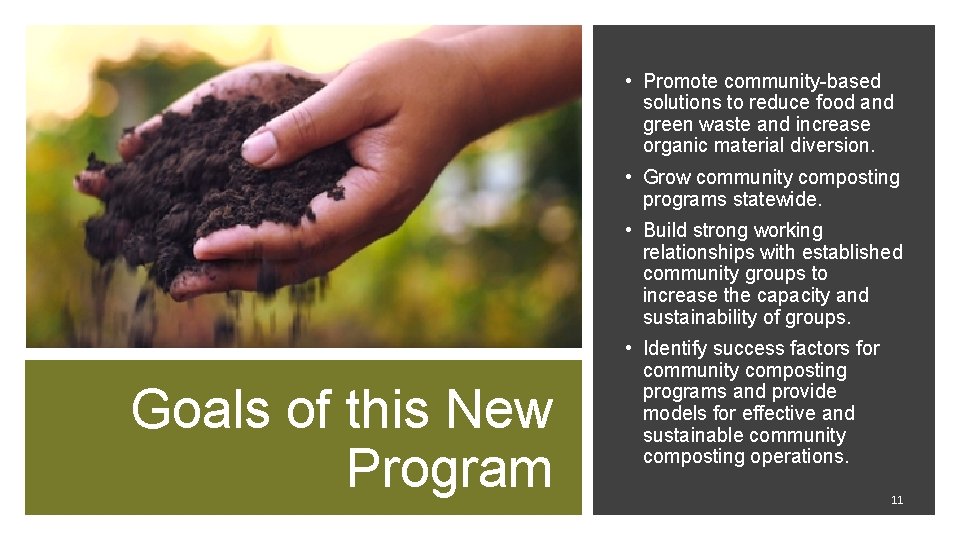
• Promote community-based solutions to reduce food and green waste and increase organic material diversion. • Grow community composting programs statewide. • Build strong working relationships with established community groups to increase the capacity and sustainability of groups. Goals of this New Program • Identify success factors for community composting programs and provide models for effective and sustainable community composting operations. 11
Grant structure • Cal. Recycle will select one grantee to implement the program statewide. • The grantee will identify community groups that have access to a site appropriate for community composting and are interested in managing a community composting site. • Projects located in and serving disadvantaged communities will have priority. • The grantee will work with community groups to plan and develop selected community composting project sites. 12
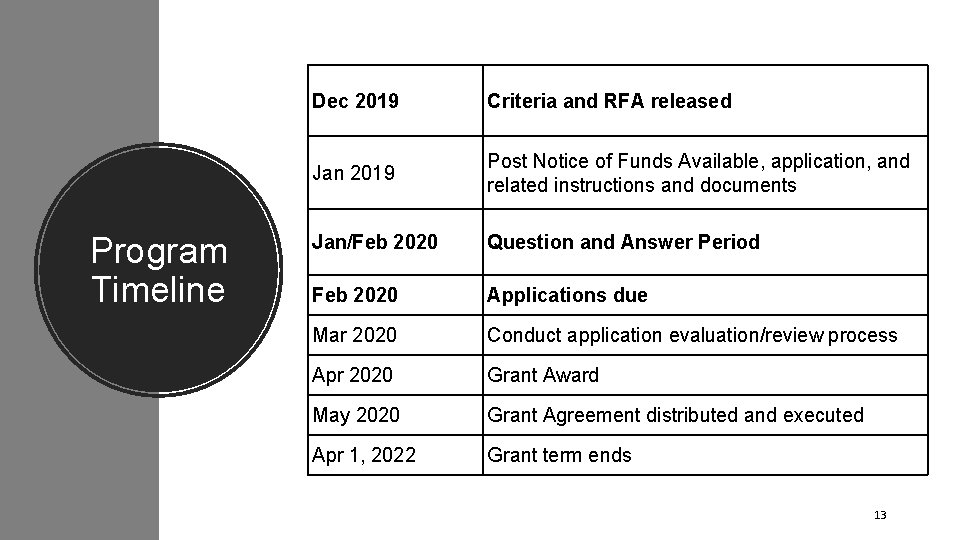
Program Timeline Dec 2019 Criteria and RFA released Jan 2019 Post Notice of Funds Available, application, and related instructions and documents Jan/Feb 2020 Question and Answer Period Feb 2020 Applications due Mar 2020 Conduct application evaluation/review process Apr 2020 Grant Award May 2020 Grant Agreement distributed and executed Apr 1, 2022 Grant term ends 13
Grantee will solicit, evaluate and select individual project sites statewide. Community engagement Grantee will coordinate with groups representing project sites to identify and address the unique needs of each community throughout creation and implementation of a project site plan. Grantee will provide education on composting fundamentals, equipment, techniques, data collection and best management practices to managers of each project site. 14
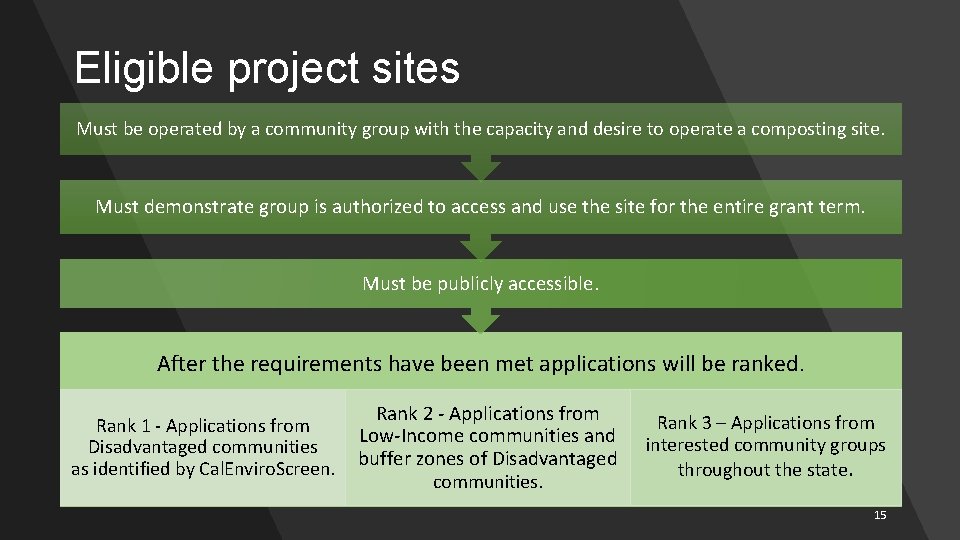
Eligible project sites Must be operated by a community group with the capacity and desire to operate a composting site. Must demonstrate group is authorized to access and use the site for the entire grant term. Must be publicly accessible. After the requirements have been met applications will be ranked. Rank 1 - Applications from Disadvantaged communities as identified by Cal. Enviro. Screen. Rank 2 - Applications from Low-Income communities and buffer zones of Disadvantaged communities. Rank 3 – Applications from interested community groups throughout the state. 15
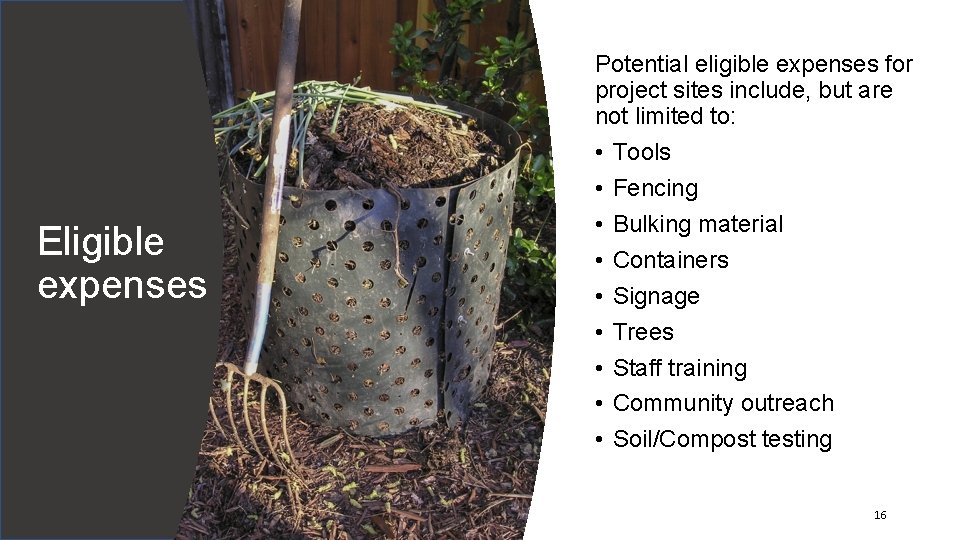
Eligible expenses Potential eligible expenses for project sites include, but are not limited to: • Tools • Fencing • Bulking material • Containers • Signage • Trees • Staff training • Community outreach • Soil/Compost testing 16
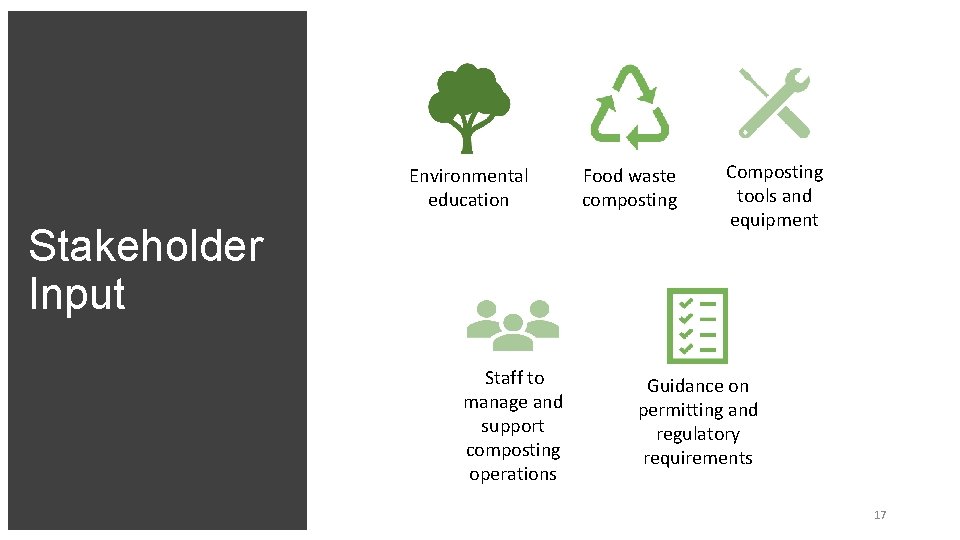
Environmental education Stakeholder Input Staff to manage and support composting operations Food waste composting Composting tools and equipment Guidance on permitting and regulatory requirements 17
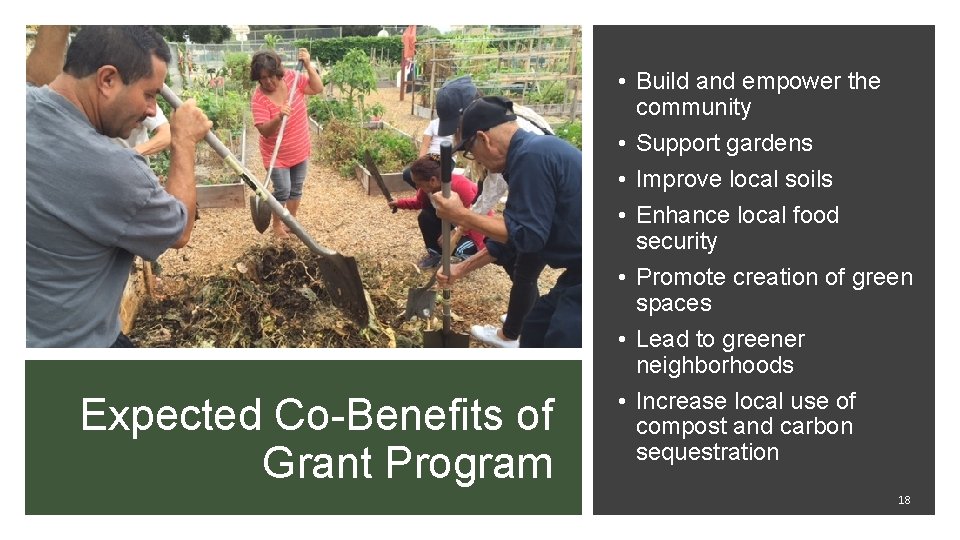
Expected Co-Benefits of Grant Program • Build and empower the community • Support gardens • Improve local soils • Enhance local food security • Promote creation of green spaces • Lead to greener neighborhoods • Increase local use of compost and carbon sequestration 18
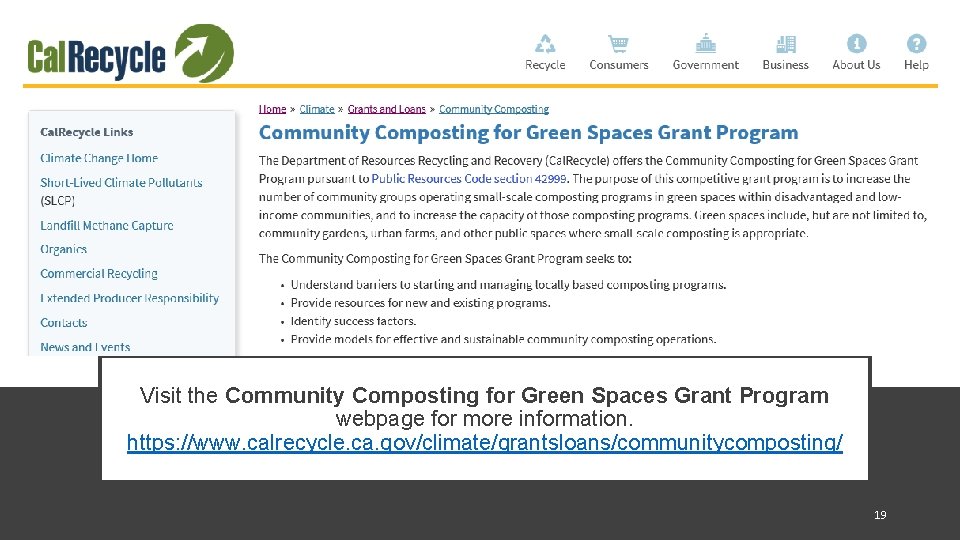
Visit the Community Composting for Green Spaces Grant Program webpage for more information. https: //www. calrecycle. ca. gov/climate/grantsloans/communitycomposting/ 19
Thank you for your time. Heather Williams Heather. Williams@calrecycle. ca. gov 916 -341 -6815 20
- Slides: 20