
Building Leadership Capacity Effective Feedback New Reality Leadership
Building Leadership Capacity Effective Feedback New Reality Leadership Copyright 2010 -2018 New Reality Leadership, LLC January 2020
1. The Good, Bad, and Ugly Feedback Context It is helpful to see illustrations of effective and ineffective feedback to identify ways we can maximize our feedback to others. To Do Think of effective and ineffective examples of feedback given to you or that you have seen given to others. Identify the characteristics of the feedback that made it effective or ineffective. How In small groups, identify several examples of effective or ineffective feedback you have observed. Chart your examples 2

Objectives 1. Identify characteristics of effective feedback. 2. Learn nine approaches to improving feedback. 3. Create a plan to apply these methods to improve your feedback approach. So that you can provide affirming or improvement feedback to employees to help them grow to their full potential at an accelerated rate. 3
Agenda 1. The Good, Bad, and Ugly Feedback 2. Assessing our Feedback Approach 3. 9 Feedback Methods 4. Cost of Poor Feedback: Illustrations 5. Exercise: Evaluating Feedback 6. Summary and Application 4
2. Assessing our Feedback Approach Ø Complete the feedback assessment in your books. Ø In pairs, discuss your key findings of strengths and opportunities. Ø Pick 2 -3 strengths and 2 -3 challenges you noted. Ø The assessment results provide information to help you focus on what is important for you in this module. 5
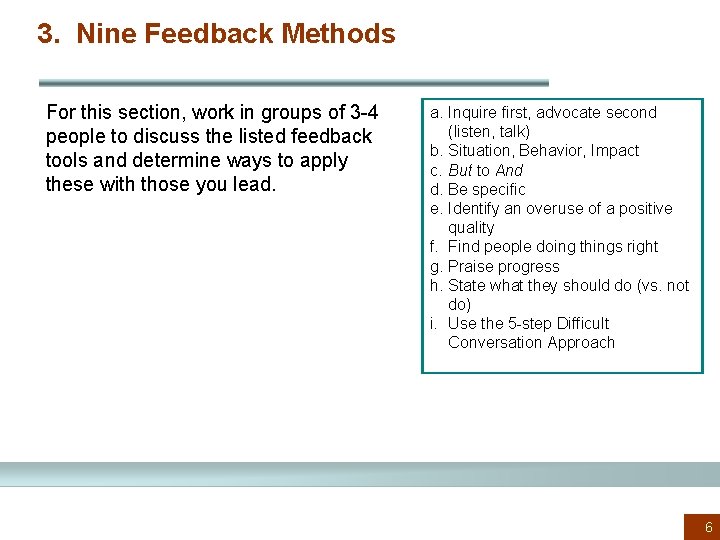
3. Nine Feedback Methods For this section, work in groups of 3 -4 people to discuss the listed feedback tools and determine ways to apply these with those you lead. a. Inquire first, advocate second (listen, talk) b. Situation, Behavior, Impact c. But to And d. Be specific e. Identify an overuse of a positive quality f. Find people doing things right g. Praise progress h. State what they should do (vs. not do) i. Use the 5 -step Difficult Conversation Approach 6
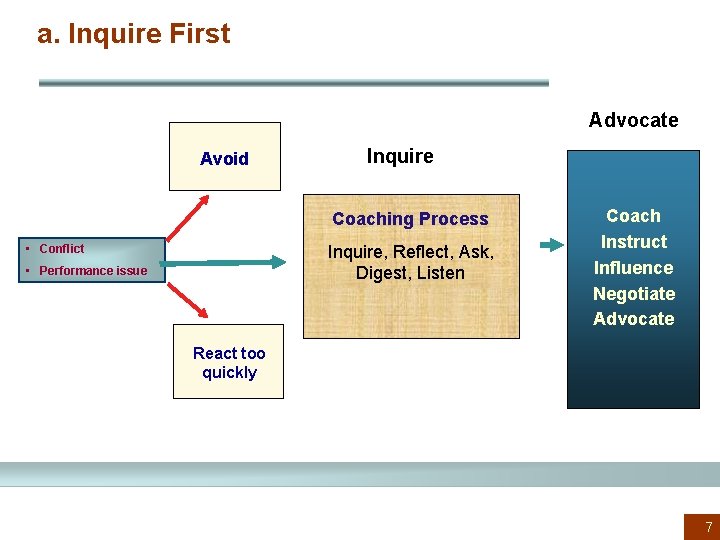
a. Inquire First Advocate Avoid Inquire Coaching Process Inquire, Reflect, Ask, Digest, Listen • Conflict • Performance issue Coach Instruct Influence Negotiate Advocate React too quickly 7
Inquire First (cont. ) List an example of where you: • Used this approach well or saw someone else use it well. • Did not use this approach or an example your observed. 8

b. Situation, Behavior, and Impact Situation you Observed Behavior or Actions you Noticed Impact or Results Monday we had an important presentation. You were late to the meeting and our presentation time was shortened. We were not able to relay important information that would have helped us gain the contract. A pump bearing was failing in the pressure room. Your attentiveness picked up the change in the normal operating sound of the pump and you called maintenance to check it out. They identified the issue and replaced the bearing before we started the next run, ensuring the product was made on time. Note: This method works well for general feedback and straight forward improvement feedback. For difficult feedback, see the Difficult Conversations coaching process. 9
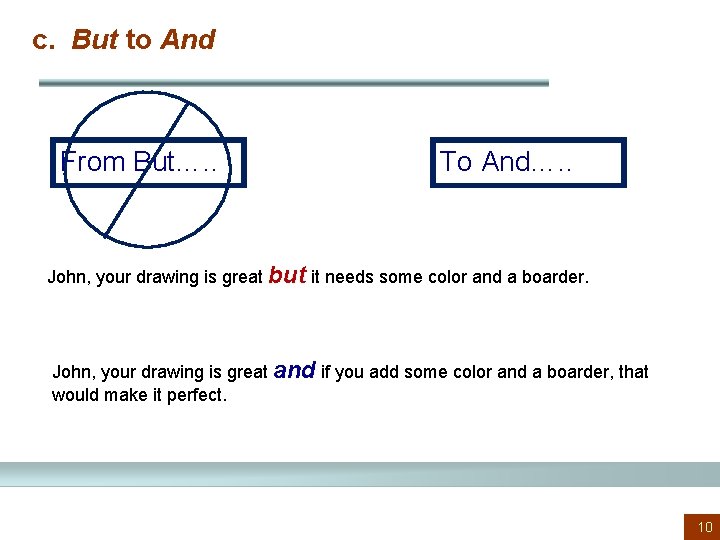
c. But to And From But…. . To And…. . John, your drawing is great but it needs some color and a boarder. John, your drawing is great and if you add some color and a boarder, that would make it perfect. 10
d. Be Specific From Great job on the presentation today. To The presentation was concise. It covered the three points we discussed and the impact of using the new system. The site leadership team agreed to adopt the process. 11
Be Specific (cont. ) Change each statement to make it specific? Ø Your driving is very good Ø I like your Excel form Ø Your session was not very clear Ø The session was boring Ø The food was great 12
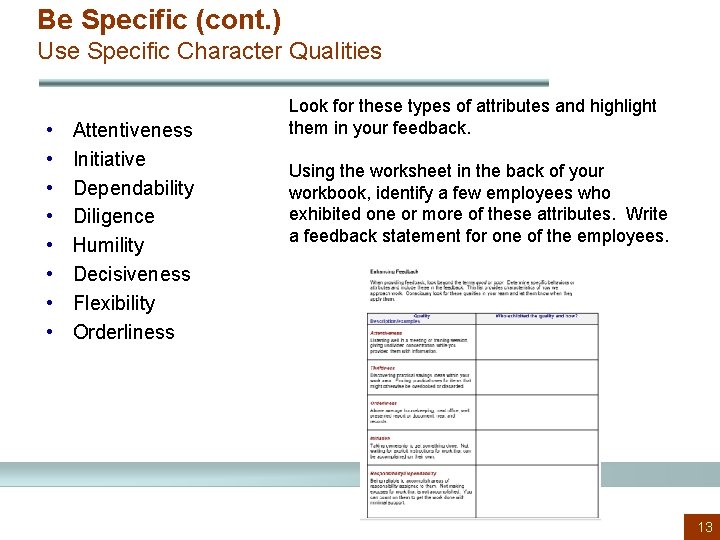
Be Specific (cont. ) Use Specific Character Qualities • • Attentiveness Initiative Dependability Diligence Humility Decisiveness Flexibility Orderliness Look for these types of attributes and highlight them in your feedback. Using the worksheet in the back of your workbook, identify a few employees who exhibited one or more of these attributes. Write a feedback statement for one of the employees. 13
e. Identify an Overuse of a Quality From You are curt with employees during the morning meetings. To You are direct in your work and get things done quickly. Sometimes you come across harshly to the participants in the morning meeting causing them to shut down and not contribute. How can you use your ability to execute the work and be more patient in the discussions? 14
Overuse of a Quality (cont. ) Create a feedback statement based on these two scenarios: Ø Mark creates a great process drawing but spends too much time on it compared to other work he needs to complete. Ø Jan gets things done quickly but sometimes rushes others to work as fast as she does. 15
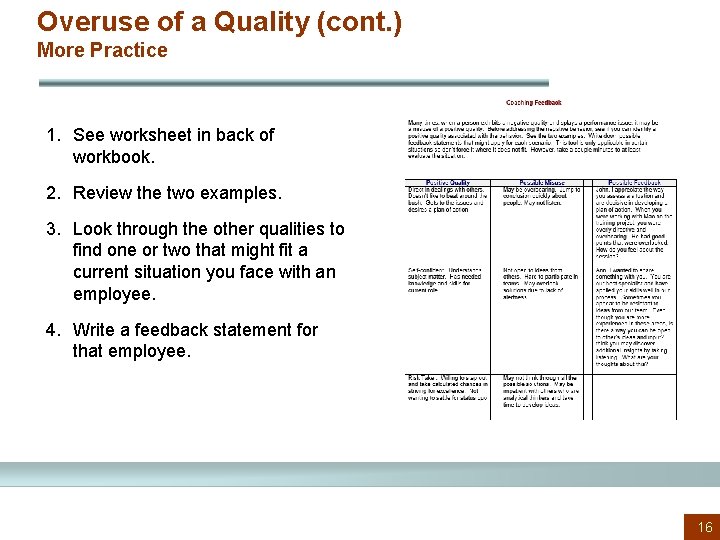
Overuse of a Quality (cont. ) More Practice 1. See worksheet in back of workbook. 2. Review the two examples. 3. Look through the other qualities to find one or two that might fit a current situation you face with an employee. 4. Write a feedback statement for that employee. 16
f. Find People doing things Right Ø It is easy to find people doing things wrong. Ø List examples of people doing things right. • On a Post-it note, write 3 -5 examples of people doing something right. • Use a separate Post-it for each example. • Share one example and then place all your examples a flip chart. 17
g. Praise Progress Ø What does Praising Progress mean? Ø Why is praising progress crucial to growing employee capacity at an accelerated rate? Ø List one or two example where you praised progress or a missed opportunity. 18
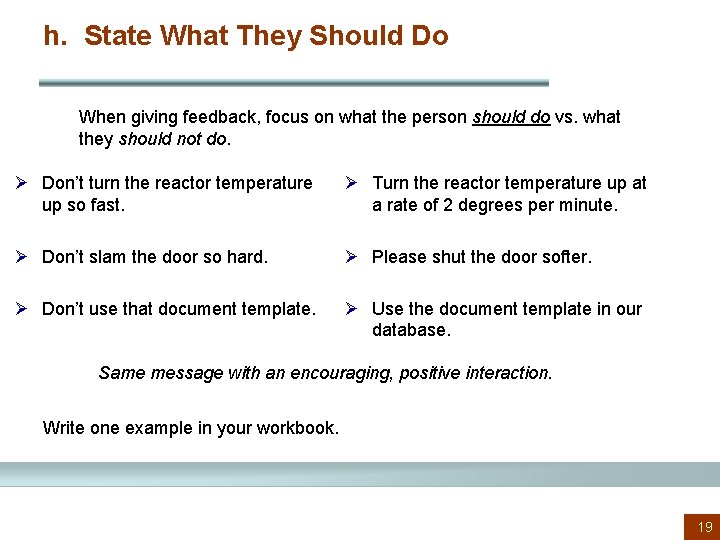
h. State What They Should Do When giving feedback, focus on what the person should do vs. what they should not do. Ø Don’t turn the reactor temperature up so fast. Ø Turn the reactor temperature up at a rate of 2 degrees per minute. Ø Don’t slam the door so hard. Ø Please shut the door softer. Ø Don’t use that document template. Ø Use the document template in our database. Same message with an encouraging, positive interaction. Write one example in your workbook. 19
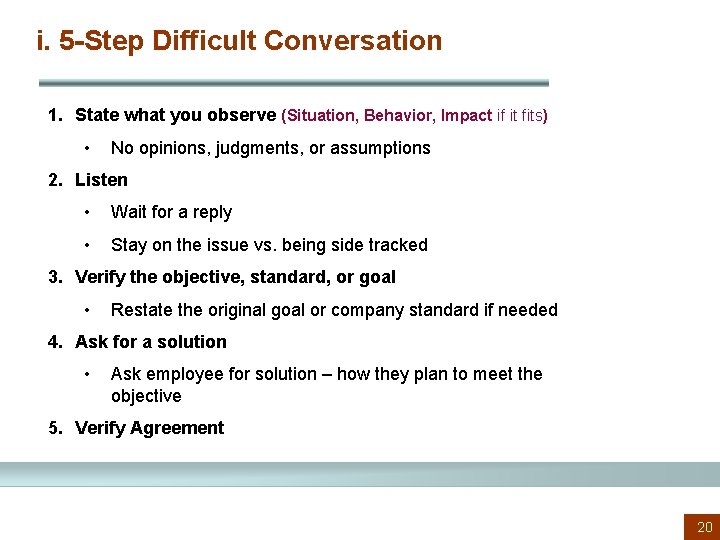
i. 5 -Step Difficult Conversation 1. State what you observe (Situation, Behavior, Impact if it fits) • No opinions, judgments, or assumptions 2. Listen • Wait for a reply • Stay on the issue vs. being side tracked 3. Verify the objective, standard, or goal • Restate the original goal or company standard if needed 4. Ask for a solution • Ask employee for solution – how they plan to meet the objective 5. Verify Agreement 20
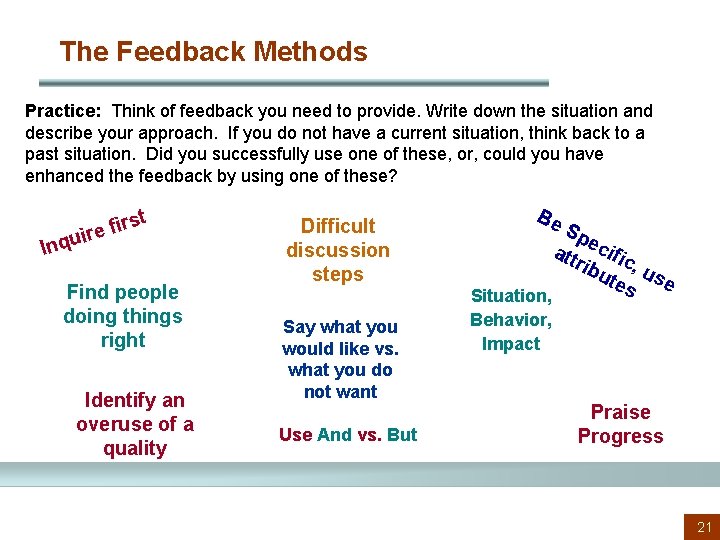
The Feedback Methods Practice: Think of feedback you need to provide. Write down the situation and describe your approach. If you do not have a current situation, think back to a past situation. Did you successfully use one of these, or, could you have enhanced the feedback by using one of these? rst i f e ir Inqu Find people doing things right Identify an overuse of a quality Difficult discussion steps Say what you would like vs. what you do not want Use And vs. But Be Sp att ecific rib ute , use s Situation, Behavior, Impact Praise Progress 21
Other Feedback Methods Ø What other methods have you found useful in addition to those discussed? 22
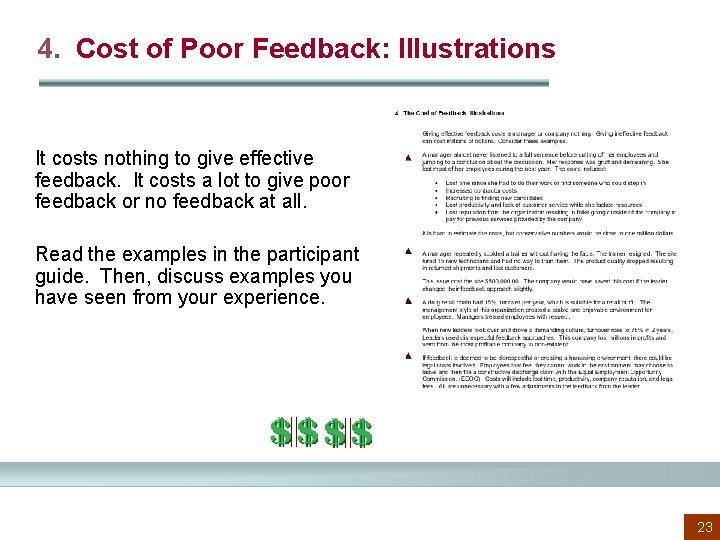
4. Cost of Poor Feedback: Illustrations It costs nothing to give effective feedback. It costs a lot to give poor feedback or no feedback at all. Read the examples in the participant guide. Then, discuss examples you have seen from your experience. 23
Exit Interviews Ø Do you conduct exit interviews for departing employees? Ø Do you collect reasons why employees leave? Ø Are any reasons related to the feedback, or lack of feedback they received? Ø If you do not obtain exit interview information, think about this question: v List up to 5 names of employees who have left your team or general part of the organization. Can you identify why they left? 24
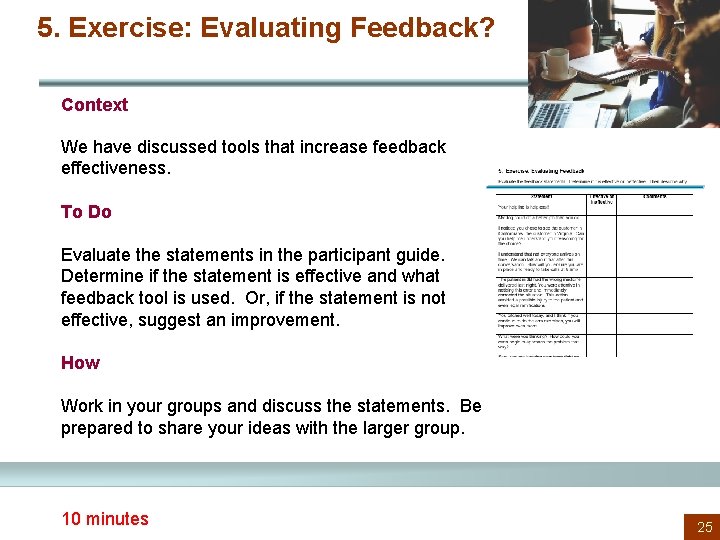
5. Exercise: Evaluating Feedback? Context We have discussed tools that increase feedback effectiveness. To Do Evaluate the statements in the participant guide. Determine if the statement is effective and what feedback tool is used. Or, if the statement is not effective, suggest an improvement. How Work in your groups and discuss the statements. Be prepared to share your ideas with the larger group. 10 minutes 25
Competency Connection Discuss how providing effective feedback increases the effectiveness of these competencies: 1. 2. 3. 4. Communicates Effectively Manages Performance Listens Actively Interacts Well with Employees 26
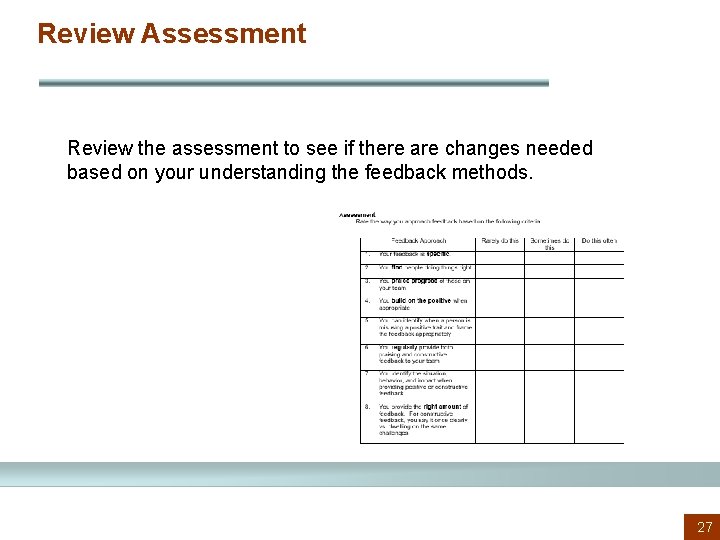
Review Assessment Review the assessment to see if there are changes needed based on your understanding the feedback methods. 27
6. Summary and Application Ø Review the possible development actions. Ø What actions will you take to enhance this area of your leadership? Ø Take a few minutes to fill in your participant guide. Ø Review the assessment for guidance. Ø Journal the application. 28
Objectives 1. Identify characteristics of effective feedback 2. Learn 9 approaches to improving feedback 3. Create a plan to apply these methods to improve your feedback approach Why do you think that providing affirming or improvement feedback to employees will help them grow to their full potential at an accelerated rate? 29
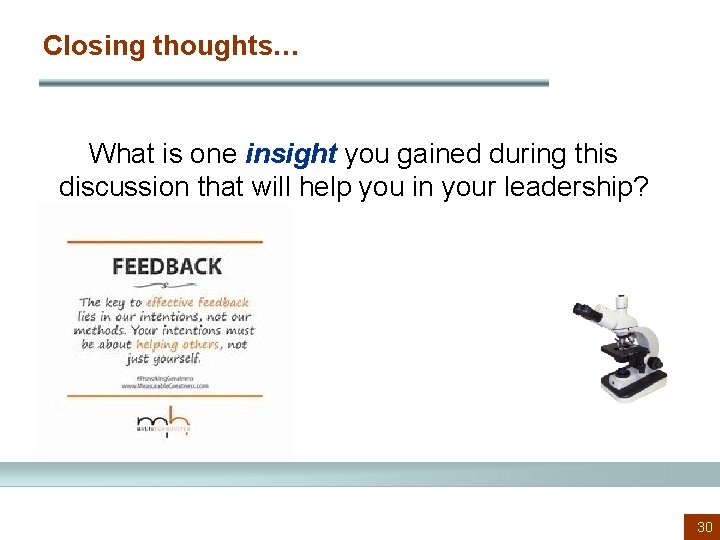
Closing thoughts… What is one insight you gained during this discussion that will help you in your leadership? 30
- Slides: 30