
Building Java Programs Using Objects These lecture notes
Building Java Programs Using Objects These lecture notes are copyright (C) Marty Stepp and Stuart Reges, 2007. They may not be rehosted, sold, or modified without expressed permission from the authors. All rights reserved. 1
Point objects n suggested reading: 3. 3 2
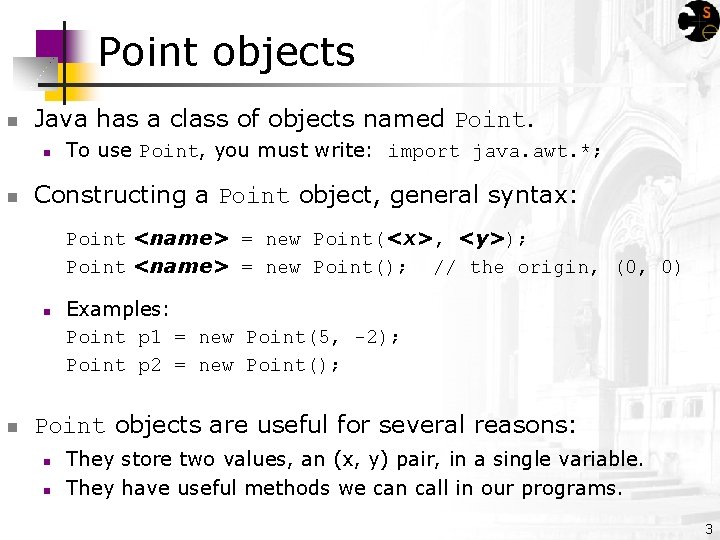
Point objects n Java has a class of objects named Point. n n To use Point, you must write: import java. awt. *; Constructing a Point object, general syntax: Point <name> = new Point(<x>, <y>); Point <name> = new Point(); // the origin, (0, 0) n n Examples: Point p 1 = new Point(5, -2); Point p 2 = new Point(); Point objects are useful for several reasons: n n They store two values, an (x, y) pair, in a single variable. They have useful methods we can call in our programs. 3
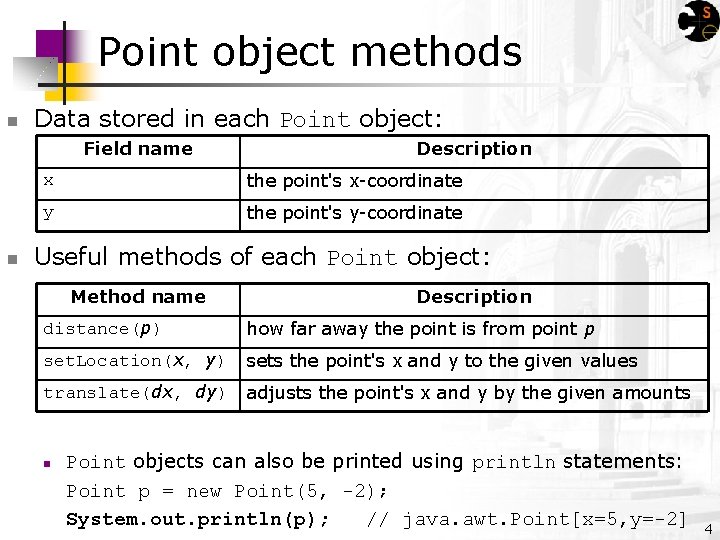
Point object methods n Data stored in each Point object: Field name n Description x the point's x-coordinate y the point's y-coordinate Useful methods of each Point object: Method name Description distance(p) how far away the point is from point p set. Location(x, y) sets the point's x and y to the given values translate(dx, dy) adjusts the point's x and y by the given amounts n Point objects can also be printed using println statements: Point p = new Point(5, -2); System. out. println(p); // java. awt. Point[x=5, y=-2] 4
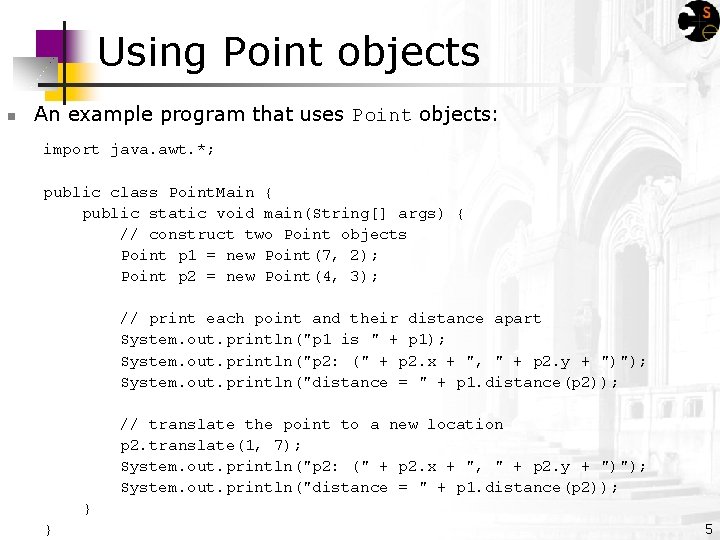
Using Point objects n An example program that uses Point objects: import java. awt. *; public class Point. Main { public static void main(String[] args) { // construct two Point objects Point p 1 = new Point(7, 2); Point p 2 = new Point(4, 3); // print each point and their distance apart System. out. println("p 1 is " + p 1); System. out. println("p 2: (" + p 2. x + ", " + p 2. y + ")"); System. out. println("distance = " + p 1. distance(p 2)); // translate the point to a new location p 2. translate(1, 7); System. out. println("p 2: (" + p 2. x + ", " + p 2. y + ")"); System. out. println("distance = " + p 1. distance(p 2)); } } 5
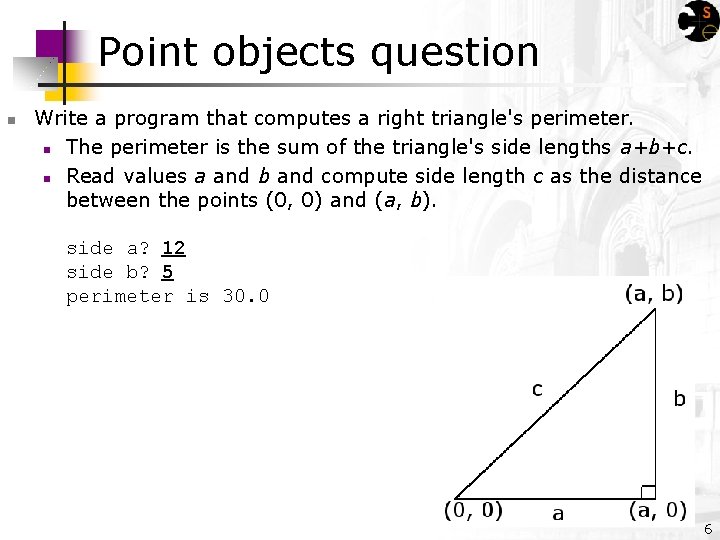
Point objects question n Write a program that computes a right triangle's perimeter. n The perimeter is the sum of the triangle's side lengths a+b+c. n Read values a and b and compute side length c as the distance between the points (0, 0) and (a, b). side a? 12 side b? 5 perimeter is 30. 0 6
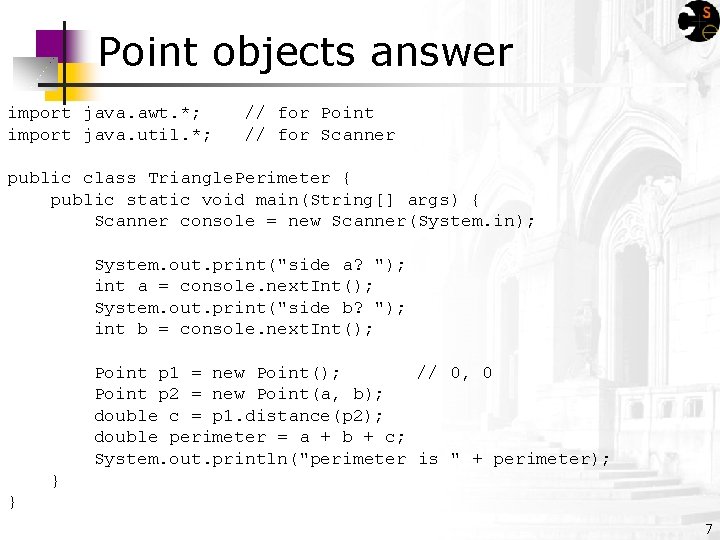
Point objects answer import java. awt. *; import java. util. *; // for Point // for Scanner public class Triangle. Perimeter { public static void main(String[] args) { Scanner console = new Scanner(System. in); System. out. print("side a? "); int a = console. next. Int(); System. out. print("side b? "); int b = console. next. Int(); Point p 1 = new Point(); // 0, 0 Point p 2 = new Point(a, b); double c = p 1. distance(p 2); double perimeter = a + b + c; System. out. println("perimeter is " + perimeter); } } 7

Objects as parameters: value vs. reference semantics n suggested reading: 3. 3 8
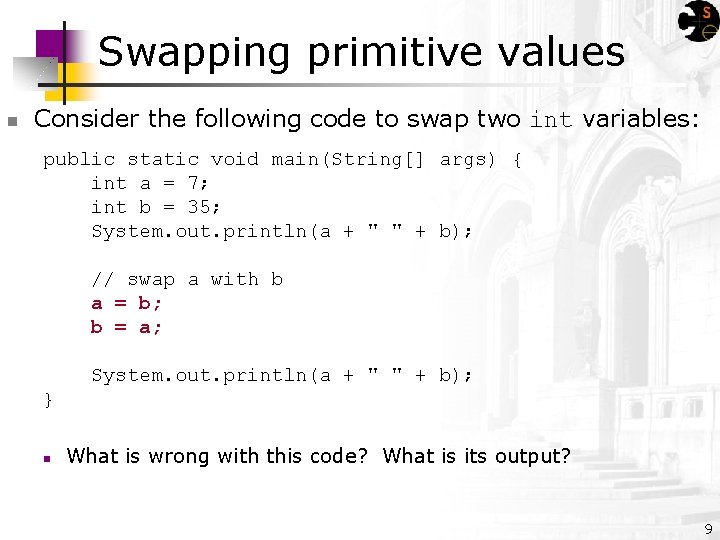
Swapping primitive values n Consider the following code to swap two int variables: public static void main(String[] args) { int a = 7; int b = 35; System. out. println(a + " " + b); // swap a with b a = b; b = a; System. out. println(a + " " + b); } n What is wrong with this code? What is its output? 9
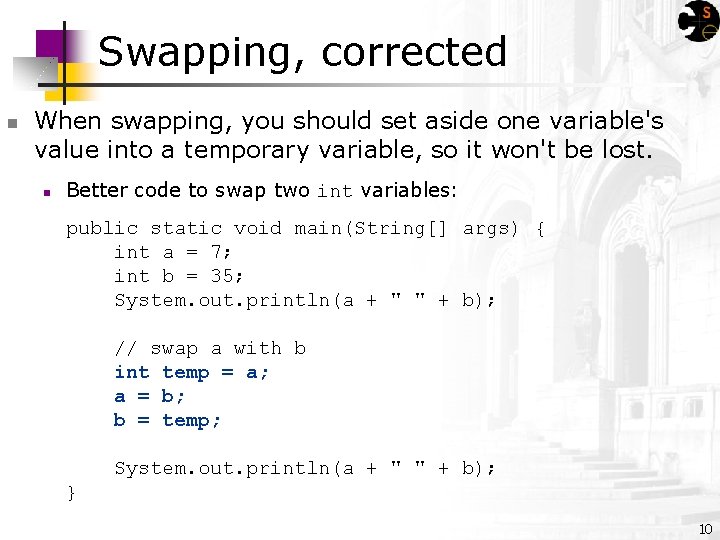
Swapping, corrected n When swapping, you should set aside one variable's value into a temporary variable, so it won't be lost. n Better code to swap two int variables: public static void main(String[] args) { int a = 7; int b = 35; System. out. println(a + " " + b); // swap a with b int temp = a; a = b; b = temp; System. out. println(a + " " + b); } 10
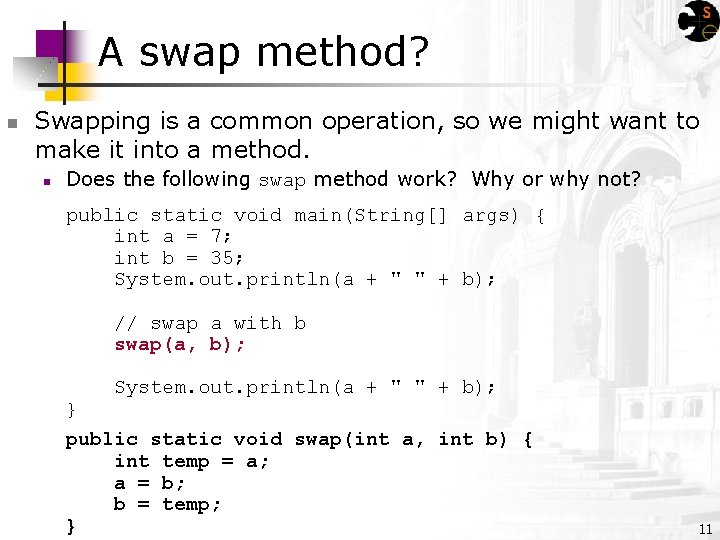
A swap method? n Swapping is a common operation, so we might want to make it into a method. n Does the following swap method work? Why or why not? public static void main(String[] args) { int a = 7; int b = 35; System. out. println(a + " " + b); // swap a with b swap(a, b); } System. out. println(a + " " + b); public static void swap(int a, int b) { int temp = a; a = b; b = temp; } 11

Value semantics n value semantics: Behavior where variables are copied when assigned to each other or passed as parameters. n n Primitive types in Java use value semantics. When one variable is assigned to another, the value is copied. Modifying the value of one variable does not affect others. Example: int y = x = 5; y = x; 17; 8; x // x = 5, y = 5 // x = 5, y = 17 // x = 8, y = 17 y 12
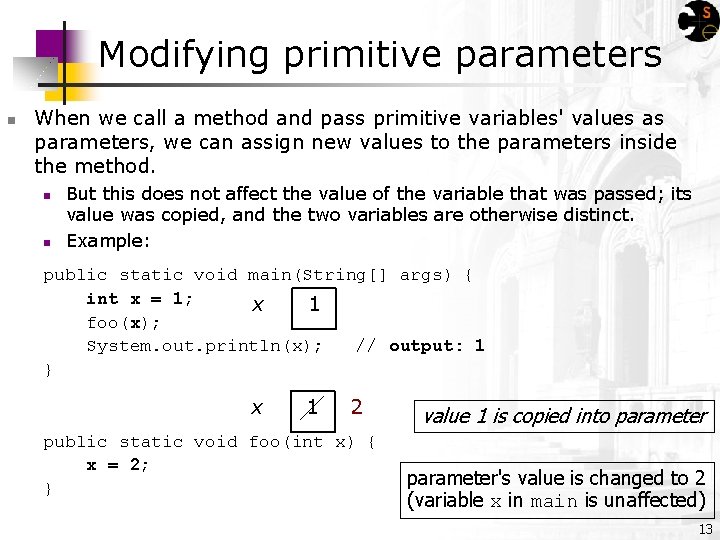
Modifying primitive parameters n When we call a method and pass primitive variables' values as parameters, we can assign new values to the parameters inside the method. n n But this does not affect the value of the variable that was passed; its value was copied, and the two variables are otherwise distinct. Example: public static void main(String[] args) { int x = 1; x 1 foo(x); System. out. println(x); // output: 1 } x 1 2 public static void foo(int x) { x = 2; } value 1 is copied into parameter's value is changed to 2 (variable x in main is unaffected) 13
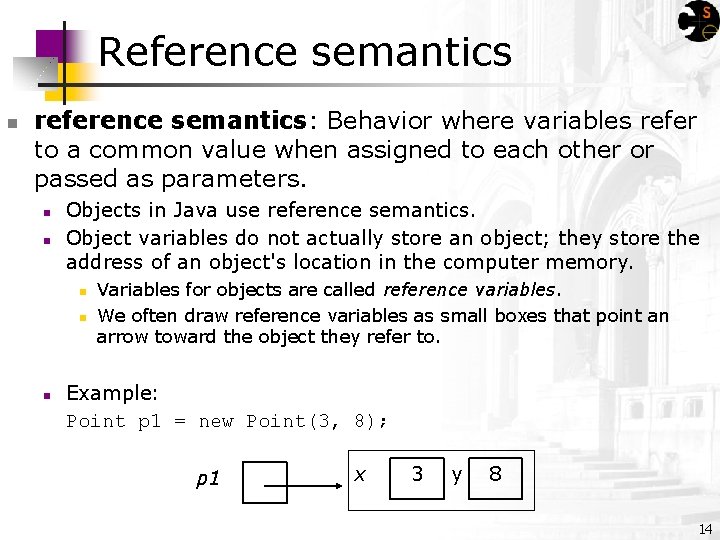
Reference semantics n reference semantics: Behavior where variables refer to a common value when assigned to each other or passed as parameters. n n Objects in Java use reference semantics. Object variables do not actually store an object; they store the address of an object's location in the computer memory. n n n Variables for objects are called reference variables. We often draw reference variables as small boxes that point an arrow toward the object they refer to. Example: Point p 1 = new Point(3, 8); p 1 x 3 y 8 14
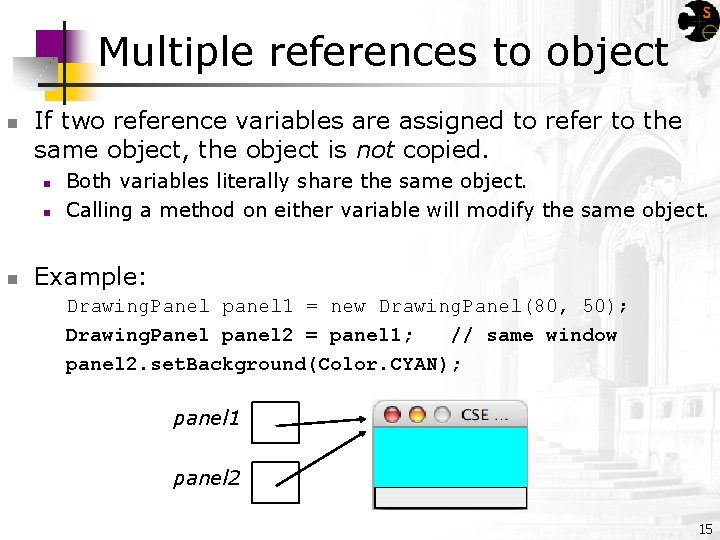
Multiple references to object n If two reference variables are assigned to refer to the same object, the object is not copied. n n n Both variables literally share the same object. Calling a method on either variable will modify the same object. Example: Drawing. Panel panel 1 = new Drawing. Panel(80, 50); Drawing. Panel panel 2 = panel 1; // same window panel 2. set. Background(Color. CYAN); panel 1 panel 2 15
Why references? n The fact that objects are passed by reference was done for several reasons: n n efficiency. Objects can be large, bulky things. Having to copy them every time they are passed as parameters would slow down the program. sharing. Since objects hold important state and have behavior that modifies that state, it is often more desirable for them to be shared by parts of the program when they're passed as parameters. Often we want the changes to occur to the same object. 16
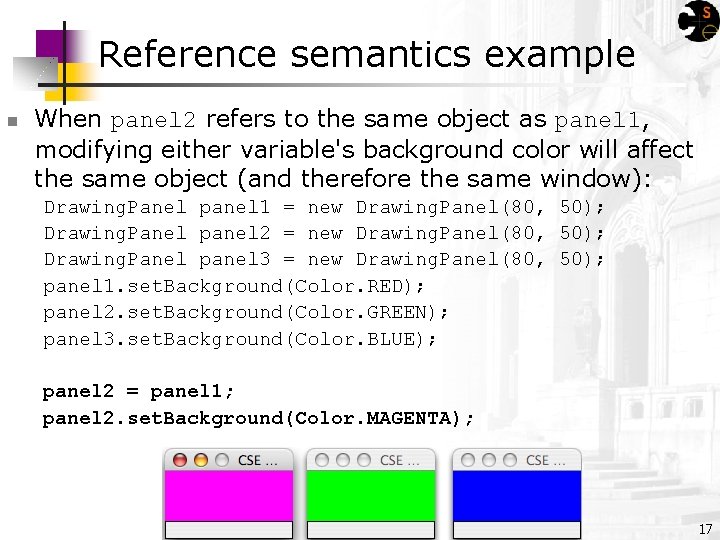
Reference semantics example n When panel 2 refers to the same object as panel 1, modifying either variable's background color will affect the same object (and therefore the same window): Drawing. Panel panel 1 = new Drawing. Panel(80, 50); Drawing. Panel panel 2 = new Drawing. Panel(80, 50); Drawing. Panel panel 3 = new Drawing. Panel(80, 50); panel 1. set. Background(Color. RED); panel 2. set. Background(Color. GREEN); panel 3. set. Background(Color. BLUE); panel 2 = panel 1; panel 2. set. Background(Color. MAGENTA); 17
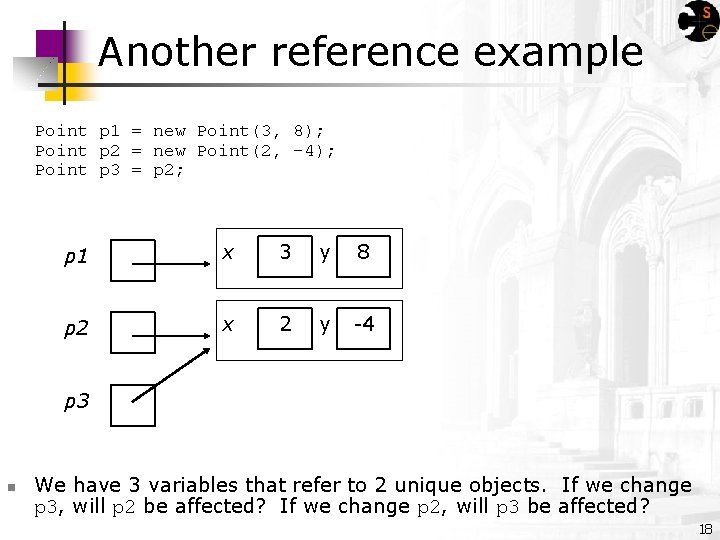
Another reference example Point p 1 = new Point(3, 8); Point p 2 = new Point(2, -4); Point p 3 = p 2; p 1 x 3 y 8 p 2 x 2 y -4 p 3 n We have 3 variables that refer to 2 unique objects. If we change p 3, will p 2 be affected? If we change p 2, will p 3 be affected? 18
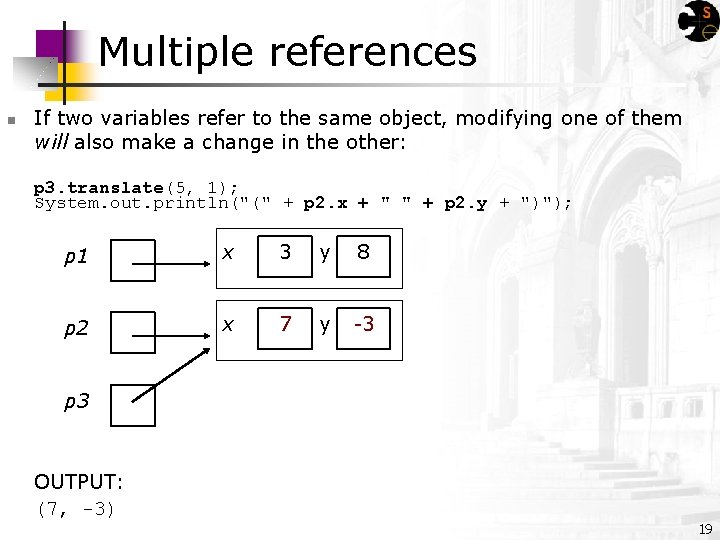
Multiple references n If two variables refer to the same object, modifying one of them will also make a change in the other: p 3. translate(5, 1); System. out. println("(" + p 2. x + " " + p 2. y + ")"); p 1 x 3 y 8 p 2 x 7 y -3 p 3 OUTPUT: (7, -3) 19
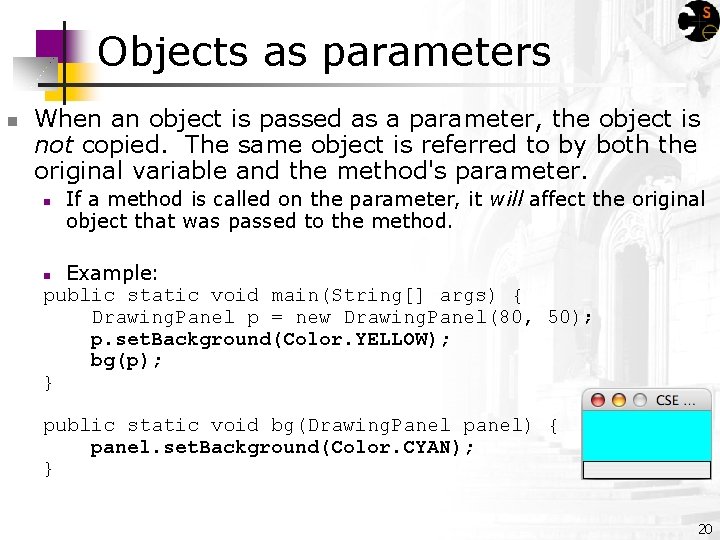
Objects as parameters n When an object is passed as a parameter, the object is not copied. The same object is referred to by both the original variable and the method's parameter. n If a method is called on the parameter, it will affect the original object that was passed to the method. Example: public static void main(String[] args) { Drawing. Panel p = new Drawing. Panel(80, 50); p. set. Background(Color. YELLOW); bg(p); } n public static void bg(Drawing. Panel panel) { panel. set. Background(Color. CYAN); } 20
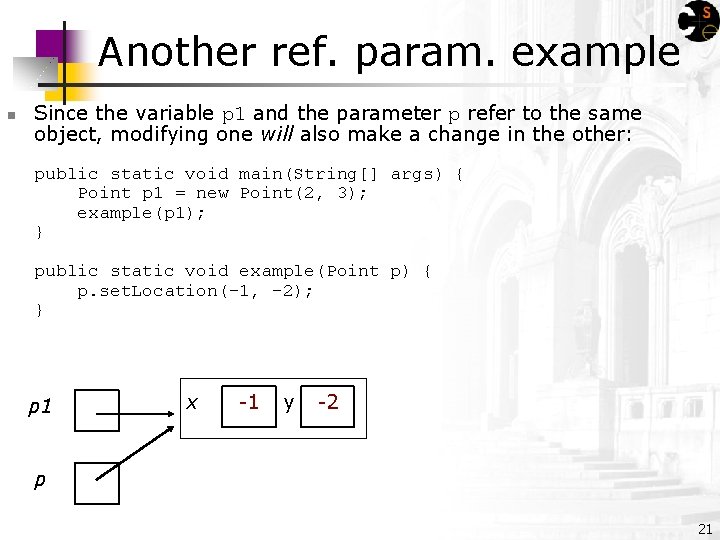
Another ref. param. example n Since the variable p 1 and the parameter p refer to the same object, modifying one will also make a change in the other: public static void main(String[] args) { Point p 1 = new Point(2, 3); example(p 1); } public static void example(Point p) { p. set. Location(-1, -2); } p 1 x -1 y -2 p 21
String objects n suggested reading: 3. 3, 4. 2 22
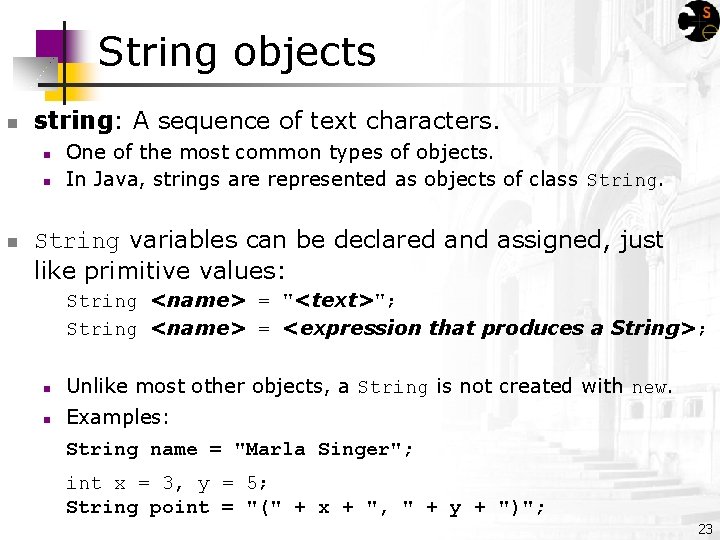
String objects n string: A sequence of text characters. n n n One of the most common types of objects. In Java, strings are represented as objects of class String variables can be declared and assigned, just like primitive values: String <name> = "<text>"; String <name> = <expression that produces a String>; n Unlike most other objects, a String is not created with new. n Examples: String name = "Marla Singer"; int x = 3, y = 5; String point = "(" + x + ", " + y + ")"; 23
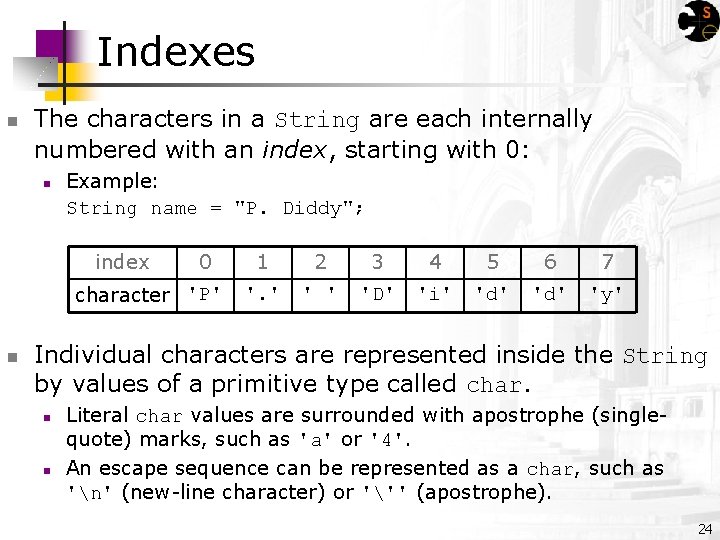
Indexes n The characters in a String are each internally numbered with an index, starting with 0: n Example: String name = "P. Diddy"; index 0 character 'P' n 1 2 3 4 5 6 7 '. ' 'D' 'i' 'd' 'y' Individual characters are represented inside the String by values of a primitive type called char. n n Literal char values are surrounded with apostrophe (singlequote) marks, such as 'a' or '4'. An escape sequence can be represented as a char, such as 'n' (new-line character) or ''' (apostrophe). 24
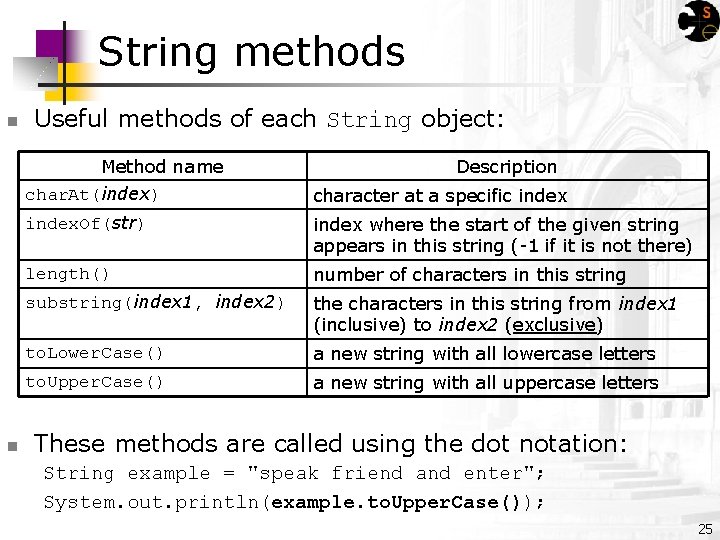
String methods n Useful methods of each String object: Method name char. At(index) n Description character at a specific index. Of(str) index where the start of the given string appears in this string (-1 if it is not there) length() number of characters in this string substring(index 1, index 2) the characters in this string from index 1 (inclusive) to index 2 (exclusive) to. Lower. Case() a new string with all lowercase letters to. Upper. Case() a new string with all uppercase letters These methods are called using the dot notation: String example = "speak friend and enter"; System. out. println(example. to. Upper. Case()); 25
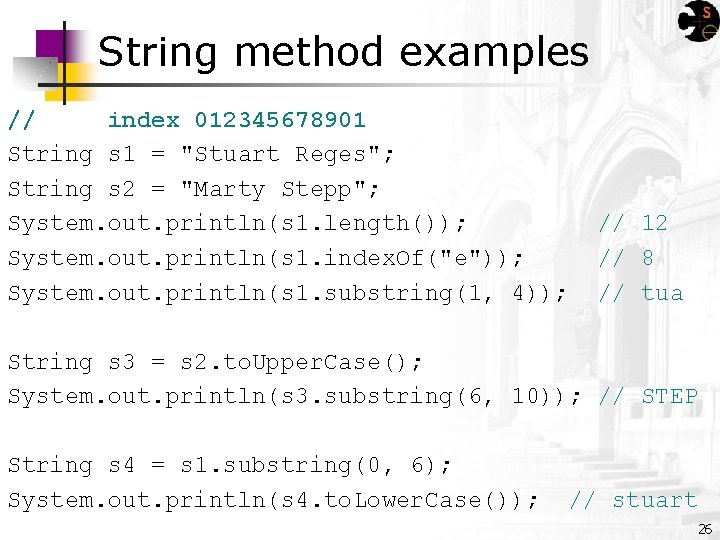
String method examples // index 012345678901 String s 1 = "Stuart Reges"; String s 2 = "Marty Stepp"; System. out. println(s 1. length()); System. out. println(s 1. index. Of("e")); System. out. println(s 1. substring(1, 4)); // 12 // 8 // tua String s 3 = s 2. to. Upper. Case(); System. out. println(s 3. substring(6, 10)); // STEP String s 4 = s 1. substring(0, 6); System. out. println(s 4. to. Lower. Case()); // stuart 26
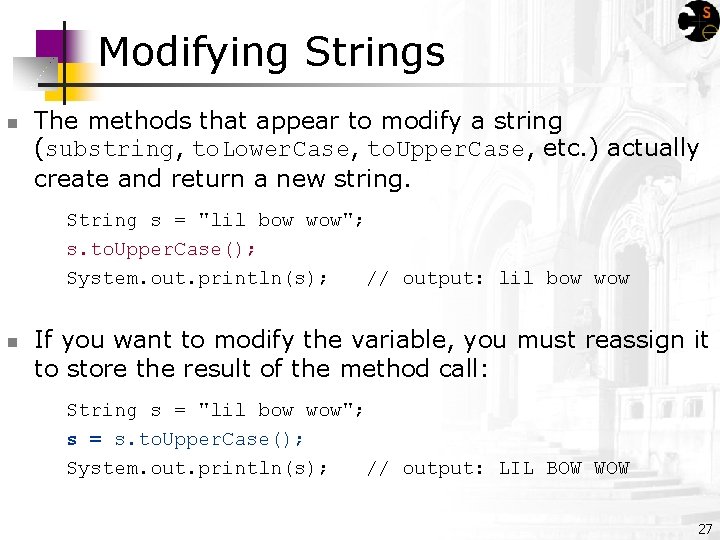
Modifying Strings n The methods that appear to modify a string (substring, to. Lower. Case, to. Upper. Case, etc. ) actually create and return a new string. String s = "lil bow wow"; s. to. Upper. Case(); System. out. println(s); // output: lil bow wow n If you want to modify the variable, you must reassign it to store the result of the method call: String s = "lil bow wow"; s = s. to. Upper. Case(); System. out. println(s); // output: LIL BOW WOW 27
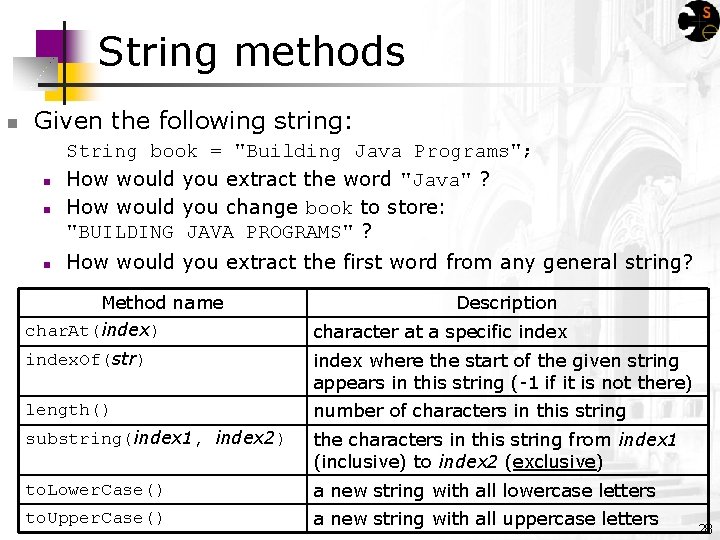
String methods n Given the following string: n n n String book = "Building Java Programs"; How would you extract the word "Java" ? How would you change book to store: "BUILDING JAVA PROGRAMS" ? How would you extract the first word from any general string? Method name char. At(index) Description character at a specific index. Of(str) index where the start of the given string appears in this string (-1 if it is not there) length() number of characters in this string substring(index 1, index 2) the characters in this string from index 1 (inclusive) to index 2 (exclusive) to. Lower. Case() a new string with all lowercase letters to. Upper. Case() a new string with all uppercase letters 28
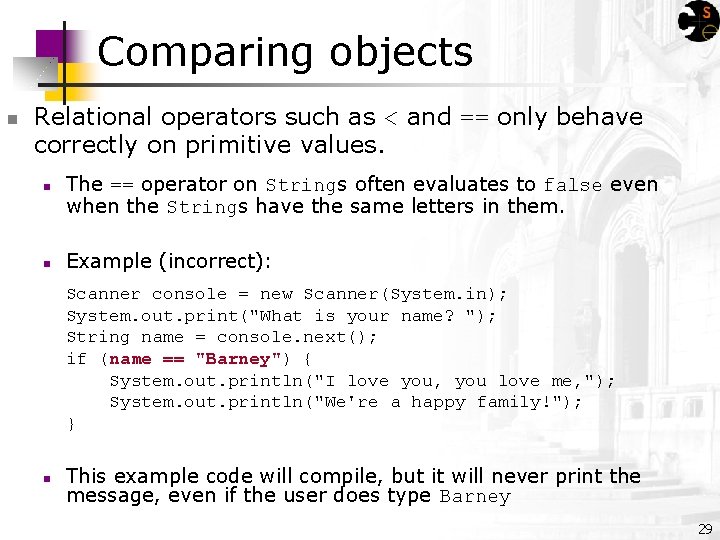
Comparing objects n Relational operators such as < and == only behave correctly on primitive values. n n The == operator on Strings often evaluates to false even when the Strings have the same letters in them. Example (incorrect): Scanner console = new Scanner(System. in); System. out. print("What is your name? "); String name = console. next(); if (name == "Barney") { System. out. println("I love you, you love me, "); System. out. println("We're a happy family!"); } n This example code will compile, but it will never print the message, even if the user does type Barney 29
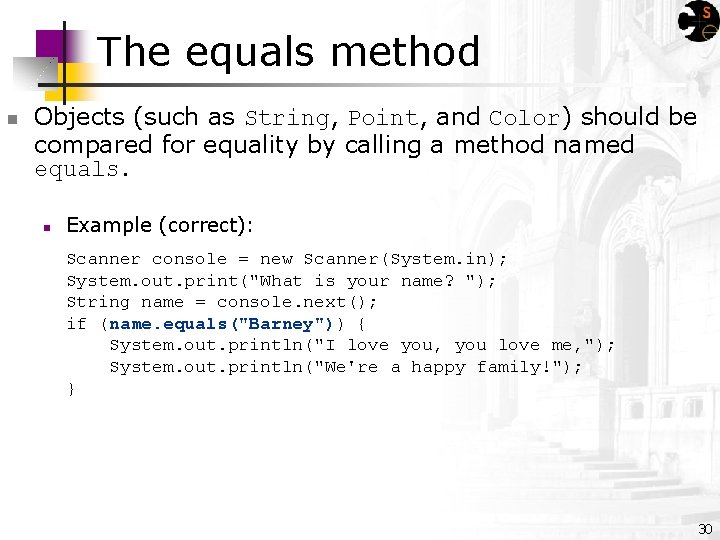
The equals method n Objects (such as String, Point, and Color) should be compared for equality by calling a method named equals. n Example (correct): Scanner console = new Scanner(System. in); System. out. print("What is your name? "); String name = console. next(); if (name. equals("Barney")) { System. out. println("I love you, you love me, "); System. out. println("We're a happy family!"); } 30
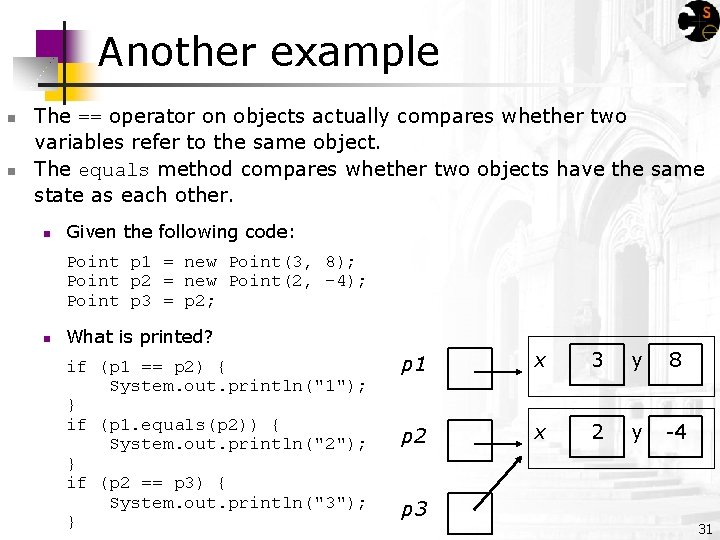
Another example n n The == operator on objects actually compares whether two variables refer to the same object. The equals method compares whether two objects have the same state as each other. n Given the following code: Point p 1 = new Point(3, 8); Point p 2 = new Point(2, -4); Point p 3 = p 2; n What is printed? if (p 1 == p 2) { System. out. println("1"); } if (p 1. equals(p 2)) { System. out. println("2"); } if (p 2 == p 3) { System. out. println("3"); } p 1 x 3 y 8 p 2 x 2 y -4 p 3 31
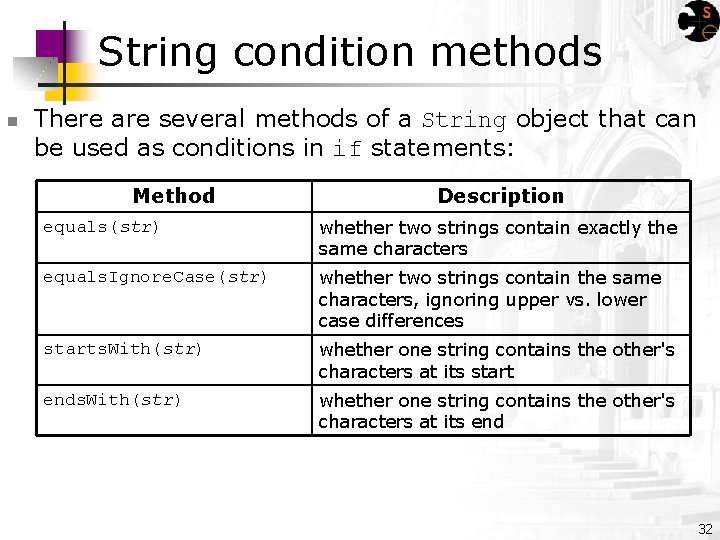
String condition methods n There are several methods of a String object that can be used as conditions in if statements: Method Description equals(str) whether two strings contain exactly the same characters equals. Ignore. Case(str) whether two strings contain the same characters, ignoring upper vs. lower case differences starts. With(str) whether one string contains the other's characters at its start ends. With(str) whether one string contains the other's characters at its end 32
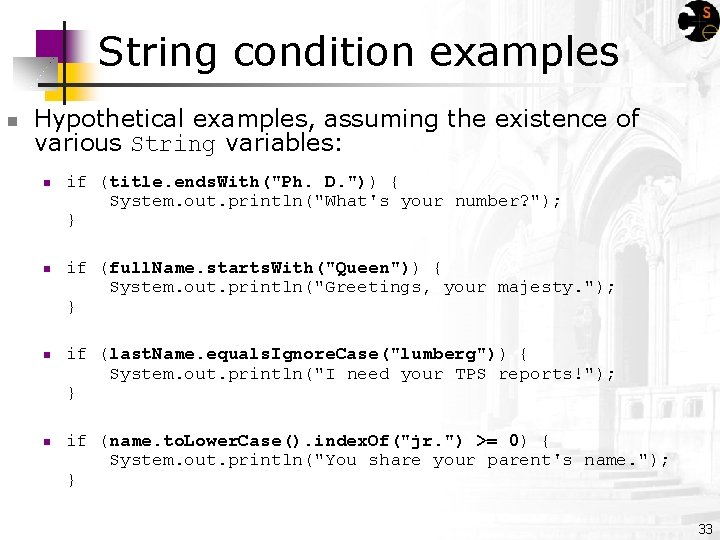
String condition examples n Hypothetical examples, assuming the existence of various String variables: n n if (title. ends. With("Ph. D. ")) { System. out. println("What's your number? "); } if (full. Name. starts. With("Queen")) { System. out. println("Greetings, your majesty. "); } if (last. Name. equals. Ignore. Case("lumberg")) { System. out. println("I need your TPS reports!"); } if (name. to. Lower. Case(). index. Of("jr. ") >= 0) { System. out. println("You share your parent's name. "); } 33
Text processing with String and char n suggested reading: 4. 4 34
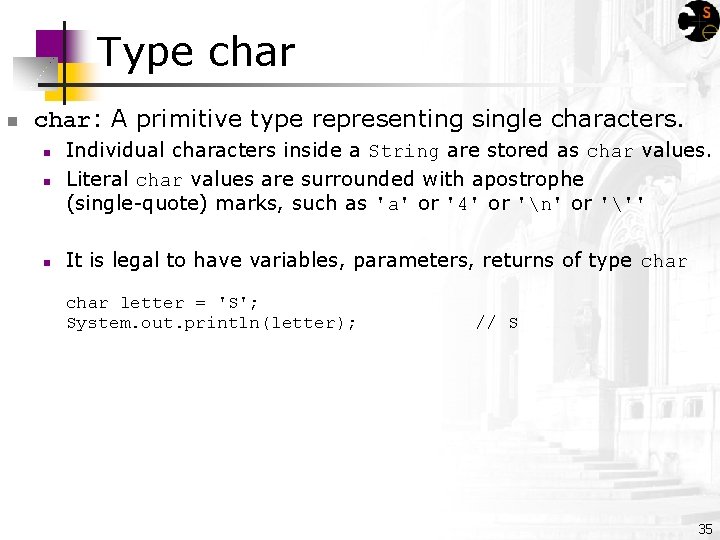
Type char n char: A primitive type representing single characters. n Individual characters inside a String are stored as char values. Literal char values are surrounded with apostrophe (single-quote) marks, such as 'a' or '4' or 'n' or ''' n It is legal to have variables, parameters, returns of type char n char letter = 'S'; System. out. println(letter); // S 35
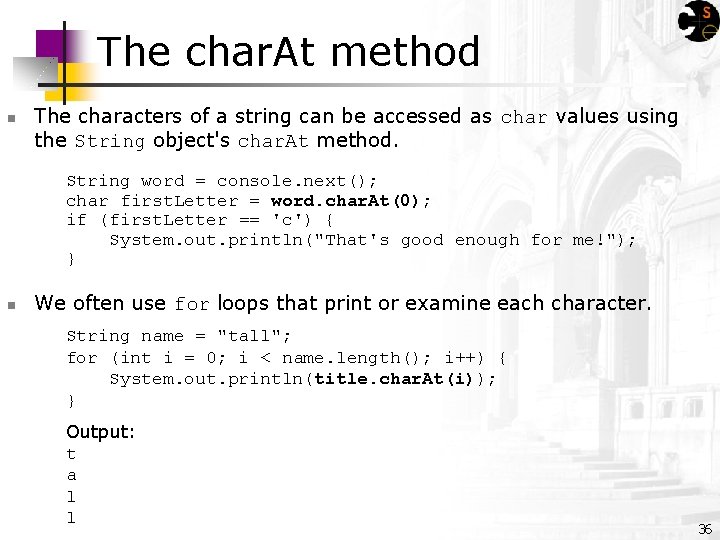
The char. At method n The characters of a string can be accessed as char values using the String object's char. At method. String word = console. next(); char first. Letter = word. char. At(0); if (first. Letter == 'c') { System. out. println("That's good enough for me!"); } n We often use for loops that print or examine each character. String name = "tall"; for (int i = 0; i < name. length(); i++) { System. out. println(title. char. At(i)); } Output: t a l l 36
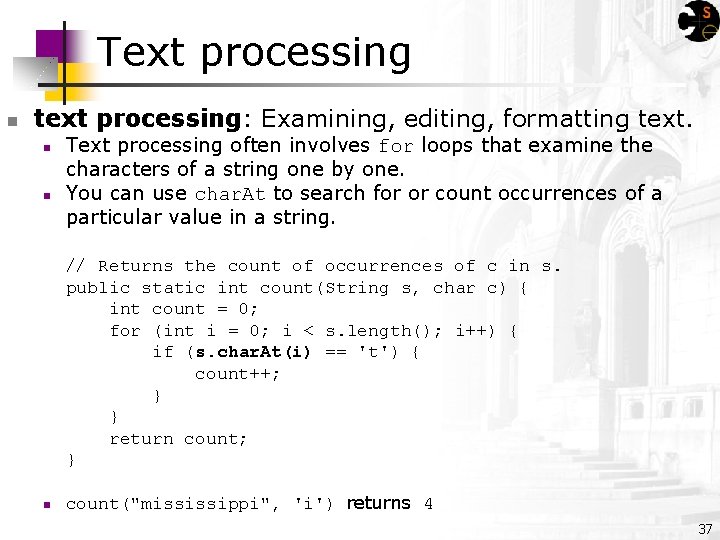
Text processing n text processing: Examining, editing, formatting text. n n Text processing often involves for loops that examine the characters of a string one by one. You can use char. At to search for or count occurrences of a particular value in a string. // Returns the count of occurrences of c in s. public static int count(String s, char c) { int count = 0; for (int i = 0; i < s. length(); i++) { if (s. char. At(i) == 't') { count++; } } return count; } n count("mississippi", 'i') returns 4 37
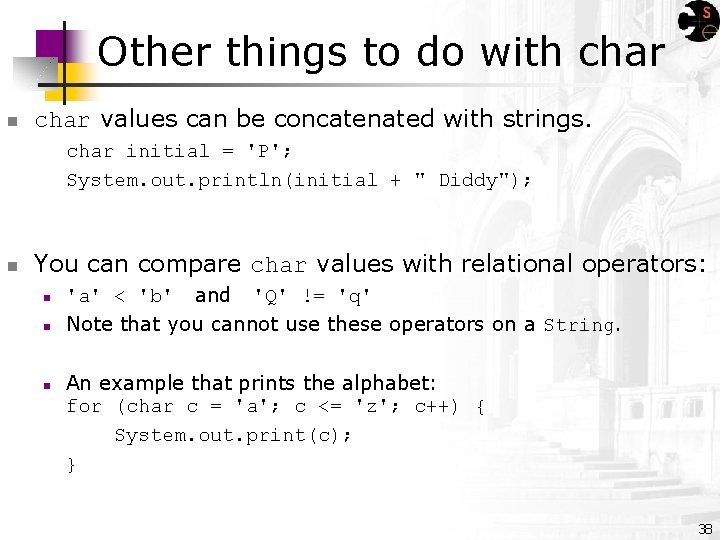
Other things to do with char n char values can be concatenated with strings. char initial = 'P'; System. out. println(initial + " Diddy"); n You can compare char values with relational operators: n n n 'a' < 'b' and 'Q' != 'q' Note that you cannot use these operators on a String. An example that prints the alphabet: for (char c = 'a'; c <= 'z'; c++) { System. out. print(c); } 38
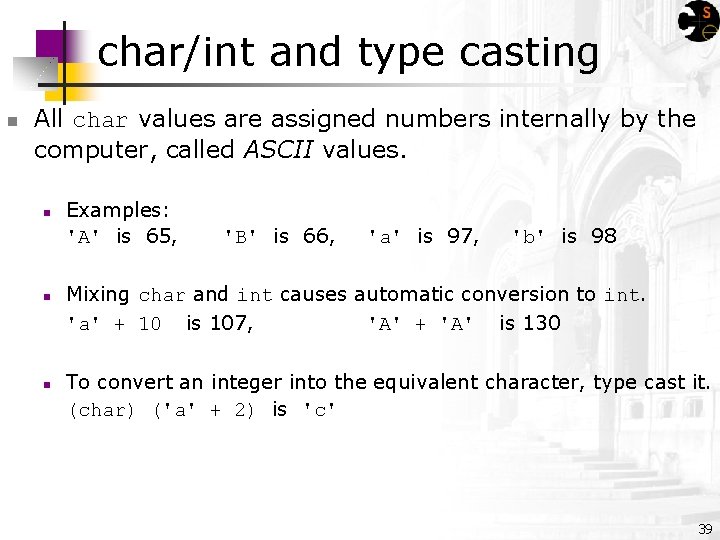
char/int and type casting n All char values are assigned numbers internally by the computer, called ASCII values. n n n Examples: 'A' is 65, 'B' is 66, 'a' is 97, 'b' is 98 Mixing char and int causes automatic conversion to int. 'a' + 10 is 107, 'A' + 'A' is 130 To convert an integer into the equivalent character, type cast it. (char) ('a' + 2) is 'c' 39
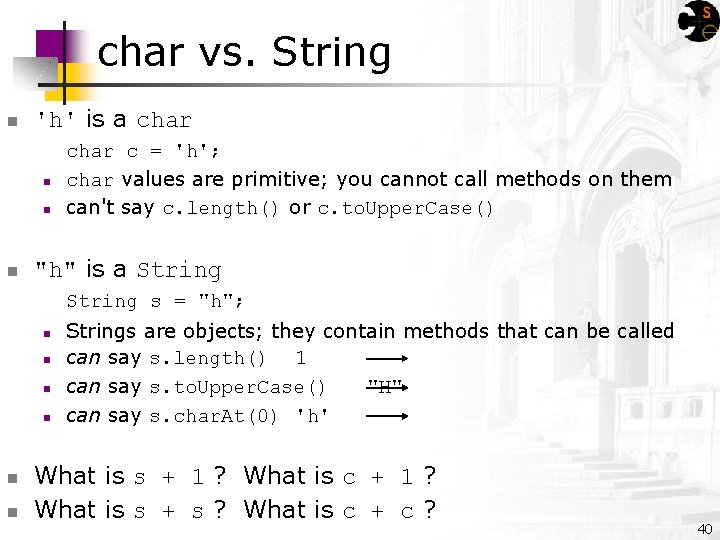
char vs. String n 'h' is a char n n n char c = 'h'; char values are primitive; you cannot call methods on them can't say c. length() or c. to. Upper. Case() "h" is a String s = "h"; n n n Strings are objects; they contain methods that can be called can say s. length() 1 can say s. to. Upper. Case() "H" can say s. char. At(0) 'h' What is s + 1 ? What is c + 1 ? What is s + s ? What is c + c ? 40
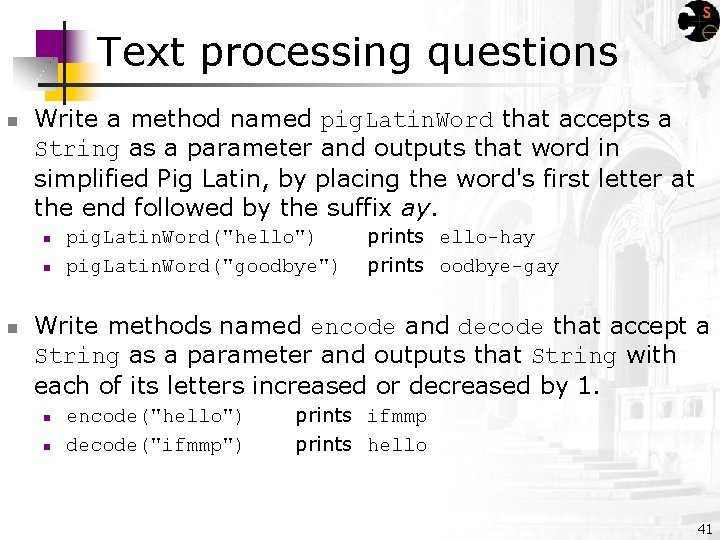
Text processing questions n Write a method named pig. Latin. Word that accepts a String as a parameter and outputs that word in simplified Pig Latin, by placing the word's first letter at the end followed by the suffix ay. n n n pig. Latin. Word("hello") pig. Latin. Word("goodbye") prints ello-hay prints oodbye-gay Write methods named encode and decode that accept a String as a parameter and outputs that String with each of its letters increased or decreased by 1. n n encode("hello") decode("ifmmp") prints ifmmp prints hello 41
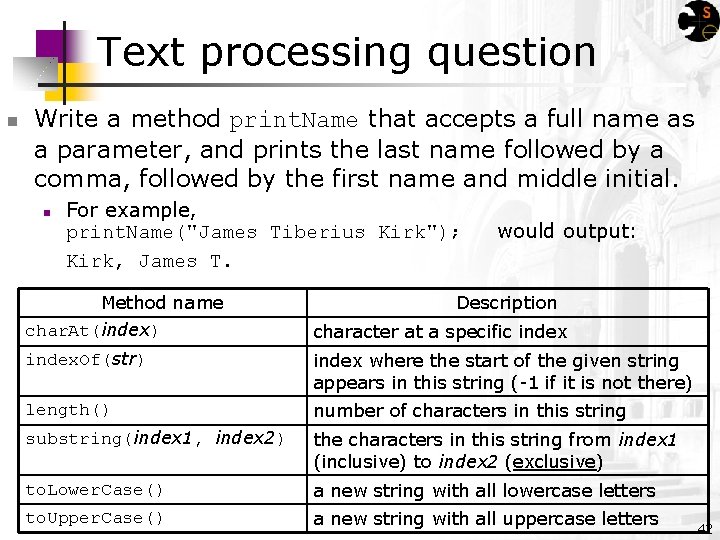
Text processing question n Write a method print. Name that accepts a full name as a parameter, and prints the last name followed by a comma, followed by the first name and middle initial. n For example, print. Name("James Tiberius Kirk"); Kirk, James T. Method name char. At(index) would output: Description character at a specific index. Of(str) index where the start of the given string appears in this string (-1 if it is not there) length() number of characters in this string substring(index 1, index 2) the characters in this string from index 1 (inclusive) to index 2 (exclusive) to. Lower. Case() a new string with all lowercase letters to. Upper. Case() a new string with all uppercase letters 42
- Slides: 42