
Building Java Programs Chapter 9 Lecture 9 1
Building Java Programs Chapter 9 Lecture 9 -1: Inheritance reading: 9. 1 Copyright 2010 by Pearson Education
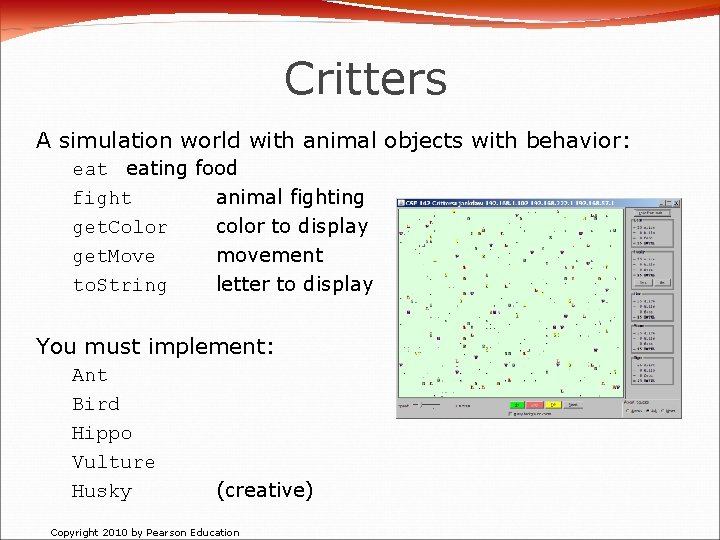
Critters A simulation world with animal objects with behavior: eating food fight animal fighting get. Color color to display get. Move movement to. String letter to display You must implement: Ant Bird Hippo Vulture Husky (creative) Copyright 2010 by Pearson Education
Testing critters Focus on one specific critter of one specific type Only spawn 1 of each animal, for debugging Make sure your fields update properly Use println statements to see field values Look at the behavior one step at a time Use "Tick" rather than "Go" Copyright 2010 by Pearson Education 3
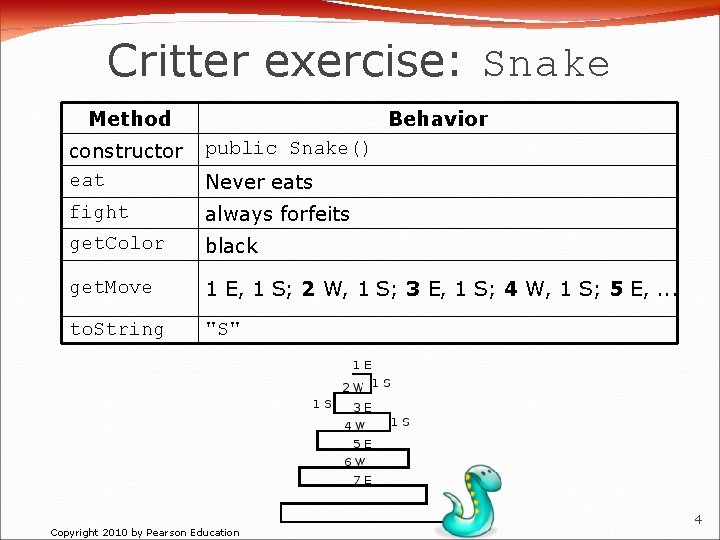
Critter exercise: Snake Method Behavior constructor eat public Snake() fight always forfeits get. Color black get. Move 1 E, 1 S; 2 W, 1 S; 3 E, 1 S; 4 W, 1 S; 5 E, . . . to. String "S" Never eats Copyright 2010 by Pearson Education 4
Determining necessary fields Information required to decide what move to make? Direction to go in Length of current cycle Number of moves made in current cycle Remembering things you've done in the past: an int counter? a boolean flag? Copyright 2010 by Pearson Education 5
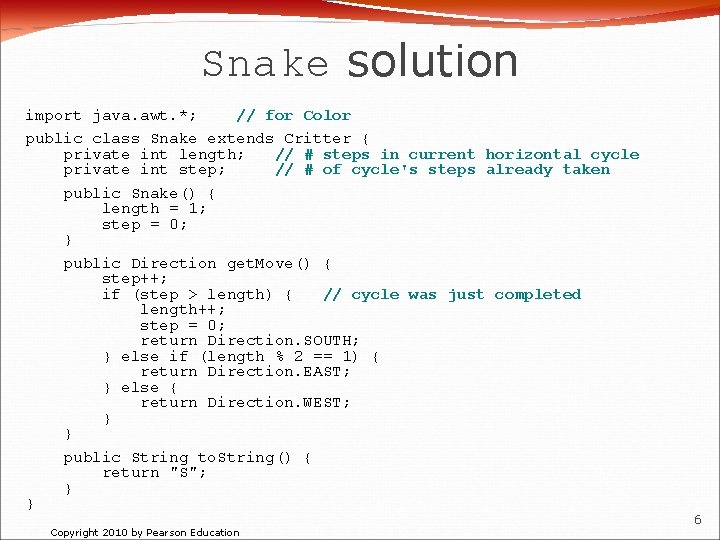
Snake solution import java. awt. *; // for Color public class Snake extends Critter { private int length; // # steps in current horizontal cycle private int step; // # of cycle's steps already taken public Snake() { length = 1; step = 0; } public Direction get. Move() { step++; if (step > length) { // cycle was just completed length++; step = 0; return Direction. SOUTH; } else if (length % 2 == 1) { return Direction. EAST; } else { return Direction. WEST; } } public String to. String() { return "S"; } } Copyright 2010 by Pearson Education 6
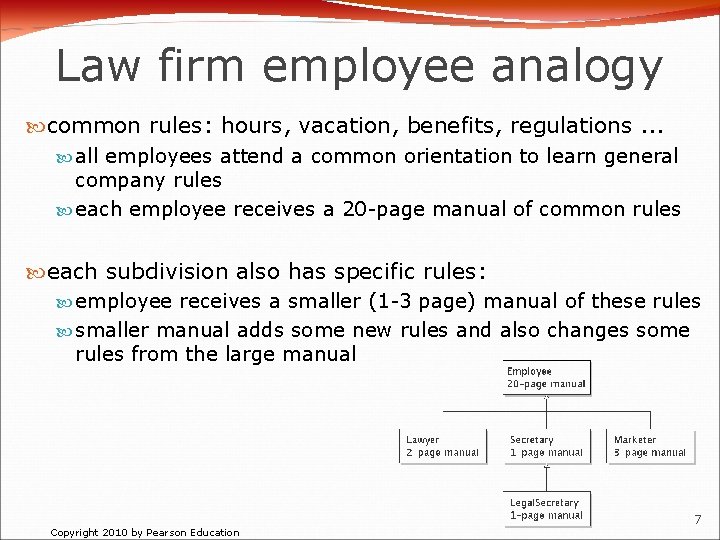
Law firm employee analogy common rules: hours, vacation, benefits, regulations. . . all employees attend a common orientation to learn general company rules each employee receives a 20 -page manual of common rules each subdivision also has specific rules: employee receives a smaller (1 -3 page) manual of these rules smaller manual adds some new rules and also changes some rules from the large manual Copyright 2010 by Pearson Education 7
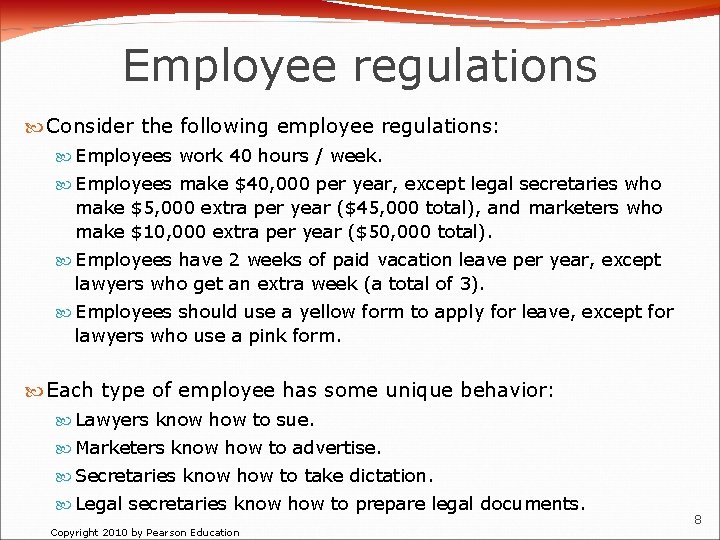
Employee regulations Consider the following employee regulations: Employees work 40 hours / week. Employees make $40, 000 per year, except legal secretaries who make $5, 000 extra per year ($45, 000 total), and marketers who make $10, 000 extra per year ($50, 000 total). Employees have 2 weeks of paid vacation leave per year, except lawyers who get an extra week (a total of 3). Employees should use a yellow form to apply for leave, except for lawyers who use a pink form. Each type of employee has some unique behavior: Lawyers know how to sue. Marketers know how to advertise. Secretaries know how to take dictation. Legal secretaries know how to prepare legal documents. Copyright 2010 by Pearson Education 8
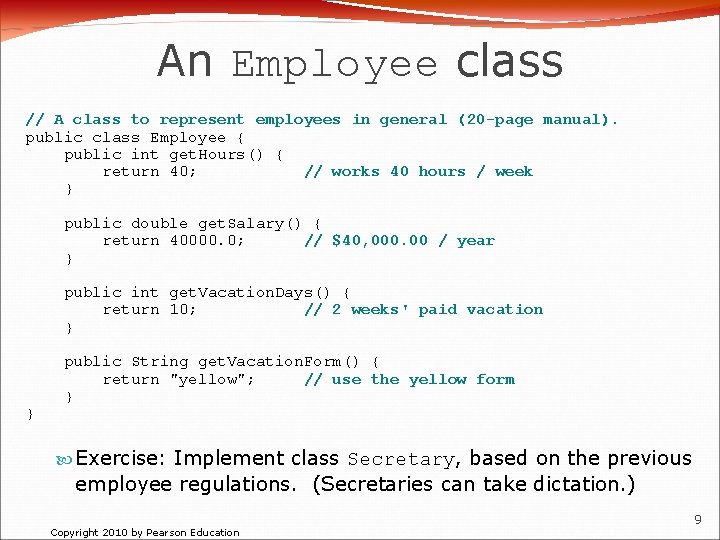
An Employee class // A class to represent employees in general (20 -page manual). public class Employee { public int get. Hours() { return 40; // works 40 hours / week } public double get. Salary() { return 40000. 0; // $40, 000. 00 / year } public int get. Vacation. Days() { return 10; // 2 weeks' paid vacation } } public String get. Vacation. Form() { return "yellow"; // use the yellow form } Exercise: Implement class Secretary, based on the previous employee regulations. (Secretaries can take dictation. ) Copyright 2010 by Pearson Education 9
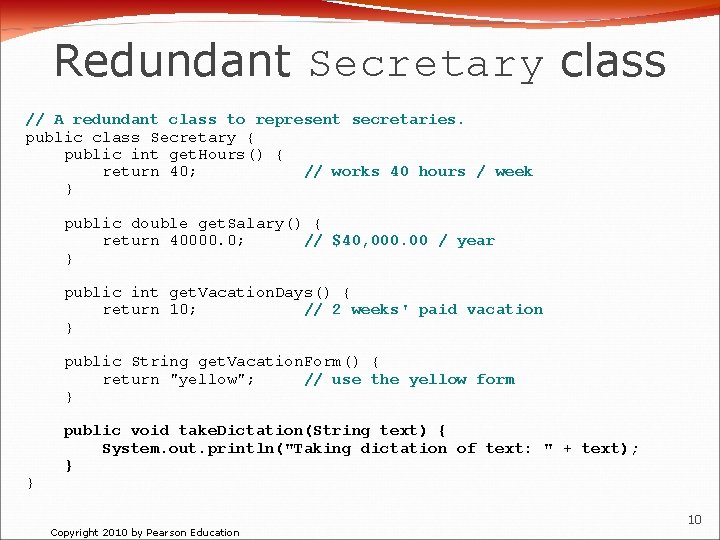
Redundant Secretary class // A redundant class to represent secretaries. public class Secretary { public int get. Hours() { return 40; // works 40 hours / week } public double get. Salary() { return 40000. 0; // $40, 000. 00 / year } public int get. Vacation. Days() { return 10; // 2 weeks' paid vacation } public String get. Vacation. Form() { return "yellow"; // use the yellow form } } public void take. Dictation(String text) { System. out. println("Taking dictation of text: " + text); } Copyright 2010 by Pearson Education 10
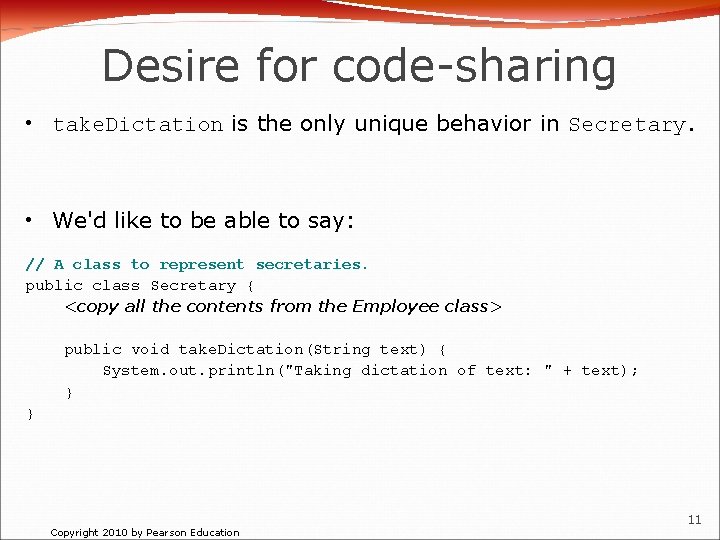
Desire for code-sharing • take. Dictation is the only unique behavior in Secretary. • We'd like to be able to say: // A class to represent secretaries. public class Secretary { <copy all the contents from the Employee class> public void take. Dictation(String text) { System. out. println("Taking dictation of text: " + text); } } Copyright 2010 by Pearson Education 11
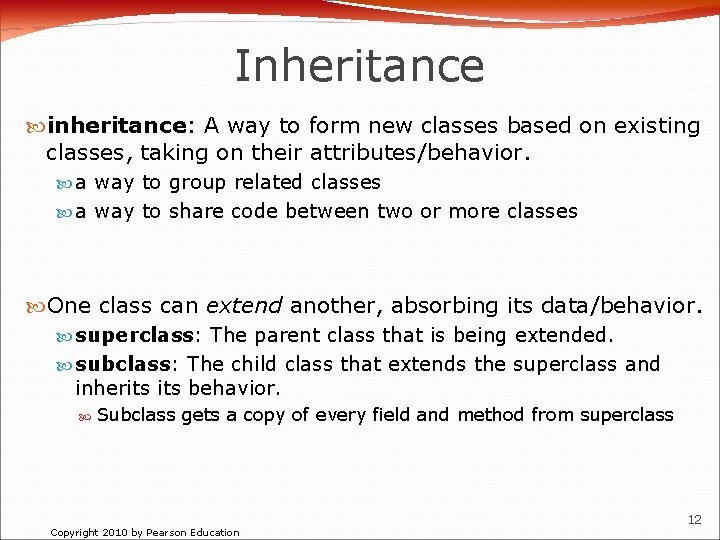
Inheritance inheritance: A way to form new classes based on existing classes, taking on their attributes/behavior. a way to group related classes a way to share code between two or more classes One class can extend another, absorbing its data/behavior. superclass: The parent class that is being extended. subclass: The child class that extends the superclass and inherits behavior. Subclass gets a copy of every field and method from superclass Copyright 2010 by Pearson Education 12
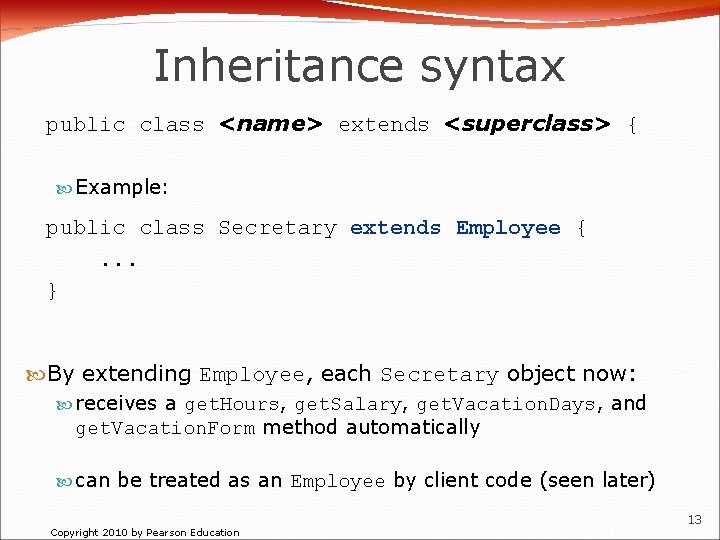
Inheritance syntax public class <name> extends <superclass> { Example: public class Secretary extends Employee {. . . } By extending Employee, each Secretary object now: receives a get. Hours, get. Salary, get. Vacation. Days, and get. Vacation. Form method automatically can be treated as an Employee by client code (seen later) Copyright 2010 by Pearson Education 13
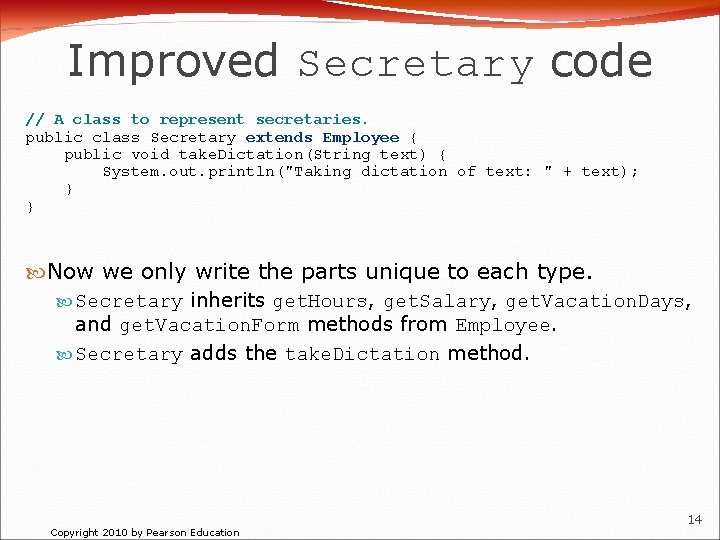
Improved Secretary code // A class to represent secretaries. public class Secretary extends Employee { public void take. Dictation(String text) { System. out. println("Taking dictation of text: " + text); } } Now we only write the parts unique to each type. Secretary inherits get. Hours, get. Salary, get. Vacation. Days, and get. Vacation. Form methods from Employee. Secretary adds the take. Dictation method. Copyright 2010 by Pearson Education 14
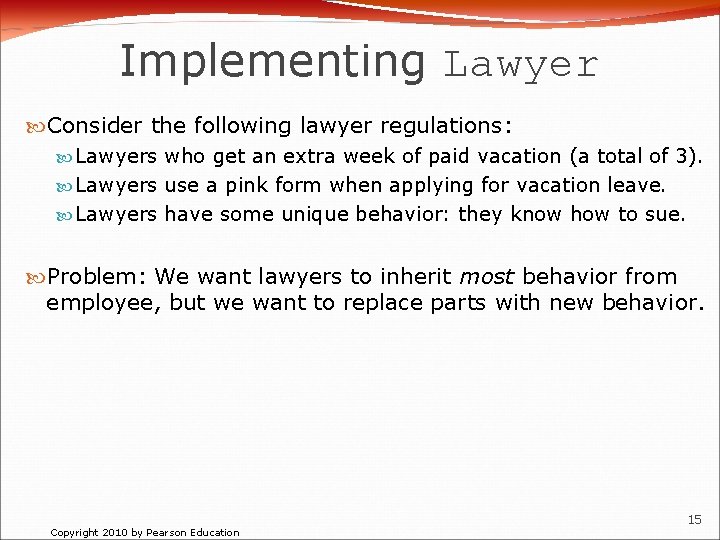
Implementing Lawyer Consider the following lawyer regulations: Lawyers who get an extra week of paid vacation (a total of 3). Lawyers use a pink form when applying for vacation leave. Lawyers have some unique behavior: they know how to sue. Problem: We want lawyers to inherit most behavior from employee, but we want to replace parts with new behavior. Copyright 2010 by Pearson Education 15
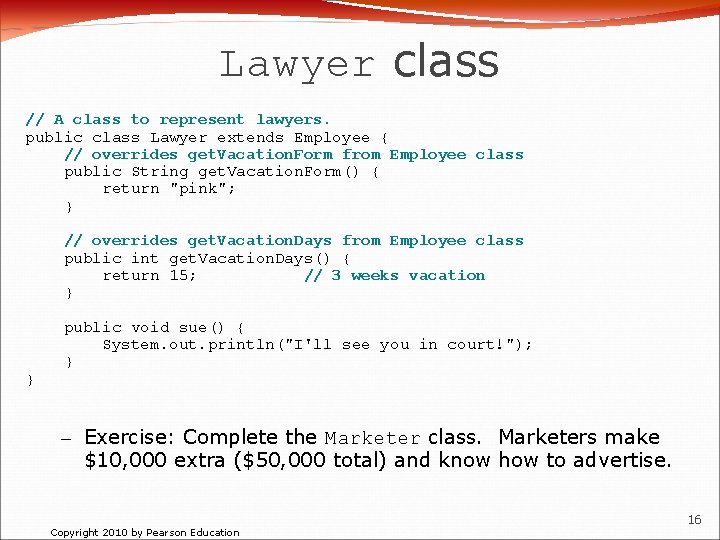
Lawyer class // A class to represent lawyers. public class Lawyer extends Employee { // overrides get. Vacation. Form from Employee class public String get. Vacation. Form() { return "pink"; } // overrides get. Vacation. Days from Employee class public int get. Vacation. Days() { return 15; // 3 weeks vacation } } public void sue() { System. out. println("I'll see you in court!"); } – Exercise: Complete the Marketer class. Marketers make $10, 000 extra ($50, 000 total) and know how to advertise. Copyright 2010 by Pearson Education 16
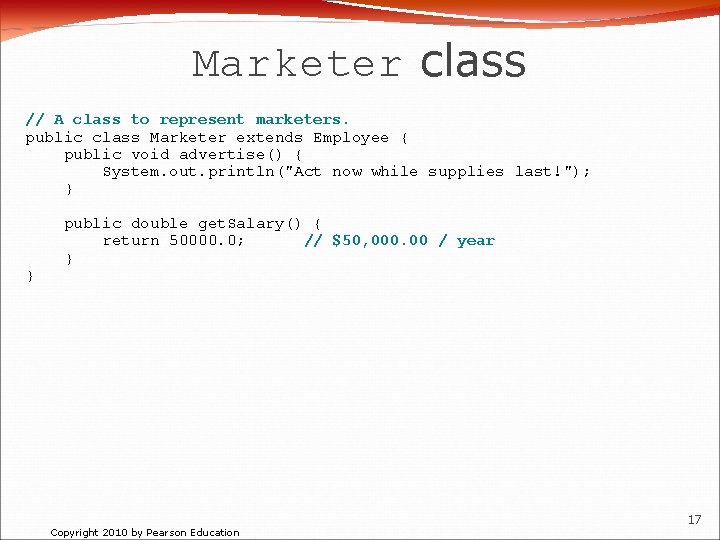
Marketer class // A class to represent marketers. public class Marketer extends Employee { public void advertise() { System. out. println("Act now while supplies last!"); } } public double get. Salary() { return 50000. 0; // $50, 000. 00 / year } Copyright 2010 by Pearson Education 17
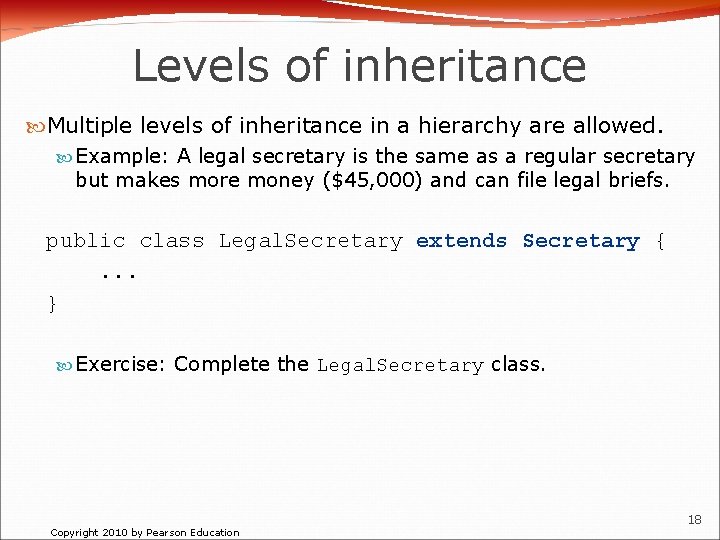
Levels of inheritance Multiple levels of inheritance in a hierarchy are allowed. Example: A legal secretary is the same as a regular secretary but makes more money ($45, 000) and can file legal briefs. public class Legal. Secretary extends Secretary {. . . } Exercise: Complete the Legal. Secretary class. Copyright 2010 by Pearson Education 18
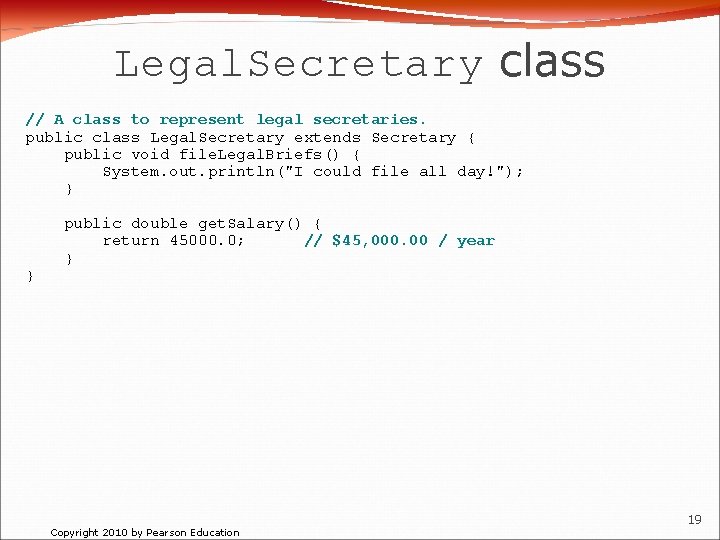
Legal. Secretary class // A class to represent legal secretaries. public class Legal. Secretary extends Secretary { public void file. Legal. Briefs() { System. out. println("I could file all day!"); } } public double get. Salary() { return 45000. 0; // $45, 000. 00 / year } Copyright 2010 by Pearson Education 19
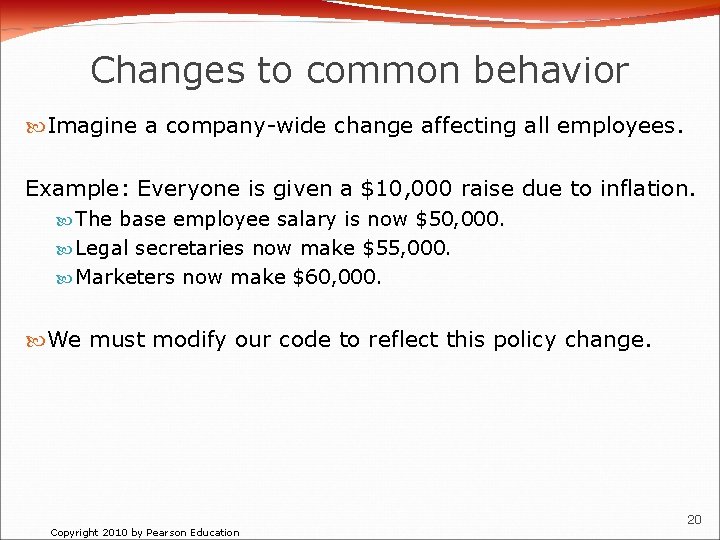
Changes to common behavior Imagine a company-wide change affecting all employees. Example: Everyone is given a $10, 000 raise due to inflation. The base employee salary is now $50, 000. Legal secretaries now make $55, 000. Marketers now make $60, 000. We must modify our code to reflect this policy change. Copyright 2010 by Pearson Education 20
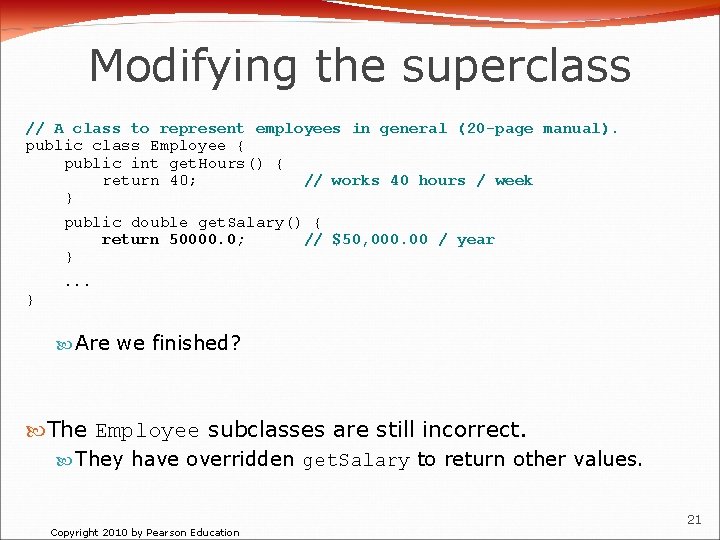
Modifying the superclass // A class to represent employees in general (20 -page manual). public class Employee { public int get. Hours() { return 40; // works 40 hours / week } public double get. Salary() { return 50000. 0; // $50, 000. 00 / year } } . . . Are we finished? The Employee subclasses are still incorrect. They have overridden get. Salary to return other values. Copyright 2010 by Pearson Education 21
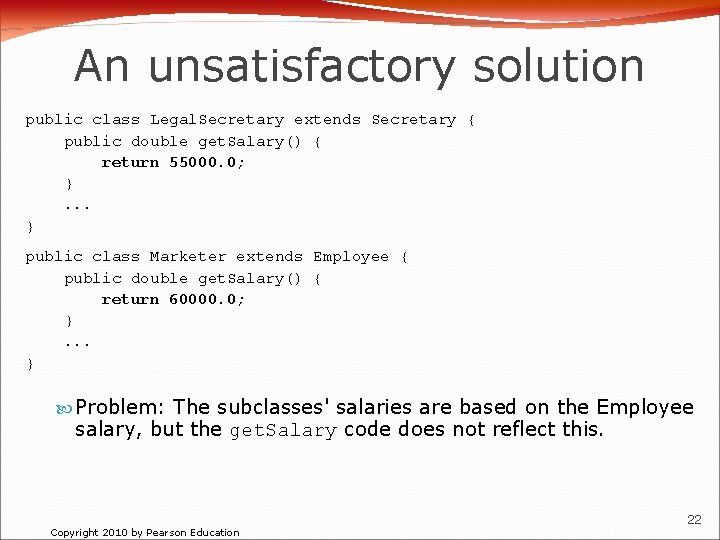
An unsatisfactory solution public class Legal. Secretary extends Secretary { public double get. Salary() { return 55000. 0; }. . . } public class Marketer extends Employee { public double get. Salary() { return 60000. 0; }. . . } Problem: The subclasses' salaries are based on the Employee salary, but the get. Salary code does not reflect this. Copyright 2010 by Pearson Education 22
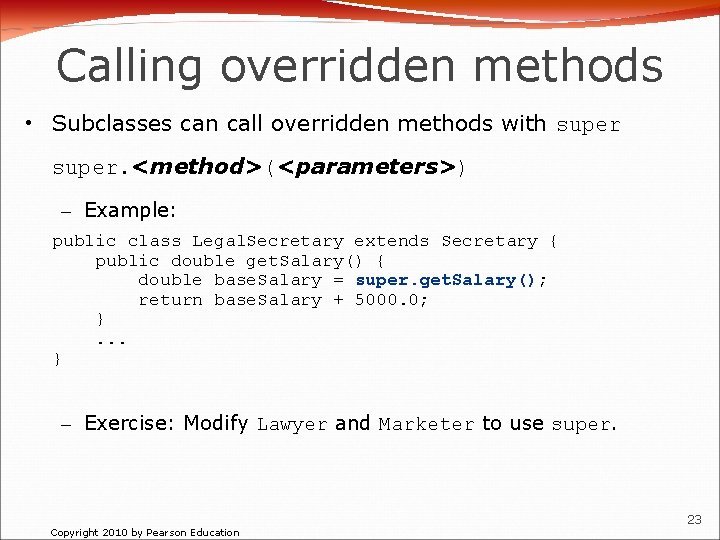
Calling overridden methods • Subclasses can call overridden methods with super. <method>(<parameters>) – Example: public class Legal. Secretary extends Secretary { public double get. Salary() { double base. Salary = super. get. Salary(); return base. Salary + 5000. 0; }. . . } – Exercise: Modify Lawyer and Marketer to use super. Copyright 2010 by Pearson Education 23
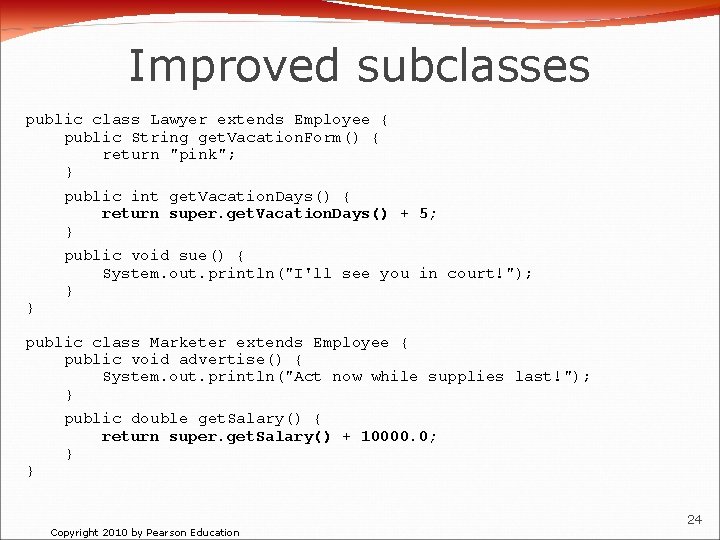
Improved subclasses public class Lawyer extends Employee { public String get. Vacation. Form() { return "pink"; } public int get. Vacation. Days() { return super. get. Vacation. Days() + 5; } } public void sue() { System. out. println("I'll see you in court!"); } public class Marketer extends Employee { public void advertise() { System. out. println("Act now while supplies last!"); } } public double get. Salary() { return super. get. Salary() + 10000. 0; } Copyright 2010 by Pearson Education 24
- Slides: 24