
Building Java Programs Chapter 9 Inheritance and Interfaces
Building Java Programs Chapter 9 Inheritance and Interfaces
The software crisis • software engineering: The practice of developing, designing, documenting, testing large computer programs. • Large-scale projects face many issues: – – – getting many programmers to work together getting code finished on time avoiding redundant code finding and fixing bugs maintaining, improving, and reusing existing code • code reuse: The practice of writing program code once and using it in many contexts. 2
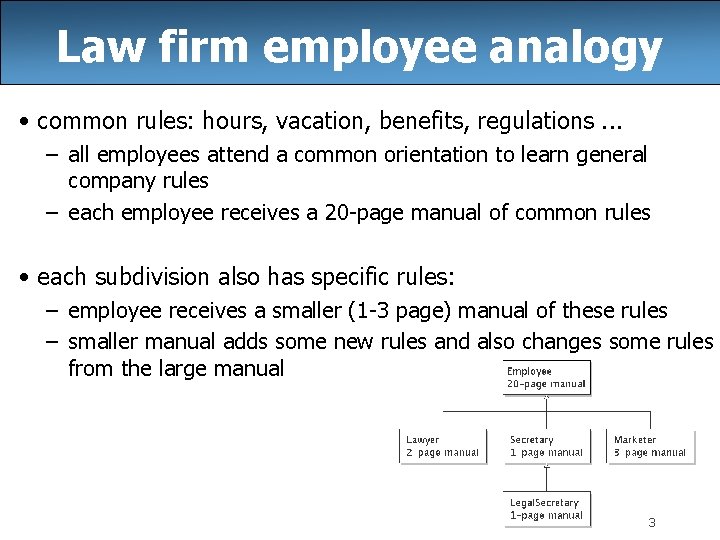
Law firm employee analogy • common rules: hours, vacation, benefits, regulations. . . – all employees attend a common orientation to learn general company rules – each employee receives a 20 -page manual of common rules • each subdivision also has specific rules: – employee receives a smaller (1 -3 page) manual of these rules – smaller manual adds some new rules and also changes some rules from the large manual 3
Separating behavior • Why not just have a 22 page Lawyer manual, a 21 -page Secretary manual, a 23 -page Marketer manual, etc. ? • Some advantages of the separate manuals: – maintenance: Only one update if a common rule changes. – locality: Quick discovery of all rules specific to lawyers. • Some key ideas from this example: – General rules are useful (the 20 -page manual). – Specific rules that may override general ones are also useful. 4
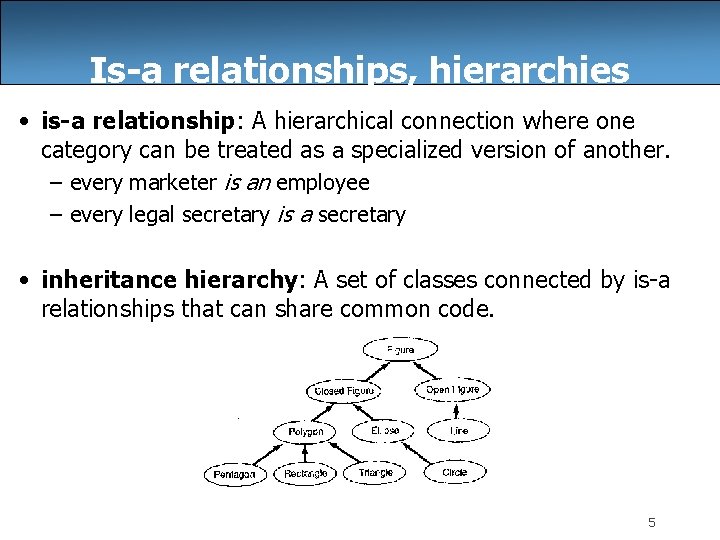
Is-a relationships, hierarchies • is-a relationship: A hierarchical connection where one category can be treated as a specialized version of another. – every marketer is an employee – every legal secretary is a secretary • inheritance hierarchy: A set of classes connected by is-a relationships that can share common code. 5
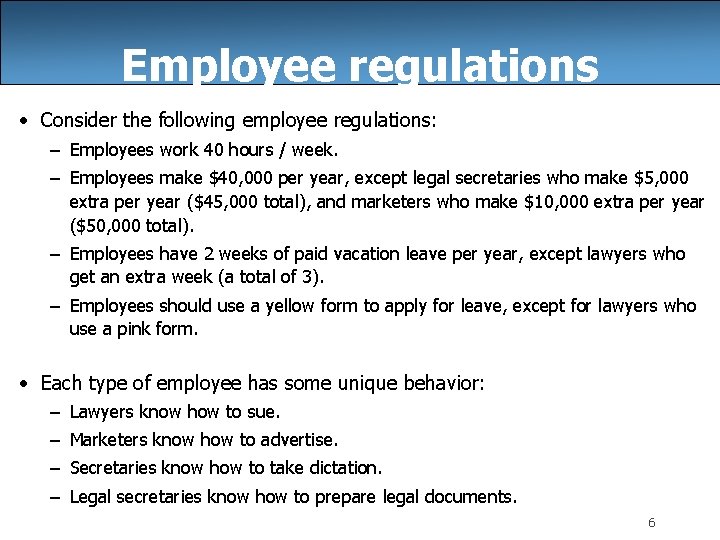
Employee regulations • Consider the following employee regulations: – Employees work 40 hours / week. – Employees make $40, 000 per year, except legal secretaries who make $5, 000 extra per year ($45, 000 total), and marketers who make $10, 000 extra per year ($50, 000 total). – Employees have 2 weeks of paid vacation leave per year, except lawyers who get an extra week (a total of 3). – Employees should use a yellow form to apply for leave, except for lawyers who use a pink form. • Each type of employee has some unique behavior: – Lawyers know how to sue. – Marketers know how to advertise. – Secretaries know how to take dictation. – Legal secretaries know how to prepare legal documents. 6
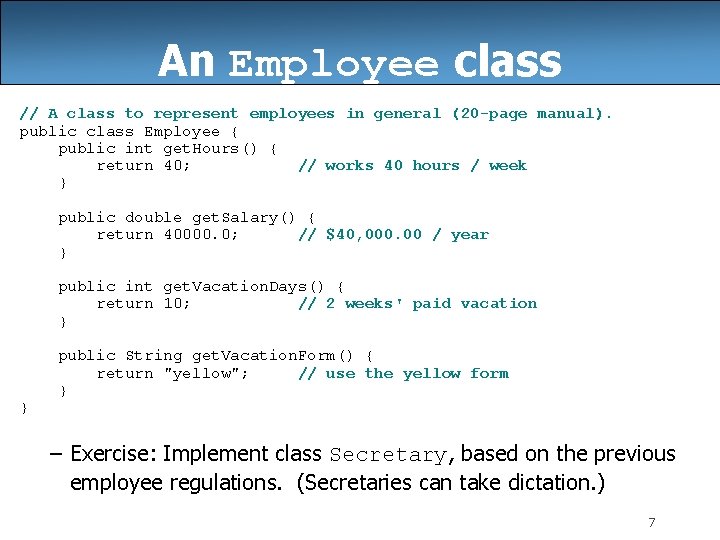
An Employee class // A class to represent employees in general (20 -page manual). public class Employee { public int get. Hours() { return 40; // works 40 hours / week } public double get. Salary() { return 40000. 0; // $40, 000. 00 / year } public int get. Vacation. Days() { return 10; // 2 weeks' paid vacation } } public String get. Vacation. Form() { return "yellow"; // use the yellow form } – Exercise: Implement class Secretary, based on the previous employee regulations. (Secretaries can take dictation. ) 7
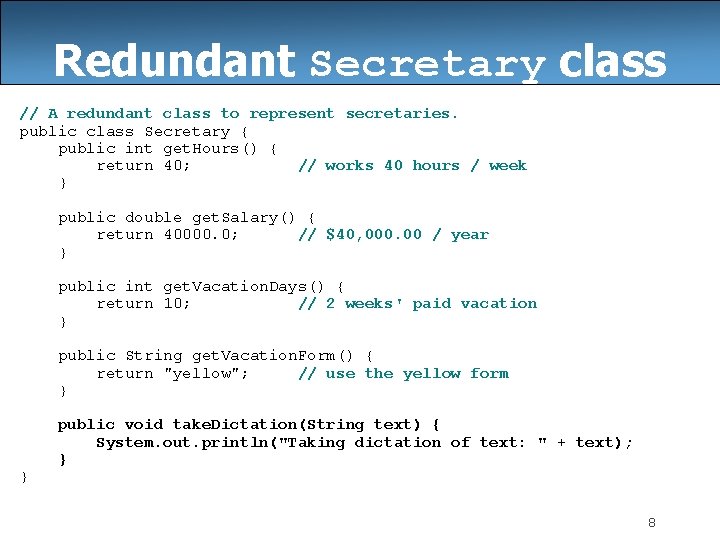
Redundant Secretary class // A redundant class to represent secretaries. public class Secretary { public int get. Hours() { return 40; // works 40 hours / week } public double get. Salary() { return 40000. 0; // $40, 000. 00 / year } public int get. Vacation. Days() { return 10; // 2 weeks' paid vacation } public String get. Vacation. Form() { return "yellow"; // use the yellow form } } public void take. Dictation(String text) { System. out. println("Taking dictation of text: " + text); } 8
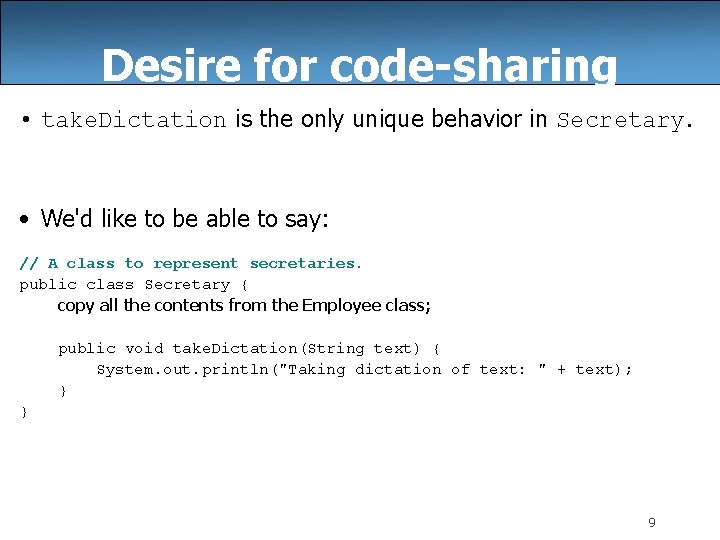
Desire for code-sharing • take. Dictation is the only unique behavior in Secretary. • We'd like to be able to say: // A class to represent secretaries. public class Secretary { copy all the contents from the Employee class; public void take. Dictation(String text) { System. out. println("Taking dictation of text: " + text); } } 9
Inheritance • inheritance: A way to form new classes based on existing classes, taking on their attributes/behavior. – a way to group related classes – a way to share code between two or more classes • One class can extend another, absorbing its data/behavior. – superclass: The parent class that is being extended. – subclass: The child class that extends the superclass and inherits behavior. • Subclass gets a copy of every field and method from superclass 10
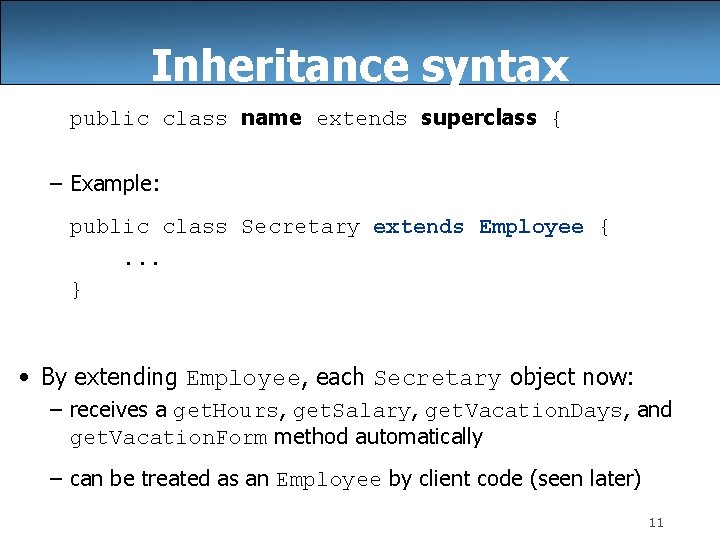
Inheritance syntax public class name extends superclass { – Example: public class Secretary extends Employee {. . . } • By extending Employee, each Secretary object now: – receives a get. Hours, get. Salary, get. Vacation. Days, and get. Vacation. Form method automatically – can be treated as an Employee by client code (seen later) 11
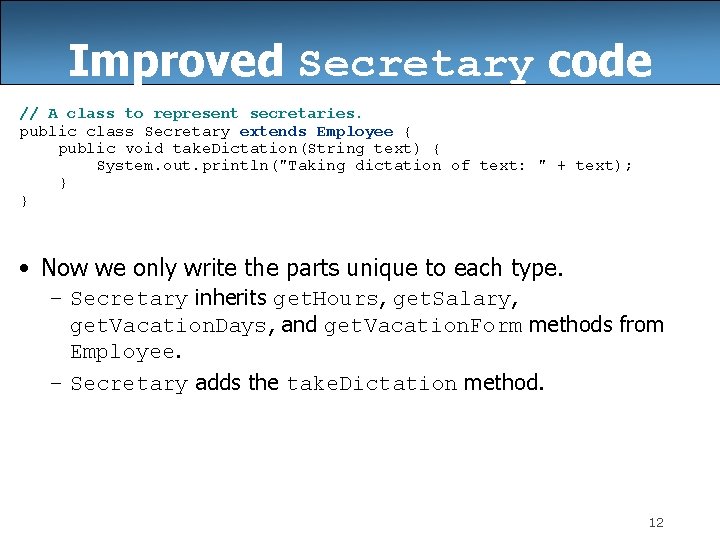
Improved Secretary code // A class to represent secretaries. public class Secretary extends Employee { public void take. Dictation(String text) { System. out. println("Taking dictation of text: " + text); } } • Now we only write the parts unique to each type. – Secretary inherits get. Hours, get. Salary, get. Vacation. Days, and get. Vacation. Form methods from Employee. – Secretary adds the take. Dictation method. 12
Implementing Lawyer • Consider the following lawyer regulations: – Lawyers who get an extra week of paid vacation (a total of 3). – Lawyers use a pink form when applying for vacation leave. – Lawyers have some unique behavior: they know how to sue. • Problem: We want lawyers to inherit most behavior from employee, but we want to replace parts with new behavior. 13
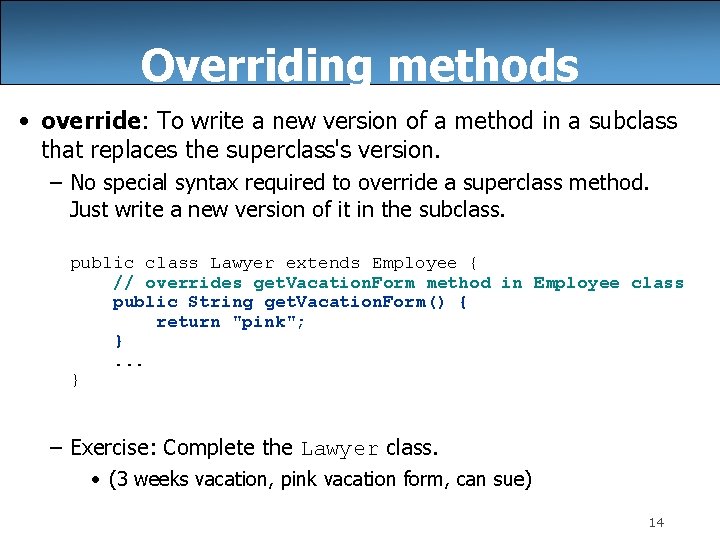
Overriding methods • override: To write a new version of a method in a subclass that replaces the superclass's version. – No special syntax required to override a superclass method. Just write a new version of it in the subclass. public class Lawyer extends Employee { // overrides get. Vacation. Form method in Employee class public String get. Vacation. Form() { return "pink"; }. . . } – Exercise: Complete the Lawyer class. • (3 weeks vacation, pink vacation form, can sue) 14
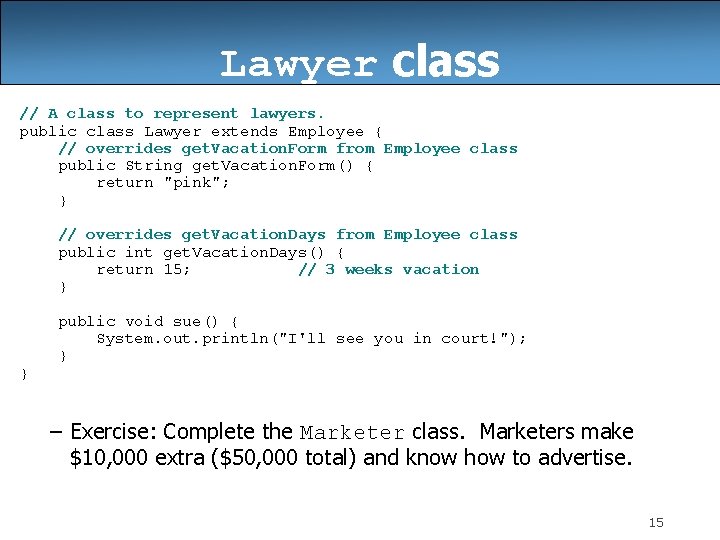
Lawyer class // A class to represent lawyers. public class Lawyer extends Employee { // overrides get. Vacation. Form from Employee class public String get. Vacation. Form() { return "pink"; } // overrides get. Vacation. Days from Employee class public int get. Vacation. Days() { return 15; // 3 weeks vacation } } public void sue() { System. out. println("I'll see you in court!"); } – Exercise: Complete the Marketer class. Marketers make $10, 000 extra ($50, 000 total) and know how to advertise. 15
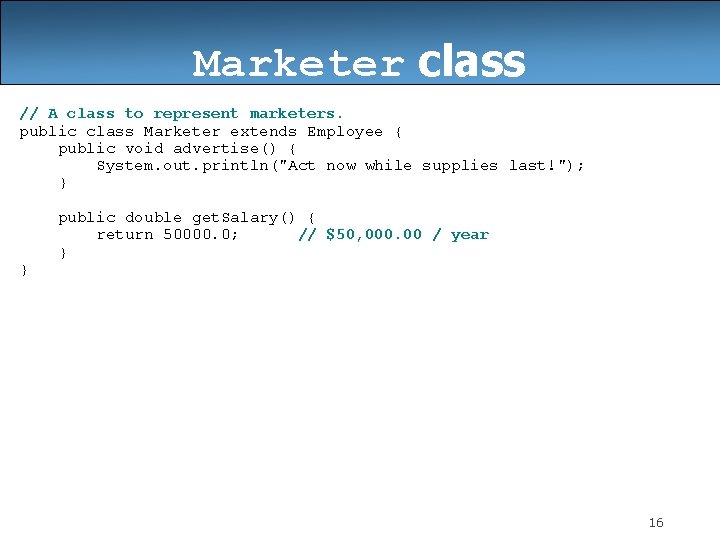
Marketer class // A class to represent marketers. public class Marketer extends Employee { public void advertise() { System. out. println("Act now while supplies last!"); } } public double get. Salary() { return 50000. 0; // $50, 000. 00 / year } 16
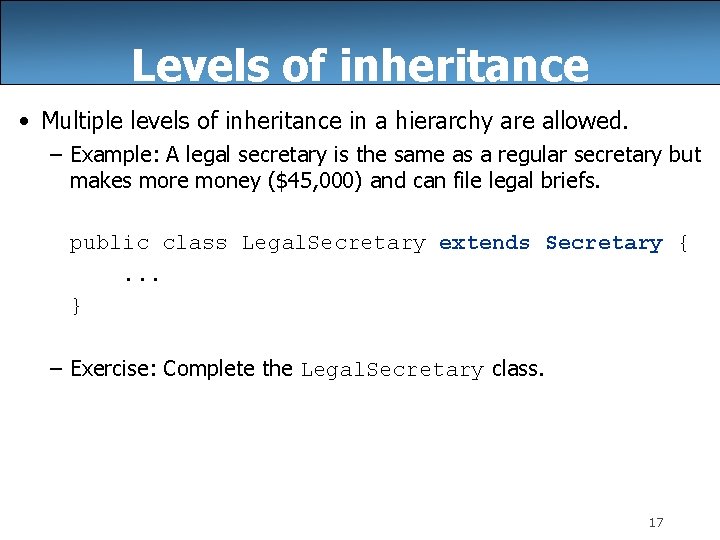
Levels of inheritance • Multiple levels of inheritance in a hierarchy are allowed. – Example: A legal secretary is the same as a regular secretary but makes more money ($45, 000) and can file legal briefs. public class Legal. Secretary extends Secretary {. . . } – Exercise: Complete the Legal. Secretary class. 17
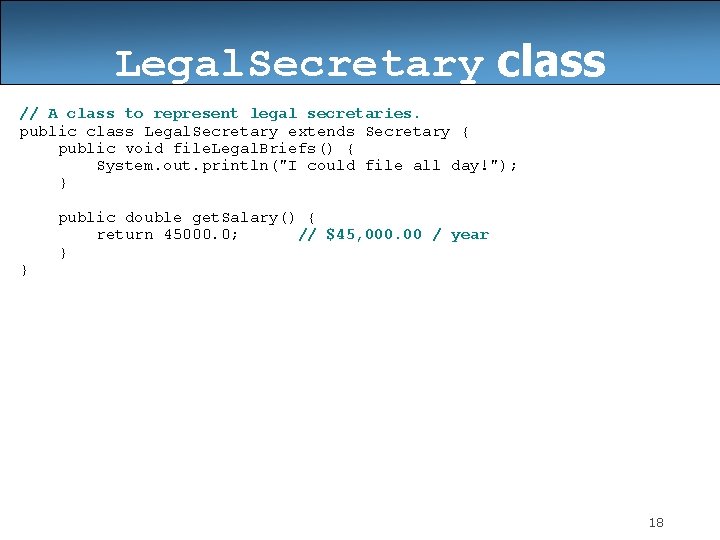
Legal. Secretary class // A class to represent legal secretaries. public class Legal. Secretary extends Secretary { public void file. Legal. Briefs() { System. out. println("I could file all day!"); } } public double get. Salary() { return 45000. 0; // $45, 000. 00 / year } 18
Interacting with the superclass
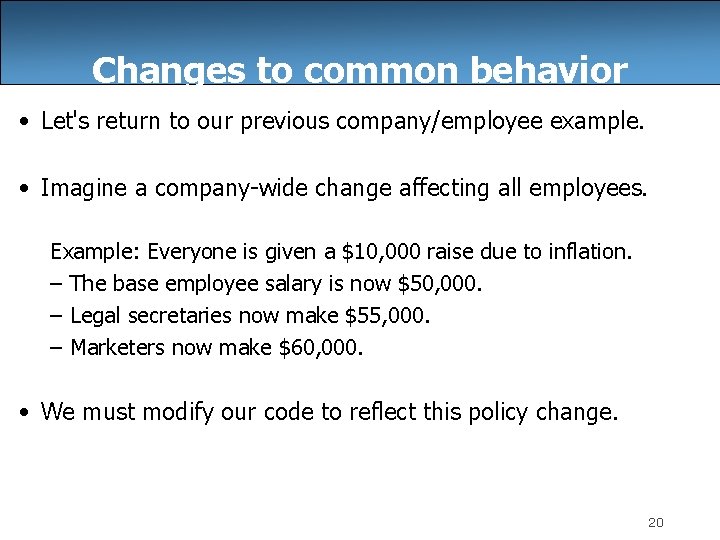
Changes to common behavior • Let's return to our previous company/employee example. • Imagine a company-wide change affecting all employees. Example: Everyone is given a $10, 000 raise due to inflation. – The base employee salary is now $50, 000. – Legal secretaries now make $55, 000. – Marketers now make $60, 000. • We must modify our code to reflect this policy change. 20
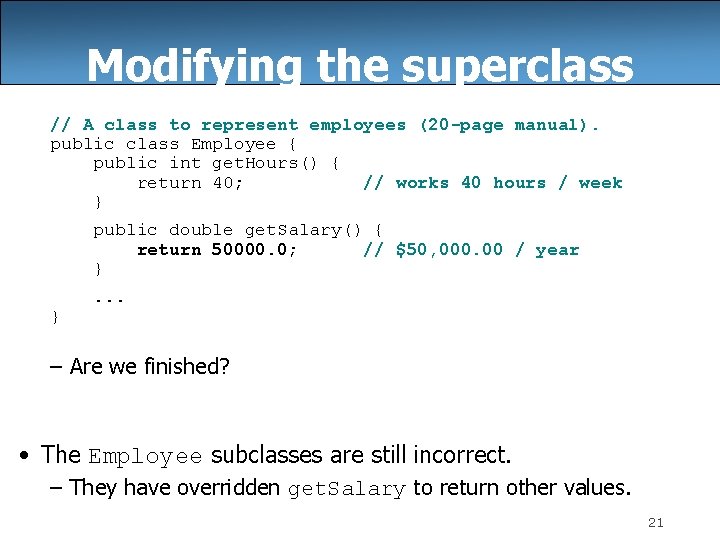
Modifying the superclass // A class to represent employees (20 -page manual). public class Employee { public int get. Hours() { return 40; // works 40 hours / week } public double get. Salary() { return 50000. 0; // $50, 000. 00 / year } } . . . – Are we finished? • The Employee subclasses are still incorrect. – They have overridden get. Salary to return other values. 21
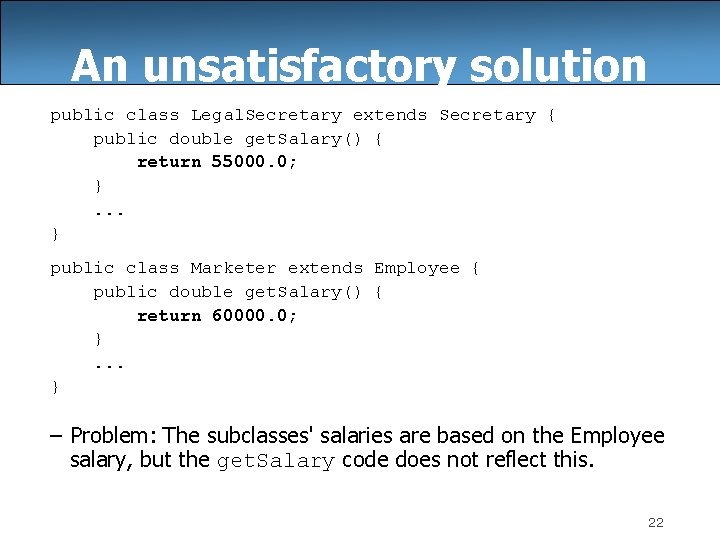
An unsatisfactory solution public class Legal. Secretary extends Secretary { public double get. Salary() { return 55000. 0; }. . . } public class Marketer extends Employee { public double get. Salary() { return 60000. 0; }. . . } – Problem: The subclasses' salaries are based on the Employee salary, but the get. Salary code does not reflect this. 22
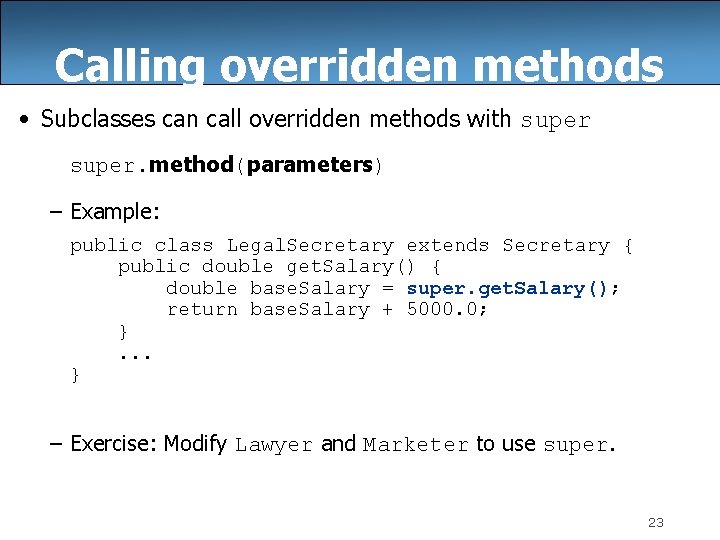
Calling overridden methods • Subclasses can call overridden methods with super. method(parameters) – Example: public class Legal. Secretary extends Secretary { public double get. Salary() { double base. Salary = super. get. Salary(); return base. Salary + 5000. 0; }. . . } – Exercise: Modify Lawyer and Marketer to use super. 23
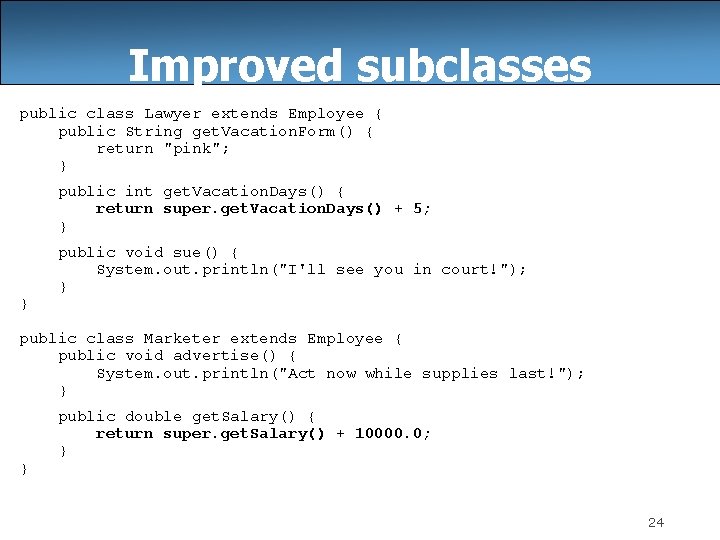
Improved subclasses public class Lawyer extends Employee { public String get. Vacation. Form() { return "pink"; } public int get. Vacation. Days() { return super. get. Vacation. Days() + 5; } } public void sue() { System. out. println("I'll see you in court!"); } public class Marketer extends Employee { public void advertise() { System. out. println("Act now while supplies last!"); } } public double get. Salary() { return super. get. Salary() + 10000. 0; } 24
Inheritance and constructors • Imagine that we want to give employees more vacation days the longer they've been with the company. – For each year worked, we'll award 2 additional vacation days. – When an Employee object is constructed, we'll pass in the number of years the person has been with the company. – This will require us to modify our Employee class and add some new state and behavior. – Exercise: Make necessary modifications to the Employee class. 25
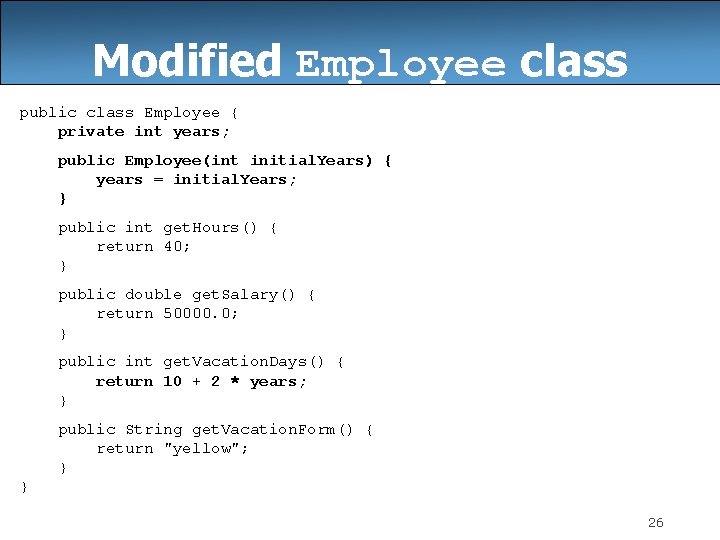
Modified Employee class public class Employee { private int years; public Employee(int initial. Years) { years = initial. Years; } public int get. Hours() { return 40; } public double get. Salary() { return 50000. 0; } public int get. Vacation. Days() { return 10 + 2 * years; } public String get. Vacation. Form() { return "yellow"; } } 26
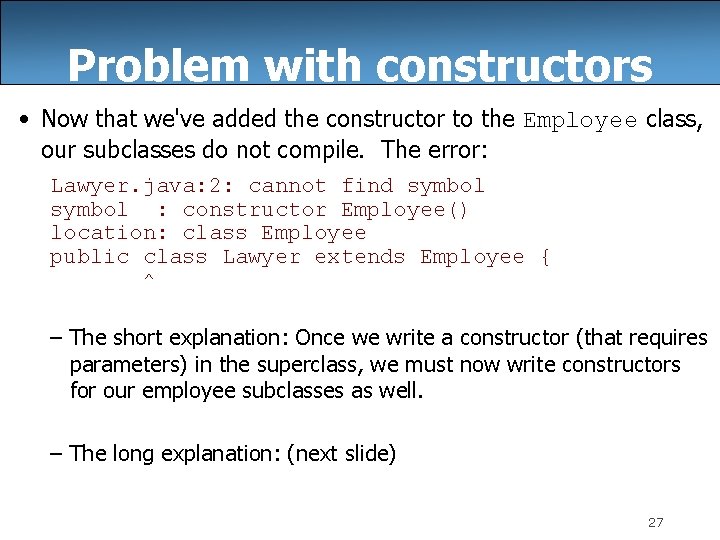
Problem with constructors • Now that we've added the constructor to the Employee class, our subclasses do not compile. The error: Lawyer. java: 2: cannot find symbol : constructor Employee() location: class Employee public class Lawyer extends Employee { ^ – The short explanation: Once we write a constructor (that requires parameters) in the superclass, we must now write constructors for our employee subclasses as well. – The long explanation: (next slide) 27
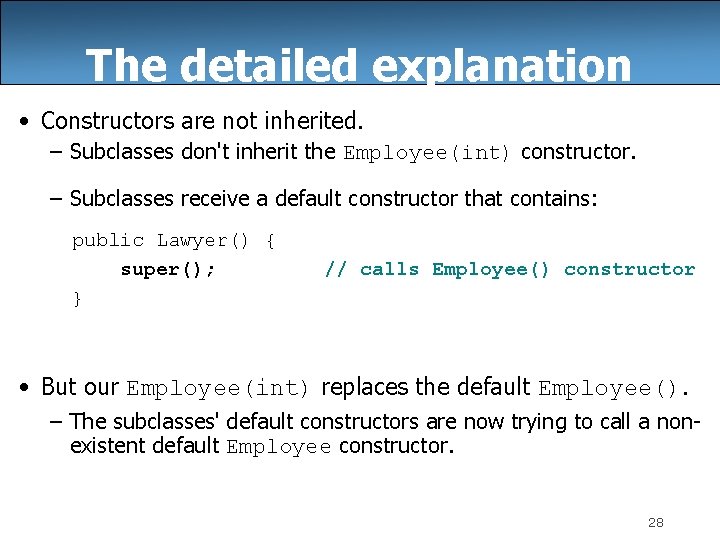
The detailed explanation • Constructors are not inherited. – Subclasses don't inherit the Employee(int) constructor. – Subclasses receive a default constructor that contains: public Lawyer() { super(); } // calls Employee() constructor • But our Employee(int) replaces the default Employee(). – The subclasses' default constructors are now trying to call a nonexistent default Employee constructor. 28
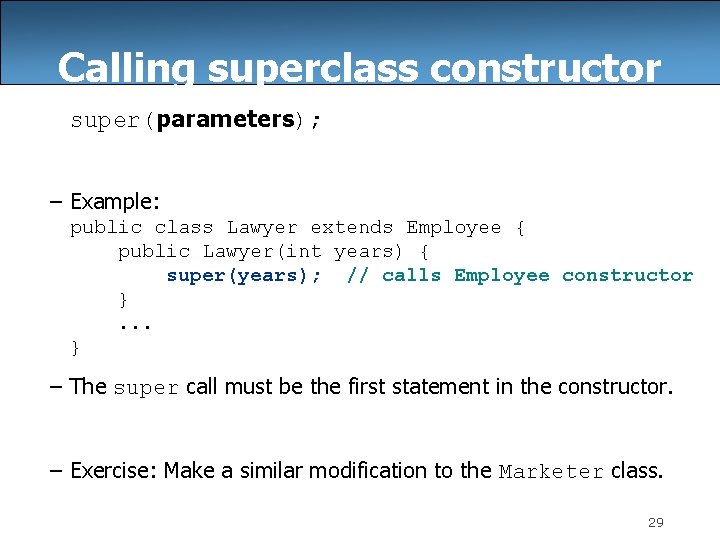
Calling superclass constructor super(parameters); – Example: public class Lawyer extends Employee { public Lawyer(int years) { super(years); // calls Employee constructor }. . . } – The super call must be the first statement in the constructor. – Exercise: Make a similar modification to the Marketer class. 29
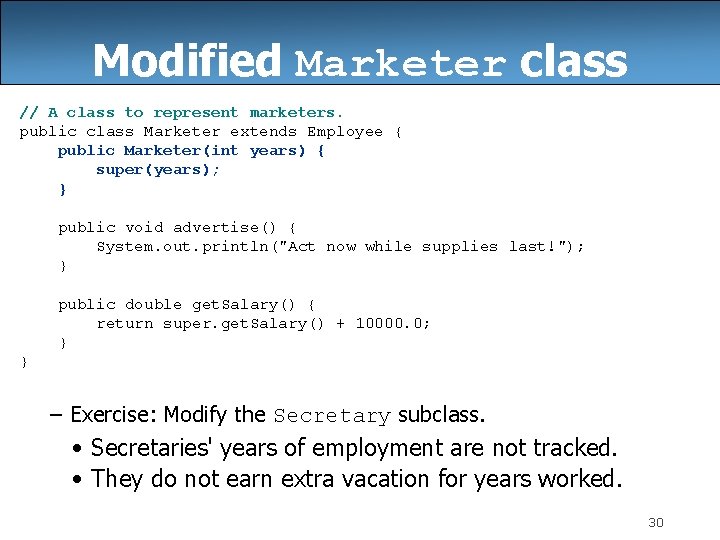
Modified Marketer class // A class to represent marketers. public class Marketer extends Employee { public Marketer(int years) { super(years); } public void advertise() { System. out. println("Act now while supplies last!"); } public double get. Salary() { return super. get. Salary() + 10000. 0; } } – Exercise: Modify the Secretary subclass. • Secretaries' years of employment are not tracked. • They do not earn extra vacation for years worked. 30
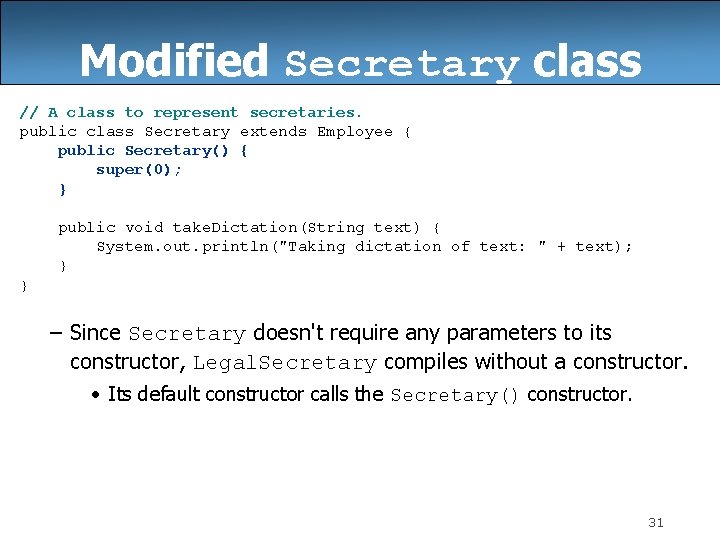
Modified Secretary class // A class to represent secretaries. public class Secretary extends Employee { public Secretary() { super(0); } public void take. Dictation(String text) { System. out. println("Taking dictation of text: " + text); } } – Since Secretary doesn't require any parameters to its constructor, Legal. Secretary compiles without a constructor. • Its default constructor calls the Secretary() constructor. 31
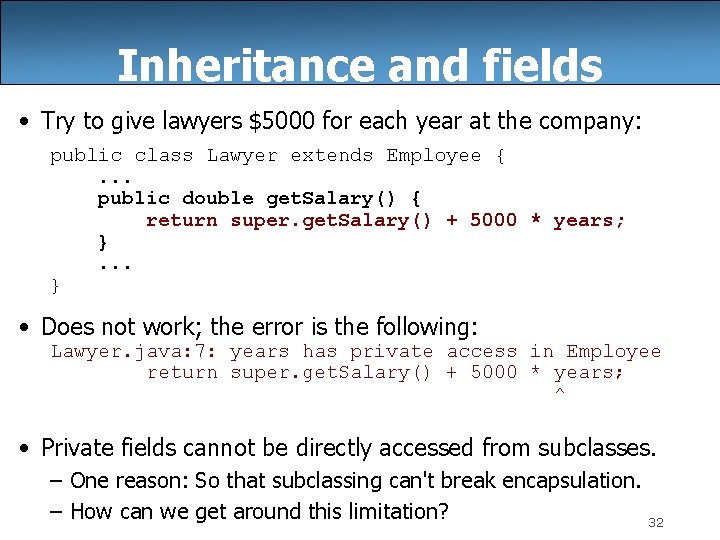
Inheritance and fields • Try to give lawyers $5000 for each year at the company: public class Lawyer extends Employee {. . . public double get. Salary() { return super. get. Salary() + 5000 * years; }. . . } • Does not work; the error is the following: Lawyer. java: 7: years has private access in Employee return super. get. Salary() + 5000 * years; ^ • Private fields cannot be directly accessed from subclasses. – One reason: So that subclassing can't break encapsulation. – How can we get around this limitation? 32
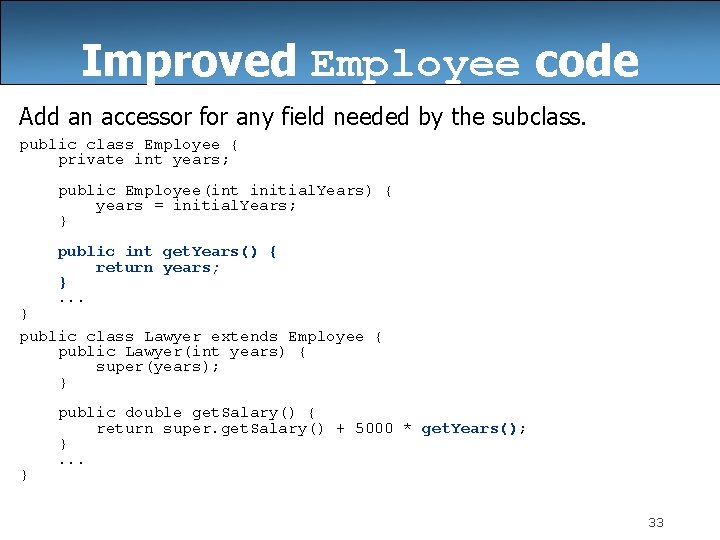
Improved Employee code Add an accessor for any field needed by the subclass. public class Employee { private int years; public Employee(int initial. Years) { years = initial. Years; } public int get. Years() { return years; }. . . } public class Lawyer extends Employee { public Lawyer(int years) { super(years); } } public double get. Salary() { return super. get. Salary() + 5000 * get. Years(); }. . . 33
Revisiting Secretary • The Secretary class currently has a poor solution. – We set all Secretaries to 0 years because they do not get a vacation bonus for their service. – If we call get. Years on a Secretary object, we'll always get 0. – This isn't a good solution; what if we wanted to give some other reward to all employees based on years of service? • Redesign our Employee class to allow for a better solution. 34
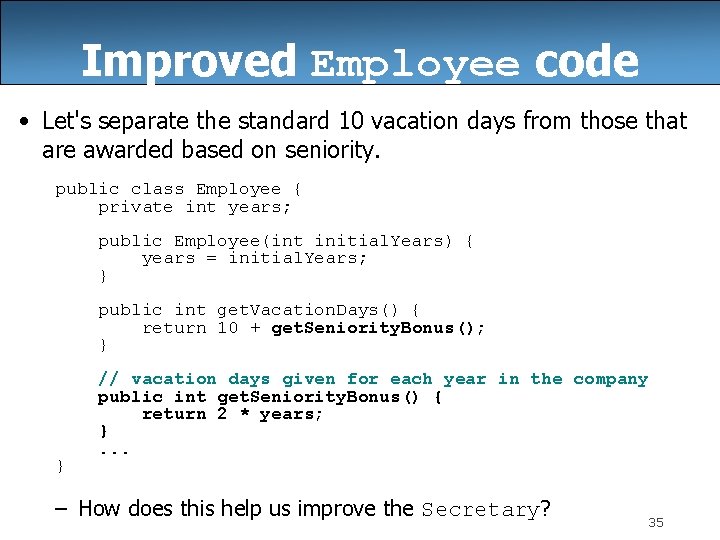
Improved Employee code • Let's separate the standard 10 vacation days from those that are awarded based on seniority. public class Employee { private int years; public Employee(int initial. Years) { years = initial. Years; } public int get. Vacation. Days() { return 10 + get. Seniority. Bonus(); } } // vacation days given for each year in the company public int get. Seniority. Bonus() { return 2 * years; }. . . – How does this help us improve the Secretary? 35
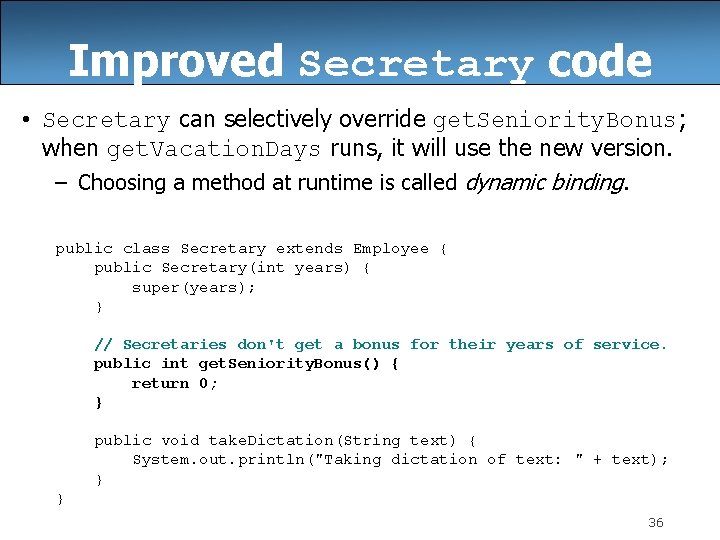
Improved Secretary code • Secretary can selectively override get. Seniority. Bonus; when get. Vacation. Days runs, it will use the new version. – Choosing a method at runtime is called dynamic binding. public class Secretary extends Employee { public Secretary(int years) { super(years); } // Secretaries don't get a bonus for their years of service. public int get. Seniority. Bonus() { return 0; } public void take. Dictation(String text) { System. out. println("Taking dictation of text: " + text); } } 36
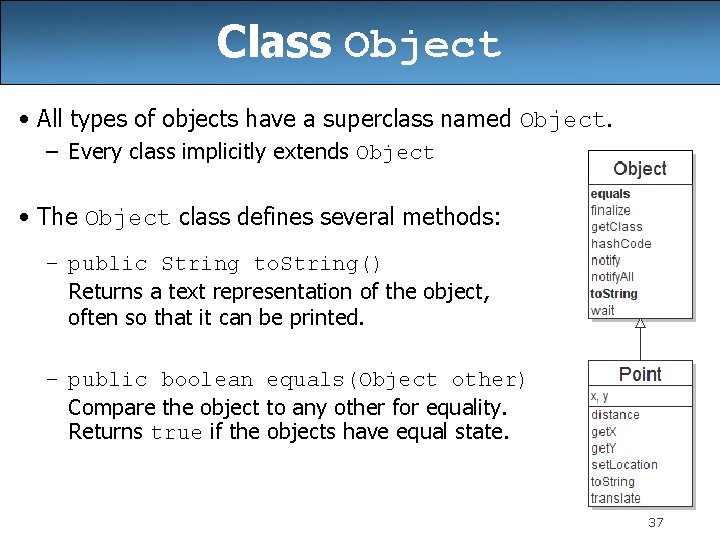
Class Object • All types of objects have a superclass named Object. – Every class implicitly extends Object • The Object class defines several methods: – public String to. String() Returns a text representation of the object, often so that it can be printed. – public boolean equals(Object other) Compare the object to any other for equality. Returns true if the objects have equal state. 37
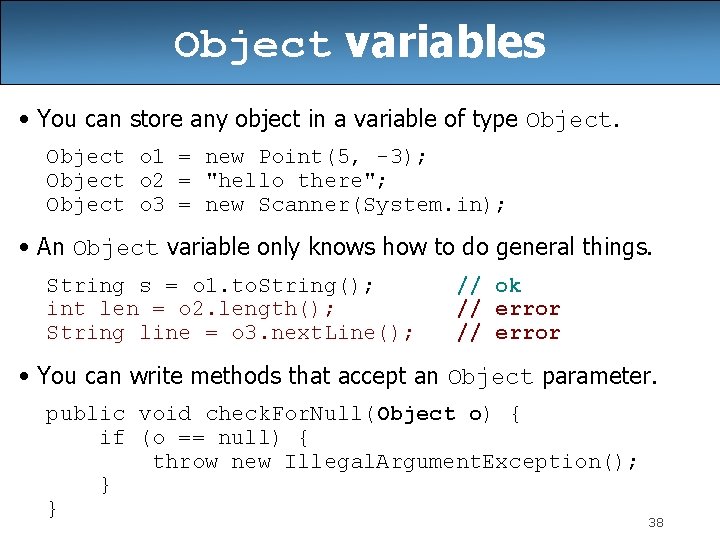
Object variables • You can store any object in a variable of type Object o 1 = new Point(5, -3); Object o 2 = "hello there"; Object o 3 = new Scanner(System. in); • An Object variable only knows how to do general things. String s = o 1. to. String(); int len = o 2. length(); String line = o 3. next. Line(); // ok // error • You can write methods that accept an Object parameter. public void check. For. Null(Object o) { if (o == null) { throw new Illegal. Argument. Exception(); } } 38
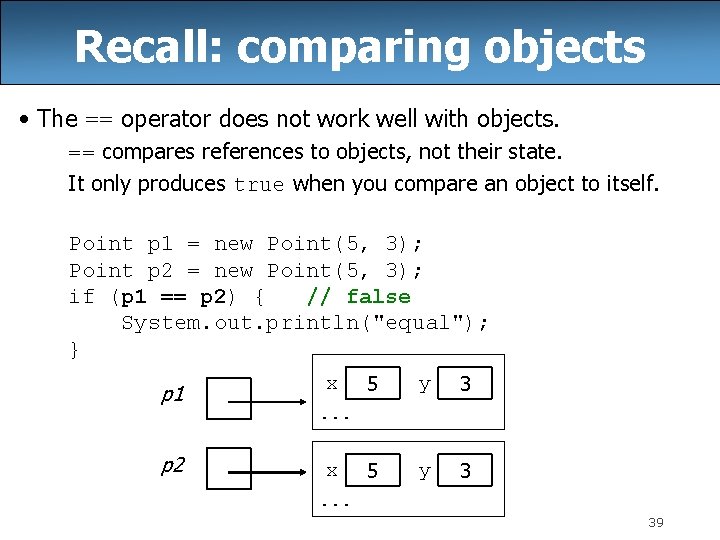
Recall: comparing objects • The == operator does not work well with objects. == compares references to objects, not their state. It only produces true when you compare an object to itself. Point p 1 = new Point(5, 3); Point p 2 = new Point(5, 3); if (p 1 == p 2) { // false System. out. println("equal"); } p 1 p 2 x 5 y 3 . . . x. . . 39
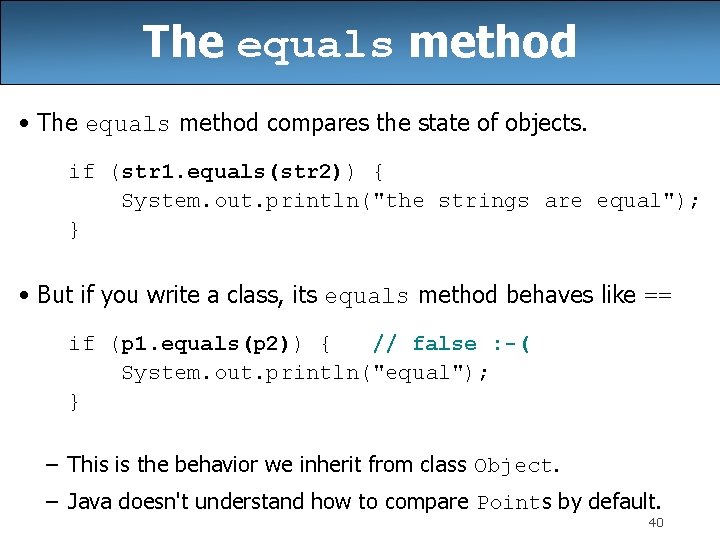
The equals method • The equals method compares the state of objects. if (str 1. equals(str 2)) { System. out. println("the strings are equal"); } • But if you write a class, its equals method behaves like == if (p 1. equals(p 2)) { // false : -( System. out. println("equal"); } – This is the behavior we inherit from class Object. – Java doesn't understand how to compare Points by default. 40
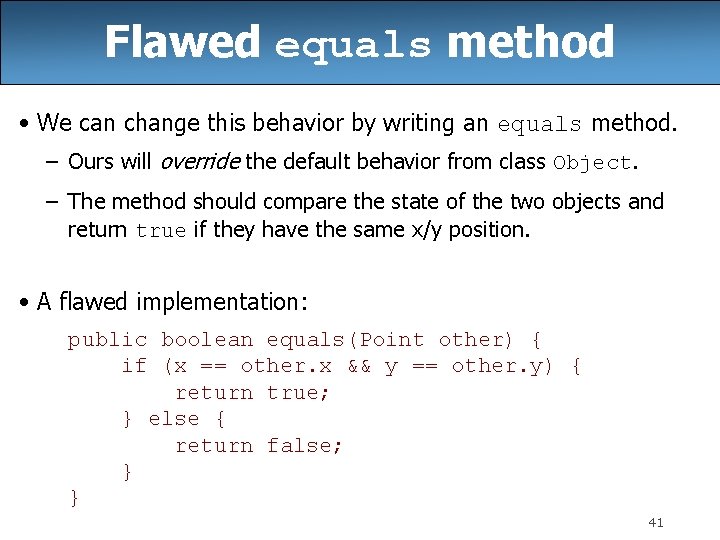
Flawed equals method • We can change this behavior by writing an equals method. – Ours will override the default behavior from class Object. – The method should compare the state of the two objects and return true if they have the same x/y position. • A flawed implementation: public boolean equals(Point other) { if (x == other. x && y == other. y) { return true; } else { return false; } } 41
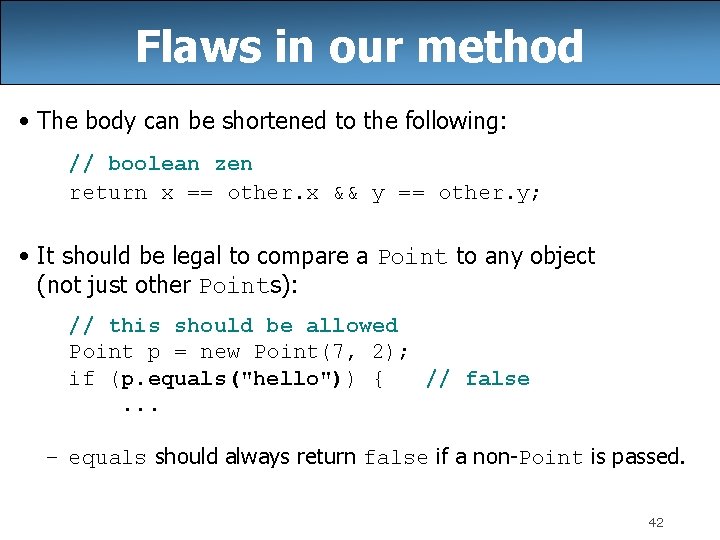
Flaws in our method • The body can be shortened to the following: // boolean zen return x == other. x && y == other. y; • It should be legal to compare a Point to any object (not just other Points): // this should be allowed Point p = new Point(7, 2); if (p. equals("hello")) { // false. . . – equals should always return false if a non-Point is passed. 42
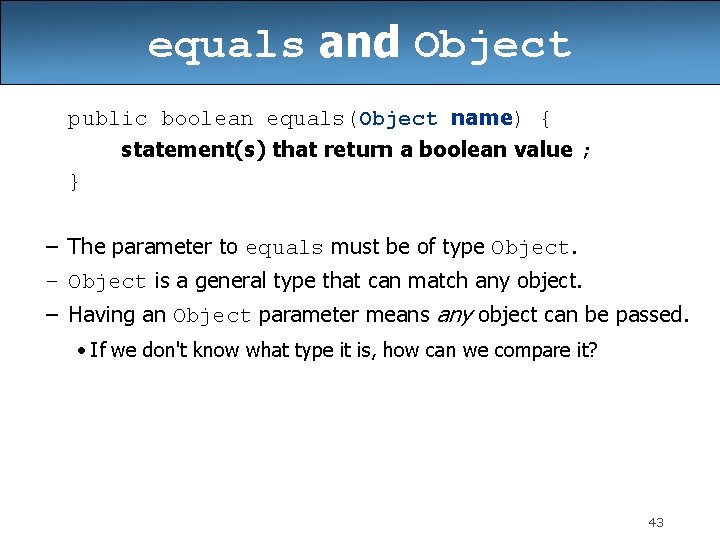
equals and Object public boolean equals(Object name) { statement(s) that return a boolean value ; } – The parameter to equals must be of type Object. – Object is a general type that can match any object. – Having an Object parameter means any object can be passed. • If we don't know what type it is, how can we compare it? 43
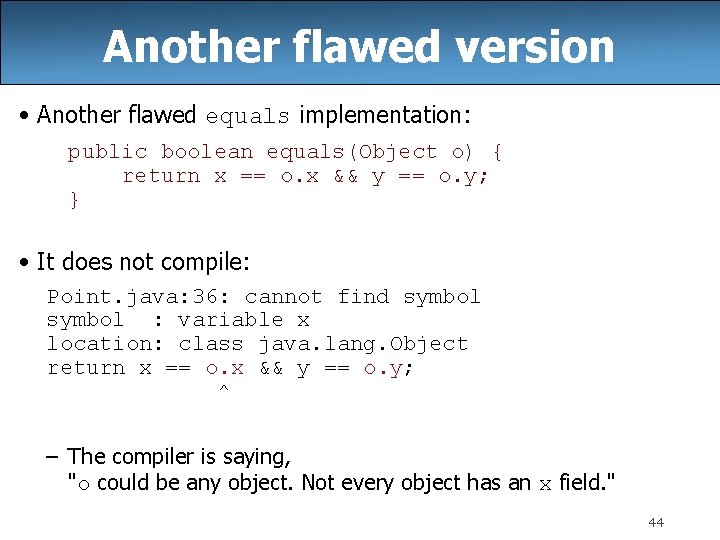
Another flawed version • Another flawed equals implementation: public boolean equals(Object o) { return x == o. x && y == o. y; } • It does not compile: Point. java: 36: cannot find symbol : variable x location: class java. lang. Object return x == o. x && y == o. y; ^ – The compiler is saying, "o could be any object. Not every object has an x field. " 44
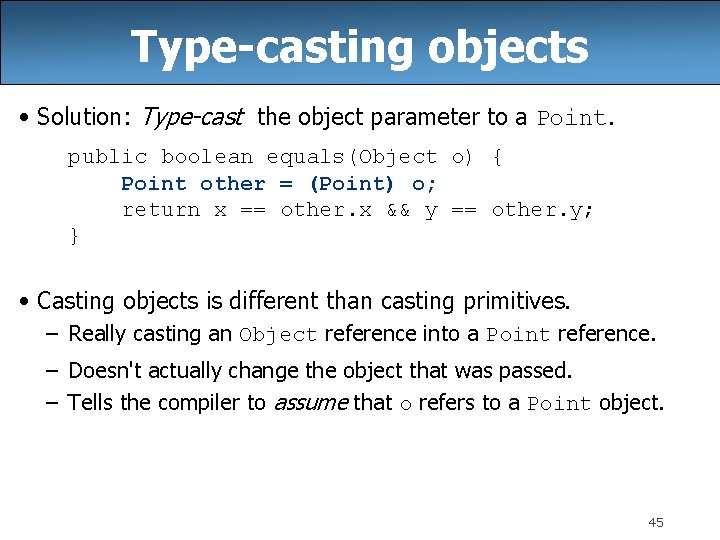
Type-casting objects • Solution: Type-cast the object parameter to a Point. public boolean equals(Object o) { Point other = (Point) o; return x == other. x && y == other. y; } • Casting objects is different than casting primitives. – Really casting an Object reference into a Point reference. – Doesn't actually change the object that was passed. – Tells the compiler to assume that o refers to a Point object. 45
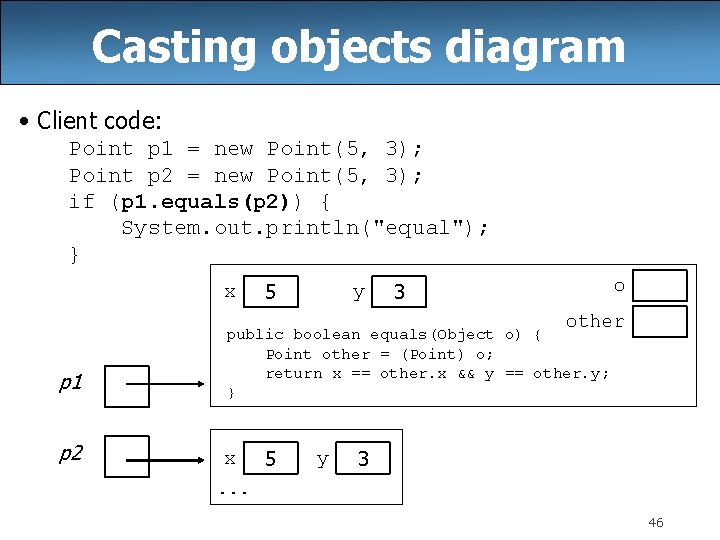
Casting objects diagram • Client code: Point p 1 = new Point(5, 3); Point p 2 = new Point(5, 3); if (p 1. equals(p 2)) { System. out. println("equal"); } x 5 y o 3 other p 1 public boolean equals(Object o) { Point other = (Point) o; return x == other. x && y == other. y; } p 2 x 5 y 3 . . . 46
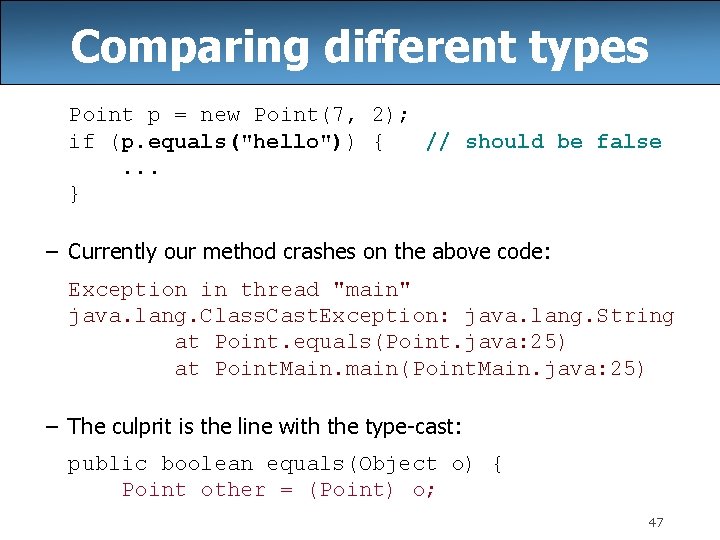
Comparing different types Point p = new Point(7, 2); if (p. equals("hello")) { // should be false. . . } – Currently our method crashes on the above code: Exception in thread "main" java. lang. Class. Cast. Exception: java. lang. String at Point. equals(Point. java: 25) at Point. Main. main(Point. Main. java: 25) – The culprit is the line with the type-cast: public boolean equals(Object o) { Point other = (Point) o; 47
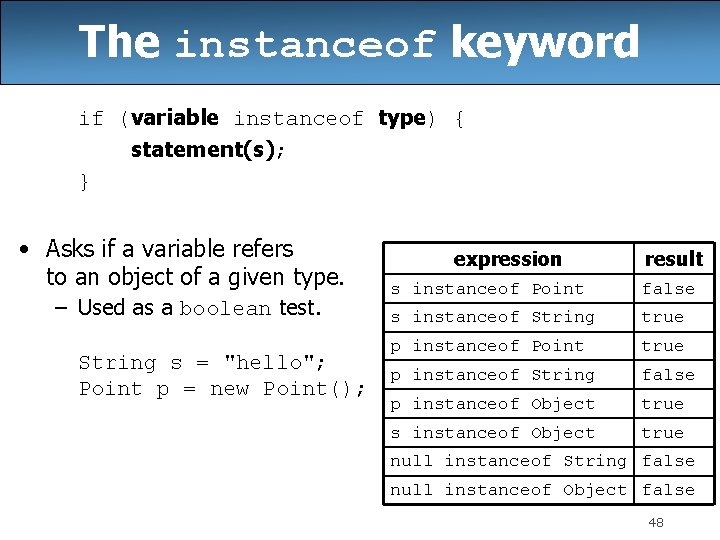
The instanceof keyword if (variable instanceof type) { statement(s); } • Asks if a variable refers to an object of a given type. – Used as a boolean test. String s = "hello"; Point p = new Point(); expression result s instanceof Point false s instanceof String true p instanceof Point true p instanceof String false p instanceof Object true s instanceof Object true null instanceof String false null instanceof Object false 48
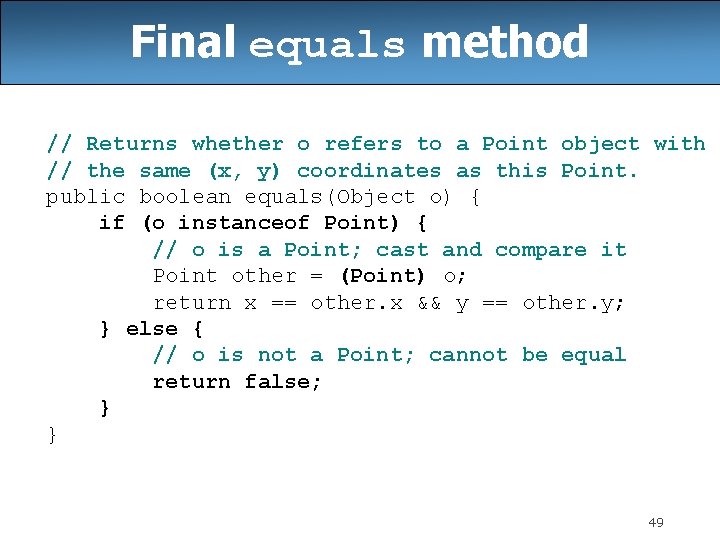
Final equals method // Returns whether o refers to a Point object with // the same (x, y) coordinates as this Point. public boolean equals(Object o) { if (o instanceof Point) { // o is a Point; cast and compare it Point other = (Point) o; return x == other. x && y == other. y; } else { // o is not a Point; cannot be equal return false; } } 49
Polymorphism
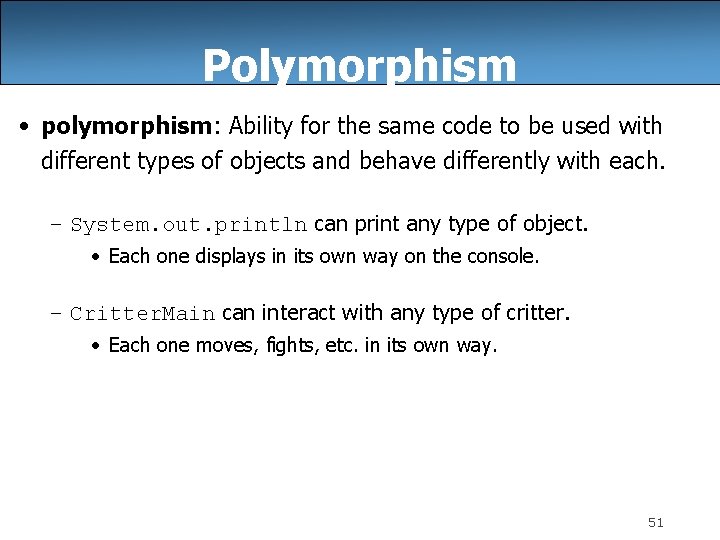
Polymorphism • polymorphism: Ability for the same code to be used with different types of objects and behave differently with each. – System. out. println can print any type of object. • Each one displays in its own way on the console. – Critter. Main can interact with any type of critter. • Each one moves, fights, etc. in its own way. 51
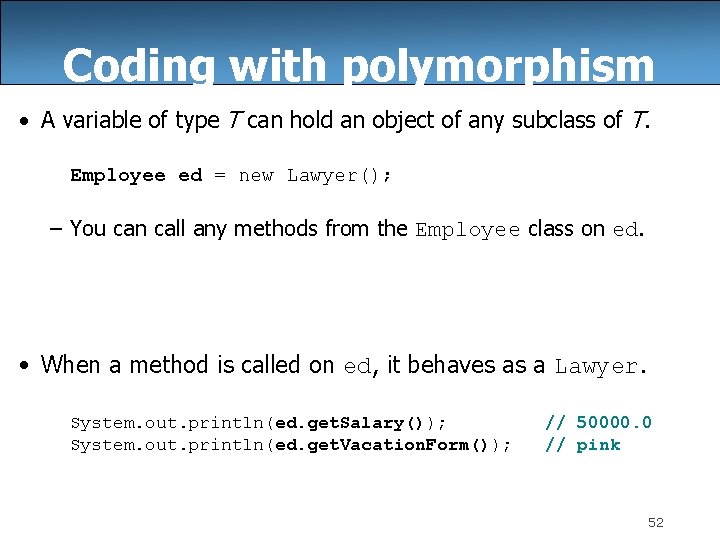
Coding with polymorphism • A variable of type T can hold an object of any subclass of T. Employee ed = new Lawyer(); – You can call any methods from the Employee class on ed. • When a method is called on ed, it behaves as a Lawyer. System. out. println(ed. get. Salary()); System. out. println(ed. get. Vacation. Form()); // 50000. 0 // pink 52
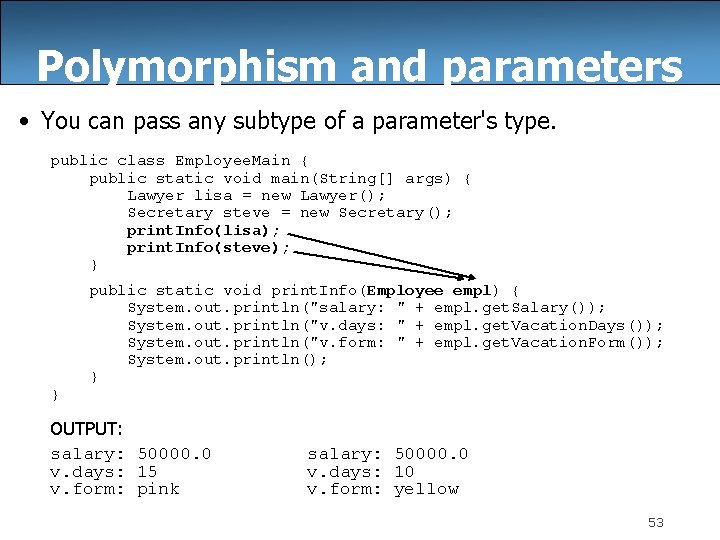
Polymorphism and parameters • You can pass any subtype of a parameter's type. public class Employee. Main { public static void main(String[] args) { Lawyer lisa = new Lawyer(); Secretary steve = new Secretary(); print. Info(lisa); print. Info(steve); } } public static void print. Info(Employee empl) { System. out. println("salary: " + empl. get. Salary()); System. out. println("v. days: " + empl. get. Vacation. Days()); System. out. println("v. form: " + empl. get. Vacation. Form()); System. out. println(); } OUTPUT: salary: 50000. 0 v. days: 15 v. form: pink salary: 50000. 0 v. days: 10 v. form: yellow 53
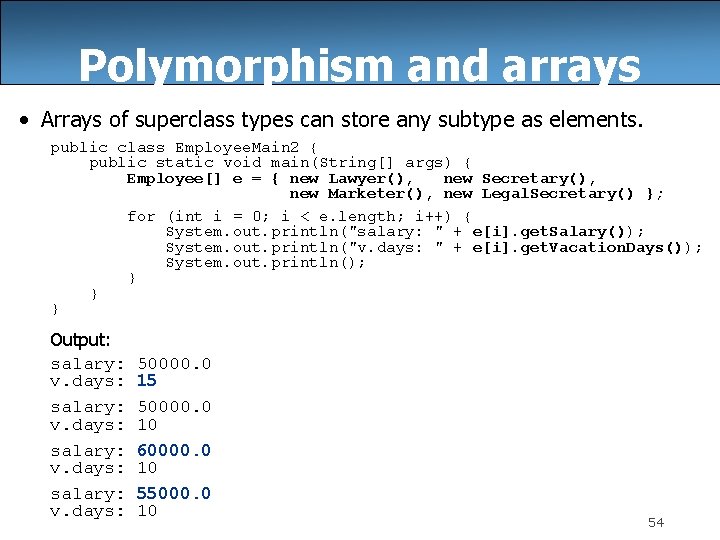
Polymorphism and arrays • Arrays of superclass types can store any subtype as elements. public class Employee. Main 2 { public static void main(String[] args) { Employee[] e = { new Lawyer(), new Secretary(), new Marketer(), new Legal. Secretary() }; for (int i = 0; i < e. length; i++) { System. out. println("salary: " + e[i]. get. Salary()); System. out. println("v. days: " + e[i]. get. Vacation. Days()); System. out. println(); } } } Output: salary: v. days: 50000. 0 15 50000. 0 10 60000. 0 10 55000. 0 10 54
Polymorphism problems • 4 -5 classes with inheritance relationships are shown. • A client program calls methods on objects of each class. • You must read the code and determine the client's output. • We always put such a question on our final exams! 55
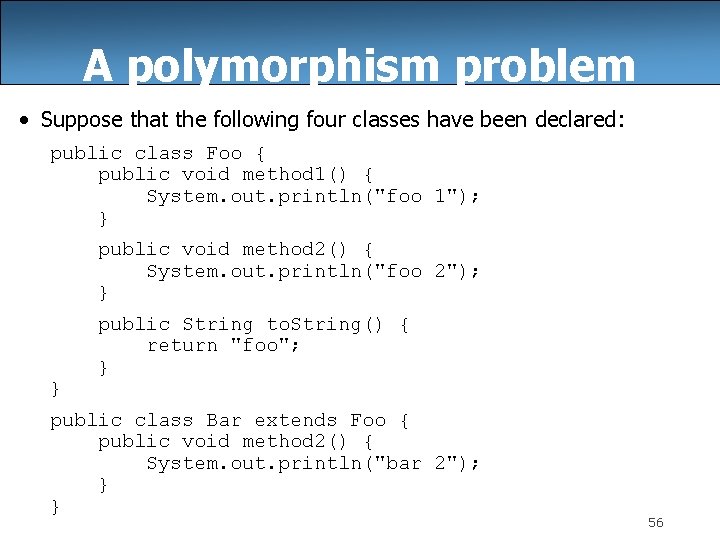
A polymorphism problem • Suppose that the following four classes have been declared: public class Foo { public void method 1() { System. out. println("foo 1"); } public void method 2() { System. out. println("foo 2"); } } public String to. String() { return "foo"; } public class Bar extends Foo { public void method 2() { System. out. println("bar 2"); } } 56
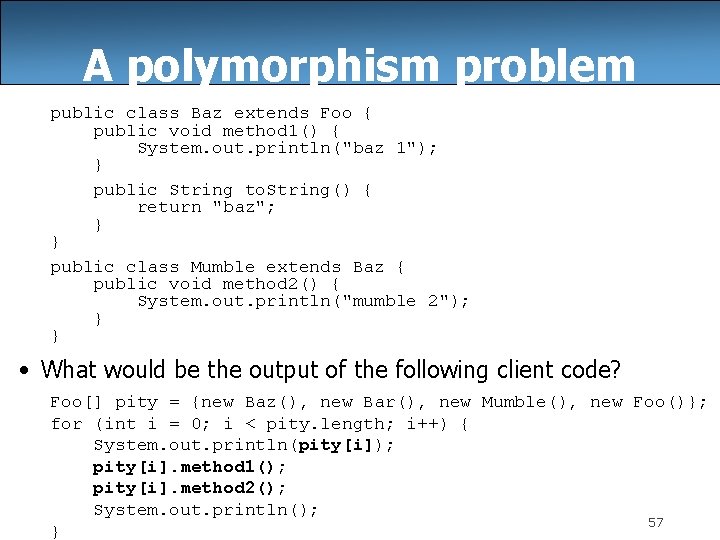
A polymorphism problem public class Baz extends Foo { public void method 1() { System. out. println("baz 1"); } public String to. String() { return "baz"; } } public class Mumble extends Baz { public void method 2() { System. out. println("mumble 2"); } } • What would be the output of the following client code? Foo[] pity = {new Baz(), new Bar(), new Mumble(), new Foo()}; for (int i = 0; i < pity. length; i++) { System. out. println(pity[i]); pity[i]. method 1(); pity[i]. method 2(); System. out. println(); 57 }
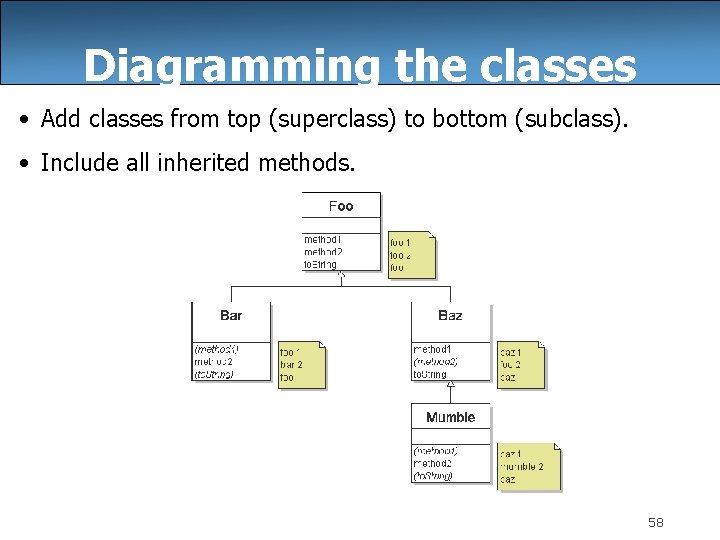
Diagramming the classes • Add classes from top (superclass) to bottom (subclass). • Include all inherited methods. 58
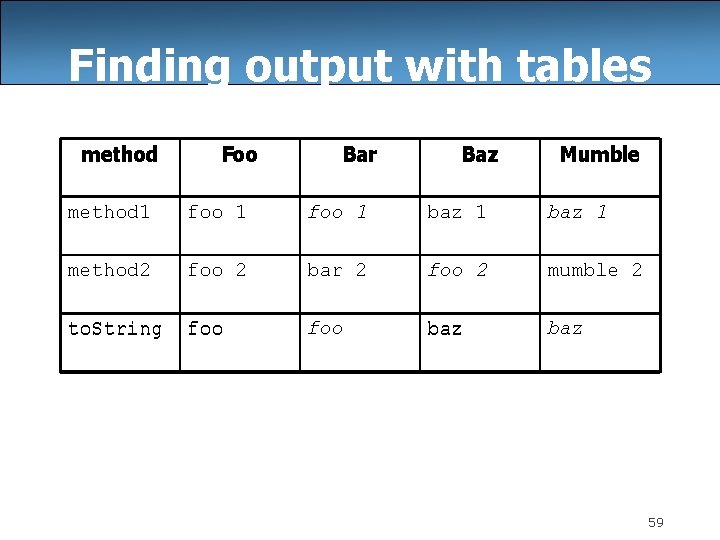
Finding output with tables method Foo Bar Baz Mumble method 1 foo 1 baz 1 method 2 foo 2 bar 2 foo 2 mumble 2 to. String foo baz 59
![Polymorphism answer Foo[] pity = {new Baz(), new Bar(), new Mumble(), new Foo()}; for](http://slidetodoc.com/presentation_image/eb2dfb57d77f67038d8a11524b6123bf/image-60.jpg "Polymorphism answer Foo[] pity = {new Baz(), new Bar(), new Mumble(), new Foo()}; for")
Polymorphism answer Foo[] pity = {new Baz(), new Bar(), new Mumble(), new Foo()}; for (int i = 0; i < pity. length; i++) { System. out. println(pity[i]); pity[i]. method 1(); pity[i]. method 2(); System. out. println(); } • Output: baz 1 foo 2 foo 1 bar 2 baz 1 mumble 2 foo 1 foo 2 60
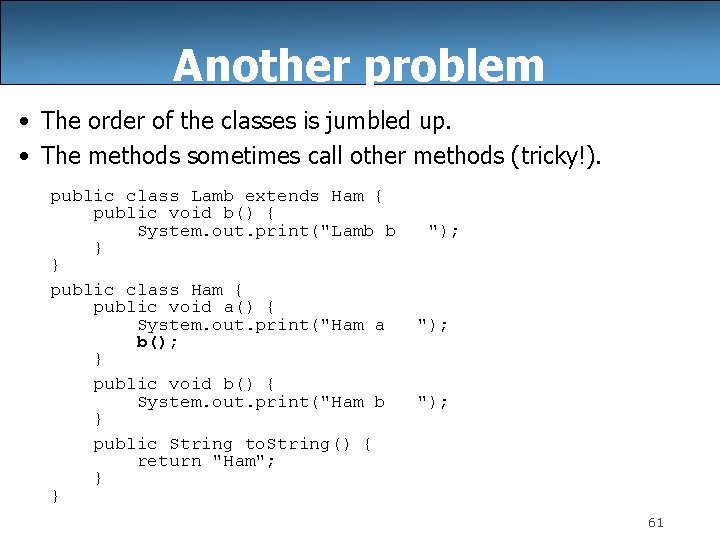
Another problem • The order of the classes is jumbled up. • The methods sometimes call other methods (tricky!). public class Lamb extends Ham { public void b() { System. out. print("Lamb b } } public class Ham { public void a() { System. out. print("Ham a b(); } public void b() { System. out. print("Ham b } public String to. String() { return "Ham"; } } "); 61
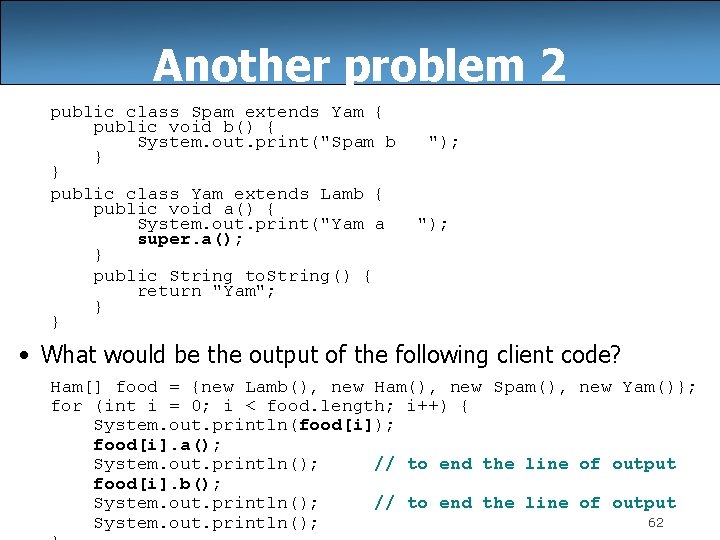
Another problem 2 public class Spam extends Yam { public void b() { System. out. print("Spam b } } public class Yam extends Lamb { public void a() { System. out. print("Yam a super. a(); } public String to. String() { return "Yam"; } } "); • What would be the output of the following client code? Ham[] food = {new Lamb(), new Ham(), new Spam(), new Yam()}; for (int i = 0; i < food. length; i++) { System. out. println(food[i]); food[i]. a(); System. out. println(); // to end the line of output food[i]. b(); System. out. println(); // to end the line of output 62 System. out. println();
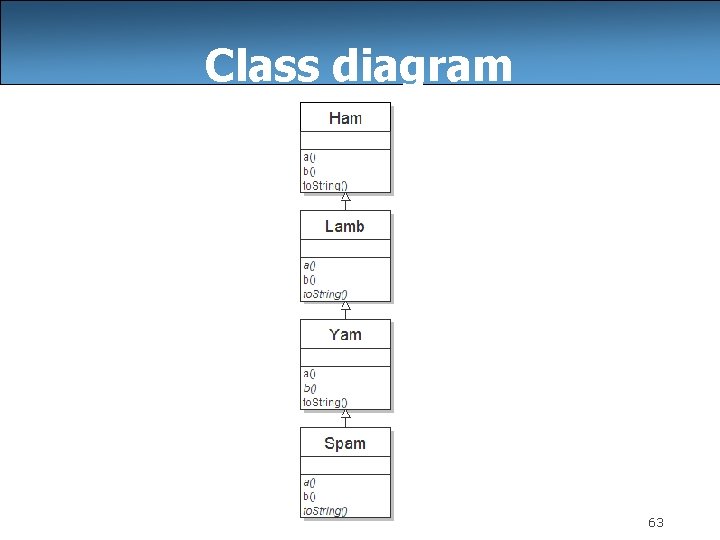
Class diagram 63
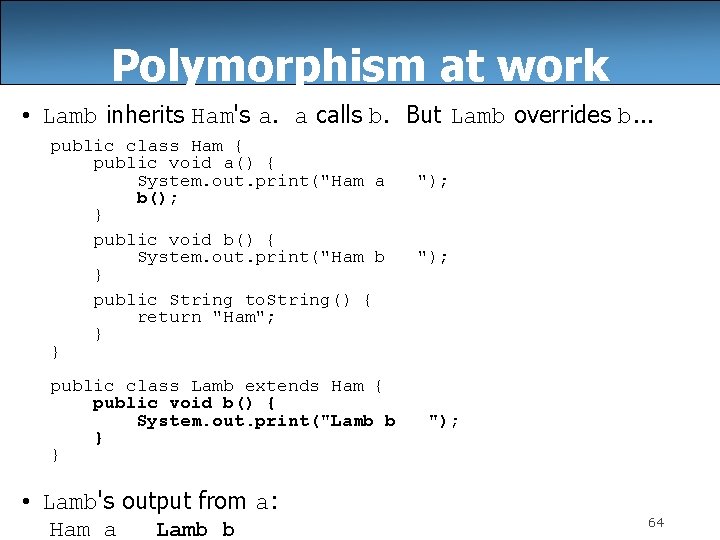
Polymorphism at work • Lamb inherits Ham's a. a calls b. But Lamb overrides b. . . public class Ham { public void a() { System. out. print("Ham a b(); } public void b() { System. out. print("Ham b } public String to. String() { return "Ham"; } } public class Lamb extends Ham { public void b() { System. out. print("Lamb b } } • Lamb's output from a: Ham a Lamb b "); 64
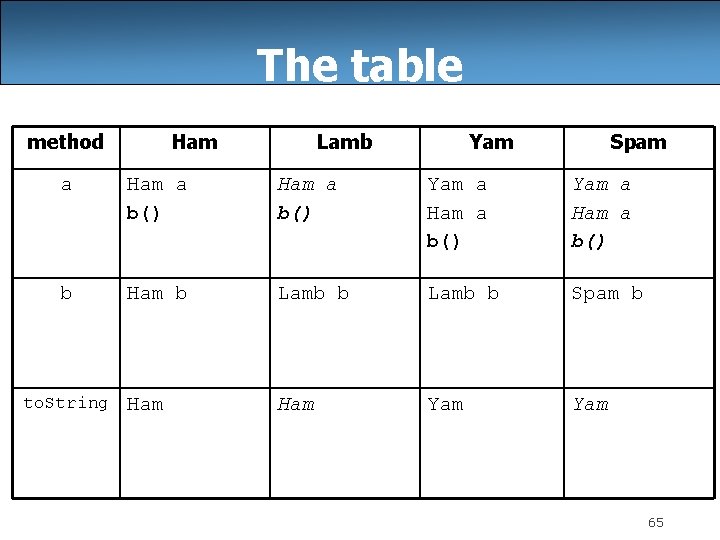
The table method Ham Lamb Yam Spam a Ham a b() Yam a Ham a b() b Ham b Lamb b Spam b Ham Yam to. String 65
![The answer Ham[] food = {new Lamb(), new Ham(), new Spam(), new Yam()}; for](http://slidetodoc.com/presentation_image/eb2dfb57d77f67038d8a11524b6123bf/image-66.jpg "The answer Ham[] food = {new Lamb(), new Ham(), new Spam(), new Yam()}; for")
The answer Ham[] food = {new Lamb(), new Ham(), new Spam(), new Yam()}; for (int i = 0; i < food. length; i++) { System. out. println(food[i]); food[i]. a(); food[i]. b(); System. out. println(); } • Output: Ham a Lamb b Ham a Ham b Yam a Spam b Yam a Lamb b Ham a Spam b Ham a Lamb b 66
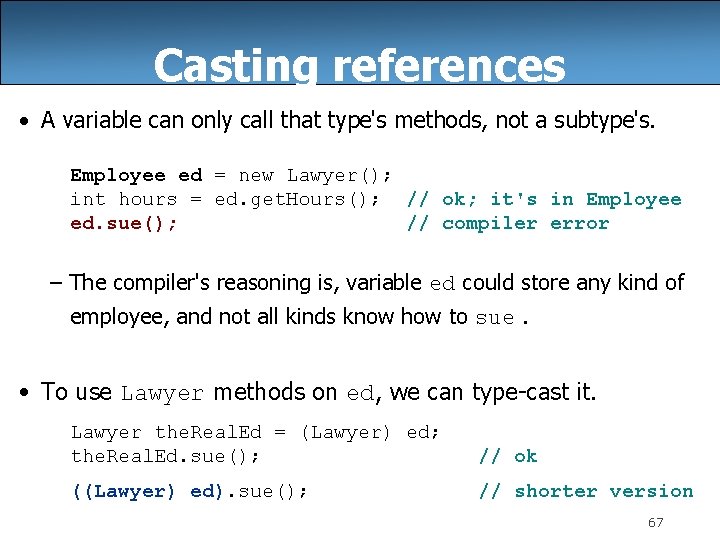
Casting references • A variable can only call that type's methods, not a subtype's. Employee ed = new Lawyer(); int hours = ed. get. Hours(); // ok; it's in Employee ed. sue(); // compiler error – The compiler's reasoning is, variable ed could store any kind of employee, and not all kinds know how to sue. • To use Lawyer methods on ed, we can type-cast it. Lawyer the. Real. Ed = (Lawyer) ed; the. Real. Ed. sue(); // ok ((Lawyer) ed). sue(); // shorter version 67
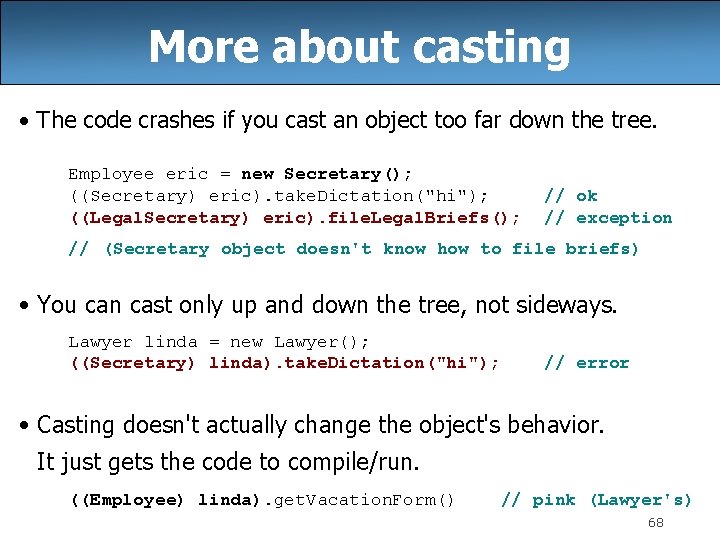
More about casting • The code crashes if you cast an object too far down the tree. Employee eric = new Secretary(); ((Secretary) eric). take. Dictation("hi"); ((Legal. Secretary) eric). file. Legal. Briefs(); // ok // exception // (Secretary object doesn't know how to file briefs) • You can cast only up and down the tree, not sideways. Lawyer linda = new Lawyer(); ((Secretary) linda). take. Dictation("hi"); // error • Casting doesn't actually change the object's behavior. It just gets the code to compile/run. ((Employee) linda). get. Vacation. Form() // pink (Lawyer's) 68
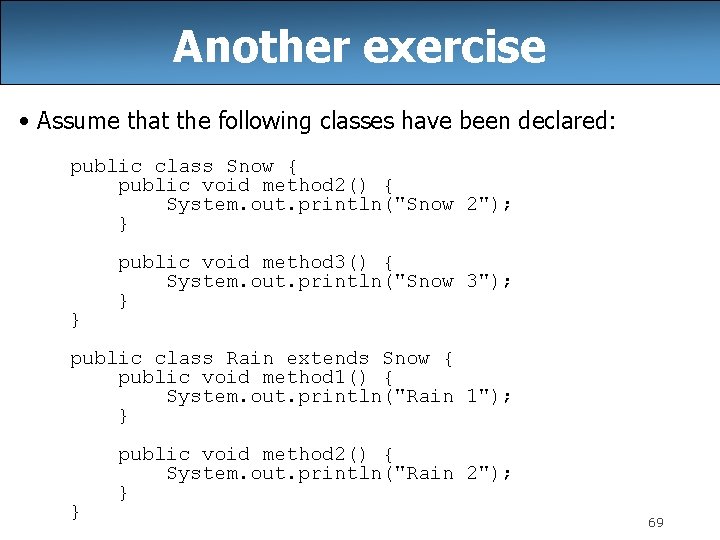
Another exercise • Assume that the following classes have been declared: public class Snow { public void method 2() { System. out. println("Snow 2"); } } public void method 3() { System. out. println("Snow 3"); } public class Rain extends Snow { public void method 1() { System. out. println("Rain 1"); } } public void method 2() { System. out. println("Rain 2"); } 69
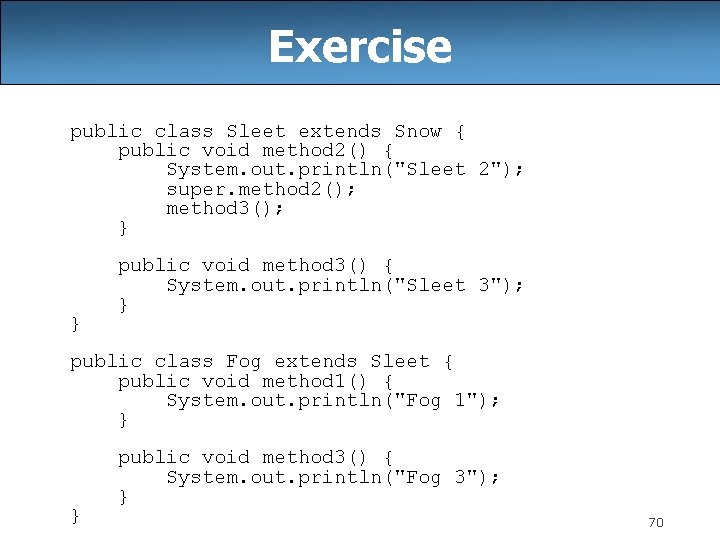
Exercise public class Sleet extends Snow { public void method 2() { System. out. println("Sleet 2"); super. method 2(); method 3(); } } public void method 3() { System. out. println("Sleet 3"); } public class Fog extends Sleet { public void method 1() { System. out. println("Fog 1"); } } public void method 3() { System. out. println("Fog 3"); } 70
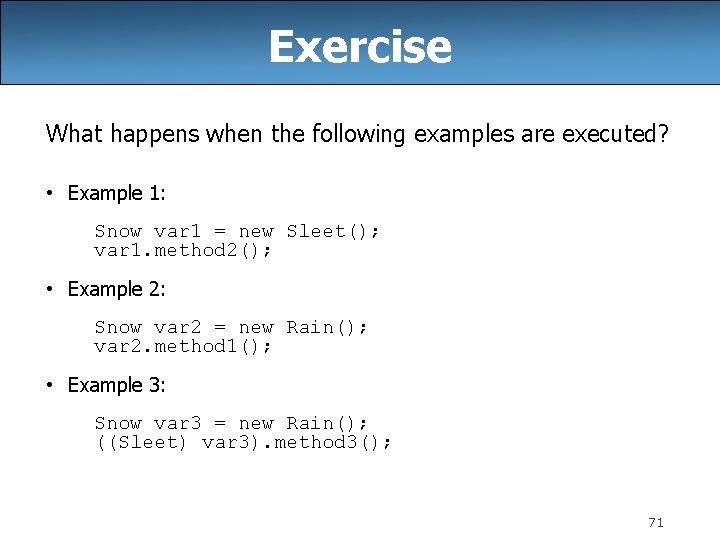
Exercise What happens when the following examples are executed? • Example 1: Snow var 1 = new Sleet(); var 1. method 2(); • Example 2: Snow var 2 = new Rain(); var 2. method 1(); • Example 3: Snow var 3 = new Rain(); ((Sleet) var 3). method 3(); 71
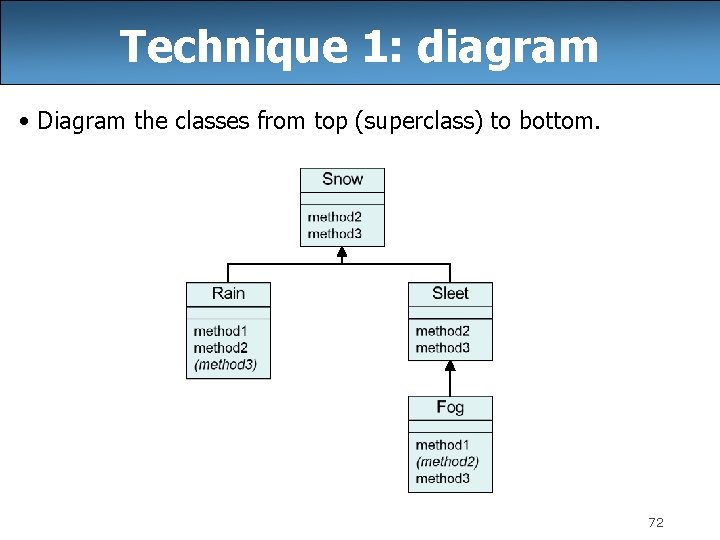
Technique 1: diagram • Diagram the classes from top (superclass) to bottom. 72
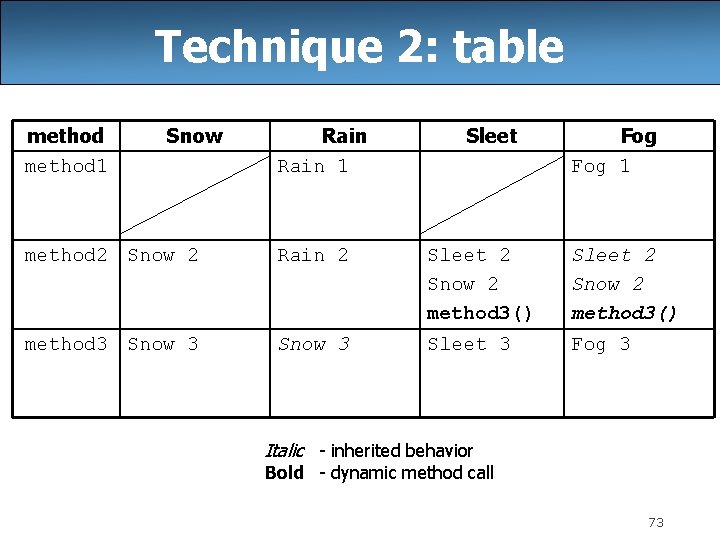
Technique 2: table method 1 Snow Rain 1 Sleet Fog 1 method 2 Snow 2 Rain 2 Sleet 2 Snow 2 method 3() method 3 Snow 3 Sleet 3 Fog 3 Italic - inherited behavior Bold - dynamic method call 73
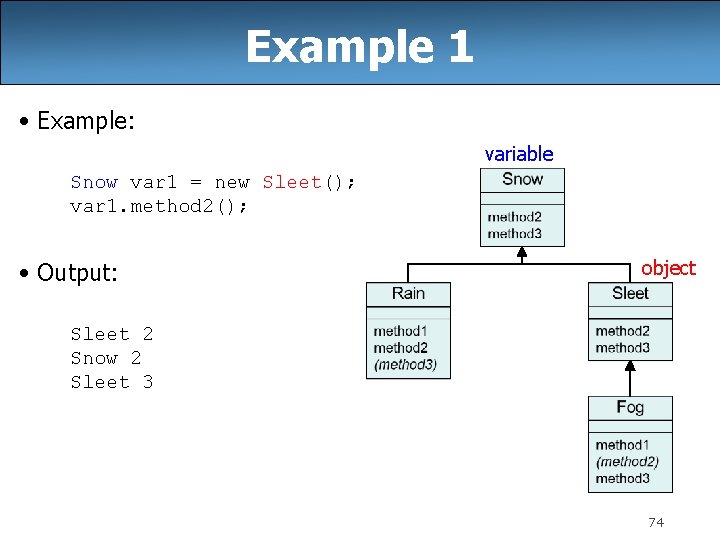
Example 1 • Example: variable Snow var 1 = new Sleet(); var 1. method 2(); • Output: object Sleet 2 Snow 2 Sleet 3 74
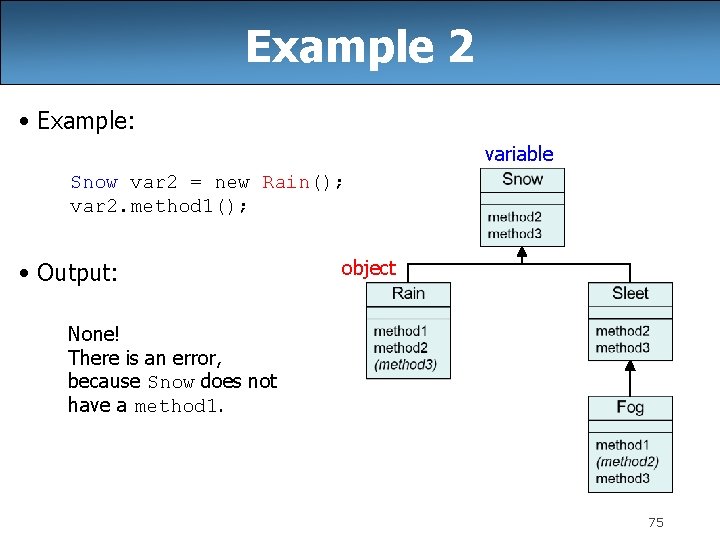
Example 2 • Example: variable Snow var 2 = new Rain(); var 2. method 1(); • Output: object None! There is an error, because Snow does not have a method 1. 75
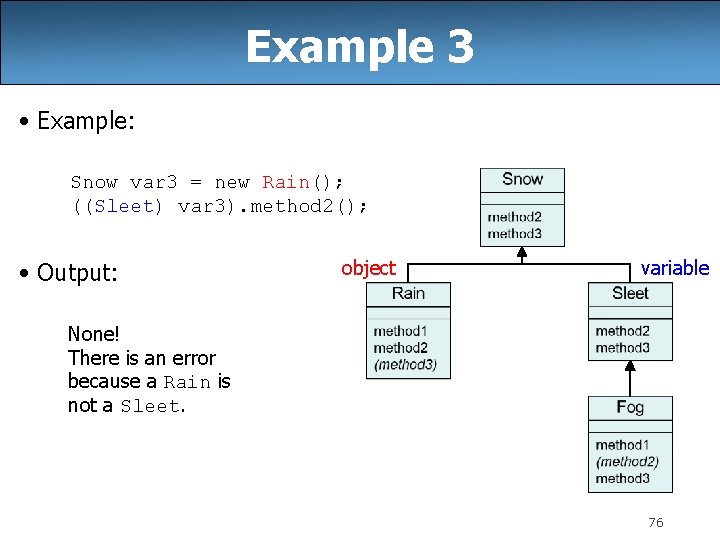
Example 3 • Example: Snow var 3 = new Rain(); ((Sleet) var 3). method 2(); • Output: object variable None! There is an error because a Rain is not a Sleet. 76
Interfaces
Relatedness of types Write a set of Circle, Rectangle, and Triangle classes. • Certain operations that are common to all shapes. perimeter - distance around the outside of the shape area - amount of 2 D space occupied by the shape • Every shape has them but computes them differently. 78
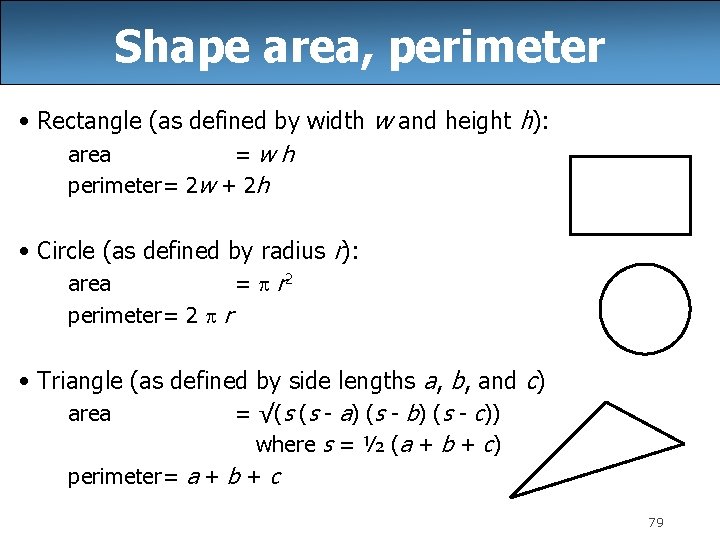
Shape area, perimeter • Rectangle (as defined by width w and height h): area =wh perimeter= 2 w + 2 h • Circle (as defined by radius r): area = r 2 perimeter= 2 r • Triangle (as defined by side lengths a, b, and c) area = √(s (s - a) (s - b) (s - c)) where s = ½ (a + b + c) perimeter= a + b + c 79
Common behavior • Write shape classes with methods perimeter and area. • We'd like to be able to write client code that treats different kinds of shape objects in the same way, such as: – Write a method that prints any shape's area and perimeter. – Create an array of shapes that could hold a mixture of the various shape objects. – Write a method that could return a rectangle, a circle, a triangle, or any other shape we've written. – Make a Drawing. Panel display many shapes on screen. 80
Interfaces • interface: A list of methods that a class can implement. – Inheritance gives you an is-a relationship and code-sharing. • A Lawyer object can be treated as an Employee, and Lawyer inherits Employee's code. – Interfaces give you an is-a relationship without code sharing. • A Rectangle object can be treated as a Shape. – Analogous to the idea of roles or certifications: • "I'm certified as a CPA accountant. That means I know how to compute taxes, perform audits, and do consulting. " • "I'm certified as a Shape. That means I know how to compute my area and perimeter. " 81
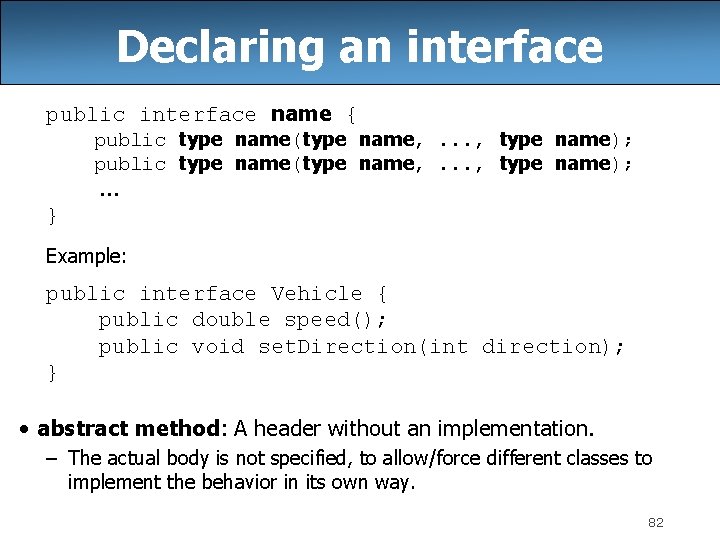
Declaring an interface public interface name { public type name(type name, . . . , type name); . . . } Example: public interface Vehicle { public double speed(); public void set. Direction(int direction); } • abstract method: A header without an implementation. – The actual body is not specified, to allow/force different classes to implement the behavior in its own way. 82
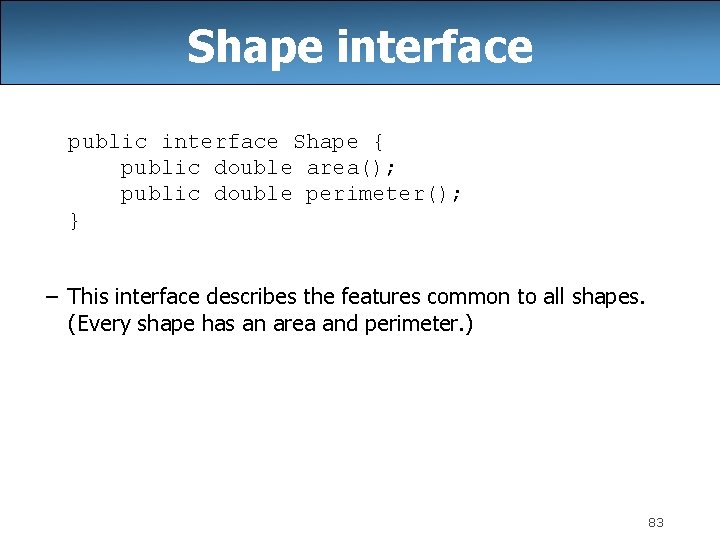
Shape interface public interface Shape { public double area(); public double perimeter(); } – This interface describes the features common to all shapes. (Every shape has an area and perimeter. ) 83
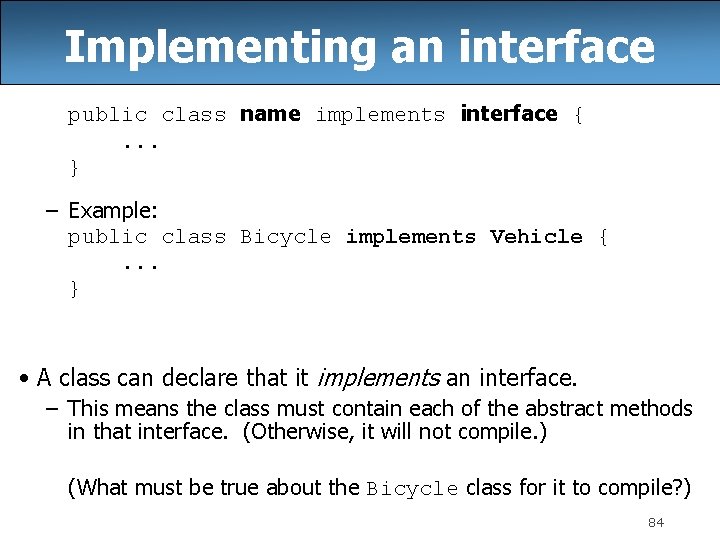
Implementing an interface public class name implements interface {. . . } – Example: public class Bicycle implements Vehicle {. . . } • A class can declare that it implements an interface. – This means the class must contain each of the abstract methods in that interface. (Otherwise, it will not compile. ) (What must be true about the Bicycle class for it to compile? ) 84
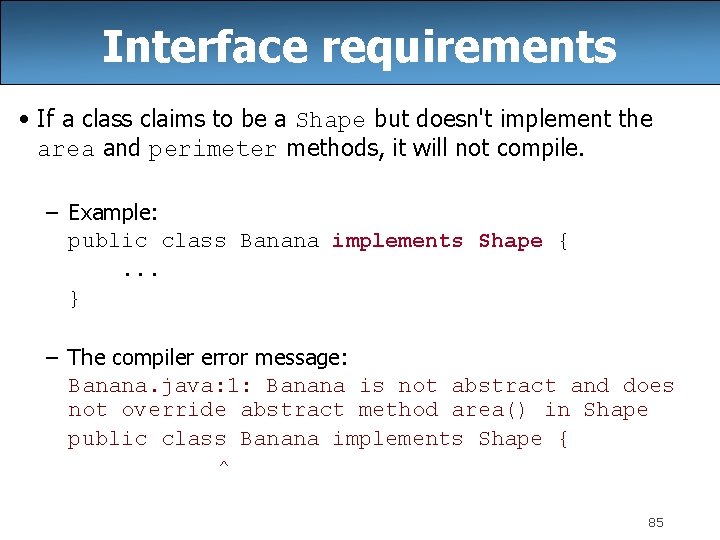
Interface requirements • If a class claims to be a Shape but doesn't implement the area and perimeter methods, it will not compile. – Example: public class Banana implements Shape {. . . } – The compiler error message: Banana. java: 1: Banana is not abstract and does not override abstract method area() in Shape public class Banana implements Shape { ^ 85
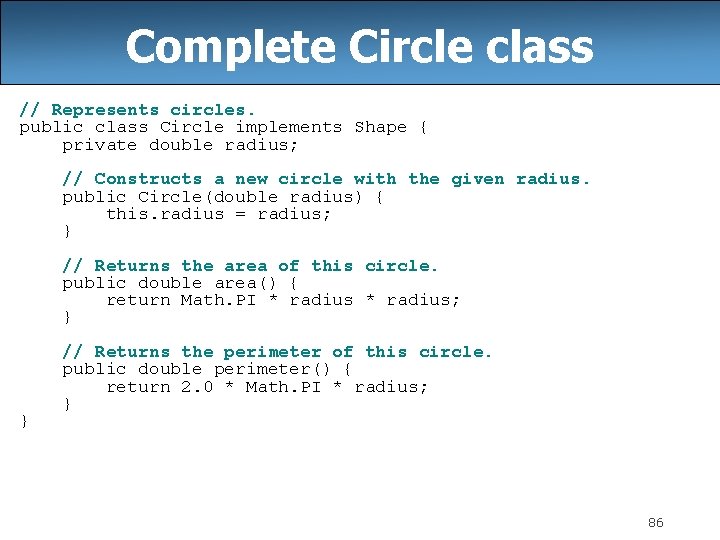
Complete Circle class // Represents circles. public class Circle implements Shape { private double radius; // Constructs a new circle with the given radius. public Circle(double radius) { this. radius = radius; } // Returns the area of this circle. public double area() { return Math. PI * radius; } } // Returns the perimeter of this circle. public double perimeter() { return 2. 0 * Math. PI * radius; } 86
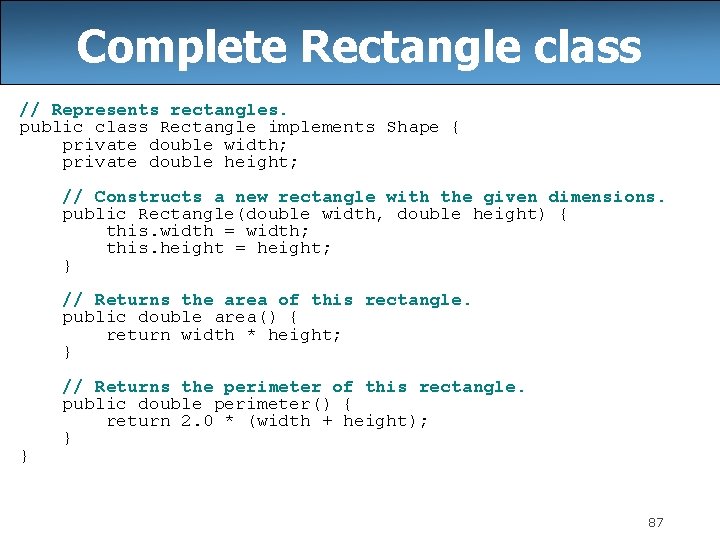
Complete Rectangle class // Represents rectangles. public class Rectangle implements Shape { private double width; private double height; // Constructs a new rectangle with the given dimensions. public Rectangle(double width, double height) { this. width = width; this. height = height; } // Returns the area of this rectangle. public double area() { return width * height; } } // Returns the perimeter of this rectangle. public double perimeter() { return 2. 0 * (width + height); } 87
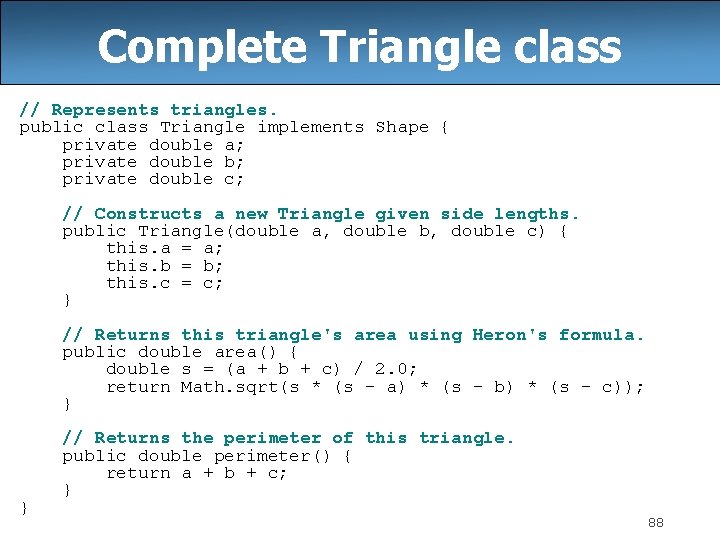
Complete Triangle class // Represents triangles. public class Triangle implements Shape { private double a; private double b; private double c; // Constructs a new Triangle given side lengths. public Triangle(double a, double b, double c) { this. a = a; this. b = b; this. c = c; } // Returns this triangle's area using Heron's formula. public double area() { double s = (a + b + c) / 2. 0; return Math. sqrt(s * (s - a) * (s - b) * (s - c)); } } // Returns the perimeter of this triangle. public double perimeter() { return a + b + c; } 88
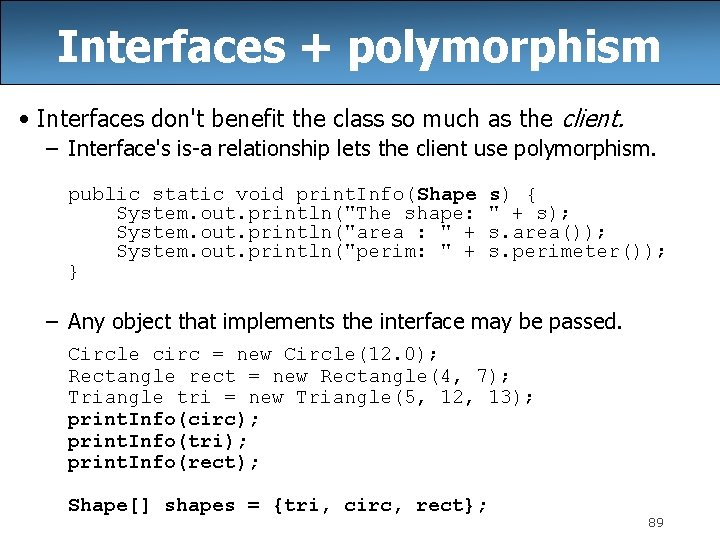
Interfaces + polymorphism • Interfaces don't benefit the class so much as the client. – Interface's is-a relationship lets the client use polymorphism. public static void print. Info(Shape System. out. println("The shape: System. out. println("area : " + System. out. println("perim: " + } s) { " + s); s. area()); s. perimeter()); – Any object that implements the interface may be passed. Circle circ = new Circle(12. 0); Rectangle rect = new Rectangle(4, 7); Triangle tri = new Triangle(5, 12, 13); print. Info(circ); print. Info(tri); print. Info(rect); Shape[] shapes = {tri, circ, rect}; 89
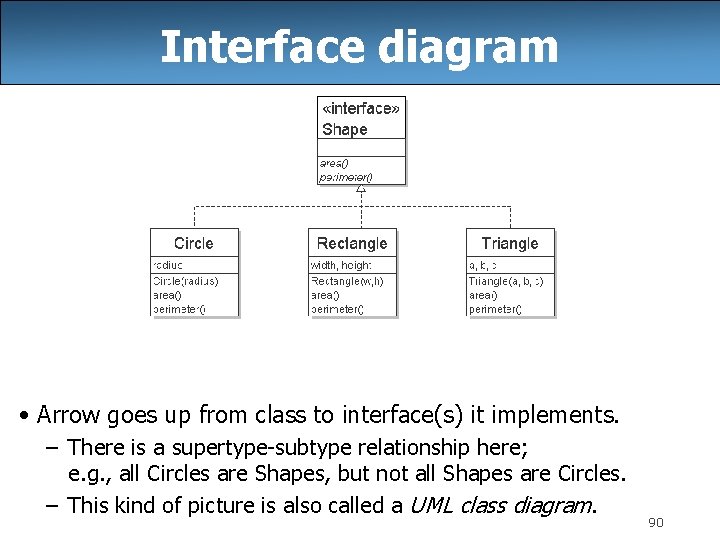
Interface diagram • Arrow goes up from class to interface(s) it implements. – There is a supertype-subtype relationship here; e. g. , all Circles are Shapes, but not all Shapes are Circles. – This kind of picture is also called a UML class diagram. 90
- Slides: 90