
Building Java Programs Chapter 9 Critters Subtype Polymorphism
Building Java Programs Chapter 9 Critters; Subtype Polymorphism Reading: HW 9 Handout, Chapter 9. 2 Copyright 2008 by Pearson Education 1
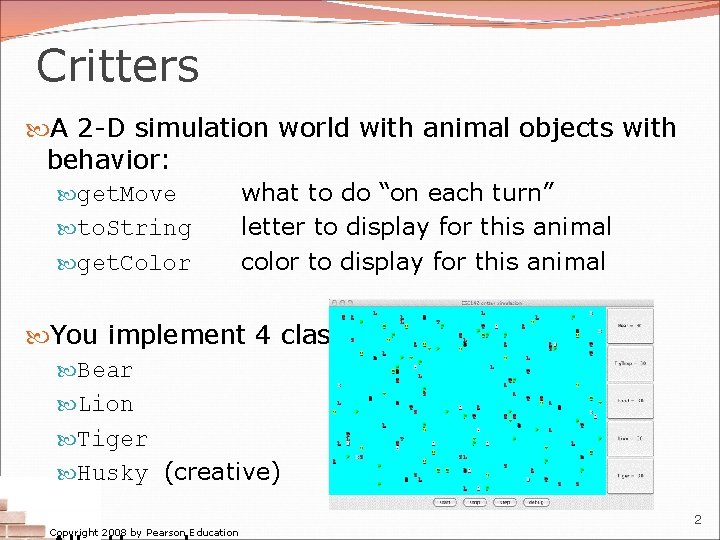
Critters A 2 -D simulation world with animal objects with behavior: get. Move what to do “on each turn” to. String letter to display for this animal get. Color color to display for this animal You implement 4 classes (kinds of critters): Bear Lion Tiger Husky (creative) Copyright 2008 by Pearson Education 2
A Critter subclass public class name extends Critter {. . . } extends Critter tells the simulator your class is a critter an example of inheritance Write a constructor to initialize each critter’s state Implement the 3 methods that define the critter’s 3 behavior Copyright 2008 by Pearson Education
How the simulator works Critter. Main. java (written for you) makes a bunch of critters and puts them randomly in the world. All you do is (un)comment-out relevant lines When you press “start”, the simulator enters a loop: moves each animal once (get. Move), in random order uses get. Color and to. String to display your critter Key concept: The simulator is in control, NOT your animal. Example: get. Move can return only one move at a 4 Copyright 2008 by Pearson Education
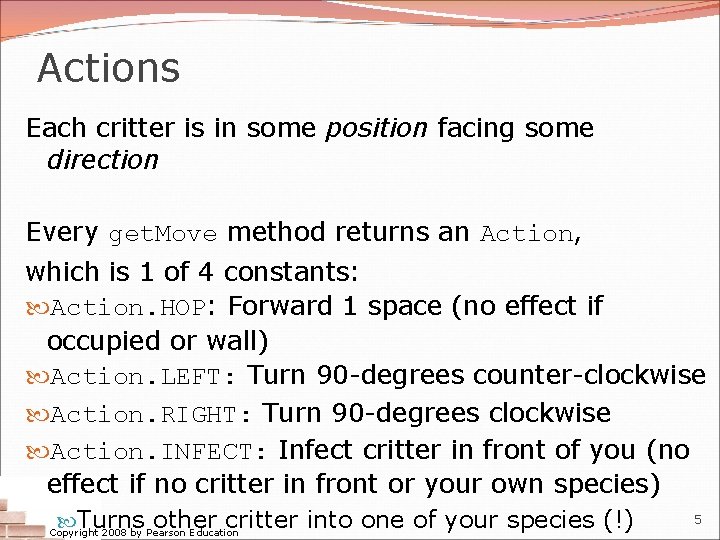
Actions Each critter is in some position facing some direction Every get. Move method returns an Action, which is 1 of 4 constants: Action. HOP: Forward 1 space (no effect if occupied or wall) Action. LEFT: Turn 90 -degrees counter-clockwise Action. RIGHT: Turn 90 -degrees clockwise Action. INFECT: Infect critter in front of you (no effect if no critter in front or your own species) Turns other critter into one of your species (!) Copyright 2008 by Pearson Education 5
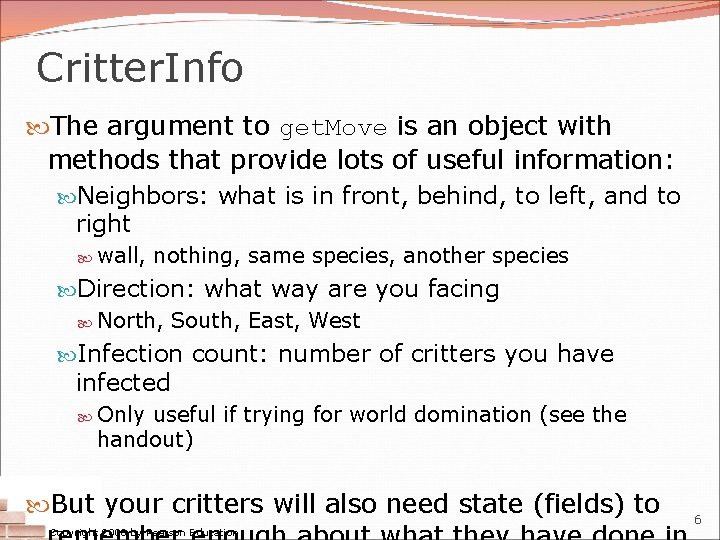
Critter. Info The argument to get. Move is an object with methods that provide lots of useful information: Neighbors: what is in front, behind, to left, and to right wall, nothing, same species, another species Direction: what way are you facing North, South, East, West Infection count: number of critters you have infected Only useful if trying for world domination (see the handout) But your critters will also need state (fields) to Copyright 2008 by Pearson Education 6
Tournament Your Husky class can do whatever you want Some style points dedicated to creativity To win the tournament, must best “survive” in a world filled with other species (your opponents) Details posted later “Playoffs” in class on last day Copyright 2008 by Pearson Education 7

Example Critters The code provided to you also includes two simple critters Yours will be more interesting Food: Stay in one place, easy to be infected Does try to infect others (rather unlike “food”) Fly. Trap: Stay in one place, but spin around always try to infect A surprisingly good strategy Copyright 2008 by Pearson Education 8
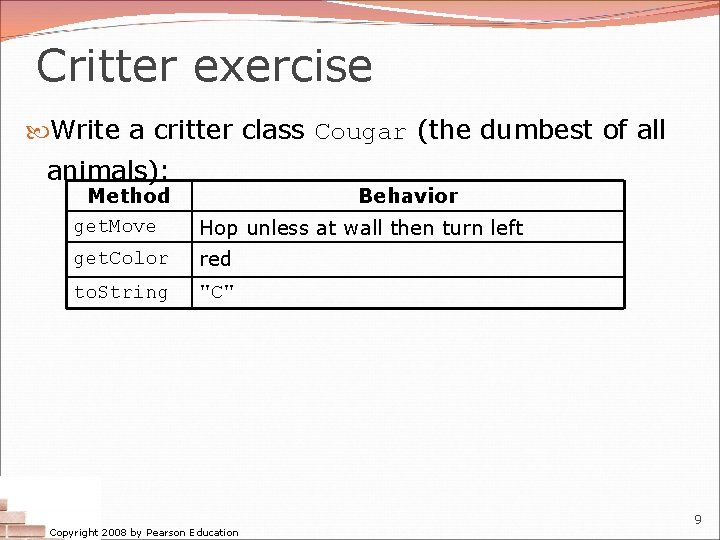
Critter exercise Write a critter class Cougar (the dumbest of all animals): Method get. Move Behavior Hop unless at wall then turn left get. Color red to. String "C" Copyright 2008 by Pearson Education 9
Ideas for state You must not only have the right state, but update that state properly when relevant actions occur. Two approaches: How many moves of some sort has this animal made? What has this animal done recently? (The first approach is often shorter. ) Food, Fly. Trap, and Cougar are too simple to need state. 10 Copyright 2008 by Pearson Education
Testing critters Focus on one specific Critter of one specific type Only spawn 1 of each Critter type (Be sure to test with more later) Make sure your fields update properly Use println statements to see field values Look at the behavior one step at a time Use “step” rather than “start” Debug: Shows direction faced rather than normal 11 String Copyright 2008 by Pearson Education
Building Java Programs Chapter 9 Lecture 9 -3: Polymorphism reading: 9. 1 -9. 2 self-check: #5 -9 Copyright 2008 by Pearson Education 12
Polymorphism polymorphism: Ability for the same code to be used with different types of objects. System. out. println can print any type of object. Each one displays in its own way on the console. Critter. Main can interact with any type of critter. Each one moves, infects, etc. in its own way. Java supports polymorphism in a few ways We will learn about subtyping via inheritance Copyright 2008 by Pearson Education 13
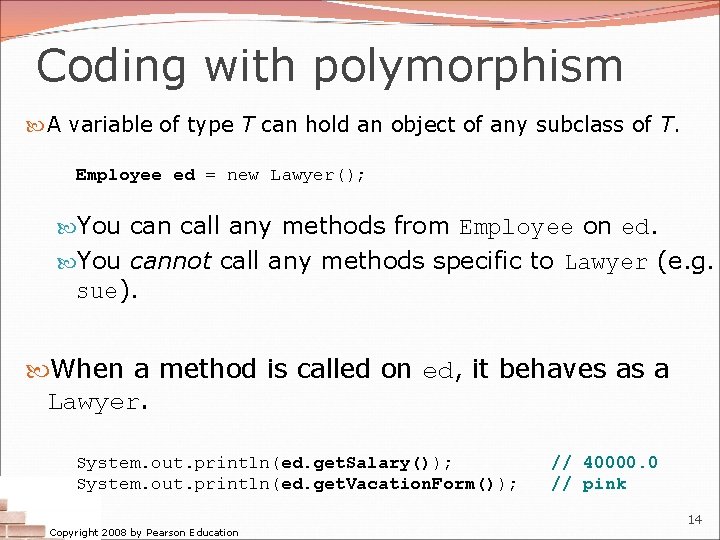
Coding with polymorphism A variable of type T can hold an object of any subclass of T. Employee ed = new Lawyer(); You can call any methods from Employee on ed. You cannot call any methods specific to Lawyer (e. g. sue). When a method is called on ed, it behaves as a Lawyer. System. out. println(ed. get. Salary()); System. out. println(ed. get. Vacation. Form()); Copyright 2008 by Pearson Education // 40000. 0 // pink 14
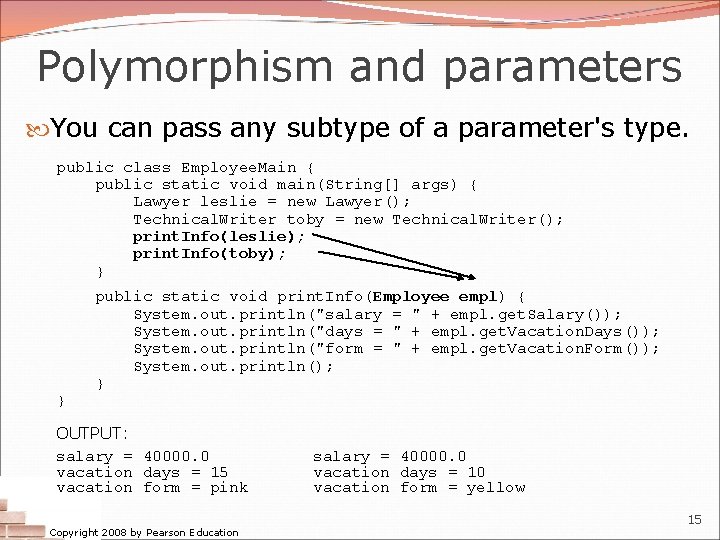
Polymorphism and parameters You can pass any subtype of a parameter's type. public class Employee. Main { public static void main(String[] args) { Lawyer leslie = new Lawyer(); Technical. Writer toby = new Technical. Writer(); print. Info(leslie); print. Info(toby); } } public static void print. Info(Employee empl) { System. out. println("salary = " + empl. get. Salary()); System. out. println("days = " + empl. get. Vacation. Days()); System. out. println("form = " + empl. get. Vacation. Form()); System. out. println(); } OUTPUT: salary = 40000. 0 vacation days = 15 vacation form = pink Copyright 2008 by Pearson Education salary = 40000. 0 vacation days = 10 vacation form = yellow 15
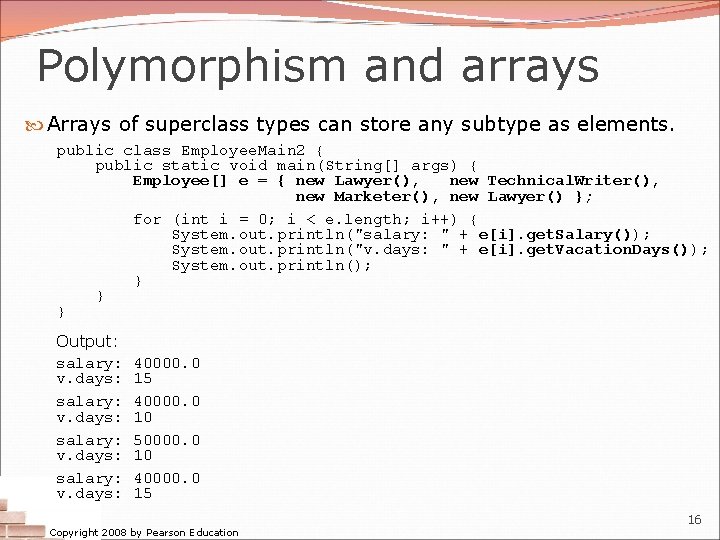
Polymorphism and arrays Arrays of superclass types can store any subtype as elements. public class Employee. Main 2 { public static void main(String[] args) { Employee[] e = { new Lawyer(), new Technical. Writer(), new Marketer(), new Lawyer() }; for (int i = 0; i < e. length; i++) { System. out. println("salary: " + e[i]. get. Salary()); System. out. println("v. days: " + e[i]. get. Vacation. Days()); System. out. println(); } } } Output: salary: v. days: 40000. 0 15 40000. 0 10 50000. 0 10 40000. 0 15 Copyright 2008 by Pearson Education 16
Polymorphism problems A few classes with inheritance relationships are shown. Can have multiple levels of subclasses A client program calls methods on objects of each class. You must read the code and determine the client's output. (On the final exam, at least a “simple” version) Copyright 2008 by Pearson Education 17
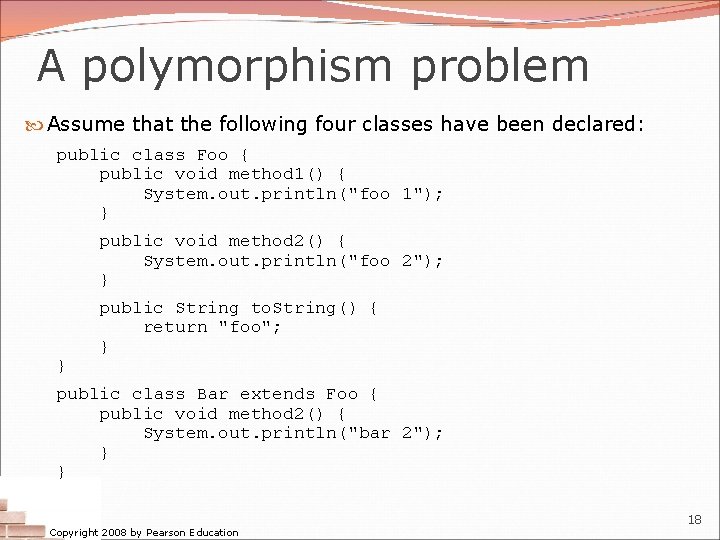
A polymorphism problem Assume that the following four classes have been declared: public class Foo { public void method 1() { System. out. println("foo 1"); } public void method 2() { System. out. println("foo 2"); } } public String to. String() { return "foo"; } public class Bar extends Foo { public void method 2() { System. out. println("bar 2"); } } Copyright 2008 by Pearson Education 18
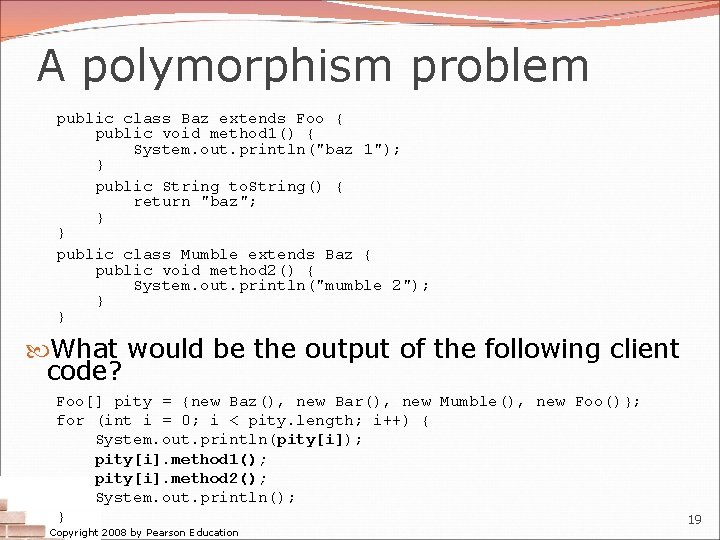
A polymorphism problem public class Baz extends Foo { public void method 1() { System. out. println("baz 1"); } public String to. String() { return "baz"; } } public class Mumble extends Baz { public void method 2() { System. out. println("mumble 2"); } } What would be the output of the following client code? Foo[] pity = {new Baz(), new Bar(), new Mumble(), new Foo()}; for (int i = 0; i < pity. length; i++) { System. out. println(pity[i]); pity[i]. method 1(); pity[i]. method 2(); System. out. println(); } Copyright 2008 by Pearson Education 19
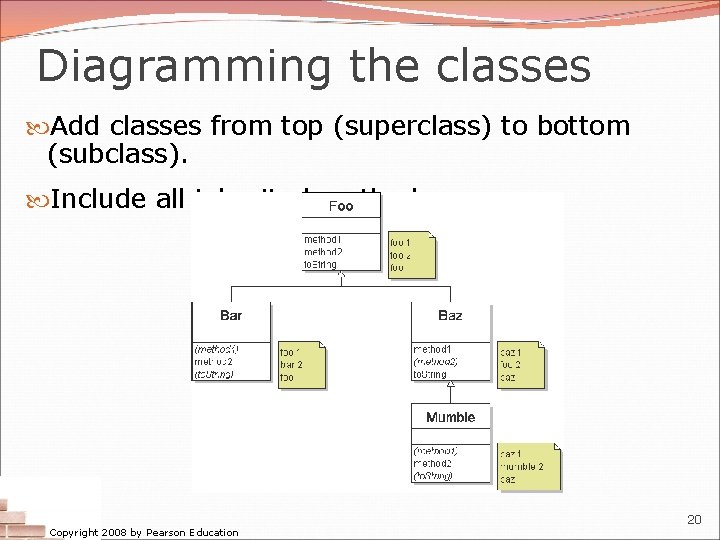
Diagramming the classes Add classes from top (superclass) to bottom (subclass). Include all inherited methods. Copyright 2008 by Pearson Education 20
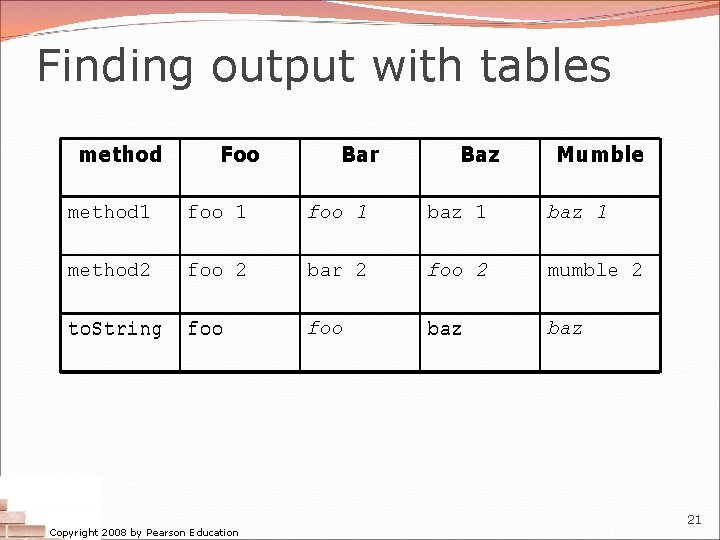
Finding output with tables method Foo Bar Baz Mumble method 1 foo 1 baz 1 method 2 foo 2 bar 2 foo 2 mumble 2 to. String foo baz Copyright 2008 by Pearson Education 21
![Polymorphism answer Foo[] pity = {new Baz(), new Bar(), new Mumble(), new Foo()}; for](http://slidetodoc.com/presentation_image_h2/da9dfa15b93c4711f3a33b25642ab7bf/image-22.jpg "Polymorphism answer Foo[] pity = {new Baz(), new Bar(), new Mumble(), new Foo()}; for")
Polymorphism answer Foo[] pity = {new Baz(), new Bar(), new Mumble(), new Foo()}; for (int i = 0; i < pity. length; i++) { System. out. println(pity[i]); pity[i]. method 1(); pity[i]. method 2(); System. out. println(); } Output: baz 1 foo 2 foo 1 bar 2 baz 1 mumble 2 foo 1 foo 2 Copyright 2008 by Pearson Education 22
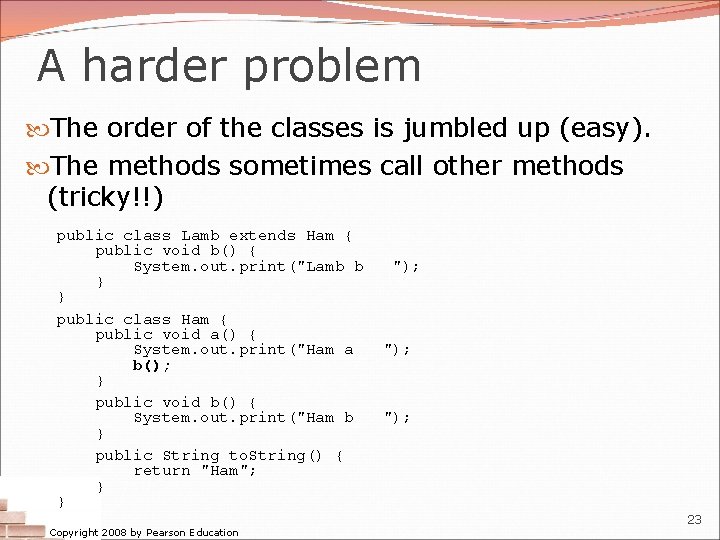
A harder problem The order of the classes is jumbled up (easy). The methods sometimes call other methods (tricky!!) public class Lamb extends Ham { public void b() { System. out. print("Lamb b } } public class Ham { public void a() { System. out. print("Ham a b(); } public void b() { System. out. print("Ham b } public String to. String() { return "Ham"; } } Copyright 2008 by Pearson Education "); 23
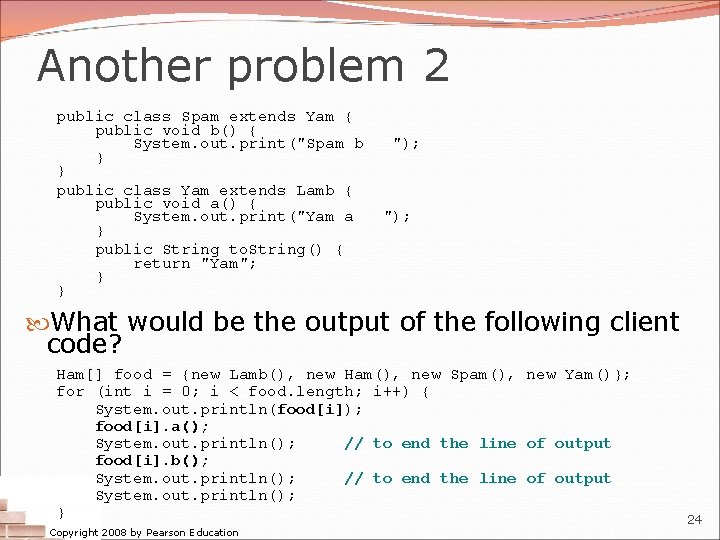
Another problem 2 public class Spam extends Yam { public void b() { System. out. print("Spam b } } public class Yam extends Lamb { public void a() { System. out. print("Yam a } public String to. String() { return "Yam"; } } "); What would be the output of the following client code? Ham[] food = {new Lamb(), new Ham(), new Spam(), new Yam()}; for (int i = 0; i < food. length; i++) { System. out. println(food[i]); food[i]. a(); System. out. println(); // to end the line of output food[i]. b(); System. out. println(); // to end the line of output System. out. println(); } Copyright 2008 by Pearson Education 24
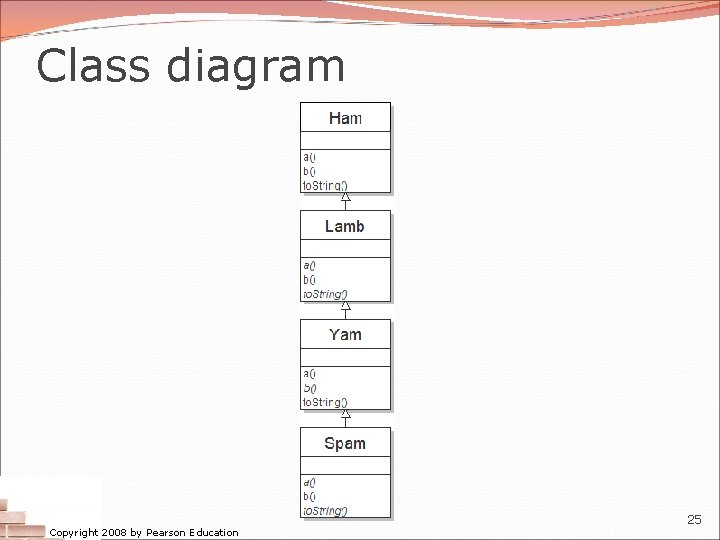
Class diagram Copyright 2008 by Pearson Education 25
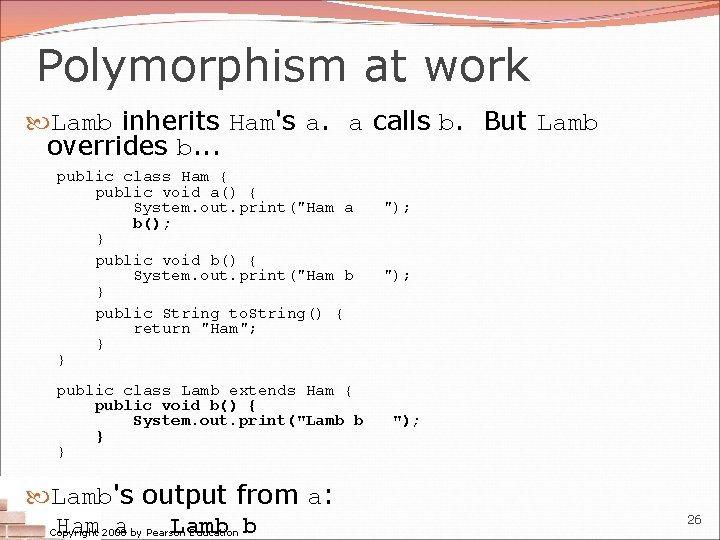
Polymorphism at work Lamb inherits Ham's a. a calls b. But Lamb overrides b. . . public class Ham { public void a() { System. out. print("Ham a b(); } public void b() { System. out. print("Ham b } public String to. String() { return "Ham"; } } public class Lamb extends Ham { public void b() { System. out. print("Lamb b } } Lamb's output from a: Ham a Lamb b Copyright 2008 by Pearson Education "); 26
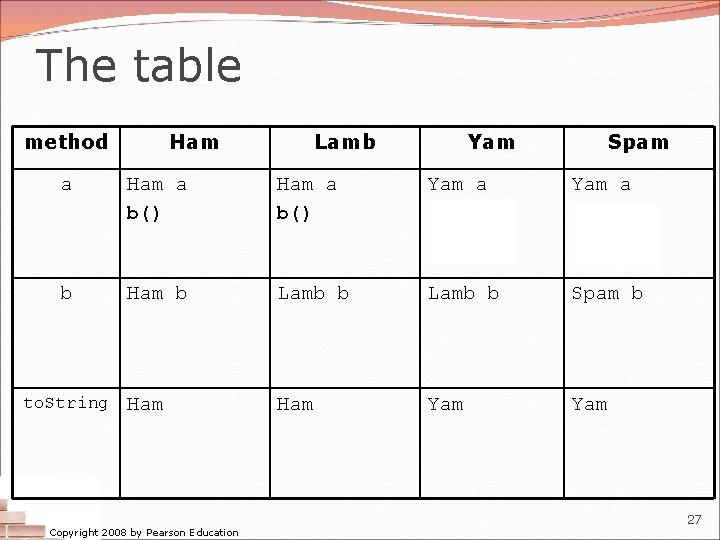
The table method Ham Lamb Yam Spam a Ham a b() Yam a Ham a b() b Ham b Lamb b Spam b Ham Yam to. String Copyright 2008 by Pearson Education 27
![The answer Ham[] food = {new Lamb(), new Ham(), new Spam(), new Yam()}; for](http://slidetodoc.com/presentation_image_h2/da9dfa15b93c4711f3a33b25642ab7bf/image-28.jpg "The answer Ham[] food = {new Lamb(), new Ham(), new Spam(), new Yam()}; for")
The answer Ham[] food = {new Lamb(), new Ham(), new Spam(), new Yam()}; for (int i = 0; i < food. length; i++) { System. out. println(food[i]); food[i]. a(); food[i]. b(); System. out. println(); } Output: Ham a Lamb b Ham a Ham b Yam a Spam b Yam a Lamb b Ham b Copyright 2008 by Pearson Education 28
- Slides: 28