
Building Java Programs Chapter 8 Lecture 8 2
Building Java Programs Chapter 8 Lecture 8 -2: Object Behavior (Methods) reading: 8. 3 self-checks: #1 -12 exercises: #1 -4, 9, 11, 14, 16 Copyright 2010 by Pearson Education 1
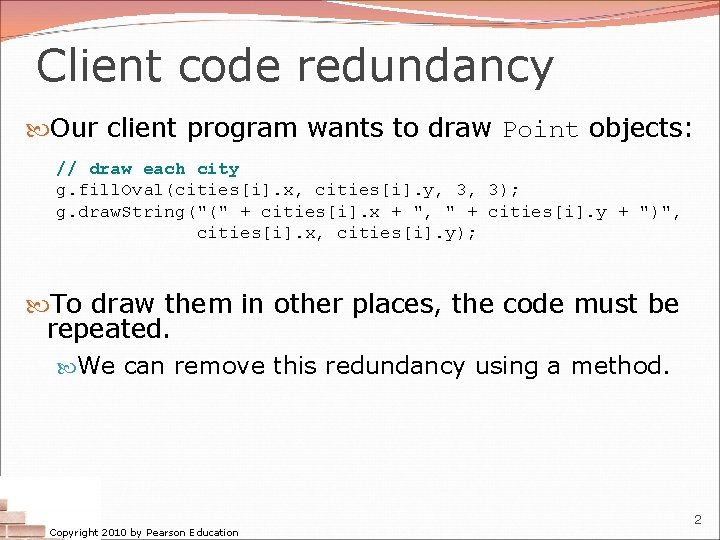
Client code redundancy Our client program wants to draw Point objects: // draw each city g. fill. Oval(cities[i]. x, cities[i]. y, 3, 3); g. draw. String("(" + cities[i]. x + ", " + cities[i]. y + ")", cities[i]. x, cities[i]. y); To draw them in other places, the code must be repeated. We can remove this redundancy using a method. Copyright 2010 by Pearson Education 2
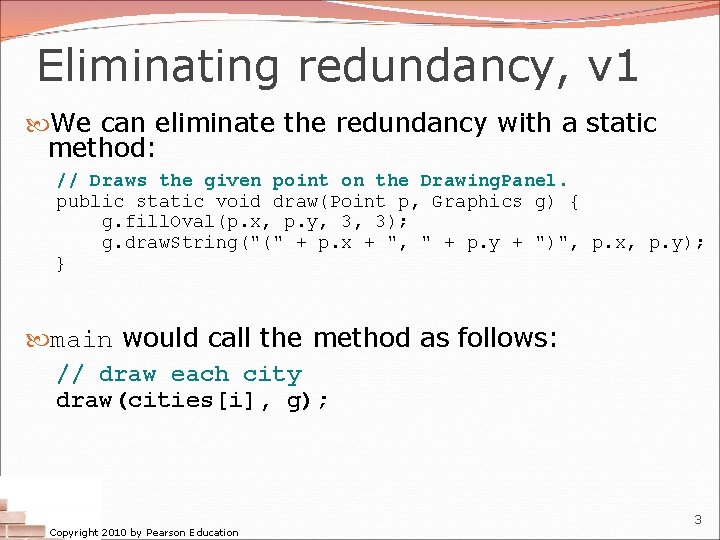
Eliminating redundancy, v 1 We can eliminate the redundancy with a static method: // Draws the given point on the Drawing. Panel. public static void draw(Point p, Graphics g) { g. fill. Oval(p. x, p. y, 3, 3); g. draw. String("(" + p. x + ", " + p. y + ")", p. x, p. y); } main would call the method as follows: // draw each city draw(cities[i], g); Copyright 2010 by Pearson Education 3
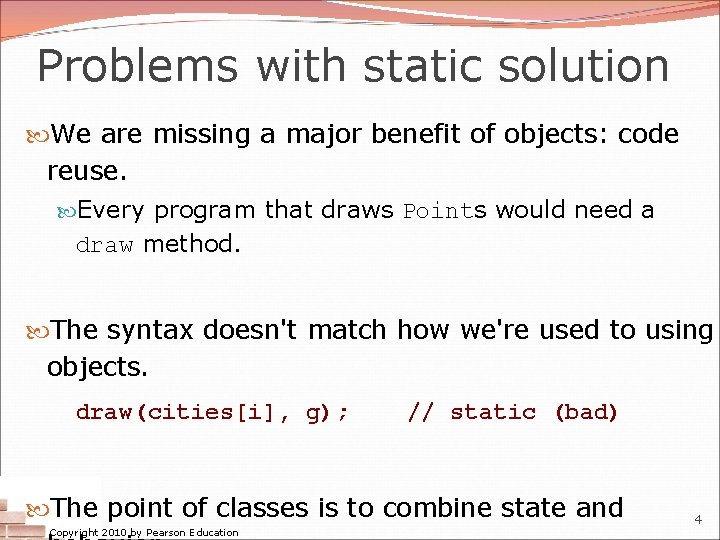
Problems with static solution We are missing a major benefit of objects: code reuse. Every program that draws Points would need a draw method. The syntax doesn't match how we're used to using objects. draw(cities[i], g); // static (bad) The point of classes is to combine state and Copyright 2010 by Pearson Education 4

Instance methods instance method (or object method): Exists inside each object of a class and gives behavior to each object. public type name(parameters) { statements; } same syntax as static methods, but without static keyword Example: Copyright 2010 by Pearson Education 5
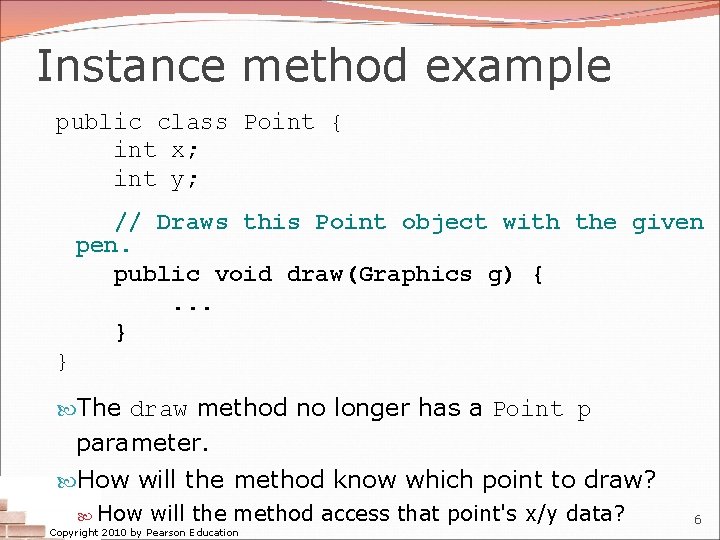
Instance method example public class Point { int x; int y; // Draws this Point object with the given pen. public void draw(Graphics g) {. . . } } The draw method no longer has a Point p parameter. How will the method know which point to draw? How will the method access that point's x/y data? Copyright 2010 by Pearson Education 6
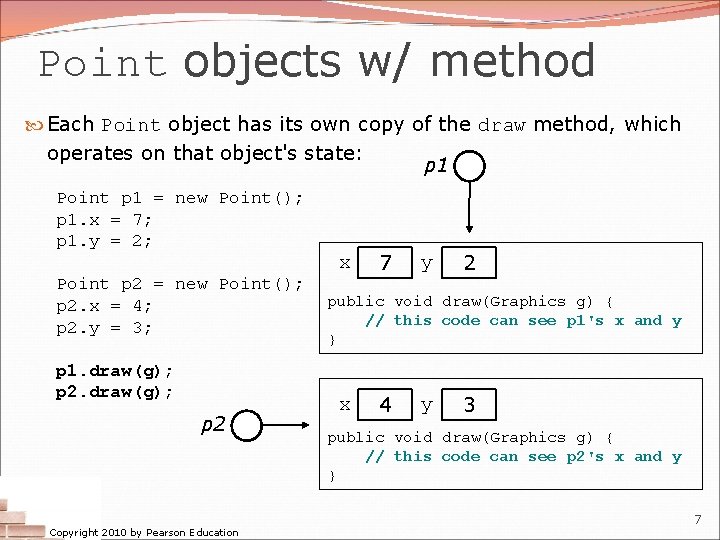
Point objects w/ method Each Point object has its own copy of the draw method, which operates on that object's state: p 1 Point p 1 = new Point(); p 1. x = 7; p 1. y = 2; Point p 2 = new Point(); p 2. x = 4; p 2. y = 3; p 1. draw(g); p 2. draw(g); p 2 Copyright 2010 by Pearson Education x 7 y 2 public void draw(Graphics g) { // this code can see p 1's x and y } x 4 y 3 public void draw(Graphics g) { // this code can see p 2's x and y } 7
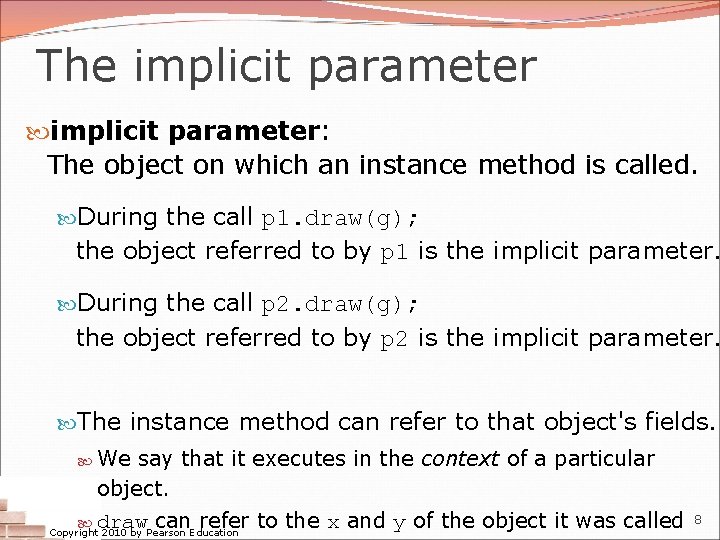
The implicit parameter: The object on which an instance method is called. During the call p 1. draw(g); the object referred to by p 1 is the implicit parameter. During the call p 2. draw(g); the object referred to by p 2 is the implicit parameter. The instance method can refer to that object's fields. We say that it executes in the context of a particular object. draw can refer to the x and y of the object it was called Copyright 2010 by Pearson Education 8
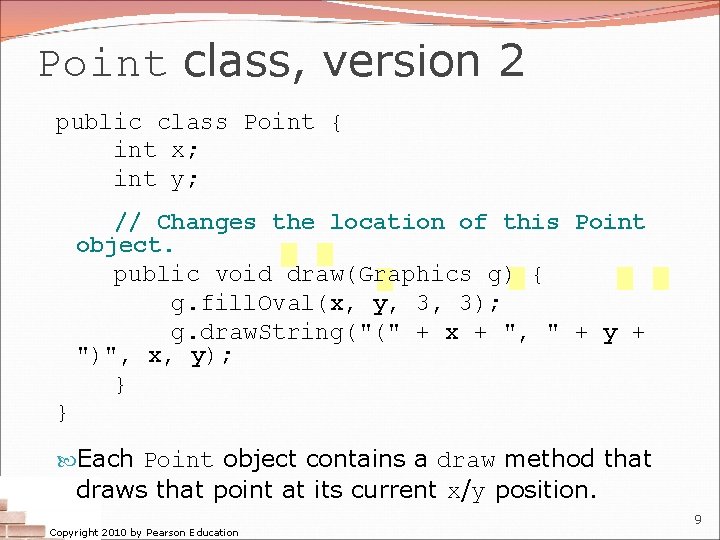
Point class, version 2 public class Point { int x; int y; // Changes the location of this Point object. public void draw(Graphics g) { g. fill. Oval(x, y, 3, 3); g. draw. String("(" + x + ", " + y + ")", x, y); } } Each Point object contains a draw method that draws that point at its current x/y position. Copyright 2010 by Pearson Education 9
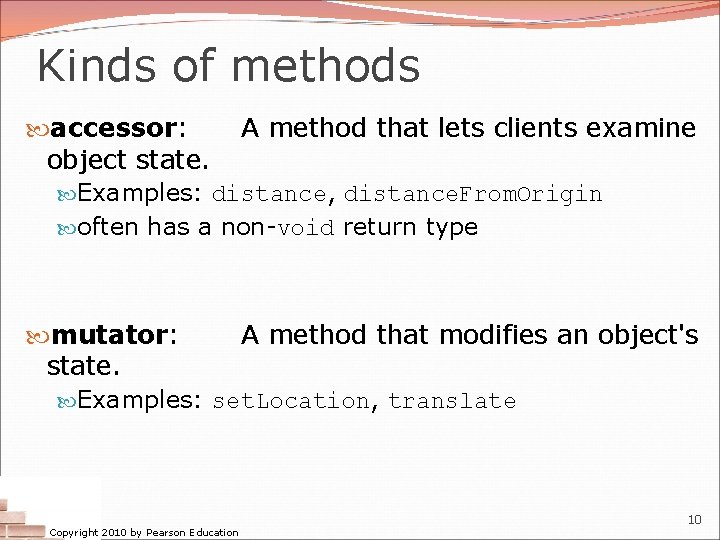
Kinds of methods accessor: A method that lets clients examine object state. Examples: distance, distance. From. Origin often has a non-void return type mutator: A method that modifies an object's state. Examples: set. Location, translate Copyright 2010 by Pearson Education 10
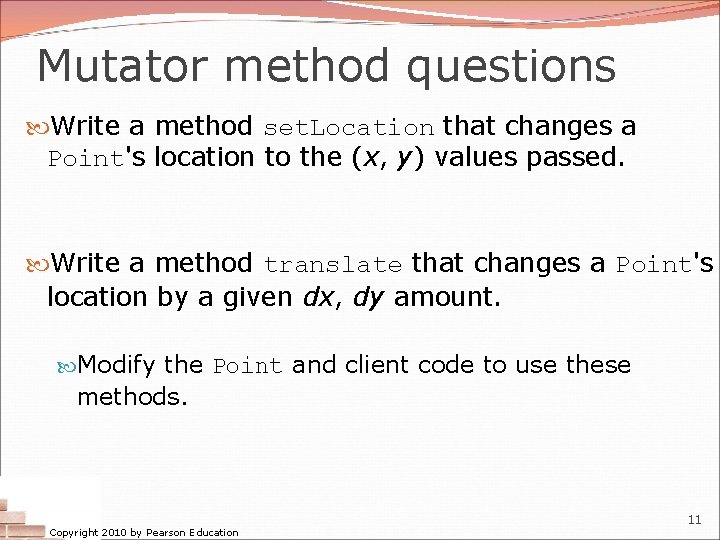
Mutator method questions Write a method set. Location that changes a Point's location to the (x, y) values passed. Write a method translate that changes a Point's location by a given dx, dy amount. Modify the Point and client code to use these methods. Copyright 2010 by Pearson Education 11
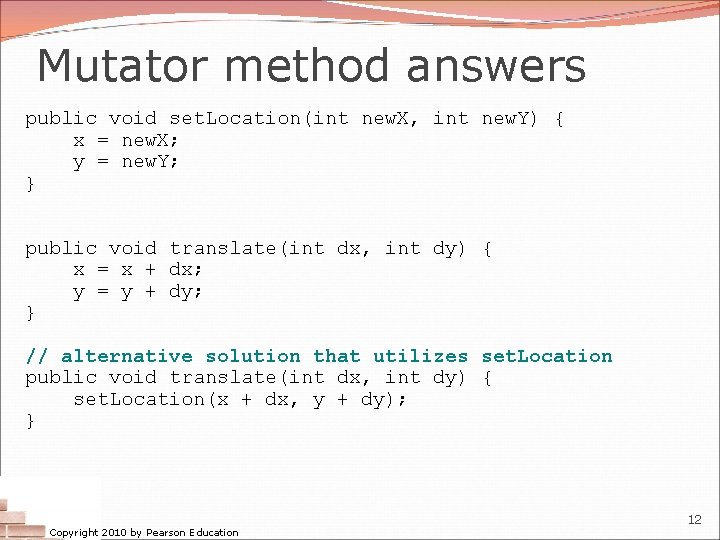
Mutator method answers public void set. Location(int new. X, int new. Y) { x = new. X; y = new. Y; } public void translate(int dx, int dy) { x = x + dx; y = y + dy; } // alternative solution that utilizes set. Location public void translate(int dx, int dy) { set. Location(x + dx, y + dy); } Copyright 2010 by Pearson Education 12
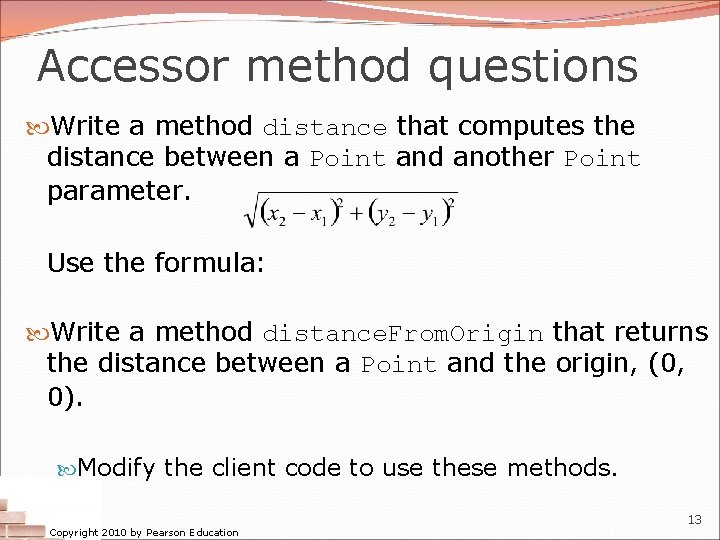
Accessor method questions Write a method distance that computes the distance between a Point and another Point parameter. Use the formula: Write a method distance. From. Origin that returns the distance between a Point and the origin, (0, 0). Modify the client code to use these methods. Copyright 2010 by Pearson Education 13
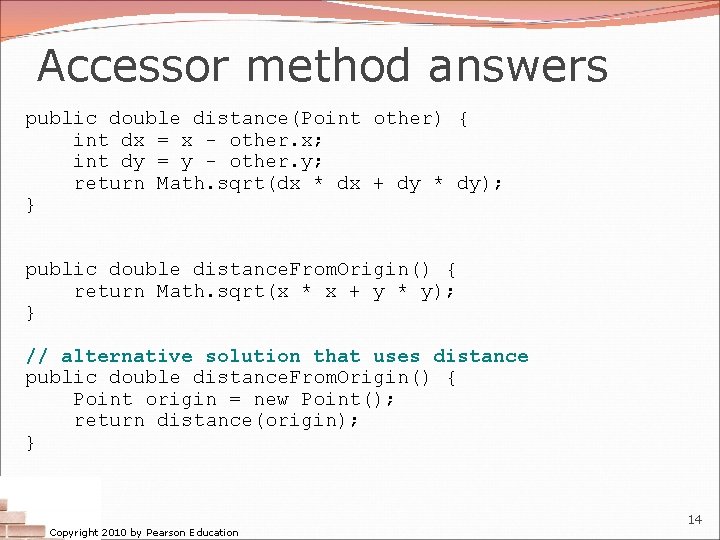
Accessor method answers public double distance(Point other) { int dx = x - other. x; int dy = y - other. y; return Math. sqrt(dx * dx + dy * dy); } public double distance. From. Origin() { return Math. sqrt(x * x + y * y); } // alternative solution that uses distance public double distance. From. Origin() { Point origin = new Point(); return distance(origin); } Copyright 2010 by Pearson Education 14
- Slides: 14