
Building Java Programs Chapter 8 Lecture 8 1
Building Java Programs Chapter 8 Lecture 8 -1: Classes and Objects reading: 8. 1 – 8. 2
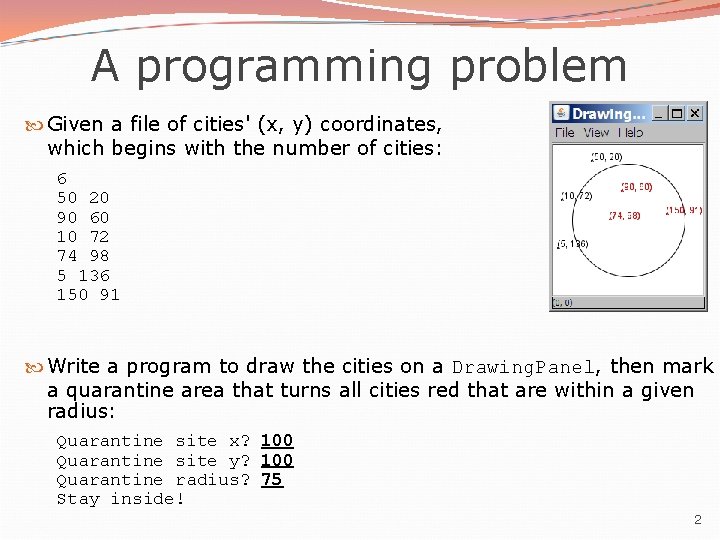
A programming problem Given a file of cities' (x, y) coordinates, which begins with the number of cities: 6 50 20 90 60 10 72 74 98 5 136 150 91 Write a program to draw the cities on a Drawing. Panel, then mark a quarantine area that turns all cities red that are within a given radius: Quarantine site x? 100 Quarantine site y? 100 Quarantine radius? 75 Stay inside! 2
![A bad solution Scanner input int city. Count int[] x. Coords int[] y. Coords](http://slidetodoc.com/presentation_image_h2/143b970b0756e7007601d868b366a732/image-3.jpg "A bad solution Scanner input int city. Count int[] x. Coords int[] y. Coords")
A bad solution Scanner input int city. Count int[] x. Coords int[] y. Coords = = new Scanner(new File("cities. txt")); input. next. Int(); new int[city. Count]; for (int i = 0; i < city. Count; i++) { x. Coords[i] = input. next. Int(); // read each city y. Coords[i] = input. next. Int(); }. . . parallel arrays: 2+ arrays with related data at same indexes. Considered poor style. 3
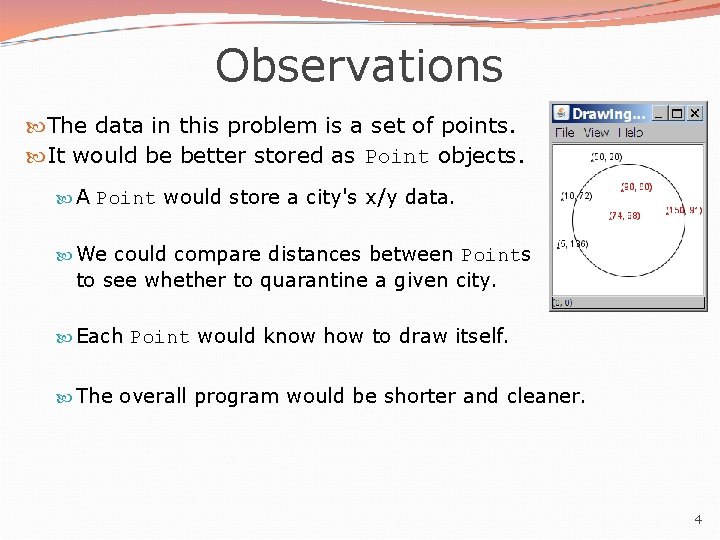
Observations The data in this problem is a set of points. It would be better stored as Point objects. A Point would store a city's x/y data. We could compare distances between Points to see whether to quarantine a given city. Each Point would know how to draw itself. The overall program would be shorter and cleaner. 4
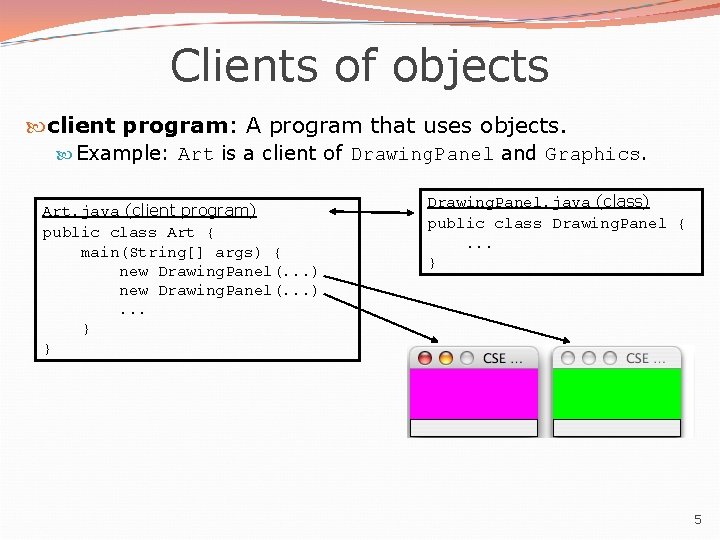
Clients of objects client program: A program that uses objects. Example: Art is a client of Drawing. Panel and Graphics. Art. java (client program) public class Art { main(String[] args) { new Drawing. Panel(. . . ). . . } } Drawing. Panel. java (class) public class Drawing. Panel {. . . } 5
Classes and objects class: A program entity that represents either: 1. A program / module, or 2. A template for a new type of objects. The Drawing. Panel class is a template for creating Drawing. Panel objects. object: An entity that combines state and behavior. object-oriented programming (OOP): Programs that perform their behavior as interactions between objects. 6
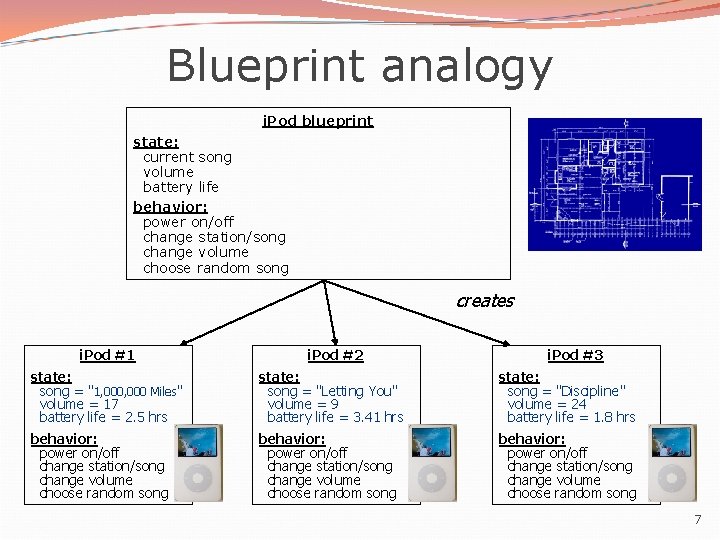
Blueprint analogy i. Pod blueprint state: current song volume battery life behavior: power on/off change station/song change volume choose random song creates i. Pod #1 i. Pod #2 i. Pod #3 state: song = "1, 000 Miles" volume = 17 battery life = 2. 5 hrs state: song = "Letting You" volume = 9 battery life = 3. 41 hrs state: song = "Discipline" volume = 24 battery life = 1. 8 hrs behavior: power on/off change station/song change volume choose random song 7
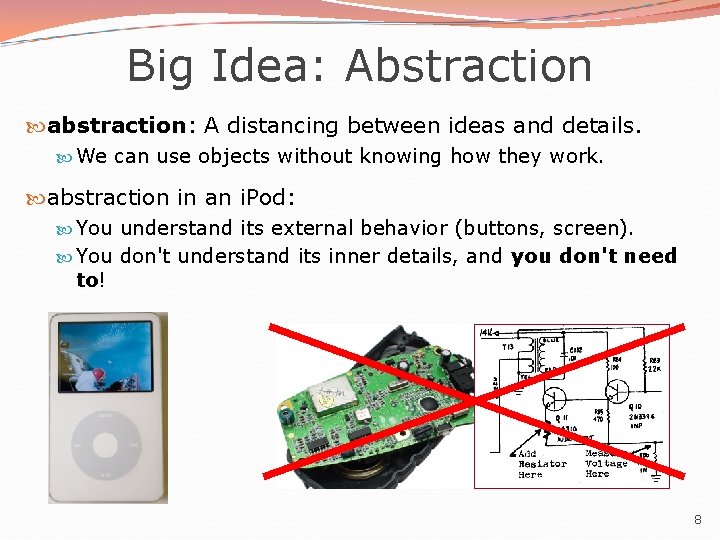
Big Idea: Abstraction abstraction: A distancing between ideas and details. We can use objects without knowing how they work. abstraction in an i. Pod: You understand its external behavior (buttons, screen). You don't understand its inner details, and you don't need to! 8
Our task We will implement a Point class as a way of learning about defining classes. We will define a type named Point. Each Point object will contain x/y data called fields. Each Point object will contain behavior called methods. Client programs will use the Point objects. 9
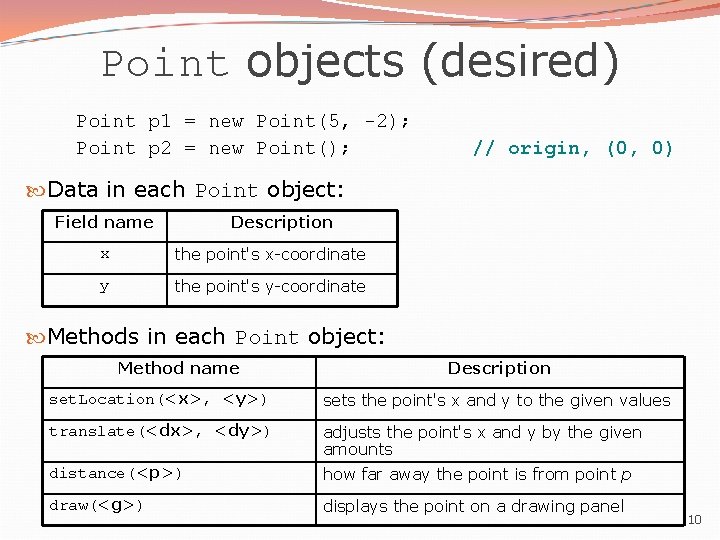
Point objects (desired) Point p 1 = new Point(5, -2); Point p 2 = new Point(); // origin, (0, 0) Data in each Point object: Field name Description x the point's x-coordinate y the point's y-coordinate Methods in each Point object: Method name Description set. Location(<x>, <y>) sets the point's x and y to the given values translate(<dx>, <dy>) adjusts the point's x and y by the given amounts distance(<p>) how far away the point is from point p draw(<g>) displays the point on a drawing panel 10
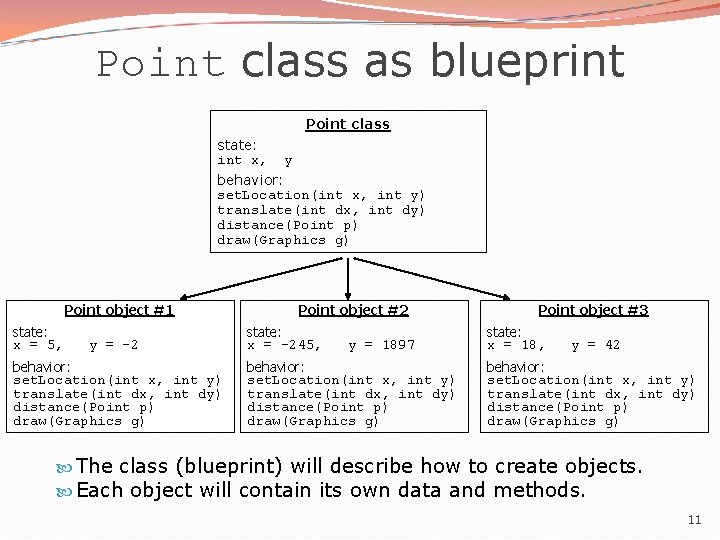
Point class as blueprint Point class state: int x, y behavior: set. Location(int x, int y) translate(int dx, int dy) distance(Point p) draw(Graphics g) Point object #1 state: x = 5, y = -2 behavior: set. Location(int x, int y) translate(int dx, int dy) distance(Point p) draw(Graphics g) Point object #2 state: x = -245, y = 1897 behavior: set. Location(int x, int y) translate(int dx, int dy) distance(Point p) draw(Graphics g) Point object #3 state: x = 18, y = 42 behavior: set. Location(int x, int y) translate(int dx, int dy) distance(Point p) draw(Graphics g) The class (blueprint) will describe how to create objects. Each object will contain its own data and methods. 11
Object state: Fields reading: 8. 2 12
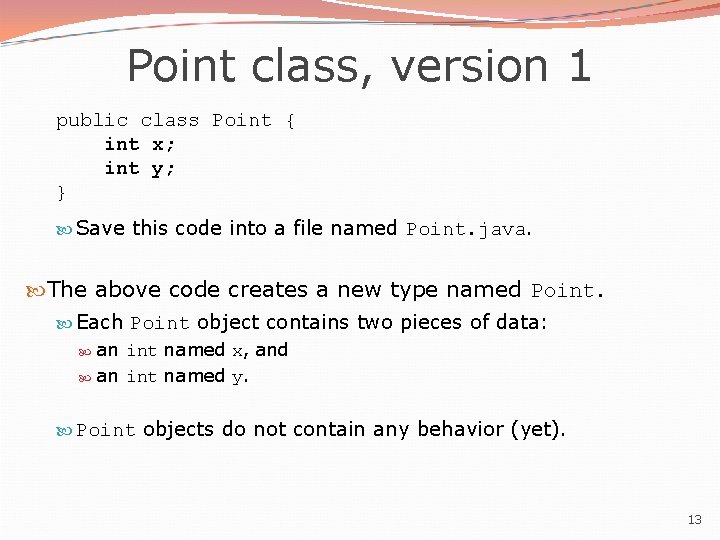
Point class, version 1 public class Point { int x; int y; } Save this code into a file named Point. java. The above code creates a new type named Point. Each Point object contains two pieces of data: an int named x, and an int named y. Point objects do not contain any behavior (yet). 13
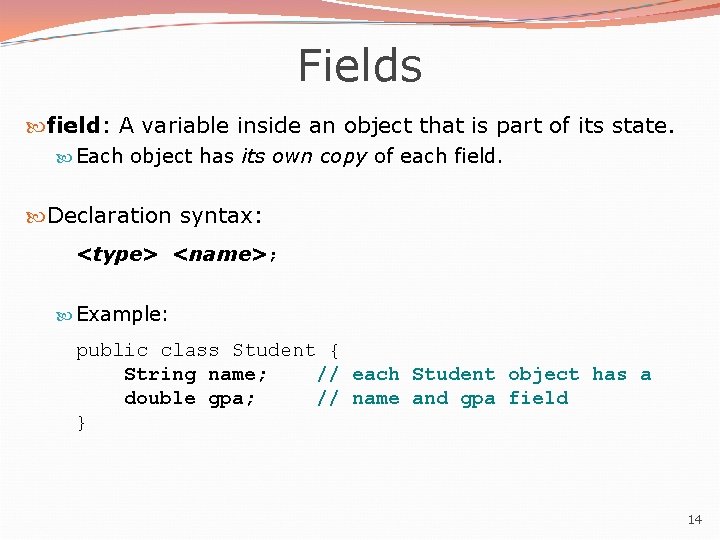
Fields field: A variable inside an object that is part of its state. Each object has its own copy of each field. Declaration syntax: <type> <name>; Example: public class Student { String name; // each Student object has a double gpa; // name and gpa field } 14
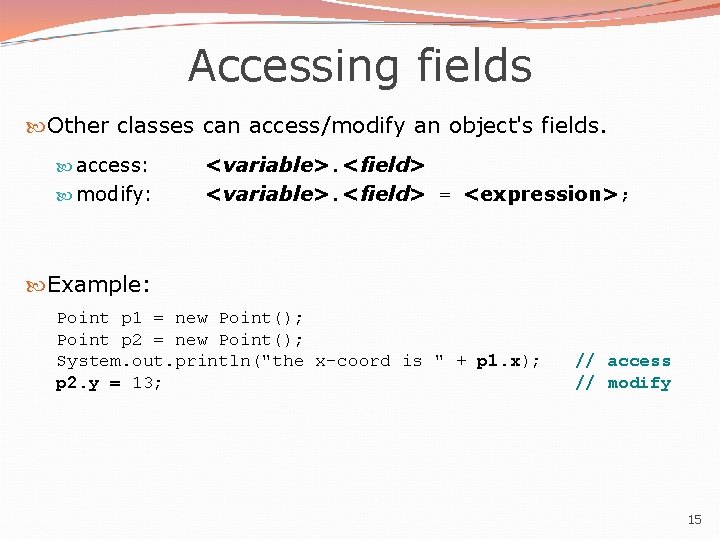
Accessing fields Other classes can access/modify an object's fields. access: modify: <variable>. <field> = <expression>; Example: Point p 1 = new Point(); Point p 2 = new Point(); System. out. println("the x-coord is " + p 1. x); p 2. y = 13; // access // modify 15
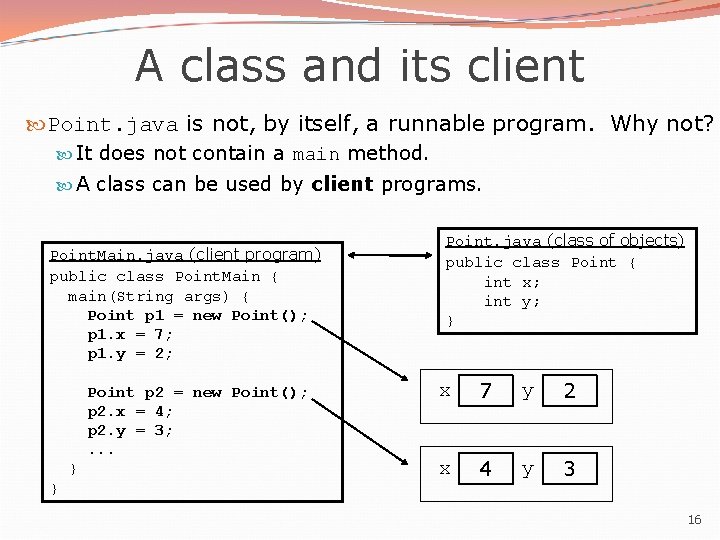
A class and its client Point. java is not, by itself, a runnable program. Why not? It does not contain a main method. A class can be used by client programs. Point. Main. java (client program) public class Point. Main { main(String args) { Point p 1 = new Point(); p 1. x = 7; p 1. y = 2; Point p 2 = new Point(); p 2. x = 4; p 2. y = 3; . . . } } Point. java (class of objects) public class Point { int x; int y; } x 7 y 2 x 4 y 3 16
![Point. Main client example public class Point. Main { public static void main(String[] args)](http://slidetodoc.com/presentation_image_h2/143b970b0756e7007601d868b366a732/image-17.jpg "Point. Main client example public class Point. Main { public static void main(String[] args)")
Point. Main client example public class Point. Main { public static void main(String[] args) { // create two Point objects Point p 1 = new Point(); p 1. y = 2; Point p 2 = new Point(); p 2. x = 4; System. out. println(p 1. x + ", " + p 1. y); // 0, 2 // move p 2 and then print it p 2. x += 2; p 2. y++; System. out. println(p 2. x + ", " + p 2. y); // 6, 1 } } 17
Object behavior: Methods reading: 8. 2 18
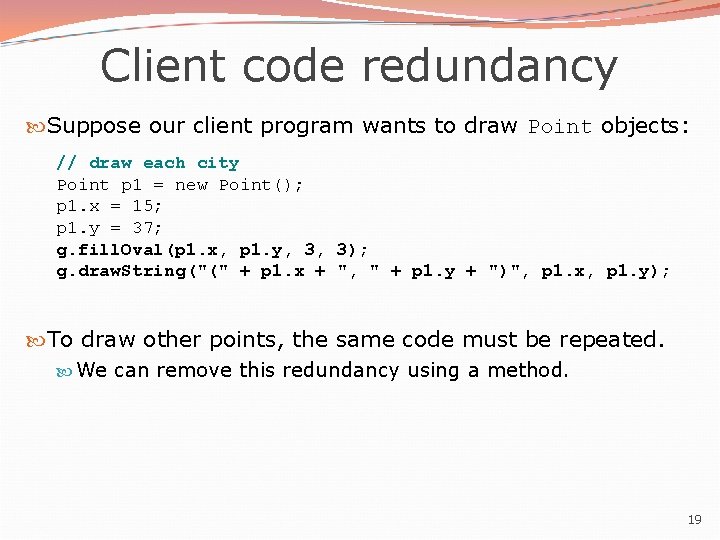
Client code redundancy Suppose our client program wants to draw Point objects: // draw each city Point p 1 = new Point(); p 1. x = 15; p 1. y = 37; g. fill. Oval(p 1. x, p 1. y, 3, 3); g. draw. String("(" + p 1. x + ", " + p 1. y + ")", p 1. x, p 1. y); To draw other points, the same code must be repeated. We can remove this redundancy using a method. 19
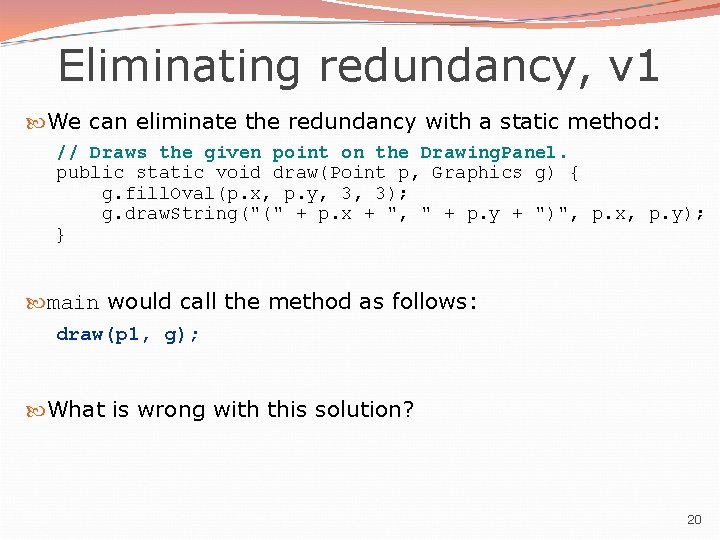
Eliminating redundancy, v 1 We can eliminate the redundancy with a static method: // Draws the given point on the Drawing. Panel. public static void draw(Point p, Graphics g) { g. fill. Oval(p. x, p. y, 3, 3); g. draw. String("(" + p. x + ", " + p. y + ")", p. x, p. y); } main would call the method as follows: draw(p 1, g); What is wrong with this solution? 20
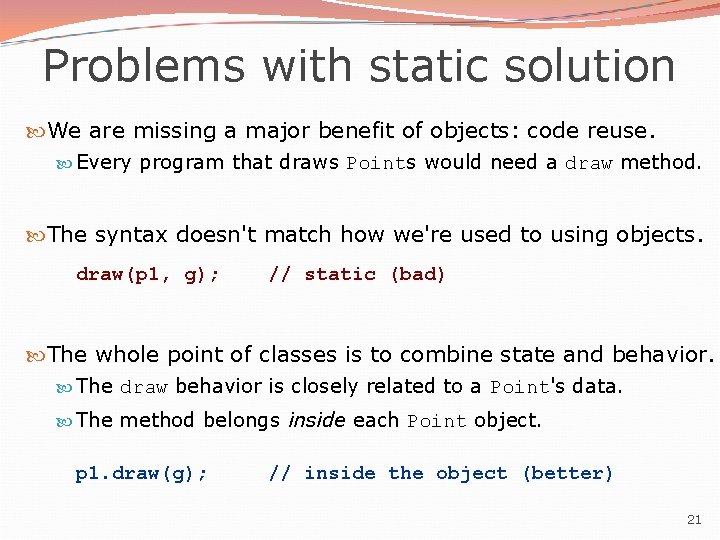
Problems with static solution We are missing a major benefit of objects: code reuse. Every program that draws Points would need a draw method. The syntax doesn't match how we're used to using objects. draw(p 1, g); // static (bad) The whole point of classes is to combine state and behavior. The draw behavior is closely related to a Point's data. The method belongs inside each Point object. p 1. draw(g); // inside the object (better) 21
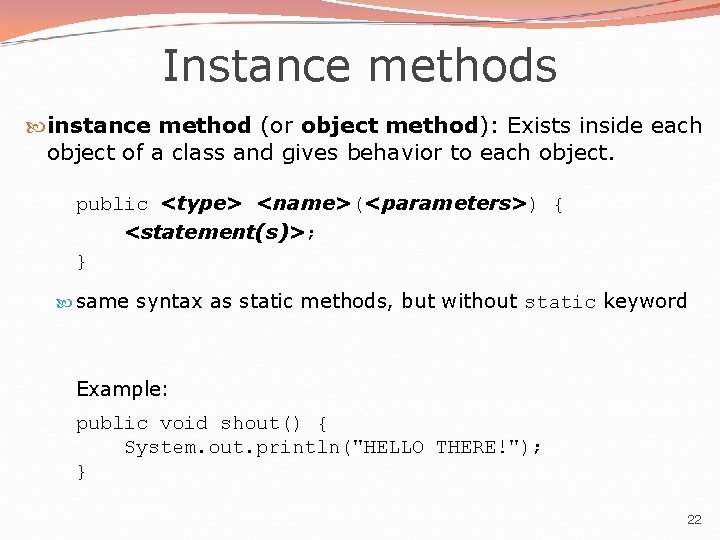
Instance methods instance method (or object method): Exists inside each object of a class and gives behavior to each object. public <type> <name>(<parameters>) { <statement(s)>; } same syntax as static methods, but without static keyword Example: public void shout() { System. out. println("HELLO THERE!"); } 22
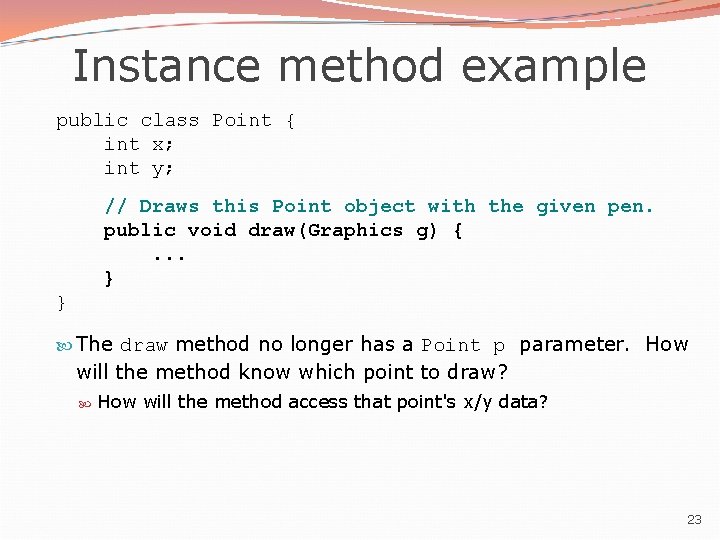
Instance method example public class Point { int x; int y; // Draws this Point object with the given pen. public void draw(Graphics g) {. . . } } The draw method no longer has a Point p parameter. How will the method know which point to draw? How will the method access that point's x/y data? 23
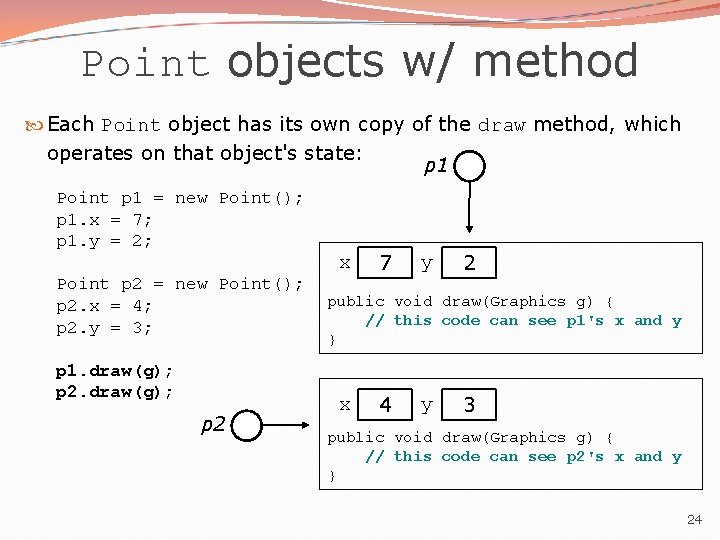
Point objects w/ method Each Point object has its own copy of the draw method, which operates on that object's state: p 1 Point p 1 = new Point(); p 1. x = 7; p 1. y = 2; Point p 2 = new Point(); p 2. x = 4; p 2. y = 3; p 1. draw(g); p 2. draw(g); p 2 x 7 y 2 public void draw(Graphics g) { // this code can see p 1's x and y } x 4 y 3 public void draw(Graphics g) { // this code can see p 2's x and y } 24
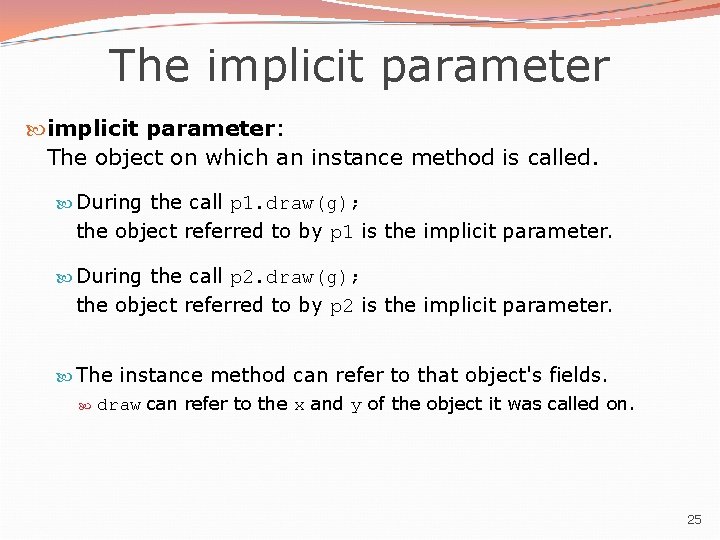
The implicit parameter: The object on which an instance method is called. During the call p 1. draw(g); the object referred to by p 1 is the implicit parameter. During the call p 2. draw(g); the object referred to by p 2 is the implicit parameter. The instance method can refer to that object's fields. draw can refer to the x and y of the object it was called on. 25
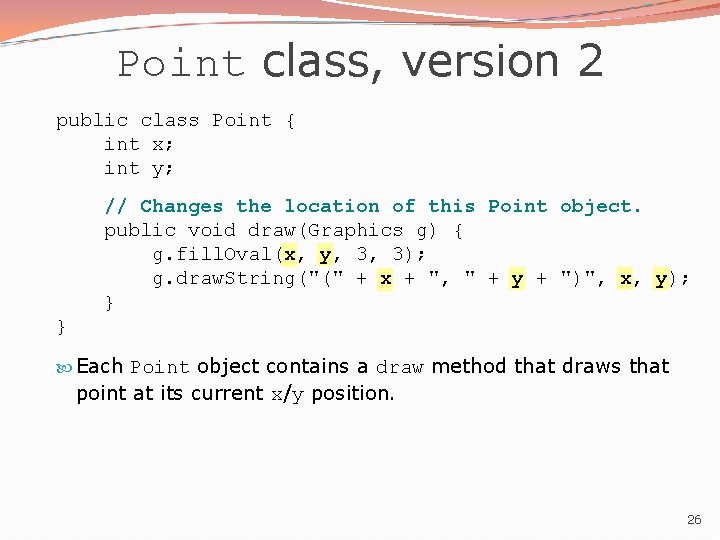
Point class, version 2 public class Point { int x; int y; // Changes the location of this Point object. public void draw(Graphics g) { g. fill. Oval(x, y, 3, 3); g. draw. String("(" + x + ", " + y + ")", x, y); } } Each Point object contains a draw method that draws that point at its current x/y position. 26
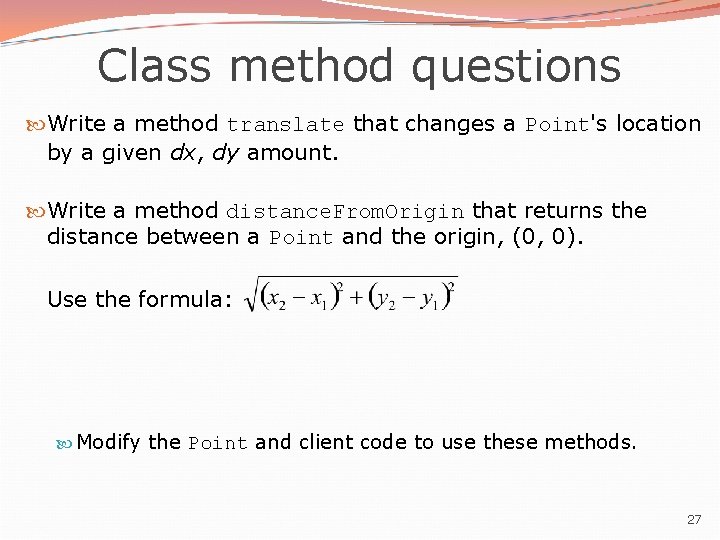
Class method questions Write a method translate that changes a Point's location by a given dx, dy amount. Write a method distance. From. Origin that returns the distance between a Point and the origin, (0, 0). Use the formula: Modify the Point and client code to use these methods. 27
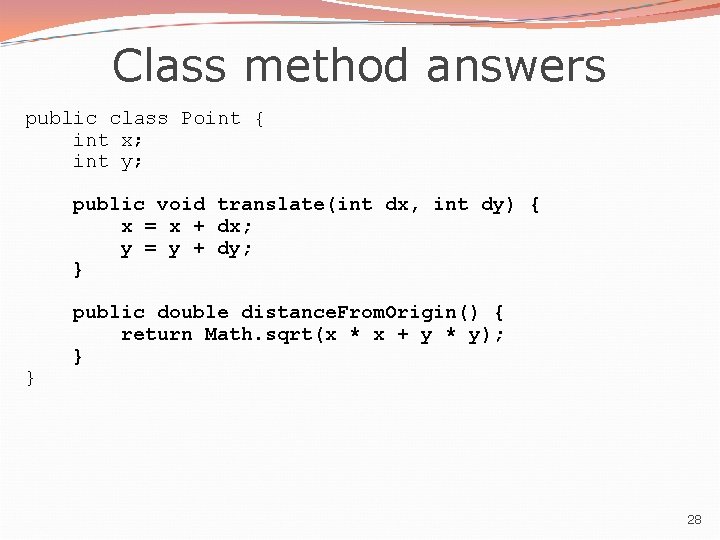
Class method answers public class Point { int x; int y; public void translate(int dx, int dy) { x = x + dx; y = y + dy; } } public double distance. From. Origin() { return Math. sqrt(x * x + y * y); } 28
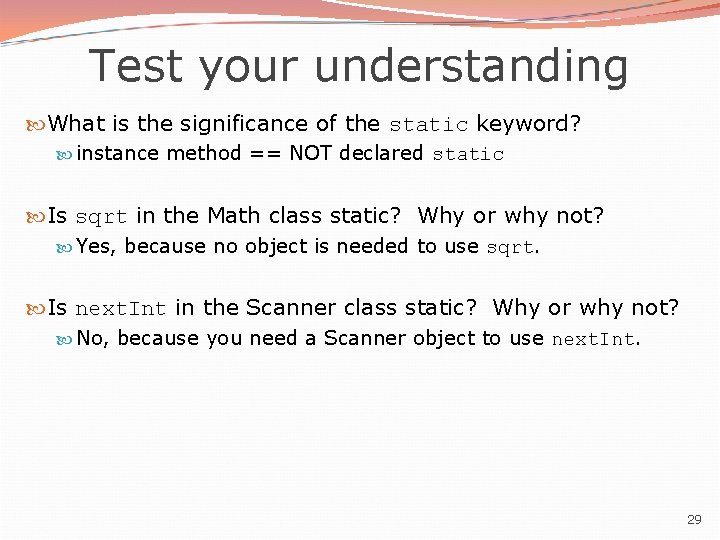
Test your understanding What is the significance of the static keyword? instance method == NOT declared static Is sqrt in the Math class static? Why or why not? Yes, because no object is needed to use sqrt. Is next. Int in the Scanner class static? Why or why not? No, because you need a Scanner object to use next. Int. 29
- Slides: 29