
Building Java Programs Chapter 8 Lecture 19 encapsulation
Building Java Programs Chapter 8 Lecture 19: encapsulation, inheritance reading: 8. 5 - 8. 6 (Slides adapted from Stuart Reges, Hélène Martin, and Marty Stepp) Copyright 2008 by Pearson Education
Copyright 2008 by Pearson Education 2
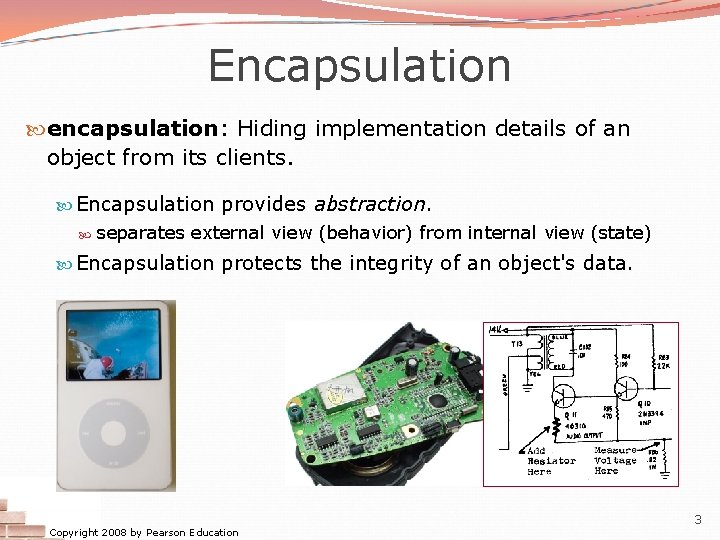
Encapsulation encapsulation: Hiding implementation details of an object from its clients. Encapsulation provides abstraction. separates external view (behavior) from internal view (state) Encapsulation protects the integrity of an object's data. Copyright 2008 by Pearson Education 3
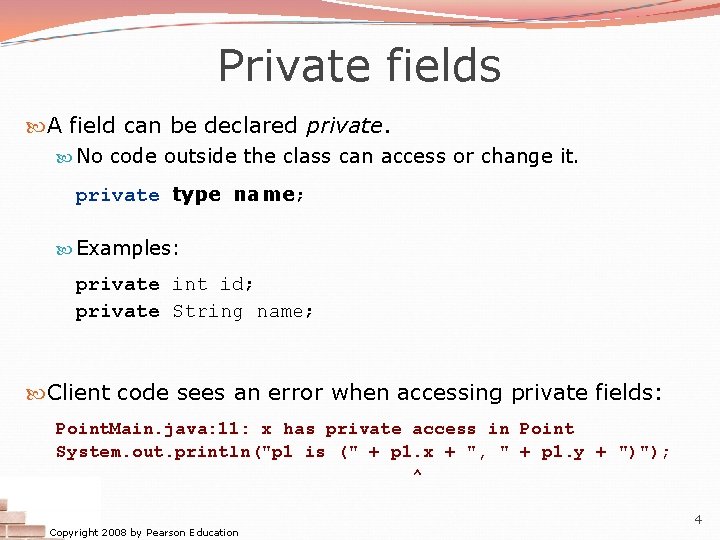
Private fields A field can be declared private. No code outside the class can access or change it. private type name; Examples: private int id; private String name; Client code sees an error when accessing private fields: Point. Main. java: 11: x has private access in Point System. out. println("p 1 is (" + p 1. x + ", " + p 1. y + ")"); ^ Copyright 2008 by Pearson Education 4
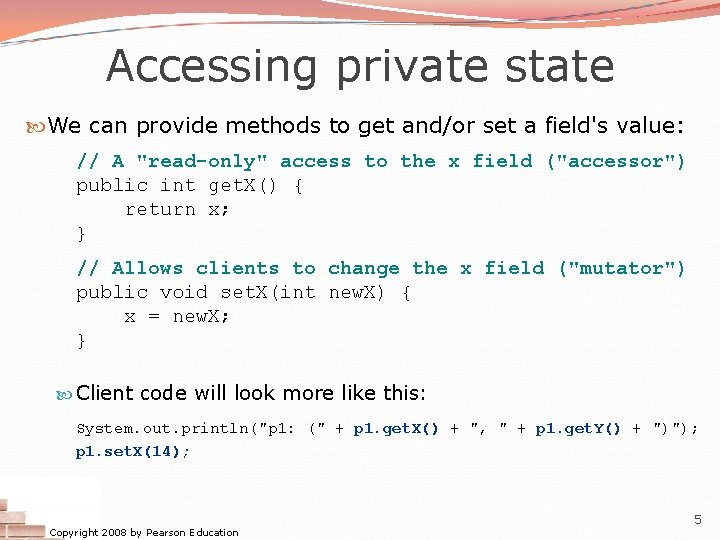
Accessing private state We can provide methods to get and/or set a field's value: // A "read-only" access to the x field ("accessor") public int get. X() { return x; } // Allows clients to change the x field ("mutator") public void set. X(int new. X) { x = new. X; } Client code will look more like this: System. out. println("p 1: (" + p 1. get. X() + ", " + p 1. get. Y() + ")"); p 1. set. X(14); Copyright 2008 by Pearson Education 5
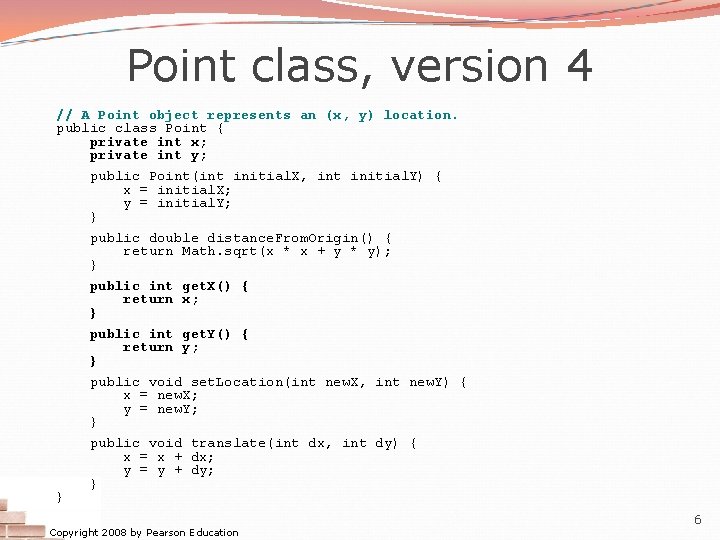
Point class, version 4 // A Point object represents an (x, y) location. public class Point { private int x; private int y; public Point(int initial. X, int initial. Y) { x = initial. X; y = initial. Y; } public double distance. From. Origin() { return Math. sqrt(x * x + y * y); } public int get. X() { return x; } public int get. Y() { return y; } public void set. Location(int new. X, int new. Y) { x = new. X; y = new. Y; } } public void translate(int dx, int dy) { x = x + dx; y = y + dy; } Copyright 2008 by Pearson Education 6
![Client code, version 4 public class Point. Main 4 { public static void main(String[]](http://slidetodoc.com/presentation_image_h2/97313b45abf7b48bd70ad602fc7bab75/image-7.jpg "Client code, version 4 public class Point. Main 4 { public static void main(String[]")
Client code, version 4 public class Point. Main 4 { public static void main(String[] args) { // create two Point objects Point p 1 = new Point(5, 2); Point p 2 = new Point(4, 3); // print each point System. out. println("p 1: (" + p 1. get. X() + ", " + p 1. get. Y() + ")"); System. out. println("p 2: (" + p 2. get. X() + ", " + p 2. get. Y() + ")"); // move p 2 and then print it again p 2. translate(2, 4); System. out. println("p 2: (" + p 2. get. X() + ", " + p 2. get. Y() + ")"); } } OUTPUT: p 1 is (5, 2) p 2 is (4, 3) p 2 is (6, 7) Copyright 2008 by Pearson Education 7

Benefits of encapsulation Provides abstraction between an object and its clients. Protects an object from unwanted access by clients. A bank app forbids a client to change an Account's balance. Allows you to change the class implementation. Point could be rewritten to use polar coordinates (radius r, angle θ), but with the same methods. Allows you to constrain objects' state (invariants). Example: Only allow Points with non-negative coordinates. Copyright 2008 by Pearson Education 8
Inheritance reading: 9. 1 Copyright 2008 by Pearson Education
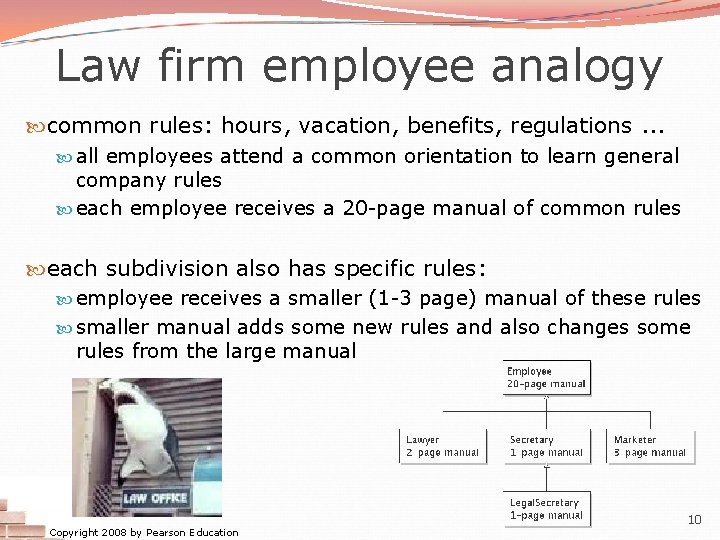
Law firm employee analogy common rules: hours, vacation, benefits, regulations. . . all employees attend a common orientation to learn general company rules each employee receives a 20 -page manual of common rules each subdivision also has specific rules: employee receives a smaller (1 -3 page) manual of these rules smaller manual adds some new rules and also changes some rules from the large manual Copyright 2008 by Pearson Education 10
Separating behavior Why not just have a 22 page Lawyer manual, a 21 -page Secretary manual, a 23 -page Marketer manual, etc. ? Some advantages of the separate manuals: maintenance: Only one update if a common rule changes. locality: Quick discovery of all rules specific to lawyers. Some key ideas from this example: General rules are useful (the 20 -page manual). Specific rules that may override general ones are also useful. Copyright 2008 by Pearson Education 11
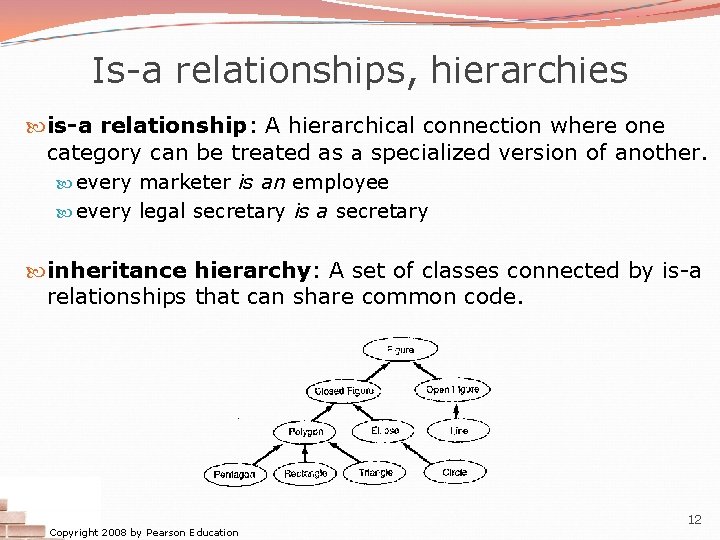
Is-a relationships, hierarchies is-a relationship: A hierarchical connection where one category can be treated as a specialized version of another. every marketer is an employee every legal secretary is a secretary inheritance hierarchy: A set of classes connected by is-a relationships that can share common code. Copyright 2008 by Pearson Education 12
Employee regulations Consider the following employee regulations: Employees work 40 hours / week. Employees make $40, 000 per year, except legal secretaries who make $5, 000 extra per year ($45, 000 total), and marketers who make $10, 000 extra per year ($50, 000 total). Employees have 2 weeks of paid vacation leave per year, except lawyers who get an extra week (a total of 3). Employees should use a yellow form to apply for leave, except for lawyers who use a pink form. Each type of employee has some unique behavior: Lawyers know how to sue. Marketers know how to advertise. Secretaries know how to take dictation. Legal secretaries know how to prepare legal documents. Copyright 2008 by Pearson Education 13
An Employee class // A class to represent employees in general (20 -page manual). public class Employee { public int get. Hours() { return 40; // works 40 hours / week } public double get. Salary() { return 40000. 0; // $40, 000. 00 / year } public int get. Vacation. Days() { return 10; // 2 weeks' paid vacation } } public String get. Vacation. Form() { return "yellow"; // use the yellow form } Exercise: Implement class Secretary, based on the previous employee regulations. (Secretaries can take dictation. ) Copyright 2008 by Pearson Education 14
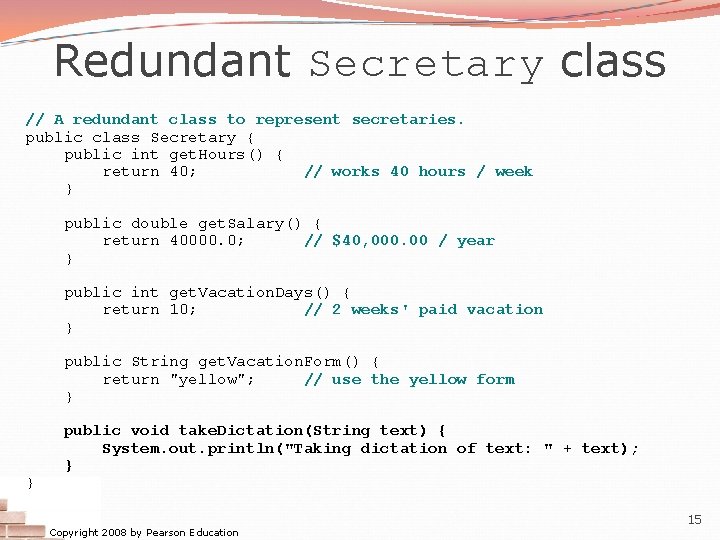
Redundant Secretary class // A redundant class to represent secretaries. public class Secretary { public int get. Hours() { return 40; // works 40 hours / week } public double get. Salary() { return 40000. 0; // $40, 000. 00 / year } public int get. Vacation. Days() { return 10; // 2 weeks' paid vacation } public String get. Vacation. Form() { return "yellow"; // use the yellow form } } public void take. Dictation(String text) { System. out. println("Taking dictation of text: " + text); } Copyright 2008 by Pearson Education 15
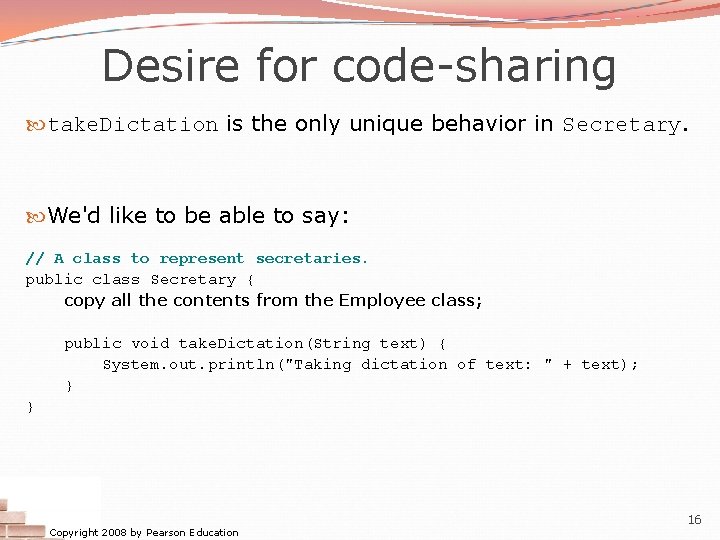
Desire for code-sharing take. Dictation is the only unique behavior in Secretary. We'd like to be able to say: // A class to represent secretaries. public class Secretary { copy all the contents from the Employee class; public void take. Dictation(String text) { System. out. println("Taking dictation of text: " + text); } } Copyright 2008 by Pearson Education 16
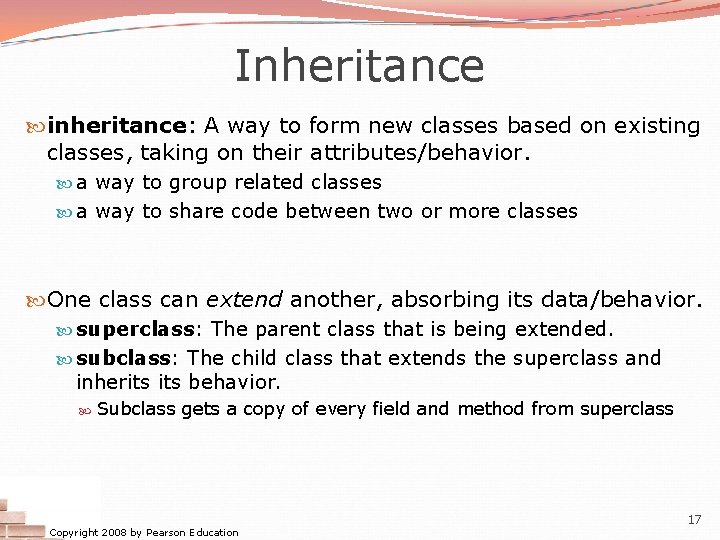
Inheritance inheritance: A way to form new classes based on existing classes, taking on their attributes/behavior. a way to group related classes a way to share code between two or more classes One class can extend another, absorbing its data/behavior. superclass: The parent class that is being extended. subclass: The child class that extends the superclass and inherits behavior. Subclass gets a copy of every field and method from superclass Copyright 2008 by Pearson Education 17
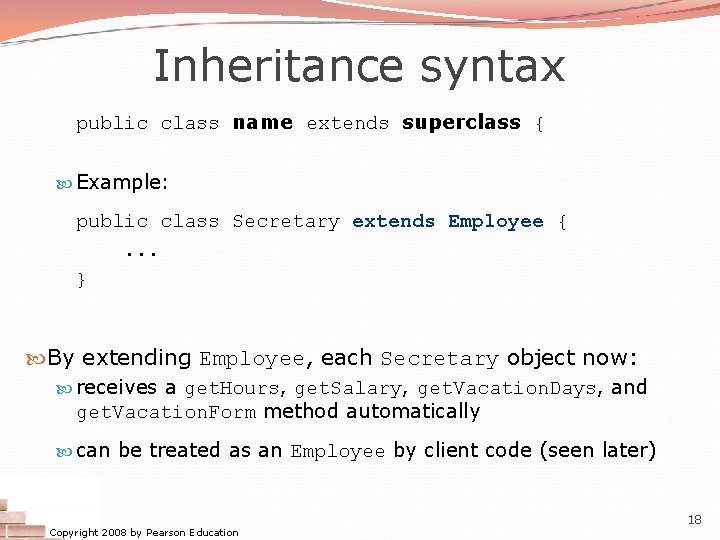
Inheritance syntax public class name extends superclass { Example: public class Secretary extends Employee {. . . } By extending Employee, each Secretary object now: receives a get. Hours, get. Salary, get. Vacation. Days, and get. Vacation. Form method automatically can be treated as an Employee by client code (seen later) Copyright 2008 by Pearson Education 18
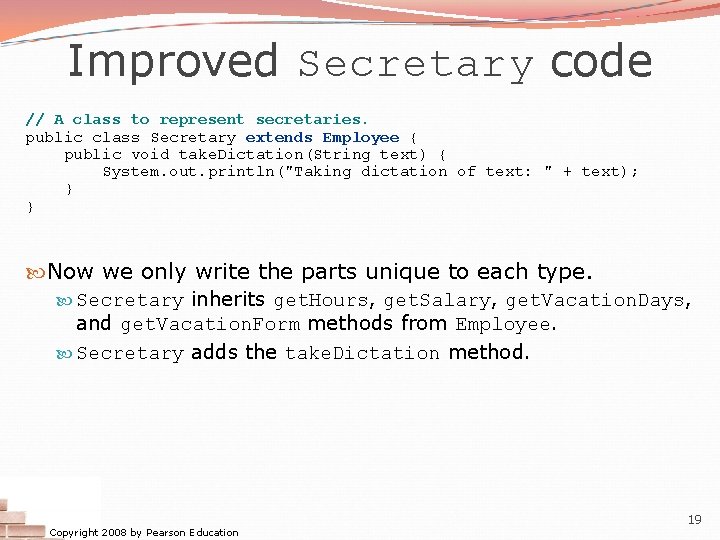
Improved Secretary code // A class to represent secretaries. public class Secretary extends Employee { public void take. Dictation(String text) { System. out. println("Taking dictation of text: " + text); } } Now we only write the parts unique to each type. Secretary inherits get. Hours, get. Salary, get. Vacation. Days, and get. Vacation. Form methods from Employee. Secretary adds the take. Dictation method. Copyright 2008 by Pearson Education 19
Implementing Lawyer Consider the following lawyer regulations: Lawyers who get an extra week of paid vacation (a total of 3). Lawyers use a pink form when applying for vacation leave. Lawyers have some unique behavior: they know how to sue. Problem: We want lawyers to inherit most behavior from employee, but we want to replace parts with new behavior. Copyright 2008 by Pearson Education 20
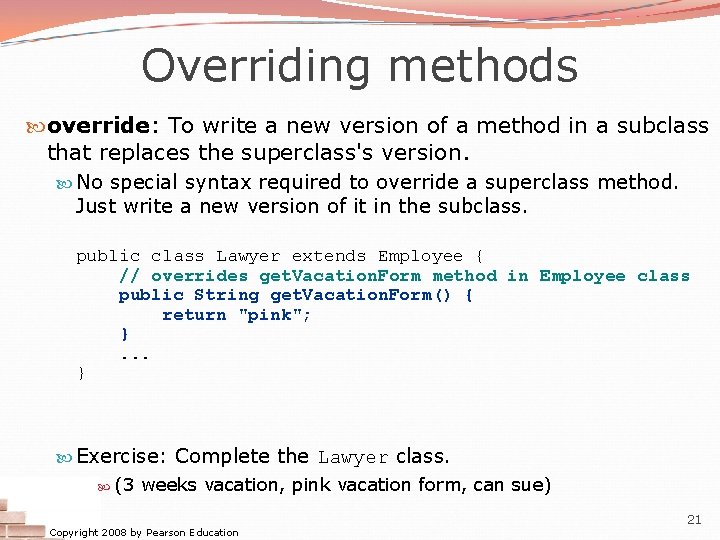
Overriding methods override: To write a new version of a method in a subclass that replaces the superclass's version. No special syntax required to override a superclass method. Just write a new version of it in the subclass. public class Lawyer extends Employee { // overrides get. Vacation. Form method in Employee class public String get. Vacation. Form() { return "pink"; }. . . } Exercise: Complete the Lawyer class. (3 weeks vacation, pink vacation form, can sue) Copyright 2008 by Pearson Education 21
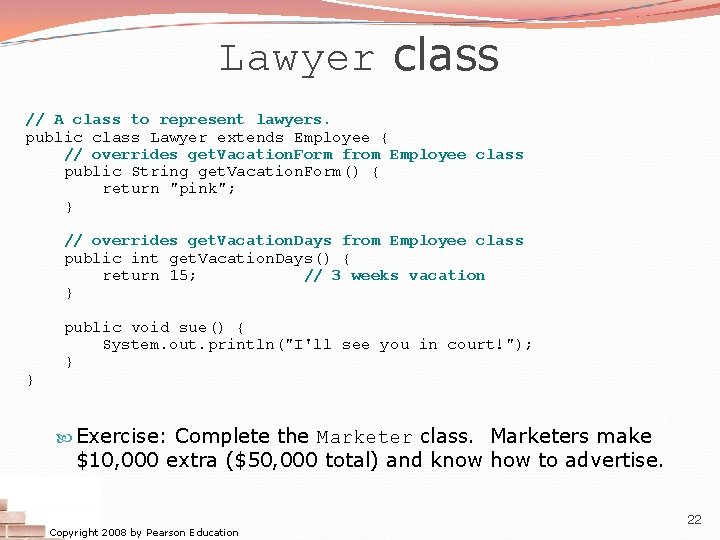
Lawyer class // A class to represent lawyers. public class Lawyer extends Employee { // overrides get. Vacation. Form from Employee class public String get. Vacation. Form() { return "pink"; } // overrides get. Vacation. Days from Employee class public int get. Vacation. Days() { return 15; // 3 weeks vacation } } public void sue() { System. out. println("I'll see you in court!"); } Exercise: Complete the Marketer class. Marketers make $10, 000 extra ($50, 000 total) and know how to advertise. Copyright 2008 by Pearson Education 22
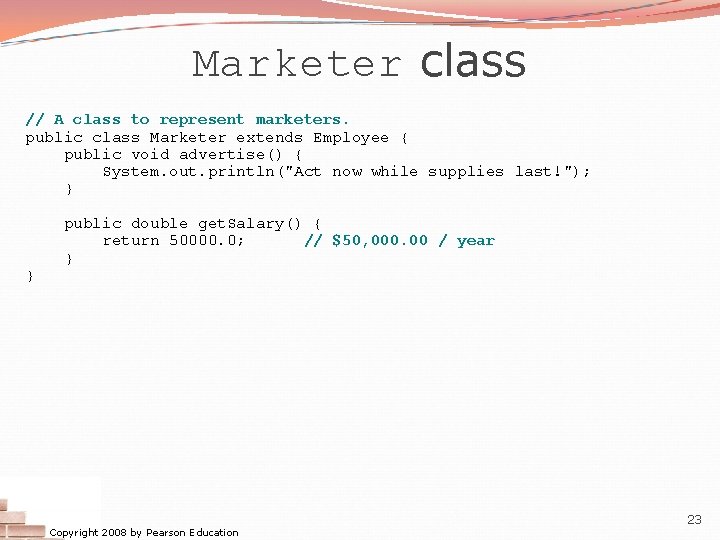
Marketer class // A class to represent marketers. public class Marketer extends Employee { public void advertise() { System. out. println("Act now while supplies last!"); } } public double get. Salary() { return 50000. 0; // $50, 000. 00 / year } Copyright 2008 by Pearson Education 23
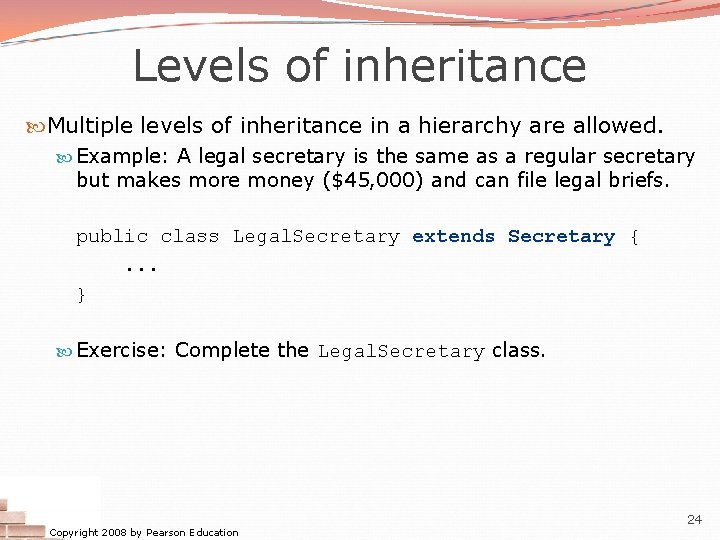
Levels of inheritance Multiple levels of inheritance in a hierarchy are allowed. Example: A legal secretary is the same as a regular secretary but makes more money ($45, 000) and can file legal briefs. public class Legal. Secretary extends Secretary {. . . } Exercise: Complete the Legal. Secretary class. Copyright 2008 by Pearson Education 24
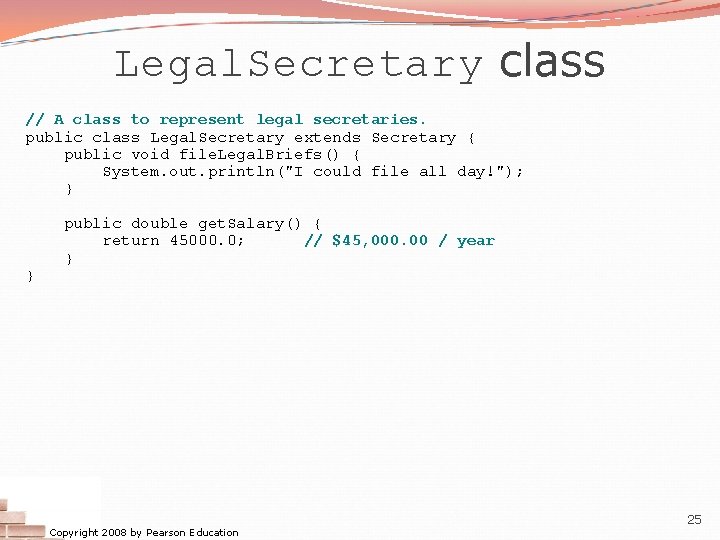
Legal. Secretary class // A class to represent legal secretaries. public class Legal. Secretary extends Secretary { public void file. Legal. Briefs() { System. out. println("I could file all day!"); } } public double get. Salary() { return 45000. 0; // $45, 000. 00 / year } Copyright 2008 by Pearson Education 25
- Slides: 25