
Building Java Programs Chapter 8 Classes and Objects
Building Java Programs Chapter 8: Classes and Objects Copyright 2006 by Pearson Education 1
Lecture outline n the keyword this n n multiple constructors static fields and methods in a class Copyright 2006 by Pearson Education 2
The keyword this reading: 8. 7 Copyright 2006 by Pearson Education 3
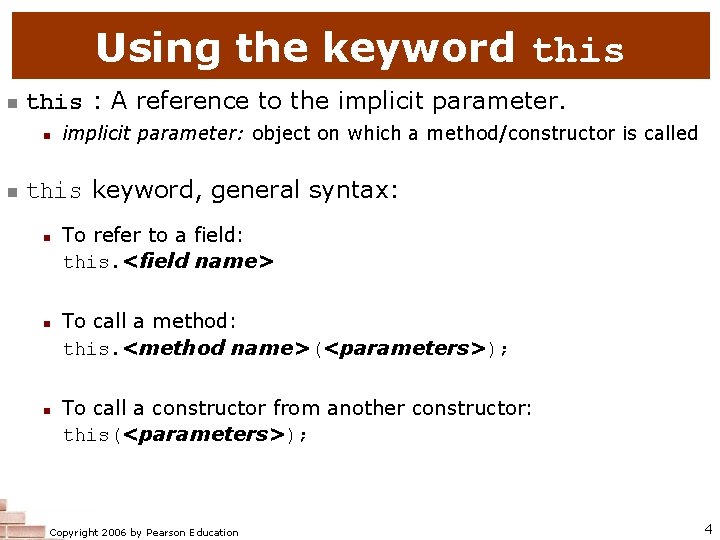
Using the keyword this n this : A reference to the implicit parameter. n n implicit parameter: object on which a method/constructor is called this keyword, general syntax: n n n To refer to a field: this. <field name> To call a method: this. <method name>(<parameters>); To call a constructor from another constructor: this(<parameters>); Copyright 2006 by Pearson Education 4
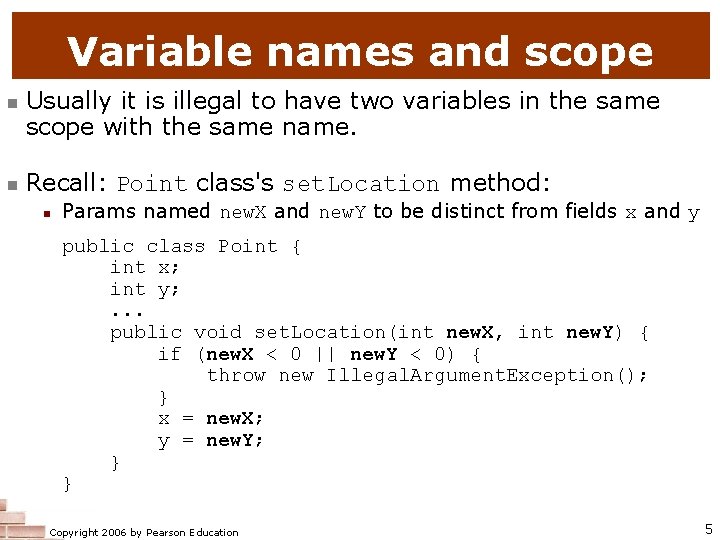
Variable names and scope n n Usually it is illegal to have two variables in the same scope with the same name. Recall: Point class's set. Location method: n Params named new. X and new. Y to be distinct from fields x and y public class Point { int x; int y; . . . public void set. Location(int new. X, int new. Y) { if (new. X < 0 || new. Y < 0) { throw new Illegal. Argument. Exception(); } x = new. X; y = new. Y; } } Copyright 2006 by Pearson Education 5
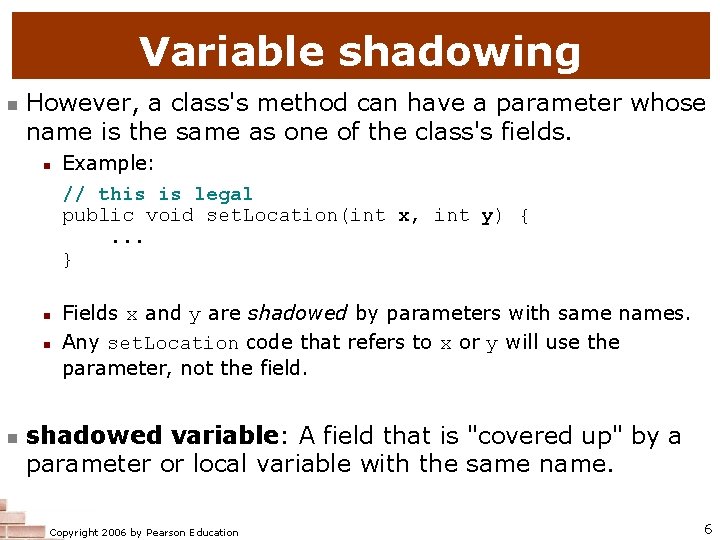
Variable shadowing n However, a class's method can have a parameter whose name is the same as one of the class's fields. n n Example: // this is legal public void set. Location(int x, int y) {. . . } Fields x and y are shadowed by parameters with same names. Any set. Location code that refers to x or y will use the parameter, not the field. shadowed variable: A field that is "covered up" by a parameter or local variable with the same name. Copyright 2006 by Pearson Education 6

Avoiding shadowing with this n The keyword this prevents shadowing: public class Point { private int x; private int y; . . . } public void set. Location(int x, int y) { if (x < 0 || y < 0) { throw new Illegal. Argument. Exception(); } this. x = x; this. y = y; } Inside the set. Location method: n When this. x is seen, the field x is used. n When x is seen, the parameter x is used. Copyright 2006 by Pearson Education 7
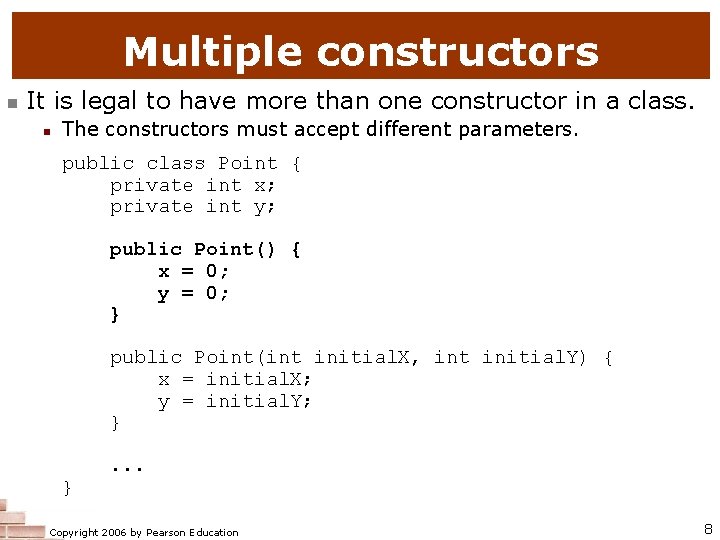
Multiple constructors n It is legal to have more than one constructor in a class. n The constructors must accept different parameters. public class Point { private int x; private int y; public Point() { x = 0; y = 0; } public Point(int initial. X, int initial. Y) { x = initial. X; y = initial. Y; } } . . . Copyright 2006 by Pearson Education 8
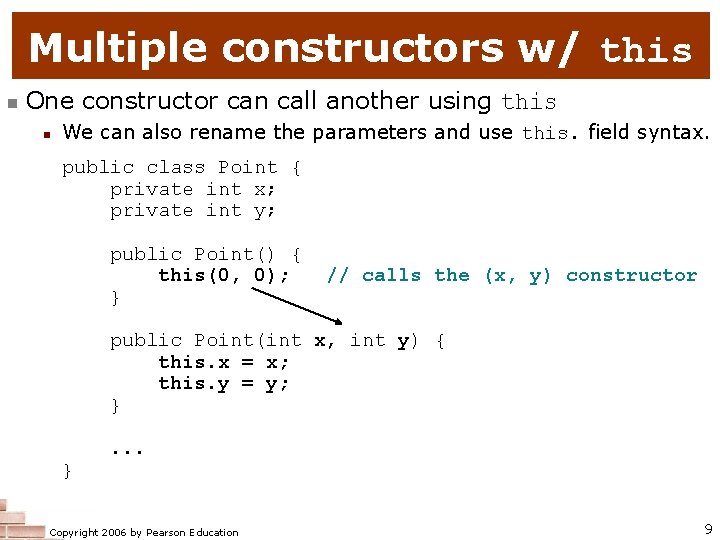
Multiple constructors w/ this n One constructor can call another using this n We can also rename the parameters and use this. field syntax. public class Point { private int x; private int y; public Point() { this(0, 0); } // calls the (x, y) constructor public Point(int x, int y) { this. x = x; this. y = y; } } . . . Copyright 2006 by Pearson Education 9
Static fields / methods Copyright 2006 by Pearson Education 10
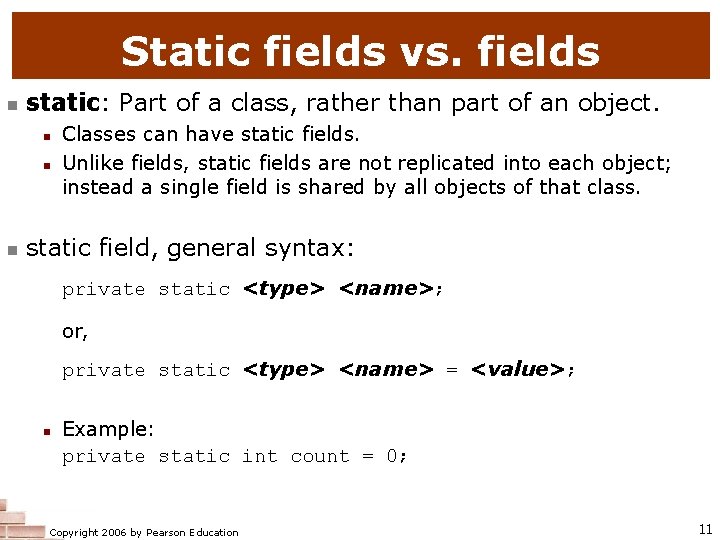
Static fields vs. fields n static: Part of a class, rather than part of an object. n n n Classes can have static fields. Unlike fields, static fields are not replicated into each object; instead a single field is shared by all objects of that class. static field, general syntax: private static <type> <name>; or, private static <type> <name> = <value>; n Example: private static int count = 0; Copyright 2006 by Pearson Education 11
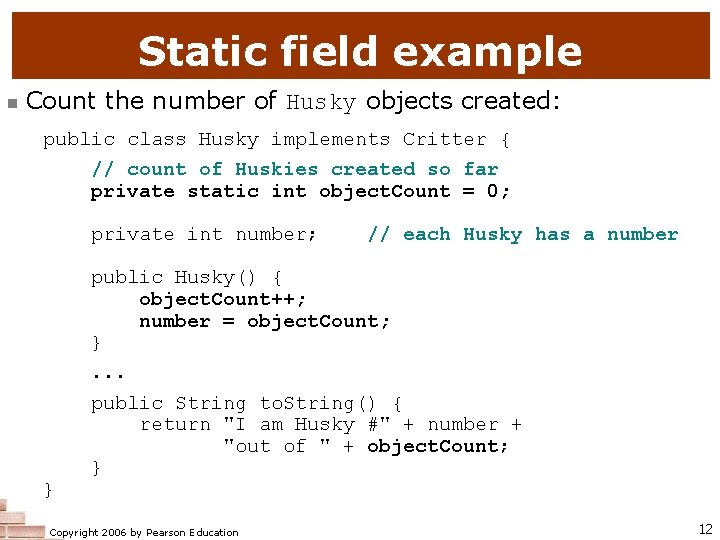
Static field example n Count the number of Husky objects created: public class Husky implements Critter { // count of Huskies created so far private static int object. Count = 0; private int number; // each Husky has a number public Husky() { object. Count++; number = object. Count; }. . . } public String to. String() { return "I am Husky #" + number + "out of " + object. Count; } Copyright 2006 by Pearson Education 12
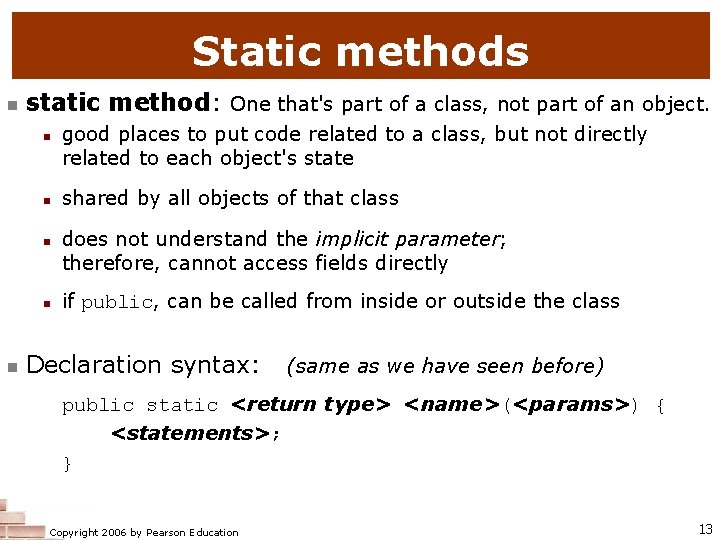
Static methods n static method: One that's part of a class, not part of an object. n n n good places to put code related to a class, but not directly related to each object's state shared by all objects of that class does not understand the implicit parameter; therefore, cannot access fields directly if public, can be called from inside or outside the class Declaration syntax: (same as we have seen before) public static <return type> <name>(<params>) { <statements>; } Copyright 2006 by Pearson Education 13
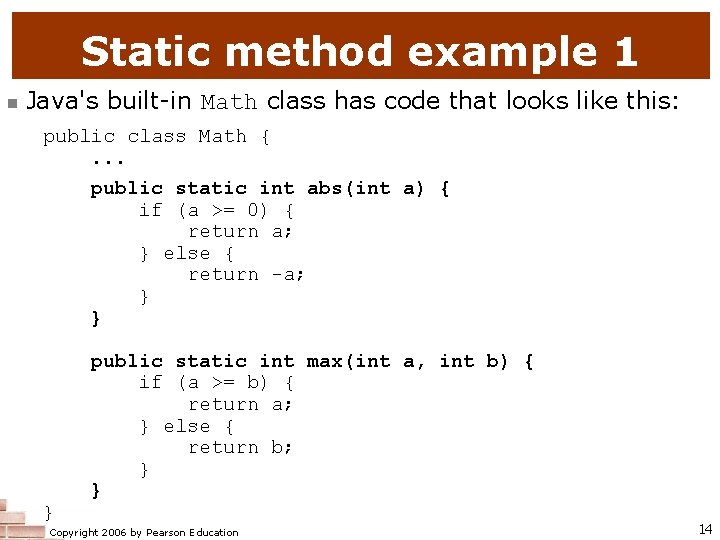
Static method example 1 n Java's built-in Math class has code that looks like this: public class Math {. . . public static int abs(int a) { if (a >= 0) { return a; } else { return -a; } } } public static int max(int a, int b) { if (a >= b) { return a; } else { return b; } } Copyright 2006 by Pearson Education 14
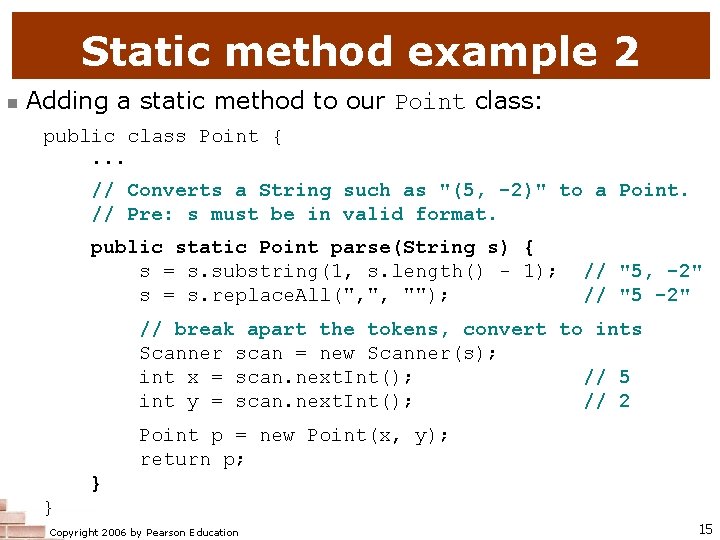
Static method example 2 n Adding a static method to our Point class: public class Point {. . . // Converts a String such as "(5, -2)" to a Point. // Pre: s must be in valid format. public static Point parse(String s) { s = s. substring(1, s. length() - 1); s = s. replace. All(", ", ""); // "5, -2" // "5 -2" // break apart the tokens, convert to ints Scanner scan = new Scanner(s); int x = scan. next. Int(); // 5 int y = scan. next. Int(); // 2 Point p = new Point(x, y); return p; } } Copyright 2006 by Pearson Education 15
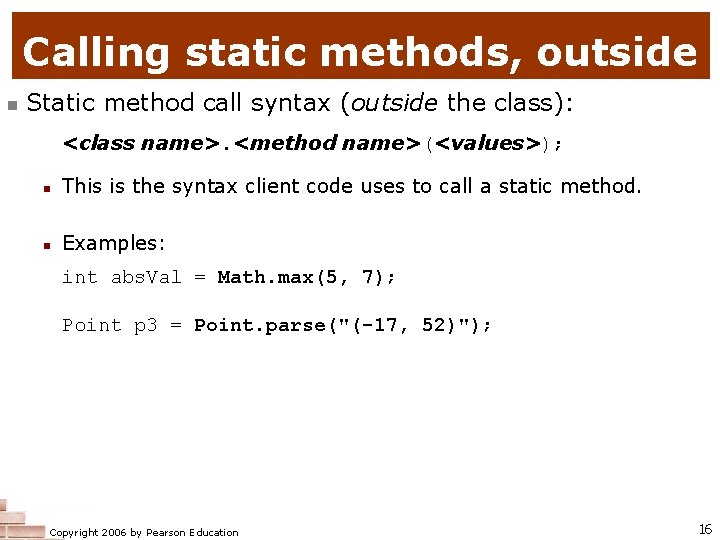
Calling static methods, outside n Static method call syntax (outside the class): <class name>. <method name>(<values>); n This is the syntax client code uses to call a static method. n Examples: int abs. Val = Math. max(5, 7); Point p 3 = Point. parse("(-17, 52)"); Copyright 2006 by Pearson Education 16
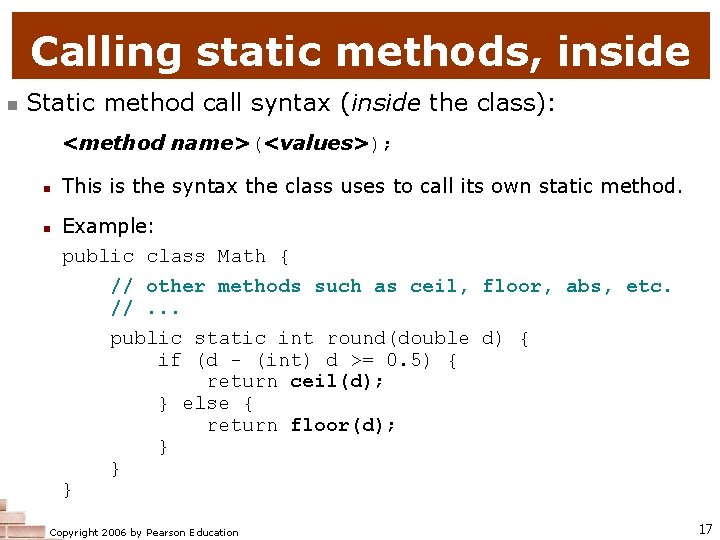
Calling static methods, inside n Static method call syntax (inside the class): <method name>(<values>); n n This is the syntax the class uses to call its own static method. Example: public class Math { // other methods such as ceil, floor, abs, etc. //. . . } public static int round(double d) { if (d - (int) d >= 0. 5) { return ceil(d); } else { return floor(d); } } Copyright 2006 by Pearson Education 17
- Slides: 17