
Building Java Programs Chapter 7 Lecture 7 3
Building Java Programs Chapter 7 Lecture 7 -3: Arrays for Tallying; Text Processing reading: 4. 3, 7. 6 Copyright 2010 by Pearson Education
Copyright 2010 by Pearson Education 2
A multi-counter problem �Problem: Write a method most. Frequent. Digit that returns the digit value that occurs most frequently in a number. � Example: The number 669260267 contains: one 0, two 2 s, four 6 es, one 7, and one 9. most. Frequent. Digit(669260267) returns 6. � If there is a tie, return the digit with the lower value. most. Frequent. Digit(57135203) returns 3. Copyright 2010 by Pearson Education 3
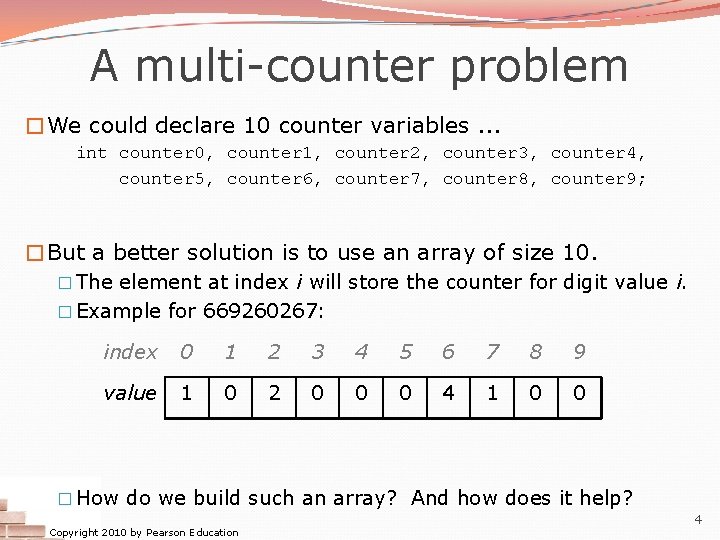
A multi-counter problem �We could declare 10 counter variables. . . int counter 0, counter 1, counter 2, counter 3, counter 4, counter 5, counter 6, counter 7, counter 8, counter 9; �But a better solution is to use an array of size 10. � The element at index i will store the counter for digit value i. � Example for 669260267: index 0 1 2 3 4 5 6 7 8 9 value 1 0 2 0 0 0 4 1 0 0 � How do we build such an array? And how does it help? Copyright 2010 by Pearson Education 4
![Creating an array of tallies // assume n = 669260267 int[] counts = new](http://slidetodoc.com/presentation_image_h2/9a46d3acb9e8a940bd48007d4bcbd3fd/image-5.jpg "Creating an array of tallies // assume n = 669260267 int[] counts = new")
Creating an array of tallies // assume n = 669260267 int[] counts = new int[10]; while (n > 0) { // pluck off a digit and add to proper counter int digit = n % 10; counts[digit]++; n = n / 10; } index 0 1 2 3 4 5 6 7 8 9 value 1 0 2 0 0 0 4 1 0 0 Copyright 2010 by Pearson Education 5
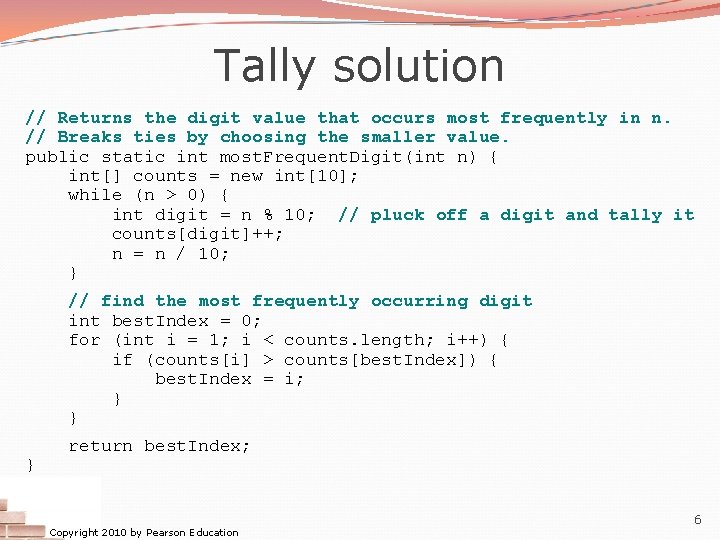
Tally solution // Returns the digit value that occurs most frequently in n. // Breaks ties by choosing the smaller value. public static int most. Frequent. Digit(int n) { int[] counts = new int[10]; while (n > 0) { int digit = n % 10; // pluck off a digit and tally it counts[digit]++; n = n / 10; } // find the most frequently occurring digit int best. Index = 0; for (int i = 1; i < counts. length; i++) { if (counts[i] > counts[best. Index]) { best. Index = i; } } } return best. Index; Copyright 2010 by Pearson Education 6
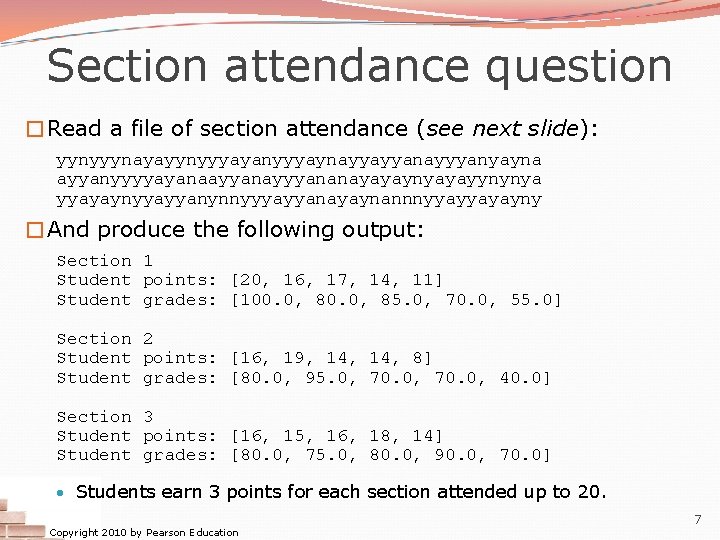
Section attendance question �Read a file of section attendance (see next slide): yynyyynayayynyyyayanyyyaynayyayyanayyyanyayna ayyanyyyyayanaayyanayyyananayayaynyayayynynya yyayaynyyayyanynnyyyayyanayaynannnyyayyayayny �And produce the following output: Section 1 Student points: [20, 16, 17, 14, 11] Student grades: [100. 0, 85. 0, 70. 0, 55. 0] Section 2 Student points: [16, 19, 14, 8] Student grades: [80. 0, 95. 0, 70. 0, 40. 0] Section 3 Student points: [16, 15, 16, 18, 14] Student grades: [80. 0, 75. 0, 80. 0, 90. 0, 70. 0] • Students earn 3 points for each section attended up to 20. Copyright 2010 by Pearson Education 7
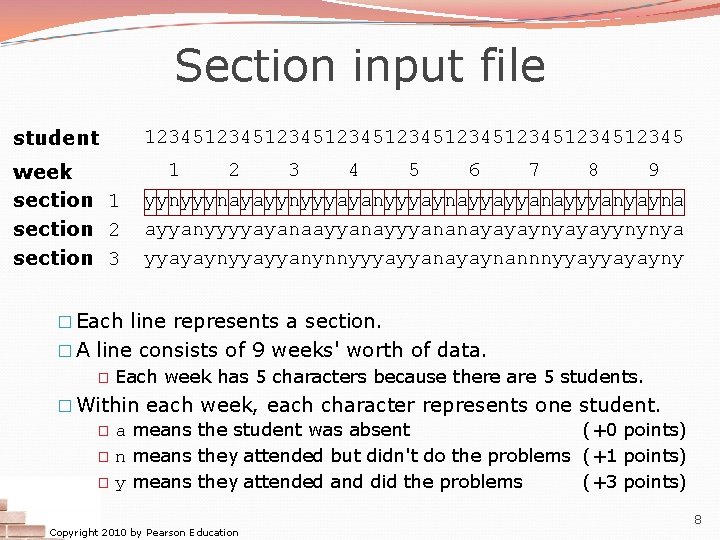
Section input file student 1234512345123451234512345 week section 1 section 2 section 3 1 2 3 4 5 6 7 8 9 yynyyynayayynyyyayanyyyaynayyayyanayyyanyayna ayyanyyyyayanaayyanayyyananayayaynyayayynynya yyayaynyyayyanynnyyyayyanayaynannnyyayyayayny � Each line represents a section. � A line consists of 9 weeks' worth of data. � Each week has 5 characters because there are 5 students. � Within each week, each character represents one � a means the student was absent � n means they attended but didn't do the problems � y means they attended and did the problems Copyright 2010 by Pearson Education student. (+0 points) (+1 points) (+3 points) 8
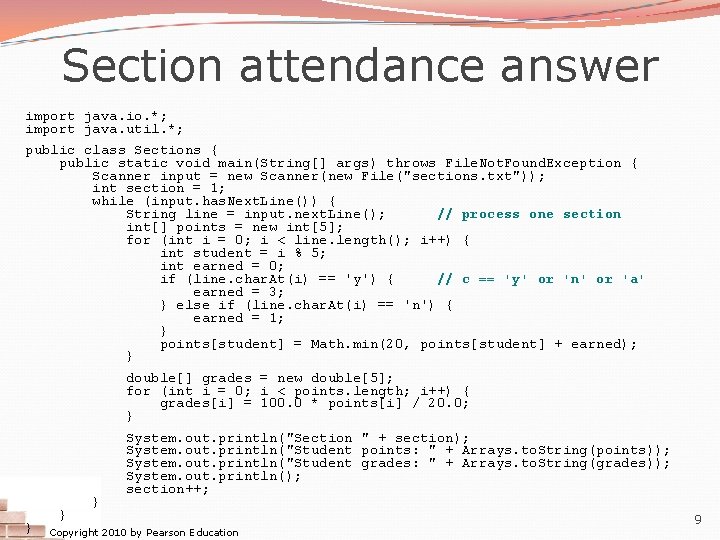
Section attendance answer import java. io. *; import java. util. *; public class Sections { public static void main(String[] args) throws File. Not. Found. Exception { Scanner input = new Scanner(new File("sections. txt")); int section = 1; while (input. has. Next. Line()) { String line = input. next. Line(); // process one section int[] points = new int[5]; for (int i = 0; i < line. length(); i++) { int student = i % 5; int earned = 0; if (line. char. At(i) == 'y') { // c == 'y' or 'n' or 'a' earned = 3; } else if (line. char. At(i) == 'n') { earned = 1; } points[student] = Math. min(20, points[student] + earned); } double[] grades = new double[5]; for (int i = 0; i < points. length; i++) { grades[i] = 100. 0 * points[i] / 20. 0; } } System. out. println("Section " + section); System. out. println("Student points: " + Arrays. to. String(points)); System. out. println("Student grades: " + Arrays. to. String(grades)); System. out. println(); section++; Copyright 2010 by Pearson Education 9
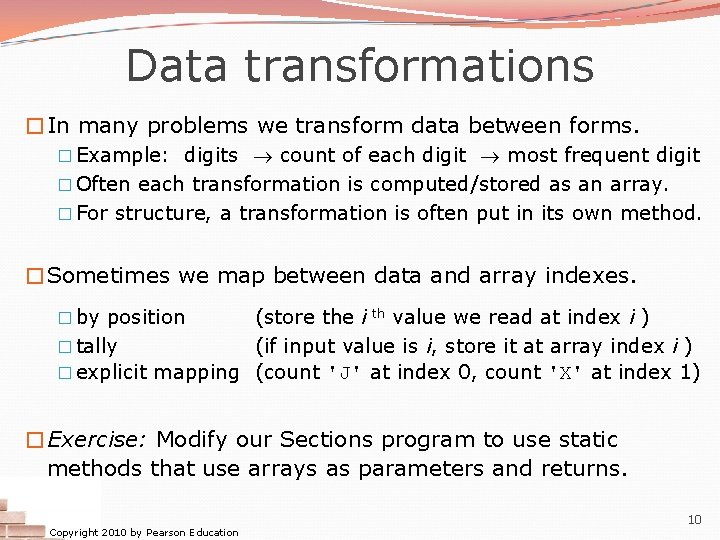
Data transformations �In many problems we transform data between forms. � Example: digits count of each digit most frequent digit � Often each transformation is computed/stored as an array. � For structure, a transformation is often put in its own method. �Sometimes we map between data and array indexes. � by position (store the i th value we read at index i ) � tally (if input value is i, store it at array index i ) � explicit mapping (count 'J' at index 0, count 'X' at index 1) �Exercise: Modify our Sections program to use static methods that use arrays as parameters and returns. Copyright 2010 by Pearson Education 10
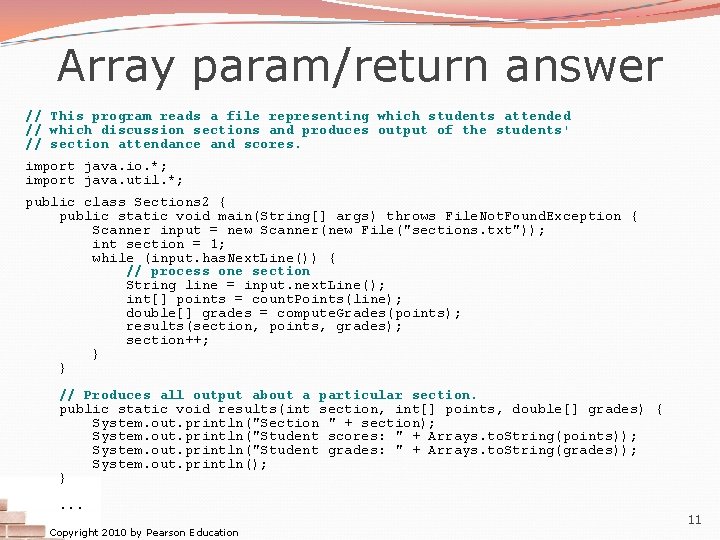
Array param/return answer // This program reads a file representing which students attended // which discussion sections and produces output of the students' // section attendance and scores. import java. io. *; import java. util. *; public class Sections 2 { public static void main(String[] args) throws File. Not. Found. Exception { Scanner input = new Scanner(new File("sections. txt")); int section = 1; while (input. has. Next. Line()) { // process one section String line = input. next. Line(); int[] points = count. Points(line); double[] grades = compute. Grades(points); results(section, points, grades); section++; } } // Produces all output about a particular section. public static void results(int section, int[] points, double[] grades) { System. out. println("Section " + section); System. out. println("Student scores: " + Arrays. to. String(points)); System. out. println("Student grades: " + Arrays. to. String(grades)); System. out. println(); }. . . Copyright 2010 by Pearson Education 11
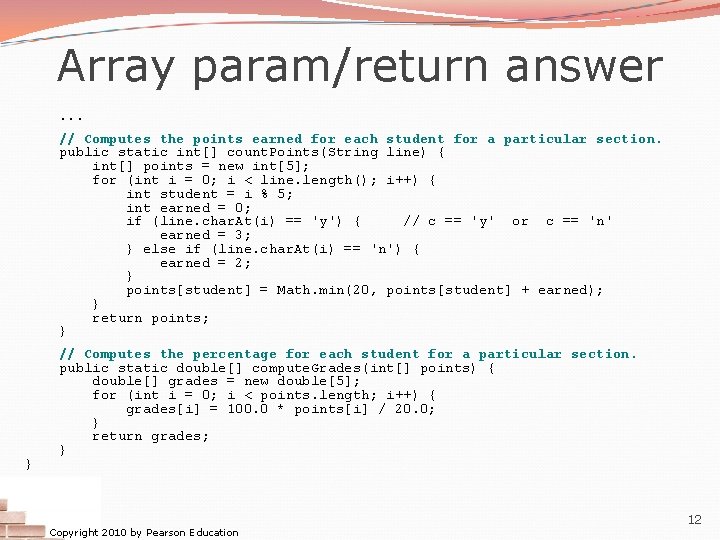
Array param/return answer. . . // Computes the points earned for each student for a particular section. public static int[] count. Points(String line) { int[] points = new int[5]; for (int i = 0; i < line. length(); i++) { int student = i % 5; int earned = 0; if (line. char. At(i) == 'y') { // c == 'y' or c == 'n' earned = 3; } else if (line. char. At(i) == 'n') { earned = 2; } points[student] = Math. min(20, points[student] + earned); } return points; } } // Computes the percentage for each student for a particular section. public static double[] compute. Grades(int[] points) { double[] grades = new double[5]; for (int i = 0; i < points. length; i++) { grades[i] = 100. 0 * points[i] / 20. 0; } return grades; } Copyright 2010 by Pearson Education 12
- Slides: 12