
Building Java Programs Chapter 5 Lecture 5 3
Building Java Programs Chapter 5 Lecture 5 -3: Boolean Logic reading: 5. 2 self-check: #11 - 17 exercises: #12 videos: Ch. 5 #2 Copyright 2008 by Pearson Education 1
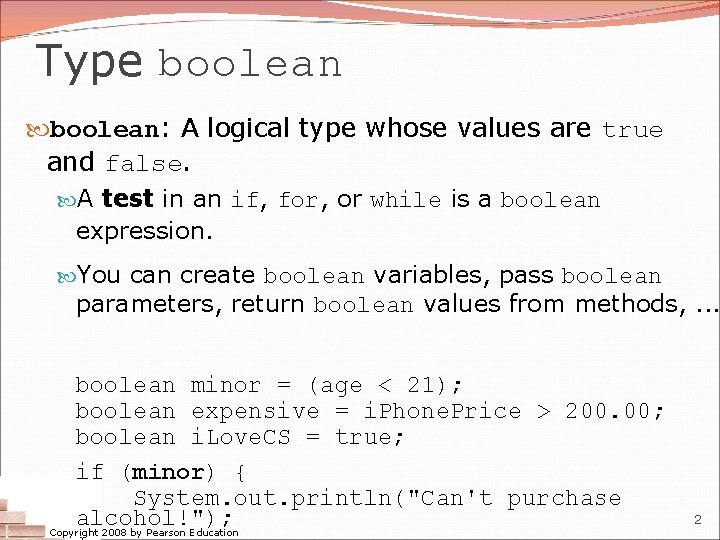
Type boolean: A logical type whose values are true and false. A test in an if, for, or while is a boolean expression. You can create boolean variables, pass boolean parameters, return boolean values from methods, . . . boolean minor = (age < 21); boolean expensive = i. Phone. Price > 200. 00; boolean i. Love. CS = true; if (minor) { System. out. println("Can't purchase alcohol!"); Copyright 2008 by Pearson Education 2
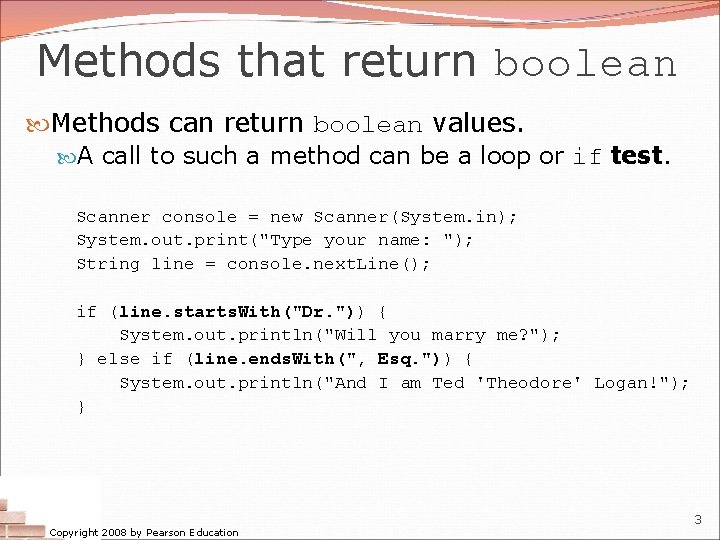
Methods that return boolean Methods can return boolean values. A call to such a method can be a loop or if test. Scanner console = new Scanner(System. in); System. out. print("Type your name: "); String line = console. next. Line(); if (line. starts. With("Dr. ")) { System. out. println("Will you marry me? "); } else if (line. ends. With(", Esq. ")) { System. out. println("And I am Ted 'Theodore' Logan!"); } Copyright 2008 by Pearson Education 3
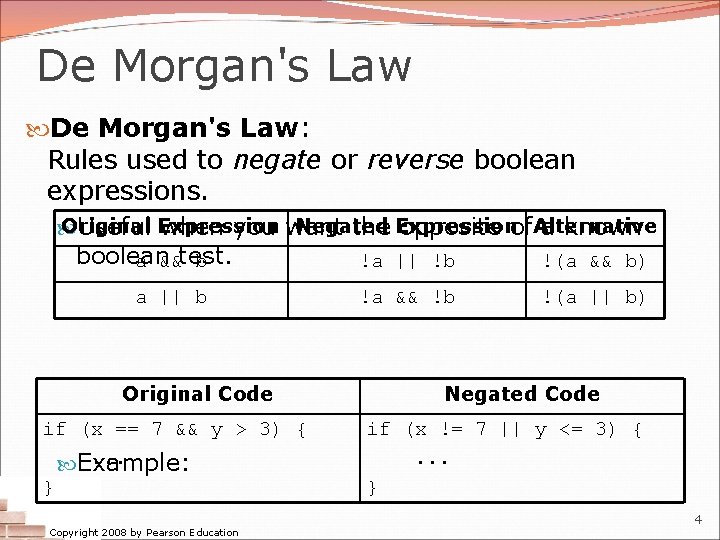
De Morgan's Law: Rules used to negate or reverse boolean expressions. Original Negated Useful Expression when you want the Expression opposite of. Alternative a known boolean a &&test. b !a || !b !(a && b) a || b Original Code if (x == 7 && y > 3) {. . . Example: } Copyright 2008 by Pearson Education !a && !b !(a || b) Negated Code if (x != 7 || y <= 3) {. . . } 4
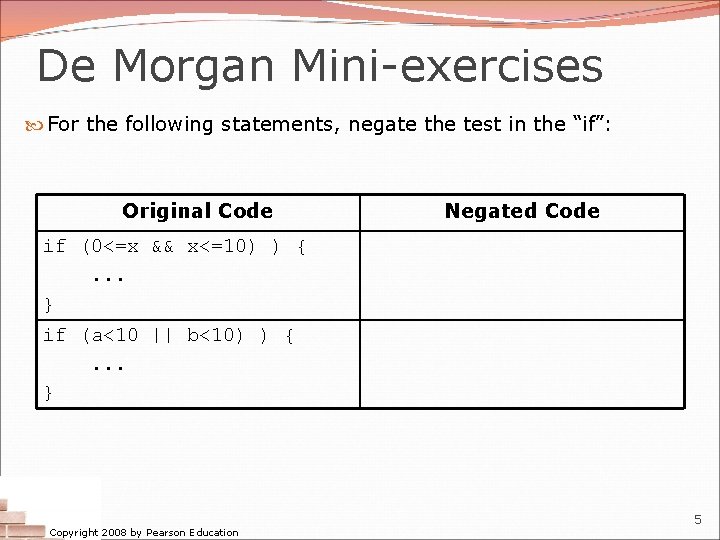
De Morgan Mini-exercises For the following statements, negate the test in the “if”: Original Code Negated Code if (0<=x && x<=10) ) {. . . } if (a<10 || b<10) ) {. . . } Copyright 2008 by Pearson Education 5
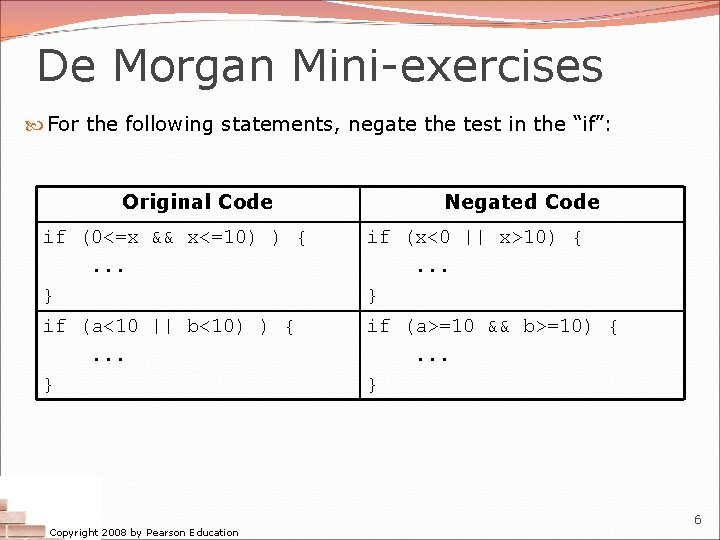
De Morgan Mini-exercises For the following statements, negate the test in the “if”: Original Code Negated Code if (0<=x && x<=10) ) {. . . } if (x<0 || x>10) {. . . } if (a<10 || b<10) ) {. . . } if (a>=10 && b>=10) {. . . } Copyright 2008 by Pearson Education 6
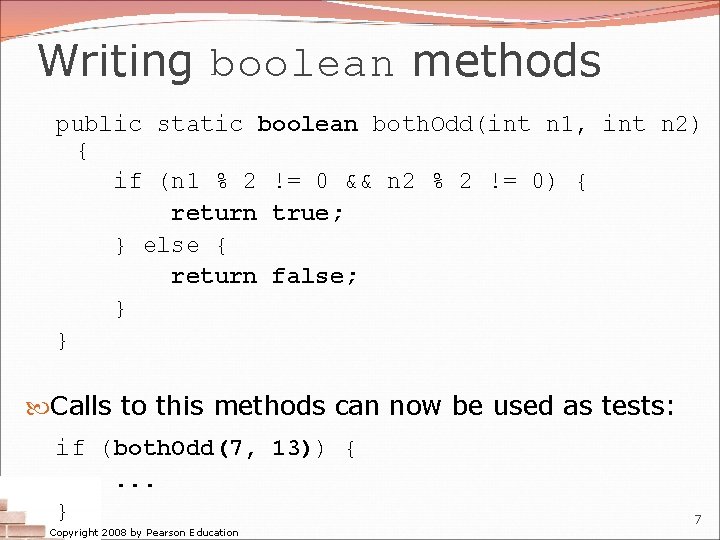
Writing boolean methods public static boolean both. Odd(int n 1, int n 2) { if (n 1 % 2 != 0 && n 2 % 2 != 0) { return true; } else { return false; } } Calls to this methods can now be used as tests: if (both. Odd(7, 13)) {. . . } Copyright 2008 by Pearson Education 7
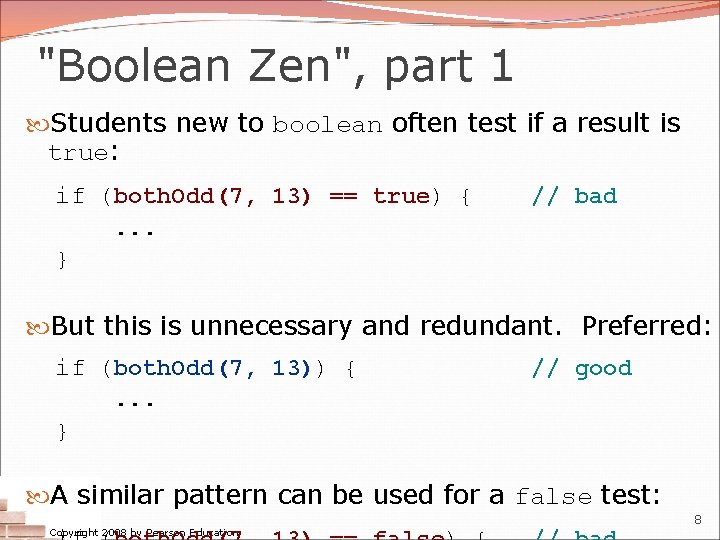
"Boolean Zen", part 1 Students new to boolean often test if a result is true: if (both. Odd(7, 13) == true) {. . . } // bad But this is unnecessary and redundant. Preferred: if (both. Odd(7, 13)) {. . . } // good A similar pattern can be used for a false test: Copyright 2008 by Pearson Education 8
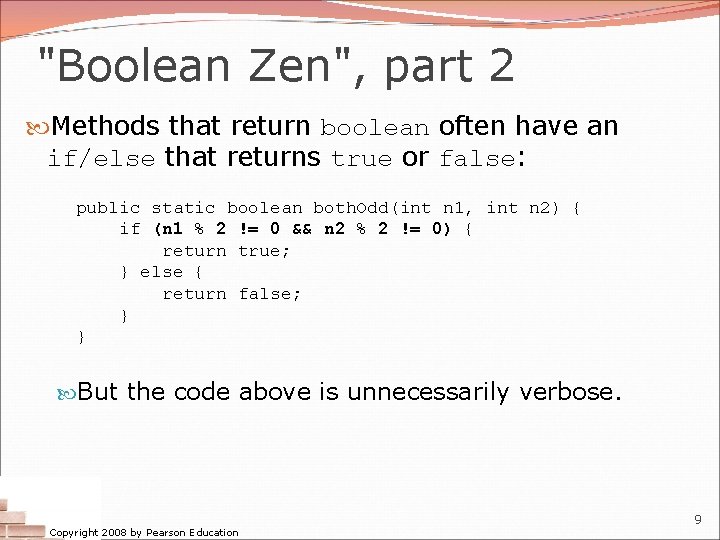
"Boolean Zen", part 2 Methods that return boolean often have an if/else that returns true or false: public static boolean both. Odd(int n 1, int n 2) { if (n 1 % 2 != 0 && n 2 % 2 != 0) { return true; } else { return false; } } But the code above is unnecessarily verbose. Copyright 2008 by Pearson Education 9
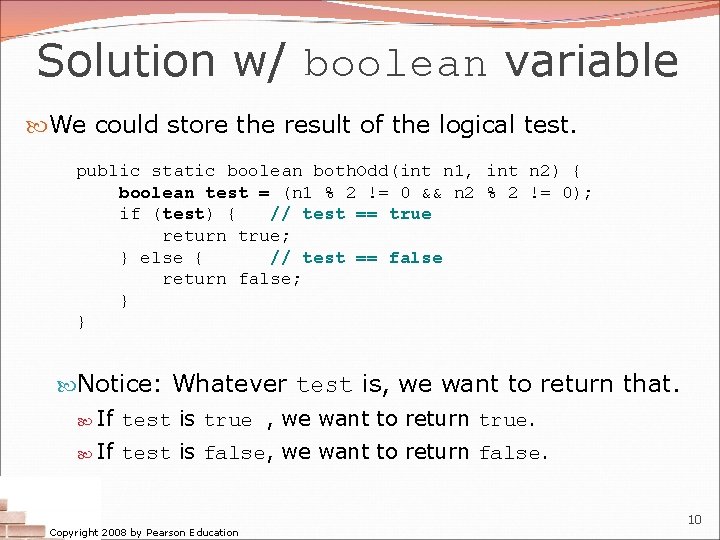
Solution w/ boolean variable We could store the result of the logical test. public static boolean both. Odd(int n 1, int n 2) { boolean test = (n 1 % 2 != 0 && n 2 % 2 != 0); if (test) { // test == true return true; } else { // test == false return false; } } Notice: Whatever test is, we want to return that. If test is true , we want to return true. If test is false, we want to return false. Copyright 2008 by Pearson Education 10
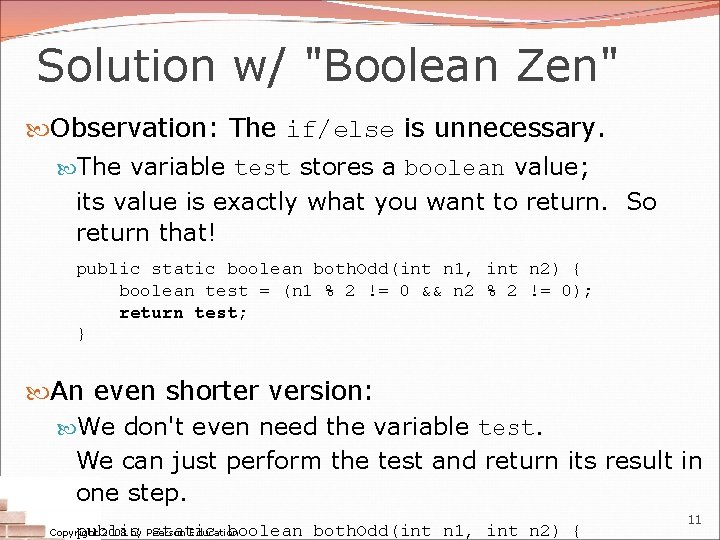
Solution w/ "Boolean Zen" Observation: The if/else is unnecessary. The variable test stores a boolean value; its value is exactly what you want to return. So return that! public static boolean both. Odd(int n 1, int n 2) { boolean test = (n 1 % 2 != 0 && n 2 % 2 != 0); return test; } An even shorter version: We don't even need the variable test. We can just perform the test and return its result in one step. public static boolean both. Odd(int n 1, int n 2) { Copyright 2008 by Pearson Education 11
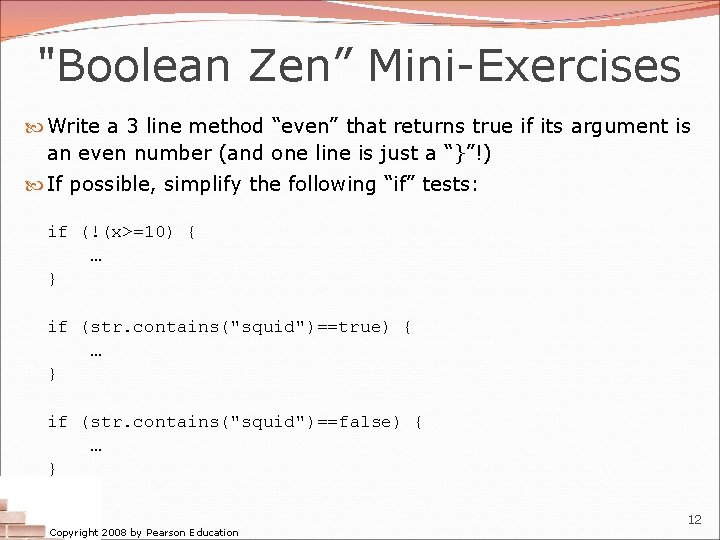
"Boolean Zen” Mini-Exercises Write a 3 line method “even” that returns true if its argument is an even number (and one line is just a “}”!) If possible, simplify the following “if” tests: if (!(x>=10) { … } if (str. contains("squid")==true) { … } if (str. contains("squid")==false) { … } Copyright 2008 by Pearson Education 12
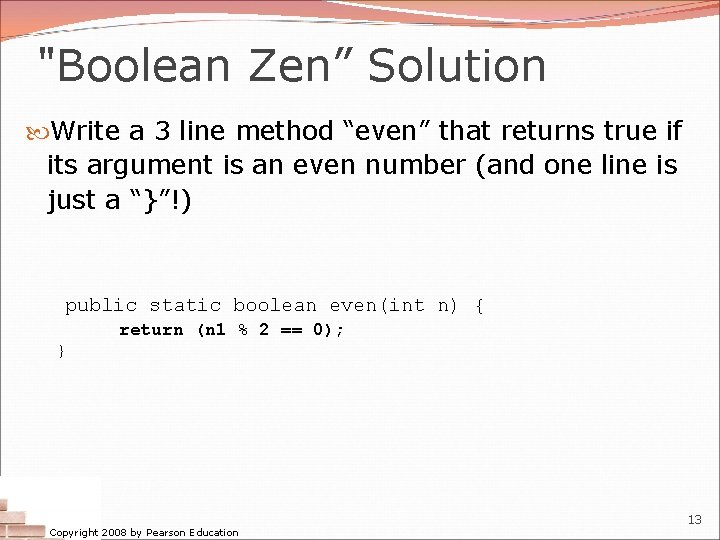
"Boolean Zen” Solution Write a 3 line method “even” that returns true if its argument is an even number (and one line is just a “}”!) public static boolean even(int n) { return (n 1 % 2 == 0); } Copyright 2008 by Pearson Education 13
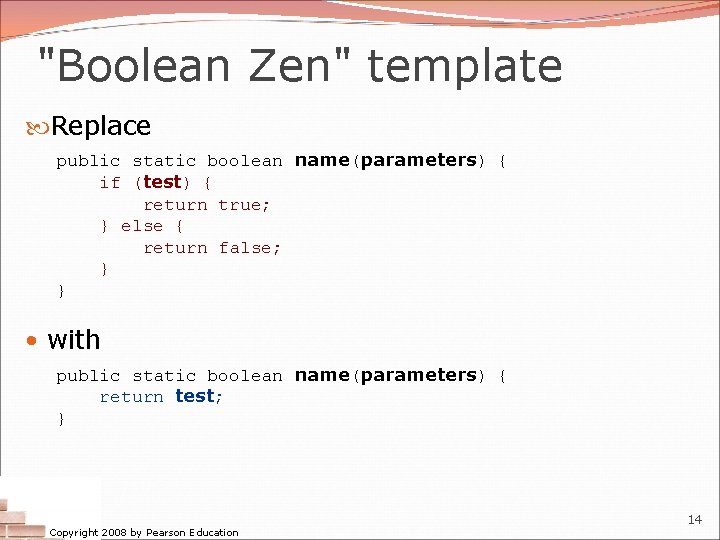
"Boolean Zen" template Replace public static boolean name(parameters) { if (test) { return true; } else { return false; } } • with public static boolean name(parameters) { return test; } Copyright 2008 by Pearson Education 14
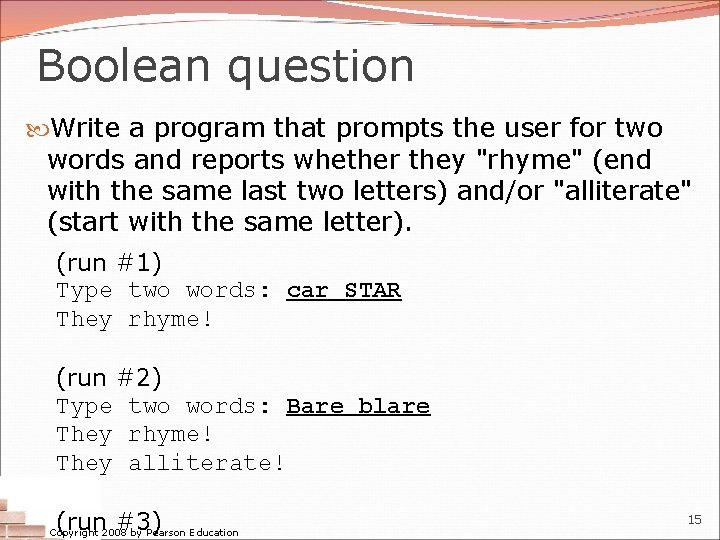
Boolean question Write a program that prompts the user for two words and reports whether they "rhyme" (end with the same last two letters) and/or "alliterate" (start with the same letter). (run #1) Type two words: car STAR They rhyme! (run #2) Type two words: Bare blare They rhyme! They alliterate! (run #3) Copyright 2008 by Pearson Education 15
![Boolean answer public static void main(String[] args) { Scanner console = new Scanner(System. in);](http://slidetodoc.com/presentation_image_h2/9534a4fde4e7571a2ee77f1959e47053/image-16.jpg "Boolean answer public static void main(String[] args) { Scanner console = new Scanner(System. in);")
Boolean answer public static void main(String[] args) { Scanner console = new Scanner(System. in); System. out. print("Type two words: "); String word 1 = console. next(); // Type two words: car STAR String word 2 = console. next(); // They rhyme! } if (rhyme(word 1, word 2)) { System. out. println("They rhyme!"); } if (alliterate(word 1, word 2)) { System. out. println("They alliterate (start with the same letter)!"); } // Returns true if s 1 and s 2 end with the same two letters. public static boolean rhyme(String s 1, String s 2) { return s 2. length() >= 2 && s 1. ends. With(s 2. substring(s 2. length() - 2)); } // Returns true if s 1 and s 2 start with the same letter. public static boolean alliterate(String s 1, String s 2) { return s 1. starts. With(s 2. substring(0, 1)); } Copyright 2008 by Pearson Education 16
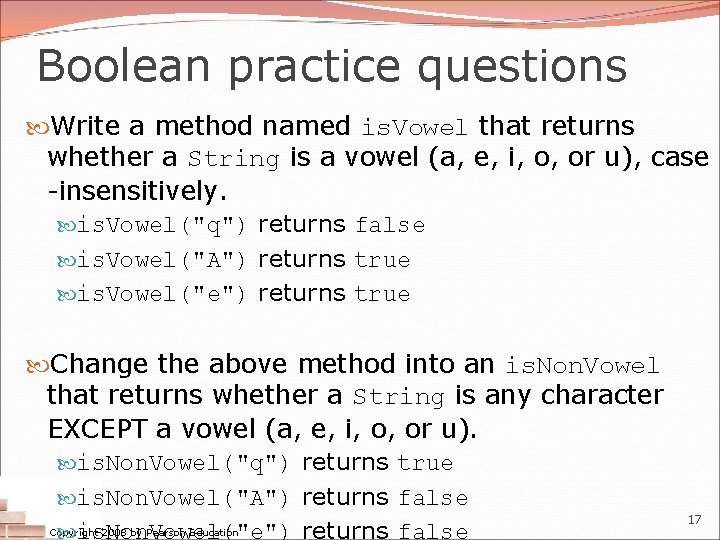
Boolean practice questions Write a method named is. Vowel that returns whether a String is a vowel (a, e, i, o, or u), case -insensitively. is. Vowel("q") returns false is. Vowel("A") returns true is. Vowel("e") returns true Change the above method into an is. Non. Vowel that returns whether a String is any character EXCEPT a vowel (a, e, i, o, or u). is. Non. Vowel("q") returns true is. Non. Vowel("A") returns false is. Non. Vowel("e") returns false Copyright 2008 by Pearson Education 17
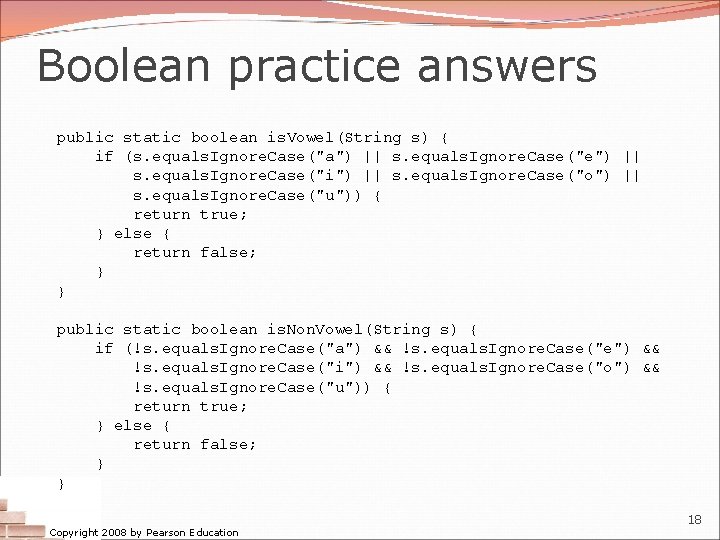
Boolean practice answers public static boolean is. Vowel(String s) { if (s. equals. Ignore. Case("a") || s. equals. Ignore. Case("e") || s. equals. Ignore. Case("i") || s. equals. Ignore. Case("o") || s. equals. Ignore. Case("u")) { return true; } else { return false; } } public static boolean is. Non. Vowel(String s) { if (!s. equals. Ignore. Case("a") && !s. equals. Ignore. Case("e") && !s. equals. Ignore. Case("i") && !s. equals. Ignore. Case("o") && !s. equals. Ignore. Case("u")) { return true; } else { return false; } } Copyright 2008 by Pearson Education 18
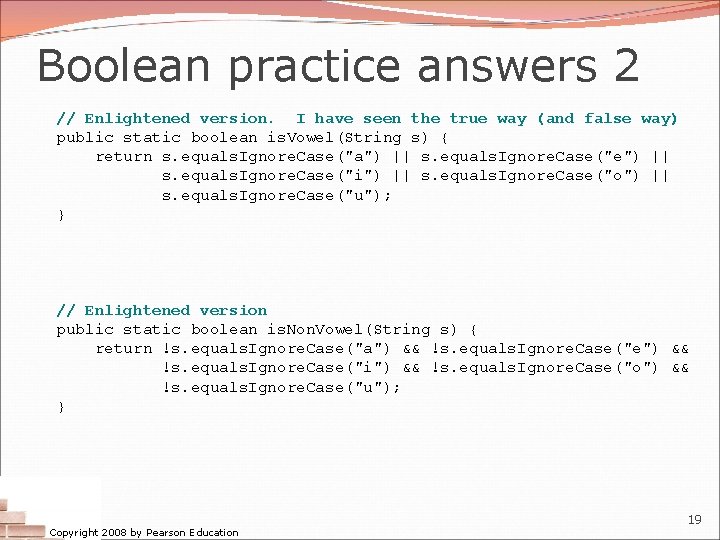
Boolean practice answers 2 // Enlightened version. I have seen the true way (and false way) public static boolean is. Vowel(String s) { return s. equals. Ignore. Case("a") || s. equals. Ignore. Case("e") || s. equals. Ignore. Case("i") || s. equals. Ignore. Case("o") || s. equals. Ignore. Case("u"); } // Enlightened version public static boolean is. Non. Vowel(String s) { return !s. equals. Ignore. Case("a") && !s. equals. Ignore. Case("e") && !s. equals. Ignore. Case("i") && !s. equals. Ignore. Case("o") && !s. equals. Ignore. Case("u"); } Copyright 2008 by Pearson Education 19
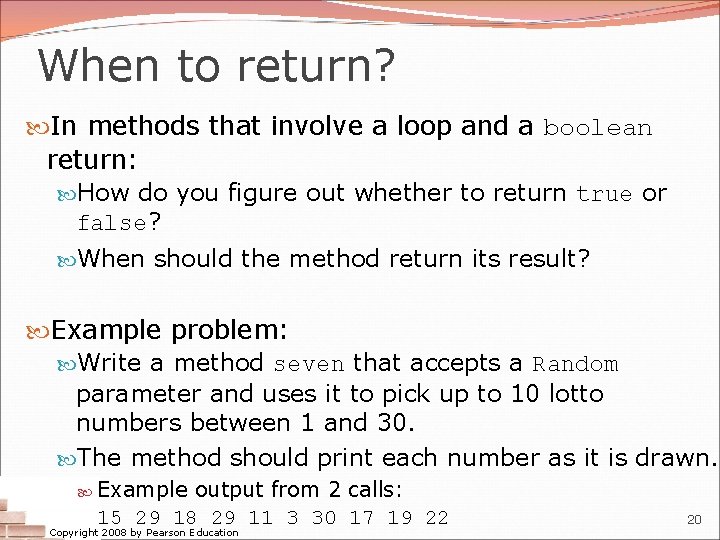
When to return? In methods that involve a loop and a boolean return: How do you figure out whether to return true or false? When should the method return its result? Example problem: Write a method seven that accepts a Random parameter and uses it to pick up to 10 lotto numbers between 1 and 30. The method should print each number as it is drawn. Example output from 2 calls: 15 29 18 29 11 3 30 17 19 22 Copyright 2008 by Pearson Education 20
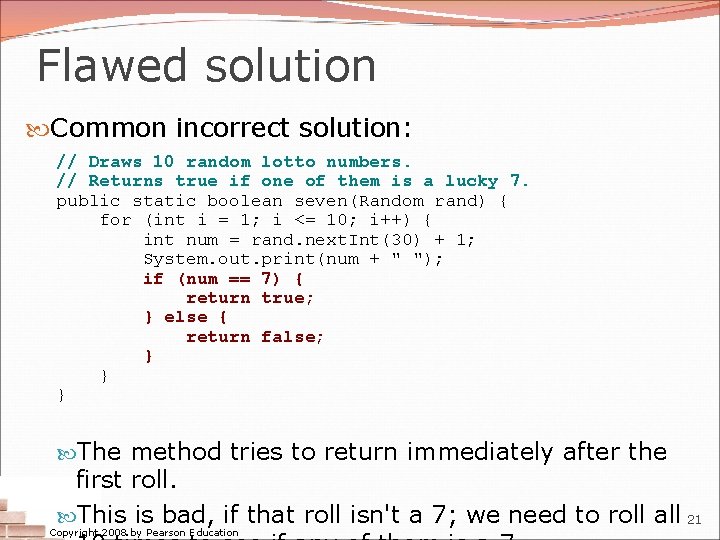
Flawed solution Common incorrect solution: // Draws 10 random lotto numbers. // Returns true if one of them is a lucky 7. public static boolean seven(Random rand) { for (int i = 1; i <= 10; i++) { int num = rand. next. Int(30) + 1; System. out. print(num + " "); if (num == 7) { return true; } else { return false; } } } The method tries to return immediately after the first roll. This is bad, if that roll isn't a 7; we need to roll all 21 Copyright 2008 by Pearson Education
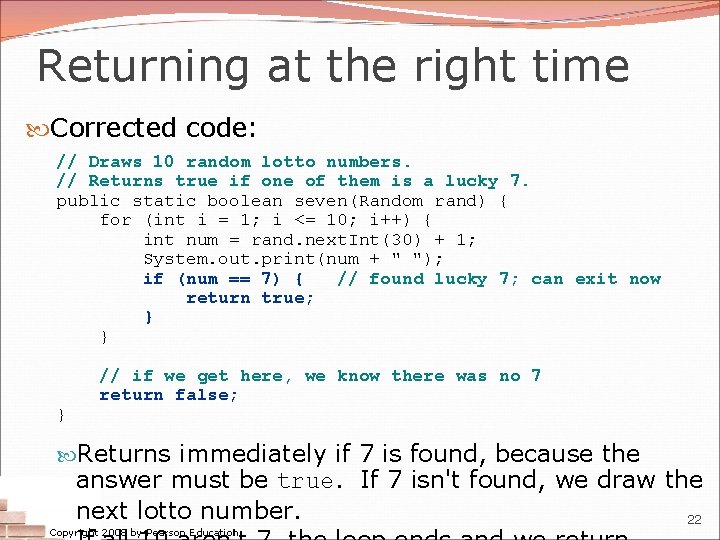
Returning at the right time Corrected code: // Draws 10 random lotto numbers. // Returns true if one of them is a lucky 7. public static boolean seven(Random rand) { for (int i = 1; i <= 10; i++) { int num = rand. next. Int(30) + 1; System. out. print(num + " "); if (num == 7) { // found lucky 7; can exit now return true; } } } // if we get here, we know there was no 7 return false; Returns immediately if 7 is found, because the answer must be true. If 7 isn't found, we draw the next lotto number. 22 Copyright 2008 by Pearson Education
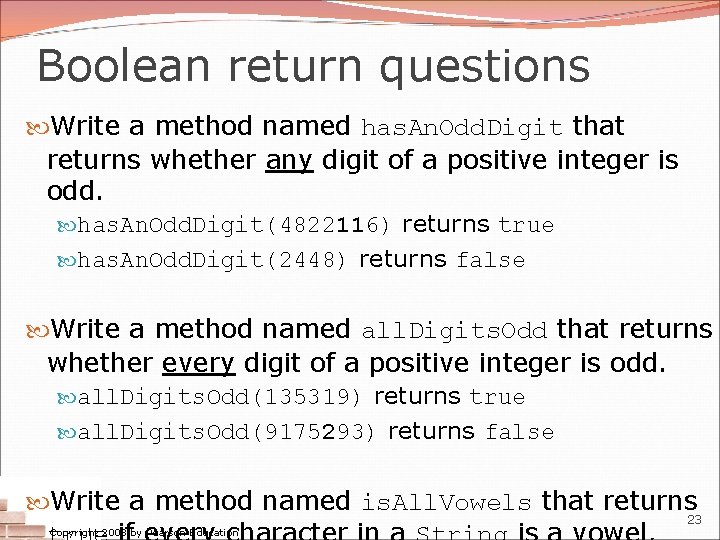
Boolean return questions Write a method named has. An. Odd. Digit that returns whether any digit of a positive integer is odd. has. An. Odd. Digit(4822116) returns true has. An. Odd. Digit(2448) returns false Write a method named all. Digits. Odd that returns whether every digit of a positive integer is odd. all. Digits. Odd(135319) returns true all. Digits. Odd(9175293) returns false Write a method named is. All. Vowels that returns Copyright 2008 by Pearson Education 23
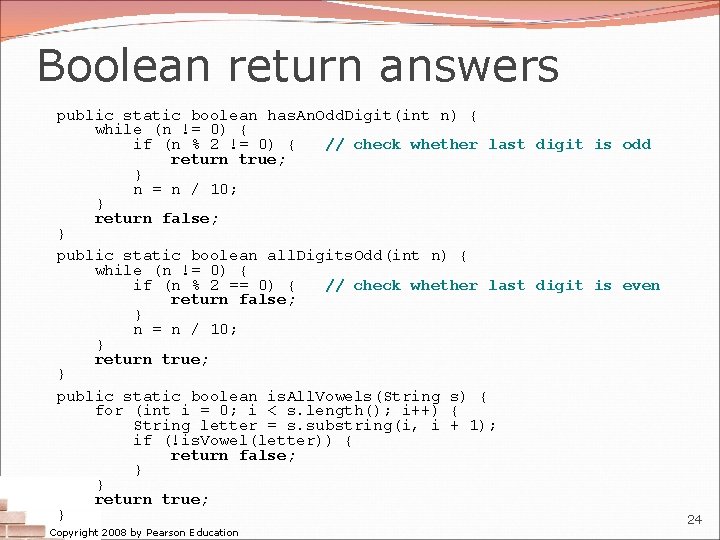
Boolean return answers public static boolean has. An. Odd. Digit(int n) { while (n != 0) { if (n % 2 != 0) { // check whether last digit is odd return true; } n = n / 10; } return false; } public static boolean all. Digits. Odd(int n) { while (n != 0) { if (n % 2 == 0) { // check whether last digit is even return false; } n = n / 10; } return true; } public static boolean is. All. Vowels(String s) { for (int i = 0; i < s. length(); i++) { String letter = s. substring(i, i + 1); if (!is. Vowel(letter)) { return false; } } return true; } Copyright 2008 by Pearson Education 24
- Slides: 24