
Building Java Programs Chapter 4 Lecture 4 3
Building Java Programs Chapter 4 Lecture 4 -3: Strings; char reading: 3. 3, 4. 3 1
Strings reading: 3. 3
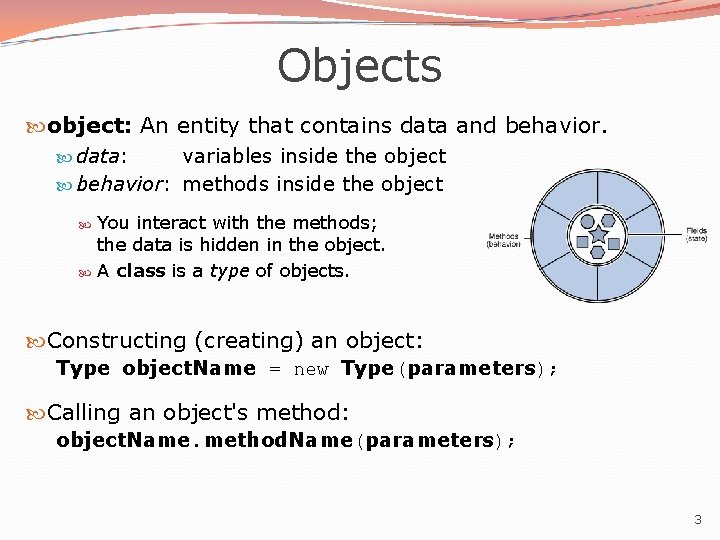
Objects object: An entity that contains data and behavior. data: variables inside the object behavior: methods inside the object You interact with the methods; the data is hidden in the object. A class is a type of objects. Constructing (creating) an object: Type object. Name = new Type(parameters); Calling an object's method: object. Name. method. Name(parameters); 3
Strings string: An object storing a sequence of text characters. Unlike most other objects, a String is not created with new. String name = "text"; String name = expression (with String value); Examples: String names = "Alice and Bob"; int x = 3; int y = 5; String point = "(" + x + ", " + y + ")"; 4
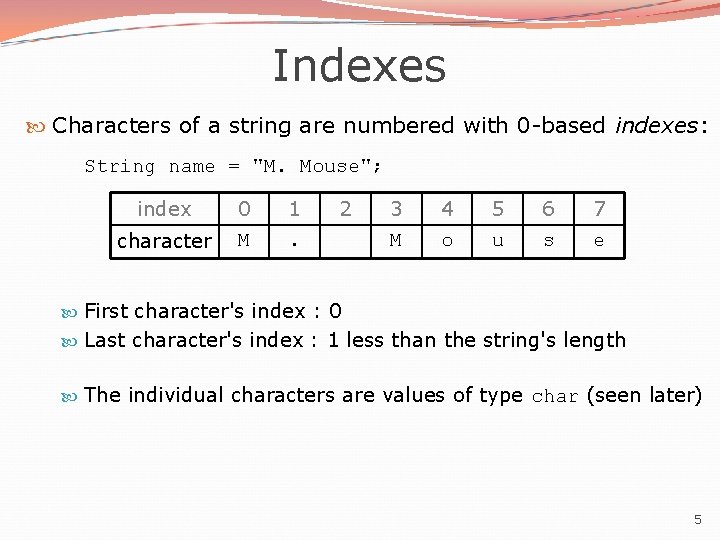
Indexes Characters of a string are numbered with 0 -based indexes: String name = "M. Mouse"; index 0 1 character M . 2 3 4 5 6 7 M o u s e First character's index : 0 Last character's index : 1 less than the string's length The individual characters are values of type char (seen later) 5
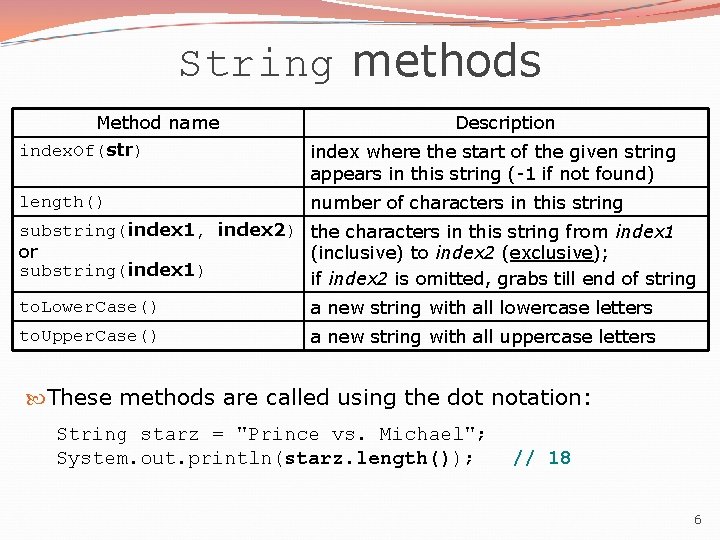
String methods Method name index. Of(str) length() Description index where the start of the given string appears in this string (-1 if not found) number of characters in this string substring(index 1, index 2) the characters in this string from index 1 or (inclusive) to index 2 (exclusive); substring(index 1) if index 2 is omitted, grabs till end of string to. Lower. Case() a new string with all lowercase letters to. Upper. Case() a new string with all uppercase letters These methods are called using the dot notation: String starz = "Prince vs. Michael"; System. out. println(starz. length()); // 18 6
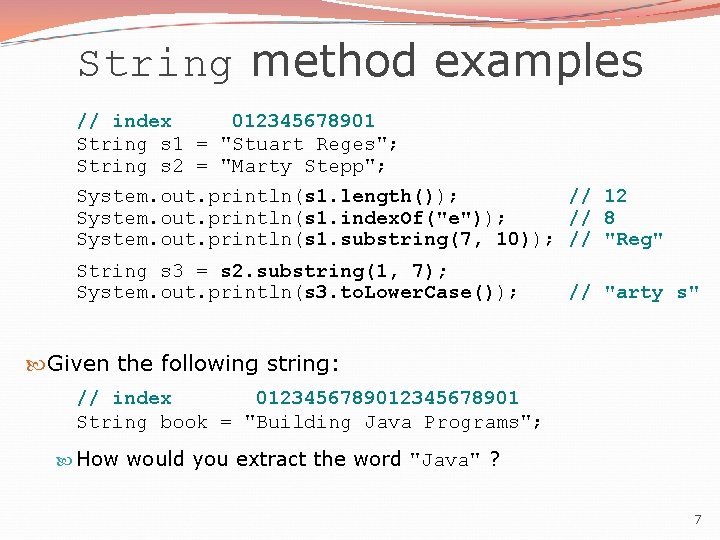
String method examples // index 012345678901 String s 1 = "Stuart Reges"; String s 2 = "Marty Stepp"; System. out. println(s 1. length()); // 12 System. out. println(s 1. index. Of("e")); // 8 System. out. println(s 1. substring(7, 10)); // "Reg" String s 3 = s 2. substring(1, 7); System. out. println(s 3. to. Lower. Case()); // "arty s" Given the following string: // index 012345678901 String book = "Building Java Programs"; How would you extract the word "Java" ? 7
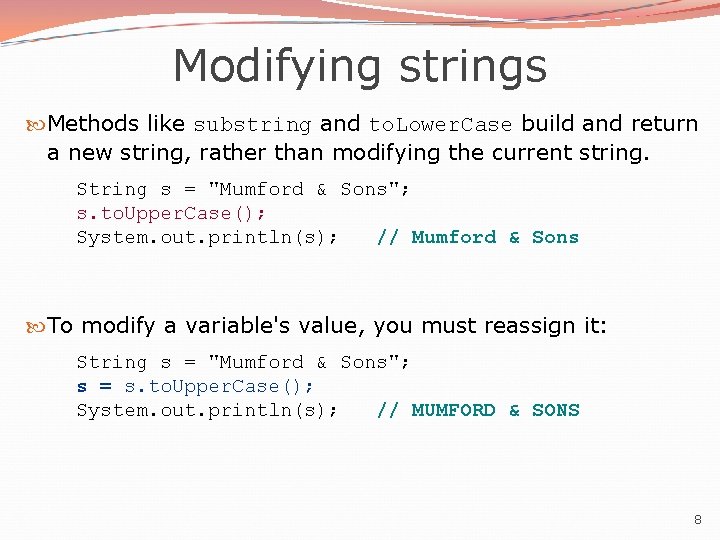
Modifying strings Methods like substring and to. Lower. Case build and return a new string, rather than modifying the current string. String s = "Mumford & Sons"; s. to. Upper. Case(); System. out. println(s); // Mumford & Sons To modify a variable's value, you must reassign it: String s = "Mumford & Sons"; s = s. to. Upper. Case(); System. out. println(s); // MUMFORD & SONS 8
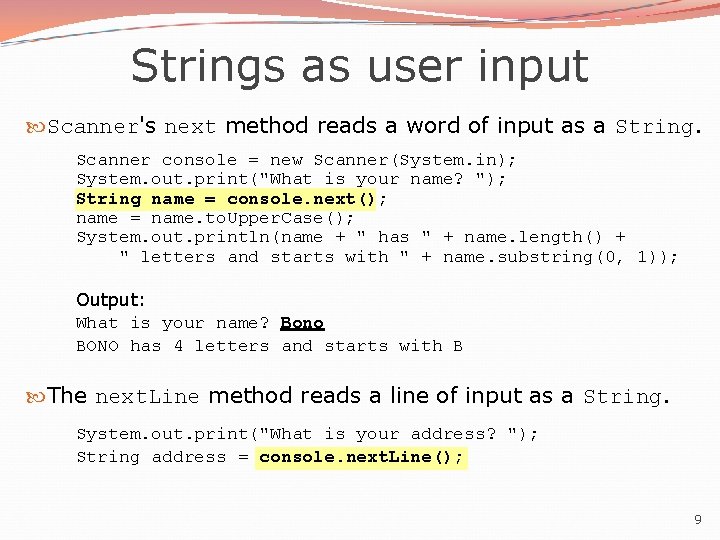
Strings as user input Scanner's next method reads a word of input as a String. Scanner console = new Scanner(System. in); System. out. print("What is your name? "); String name = console. next(); name = name. to. Upper. Case(); System. out. println(name + " has " + name. length() + " letters and starts with " + name. substring(0, 1)); Output: What is your name? Bono BONO has 4 letters and starts with B The next. Line method reads a line of input as a String. System. out. print("What is your address? "); String address = console. next. Line(); 9
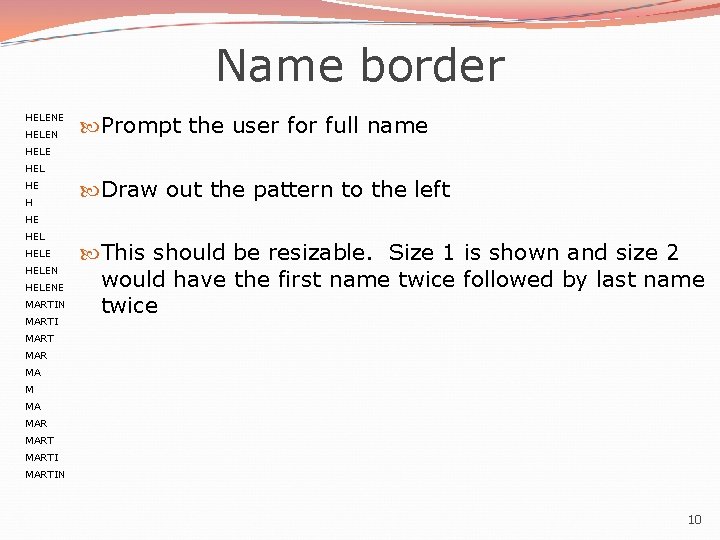
Name border HELENE HELEN Prompt the user for full name HELE HEL HE H Draw out the pattern to the left HE HELENE MARTIN MARTI This should be resizable. Size 1 is shown and size 2 would have the first name twice followed by last name twice MART MAR MARTI MARTIN 10
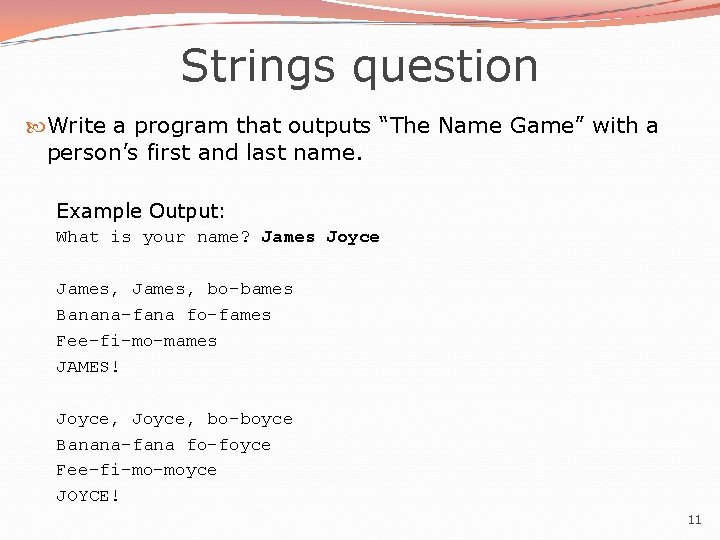
Strings question Write a program that outputs “The Name Game” with a person’s first and last name. Example Output: What is your name? James Joyce James, bo-bames Banana-fana fo-fames Fee-fi-mo-mames JAMES! Joyce, bo-boyce Banana-fana fo-foyce Fee-fi-mo-moyce JOYCE! 11
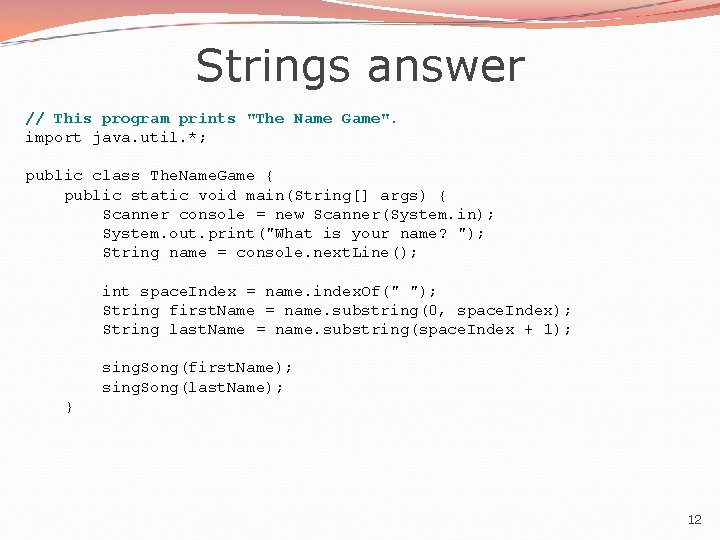
Strings answer // This program prints "The Name Game". import java. util. *; public class The. Name. Game { public static void main(String[] args) { Scanner console = new Scanner(System. in); System. out. print("What is your name? "); String name = console. next. Line(); int space. Index = name. index. Of(" "); String first. Name = name. substring(0, space. Index); String last. Name = name. substring(space. Index + 1); sing. Song(first. Name); sing. Song(last. Name); } 12
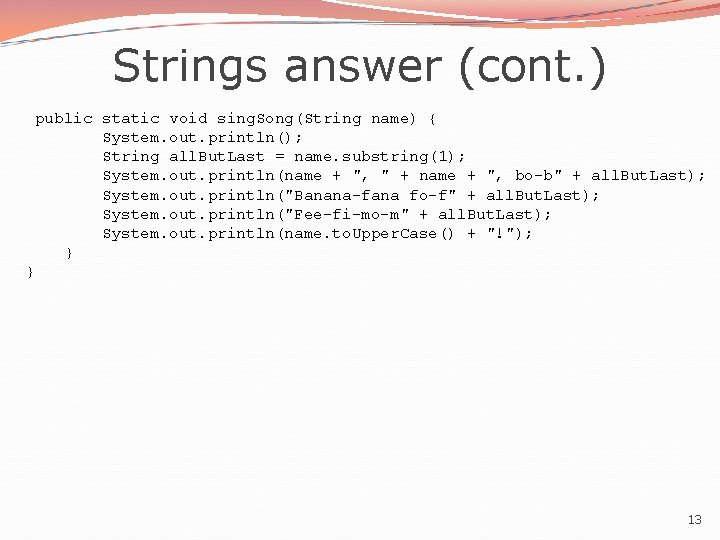
Strings answer (cont. ) public static void sing. Song(String name) { System. out. println(); String all. But. Last = name. substring(1); System. out. println(name + ", " + name + ", bo-b" + all. But. Last); System. out. println("Banana-fana fo-f" + all. But. Last); System. out. println("Fee-fi-mo-m" + all. But. Last); System. out. println(name. to. Upper. Case() + "!"); } } 13
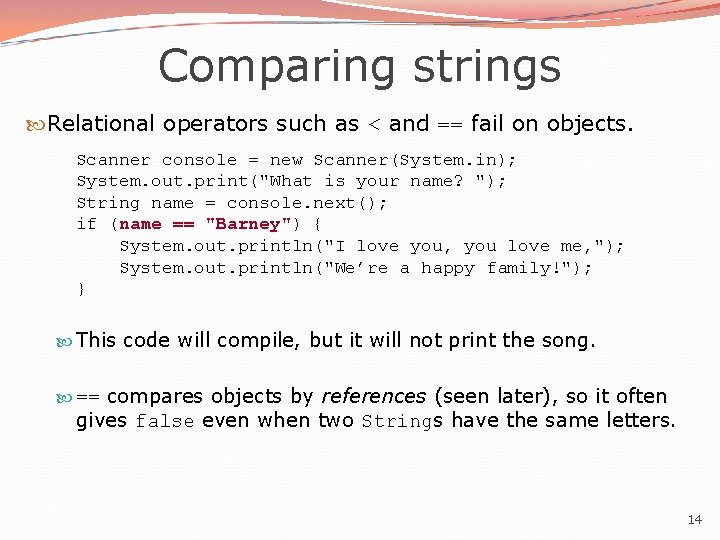
Comparing strings Relational operators such as < and == fail on objects. Scanner console = new Scanner(System. in); System. out. print("What is your name? "); String name = console. next(); if (name == "Barney") { System. out. println("I love you, you love me, "); System. out. println("We’re a happy family!"); } This code will compile, but it will not print the song. == compares objects by references (seen later), so it often gives false even when two Strings have the same letters. 14
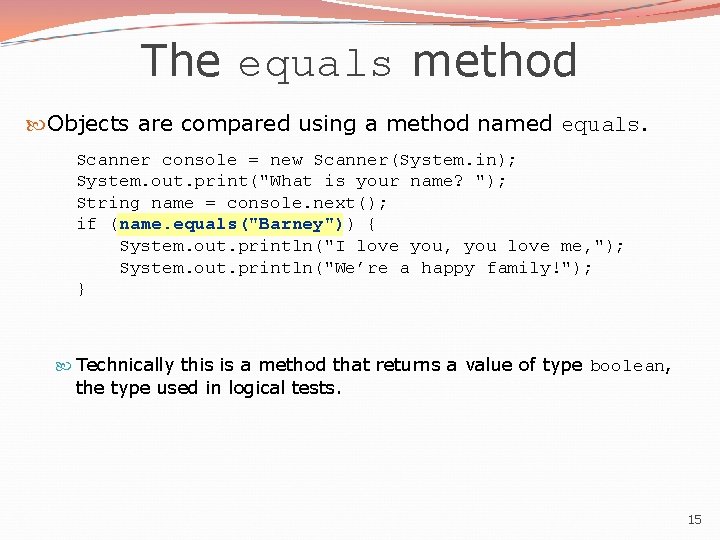
The equals method Objects are compared using a method named equals. Scanner console = new Scanner(System. in); System. out. print("What is your name? "); String name = console. next(); if (name. equals("Barney")) { System. out. println("I love you, you love me, "); System. out. println("We’re a happy family!"); } Technically this is a method that returns a value of type boolean, the type used in logical tests. 15
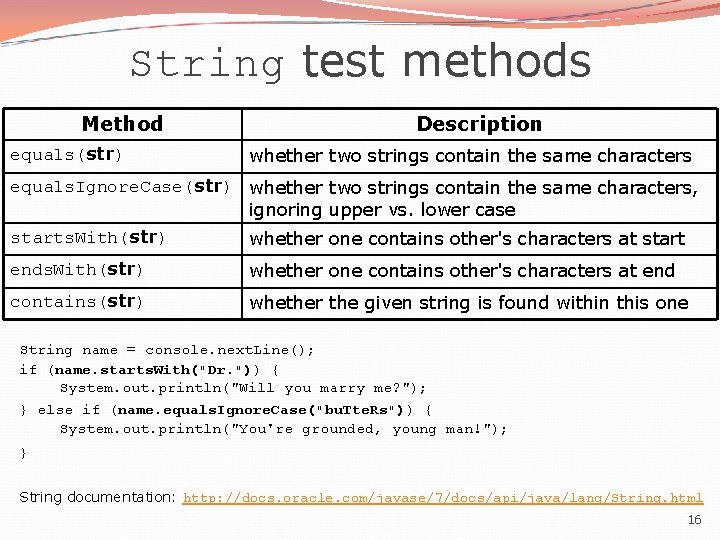
String test methods Method equals(str) Description whether two strings contain the same characters equals. Ignore. Case(str) whether two strings contain the same characters, ignoring upper vs. lower case starts. With(str) whether one contains other's characters at start ends. With(str) whether one contains other's characters at end contains(str) whether the given string is found within this one String name = console. next. Line(); if (name. starts. With("Dr. ")) { System. out. println("Will you marry me? "); } else if (name. equals. Ignore. Case("bu. Tte. Rs")) { System. out. println("You're grounded, young man!"); } String documentation: http: //docs. oracle. com/javase/7/docs/api/java/lang/String. html 16
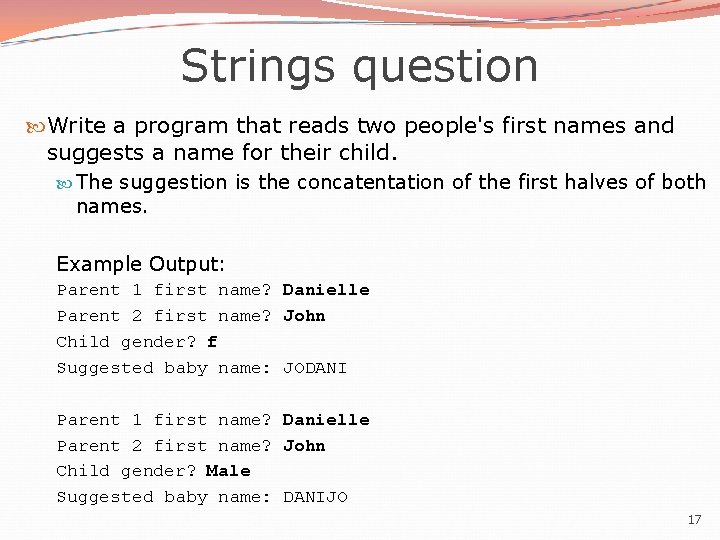
Strings question Write a program that reads two people's first names and suggests a name for their child. The suggestion is the concatentation of the first halves of both names. Example Output: Parent 1 first name? Danielle Parent 2 first name? John Child gender? f Suggested baby name: JODANI Parent 1 first name? Danielle Parent 2 first name? John Child gender? Male Suggested baby name: DANIJO 17
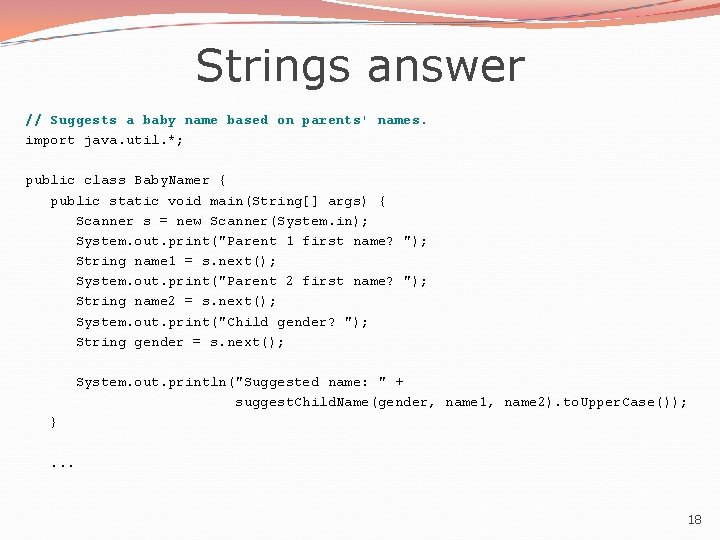
Strings answer // Suggests a baby name based on parents' names. import java. util. *; public class Baby. Namer { public static void main(String[] args) { Scanner s = new Scanner(System. in); System. out. print("Parent 1 first name? "); String name 1 = s. next(); System. out. print("Parent 2 first name? "); String name 2 = s. next(); System. out. print("Child gender? "); String gender = s. next(); System. out. println("Suggested name: " + suggest. Child. Name(gender, name 1, name 2). to. Upper. Case()); }. . . 18
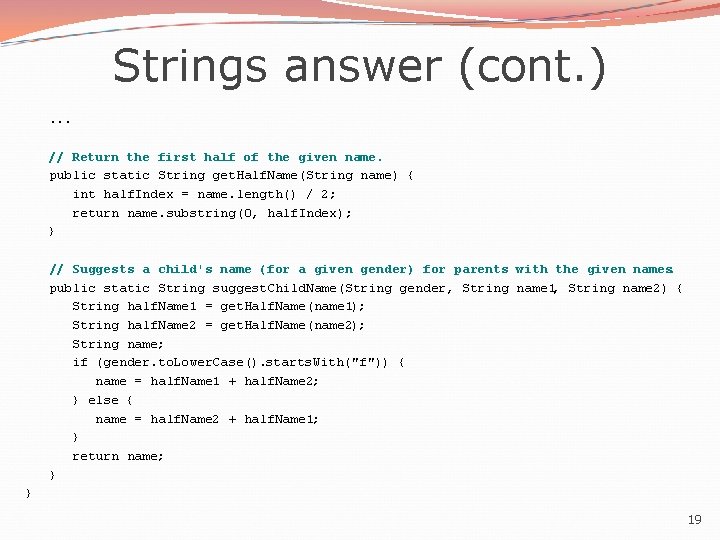
Strings answer (cont. ). . . // Return the first half of the given name. public static String get. Half. Name(String name) { int half. Index = name. length() / 2; return name. substring(0, half. Index); } // Suggests a child's name (for a given gender) for parents with the given names. public static String suggest. Child. Name(String gender, String name 1, String name 2) { String half. Name 1 = get. Half. Name(name 1); String half. Name 2 = get. Half. Name(name 2); String name; if (gender. to. Lower. Case(). starts. With("f")) { name = half. Name 1 + half. Name 2; } else { name = half. Name 2 + half. Name 1; } return name; } } 19
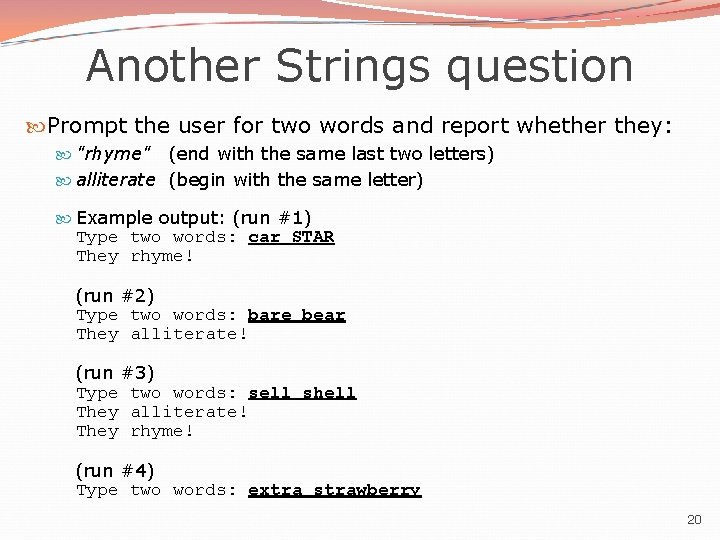
Another Strings question Prompt the user for two words and report whether they: "rhyme" (end with the same last two letters) alliterate (begin with the same letter) Example output: (run #1) Type two words: car STAR They rhyme! (run #2) Type two words: bare bear They alliterate! (run #3) Type two words: sell shell They alliterate! They rhyme! (run #4) Type two words: extra strawberry 20
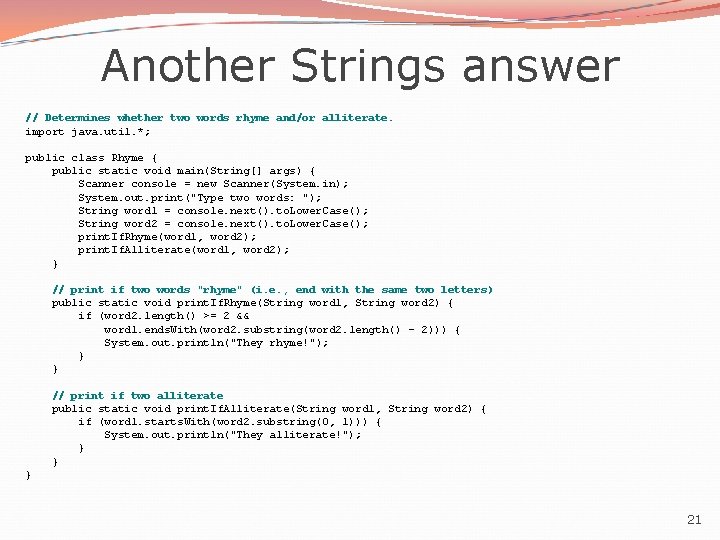
Another Strings answer // Determines whether two words rhyme and/or alliterate. import java. util. *; public class Rhyme { public static void main(String[] args) { Scanner console = new Scanner(System. in); System. out. print("Type two words: "); String word 1 = console. next(). to. Lower. Case(); String word 2 = console. next(). to. Lower. Case(); print. If. Rhyme(word 1, word 2); print. If. Alliterate(word 1, word 2); } // print if two words "rhyme" (i. e. , end with the same two letters) public static void print. If. Rhyme(String word 1, String word 2) { if (word 2. length() >= 2 && word 1. ends. With(word 2. substring(word 2. length() - 2))) { System. out. println("They rhyme!"); } } // print if two alliterate public static void print. If. Alliterate(String word 1, String word 2) { if (word 1. starts. With(word 2. substring(0, 1))) { System. out. println("They alliterate!"); } } } 21
char reading: 4. 3
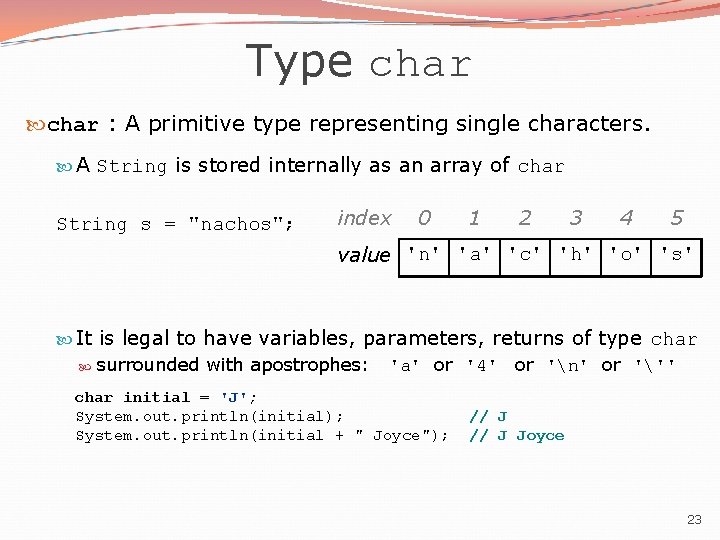
Type char : A primitive type representing single characters. A String is stored internally as an array of char String s = "nachos"; index 0 1 2 3 4 5 value 'n' 'a' 'c' 'h' 'o' 's' It is legal to have variables, parameters, returns of type char surrounded with apostrophes: 'a' or '4' or 'n' or ''' char initial = 'J'; System. out. println(initial); System. out. println(initial + " Joyce"); // J Joyce 23
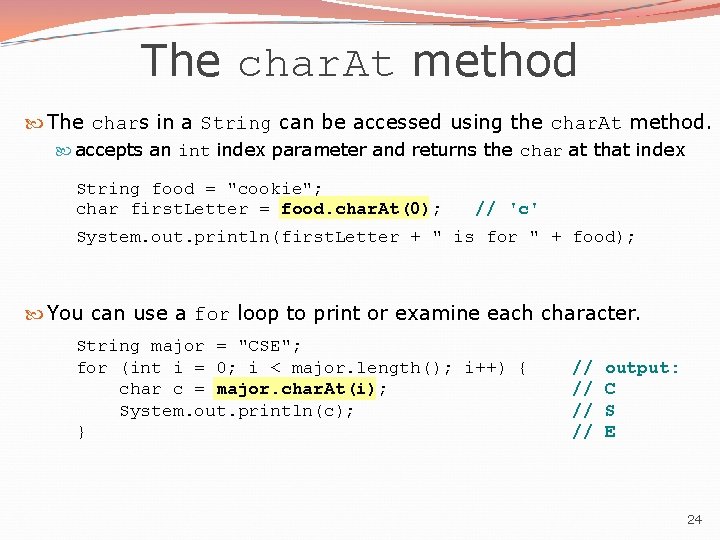
The char. At method The chars in a String can be accessed using the char. At method. accepts an int index parameter and returns the char at that index String food = "cookie"; char first. Letter = food. char. At(0); // 'c' System. out. println(first. Letter + " is for " + food); You can use a for loop to print or examine each character. String major = "CSE"; for (int i = 0; i < major. length(); i++) { char c = major. char. At(i); System. out. println(c); } // // output: C S E 24
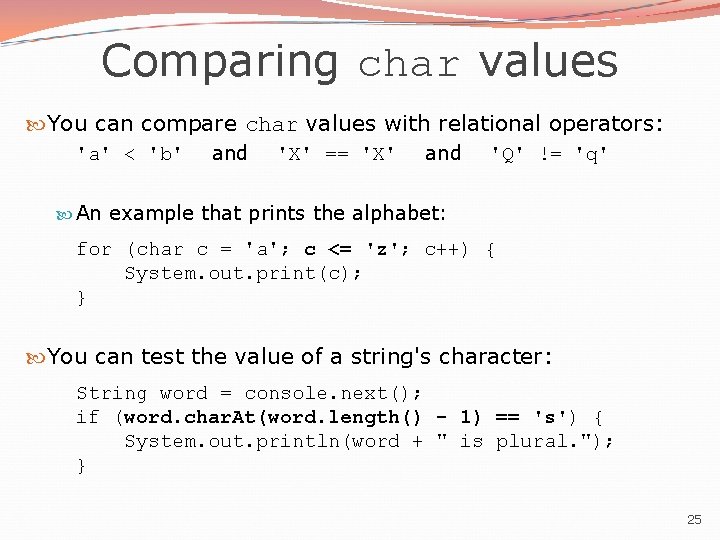
Comparing char values You can compare char values with relational operators: 'a' < 'b' and 'X' == 'X' and 'Q' != 'q' An example that prints the alphabet: for (char c = 'a'; c <= 'z'; c++) { System. out. print(c); } You can test the value of a string's character: String word = console. next(); if (word. char. At(word. length() - 1) == 's') { System. out. println(word + " is plural. "); } 25
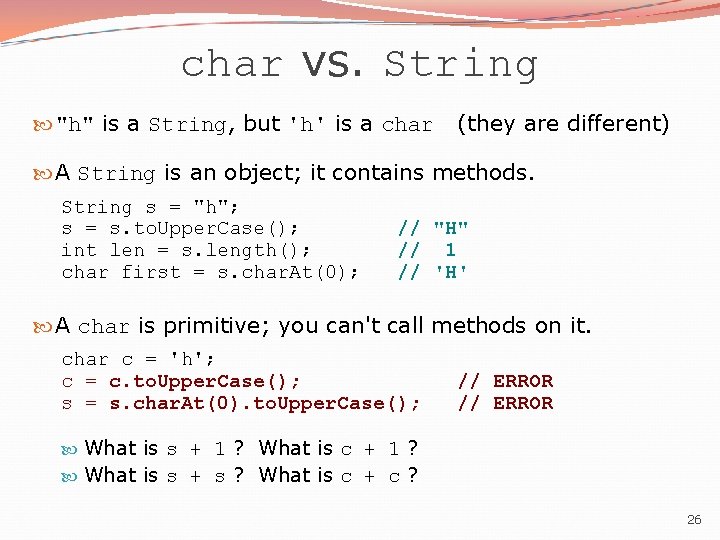
char vs. String "h" is a String, but 'h' is a char (they are different) A String is an object; it contains methods. String s = "h"; s = s. to. Upper. Case(); int len = s. length(); char first = s. char. At(0); // "H" // 1 // 'H' A char is primitive; you can't call methods on it. char c = 'h'; c = c. to. Upper. Case(); s = s. char. At(0). to. Upper. Case(); // ERROR What is s + 1 ? What is c + 1 ? What is s + s ? What is c + c ? 26
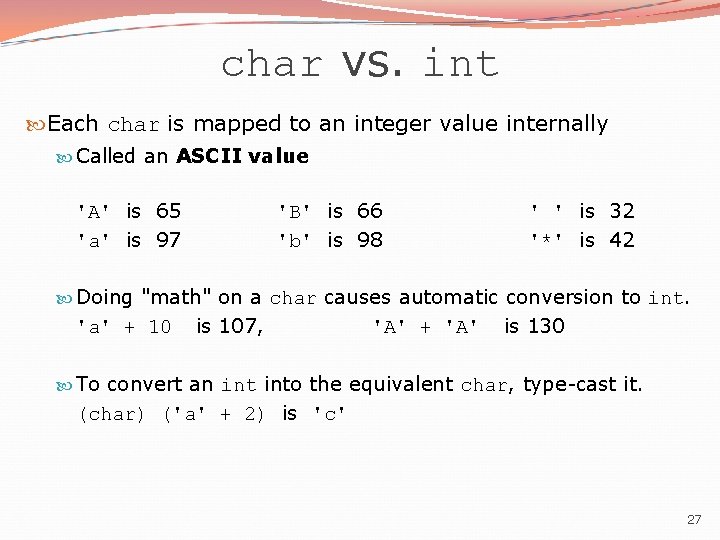
char vs. int Each char is mapped to an integer value internally Called an ASCII value 'A' is 65 'a' is 97 'B' is 66 'b' is 98 ' ' is 32 '*' is 42 Doing "math" on a char causes automatic conversion to int. 'a' + 10 is 107, 'A' + 'A' is 130 To convert an into the equivalent char, type-cast it. (char) ('a' + 2) is 'c' 27
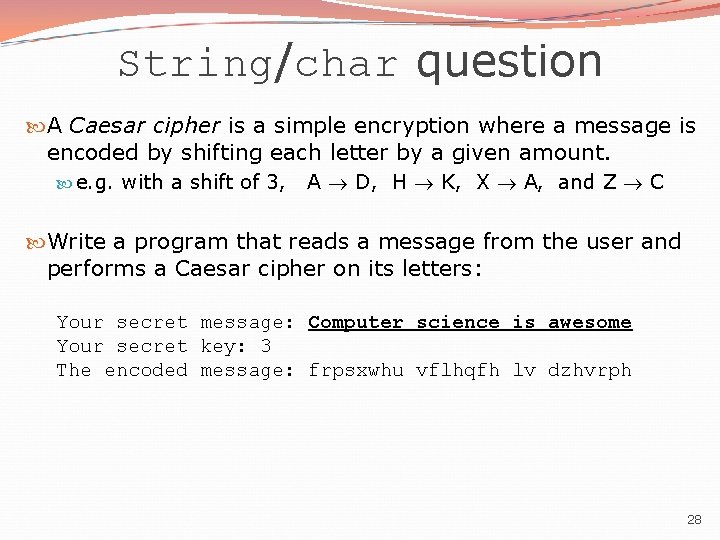
String/char question A Caesar cipher is a simple encryption where a message is encoded by shifting each letter by a given amount. e. g. with a shift of 3, A D, H K, X A, and Z C Write a program that reads a message from the user and performs a Caesar cipher on its letters: Your secret message: Computer science is awesome Your secret key: 3 The encoded message: frpsxwhu vflhqfh lv dzhvrph 28
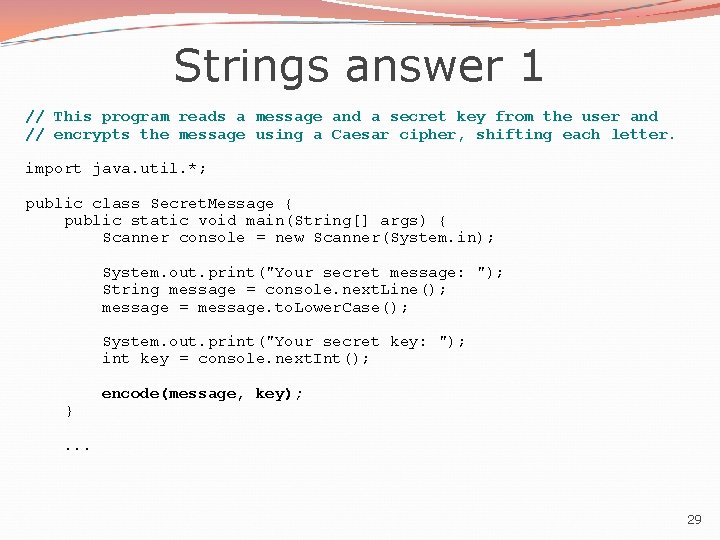
Strings answer 1 // This program reads a message and a secret key from the user and // encrypts the message using a Caesar cipher, shifting each letter. import java. util. *; public class Secret. Message { public static void main(String[] args) { Scanner console = new Scanner(System. in); System. out. print("Your secret message: "); String message = console. next. Line(); message = message. to. Lower. Case(); System. out. print("Your secret key: "); int key = console. next. Int(); } encode(message, key); . . . 29
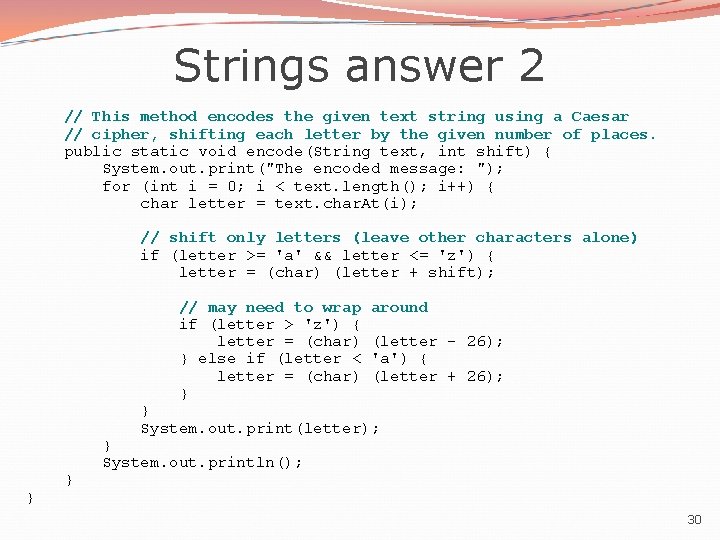
Strings answer 2 // This method encodes the given text string using a Caesar // cipher, shifting each letter by the given number of places. public static void encode(String text, int shift) { System. out. print("The encoded message: "); for (int i = 0; i < text. length(); i++) { char letter = text. char. At(i); // shift only letters (leave other characters alone) if (letter >= 'a' && letter <= 'z') { letter = (char) (letter + shift); // may need to wrap if (letter > 'z') { letter = (char) } else if (letter < letter = (char) } around (letter - 26); 'a') { (letter + 26); } System. out. print(letter); } } } System. out. println(); 30
(Optional) printf reading: 4. 3
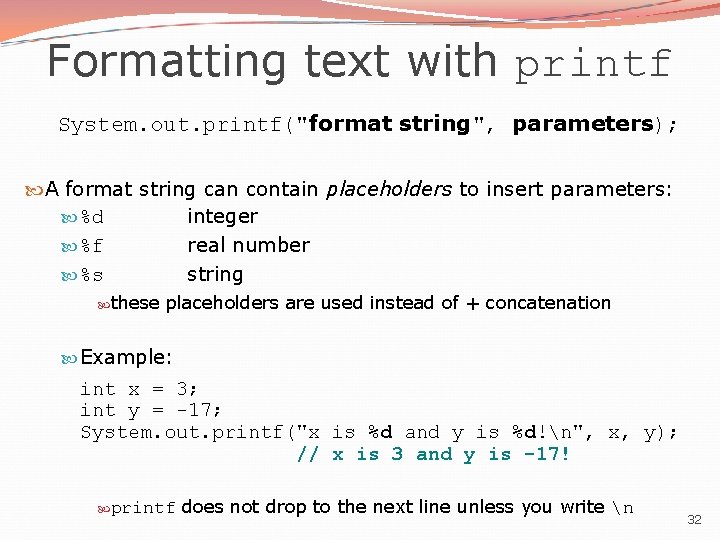
Formatting text with printf System. out. printf("format string", parameters); A format string can contain placeholders to insert parameters: %d integer %f real number %s string these placeholders are used instead of + concatenation Example: int x = 3; int y = -17; System. out. printf("x is %d and y is %d!n", x, y); // x is 3 and y is -17! printf does not drop to the next line unless you write n 32
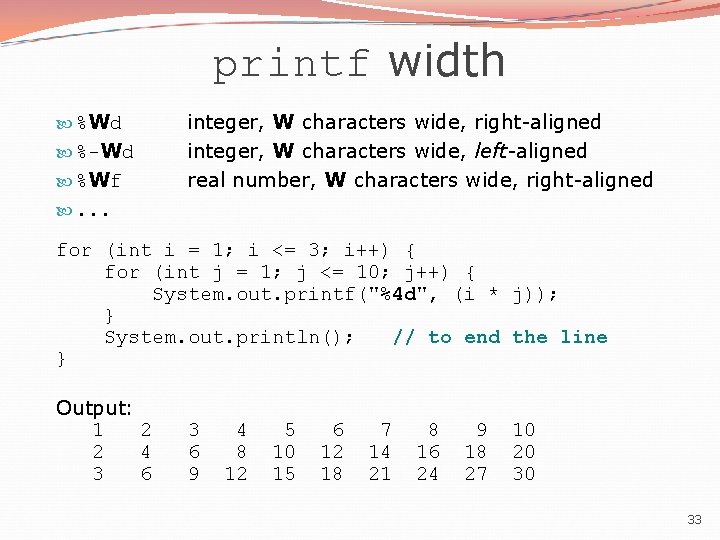
printf width %Wd %-Wd %Wf integer, W characters wide, right-aligned integer, W characters wide, left-aligned real number, W characters wide, right-aligned . . . for (int i = 1; i <= 3; i++) { for (int j = 1; j <= 10; j++) { System. out. printf("%4 d", (i * j)); } System. out. println(); // to end the line } Output: 1 2 2 4 3 6 9 4 8 12 5 10 15 6 12 18 7 14 21 8 16 24 9 18 27 10 20 30 33
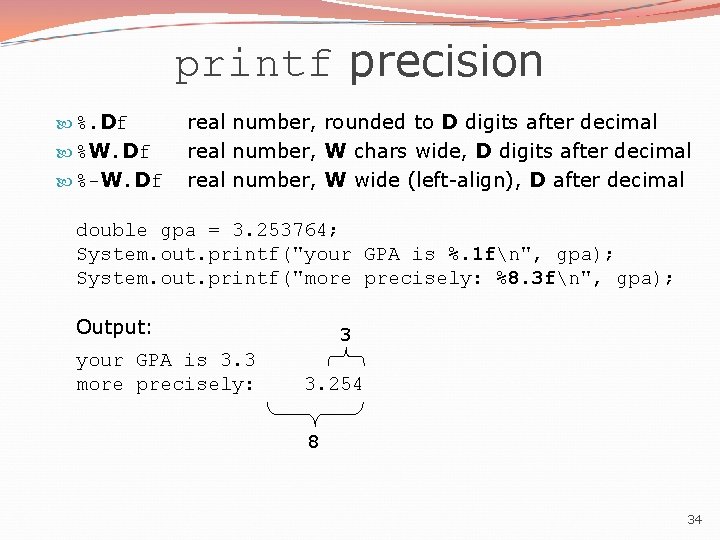
printf precision %. Df %W. Df %-W. Df real number, rounded to D digits after decimal real number, W chars wide, D digits after decimal real number, W wide (left-align), D after decimal double gpa = 3. 253764; System. out. printf("your GPA is %. 1 fn", gpa); System. out. printf("more precisely: %8. 3 fn", gpa); Output: your GPA is 3. 3 more precisely: 3 3. 254 8 34
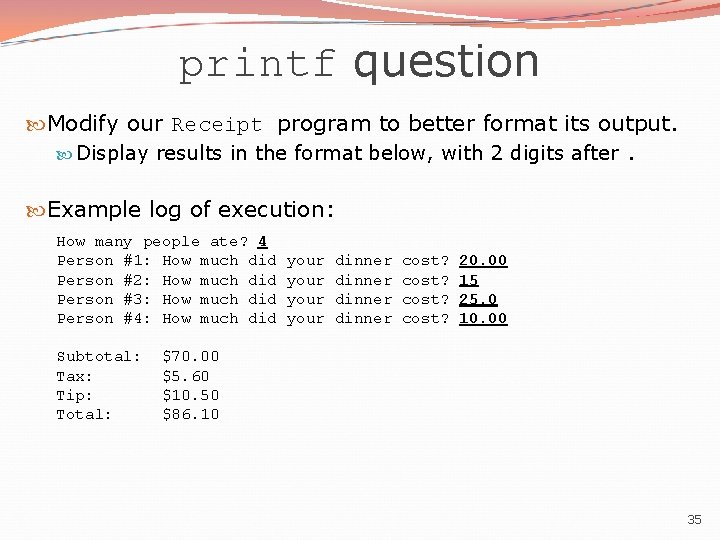
printf question Modify our Receipt program to better format its output. Display results in the format below, with 2 digits after. Example log of execution: How many people ate? 4 Person #1: How much did Person #2: How much did Person #3: How much did Person #4: How much did Subtotal: Tax: Tip: Total: your dinner cost? 20. 00 15 25. 0 10. 00 $70. 00 $5. 60 $10. 50 $86. 10 35
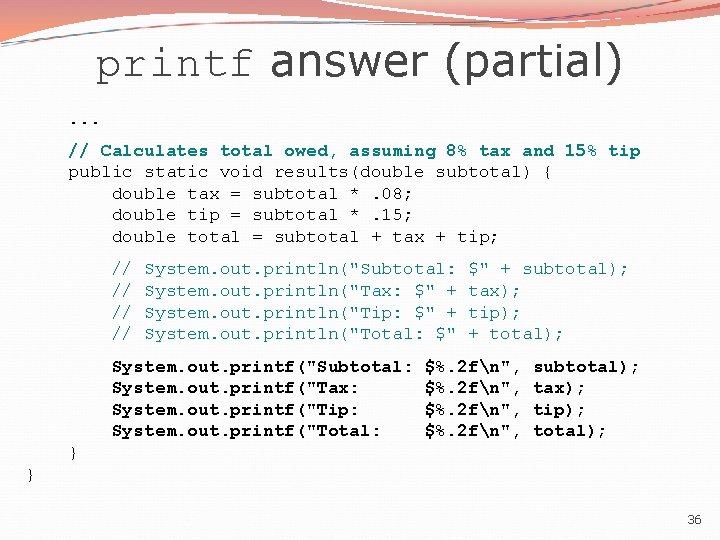
printf answer (partial). . . // Calculates total owed, assuming 8% tax and 15% tip public static void results(double subtotal) { double tax = subtotal *. 08; double tip = subtotal *. 15; double total = subtotal + tax + tip; // // System. out. println("Subtotal: System. out. println("Tax: $" + System. out. println("Tip: $" + System. out. println("Total: $" System. out. printf("Subtotal: System. out. printf("Tax: System. out. printf("Tip: System. out. printf("Total: $" + subtotal); tax); tip); + total); $%. 2 fn", subtotal); tax); tip); total); } } 36
- Slides: 36