
Building Java Programs Chapter 3 Lecture 3 3
Building Java Programs Chapter 3 Lecture 3 -3: Interactive Programs w/ Scanner reading: 3. 3 - 3. 4 self-check: #16 -19 exercises: #11 videos: Ch. 3 #4 Copyright 2008 by Pearson Education
Interactive programs We have written programs that print console output, but it is also possible to read input from the console. The user types input into the console. We capture the input and use it in our program. Such a program is called an interactive program. Interactive programs can be challenging. Computers and users think in very different ways. Users misbehave. Copyright 2008 by Pearson Education 2
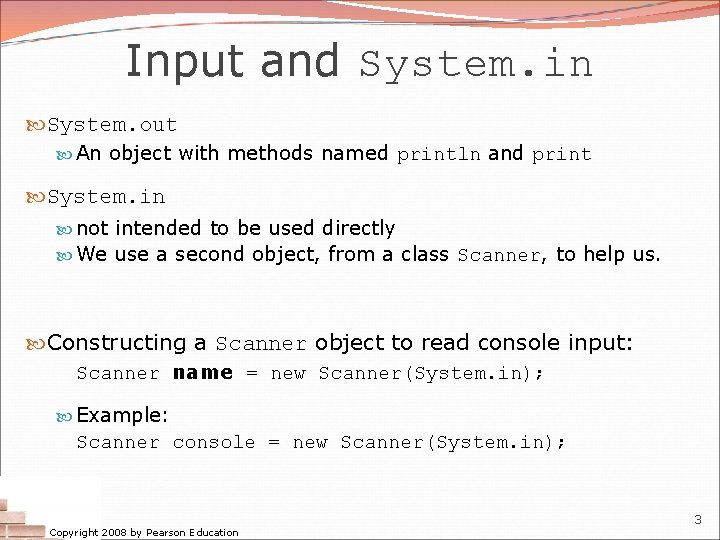
Input and System. in System. out An object with methods named println and print System. in not intended to be used directly We use a second object, from a class Scanner, to help us. Constructing a Scanner object to read console input: Scanner name = new Scanner(System. in); Example: Scanner console = new Scanner(System. in); Copyright 2008 by Pearson Education 3
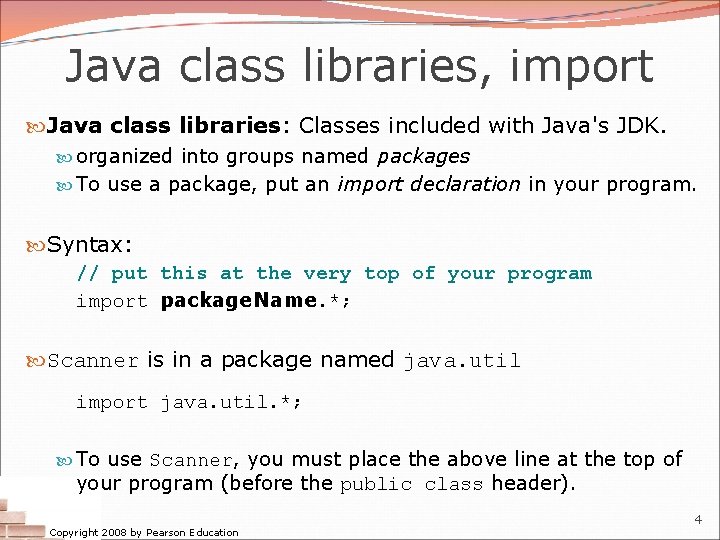
Java class libraries, import Java class libraries: Classes included with Java's JDK. organized into groups named packages To use a package, put an import declaration in your program. Syntax: // put this at the very top of your program import package. Name. *; Scanner is in a package named java. util import java. util. *; To use Scanner, you must place the above line at the top of your program (before the public class header). Copyright 2008 by Pearson Education 4
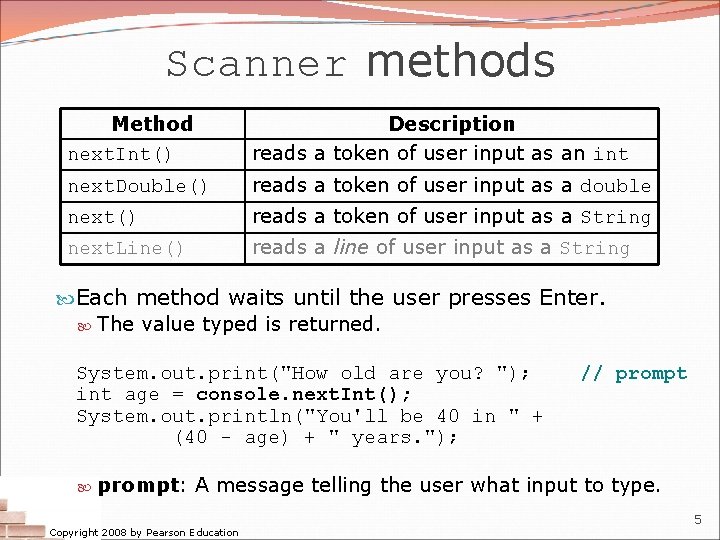
Scanner methods Method next. Int() Description reads a token of user input as an int next. Double() reads a token of user input as a double next() reads a token of user input as a String next. Line() reads a line of user input as a String Each method waits until the user presses Enter. The value typed is returned. System. out. print("How old are you? "); int age = console. next. Int(); System. out. println("You'll be 40 in " + (40 - age) + " years. "); // prompt: A message telling the user what input to type. Copyright 2008 by Pearson Education 5
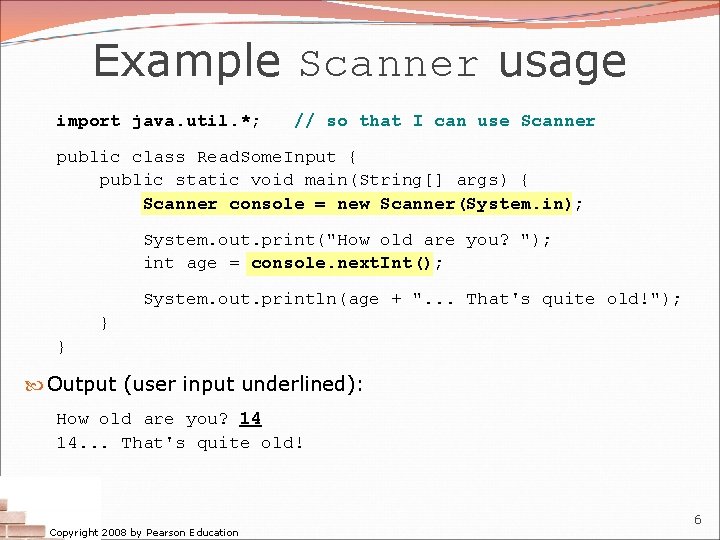
Example Scanner usage import java. util. *; // so that I can use Scanner public class Read. Some. Input { public static void main(String[] args) { Scanner console = new Scanner(System. in); System. out. print("How old are you? "); int age = console. next. Int(); System. out. println(age + ". . . That's quite old!"); } } Output (user input underlined): How old are you? 14 14. . . That's quite old! Copyright 2008 by Pearson Education 6

Another Scanner example import java. util. *; // so that I can use Scanner public class Scanner. Sum { public static void main(String[] args) { Scanner console = new Scanner(System. in); System. out. print("Please type three numbers: "); int num 1 = console. next. Int(); int num 2 = console. next. Int(); int num 3 = console. next. Int(); } } int sum = num 1 + num 2 + num 3; System. out. println("The sum is " + sum); Output (user input underlined): Please type three numbers: 8 6 13 The sum is 27 The Scanner can read multiple values from one line. Copyright 2008 by Pearson Education 7
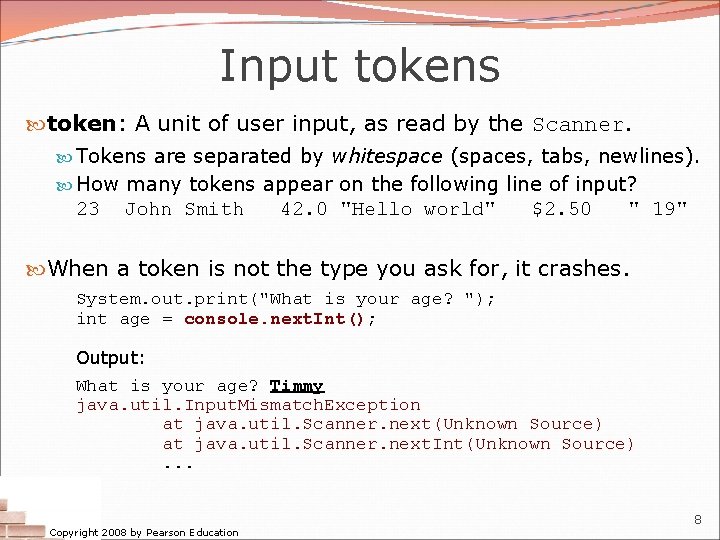
Input tokens token: A unit of user input, as read by the Scanner. Tokens are separated by whitespace (spaces, tabs, newlines). How many tokens appear on the following line of input? 23 John Smith 42. 0 "Hello world" $2. 50 " 19" When a token is not the type you ask for, it crashes. System. out. print("What is your age? "); int age = console. next. Int(); Output: What is your age? Timmy java. util. Input. Mismatch. Exception at java. util. Scanner. next(Unknown Source) at java. util. Scanner. next. Int(Unknown Source). . . Copyright 2008 by Pearson Education 8
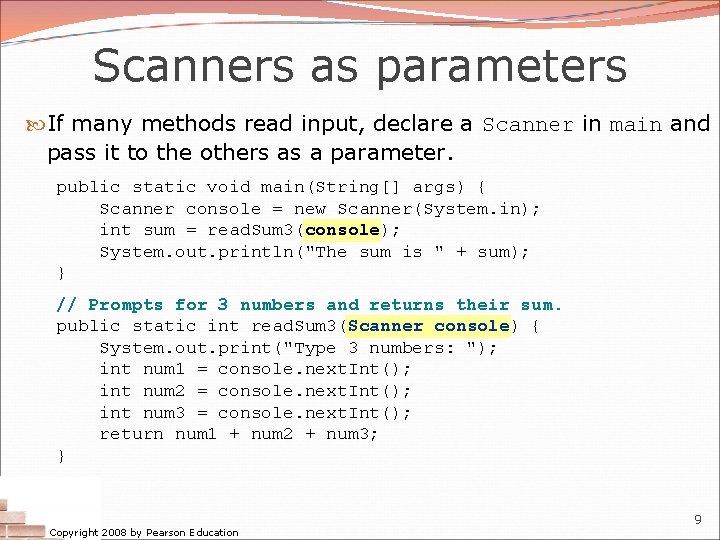
Scanners as parameters If many methods read input, declare a Scanner in main and pass it to the others as a parameter. public static void main(String[] args) { Scanner console = new Scanner(System. in); int sum = read. Sum 3(console); System. out. println("The sum is " + sum); } // Prompts for 3 numbers and returns their sum. public static int read. Sum 3(Scanner console) { System. out. print("Type 3 numbers: "); int num 1 = console. next. Int(); int num 2 = console. next. Int(); int num 3 = console. next. Int(); return num 1 + num 2 + num 3; } Copyright 2008 by Pearson Education 9
Cumulative sum reading: 4. 1 self-check: Ch. 4 #1 -3 exercises: Ch. 4 #1 -6 Copyright 2008 by Pearson Education
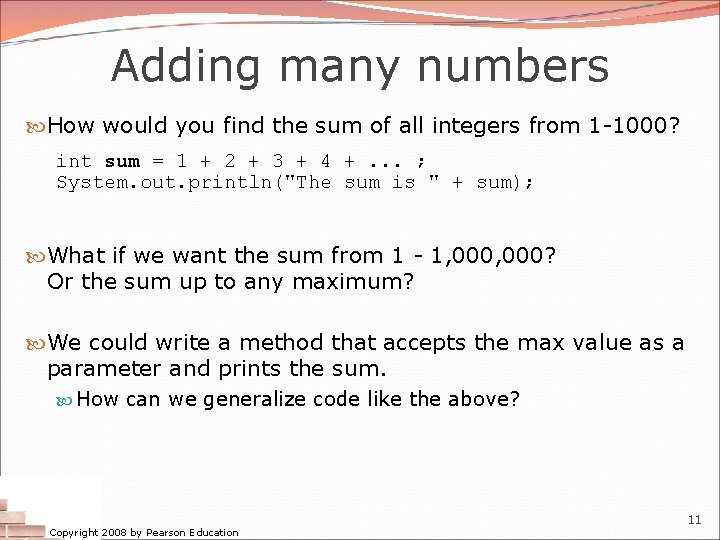
Adding many numbers How would you find the sum of all integers from 1 -1000? int sum = 1 + 2 + 3 + 4 +. . . ; System. out. println("The sum is " + sum); What if we want the sum from 1 - 1, 000? Or the sum up to any maximum? We could write a method that accepts the max value as a parameter and prints the sum. How can we generalize code like the above? Copyright 2008 by Pearson Education 11
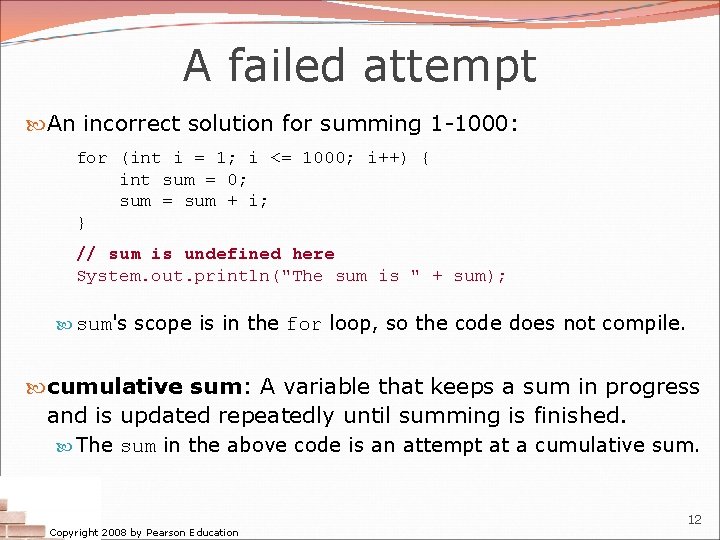
A failed attempt An incorrect solution for summing 1 -1000: for (int i = 1; i <= 1000; i++) { int sum = 0; sum = sum + i; } // sum is undefined here System. out. println("The sum is " + sum); sum's scope is in the for loop, so the code does not compile. cumulative sum: A variable that keeps a sum in progress and is updated repeatedly until summing is finished. The sum in the above code is an attempt at a cumulative sum. Copyright 2008 by Pearson Education 12
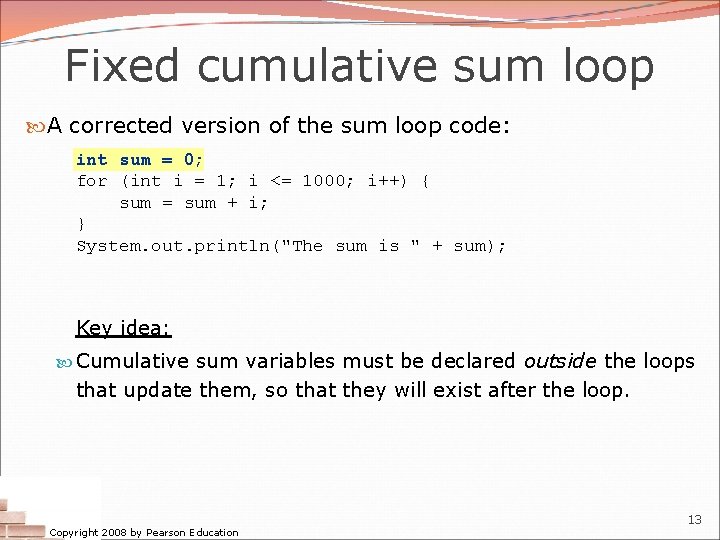
Fixed cumulative sum loop A corrected version of the sum loop code: int sum = 0; for (int i = 1; i <= 1000; i++) { sum = sum + i; } System. out. println("The sum is " + sum); Key idea: Cumulative sum variables must be declared outside the loops that update them, so that they will exist after the loop. Copyright 2008 by Pearson Education 13
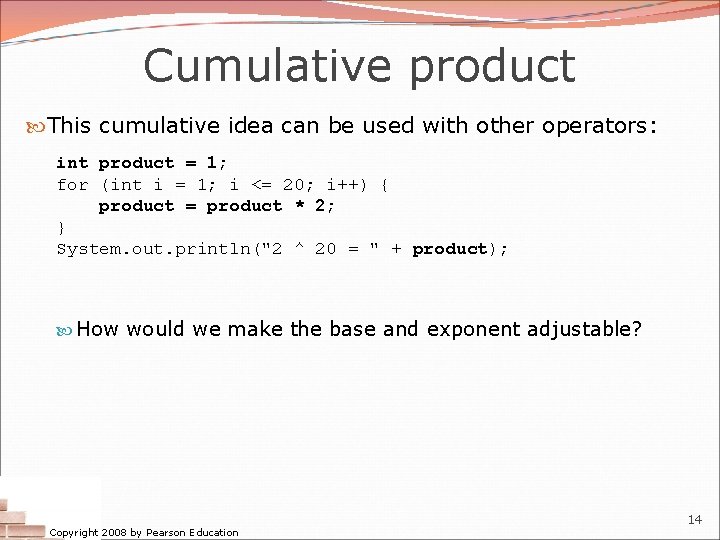
Cumulative product This cumulative idea can be used with other operators: int product = 1; for (int i = 1; i <= 20; i++) { product = product * 2; } System. out. println("2 ^ 20 = " + product); How would we make the base and exponent adjustable? Copyright 2008 by Pearson Education 14
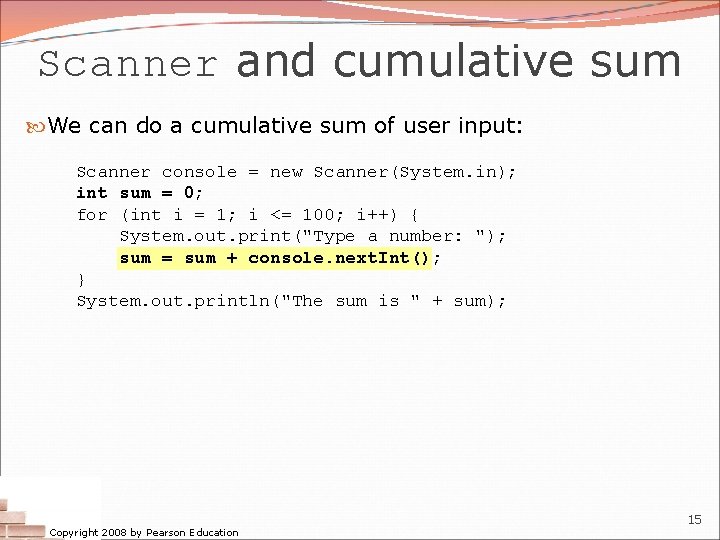
Scanner and cumulative sum We can do a cumulative sum of user input: Scanner console = new Scanner(System. in); int sum = 0; for (int i = 1; i <= 100; i++) { System. out. print("Type a number: "); sum = sum + console. next. Int(); } System. out. println("The sum is " + sum); Copyright 2008 by Pearson Education 15
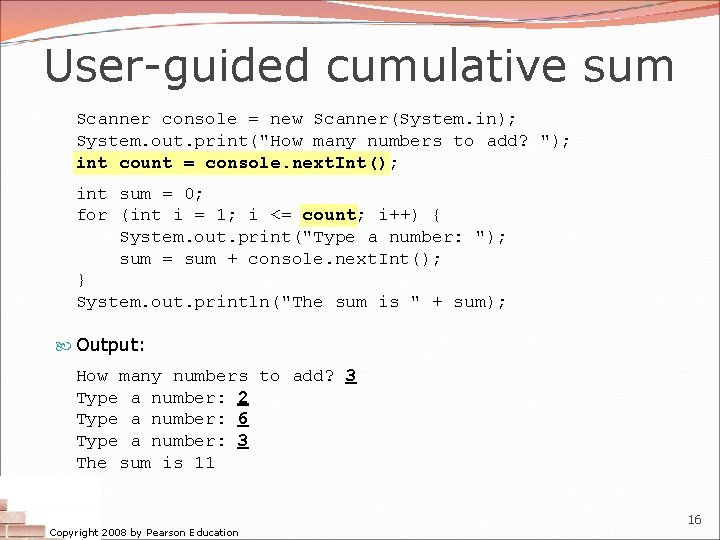
User-guided cumulative sum Scanner console = new Scanner(System. in); System. out. print("How many numbers to add? "); int count = console. next. Int(); int sum = 0; for (int i = 1; i <= count; i++) { System. out. print("Type a number: "); sum = sum + console. next. Int(); } System. out. println("The sum is " + sum); Output: How many numbers to add? 3 Type a number: 2 Type a number: 6 Type a number: 3 The sum is 11 Copyright 2008 by Pearson Education 16
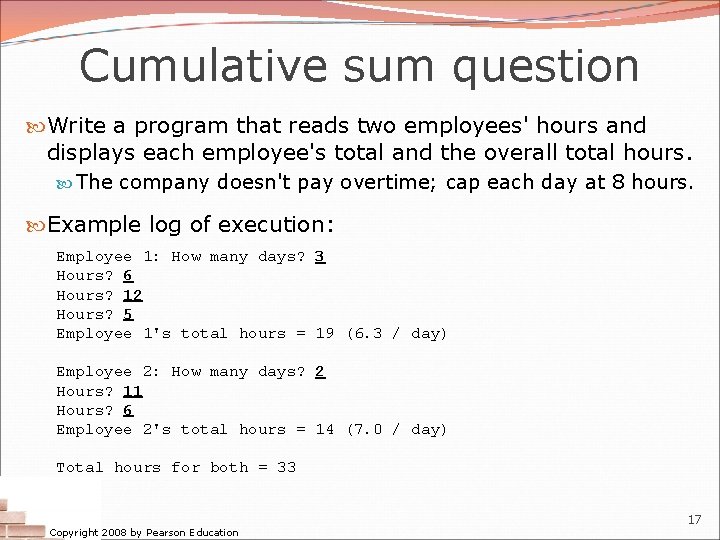
Cumulative sum question Write a program that reads two employees' hours and displays each employee's total and the overall total hours. The company doesn't pay overtime; cap each day at 8 hours. Example log of execution: Employee 1: How many days? 3 Hours? 6 Hours? 12 Hours? 5 Employee 1's total hours = 19 (6. 3 / day) Employee 2: How many days? 2 Hours? 11 Hours? 6 Employee 2's total hours = 14 (7. 0 / day) Total hours for both = 33 Copyright 2008 by Pearson Education 17
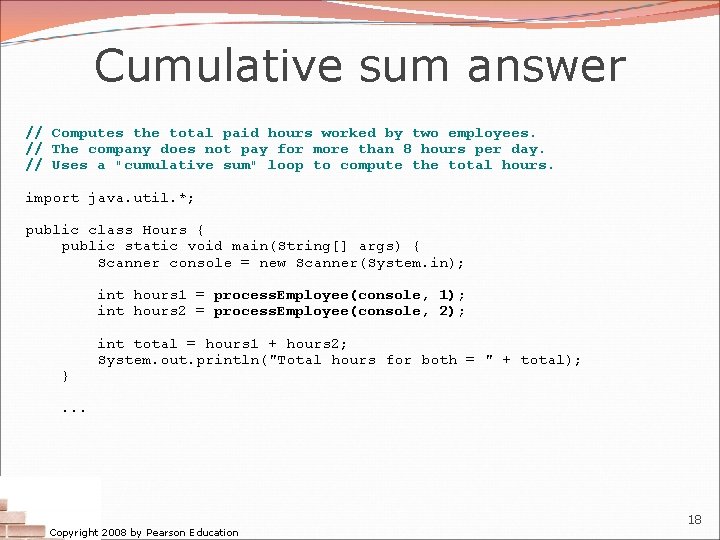
Cumulative sum answer // Computes the total paid hours worked by two employees. // The company does not pay for more than 8 hours per day. // Uses a "cumulative sum" loop to compute the total hours. import java. util. *; public class Hours { public static void main(String[] args) { Scanner console = new Scanner(System. in); int hours 1 = process. Employee(console, 1); int hours 2 = process. Employee(console, 2); } int total = hours 1 + hours 2; System. out. println("Total hours for both = " + total); . . . Copyright 2008 by Pearson Education 18
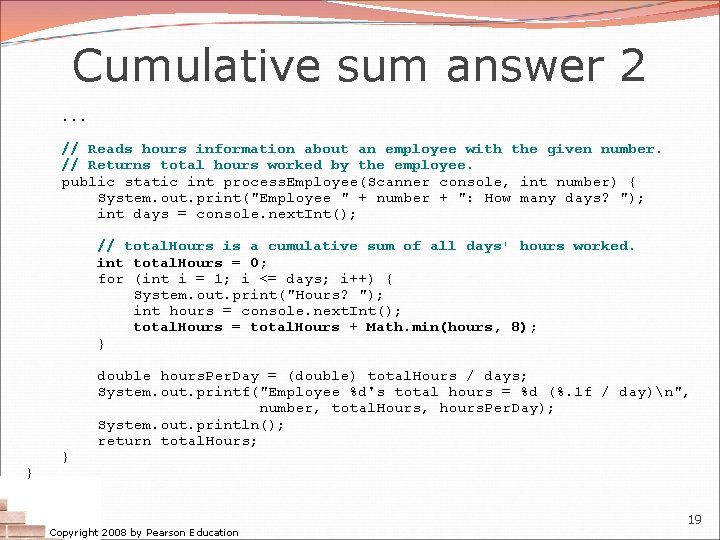
Cumulative sum answer 2. . . // Reads hours information about an employee with the given number. // Returns total hours worked by the employee. public static int process. Employee(Scanner console, int number) { System. out. print("Employee " + number + ": How many days? "); int days = console. next. Int(); // total. Hours is a cumulative sum of all days' hours worked. int total. Hours = 0; for (int i = 1; i <= days; i++) { System. out. print("Hours? "); int hours = console. next. Int(); total. Hours = total. Hours + Math. min(hours, 8); } } } double hours. Per. Day = (double) total. Hours / days; System. out. printf("Employee %d's total hours = %d (%. 1 f / day)n", number, total. Hours, hours. Per. Day); System. out. println(); return total. Hours; Copyright 2008 by Pearson Education 19
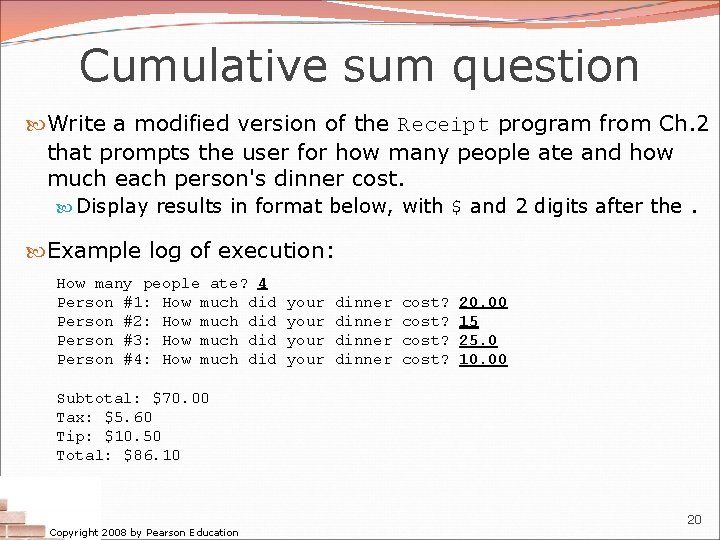
Cumulative sum question Write a modified version of the Receipt program from Ch. 2 that prompts the user for how many people ate and how much each person's dinner cost. Display results in format below, with $ and 2 digits after the. Example log of execution: How many people ate? 4 Person #1: How much did Person #2: How much did Person #3: How much did Person #4: How much did your dinner cost? 20. 00 15 25. 0 10. 00 Subtotal: $70. 00 Tax: $5. 60 Tip: $10. 50 Total: $86. 10 Copyright 2008 by Pearson Education 20
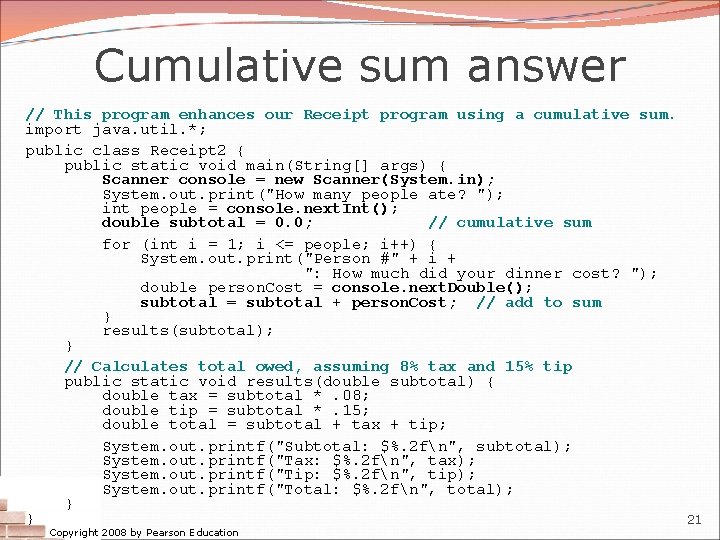
Cumulative sum answer // This program enhances our Receipt program using a cumulative sum. import java. util. *; public class Receipt 2 { public static void main(String[] args) { Scanner console = new Scanner(System. in); System. out. print("How many people ate? "); int people = console. next. Int(); double subtotal = 0. 0; // cumulative sum for (int i = 1; i <= people; i++) { System. out. print("Person #" + i + ": How much did your dinner cost? "); double person. Cost = console. next. Double(); subtotal = subtotal + person. Cost; // add to sum } results(subtotal); } // Calculates total owed, assuming 8% tax and 15% tip public static void results(double subtotal) { double tax = subtotal *. 08; double tip = subtotal *. 15; double total = subtotal + tax + tip; System. out. printf("Subtotal: $%. 2 fn", subtotal); System. out. printf("Tax: $%. 2 fn", tax); System. out. printf("Tip: $%. 2 fn", tip); System. out. printf("Total: $%. 2 fn", total); } } Copyright 2008 by Pearson Education 21
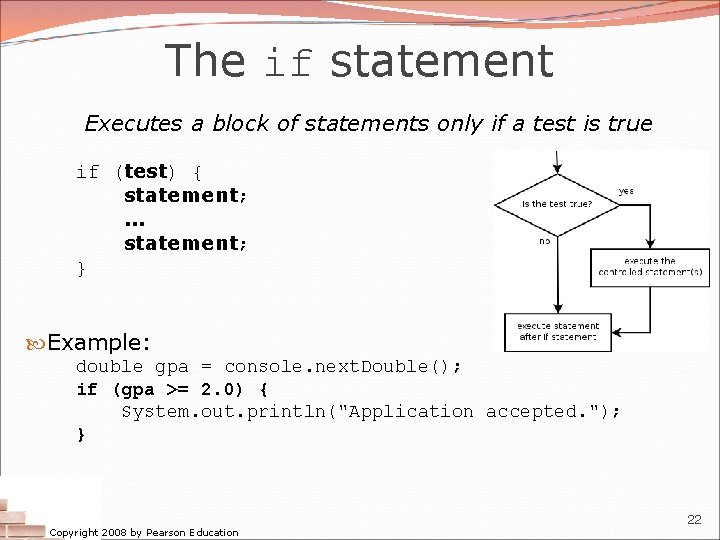
The if statement Executes a block of statements only if a test is true if (test) { statement; . . . statement; } Example: double gpa = console. next. Double(); if (gpa >= 2. 0) { System. out. println("Application accepted. "); } Copyright 2008 by Pearson Education 22
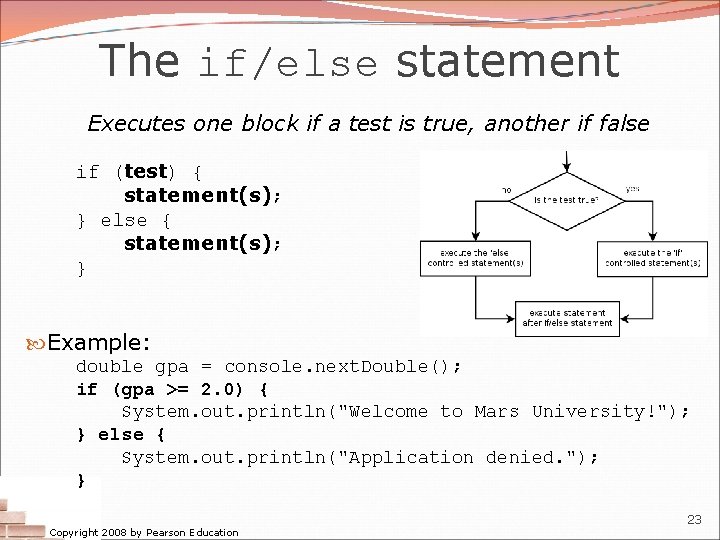
The if/else statement Executes one block if a test is true, another if false if (test) { statement(s); } else { statement(s); } Example: double gpa = console. next. Double(); if (gpa >= 2. 0) { System. out. println("Welcome to Mars University!"); } else { System. out. println("Application denied. "); } Copyright 2008 by Pearson Education 23
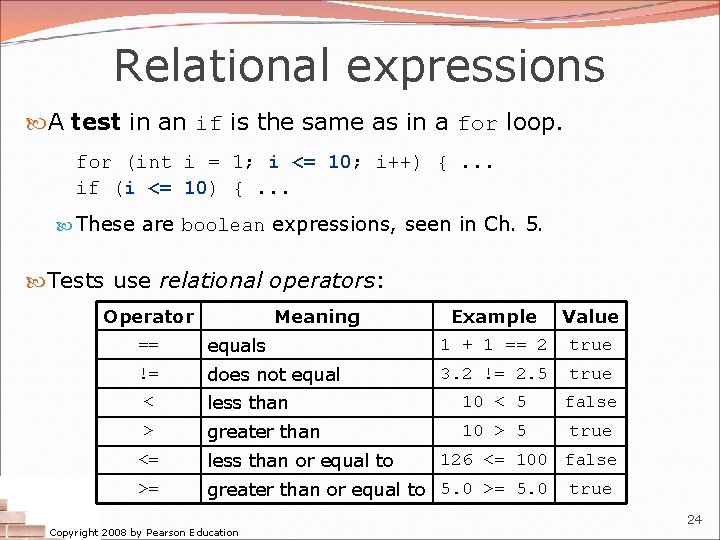
Relational expressions A test in an if is the same as in a for loop. for (int i = 1; i <= 10; i++) {. . . if (i <= 10) {. . . These are boolean expressions, seen in Ch. 5. Tests use relational operators: Operator Meaning == equals != does not equal Example Value 1 + 1 == 2 true 3. 2 != 2. 5 true < less than 10 < 5 false > greater than 10 > 5 true <= less than or equal to >= greater than or equal to 5. 0 >= 5. 0 Copyright 2008 by Pearson Education 126 <= 100 false true 24
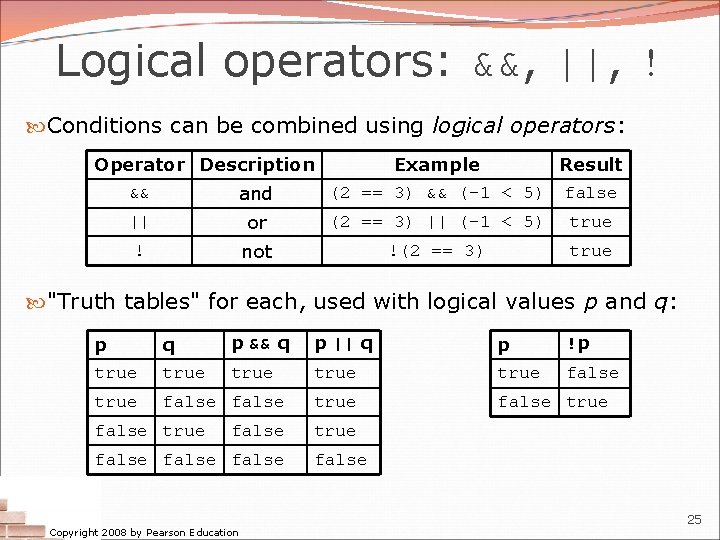
Logical operators: &&, ||, ! Conditions can be combined using logical operators: Operator Description Example Result && (2 == 3) && (-1 < 5) false and || (2 == 3) || (-1 < 5) true or not ! !(2 == 3) true "Truth tables" for each, used with logical values p and q: p && q p || q true p true false true p true q true false false Copyright 2008 by Pearson Education !p false true false 25
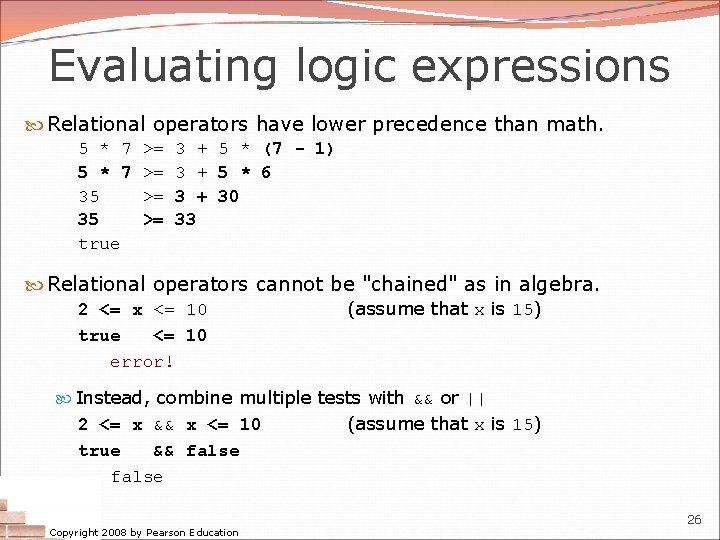
Evaluating logic expressions Relational operators have lower precedence than math. 5 * 7 35 35 true >= >= 3 + 5 * (7 - 1) 3 + 5 * 6 3 + 30 33 Relational operators cannot be "chained" as in algebra. 2 <= x <= 10 true <= 10 error! (assume that x is 15) Instead, combine multiple tests with && or || 2 <= x && x <= 10 true && false Copyright 2008 by Pearson Education (assume that x is 15) 26
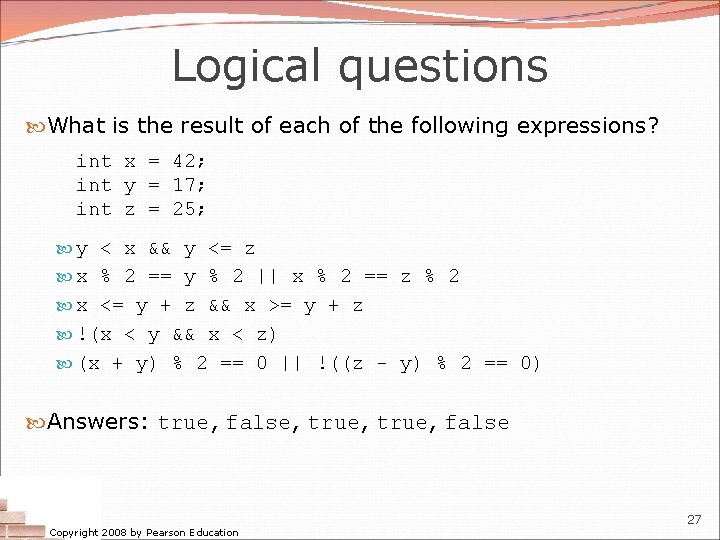
Logical questions What is the result of each of the following expressions? int x = 42; int y = 17; int z = 25; y < x && y <= z x % 2 == y % 2 || x % 2 == z % 2 x <= y + z && x >= y + z !(x < y && x < z) (x + y) % 2 == 0 || !((z - y) % 2 == 0) Answers: true, false, true, false Copyright 2008 by Pearson Education 27
- Slides: 27