
BUILDING JAVA PROGRAMS CHAPTER 2 PRIMITIVE DATA AND
BUILDING JAVA PROGRAMS CHAPTER 2 PRIMITIVE DATA AND DEFINITE LOOPS 1
CLASS CONSTANTS AND SCOPE 2
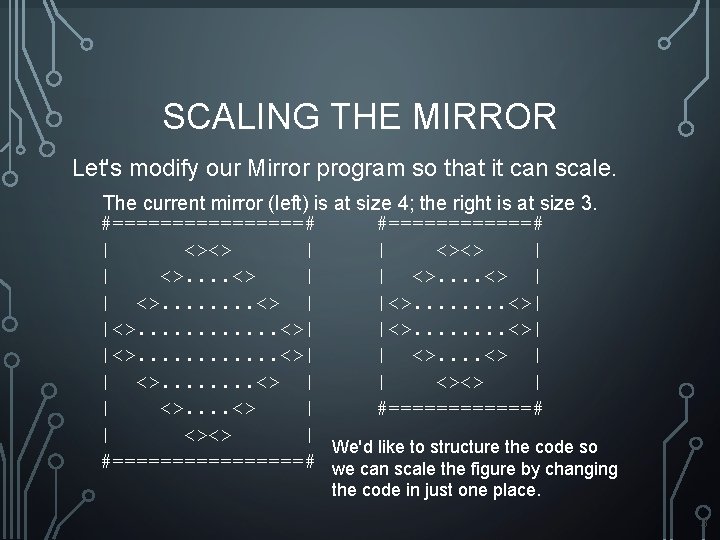
SCALING THE MIRROR Let's modify our Mirror program so that it can scale. The current mirror (left) is at size 4; the right is at size 3. #========# #======# | <><> | | <>. . . . <> | |<>. . . . <>| |<>. . . <>| | <>. . <> | #======# | <><> | We'd like to structure the code so #========# we can scale the figure by changing the code in just one place. 3
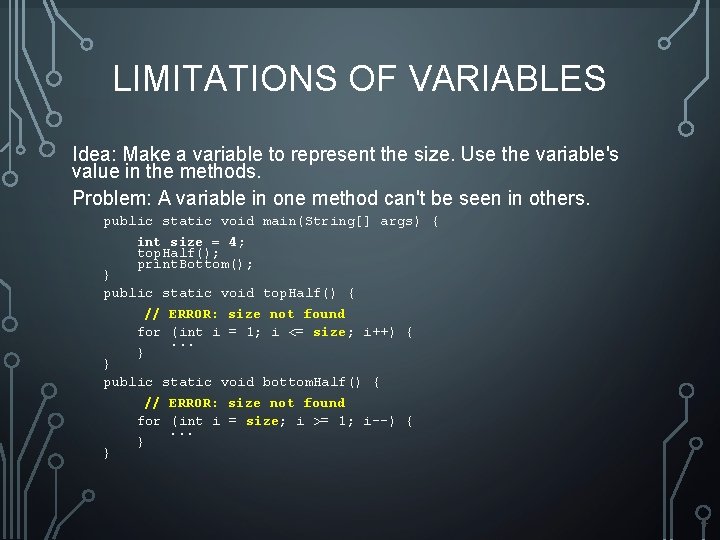
LIMITATIONS OF VARIABLES Idea: Make a variable to represent the size. Use the variable's value in the methods. Problem: A variable in one method can't be seen in others. public static void main(String[] args) { int size = 4; top. Half(); print. Bottom(); } public static void top. Half() { // ERROR: size not found for (int i = 1; i <= size; i++) {. . . } } public static void bottom. Half() { } // ERROR: size not found for (int i = size; i >= 1; i--) {. . . } 4
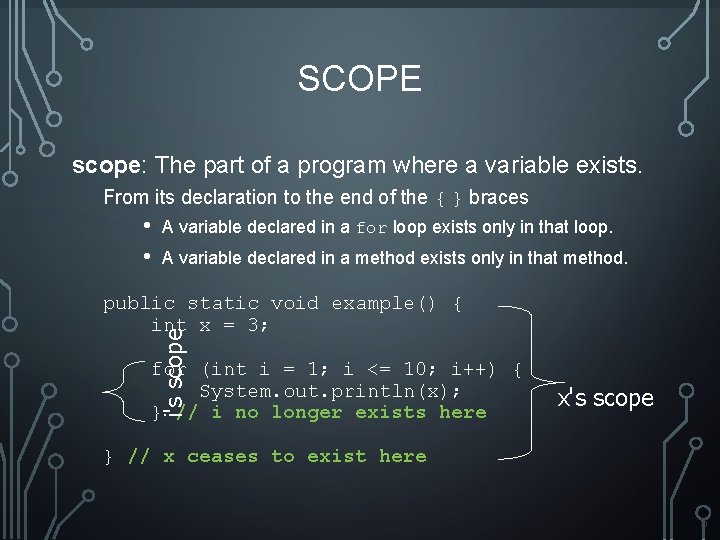
SCOPE scope: The part of a program where a variable exists. From its declaration to the end of the { } braces • • A variable declared in a for loop exists only in that loop. A variable declared in a method exists only in that method. i's scope public static void example() { int x = 3; for (int i = 1; i <= 10; i++) { System. out. println(x); } // i no longer exists here x's scope } // x ceases to exist here 5

SCOPE IMPLICATIONS Variables without overlapping scope can have same name. for (int i = 1; i <= 100; i++) { System. out. print("/"); } for (int i = 1; i <= 100; i++) { System. out. print("\"); } int i = 5; // OK: outside of loop's scope A variable can't be declared twice or used out of its scope. for (int i = 1; i <= 100 * line; i++) { int i = 2; // ERROR: overlapping scope System. out. print("/"); } i = 4; // ERROR: outside scope 6
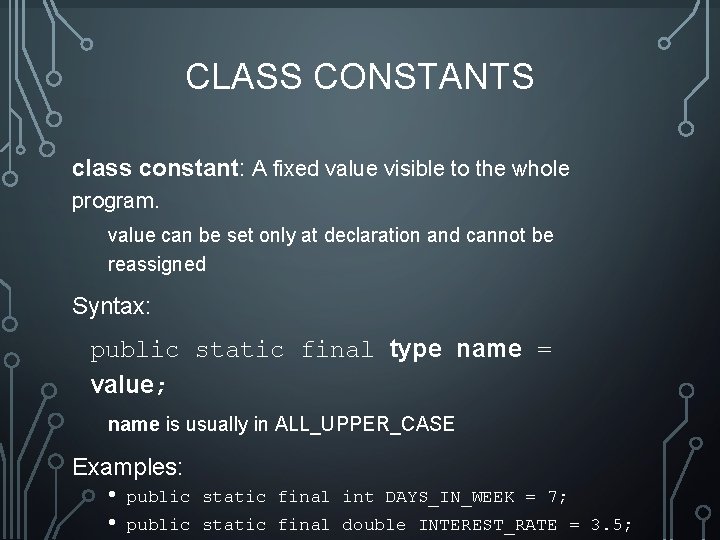
CLASS CONSTANTS class constant: A fixed value visible to the whole program. value can be set only at declaration and cannot be reassigned Syntax: public static final type name = value; name is usually in ALL_UPPER_CASE Examples: • public static final int DAYS_IN_WEEK = 7; static final double INTEREST_RATE = 3. 5; 7
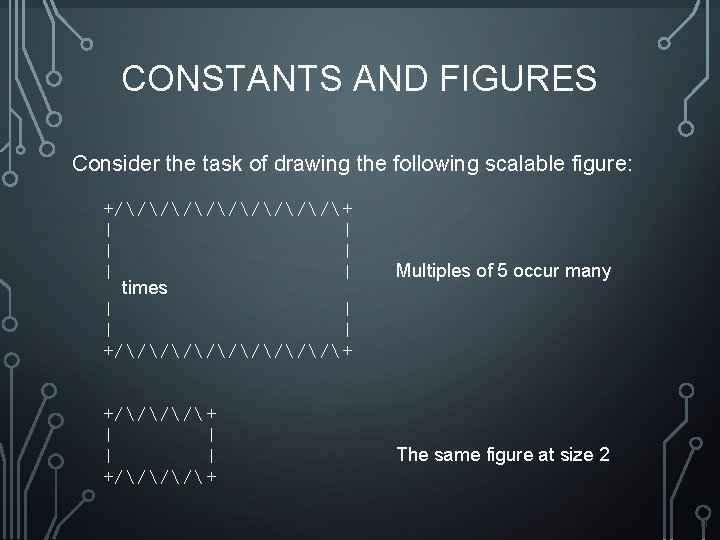
CONSTANTS AND FIGURES Consider the task of drawing the following scalable figure: +/////+ | | | times | | +/////+ +//+ | | +//+ Multiples of 5 occur many The same figure at size 2 8
![REPETITIVE FIGURE CODE public class Sign { public static void main(String[] args) { draw.](http://slidetodoc.com/presentation_image_h2/fa8213956a1aa3f068fd6db98fa238df/image-9.jpg "REPETITIVE FIGURE CODE public class Sign { public static void main(String[] args) { draw.")
REPETITIVE FIGURE CODE public class Sign { public static void main(String[] args) { draw. Line(); draw. Body(); draw. Line(); } public static void draw. Line() { System. out. print ("+"); for (int i = 1; i <= 10; i++) { System. out. print("/\"); } } System. out. println("+"); public static void draw. Body() { for (int line = 1; line <= 5; line++) { System. out. print ("|"); for (int spaces = 1; spaces <= 20; spaces++) { System. out. print(" "); } } System. out. println("|"); 9
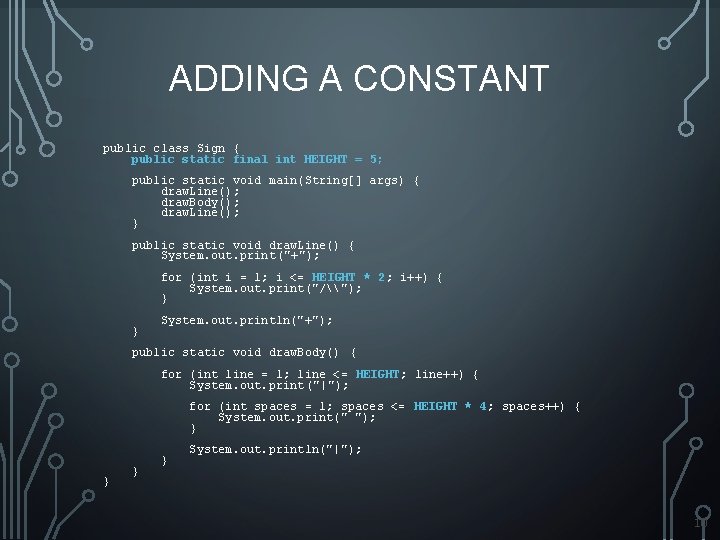
ADDING A CONSTANT public class Sign { public static final int HEIGHT = 5; public static void main(String[] args) { draw. Line(); draw. Body(); draw. Line(); } public static void draw. Line() { System. out. print ("+"); for (int i = 1; i <= HEIGHT * 2; i++) { System. out. print("/\"); } } System. out. println("+"); public static void draw. Body() { for (int line = 1; line <= HEIGHT; line++) { System. out. print ("|"); for (int spaces = 1; spaces <= HEIGHT * 4; spaces++) { System. out. print(" "); } } System. out. println("|"); 10
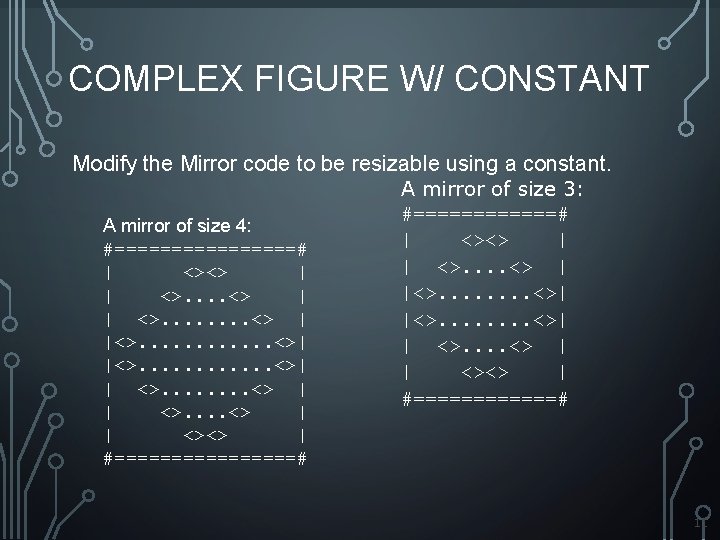
COMPLEX FIGURE W/ CONSTANT Modify the Mirror code to be resizable using a constant. A mirror of size 4: #========# | <><> | | <>. . . <> | |<>. . . <>| | <>. . . . <> | | <><> | #========# A mirror of size 3: #======# | <><> | | <>. . <> | |<>. . . . <>| | <>. . <> | | <><> | #======# 11
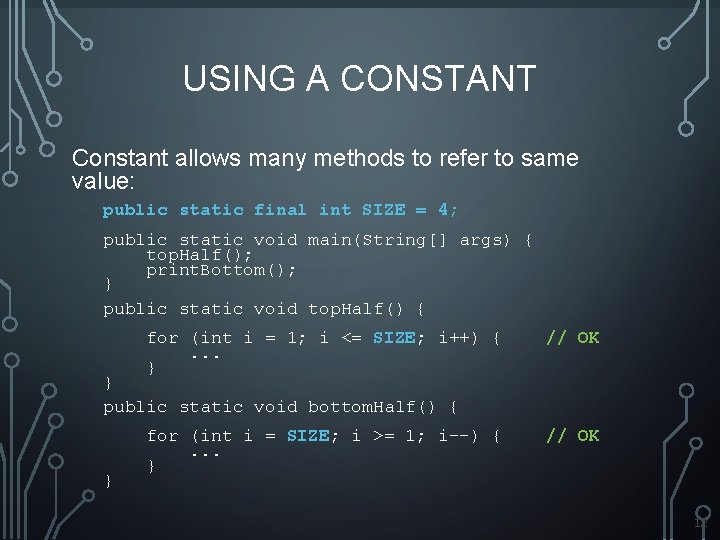
USING A CONSTANT Constant allows many methods to refer to same value: public static final int SIZE = 4; public static void main(String[] args) { top. Half(); print. Bottom(); } public static void top. Half() { for (int i = 1; i <= SIZE; i++) {. . . } // OK for (int i = SIZE; i >= 1; i--) {. . . } // OK } public static void bottom. Half() { } 12
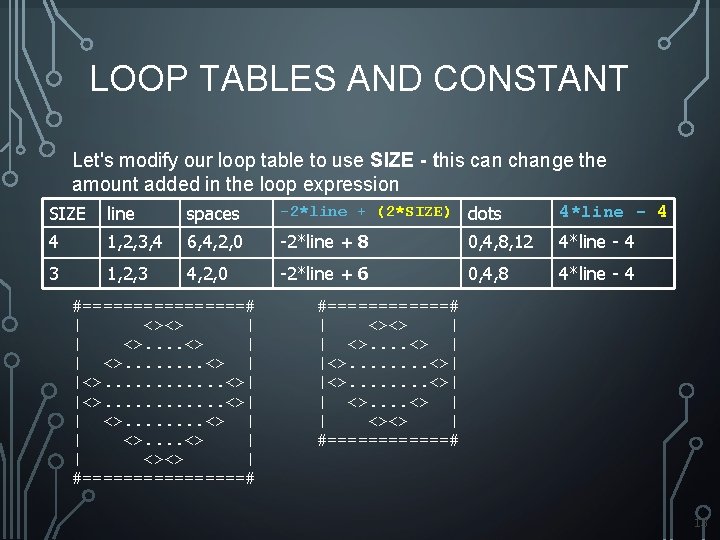
LOOP TABLES AND CONSTANT Let's modify our loop table to use SIZE - this can change the amount added in the loop expression SIZE line spaces -2*line + (2*SIZE) dots 4*line - 4 4 1, 2, 3, 4 6, 4, 2, 0 -2*line + 8 0, 4, 8, 12 4*line - 4 3 1, 2, 3 4, 2, 0 -2*line + 6 0, 4, 8 4*line - 4 #========# | <><> | | <>. . . <> | |<>. . . <>| | <>. . . . <> | | <><> | #========# #======# | <><> | | <>. . <> | |<>. . . . <>| | <>. . <> | | <><> | #======# 13
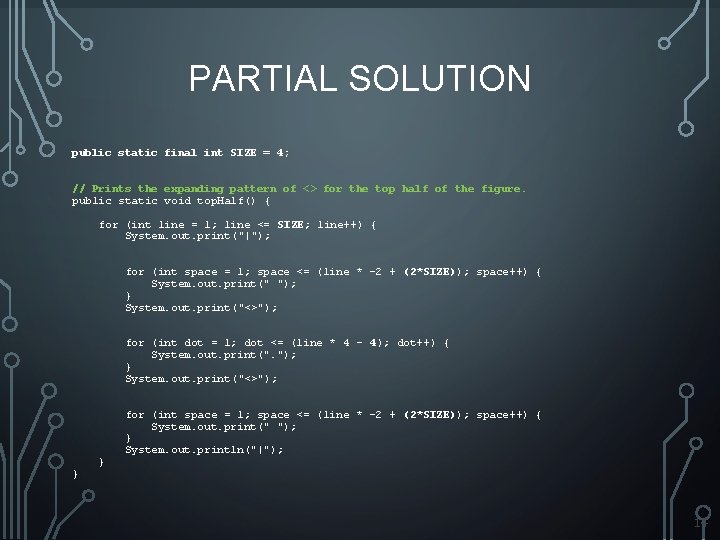
PARTIAL SOLUTION public static final int SIZE = 4; // Prints the expanding pattern of <> for the top half of the figure. public static void top. Half() { for (int line = 1; line <= SIZE; line++) { System. out. print("|"); for (int space = 1; space <= (line * -2 + (2*SIZE)); space++) { System. out. print(" "); } System. out. print("<>"); for (int dot = 1; dot <= (line * 4 - 4); dot++) { System. out. print(". "); } System. out. print("<>"); } } for (int space = 1; space <= (line * -2 + (2*SIZE)); space++) { System. out. print(" "); } System. out. println("|"); 14
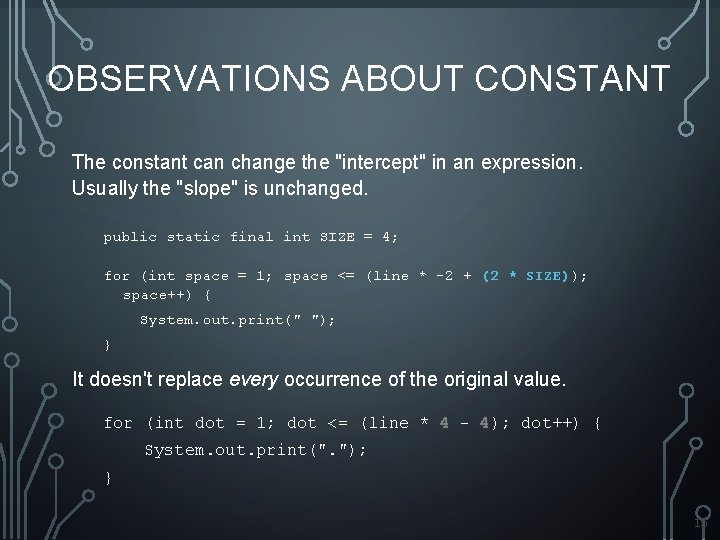
OBSERVATIONS ABOUT CONSTANT The constant can change the "intercept" in an expression. Usually the "slope" is unchanged. public static final int SIZE = 4; for (int space = 1; space <= (line * -2 + (2 * SIZE)); space++) { System. out. print(" "); } It doesn't replace every occurrence of the original value. for (int dot = 1; dot <= (line * 4 - 4); dot++) { System. out. print(". "); } 15
- Slides: 15