
Building Java Programs Chapter 2 Lecture 2 3
Building Java Programs Chapter 2 Lecture 2 -3: Loop Figures and Constants reading: 2. 4 - 2. 5 1
2
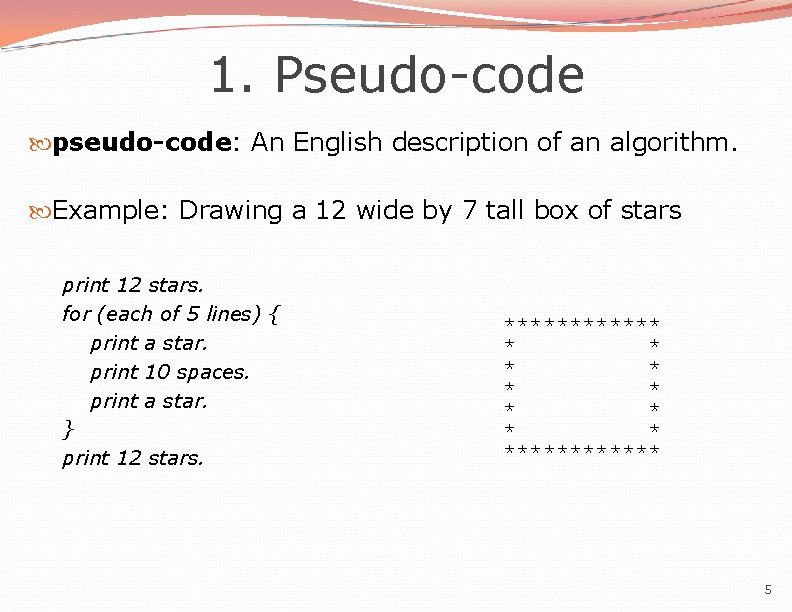
1. Pseudo-code pseudo-code: An English description of an algorithm. Example: Drawing a 12 wide by 7 tall box of stars print 12 stars. for (each of 5 lines) { print a star. print 10 spaces. print a star. } print 12 stars. ****** * * ****** 5
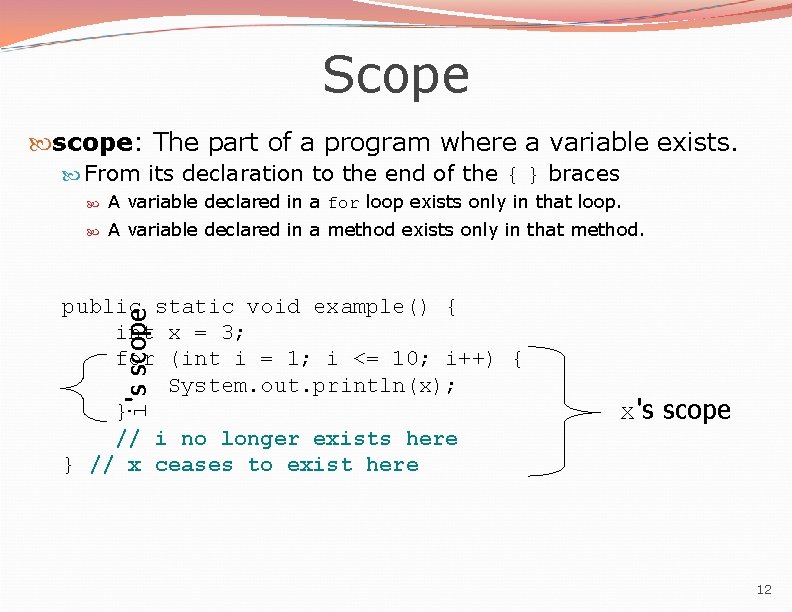
Scope scope: The part of a program where a variable exists. From its declaration to the end of the { } braces A variable declared in a for loop exists only in that loop. A variable declared in a method exists only in that method. i's scope public static void example() { int x = 3; for (int i = 1; i <= 10; i++) { System. out. println(x); } // i no longer exists here } // x ceases to exist here x's scope 12
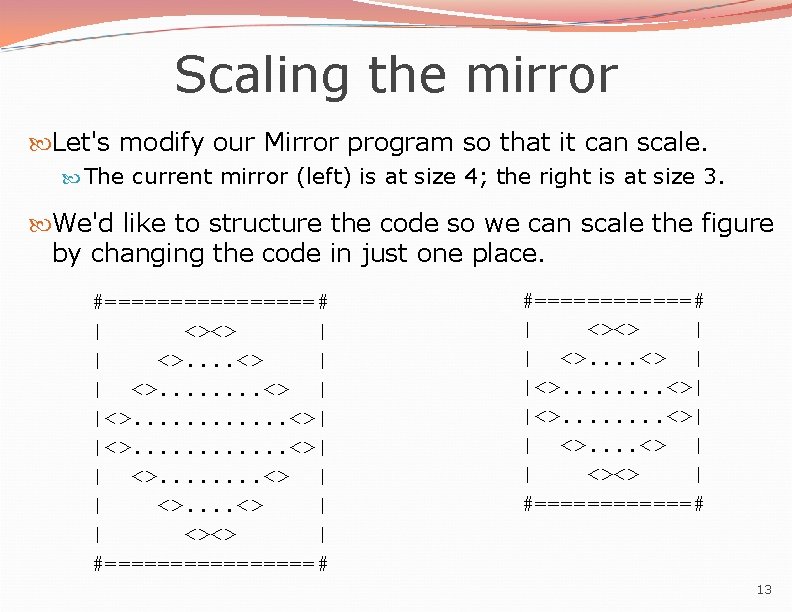
Scaling the mirror Let's modify our Mirror program so that it can scale. The current mirror (left) is at size 4; the right is at size 3. We'd like to structure the code so we can scale the figure by changing the code in just one place. #========# | <><> | | <>. . . <> | |<>. . . <>| | <>. . . . <> | | <><> | #========# #======# | <><> | | <>. . <> | |<>. . . . <>| | <>. . <> | | <><> | #======# 13
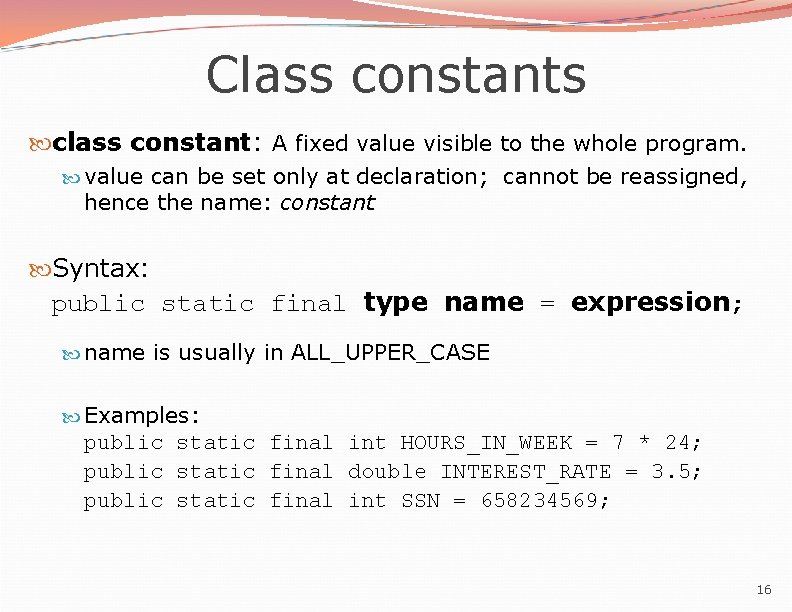
Class constants class constant: A fixed value visible to the whole program. value can be set only at declaration; cannot be reassigned, hence the name: constant Syntax: public static final type name = expression; name is usually in ALL_UPPER_CASE Examples: public static final int HOURS_IN_WEEK = 7 * 24; public static final double INTEREST_RATE = 3. 5; public static final int SSN = 658234569; 16
- Slides: 7