
Building Java Programs Chapter 2 Lecture 2 3
Building Java Programs Chapter 2 Lecture 2 -3: Loop Figures and Constants reading: 2. 4 - 2. 5 self-checks: 27 exercises: 16 -17 videos: Ch. 2 #5 Copyright 2010 by Pearson Education 1
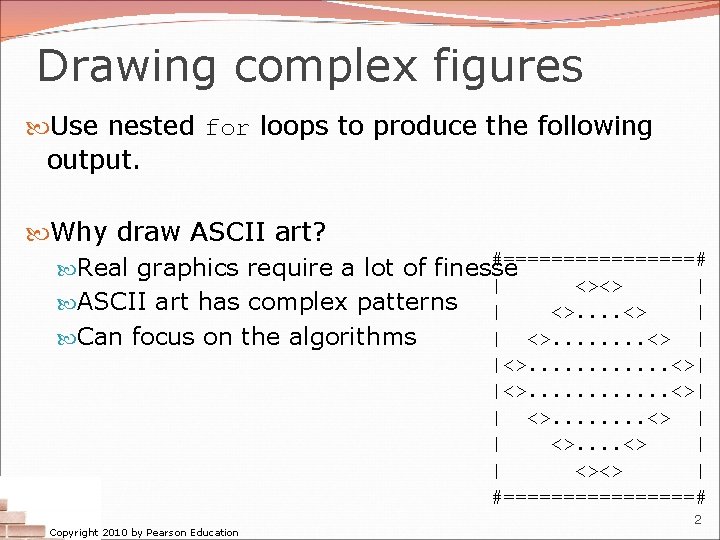
Drawing complex figures Use nested for loops to produce the following output. Why draw ASCII art? #========# Real graphics require a lot of finesse | <><> | ASCII art has complex patterns | <>. . <> | | <>. . . . <> | Can focus on the algorithms |<>. . . <>| | <>. . . . <> | | <><> | #========# Copyright 2010 by Pearson Education 2
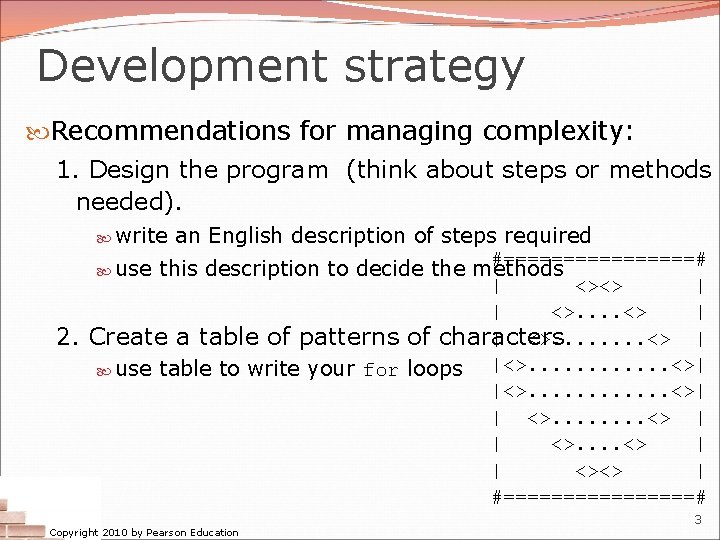
Development strategy Recommendations for managing complexity: 1. Design the program (think about steps or methods needed). write an English description of steps required #========# use this description to decide the methods | <><> | | <>. . . <> | 2. Create a table of patterns of characters |<>. . . <>| use table to write your for loops |<>. . . <>| | <>. . . . <> | | <><> | #========# Copyright 2010 by Pearson Education 3
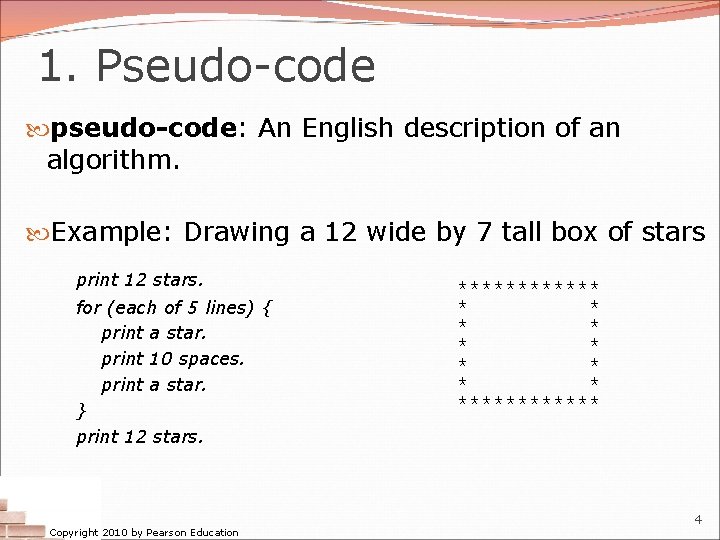
1. Pseudo-code pseudo-code: An English description of an algorithm. Example: Drawing a 12 wide by 7 tall box of stars print 12 stars. for (each of 5 lines) { print a star. print 10 spaces. print a star. } print 12 stars. Copyright 2010 by Pearson Education ****** * * ****** 4
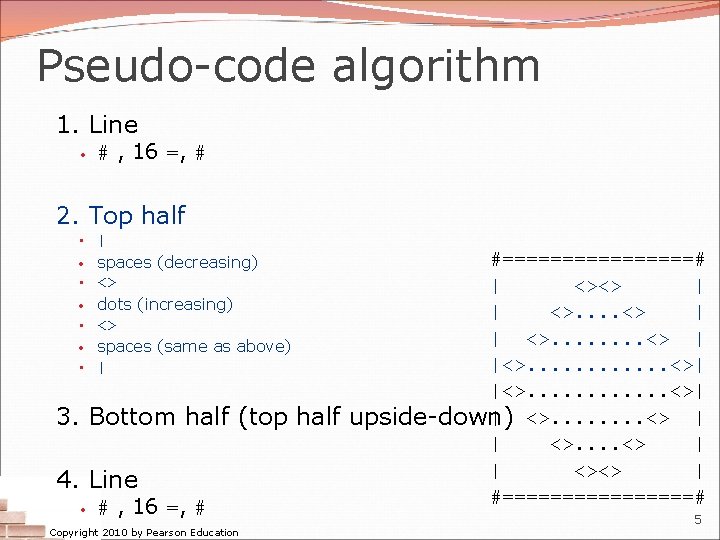
Pseudo-code algorithm 1. Line • # , 16 =, # 2. Top half • • | spaces (decreasing) <> dots (increasing) <> spaces (same as above) | 3. Bottom half (top half 4. Line • # , 16 =, # Copyright 2010 by Pearson Education #========# | <><> | | <>. . . <> | |<>. . . <>| | <>. . . . <> | upside-down) | <>. . <> | | <><> | #========# 5
![Methods from pseudocode public class Mirror { public static void main(String[] args) { line();](http://slidetodoc.com/presentation_image_h2/81c43474167c3eadd9d50cd138400646/image-6.jpg "Methods from pseudocode public class Mirror { public static void main(String[] args) { line();")
Methods from pseudocode public class Mirror { public static void main(String[] args) { line(); top. Half(); bottom. Half(); line(); } public static void top. Half() { for (int line = 1; line <= 4; line++) { // contents of each line } } public static void bottom. Half() { for (int line = 1; line <= 4; line++) { // contents of each line } } } public static void line() { //. . . } Copyright 2010 by Pearson Education 6
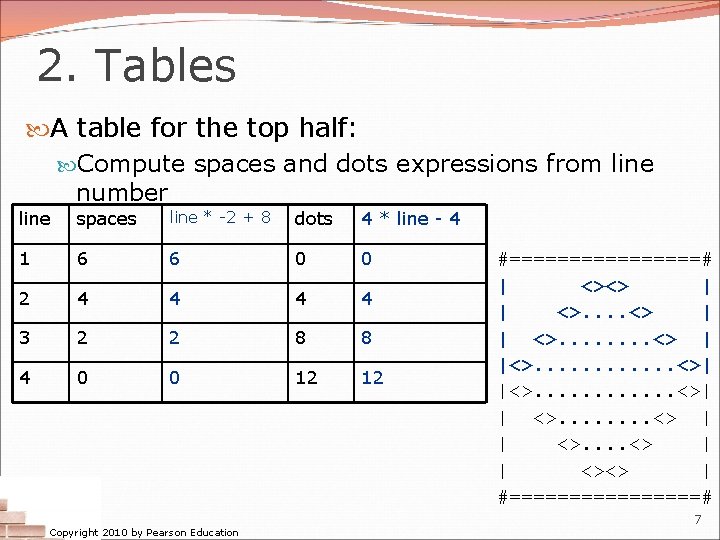
2. Tables A table for the top half: Compute spaces and dots expressions from line number line spaces line * -2 + 8 dots 4 * line - 4 1 6 6 0 0 2 4 4 3 2 2 8 8 4 0 0 12 12 Copyright 2010 by Pearson Education #========# | <><> | | <>. . . <> | |<>. . . <>| | <>. . . . <> | | <><> | #========# 7
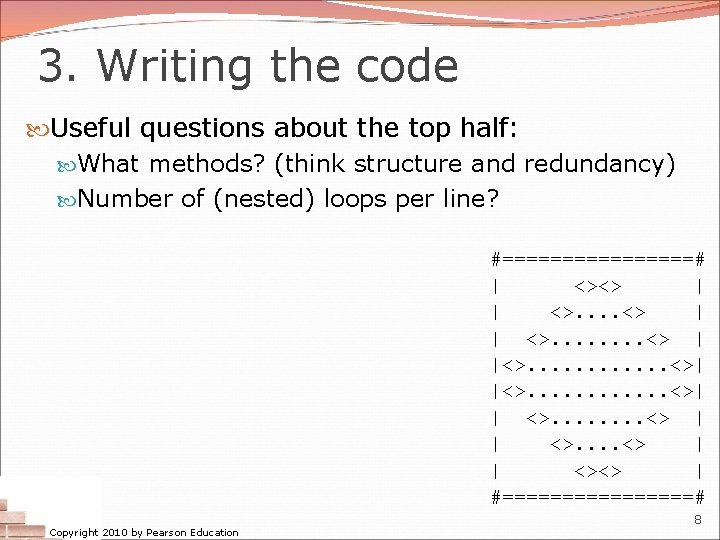
3. Writing the code Useful questions about the top half: What methods? (think structure and redundancy) Number of (nested) loops per line? #========# | <><> | | <>. . . <> | |<>. . . <>| | <>. . . . <> | | <><> | #========# Copyright 2010 by Pearson Education 8
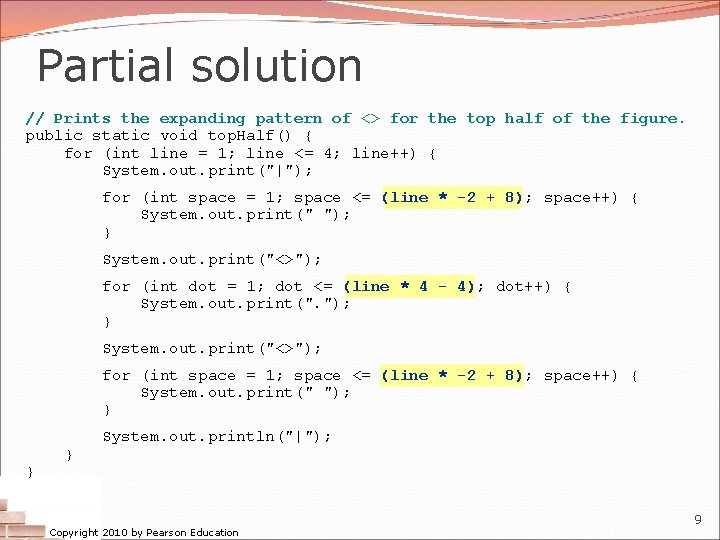
Partial solution // Prints the expanding pattern of <> for the top half of the figure. public static void top. Half() { for (int line = 1; line <= 4; line++) { System. out. print("|"); for (int space = 1; space <= (line * -2 + 8); space++) { System. out. print(" "); } System. out. print("<>"); for (int dot = 1; dot <= (line * 4 - 4); dot++) { System. out. print(". "); } System. out. print("<>"); for (int space = 1; space <= (line * -2 + 8); space++) { System. out. print(" "); } } } System. out. println("|"); Copyright 2010 by Pearson Education 9
Class constants and scope reading: 2. 4 self-check: 28 exercises: 11 videos: Ch. 2 #5 Copyright 2010 by Pearson Education 10
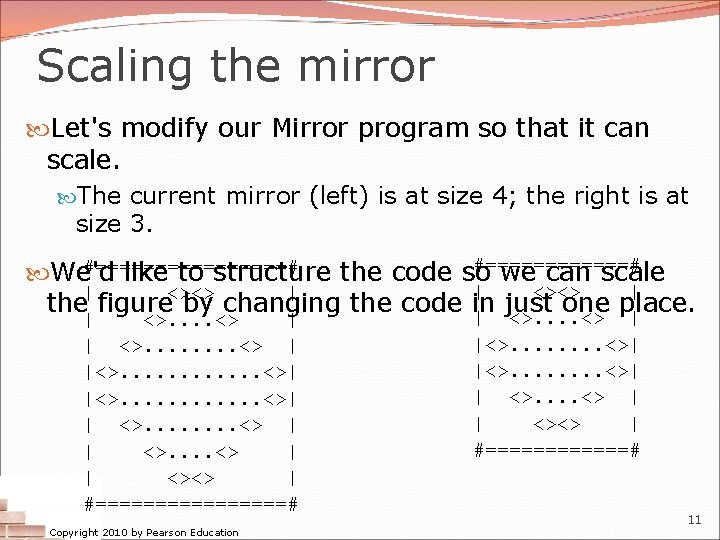
Scaling the mirror Let's modify our Mirror program so that it can scale. The current mirror (left) is at size 4; the right is at size 3. #======# #========# We'd like to structure the code so we can scale | <><> | the figure by changing the code in just one place. | <>. . . . <> | |<>. . . <>| | <>. . . . <> | | <><> | #========# Copyright 2010 by Pearson Education |<>. . . . <>| | <>. . <> | | <><> | #======# 11
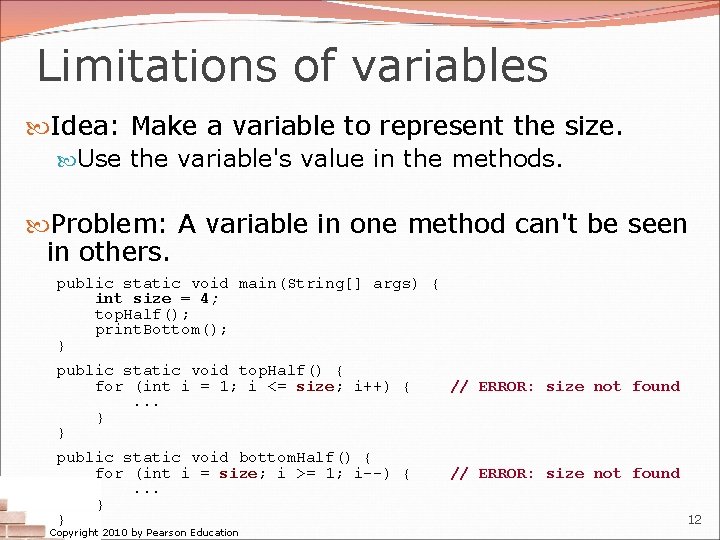
Limitations of variables Idea: Make a variable to represent the size. Use the variable's value in the methods. Problem: A variable in one method can't be seen in others. public static void main(String[] args) { int size = 4; top. Half(); print. Bottom(); } public static void top. Half() { for (int i = 1; i <= size; i++) {. . . } } public static void bottom. Half() { for (int i = size; i >= 1; i--) {. . . } } Copyright 2010 by Pearson Education // ERROR: size not found 12
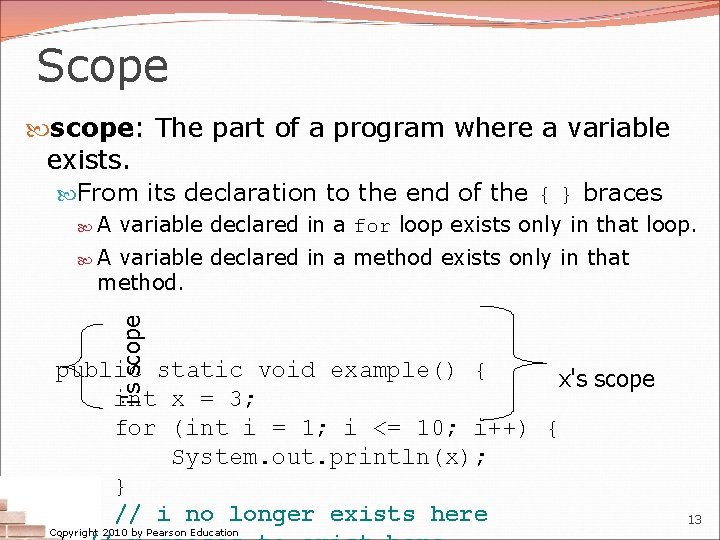
Scope scope: The part of a program where a variable exists. From its declaration to the end of the { } braces A variable declared in a for loop exists only in that loop. variable declared in a method exists only in that method. i's scope A public static void example() { x's scope int x = 3; for (int i = 1; i <= 10; i++) { System. out. println(x); } // i no longer exists here Copyright 2010 by Pearson Education 13
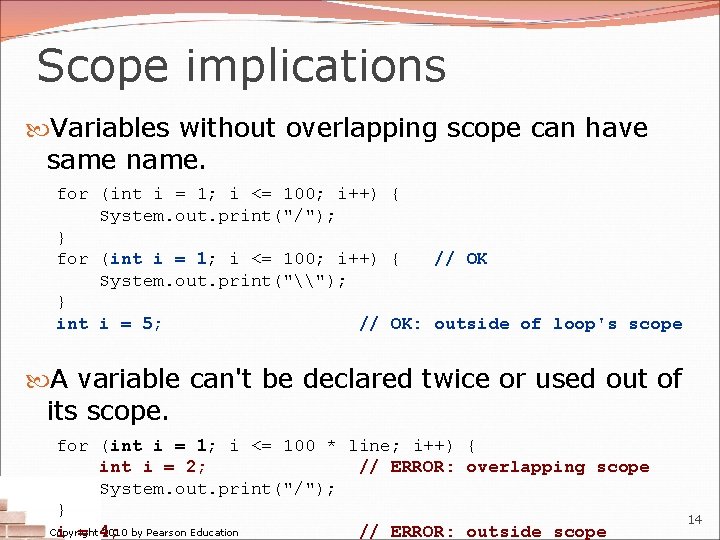
Scope implications Variables without overlapping scope can have same name. for (int i = 1; i <= 100; i++) { System. out. print("/"); } for (int i = 1; i <= 100; i++) { // OK System. out. print("\"); } int i = 5; // OK: outside of loop's scope A variable can't be declared twice or used out of its scope. for (int i = 1; i <= 100 * line; i++) { int i = 2; // ERROR: overlapping scope System. out. print("/"); } Copyright 2010 by Pearson Education i = 4; // ERROR: outside scope 14
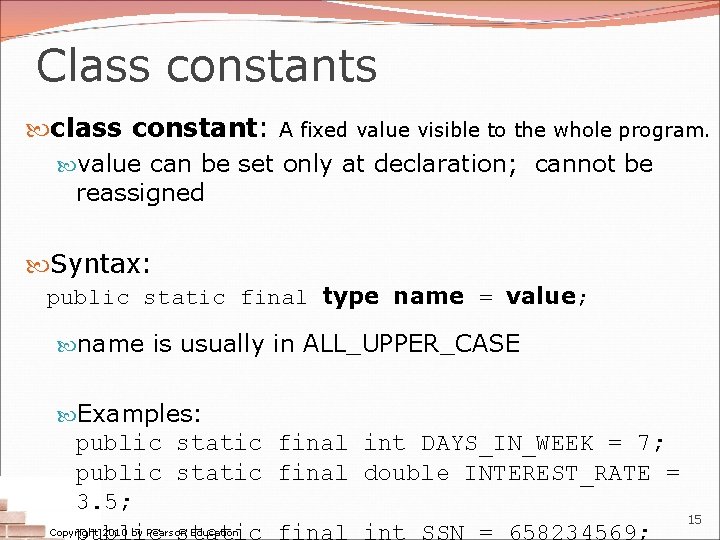
Class constants class constant: A fixed value visible to the whole program. value can be set only at declaration; cannot be reassigned Syntax: public static final type name = value; name is usually in ALL_UPPER_CASE Examples: public static final int DAYS_IN_WEEK = 7; public static final double INTEREST_RATE = 3. 5; Copyright 2010 by Pearson Education 15
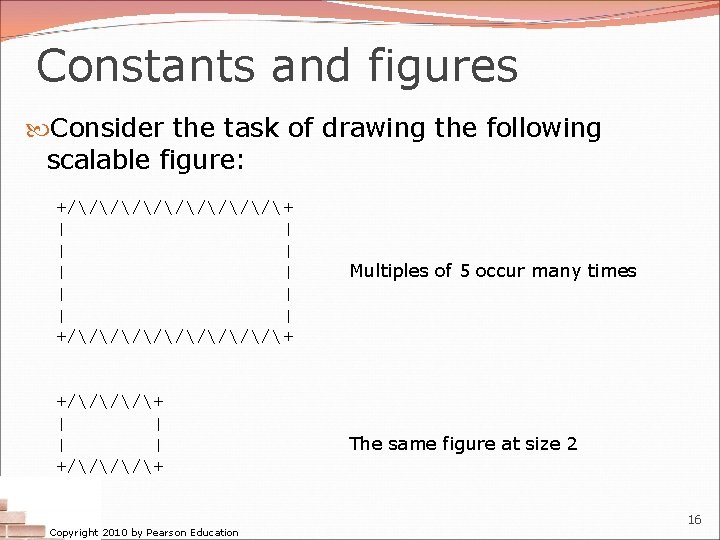
Constants and figures Consider the task of drawing the following scalable figure: +/////+ | | | | | +/////+ Multiples of 5 occur many times +//+ | | +//+ The same figure at size 2 Copyright 2010 by Pearson Education 16
![Repetitive figure code public class Sign { public static void main(String[] args) { draw.](http://slidetodoc.com/presentation_image_h2/81c43474167c3eadd9d50cd138400646/image-17.jpg "Repetitive figure code public class Sign { public static void main(String[] args) { draw.")
Repetitive figure code public class Sign { public static void main(String[] args) { draw. Line(); draw. Body(); draw. Line(); } public static void draw. Line() { System. out. print("+"); for (int i = 1; i <= 10; i++) { System. out. print("/\"); } System. out. println("+"); } } public static void draw. Body() { for (int line = 1; line <= 5; line++) { System. out. print("|"); for (int spaces = 1; spaces <= 20; spaces++) { System. out. print(" "); } System. out. println("|"); } } Copyright 2010 by Pearson Education 17
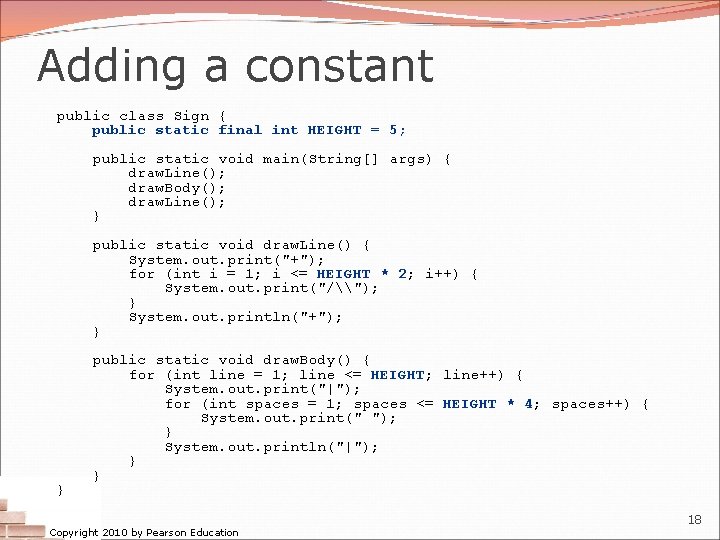
Adding a constant public class Sign { public static final int HEIGHT = 5; public static void main(String[] args) { draw. Line(); draw. Body(); draw. Line(); } public static void draw. Line() { System. out. print("+"); for (int i = 1; i <= HEIGHT * 2; i++) { System. out. print("/\"); } System. out. println("+"); } } public static void draw. Body() { for (int line = 1; line <= HEIGHT; line++) { System. out. print("|"); for (int spaces = 1; spaces <= HEIGHT * 4; spaces++) { System. out. print(" "); } System. out. println("|"); } } Copyright 2010 by Pearson Education 18
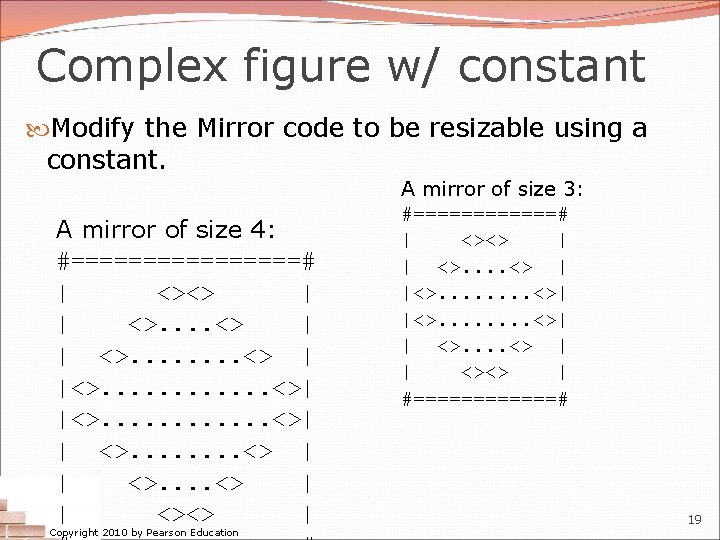
Complex figure w/ constant Modify the Mirror code to be resizable using a constant. A mirror of size 4: #========# | <><> | | <>. . . <> | |<>. . . <>| | <>. . . . <> | | <><> | Copyright 2010 by Pearson Education A mirror of size 3: #======# | <><> | | <>. . <> | |<>. . . . <>| | <>. . <> | | <><> | #======# 19
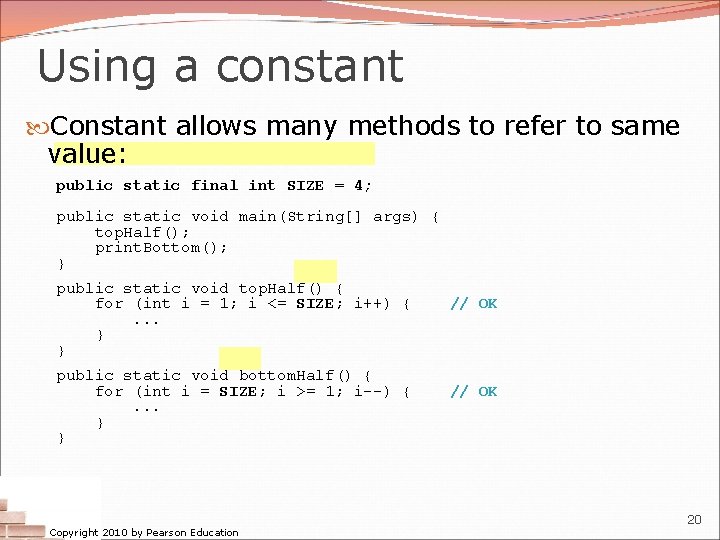
Using a constant Constant allows many methods to refer to same value: public static final int SIZE = 4; public static void main(String[] args) { top. Half(); print. Bottom(); } public static void top. Half() { for (int i = 1; i <= SIZE; i++) {. . . } } public static void bottom. Half() { for (int i = SIZE; i >= 1; i--) {. . . } } Copyright 2010 by Pearson Education // OK 20
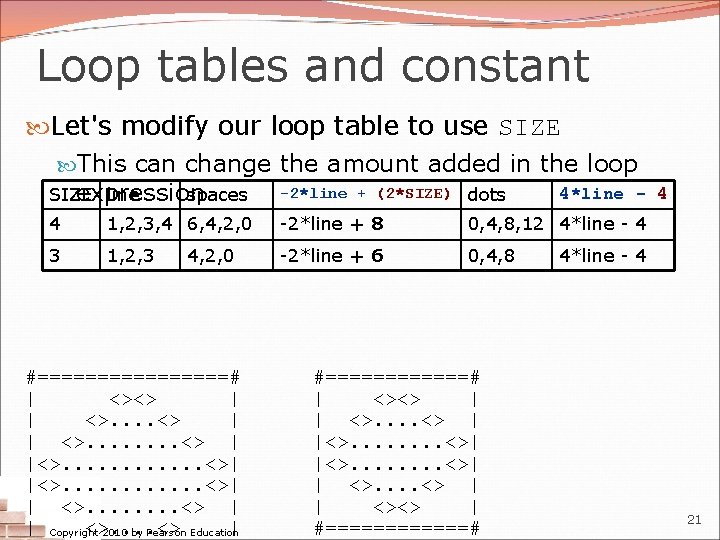
Loop tables and constant Let's modify our loop table to use SIZE This can change the amount added in the loop expression SIZE line spaces -2*line + (2*SIZE) dots 4 1, 2, 3, 4 6, 4, 2, 0 -2*line + 8 0, 4, 8, 12 4*line - 4 3 1, 2, 3 -2*line + 6 0, 4, 8 4, 2, 0 #========# | <><> | | <>. . . <> | |<>. . . <>| | <>. . . . <> | | Copyright <>. . <> | 2010 by Pearson Education #======# | <><> | | <>. . <> | |<>. . . . <>| | <>. . <> | | <><> | #======# 4*line - 4 21
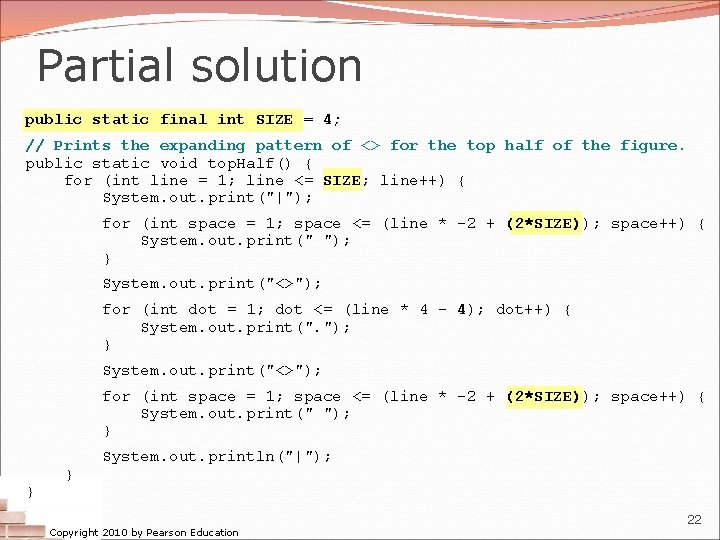
Partial solution public static final int SIZE = 4; // Prints the expanding pattern of <> for the top half of the figure. public static void top. Half() { for (int line = 1; line <= SIZE; line++) { System. out. print("|"); for (int space = 1; space <= (line * -2 + (2*SIZE)); space++) { System. out. print(" "); } System. out. print("<>"); for (int dot = 1; dot <= (line * 4 - 4); dot++) { System. out. print(". "); } System. out. print("<>"); for (int space = 1; space <= (line * -2 + (2*SIZE)); space++) { System. out. print(" "); } } } System. out. println("|"); Copyright 2010 by Pearson Education 22
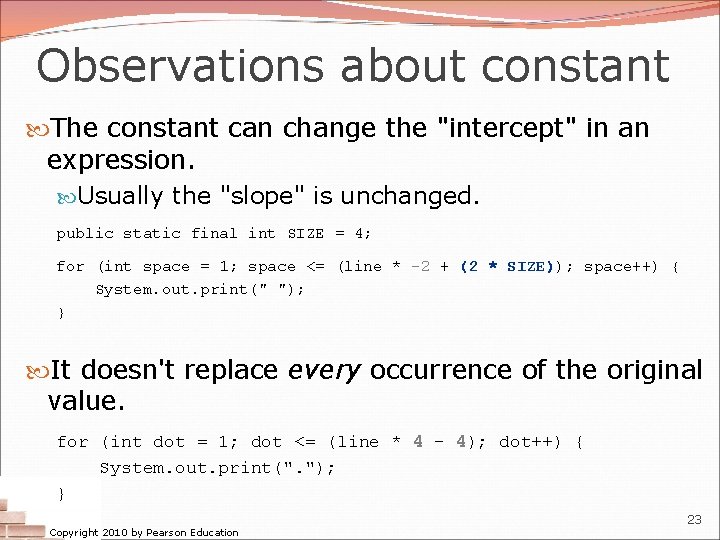
Observations about constant The constant can change the "intercept" in an expression. Usually the "slope" is unchanged. public static final int SIZE = 4; for (int space = 1; space <= (line * -2 + (2 * SIZE)); space++) { System. out. print(" "); } It doesn't replace every occurrence of the original value. for (int dot = 1; dot <= (line * 4 - 4); dot++) { System. out. print(". "); } Copyright 2010 by Pearson Education 23
- Slides: 23