
Building Java Programs Chapter 2 Lecture 2 1
Building Java Programs Chapter 2 Lecture 2 -1: Expressions and Variables reading: 2. 1 - 2. 2 1
2
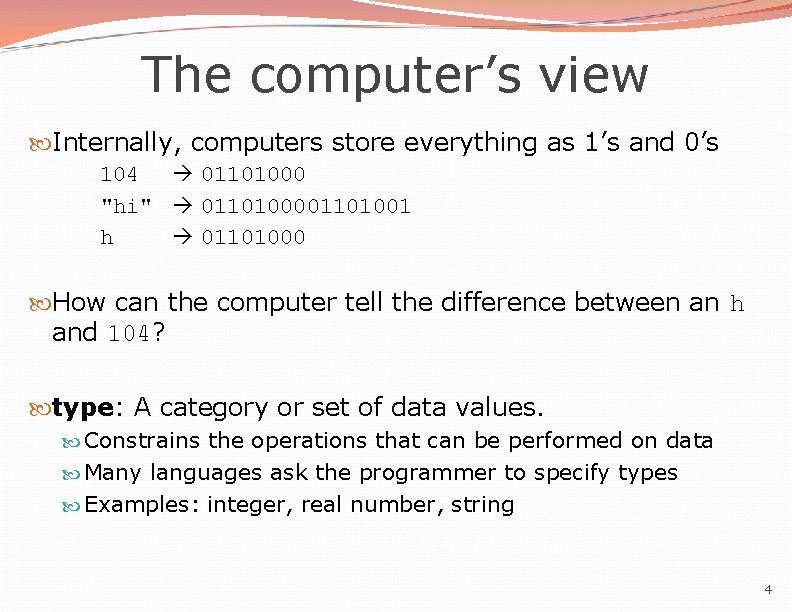
The computer’s view Internally, computers store everything as 1’s and 0’s 104 01101000 "hi" 0110100001101001 h 01101000 How can the computer tell the difference between an h and 104? type: A category or set of data values. Constrains the operations that can be performed on data Many languages ask the programmer to specify types Examples: integer, real number, string 4
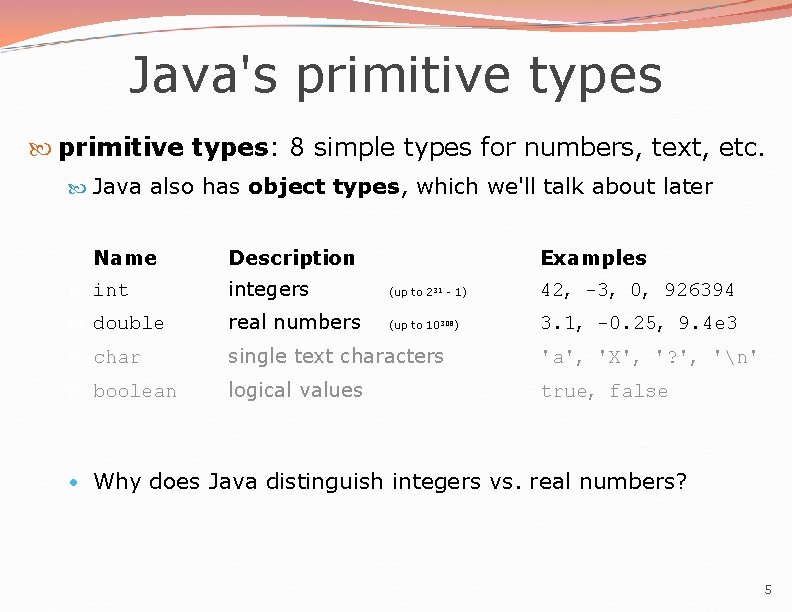
Java's primitive types: 8 simple types for numbers, text, etc. Java also has object types, which we'll talk about later Name Description Examples integers (up to 231 - 1) 42, -3, 0, 926394 double real numbers (up to 10308) 3. 1, -0. 25, 9. 4 e 3 char single text characters 'a', 'X', '? ', 'n' boolean logical values true, false • Why does Java distinguish integers vs. real numbers? 5
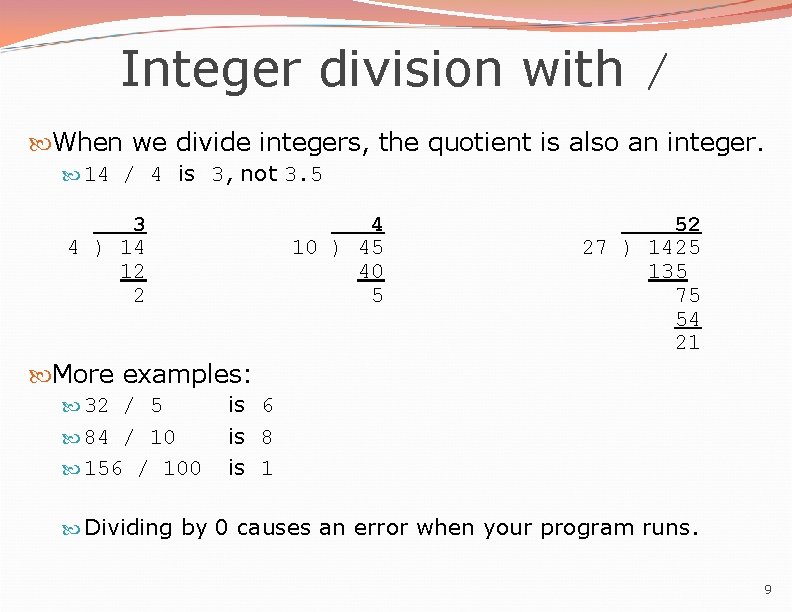
Integer division with / When we divide integers, the quotient is also an integer. 14 / 4 is 3, not 3. 5 3 4 ) 14 12 2 4 10 ) 45 40 5 52 27 ) 1425 135 75 54 21 More examples: 32 / 5 84 / 10 156 / 100 is 6 is 8 is 1 Dividing by 0 causes an error when your program runs. 9

Integer remainder with % The % operator computes the remainder from integer division. 14 % 4 is 2 What is the result? 218 % 5 is 3 45 % 6 3 43 2 % 2 4 ) 14 5 ) 218 12 20 8 % 20 2 18 11 % 0 15 3 Applications of % operator: Obtain last digit of a number: 230857 % 10 is 7 Obtain last 4 digits: 658236489 % 10000 is 6489 See whether a number is odd: 7 % 2 is 1, 42 % 2 is 0 10
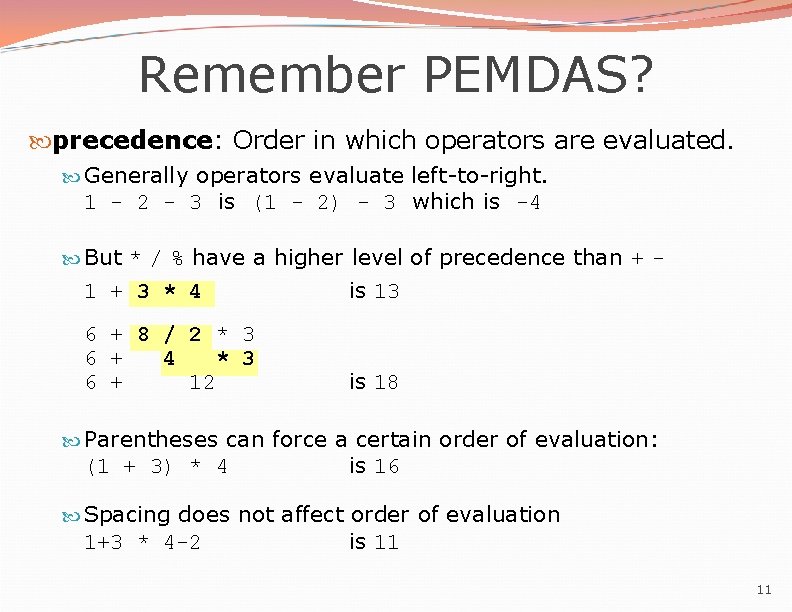
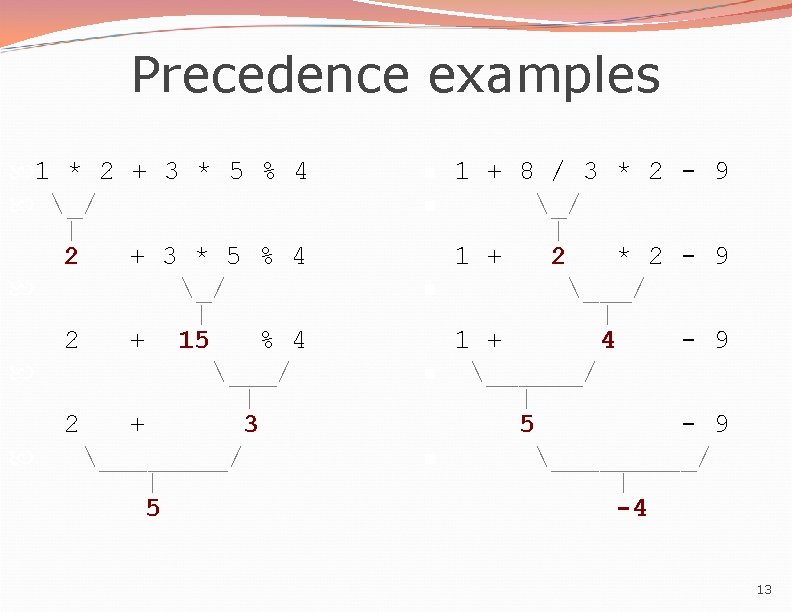
Remember PEMDAS? precedence: Order in which operators are evaluated. Generally operators evaluate left-to-right. 1 - 2 - 3 is (1 - 2) - 3 which is -4 But * / % have a higher level of precedence than + - 1 + 3 * 4 is 13 6 + 8 / 2 * 3 6 + 4 * 3 6 + 12 is 18 Parentheses can force a certain order of evaluation: (1 + 3) * 4 is 16 Spacing does not affect order of evaluation 1+3 * 4 -2 is 11 11
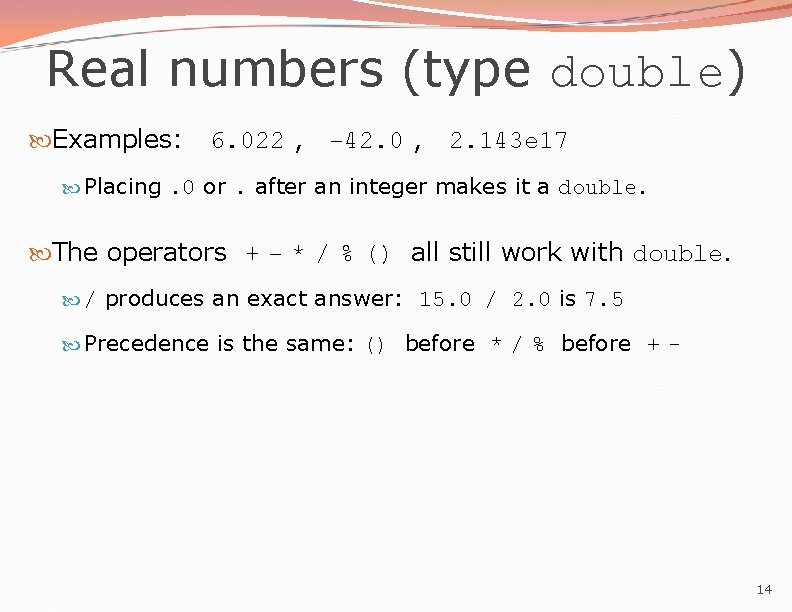
Real numbers (type double) Examples: 6. 022 , -42. 0 , 2. 143 e 17 Placing. 0 or. after an integer makes it a double. The operators + - * / % () all still work with double. / produces an exact answer: 15. 0 / 2. 0 is 7. 5 Precedence is the same: () before * / % before + - 14
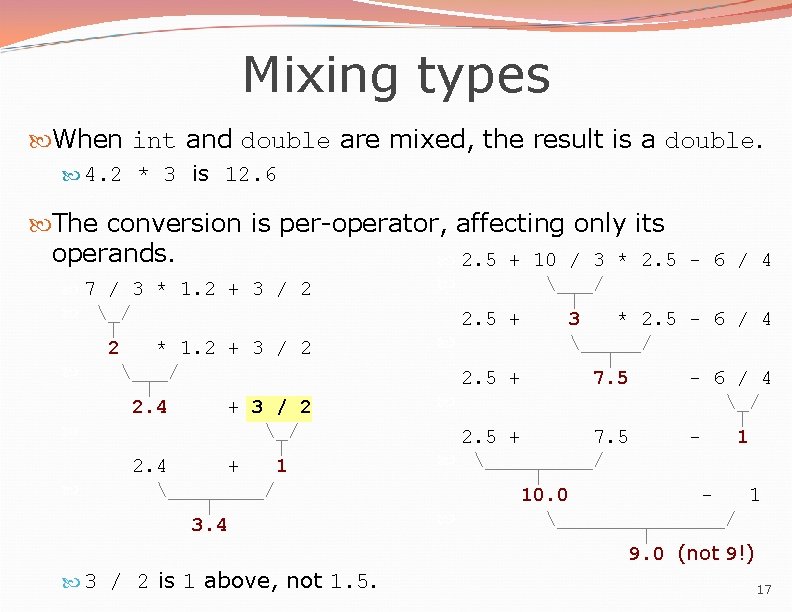
Mixing types When int and double are mixed, the result is a double. 4. 2 * 3 is 12. 6 The conversion is per-operator, affecting only its operands. 2. 5 + 10 / 3 * 2. 5 - 6 / 4 7 / 3 * 1. 2 + 3 / 2 _/ | 2 * 1. 2 + 3 / 2 ___/ | 2. 4 + 3 / 2 _/ | 2. 4 + 1 ____/ | 3. 4 3 / 2 is 1 above, not 1. 5. ___/ | 2. 5 + 3 * 2. 5 - 6 / 4 _____/ | 2. 5 + 7. 5 - 6 / 4 _/ | 2. 5 + 7. 5 1 _____/ | 10. 0 1 _______/ | 9. 0 (not 9!) 17
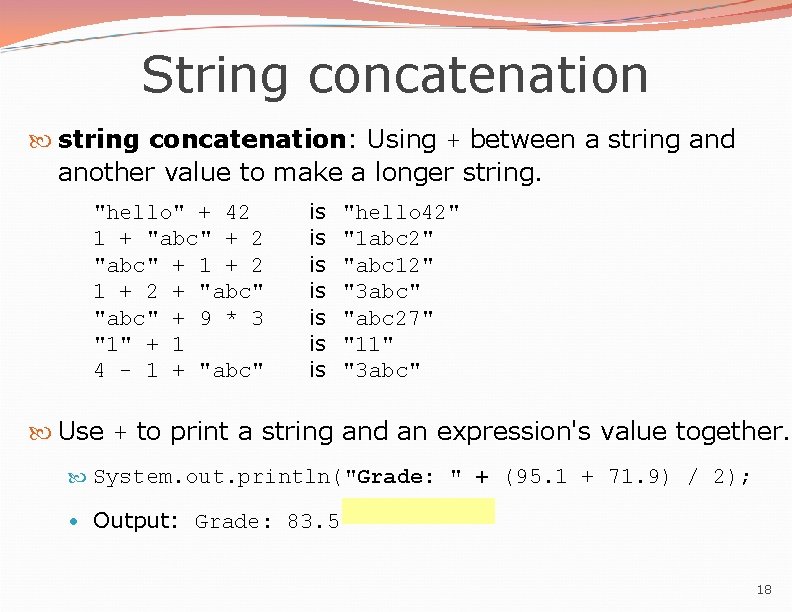
String concatenation string concatenation: Using + between a string and another value to make a longer string. "hello" + 42 1 + "abc" + 2 "abc" + 1 + 2 + "abc" + 9 * 3 "1" + 1 4 - 1 + "abc" is is "hello 42" "1 abc 2" "abc 12" "3 abc" "abc 27" "11" "3 abc" Use + to print a string and an expression's value together. System. out. println("Grade: " + (95. 1 + 71. 9) / 2); • Output: Grade: 83. 5 18
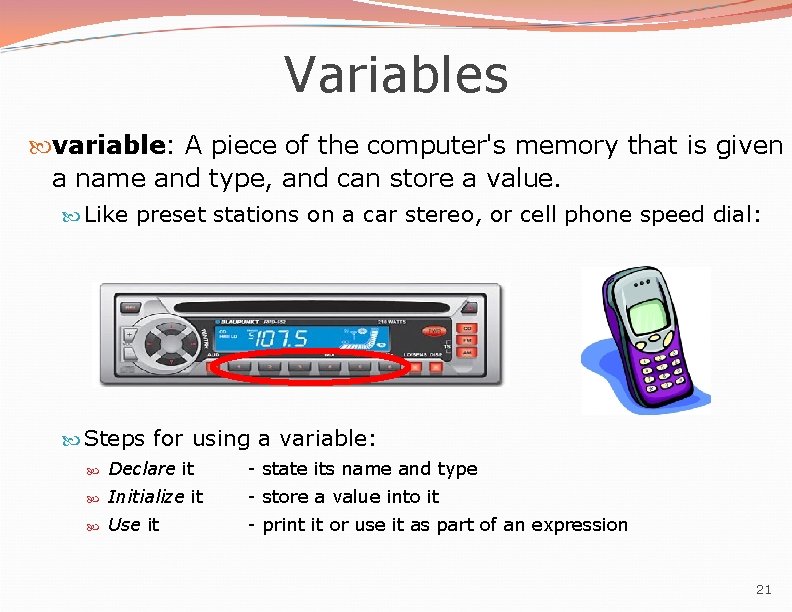
Variables variable: A piece of the computer's memory that is given a name and type, and can store a value. Like preset stations on a car stereo, or cell phone speed dial: Steps for using a variable: Declare it - state its name and type Initialize it - store a value into it Use it - print it or use it as part of an expression 21
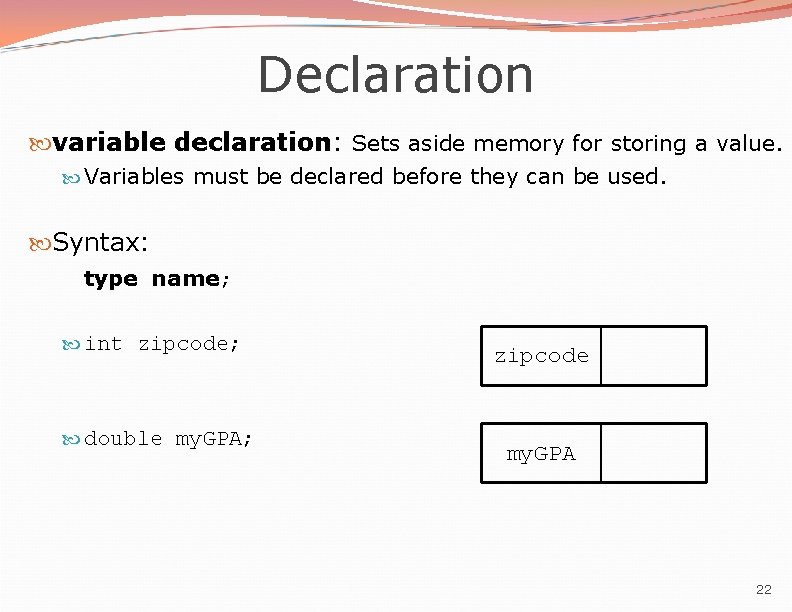
Declaration variable declaration: Sets aside memory for storing a value. Variables must be declared before they can be used. Syntax: type name; int zipcode; double my. GPA; zipcode my. GPA 22
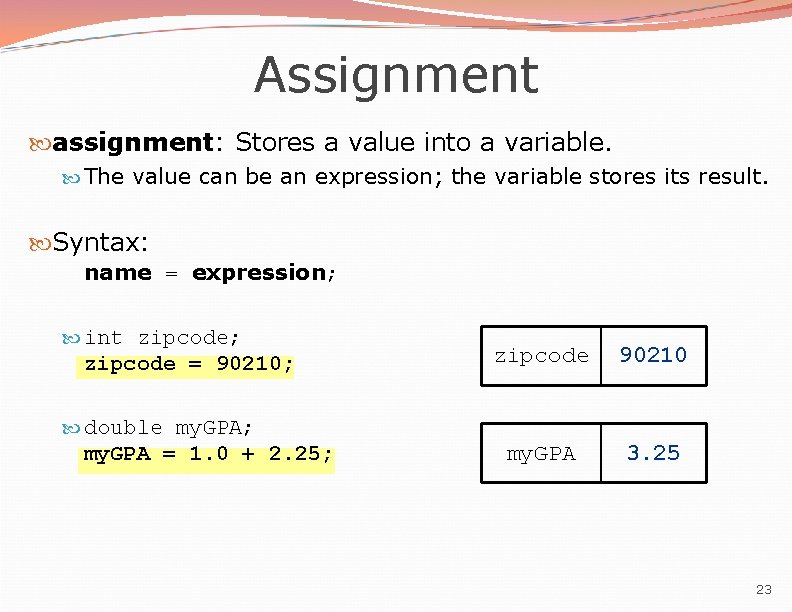
Assignment assignment: Stores a value into a variable. The value can be an expression; the variable stores its result. Syntax: name = expression; int zipcode; zipcode = 90210; zipcode 90210 my. GPA 3. 25 double my. GPA; my. GPA = 1. 0 + 2. 25; 23
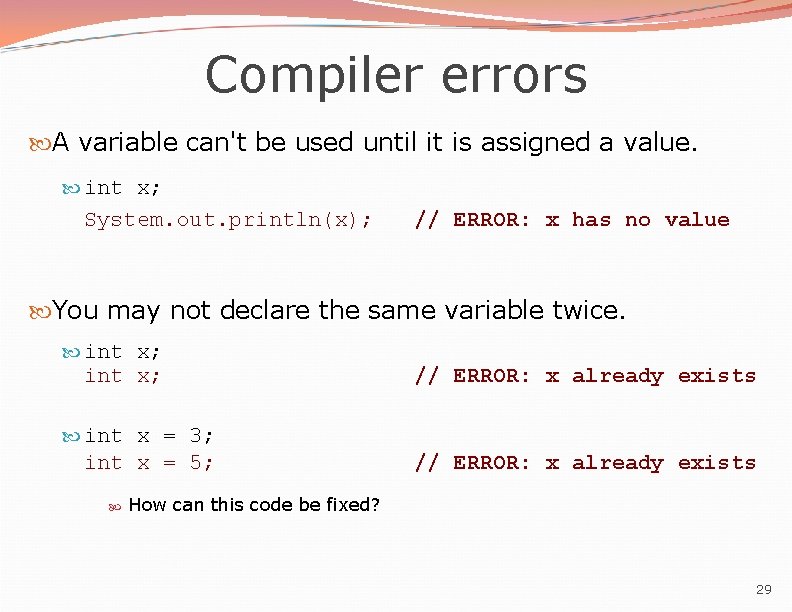
Compiler errors A variable can't be used until it is assigned a value. int x; System. out. println(x); // ERROR: x has no value You may not declare the same variable twice. int x; // ERROR: x already exists int x = 3; int x = 5; // ERROR: x already exists How can this code be fixed? 29
- Slides: 15