
Building Java Programs Chapter 16 Lecture 16 1
Building Java Programs Chapter 16 Lecture 16 -1: References and linked nodes reading: 16. 1
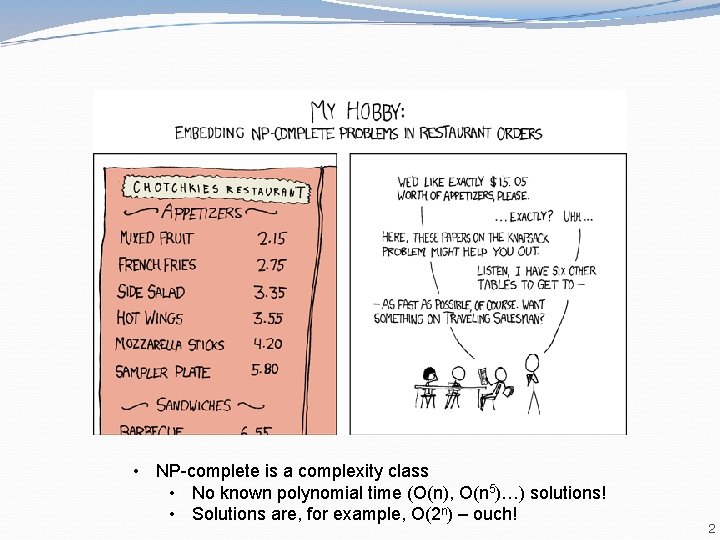
• NP-complete is a complexity class • No known polynomial time (O(n), O(n 5)…) solutions! • Solutions are, for example, O(2 n) – ouch! 2
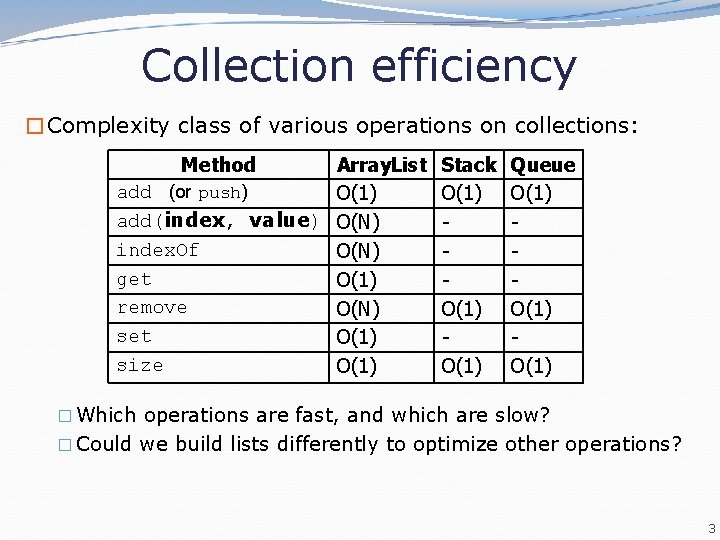
Collection efficiency �Complexity class of various operations on collections: Method Array. List add (or push) O(1) add(index, value) O(N) index. Of O(N) get O(1) remove O(N) set O(1) size O(1) Stack O(1) Queue O(1) � Which operations are fast, and which are slow? � Could we build lists differently to optimize other operations? 3
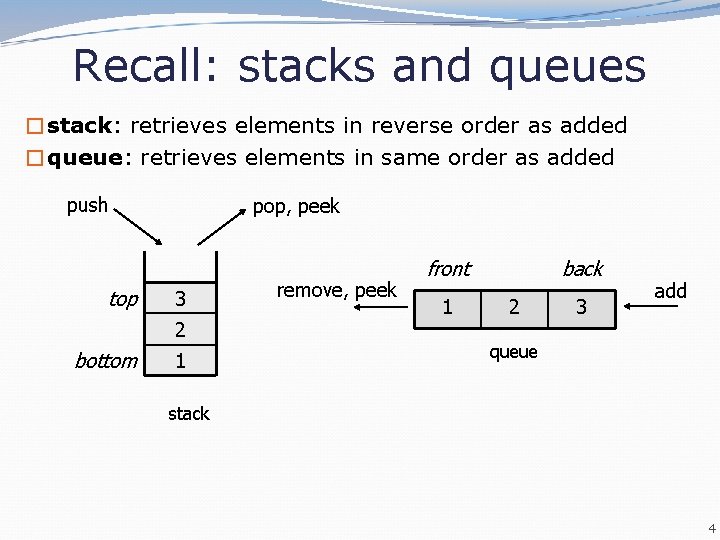
Recall: stacks and queues �stack: retrieves elements in reverse order as added �queue: retrieves elements in same order as added push top pop, peek 3 2 bottom 1 remove, peek front 1 back 2 3 add queue stack 4
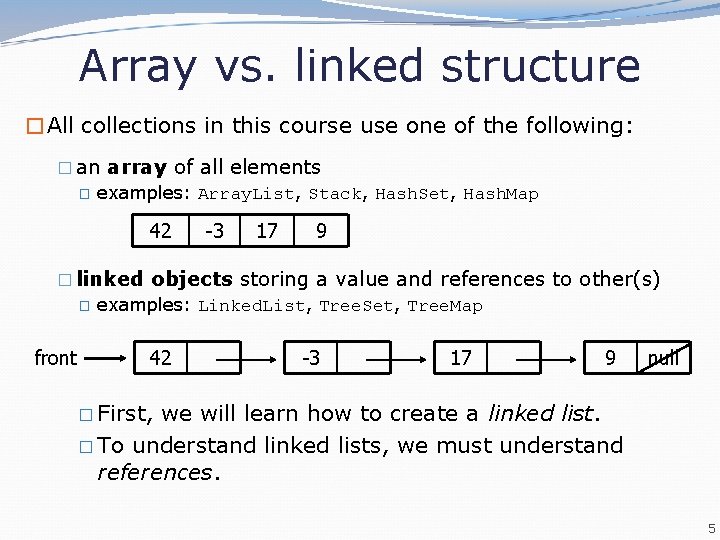
Array vs. linked structure �All collections in this course use one of the following: � an array of all elements � examples: Array. List, Stack, Hash. Set, Hash. Map 42 -3 17 9 � linked objects storing a value and references to other(s) � examples: Linked. List, Tree. Set, Tree. Map front 42 -3 17 9 null � First, we will learn how to create a linked list. � To understand linked lists, we must understand references. 5
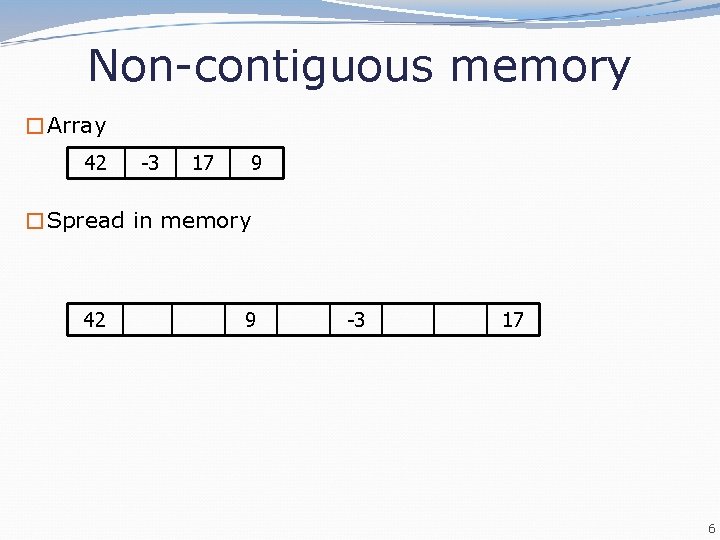
Non-contiguous memory �Array 42 -3 17 9 �Spread in memory 42 9 -3 17 6
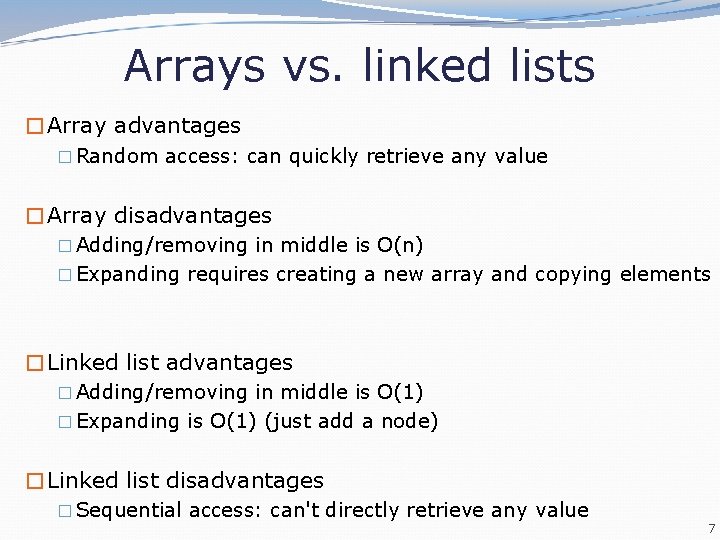
Arrays vs. linked lists �Array advantages � Random access: can quickly retrieve any value �Array disadvantages � Adding/removing in middle is O(n) � Expanding requires creating a new array and copying elements �Linked list advantages � Adding/removing in middle is O(1) � Expanding is O(1) (just add a node) �Linked list disadvantages � Sequential access: can't directly retrieve any value 7
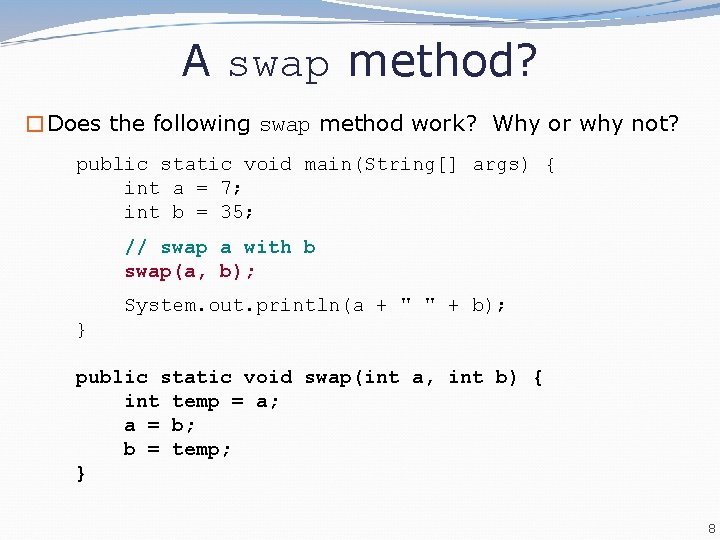
A swap method? �Does the following swap method work? Why or why not? public static void main(String[] args) { int a = 7; int b = 35; // swap a with b swap(a, b); System. out. println(a + " " + b); } public static void swap(int a, int b) { int temp = a; a = b; b = temp; } 8
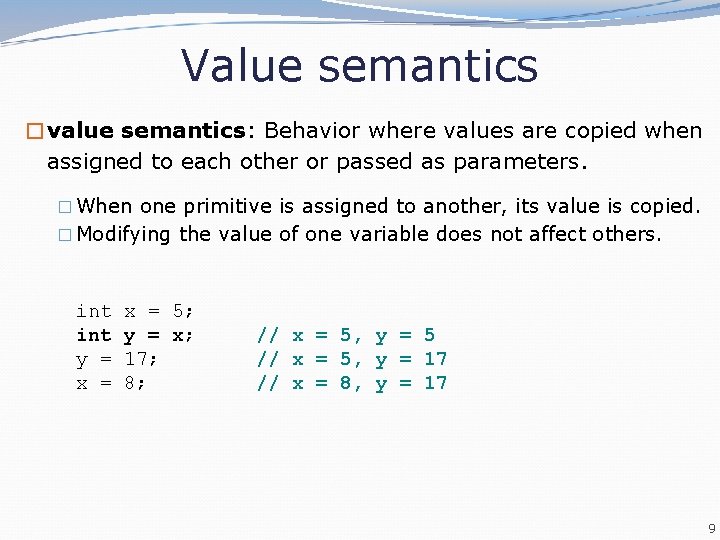
Value semantics �value semantics: Behavior where values are copied when assigned to each other or passed as parameters. � When one primitive is assigned to another, its value is copied. � Modifying the value of one variable does not affect others. int y = x = 5; y = x; 17; 8; // x = 5, y = 5 // x = 5, y = 17 // x = 8, y = 17 9
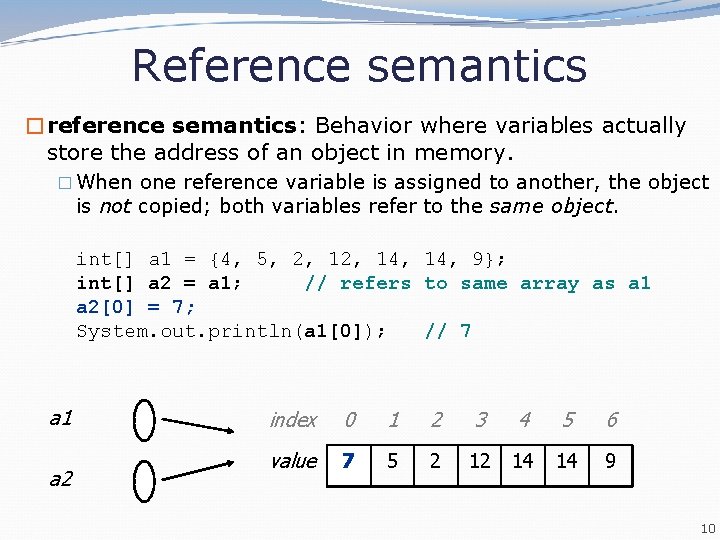
Reference semantics �reference semantics: Behavior where variables actually store the address of an object in memory. � When one reference variable is assigned to another, the object is not copied; both variables refer to the same object. int[] a 1 = {4, 5, 2, 14, 14, 9}; int[] a 2 = a 1; // refers to same array as a 1 a 2[0] = 7; System. out. println(a 1[0]); // 7 a 1 a 2 index 0 1 2 3 4 5 6 value 7 4 5 2 12 14 14 9 10
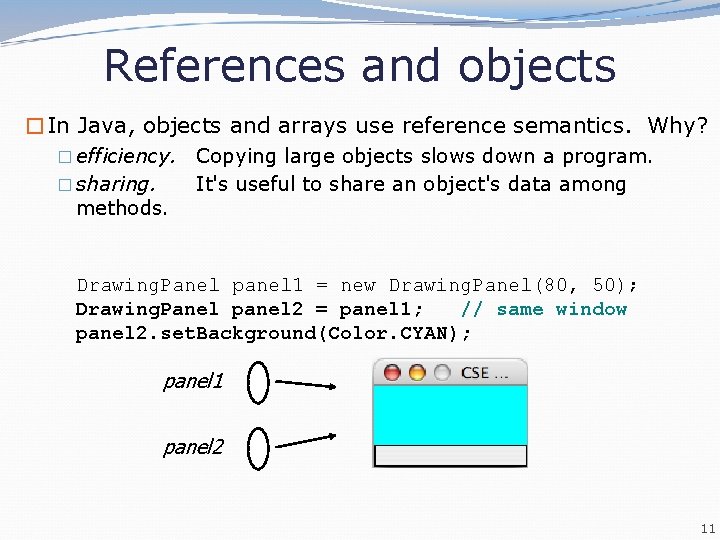
References and objects �In Java, objects and arrays use reference semantics. Why? � efficiency. � sharing. methods. Copying large objects slows down a program. It's useful to share an object's data among Drawing. Panel panel 1 = new Drawing. Panel(80, 50); Drawing. Panel panel 2 = panel 1; // same window panel 2. set. Background(Color. CYAN); panel 1 panel 2 11
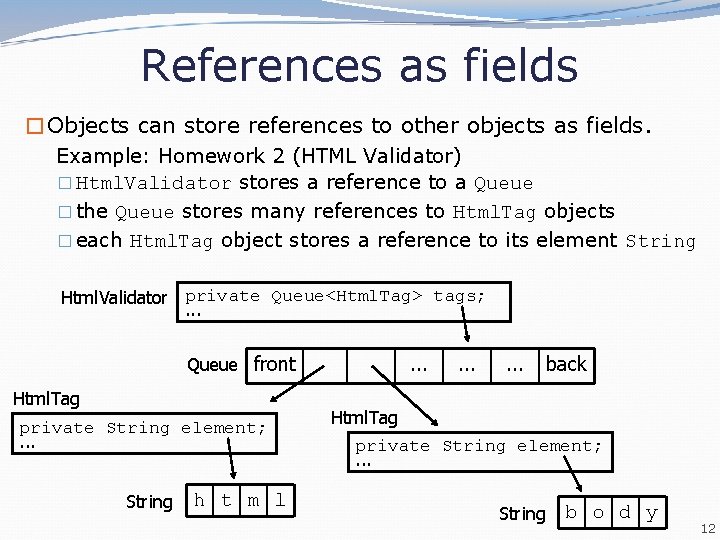
References as fields �Objects can store references to other objects as fields. Example: Homework 2 (HTML Validator) � Html. Validator stores a reference to a Queue � the Queue stores many references to Html. Tag objects � each Html. Tag object stores a reference to its element String Html. Validator private Queue<Html. Tag> tags; . . . Queue front Html. Tag private String element; . . . String h t m l . . back Html. Tag private String element; . . . String b o d y 12
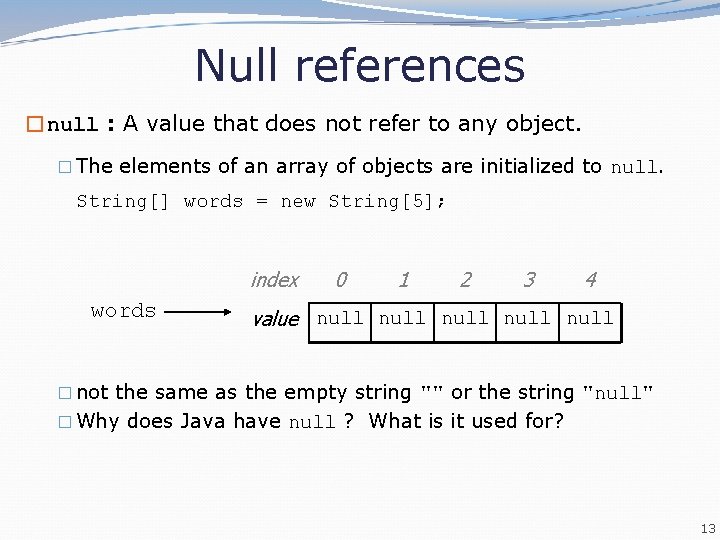
Null references �null : A value that does not refer to any object. � The elements of an array of objects are initialized to null. String[] words = new String[5]; index words 0 1 2 3 4 value null null � not the same as the empty string "" or the string "null" � Why does Java have null ? What is it used for? 13
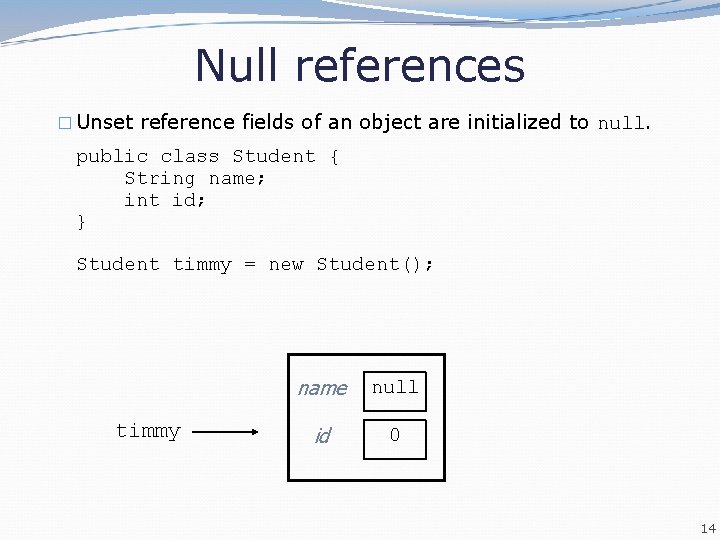
Null references � Unset reference fields of an object are initialized to null. public class Student { String name; int id; } Student timmy = new Student(); timmy name null id 0 14
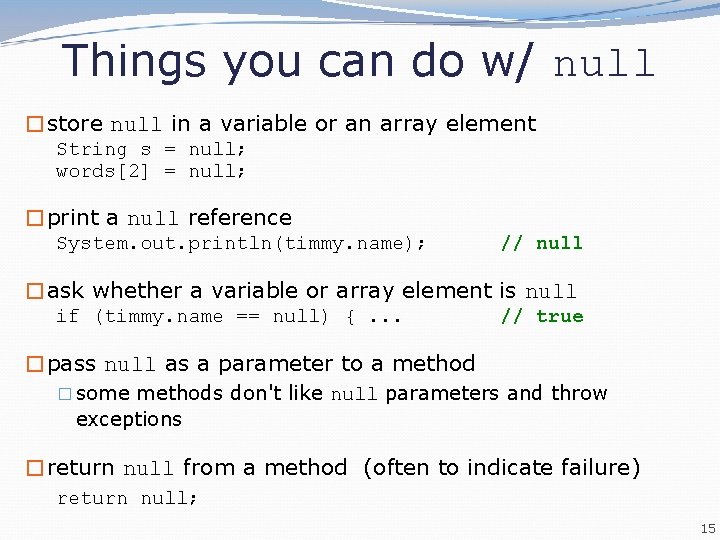
Things you can do w/ null �store null in a variable or an array element String s = null; words[2] = null; �print a null reference System. out. println(timmy. name); // null �ask whether a variable or array element is null if (timmy. name == null) {. . . // true �pass null as a parameter to a method � some methods don't like null parameters and throw exceptions �return null from a method (often to indicate failure) return null; 15
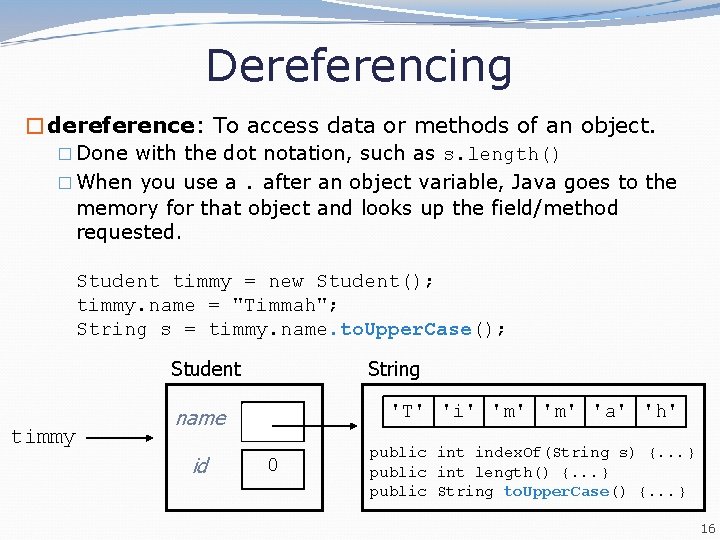
Dereferencing �dereference: To access data or methods of an object. � Done with the dot notation, such as s. length() � When you use a. after an object variable, Java goes to the memory for that object and looks up the field/method requested. Student timmy = new Student(); timmy. name = "Timmah"; String s = timmy. name. to. Upper. Case(); Student timmy String name null 'T' 'i' 'm' 'a' 'h' id 0 public int index. Of(String s) {. . . } public int length() {. . . } public String to. Upper. Case() {. . . } 16
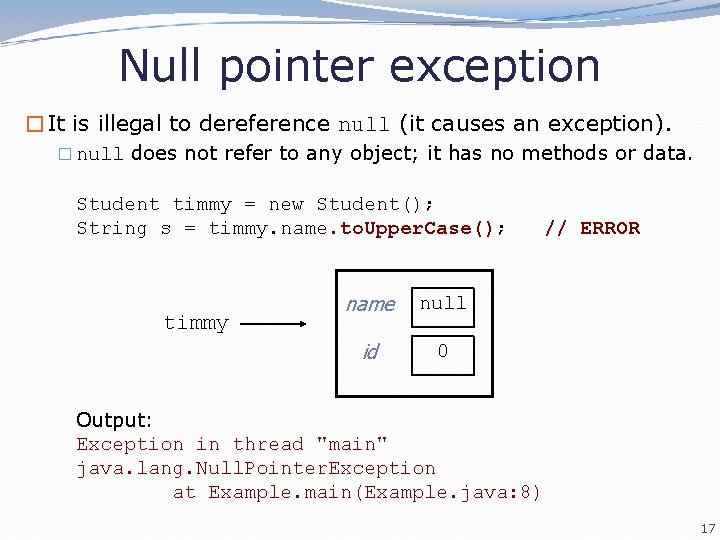
Null pointer exception �It is illegal to dereference null (it causes an exception). � null does not refer to any object; it has no methods or data. Student timmy = new Student(); String s = timmy. name. to. Upper. Case(); timmy name null id 0 // ERROR Output: Exception in thread "main" java. lang. Null. Pointer. Exception at Example. main(Example. java: 8) 17
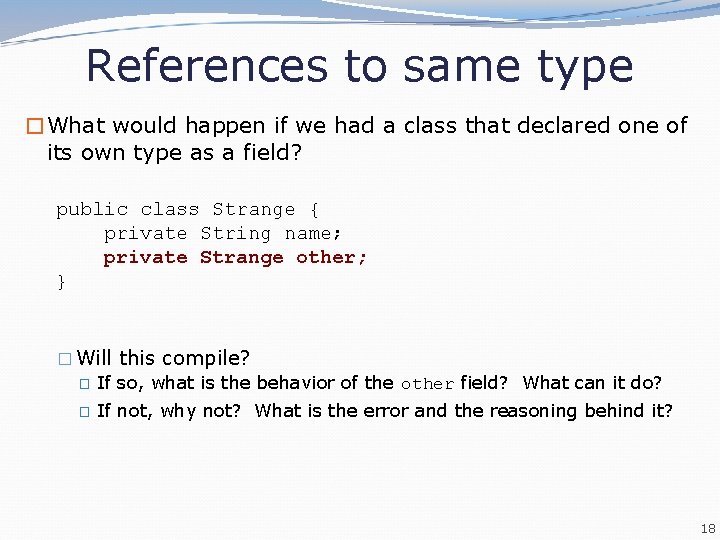
References to same type �What would happen if we had a class that declared one of its own type as a field? public class Strange { private String name; private Strange other; } � Will this compile? � If so, what is the behavior of the other field? What can it do? � If not, why not? What is the error and the reasoning behind it? 18
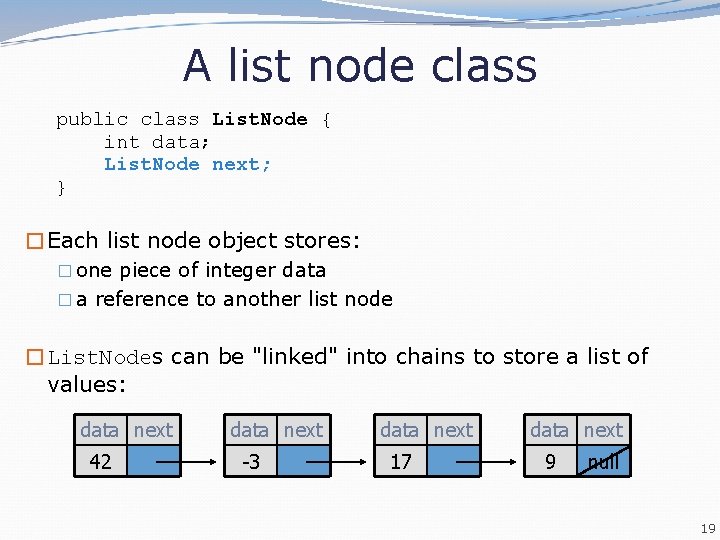
A list node class public class List. Node { int data; List. Node next; } �Each list node object stores: � one piece of integer data � a reference to another list node �List. Nodes can be "linked" into chains to store a list of values: data next 42 data next -3 data next 17 data next 9 null 19
![List node client example public class Construct. List 1 { public static void main(String[]](http://slidetodoc.com/presentation_image_h2/8706950feacbb294c59311d067e06981/image-20.jpg "List node client example public class Construct. List 1 { public static void main(String[]")
List node client example public class Construct. List 1 { public static void main(String[] args) { List. Node list = new List. Node(); list. data = 42; list. next = new List. Node(); list. next. data = -3; list. next = new List. Node(); list. next. data = 17; list. next = null; System. out. println(list. data + " " + list. next. data); // 42 -3 17 } } data next list 42 data next -3 data next 17 null 20
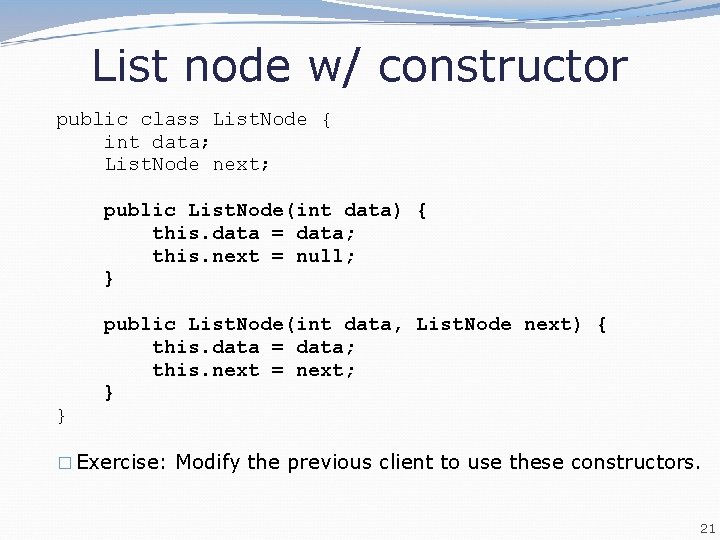
List node w/ constructor public class List. Node { int data; List. Node next; public List. Node(int data) { this. data = data; this. next = null; } public List. Node(int data, List. Node next) { this. data = data; this. next = next; } } � Exercise: Modify the previous client to use these constructors. 21
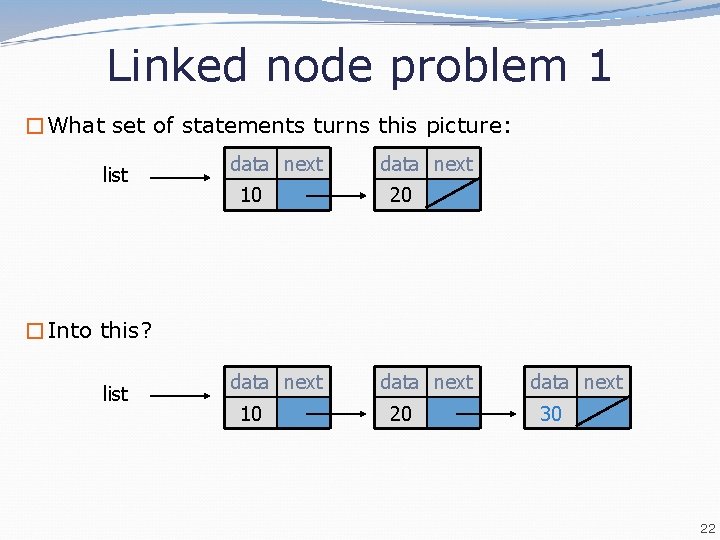
Linked node problem 1 �What set of statements turns this picture: list data next 10 data next 20 �Into this? list data next 10 data next 20 data next 30 22
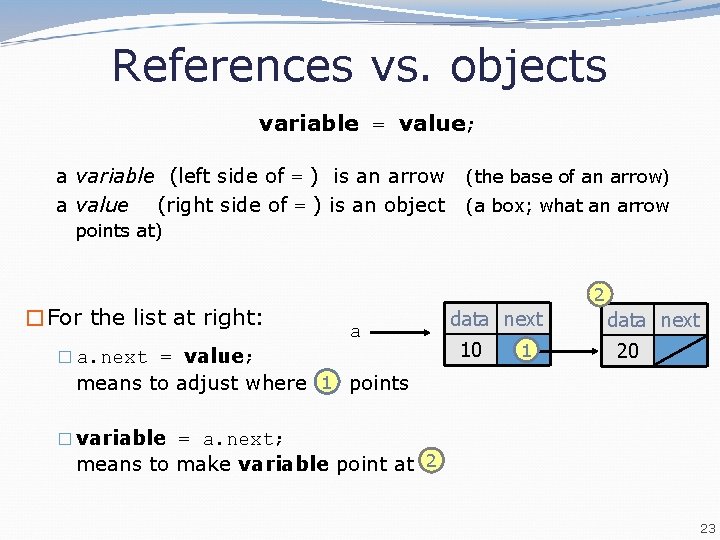
References vs. objects variable = value; a variable (left side of = ) is an arrow a value (right side of = ) is an object (the base of an arrow) (a box; what an arrow points at) �For the list at right: 2 a � a. next = value; data next 10 1 data next 20 means to adjust where 1 points � variable = a. next; means to make variable point at 2 23
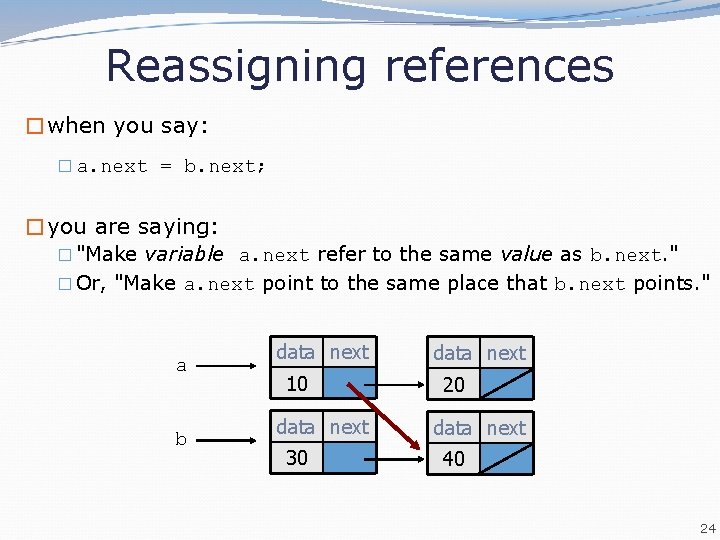
Reassigning references �when you say: � a. next = b. next; �you are saying: � "Make variable a. next refer to the same value as b. next. " � Or, "Make a. next point to the same place that b. next points. " a b data next 10 data next 30 data next 20 data next 40 24
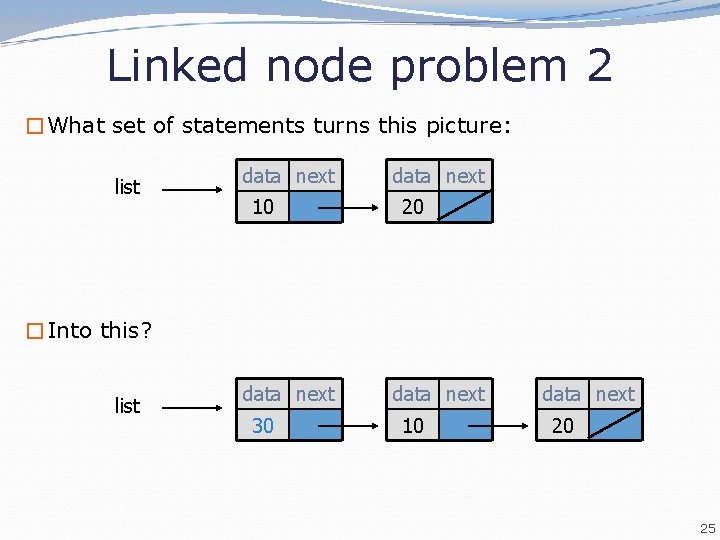
Linked node problem 2 �What set of statements turns this picture: list data next 10 data next 20 �Into this? list data next 30 data next 10 data next 20 25
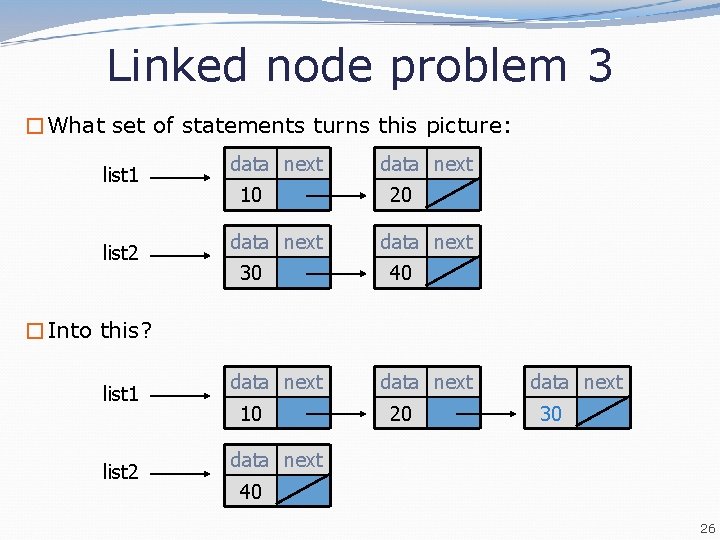
Linked node problem 3 �What set of statements turns this picture: list 1 list 2 data next 10 data next 30 data next 20 data next 40 �Into this? list 1 list 2 data next 10 data next 20 data next 30 data next 40 26
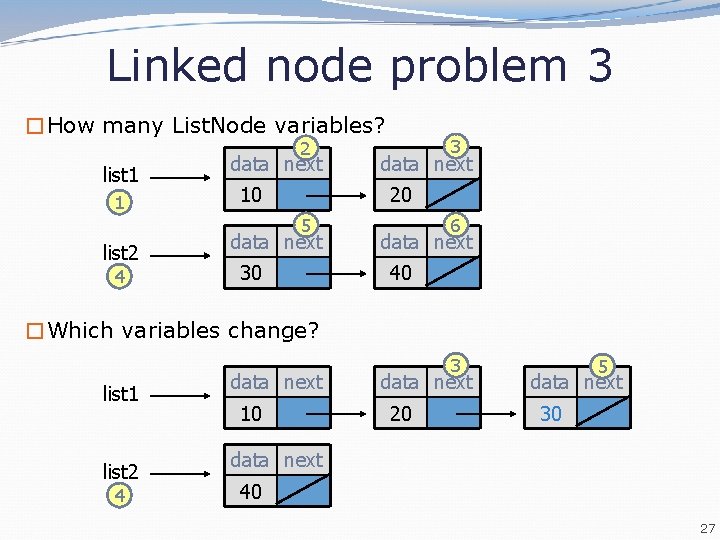
Linked node problem 3 �How many List. Node variables? 2 list 1 1 data next 10 4 data next 20 5 list 2 3 data next 30 6 data next 40 �Which variables change? list 1 list 2 4 data next 10 3 data next 20 5 data next 30 data next 40 27
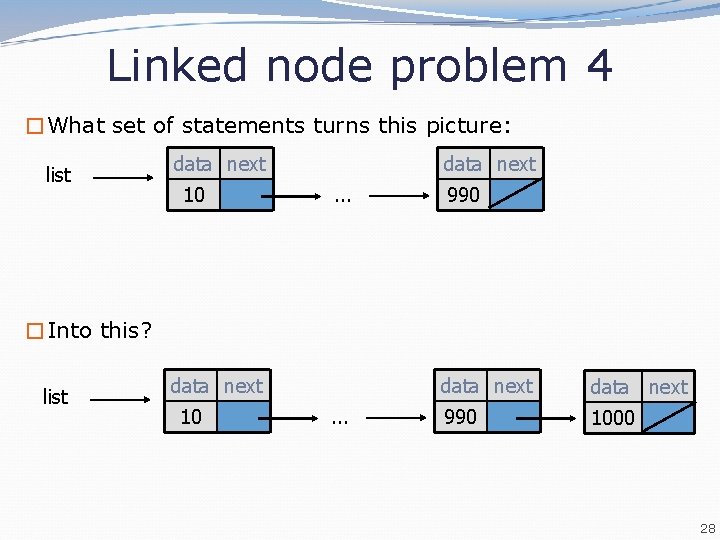
Linked node problem 4 �What set of statements turns this picture: list data next 10 data next. . . 990 �Into this? list data next 10 . . . data next 990 1000 28
- Slides: 28