
Building Java Programs Chapter 12 Lecture 12 2
Building Java Programs Chapter 12 Lecture 12 -2: recursive programming reading: 12. 2 - 12. 3
2
Exercise �Write a recursive method pow accepts an integer base and exponent and returns the base raised to that exponent. � Example: pow(3, 4) returns 81 � Solve the problem recursively and without using loops. 3
An optimization �Notice the following mathematical property: 312 = 531441 = 96 = (32)6 = (92)3 = ((32)2)3 � When does this "trick" work? � How can we incorporate this optimization into our pow method? � What is the benefit of this trick if the method already works? 4
5
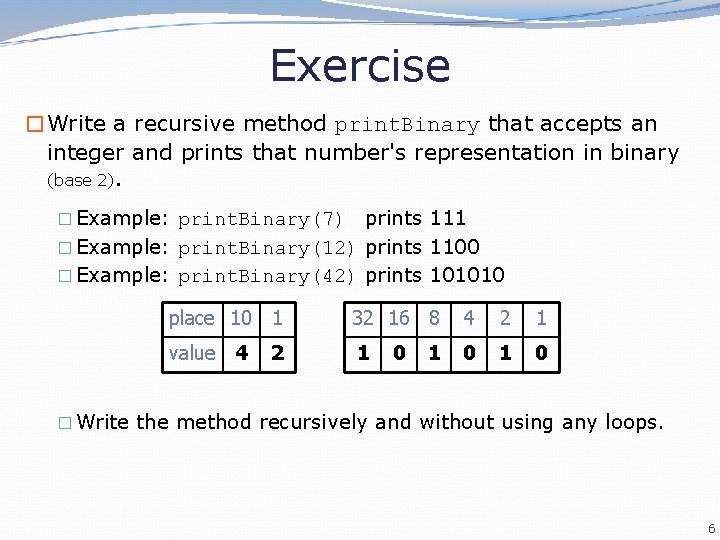
Exercise �Write a recursive method print. Binary that accepts an integer and prints that number's representation in binary (base 2). � Example: print. Binary(7) prints 111 � Example: print. Binary(12) prints 1100 � Example: print. Binary(42) prints 101010 place 10 1 32 16 8 4 2 1 value 4 1 0 2 0 1 � Write the method recursively and without using any loops. 6
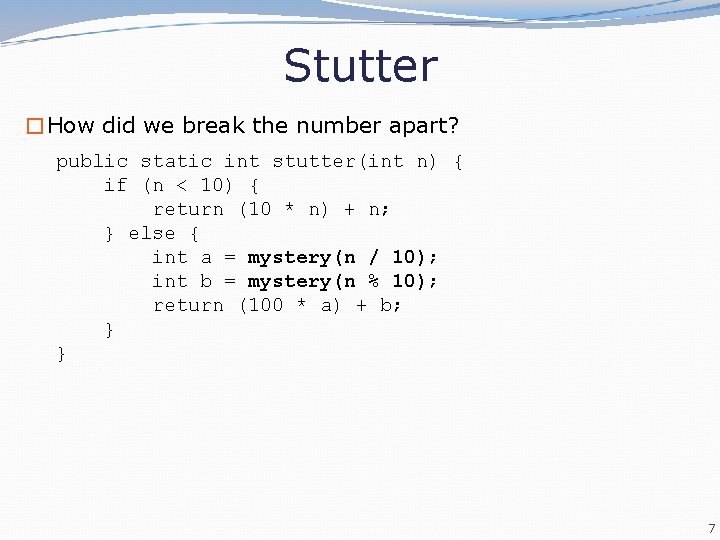
Stutter �How did we break the number apart? public static int stutter(int n) { if (n < 10) { return (10 * n) + n; } else { int a = mystery(n / 10); int b = mystery(n % 10); return (100 * a) + b; } } 7
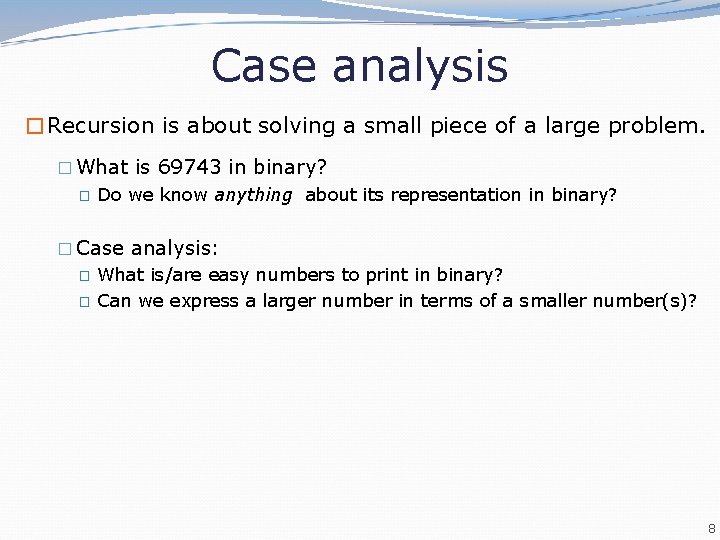
Case analysis �Recursion is about solving a small piece of a large problem. � What is 69743 in binary? � Do we know anything about its representation in binary? � Case analysis: � � What is/are easy numbers to print in binary? Can we express a larger number in terms of a smaller number(s)? 8
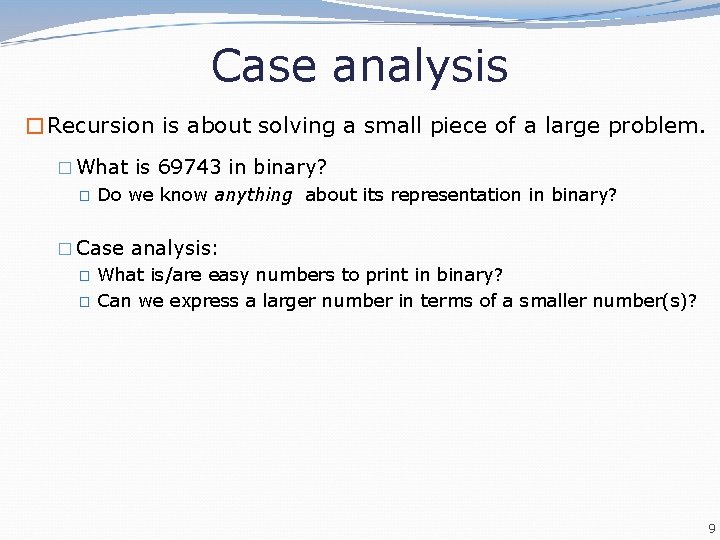
Case analysis �Recursion is about solving a small piece of a large problem. � What is 69743 in binary? � Do we know anything about its representation in binary? � Case analysis: � � What is/are easy numbers to print in binary? Can we express a larger number in terms of a smaller number(s)? 9
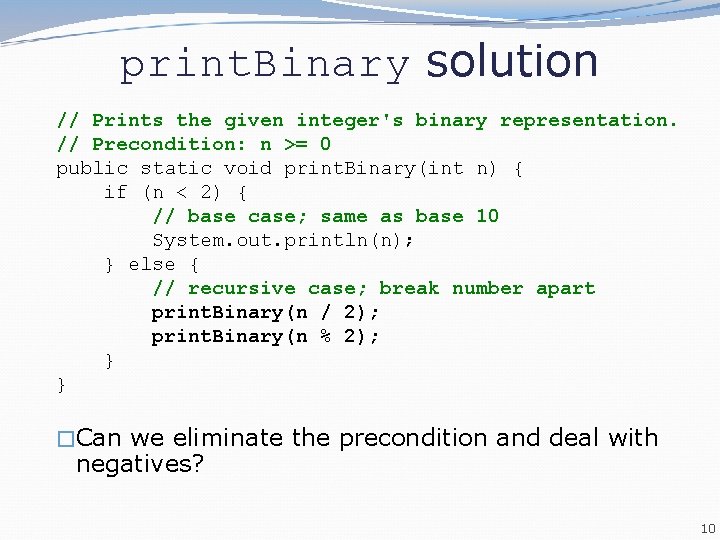
print. Binary solution // Prints the given integer's binary representation. // Precondition: n >= 0 public static void print. Binary(int n) { if (n < 2) { // base case; same as base 10 System. out. println(n); } else { // recursive case; break number apart print. Binary(n / 2); print. Binary(n % 2); } } �Can we eliminate the precondition and deal with negatives? 10
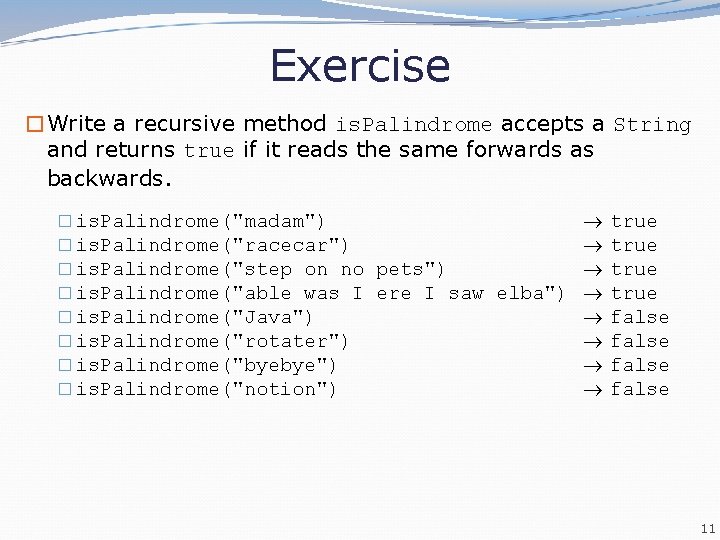
Exercise �Write a recursive method is. Palindrome accepts a String and returns true if it reads the same forwards as backwards. � is. Palindrome("madam") true � is. Palindrome("racecar") true � is. Palindrome("step on no pets") true � is. Palindrome("able was I ere I saw elba") true � is. Palindrome("Java") false � is. Palindrome("rotater") false � is. Palindrome("byebye") false � is. Palindrome("notion") false 11
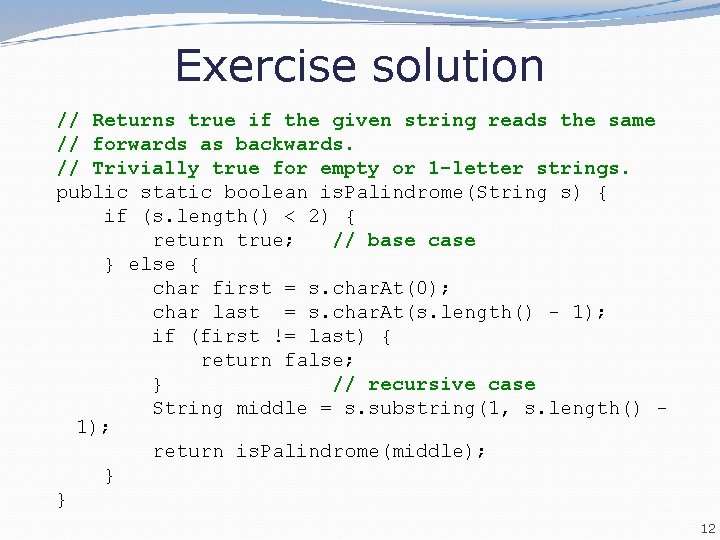
Exercise solution // Returns true if the given string reads the same // forwards as backwards. // Trivially true for empty or 1 -letter strings. public static boolean is. Palindrome(String s) { if (s. length() < 2) { return true; // base case } else { char first = s. char. At(0); char last = s. char. At(s. length() - 1); if (first != last) { return false; } // recursive case String middle = s. substring(1, s. length() 1); return is. Palindrome(middle); } } 12
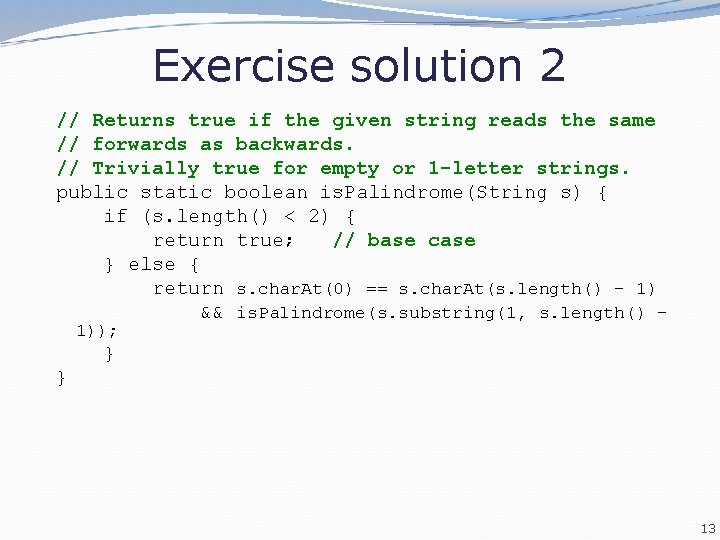
Exercise solution 2 // Returns true if the given string reads the same // forwards as backwards. // Trivially true for empty or 1 -letter strings. public static boolean is. Palindrome(String s) { if (s. length() < 2) { return true; // base case } else { return s. char. At(0) == s. char. At(s. length() - 1) && is. Palindrome(s. substring(1, s. length() 1)); } } 13
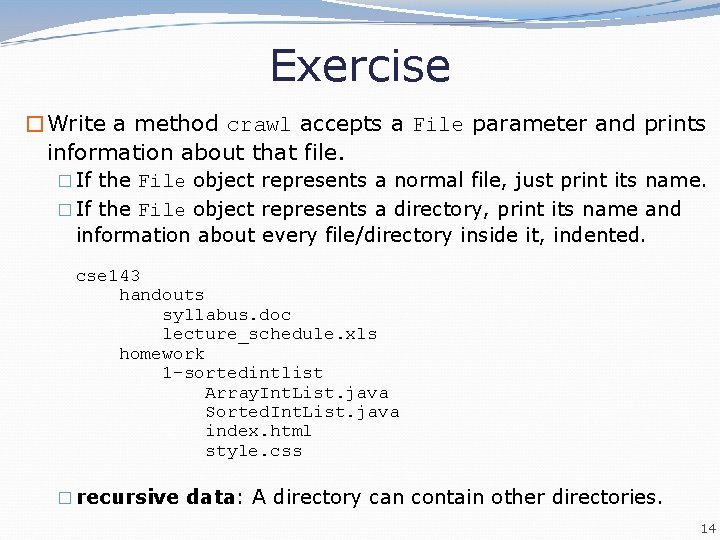
Exercise �Write a method crawl accepts a File parameter and prints information about that file. � If the File object represents a normal file, just print its name. � If the File object represents a directory, print its name and information about every file/directory inside it, indented. cse 143 handouts syllabus. doc lecture_schedule. xls homework 1 -sortedintlist Array. Int. List. java Sorted. Int. List. java index. html style. css � recursive data: A directory can contain other directories. 14
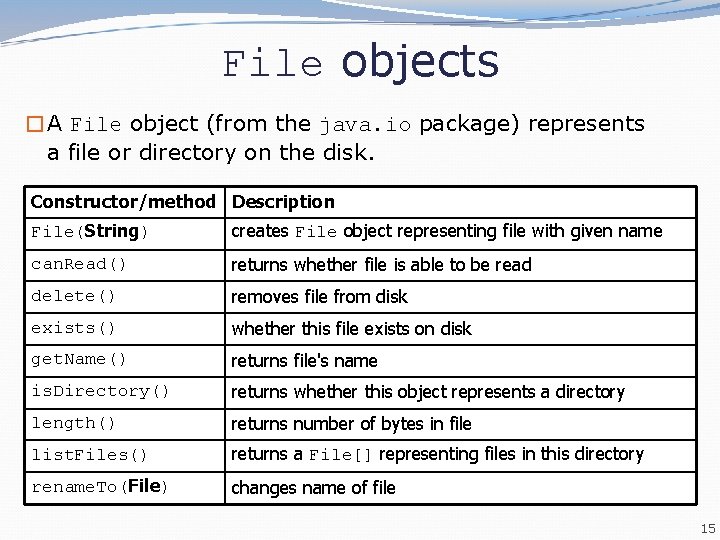
File objects �A File object (from the java. io package) represents a file or directory on the disk. Constructor/method Description File(String) creates File object representing file with given name can. Read() returns whether file is able to be read delete() removes file from disk exists() whether this file exists on disk get. Name() returns file's name is. Directory() returns whether this object represents a directory length() returns number of bytes in file list. Files() returns a File[] representing files in this directory rename. To(File) changes name of file 15
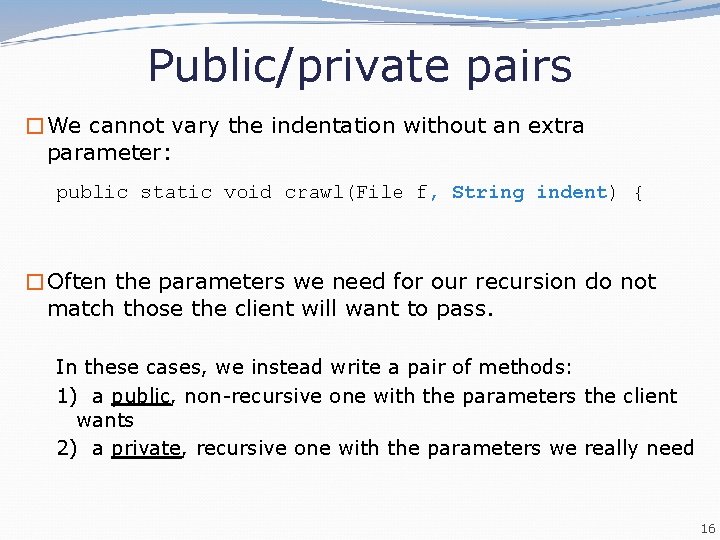
Public/private pairs �We cannot vary the indentation without an extra parameter: public static void crawl(File f, String indent) { �Often the parameters we need for our recursion do not match those the client will want to pass. In these cases, we instead write a pair of methods: 1) a public, non-recursive one with the parameters the client wants 2) a private, recursive one with the parameters we really need 16
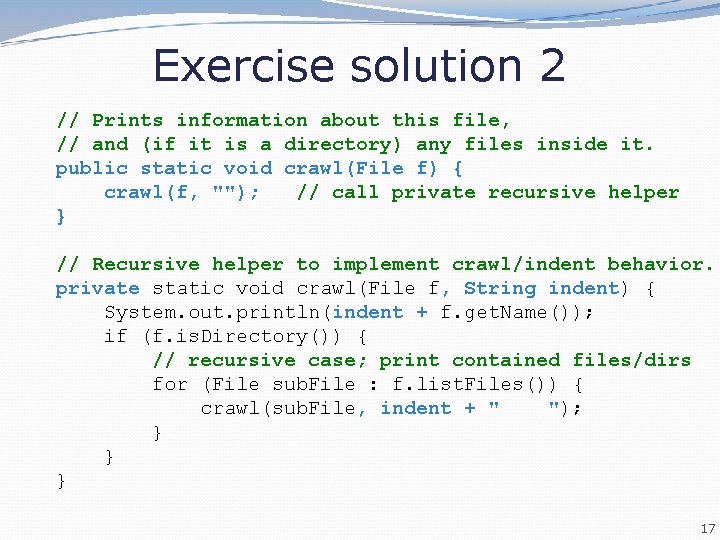
Exercise solution 2 // Prints information about this file, // and (if it is a directory) any files inside it. public static void crawl(File f) { crawl(f, ""); // call private recursive helper } // Recursive helper to implement crawl/indent behavior. private static void crawl(File f, String indent) { System. out. println(indent + f. get. Name()); if (f. is. Directory()) { // recursive case; print contained files/dirs for (File sub. File : f. list. Files()) { crawl(sub. File, indent + " "); } } } 17
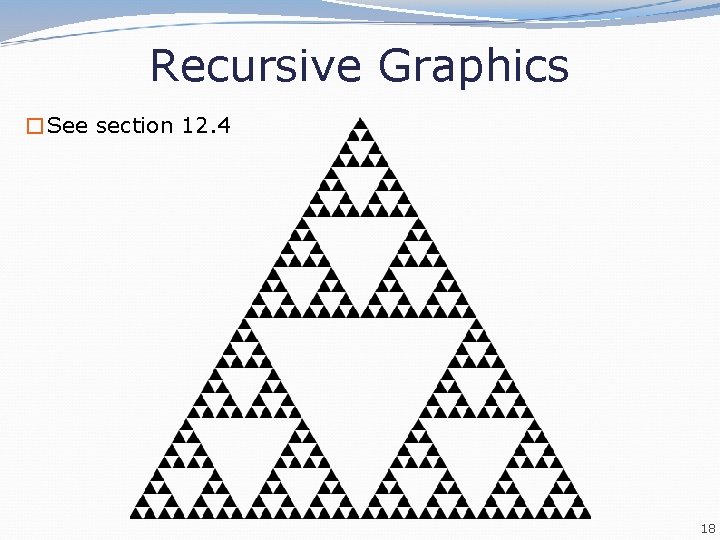
Recursive Graphics �See section 12. 4 18
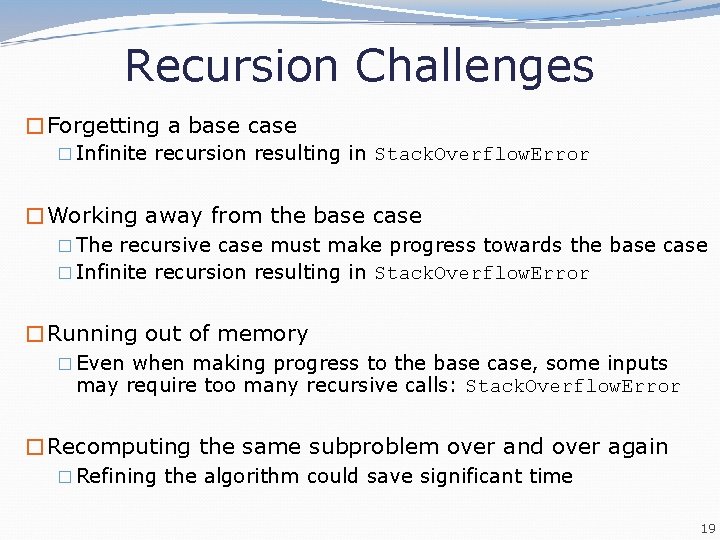
Recursion Challenges �Forgetting a base case � Infinite recursion resulting in Stack. Overflow. Error �Working away from the base case � The recursive case must make progress towards the base case � Infinite recursion resulting in Stack. Overflow. Error �Running out of memory � Even when making progress to the base case, some inputs may require too many recursive calls: Stack. Overflow. Error �Recomputing the same subproblem over and over again � Refining the algorithm could save significant time 19
- Slides: 19