
Building Java Programs Chapter 1 Lecture 1 2
Building Java Programs Chapter 1 Lecture 1 -2: Static Methods reading: 1. 4 - 1. 5
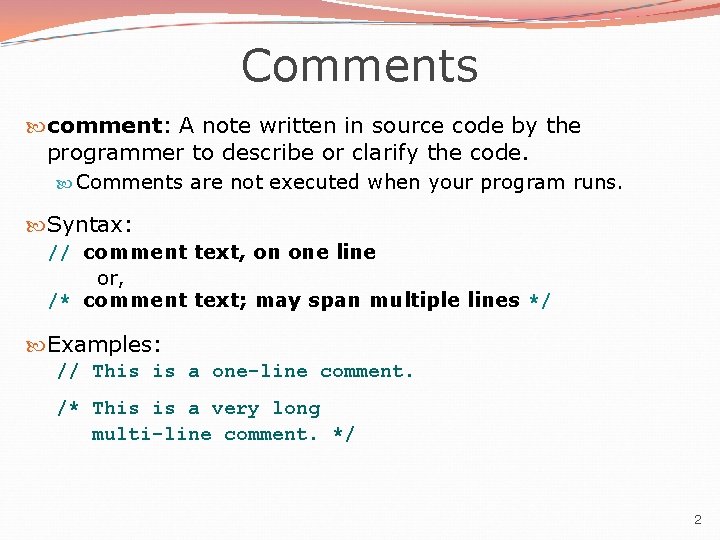
Comments comment: A note written in source code by the programmer to describe or clarify the code. Comments are not executed when your program runs. Syntax: // comment text, on one line or, /* comment text; may span multiple lines */ Examples: // This is a one-line comment. /* This is a very long multi-line comment. */ 2
Using comments Where to place comments: at the top of each file (a "comment header") at the start of every method (seen later) to explain complex pieces of code Comments are useful for: Understanding larger, more complex programs. Multiple programmers working together, who must understand each other's code. 3
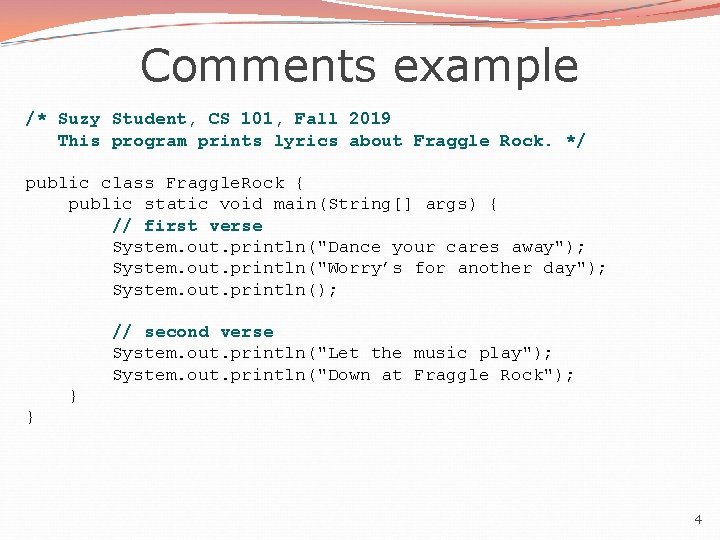
Comments example /* Suzy Student, CS 101, Fall 2019 This program prints lyrics about Fraggle Rock. */ public class Fraggle. Rock { public static void main(String[] args) { // first verse System. out. println("Dance your cares away"); System. out. println("Worry’s for another day"); System. out. println(); // second verse System. out. println("Let the music play"); System. out. println("Down at Fraggle Rock"); } } 4
Static methods reading: 1. 4
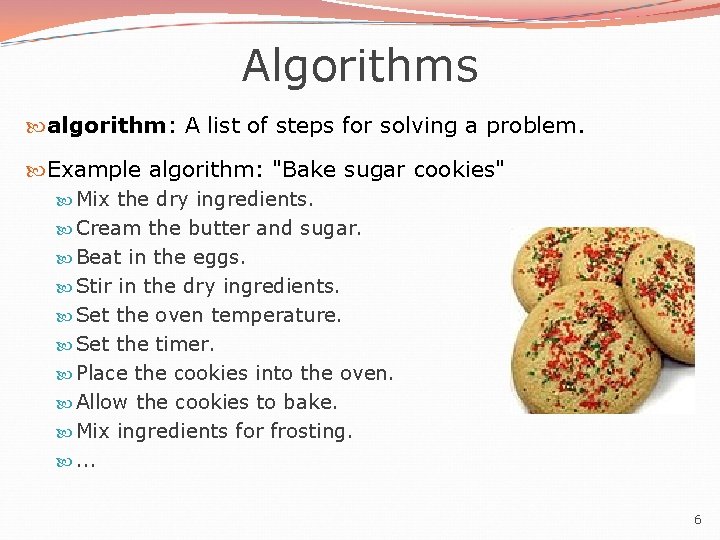
Algorithms algorithm: A list of steps for solving a problem. Example algorithm: "Bake sugar cookies" Mix the dry ingredients. Cream the butter and sugar. Beat in the eggs. Stir in the dry ingredients. Set the oven temperature. Set the timer. Place the cookies into the oven. Allow the cookies to bake. Mix ingredients for frosting. . . . 6
Problems with algorithms lack of structure: Many tiny steps; tough to remember. redundancy: Consider making a double batch. . . Mix the dry ingredients. Cream the butter and sugar. Beat in the eggs. Stir in the dry ingredients. Set the oven temperature. Set the timer. Place the first batch of cookies into the oven. Allow the cookies to bake. Set the oven temperature. Set the timer. Place the second batch of cookies into the oven. Allow the cookies to bake. Mix ingredients for frosting. . . . 7
Structured algorithms structured algorithm: Split into coherent tasks. 1 Make the cookie batter. Mix the dry ingredients. Cream the butter and sugar. Beat in the eggs. Stir in the dry ingredients. 2 Bake the cookies. Set the oven temperature. Set the timer. Place the cookies into the oven. Allow the cookies to bake. 3 Add frosting and sprinkles. Mix the ingredients for the frosting. Spread frosting and sprinkles onto the cookies. . . . 8
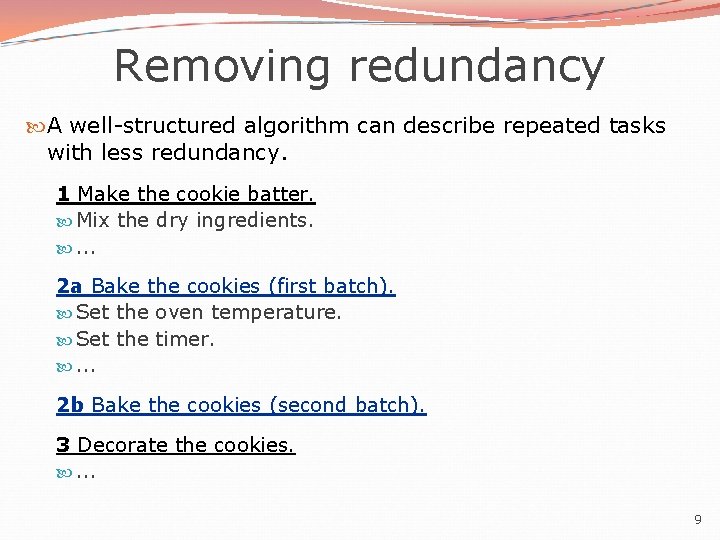
Removing redundancy A well-structured algorithm can describe repeated tasks with less redundancy. 1 Make the cookie batter. Mix the dry ingredients. . . . 2 a Bake the cookies (first batch). Set the oven temperature. Set the timer. . . . 2 b Bake the cookies (second batch). 3 Decorate the cookies. . . . 9
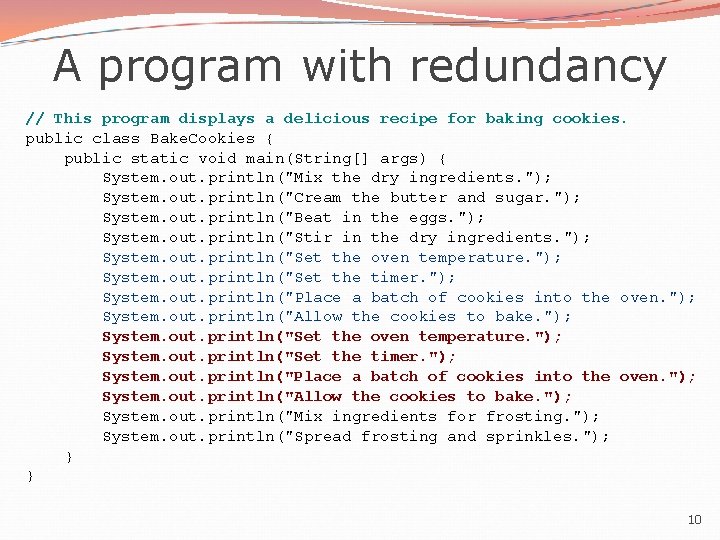
A program with redundancy // This program displays a delicious recipe for baking cookies. public class Bake. Cookies { public static void main(String[] args) { System. out. println("Mix the dry ingredients. "); System. out. println("Cream the butter and sugar. "); System. out. println("Beat in the eggs. "); System. out. println("Stir in the dry ingredients. "); System. out. println("Set the oven temperature. "); System. out. println("Set the timer. "); System. out. println("Place a batch of cookies into the oven. "); System. out. println("Allow the cookies to bake. "); System. out. println("Mix ingredients for frosting. "); System. out. println("Spread frosting and sprinkles. "); } } 10
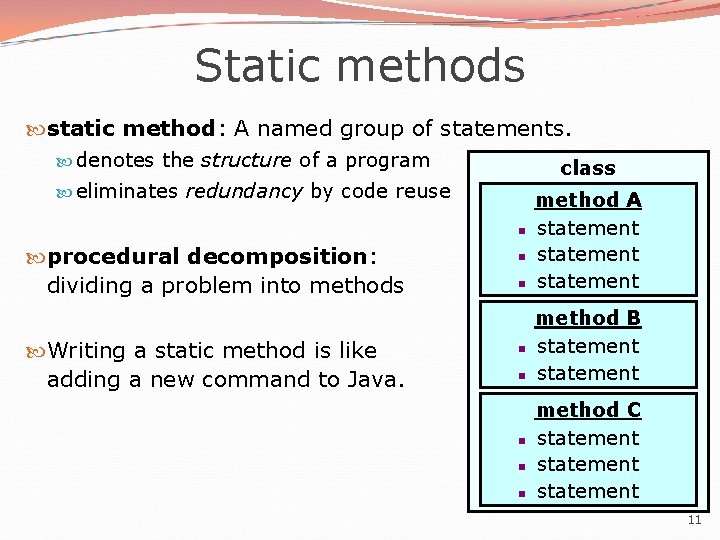
Static methods static method: A named group of statements. denotes the structure of a program class eliminates redundancy by code reuse n procedural decomposition: dividing a problem into methods Writing a static method is like adding a new command to Java. n n n n method A statement method B statement method C statement 11
Using static methods 1. Design (think about) the algorithm. Look at the structure, and which commands are repeated. Decide what are the important overall tasks. 2. Declare (write down) the methods. Arrange statements into groups and give each group a name. 3. Call (run) the methods. The program's main method executes the other methods to perform the overall task. 12
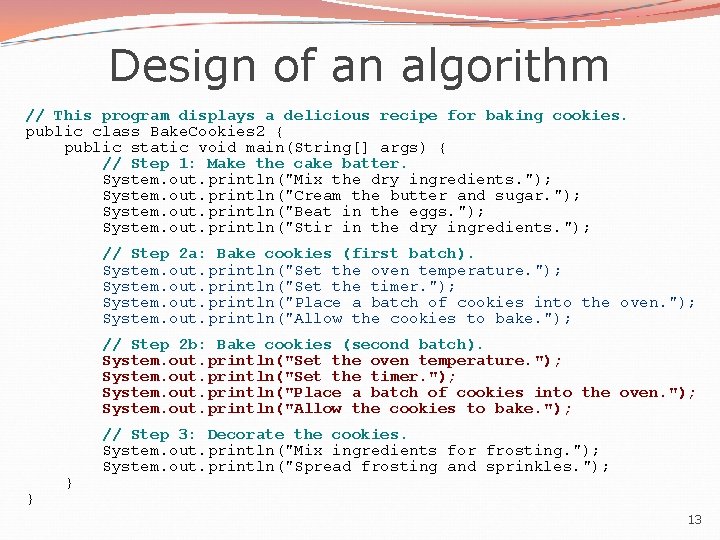
Design of an algorithm // This program displays a delicious recipe for baking cookies. public class Bake. Cookies 2 { public static void main(String[] args) { // Step 1: Make the cake batter. System. out. println("Mix the dry ingredients. "); System. out. println("Cream the butter and sugar. "); System. out. println("Beat in the eggs. "); System. out. println("Stir in the dry ingredients. "); // Step 2 a: Bake cookies (first batch). System. out. println("Set the oven temperature. "); System. out. println("Set the timer. "); System. out. println("Place a batch of cookies into the oven. "); System. out. println("Allow the cookies to bake. "); // Step 2 b: Bake cookies (second batch). System. out. println("Set the oven temperature. "); System. out. println("Set the timer. "); System. out. println("Place a batch of cookies into the oven. "); System. out. println("Allow the cookies to bake. "); } } // Step 3: Decorate the cookies. System. out. println("Mix ingredients for frosting. "); System. out. println("Spread frosting and sprinkles. "); 13
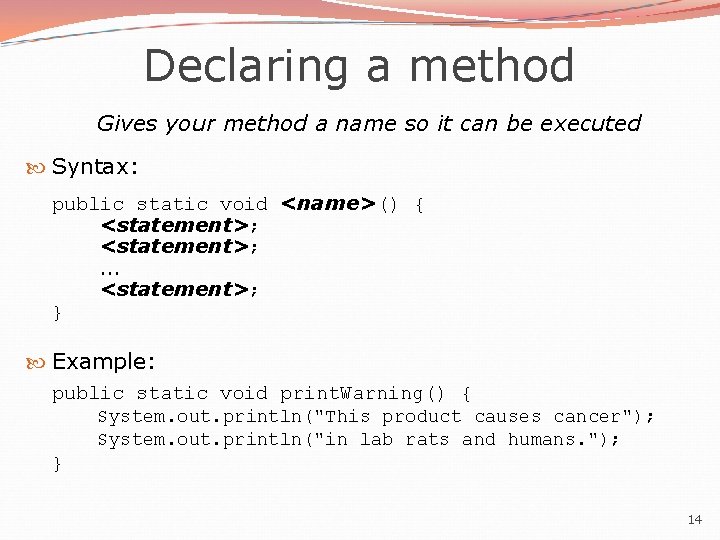
Declaring a method Gives your method a name so it can be executed Syntax: public static void <name>() { <statement>; . . . <statement>; } Example: public static void print. Warning() { System. out. println("This product causes cancer"); System. out. println("in lab rats and humans. "); } 14
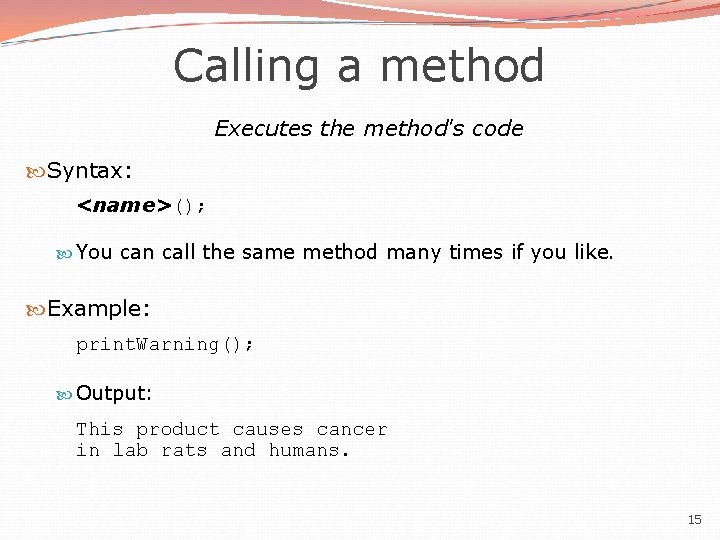
Calling a method Executes the method's code Syntax: <name>(); You can call the same method many times if you like. Example: print. Warning(); Output: This product causes cancer in lab rats and humans. 15
![Program with static method public class Fresh. Prince { public static void main(String[] args)](http://slidetodoc.com/presentation_image_h2/1d046221d1ede06a31a1c0df662436ba/image-16.jpg "Program with static method public class Fresh. Prince { public static void main(String[] args)")
Program with static method public class Fresh. Prince { public static void main(String[] args) { rap(); // Calling (running) the rap method System. out. println(); rap(); // Calling the rap method again } // This method prints the lyrics to my favorite song. public static void rap() { System. out. println("Now this is the story all about how"); System. out. println("My life got flipped turned upside-down"); } } Output: Now this is the story all about how My life got flipped turned upside-down 16
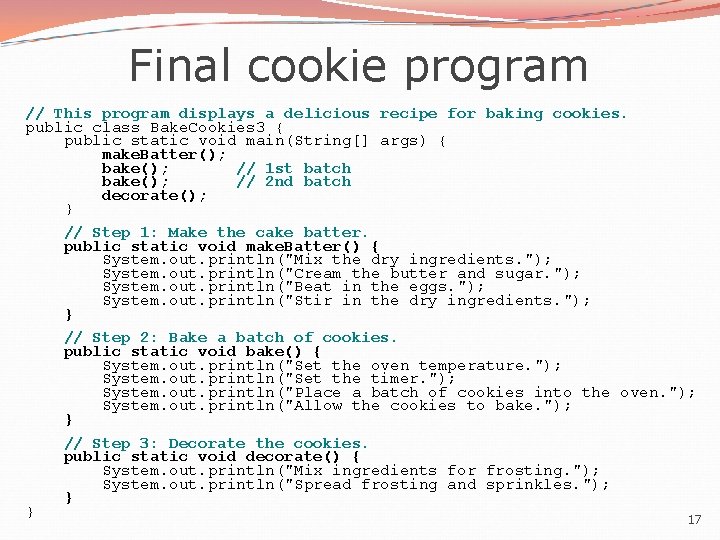
Final cookie program // This program displays a delicious recipe for baking cookies. public class Bake. Cookies 3 { public static void main(String[] args) { make. Batter(); bake(); // 1 st batch bake(); // 2 nd batch decorate(); } // Step 1: Make the cake batter. public static void make. Batter() { System. out. println("Mix the dry ingredients. "); System. out. println("Cream the butter and sugar. "); System. out. println("Beat in the eggs. "); System. out. println("Stir in the dry ingredients. "); } // Step 2: Bake a batch of cookies. public static void bake() { System. out. println("Set the oven temperature. "); System. out. println("Set the timer. "); System. out. println("Place a batch of cookies into the oven. "); System. out. println("Allow the cookies to bake. "); } // Step 3: Decorate the cookies. public static void decorate() { System. out. println("Mix ingredients for frosting. "); System. out. println("Spread frosting and sprinkles. "); } } 17
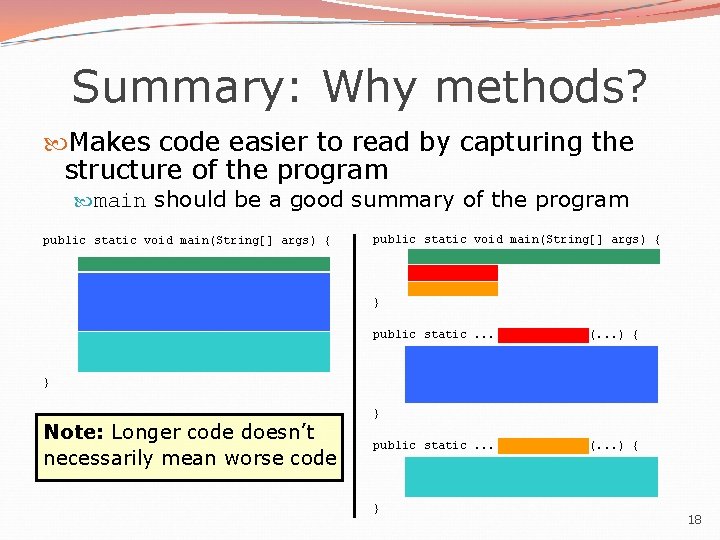
Summary: Why methods? Makes code easier to read by capturing the structure of the program main should be a good summary of the program public static void main(String[] args) { } public static. . . (. . . ) { } Note: Longer code doesn’t necessarily mean worse code } public static. . . } (. . . ) { 18
![Summary: Why methods? Eliminate redundancy public static void main(String[] args) { } public static.](http://slidetodoc.com/presentation_image_h2/1d046221d1ede06a31a1c0df662436ba/image-19.jpg "Summary: Why methods? Eliminate redundancy public static void main(String[] args) { } public static.")
Summary: Why methods? Eliminate redundancy public static void main(String[] args) { } public static. . . (. . . ) { } } 19
![Methods calling methods public class Methods. Example { public static void main(String[] args) {](http://slidetodoc.com/presentation_image_h2/1d046221d1ede06a31a1c0df662436ba/image-20.jpg "Methods calling methods public class Methods. Example { public static void main(String[] args) {")
Methods calling methods public class Methods. Example { public static void main(String[] args) { message 1(); message 2(); System. out. println("Done with main. "); } public static void message 1() { System. out. println("This is message 1. "); } public static void message 2() { System. out. println("This is message 2. "); message 1(); System. out. println("Done with message 2. "); } } Output: This Done is message 1. is message 2. is message 1. with message 2. with main. 20
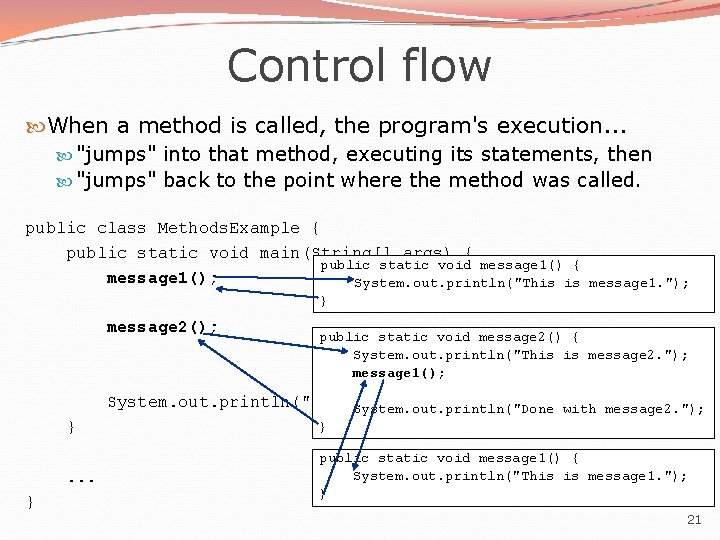
Control flow When a method is called, the program's execution. . . "jumps" into that method, executing its statements, then "jumps" back to the point where the method was called. public class Methods. Example { public static void main(String[] args) { public static void message 1() { message 1(); System. out. println("This is message 1. "); } message 2(); public static void message 2() { System. out. println("This is message 2. "); message 1(); System. out. println("Done with main. "); with message 2. "); } } } . . . public static void message 1() { System. out. println("This is message 1. "); } 21
When NOT to use methods You should not create static methods for: Only blank lines. (Put blank printlns in main. ) Unrelated or weakly related statements. (Consider splitting them into two smaller methods. ) 22
Drawing complex figures with static methods reading: 1. 5 (Ch. 1 Case Study: Draw. Figures)
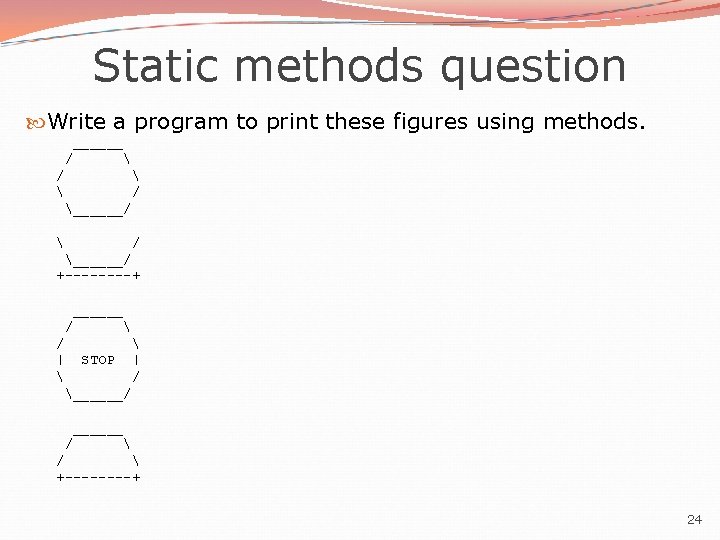
Static methods question Write a program to print these figures using methods. ______ / / ______/ +----+ ______ / | STOP | / ______/ ______ / +----+ 24
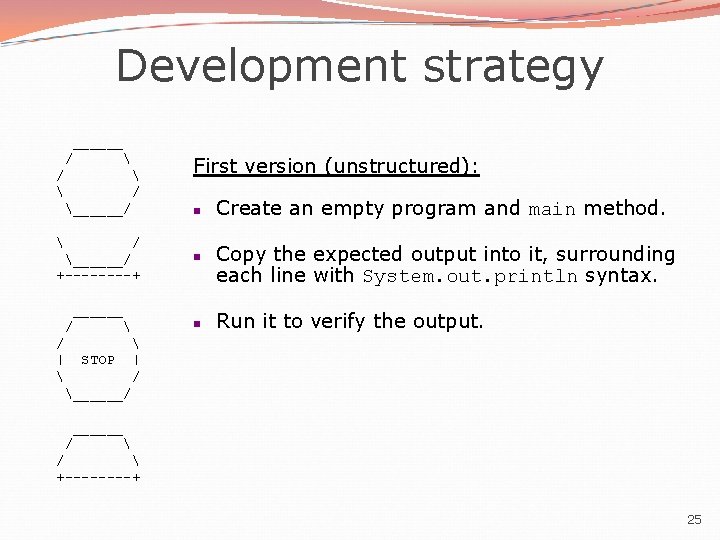
Development strategy ______ / / ______/ +----+ ______ / | STOP | / ______/ First version (unstructured): n n n Create an empty program and main method. Copy the expected output into it, surrounding each line with System. out. println syntax. Run it to verify the output. ______ / +----+ 25
![Program version 1 public class Figures 1 { public static void main(String[] args) {](http://slidetodoc.com/presentation_image_h2/1d046221d1ede06a31a1c0df662436ba/image-26.jpg "Program version 1 public class Figures 1 { public static void main(String[] args) {")
Program version 1 public class Figures 1 { public static void main(String[] args) { System. out. println(" ______"); System. out. println(" / \"); System. out. println("\ /"); System. out. println(" \______/"); System. out. println("+----+"); System. out. println(" ______"); System. out. println(" / \"); System. out. println("| STOP |"); System. out. println("\ /"); System. out. println(" \______/"); System. out. println(" ______"); System. out. println(" / \"); System. out. println("+----+"); } } 26
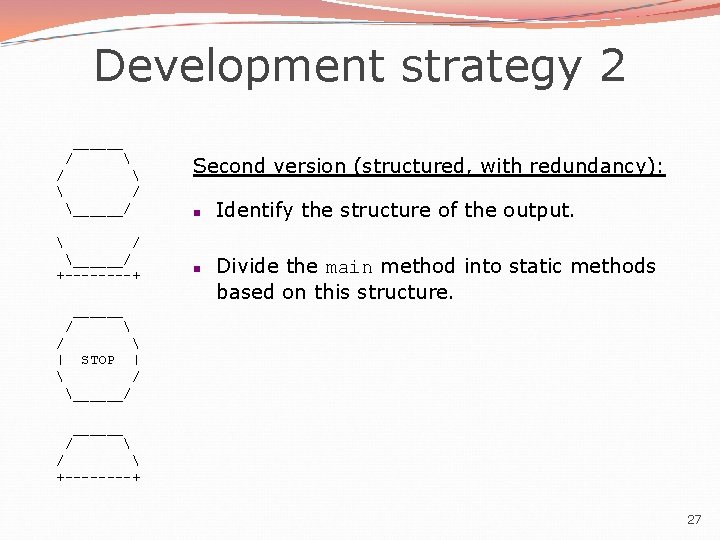
Development strategy 2 ______ / / ______/ +----+ ______ Second version (structured, with redundancy): n n Identify the structure of the output. Divide the main method into static methods based on this structure. / | STOP | / ______/ ______ / +----+ 27
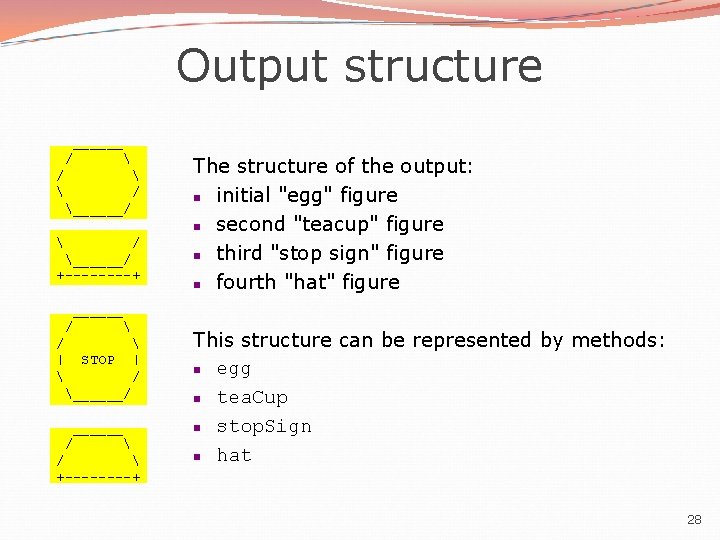
Output structure ______ / / ______/ +----+ The structure of the output: n initial "egg" figure n second "teacup" figure n third "stop sign" figure n fourth "hat" figure ______ / | STOP | / ______/ ______ / +----+ This structure can be represented by methods: n egg n tea. Cup n stop. Sign n hat 28
![Program version 2 public class Figures 2 { public static void main(String[] args) {](http://slidetodoc.com/presentation_image_h2/1d046221d1ede06a31a1c0df662436ba/image-29.jpg "Program version 2 public class Figures 2 { public static void main(String[] args) {")
Program version 2 public class Figures 2 { public static void main(String[] args) { egg(); tea. Cup(); stop. Sign(); hat(); } public static void egg() { System. out. println(" ______"); System. out. println(" / \"); System. out. println("\ /"); System. out. println(" \______/"); System. out. println(); } public static void tea. Cup() { System. out. println("\ /"); System. out. println(" \______/"); System. out. println("+----+"); System. out. println(); }. . . 29
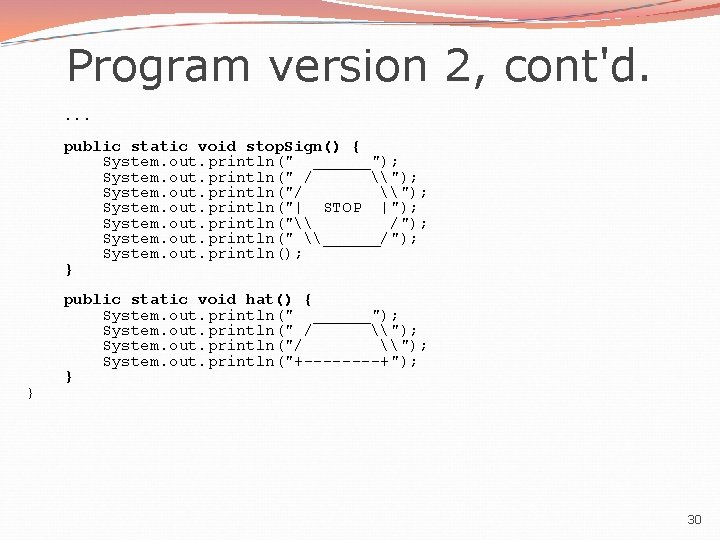
Program version 2, cont'd. . public static void stop. Sign() { System. out. println(" ______"); System. out. println(" / \"); System. out. println("| STOP |"); System. out. println("\ /"); System. out. println(" \______/"); System. out. println(); } } public static void hat() { System. out. println(" ______"); System. out. println(" / \"); System. out. println("+----+"); } 30
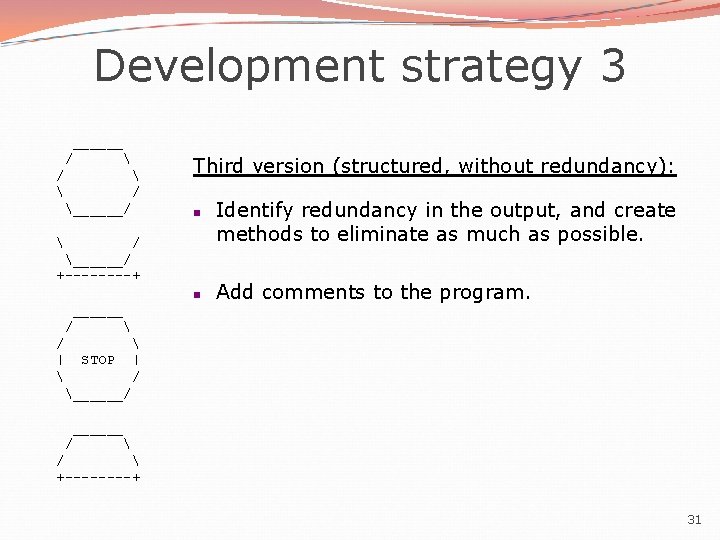
Development strategy 3 ______ / / ______/ Third version (structured, without redundancy): n / ______/ +----+ n ______ Identify redundancy in the output, and create methods to eliminate as much as possible. Add comments to the program. / | STOP | / ______/ ______ / +----+ 31
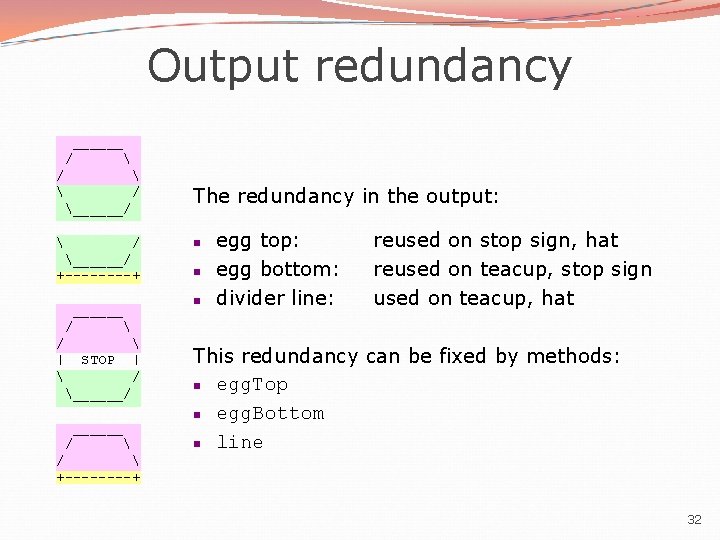
Output redundancy ______ / / ______/ +----+ ______ / | STOP | / ______/ ______ / +----+ The redundancy in the output: n n n egg top: egg bottom: divider line: reused on stop sign, hat reused on teacup, stop sign used on teacup, hat This redundancy can be fixed by methods: n egg. Top n egg. Bottom n line 32
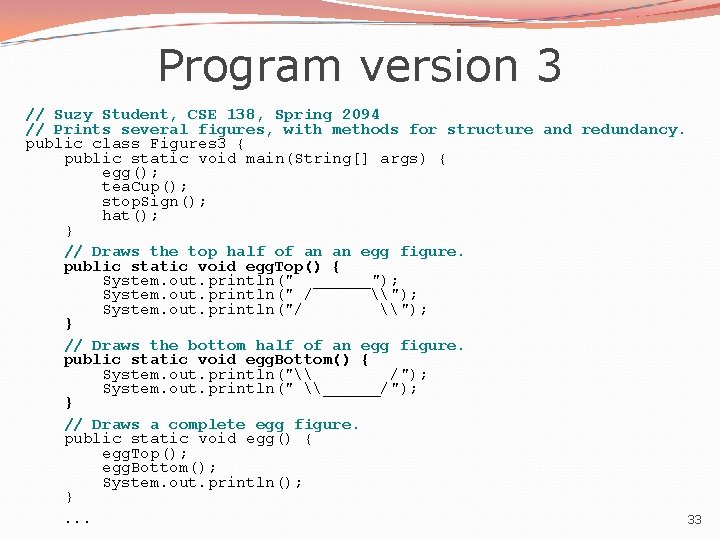
Program version 3 // Suzy Student, CSE 138, Spring 2094 // Prints several figures, with methods for structure and redundancy. public class Figures 3 { public static void main(String[] args) { egg(); tea. Cup(); stop. Sign(); hat(); } // Draws the top half of an an egg figure. public static void egg. Top() { System. out. println(" ______"); System. out. println(" / \"); System. out. println("/ \"); } // Draws the bottom half of an egg figure. public static void egg. Bottom() { System. out. println("\ /"); System. out. println(" \______/"); } // Draws a complete egg figure. public static void egg() { egg. Top(); egg. Bottom(); System. out. println(); }. . . 33
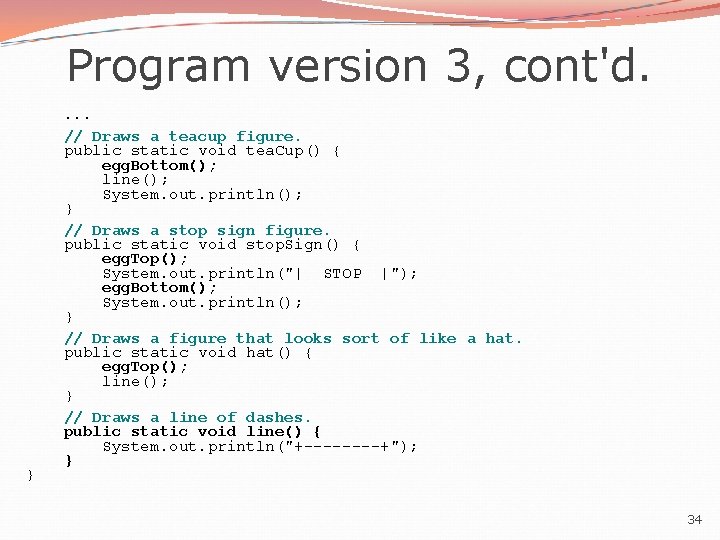
Program version 3, cont'd. } . . . // Draws a teacup figure. public static void tea. Cup() { egg. Bottom(); line(); System. out. println(); } // Draws a stop sign figure. public static void stop. Sign() { egg. Top(); System. out. println("| STOP |"); egg. Bottom(); System. out. println(); } // Draws a figure that looks sort of like a hat. public static void hat() { egg. Top(); line(); } // Draws a line of dashes. public static void line() { System. out. println("+----+"); } 34
A word about style Structure your code properly Eliminate redundant code Use spaces judiciously and consistently Indent properly Follow the naming conventions Use comments to describe code behavior 35
Why style? Programmers build on top of other’s code all the time. You shouldn’t waste time deciphering what a method does. You should spend time on thinking or coding. You should NOT be wasting time looking for that missing closing brace. So code with style! 36
- Slides: 36