
Building Java Programs Chapter 1 Lecture 1 2
Building Java Programs Chapter 1 Lecture 1 -2: Static Methods reading: 1. 4 - 1. 5 Copyright 2010 by Pearson Education
Copyright 2010 by Pearson Education 2
![Recall: structure, syntax class: a program public class name { public static void main(String[]](http://slidetodoc.com/presentation_image/a01b44f673dacb99133771d6e4b8cebf/image-3.jpg "Recall: structure, syntax class: a program public class name { public static void main(String[]")
Recall: structure, syntax class: a program public class name { public static void main(String[] args) { statement; method: a named group. . . of statements statement; } } statement: a command to be executed �Every executable Java program consists of a class, � that contains a method named main, � that contains the statements (commands) to be executed. Copyright 2010 by Pearson Education 3
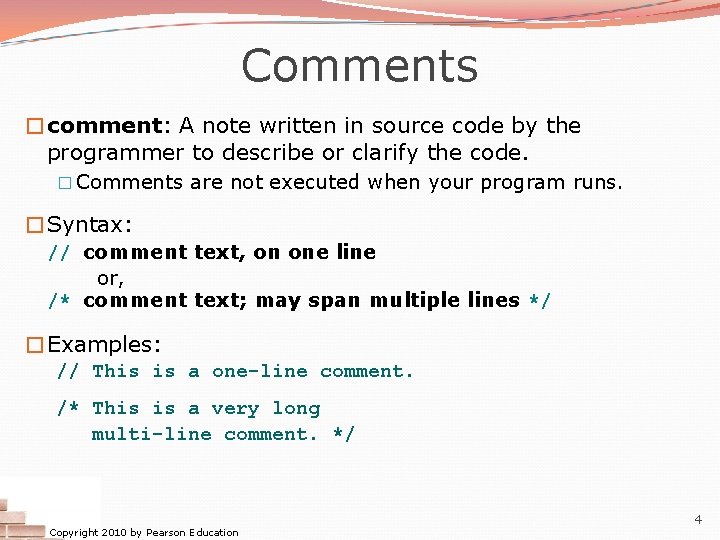
Comments �comment: A note written in source code by the programmer to describe or clarify the code. � Comments are not executed when your program runs. �Syntax: // comment text, on one line or, /* comment text; may span multiple lines */ �Examples: // This is a one-line comment. /* This is a very long multi-line comment. */ Copyright 2010 by Pearson Education 4
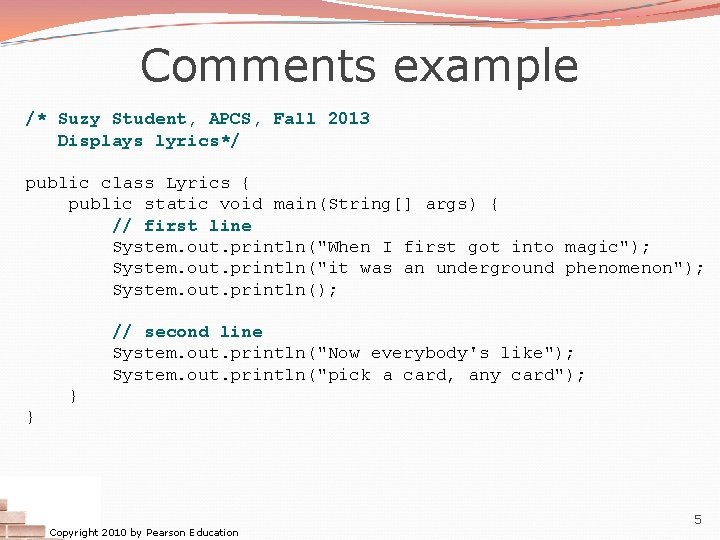
Comments example /* Suzy Student, APCS, Fall 2013 Displays lyrics*/ public class Lyrics { public static void main(String[] args) { // first line System. out. println("When I first got into magic"); System. out. println("it was an underground phenomenon"); System. out. println(); // second line System. out. println("Now everybody's like"); System. out. println("pick a card, any card"); } } Copyright 2010 by Pearson Education 5
Static methods reading: 1. 4 Copyright 2010 by Pearson Education
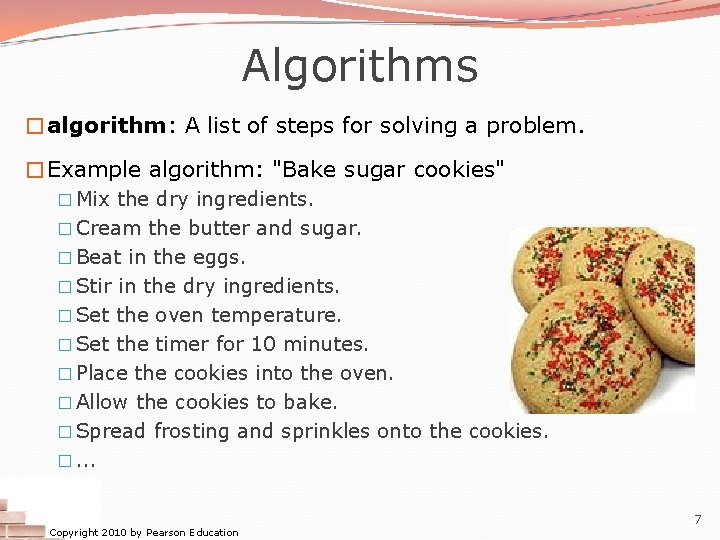
Algorithms �algorithm: A list of steps for solving a problem. �Example algorithm: "Bake sugar cookies" � Mix the dry ingredients. � Cream the butter and sugar. � Beat in the eggs. � Stir in the dry ingredients. � Set the oven temperature. � Set the timer for 10 minutes. � Place the cookies into the oven. � Allow the cookies to bake. � Spread frosting and sprinkles onto the cookies. �. . . Copyright 2010 by Pearson Education 7
Problems with algorithms �lack of structure: Many steps; tough to follow. �redundancy: Consider making a double batch. . . � Mix the dry ingredients. � Cream the butter and sugar. � Beat in the eggs. � Stir in the dry ingredients. � Set the oven temperature. � Set the timer for 10 minutes. � Place the first batch of cookies into the oven. � Allow the cookies to bake. � Set the timer for 10 minutes. � Place the second batch of cookies into the oven. � Allow the cookies to bake. � Mix ingredients for frosting. �. . . Copyright 2010 by Pearson Education 8
Structured algorithms �structured algorithm: Split into coherent tasks. 1 Make the batter. � Mix the dry ingredients. � Cream the butter and sugar. � Beat in the eggs. � Stir in the dry ingredients. 2 Bake the cookies. � Set the oven temperature. � Set the timer for 10 minutes. � Place the cookies into the oven. � Allow the cookies to bake. 3 Decorate the cookies. � Mix the ingredients for the frosting. � Spread frosting and sprinkles onto the cookies. . Copyright 2010 by Pearson Education 9
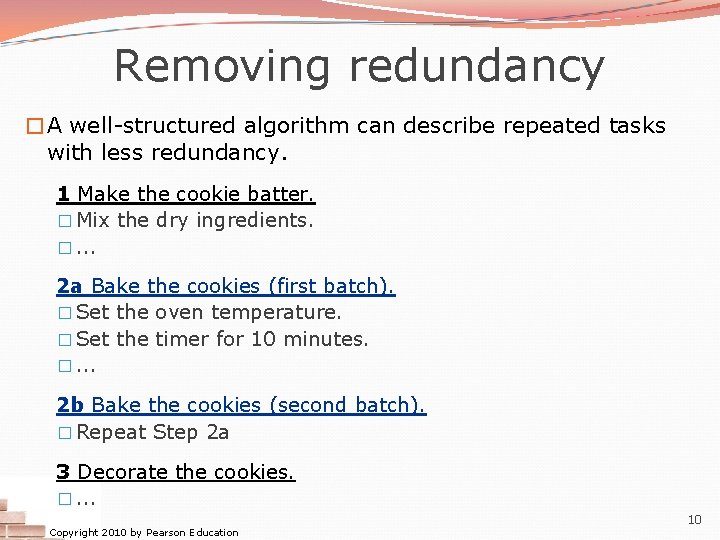
Removing redundancy �A well-structured algorithm can describe repeated tasks with less redundancy. 1 Make the cookie batter. � Mix the dry ingredients. �. . . 2 a Bake the cookies (first batch). � Set the oven temperature. � Set the timer for 10 minutes. �. . . 2 b Bake the cookies (second batch). � Repeat Step 2 a 3 Decorate the cookies. �. . . Copyright 2010 by Pearson Education 10
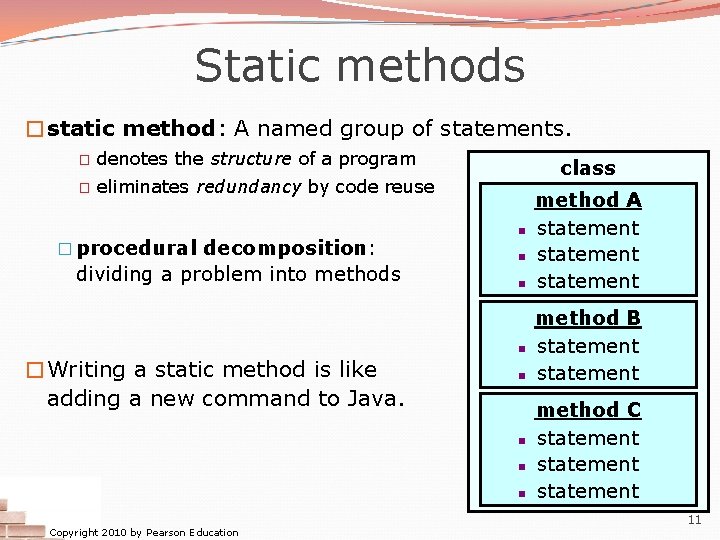
Static methods �static method: A named group of statements. � denotes the structure of a program � eliminates redundancy by code reuse � procedural decomposition: dividing a problem into methods �Writing a static method is like adding a new command to Java. class n n n n Copyright 2010 by Pearson Education method A statement method B statement method C statement 11
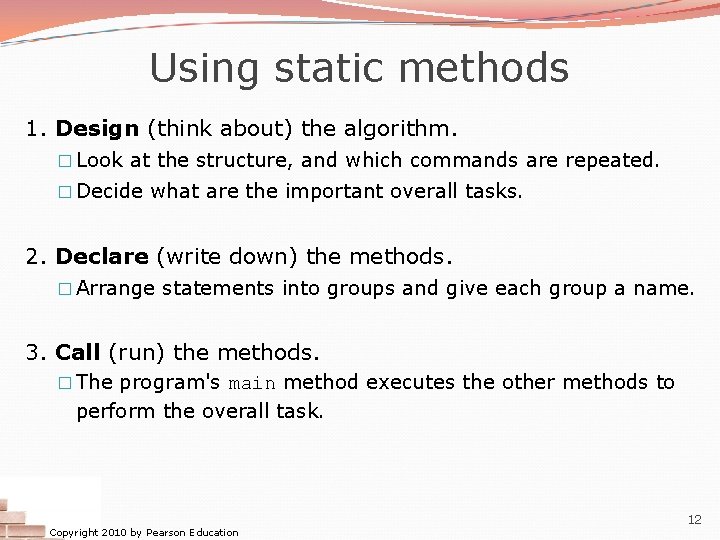
Using static methods 1. Design (think about) the algorithm. � Look at the structure, and which commands are repeated. � Decide what are the important overall tasks. 2. Declare (write down) the methods. � Arrange statements into groups and give each group a name. 3. Call (run) the methods. � The program's main method executes the other methods to perform the overall task. Copyright 2010 by Pearson Education 12
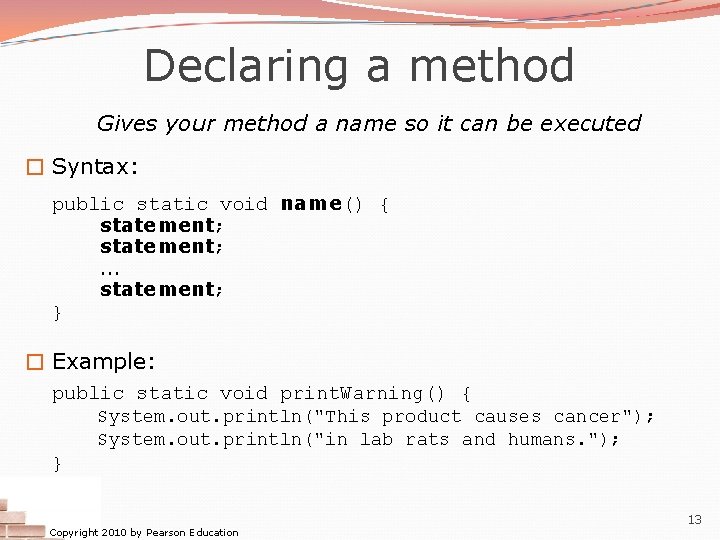
Declaring a method Gives your method a name so it can be executed � Syntax: public static void name() { statement; . . . statement; } � Example: public static void print. Warning() { System. out. println("This product causes cancer"); System. out. println("in lab rats and humans. "); } Copyright 2010 by Pearson Education 13
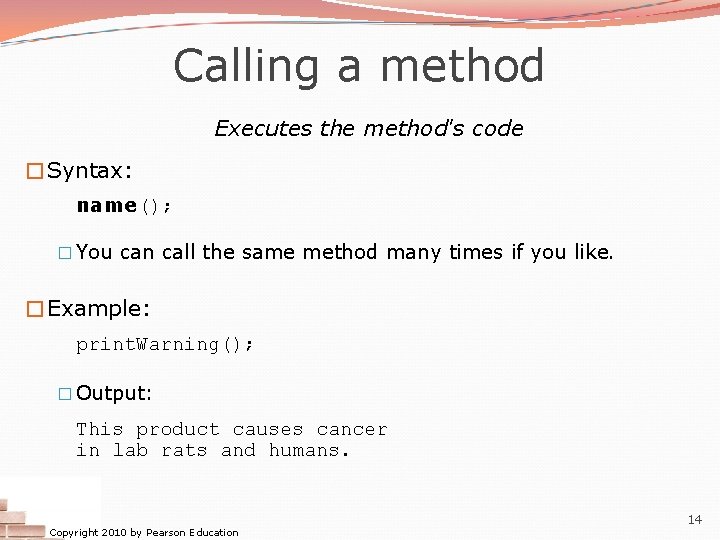
Calling a method Executes the method's code �Syntax: name(); � You can call the same method many times if you like. �Example: print. Warning(); � Output: This product causes cancer in lab rats and humans. Copyright 2010 by Pearson Education 14
![Program with static method public class Fresh. Prince { public static void main(String[] args)](http://slidetodoc.com/presentation_image/a01b44f673dacb99133771d6e4b8cebf/image-15.jpg "Program with static method public class Fresh. Prince { public static void main(String[] args)")
Program with static method public class Fresh. Prince { public static void main(String[] args) { rap(); // Calling (running) the rap method System. out. println(); rap(); // Calling the rap method again } // This method prints the lyrics to my favorite song. public static void rap() { System. out. println("Now this is the story all about how"); System. out. println("My life got flipped turned upside-down"); } } Output: Now this is the story all about how My life got flipped turned upside-down Copyright 2010 by Pearson Education 15
![Methods calling methods public class Methods. Example { public static void main(String[] args) {](http://slidetodoc.com/presentation_image/a01b44f673dacb99133771d6e4b8cebf/image-16.jpg "Methods calling methods public class Methods. Example { public static void main(String[] args) {")
Methods calling methods public class Methods. Example { public static void main(String[] args) { message 1(); message 2(); System. out. println("Done with main. "); } public static void message 1() { System. out. println("This is message 1. "); } public static void message 2() { System. out. println("This is message 2. "); message 1(); System. out. println("Done with message 2. "); } } �Output: This Done is message 1. is message 2. is message 1. with message 2. with main. Copyright 2010 by Pearson Education 16
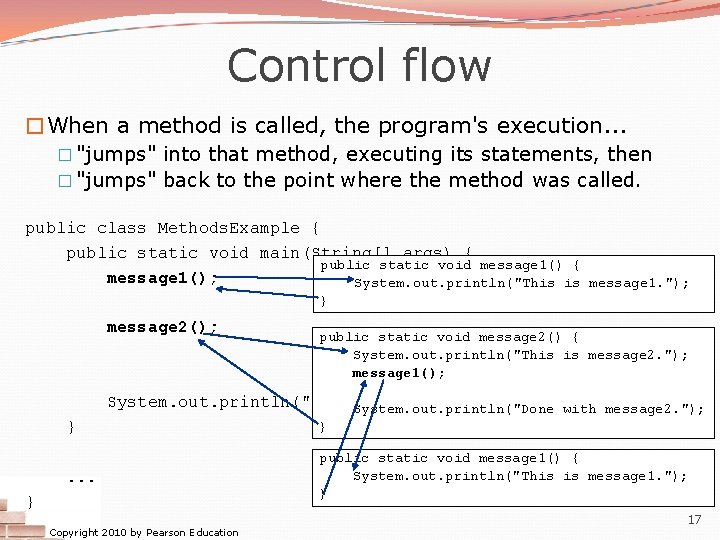
Control flow �When a method is called, the program's execution. . . � "jumps" into that method, executing its statements, then � "jumps" back to the point where the method was called. public class Methods. Example { public static void main(String[] args) { public static void message 1() { message 1(); System. out. println("This is message 1. "); } message 2(); public static void message 2() { System. out. println("This is message 2. "); message 1(); System. out. println("Done with main. "); with message 2. "); } } . . . public static void message 1() { System. out. println("This is message 1. "); } } Copyright 2010 by Pearson Education 17
When to use methods �Place statements into a static method if: � The statements are related structurally, and/or � The statements are repeated. �You should not create static methods for: � An individual println statement. � Only blank lines. (Put blank printlns in main. ) � Unrelated or weakly related statements. (Consider splitting them into two smaller methods. ) Copyright 2010 by Pearson Education 18
Drawing complex figures with static methods reading: 1. 5 (Ch. 1 Case Study: Draw. Figures) Copyright 2010 by Pearson Education
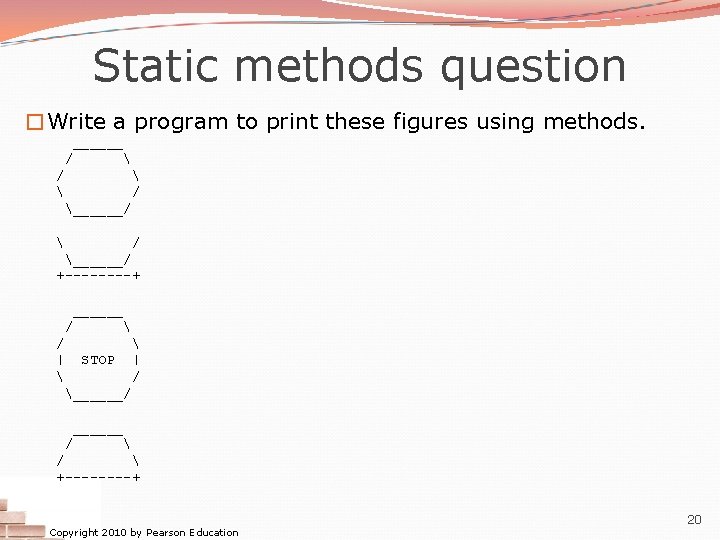
Static methods question �Write a program to print these figures using methods. ______ / / ______/ +----+ ______ / | STOP | / ______/ ______ / +----+ Copyright 2010 by Pearson Education 20
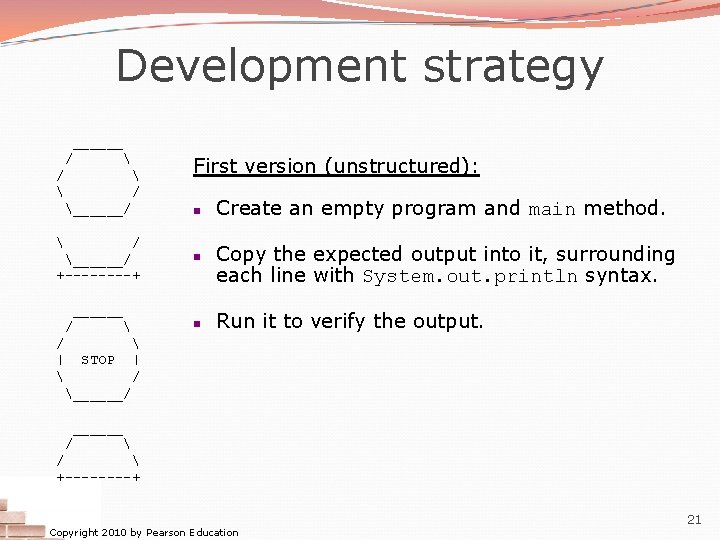
Development strategy ______ / / ______/ +----+ ______ / | STOP | / ______/ First version (unstructured): n n n Create an empty program and main method. Copy the expected output into it, surrounding each line with System. out. println syntax. Run it to verify the output. ______ / +----+ Copyright 2010 by Pearson Education 21
![Program version 1 public class Figures 1 { public static void main(String[] args) {](http://slidetodoc.com/presentation_image/a01b44f673dacb99133771d6e4b8cebf/image-22.jpg "Program version 1 public class Figures 1 { public static void main(String[] args) {")
Program version 1 public class Figures 1 { public static void main(String[] args) { System. out. println(" ______"); System. out. println(" / \"); System. out. println("\ /"); System. out. println(" \______/"); System. out. println("+----+"); System. out. println(" ______"); System. out. println(" / \"); System. out. println("| STOP |"); System. out. println("\ /"); System. out. println(" \______/"); System. out. println(" ______"); System. out. println(" / \"); System. out. println("+----+"); } } Copyright 2010 by Pearson Education 22
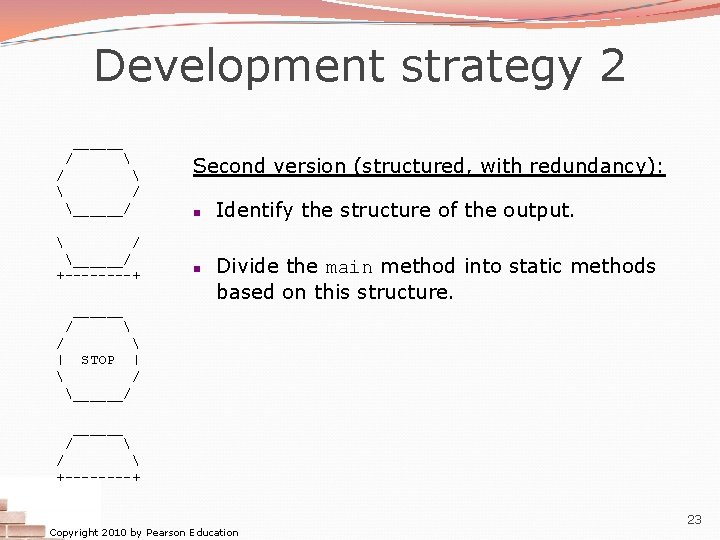
Development strategy 2 ______ / / ______/ +----+ ______ Second version (structured, with redundancy): n n Identify the structure of the output. Divide the main method into static methods based on this structure. / | STOP | / ______/ ______ / +----+ Copyright 2010 by Pearson Education 23
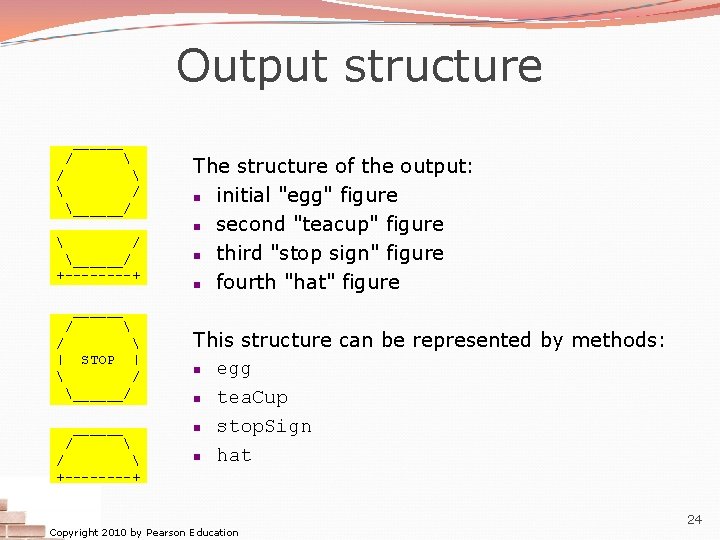
Output structure ______ / / ______/ +----+ The structure of the output: n initial "egg" figure n second "teacup" figure n third "stop sign" figure n fourth "hat" figure ______ / | STOP | / ______/ ______ / +----+ This structure can be represented by methods: n egg n tea. Cup n stop. Sign n hat Copyright 2010 by Pearson Education 24
![Program version 2 public class Figures 2 { public static void main(String[] args) {](http://slidetodoc.com/presentation_image/a01b44f673dacb99133771d6e4b8cebf/image-25.jpg "Program version 2 public class Figures 2 { public static void main(String[] args) {")
Program version 2 public class Figures 2 { public static void main(String[] args) { egg(); tea. Cup(); stop. Sign(); hat(); } public static void egg() { System. out. println(" ______"); System. out. println(" / \"); System. out. println("\ /"); System. out. println(" \______/"); System. out. println(); } public static void tea. Cup() { System. out. println("\ /"); System. out. println(" \______/"); System. out. println("+----+"); System. out. println(); }. . . Copyright 2010 by Pearson Education 25
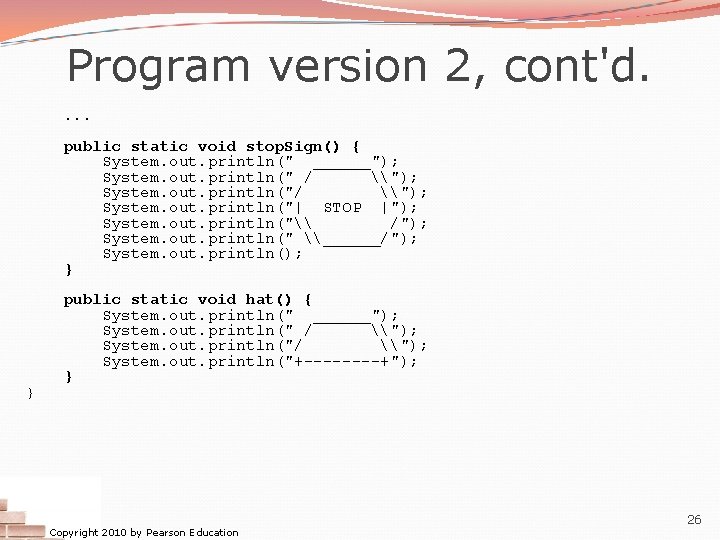
Program version 2, cont'd. . public static void stop. Sign() { System. out. println(" ______"); System. out. println(" / \"); System. out. println("| STOP |"); System. out. println("\ /"); System. out. println(" \______/"); System. out. println(); } } public static void hat() { System. out. println(" ______"); System. out. println(" / \"); System. out. println("+----+"); } Copyright 2010 by Pearson Education 26
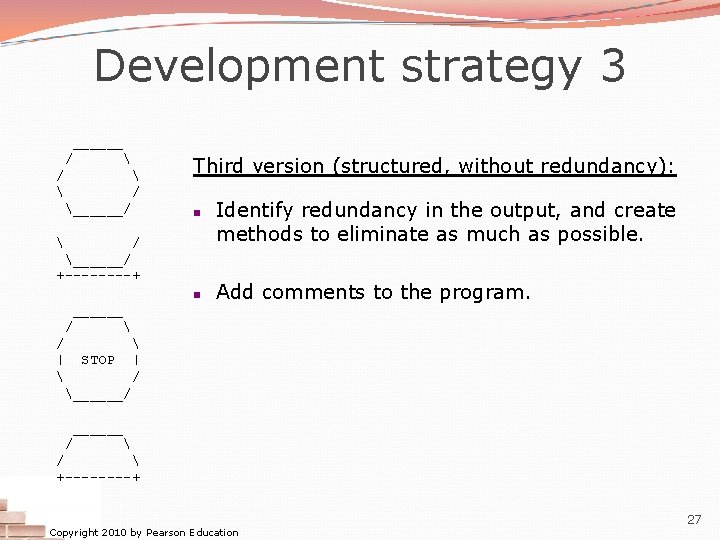
Development strategy 3 ______ / / ______/ Third version (structured, without redundancy): n / ______/ +----+ n ______ Identify redundancy in the output, and create methods to eliminate as much as possible. Add comments to the program. / | STOP | / ______/ ______ / +----+ Copyright 2010 by Pearson Education 27
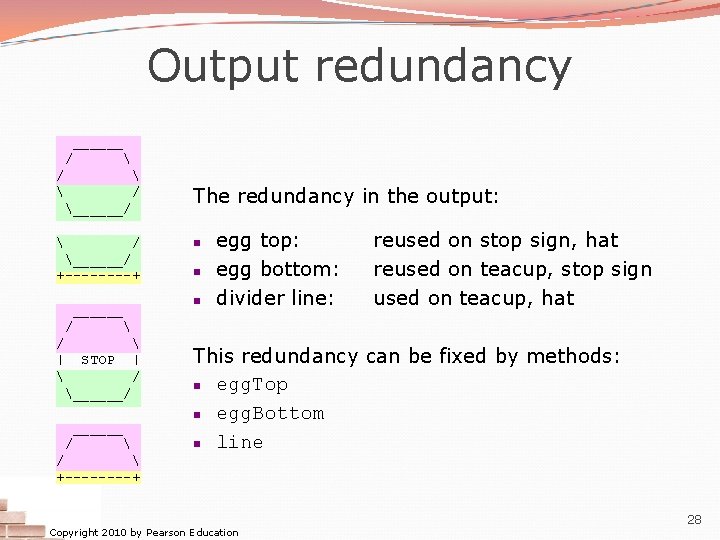
Output redundancy ______ / / ______/ +----+ ______ / | STOP | / ______/ ______ / +----+ The redundancy in the output: n n n egg top: egg bottom: divider line: reused on stop sign, hat reused on teacup, stop sign used on teacup, hat This redundancy can be fixed by methods: n egg. Top n egg. Bottom n line Copyright 2010 by Pearson Education 28
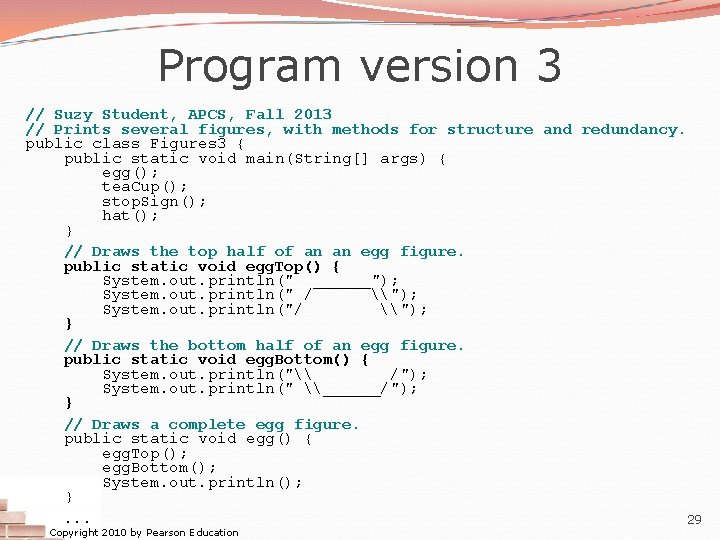
Program version 3 // Suzy Student, APCS, Fall 2013 // Prints several figures, with methods for structure and redundancy. public class Figures 3 { public static void main(String[] args) { egg(); tea. Cup(); stop. Sign(); hat(); } // Draws the top half of an an egg figure. public static void egg. Top() { System. out. println(" ______"); System. out. println(" / \"); System. out. println("/ \"); } // Draws the bottom half of an egg figure. public static void egg. Bottom() { System. out. println("\ /"); System. out. println(" \______/"); } // Draws a complete egg figure. public static void egg() { egg. Top(); egg. Bottom(); System. out. println(); }. . . 29 Copyright 2010 by Pearson Education
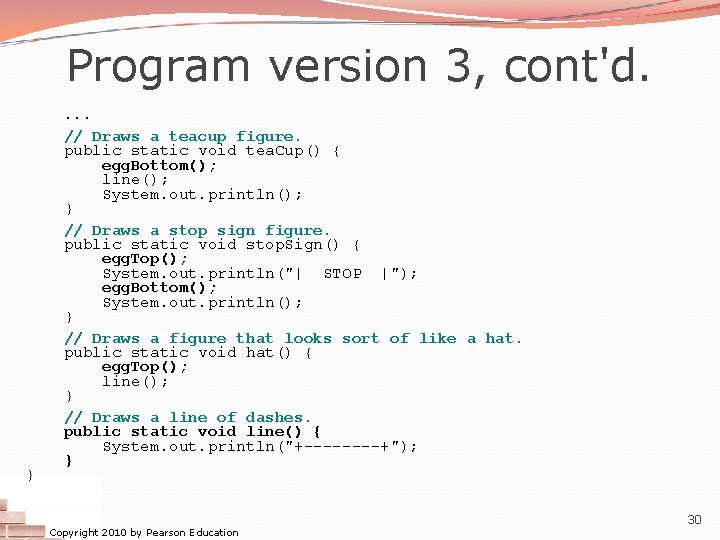
Program version 3, cont'd. } . . . // Draws a teacup figure. public static void tea. Cup() { egg. Bottom(); line(); System. out. println(); } // Draws a stop sign figure. public static void stop. Sign() { egg. Top(); System. out. println("| STOP |"); egg. Bottom(); System. out. println(); } // Draws a figure that looks sort of like a hat. public static void hat() { egg. Top(); line(); } // Draws a line of dashes. public static void line() { System. out. println("+----+"); } Copyright 2010 by Pearson Education 30
- Slides: 30