
Building Implementation Capacity West Valley School District District
Building Implementation Capacity West Valley School District: District Implementation Team & District Capacity Assessment Action Planning SISEP Active Scaling State February 2015
Purpose, Goal, & Objectives § § Purpose and Goal: § The purpose of this work is to improve student outcomes in early literacy by using effective implementation practices to bridge the gap between science and practice. § The goal of this meeting is to analyze West Valley’s current implementation infrastructure. Objectives: § Identify current District Initiatives (District Initiative Inventory) § Define key functions of a District Implementation Team (DIT) § Analyze and Use District Capacity Assessment Results (DCA) for action planning
Why Implementation Science § Implementation Science Quick Start Video
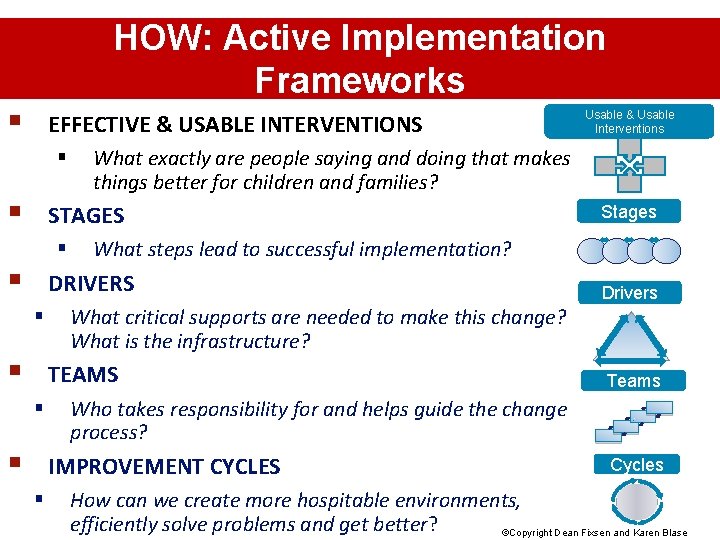
HOW: Active Implementation Making It Happen Frameworks § EFFECTIVE & USABLE INTERVENTIONS § § What exactly are people saying and doing that makes things better for children and families? STAGES § § Teams Who takes responsibility for and helps guide the change process? IMPROVEMENT CYCLES § Drivers What critical supports are needed to make this change? What is the infrastructure? TEAMS § Stages What steps lead to successful implementation? DRIVERS § Usable & Usable Interventions Cycles How can we create more hospitable environments, efficiently solve problems and get better? ©Copyright Dean Fixsen and Karen Blase
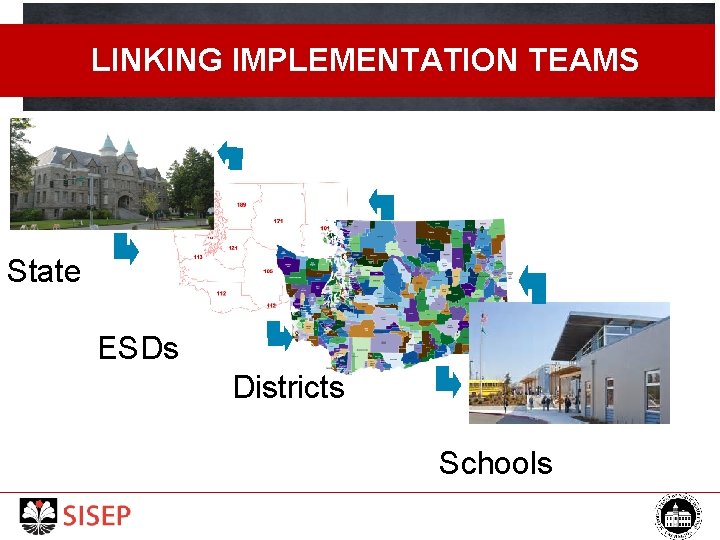
LINKING IMPLEMENTATION TEAMS State ESDs Districts Schools
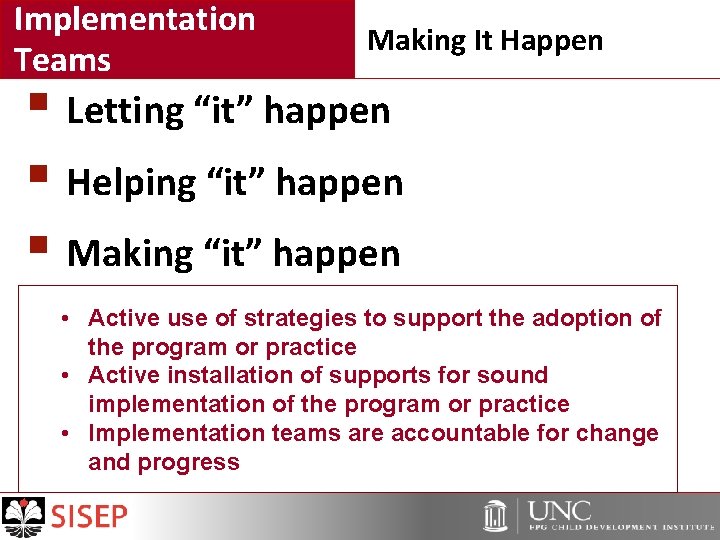
Implementation Teams Making It Happen § Letting “it” happen § Helping “it” happen § Making “it” happen • Active use of strategies to support the adoption of the program or practice • Active installation of supports for sound implementation of the program or practice • Implementation teams are accountable for change Based on Hall & Hord (1987); Greenhalgh, Robert, Mac. Farlane, Bate, & Kyriakidou (2004); Fixsen, Blase, and progress Duda, Naoom, & Van Dyke (2010)
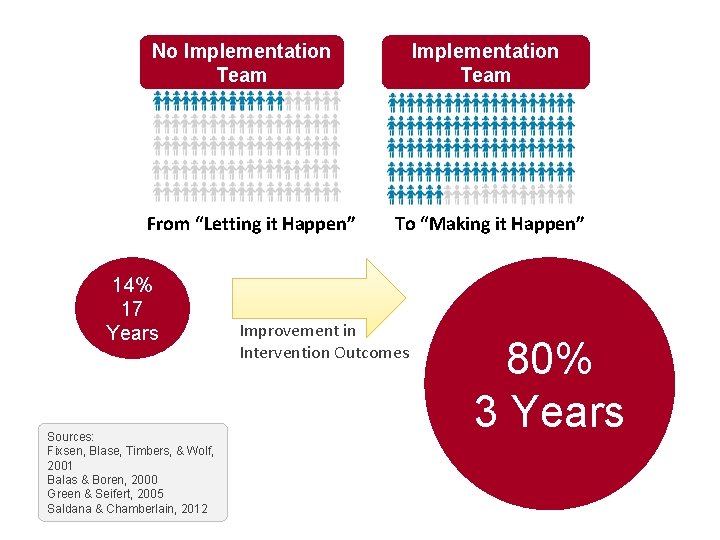
No Implementation Team From “Letting it Happen” 14% 17 Years Sources: Fixsen, Blase, Timbers, & Wolf, 2001 Balas & Boren, 2000 Green & Seifert, 2005 Saldana & Chamberlain, 2012 Implementation Team To “Making it Happen” Improvement in Intervention Outcomes 80% 3 Years
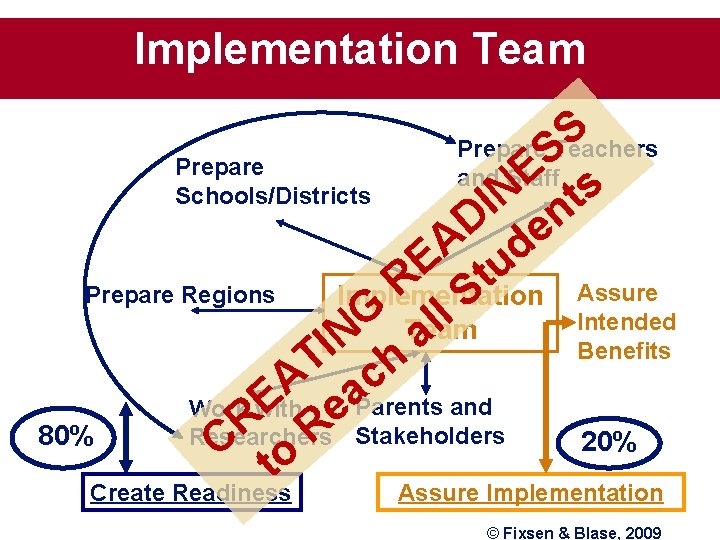
Implementation Team S S Prepare E Schools/Districts N nts I D e A d E u t R S Assure Prepare Regions Implementation l G Intended l Team N a I Benefits T h c A a Parents and E Work with e R 80% Researchers 20% C o R Stakeholders t Create Readiness Assure Implementation Prepare Teachers and Staff © Fixsen & Blase, 2009

District Implementation Teams The Work Exploration Installation • Engage in Exploration Stage activities with the first 3 -4 schools • Create readiness in the remaining schools • Complete District Capacity Assessments and engage in action planning • Analyze data and select innovation/practice • Operationalize selected innovations
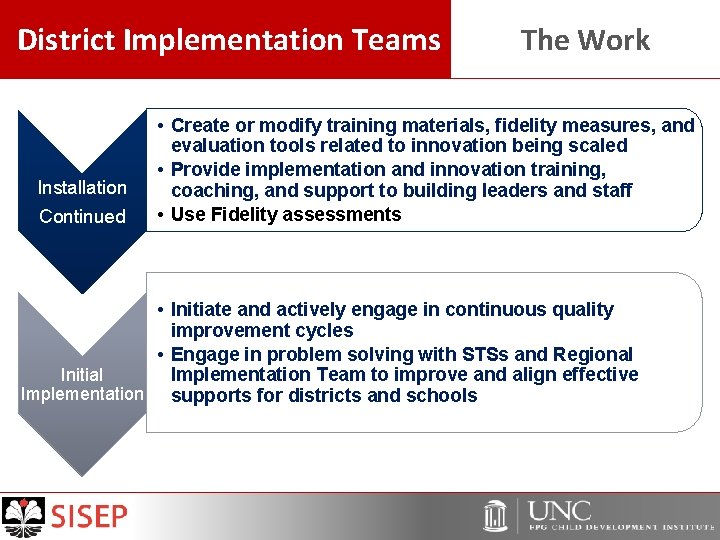
District Implementation Teams Installation Continued The Work • Create or modify training materials, fidelity measures, and evaluation tools related to innovation being scaled • Provide implementation and innovation training, coaching, and support to building leaders and staff • Use Fidelity assessments • Initiate and actively engage in continuous quality improvement cycles • Engage in problem solving with STSs and Regional Initial Implementation Team to improve and align effective Implementation supports for districts and schools
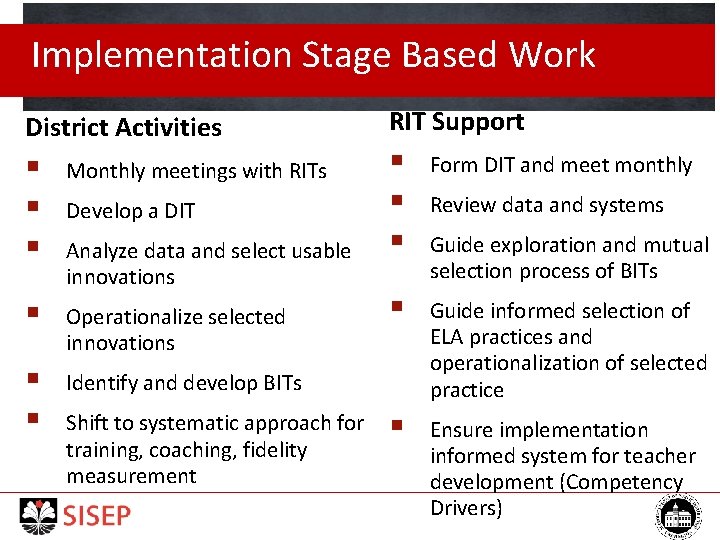
Implementation Stage Based Work District Activities § § § Monthly meetings with RITs § Operationalize selected innovations § § Identify and develop BITs Develop a DIT Analyze data and select usable innovations Shift to systematic approach for training, coaching, fidelity measurement RIT Support § § § Form DIT and meet monthly § Guide informed selection of ELA practices and operationalization of selected practice § Ensure implementation informed system for teacher development (Competency Drivers) Review data and systems Guide exploration and mutual selection process of BITs
Terms of Reference § Terms of Reference is a documented internal memorandum of understanding that is developed as groups form in order to § § § build consensus on mission, vision, define ways of work, determine levels of authority, create decision making protocols develop formal linking communication protocols
Why a Terms of Reference? § § Assists with: § Maintaining focus § Serving as a ‘prompt’ before a meeting, a discussion, or a decision § Reducing risk & building trust § Recruiting, engaging, and orienting new members of the group Nothing is carved in stone! § Revise and Reflect
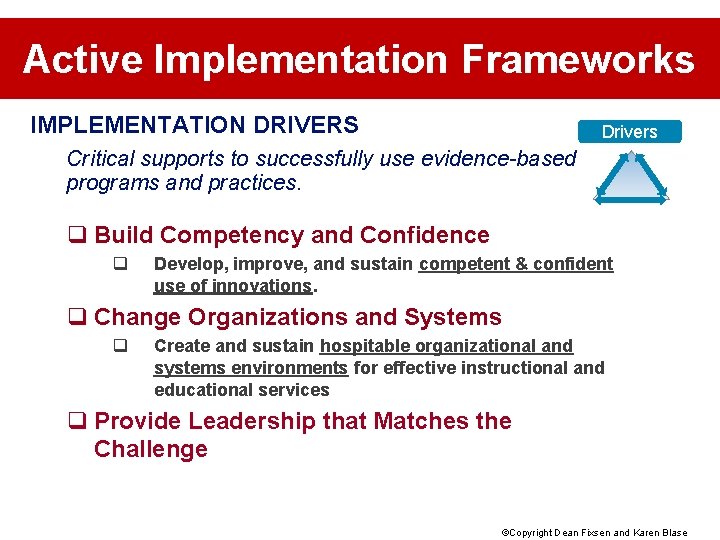
Making It Happen Frameworks Active Implementation IMPLEMENTATION DRIVERS Drivers Critical supports to successfully use evidence-based programs and practices. q Build Competency and Confidence q Develop, improve, and sustain competent & confident use of innovations. q Change Organizations and Systems q Create and sustain hospitable organizational and systems environments for effective instructional and educational services q Provide Leadership that Matches the Challenge ©Copyright Dean Fixsen and Karen Blase
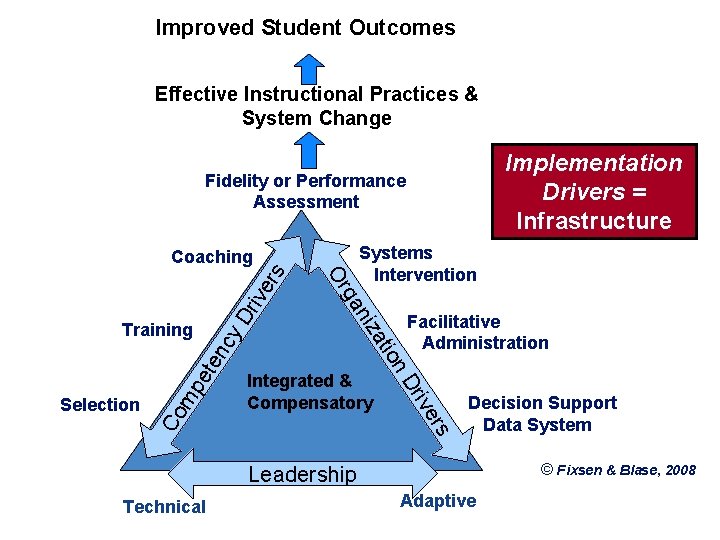
Improved Student Outcomes Effective Instructional Practices & System Change Implementation Drivers = Infrastructure Fidelity or Performance Assessment er riv y. D nc ete mp Co rs ive Dr Integrated & Compensatory Facilitative Administration on ati niz Selection Systems Intervention ga Training Or s Coaching Decision Support Data System © Fixsen & Blase, 2008 Leadership Technical Adaptive
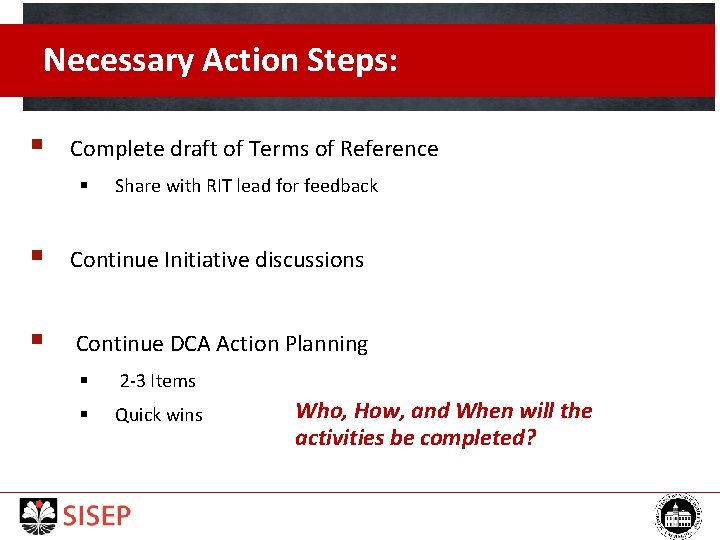
Necessary Action Steps: § Complete draft of Terms of Reference § Share with RIT lead for feedback § Continue Initiative discussions § Continue DCA Action Planning § 2 -3 Items § Quick wins Who, How, and When will the activities be completed?
For More Information State Transformation Specialist Wendy Iwaszuk Rachel Hart wendy. iwaszuk@k 12. wa. us rachel. hart@k 12. wa. us http: //nirn. fpg. unc. edu www. scalingup. org http: //implementation. fpg. unc. edu
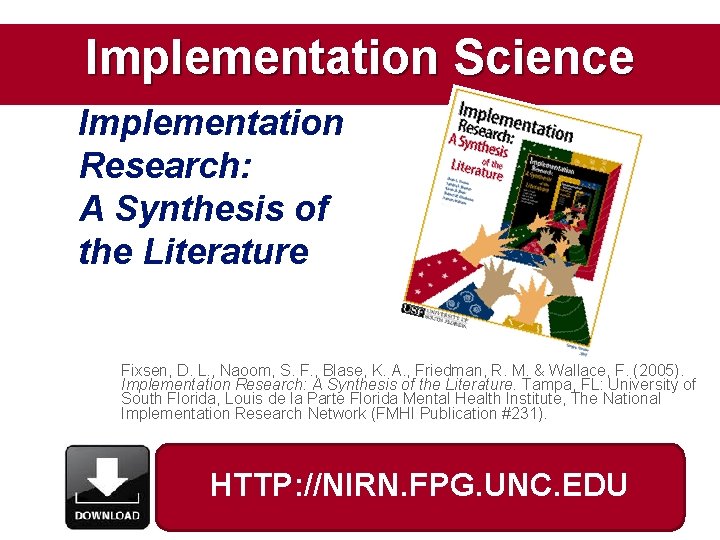
Implementation Science Implementation Research: A Synthesis of the Literature Fixsen, D. L. , Naoom, S. F. , Blase, K. A. , Friedman, R. M. & Wallace, F. (2005). Implementation Research: A Synthesis of the Literature. Tampa, FL: University of South Florida, Louis de la Parte Florida Mental Health Institute, The National Implementation Research Network (FMHI Publication #231). HTTP: //NIRN. FPG. UNC. EDU
©Copyright Dean Fixsen and Karen Blase This content is licensed under Creative Commons license CC BYNC-ND, Attribution-Non. Commercial-No. Derivs. You are free to share, copy, distribute and transmit the work under the following conditions: Attribution — You must attribute the work in the manner specified by the author or licensor (but not in any way that suggests that they endorse you or your use of the work); Noncommercial — You may not use this work for commercial purposes; No Derivative Works — You may not alter or transform this work. Any of the above conditions can be waived if you get permission from the copyright holder. http: //creativecommons. org/licenses/by-nc-nd/3. 0
- Slides: 19