
Building Homes Building Communities Partnering Partnering Session Agenda
Building Homes, Building Communities Partnering
Partnering Session Agenda Your Town Date 9: 00 am 9: 15 am 9: 45 am 10: 25 am WELCOME Review Agenda What is Partnering? Why Partnering? History of… GROUP DISCUSSION Who we are Roles – Goals - Concerns MEET YOUR NEIGHBORS/PARTNERS TEAM BUILDING PRINCIPLES Highly Effective Partnerships Partnership Breakdown Assumptions Communication 2
Partnering Session Agenda (continued) 12 noon 12: 30 pm 1: 15 pm 1: 35 pm 1: 55 pm 2: 00 pm ISSUE/DISPUTE RESOLUTION HOME BUILDING PROCESS FORMALIZING THE PARTNERSHIP - Partnering Charter THE PROMISE – Public Declaration - Commitment THUNDERSTORM POEM – Presentation CLOSE – Pictures/Evaluations 3
Why Partnering? • Establishment of effective lines of communication. • Establishment of trust between the individuals on the project. • Personal acquaintance of the key individuals on the project. • Addressing issues up front that may lead to disagreements, disputes, claims and litigation if they are left unaddressed. • Establishment of a process for resolution of disagreements. • Commitment by all major project participants to a charter establishing each individual’s intent to work in good faith within the content of the partnering approach. 4
History of Partnering • Partnering is a management concept, developed by the construction industry throughout the United States over the last 15 – 20 years • Many organizations, fed up with conflict, are now turning to this innovative approach • Referred to as a return to the “old way” of doing business - of putting the “handshake” back into the process • Partnering promises to dramatically change the course of how people do business • It embraces the concept of honor, integrity and working together in ways which allow more to be accomplished to complete challenging projects 5
History of Partnering • Colorado – the mid 90’s – We were experiencing problems with conflicts between Rural Development and the self-help organizations – Homeowners were also having trouble communicating with the organizations, as well as RD field offices – We completed an assessment of a particularly troubled project and decided to pursue the Partnering concept – In 1994, we began the Partnering Process by first using consultants and then making this management concept integral to our own staff’s expertise 6
Four Cornerstones of Partnering • The Partnering Process emphasizes four cornerstones: – Teamwork, Communication, Conflict Resolution, and Commitment between all the parties involved • Those parties are: – – Homeowners Self-Help Organization Rural Development Staff Technical & Management Assistance Consultant • These partnering cornerstones were critical in making Mutual Self Help successful in CO 7
Invitation to Get Involved • We invite you to get actively involved as we explore each one of these cornerstones today, and throughout the construction process • We believe you will find that the Partnering Process teaches us how to work effectively together towards achieving common goals 8
Meet Your Neighbors • Who we are? – Names – Occupations – Interests • Roles – What do we see as our part or contribution to the home-building process? • Goals – What are the goals we want to accomplish? • Concerns – What concerns do we have? 9
Meet Your Neighbors • Who we are? – Lindsey Vonn, single – US Alpine Ski Team/Teacher – Skiing, snow-boarding, community theater • Roles – Home-builder, team member, community PR • Goals – Quality homes, on-time/on-budget, learn skills, happy homeowners/community, good subs • Concerns – Getting hours each week, productive team, lack of quality, over Budget 10
The Stakeholders “The Partners of the ”Yes We Can” Mutual Self-Help Homeownership Program” • HOMEOWNERS – – Home-builders Skill-building Community-builders Neighbors • SELF-HELP ORGANIZATION – – Provide Technical Assistance Financial Advisors Construction Supervision Counselors/Mentors 11
The Stakeholders • USDA/RURAL DEVELOPMENT – – Underwrites, approves, closes and services loans Inspects sites and homes under construction Credit counselor Partner with the Self Help Organization • T&MA CONTRACTOR – Provides technical assistance to RD and Mutual Self. Help Organization 12
Team Building Principles
Team Building - Trust “People live up to the level they are trusted and down to the level they are distrusted. ” Unknown Author 14
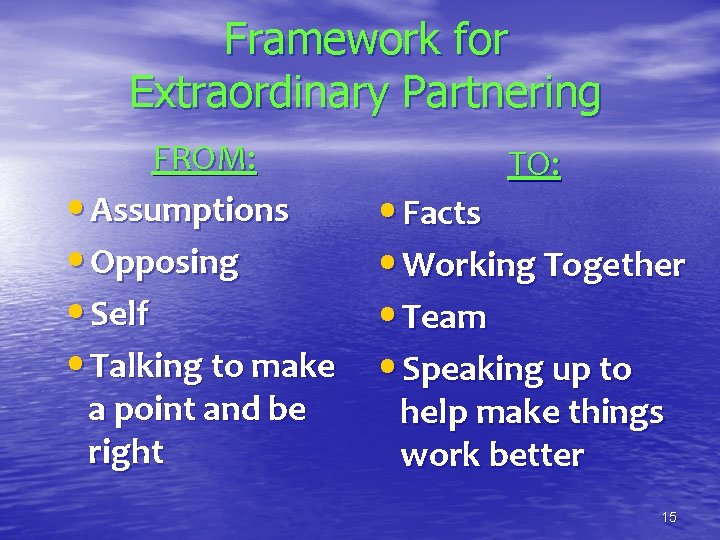
Framework for Extraordinary Partnering FROM: • Assumptions • Opposing • Self • Talking to make a point and be right TO: • Facts • Working Together • Team • Speaking up to help make things work better 15
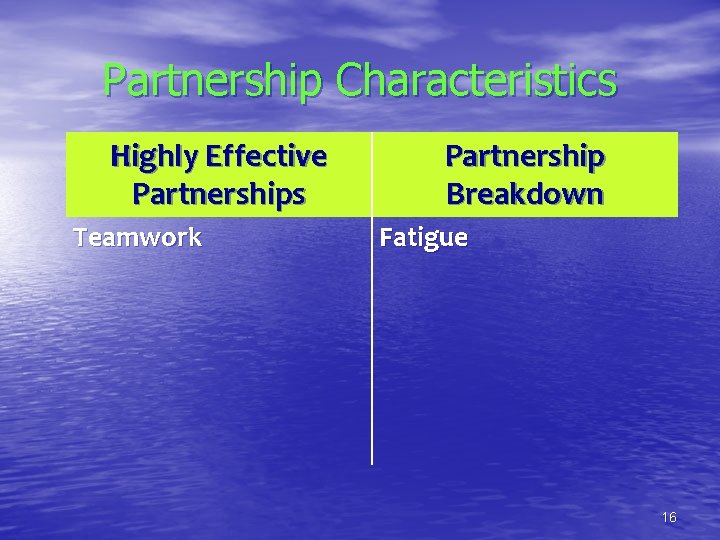
Partnership Characteristics Highly Effective Partnerships Teamwork Partnership Breakdown Fatigue 16
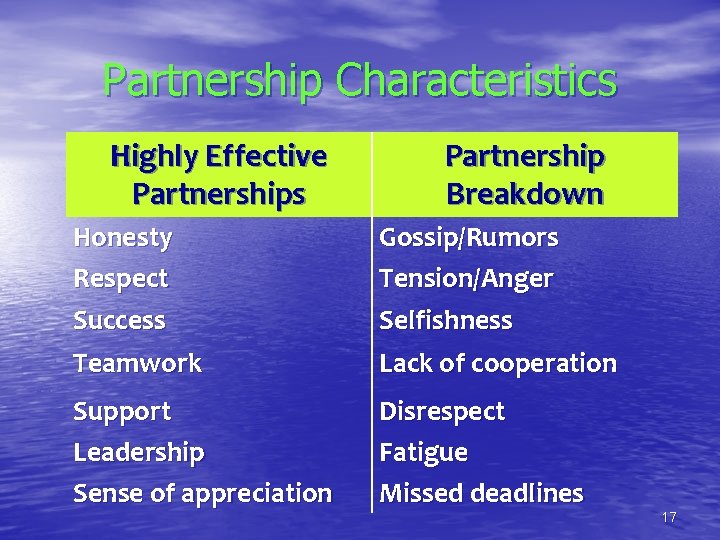
Partnership Characteristics Highly Effective Partnerships Partnership Breakdown Honesty Respect Gossip/Rumors Tension/Anger Success Selfishness Teamwork Lack of cooperation Support Leadership Sense of appreciation Disrespect Fatigue Missed deadlines 17
Contributions to the Game 18
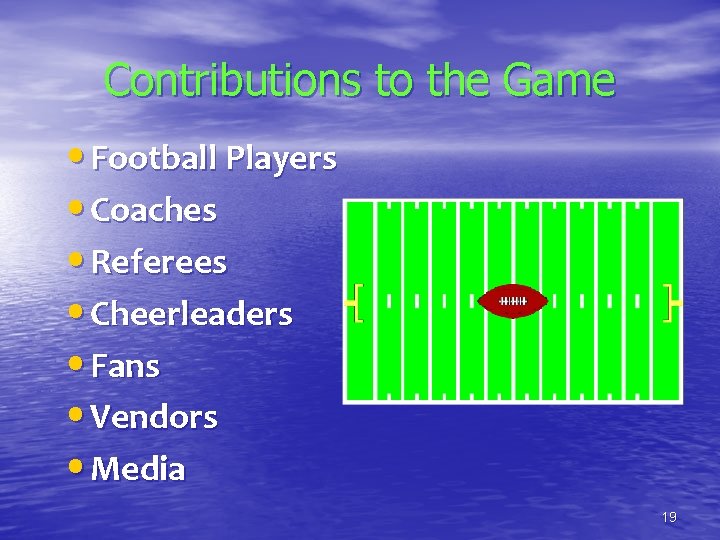
Contributions to the Game • Football Players • Coaches • Referees • Cheerleaders • Fans • Vendors • Media 19
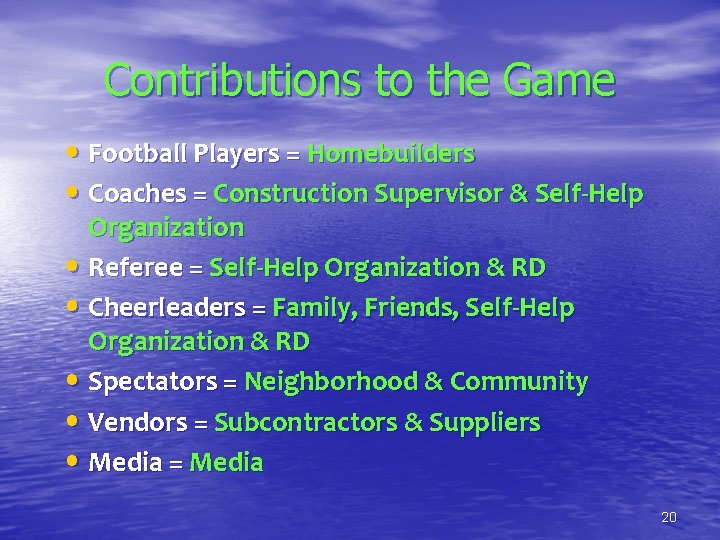
Contributions to the Game • Football Players = Homebuilders • Coaches = Construction Supervisor & Self-Help Organization • Referee = Self-Help Organization & RD • Cheerleaders = Family, Friends, Self-Help Organization & RD • Spectators = Neighborhood & Community • Vendors = Subcontractors & Suppliers • Media = Media 20
Teams – True or False Answer the following true/false questions…. • Team leaders emphasize each member’s involvement and expect that person to take responsibility for his/her contributions. • People are more productive when they feel a sense of ownership of the Task or Group. • Construction Supervisor’s teach skills for home-builders and coach them to apply what has been learned. 21
Teams – True or False Answer the following true/false questions…. • Team leaders emphasize each member’s involvement and expect that person to take responsibility for his/her contributions. True • People are more productive when they feel a sense of ownership of the Task or Group. True • Construction Supervisor’s teach skills for home-builders and coach them to apply what has been learned. True 22
Teams – True or False Answer the following true/false questions…. • Teams are more concerned with getting positive results than they are with “turf” considerations. • Trust is a minor factor in most team situations. • Competition in a team is healthy if it is properly controlled and quickly resolved. 23
Teams – True or False Answer the following true/false questions…. • Teams are more concerned with getting positive results than they are with “turf” considerations. True • Trust is a minor factor in most team situations. False • Competition in a team is healthy if it is properly controlled and quickly resolved. True 24
Teams – True or False Answer the following true/false questions…. • Open communication in a team will promote understanding, a recognition of individual differences and encourage mutual support. • Teams participate in decision making but recognize their Construction Supervisor must act on his or her own if a consensus cannot be reached or there is a crisis. • Successful teams have little need for recognition, acknowledgment or praise. 25
Teams – True or False Answer the following true/false questions…. • Open communication in a team will promote understanding, a recognition of individual differences and encourage mutual support. True • Teams participate in decision making but recognize their Construction Supervisor must act on his or her own if a consensus cannot be reached or there is a crisis. True • Successful teams have little need for recognition, acknowledgment or praise. False 26
Assumptions Lets read this story and decide if the statements on the next screen are True, False or Assumptions: Story 1 You are late one evening and see that the lights are on in your living room. There is only one car parked in front of your house and the words “Harold R. Jones, MD” are spelled in small gold letters across one of the car’s doors. 27
Assumptions 1. The car parked in front of your house has lettering on one of it’s doors. T F ? 2. Someone in your family is sick. T F ? 3. No car is parked in front of your house. T F ? 4. The car parked in front of your house belongs to a man named Jones. T F ? 28
Assumptions 1. The car parked in front of your house has lettering on one of it’s doors. T F ? 2. Someone in your family is sick. T F ? 3. No car is parked in front of your house. T F ? 4. The car parked in front of your house belongs to a man named Jones. T F ? 29
Assumptions Lets read this story and decide if the statements on the next screen are True, False or Assumptions: Story 2 A businessman has just turned off the lights in the store when a man appeared and demanded money. The owner opened the cash register. The contents of the cash register were scooped up and the man dashed away. A member of the police force was promptly notified. 30
Assumptions 1. A man appeared after the owner had turned off the lights in the store. T F ? 2. The robber was a man. T F ? 3. The man did not demand money. T F ? 4. The man who owned the store opened the cash register. T F ? 5. Someone opened the cash register. T F ? 6. While the cash register contained money, the story doesn’t say how much. T F ? 31
Assumptions 1. A man appeared after the owner had turned off the lights in the store. T F ? 2. The robber was a man. T F ? 3. The man did not demand money. T F ? 4. The man who owned the store opened the cash register. T F ? 5. Someone opened the cash register. T F ? 6. While the cash register contained money, the story doesn’t say how much. T F ? 32
Situations Which May Occur During Construction 1. My house was the first one started. It will be the first one finished. T F ? 2. The Construction Supervisor will always be on site when the families are present. T F ? 3. I can contact the sub-contractor to make changes to my home. (i. e. additional outlets, additional lighting, walls moved). T F ? 4. The invoices for materials and work are reviewed by the Construction Supervisor, the bookkeeper and the RD staff, therefore I don’t have to check them to make sure they are right. T F ? 33
Situations Which May Occur During Construction 1. My house was the first one started. It will be the first one finished. T F ? 2. The Construction Supervisor will always be on site when the families are present. T F ? 3. I can contact the sub-contractor to make changes to my home. (i. e. additional outlets, additional lighting, walls moved). T F ? 4. The invoices for materials and work are reviewed by the Construction Supervisor, the bookkeeper and the RD staff, therefore I don’t have to check them to make sure they are right. T F ? 34
Situations Which May Occur During Construction 5. I’ll be working only on my house when I’m on the site. T F ? 6. If I don’t put in my hours, the rest of the families will finish the house. T F ? 7. I have to put in at least 50% of the required hours each week. I can not use all volunteer hours. T F ? 8. Two Homeowners put up siding on one house; so they will be putting up the siding on all the houses. T F ? 9. I can’t see anyone on site so I will go home. No one must be working today. T F ? 35
Situations Which May Occur During Construction 5. I’ll be working only on my house when I’m on the site. T F ? 6. If I don’t put in my hours, the rest of the families will finish the house. T F ? 7. I have to put in at least 50% of the required hours each week. I can not use all volunteer hours. T F ? 8. Two Homeowners put up siding on one house; so they will be putting up the siding on all the houses. T F ? 9. I can’t see anyone on site so I will go home. No one must be working today. T F ? 36
Situations Which May Occur During Construction 10. Our group will always be working on the homes at the same time. T F ? 11. The Construction Supervisor inspects all the delivered materials for damage, therefore I don’t have to. T F ? 12. No one can move into the homes until the entire group is finished on their homes. T F ? 13. If I don’t get it done, the construction supervisor will finish it for me. T F ? 37
Situations Which May Occur During Construction 10. Our group will always be working on the homes at the same time. T F ? 11. The Construction Supervisor inspects all the delivered materials for damage, therefore I don’t have to. T F ? 12. No one can move into the homes until the entire group is finished on their homes. T F ? 13. If I don’t get it done, the construction supervisor will finish it for me. T F ? 38

Communication
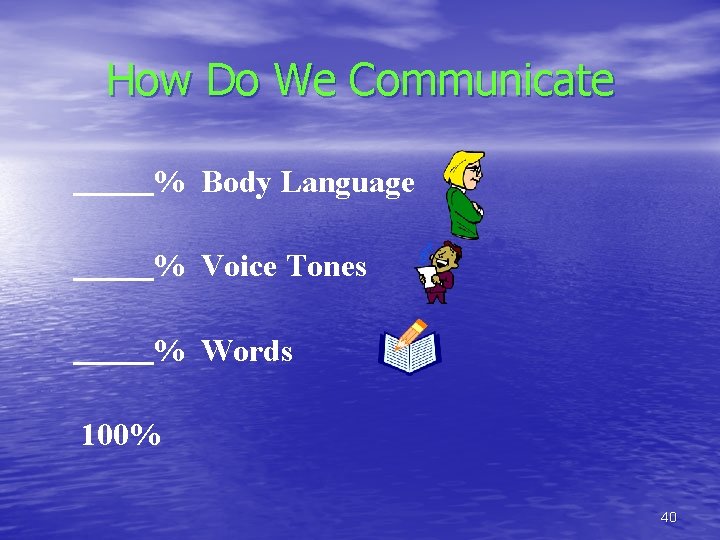
How Do We Communicate % Body Language % Voice Tones % Words 100% 40
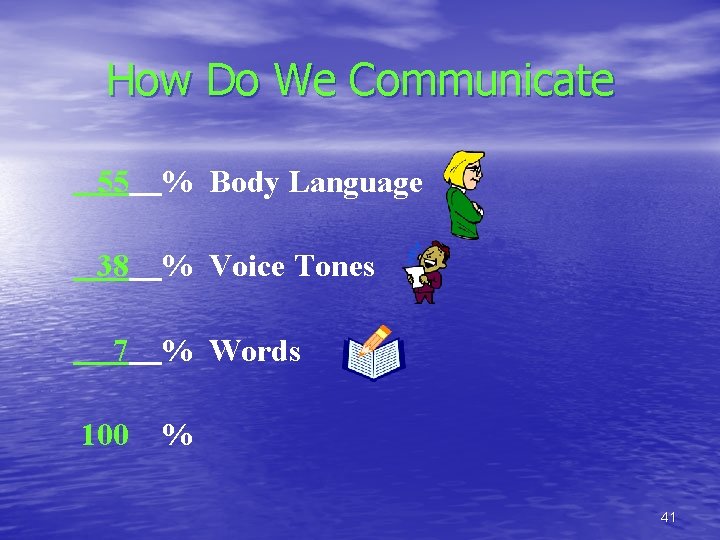
How Do We Communicate 55 % Body Language 38 % Voice Tones 7 % Words 100 % 41
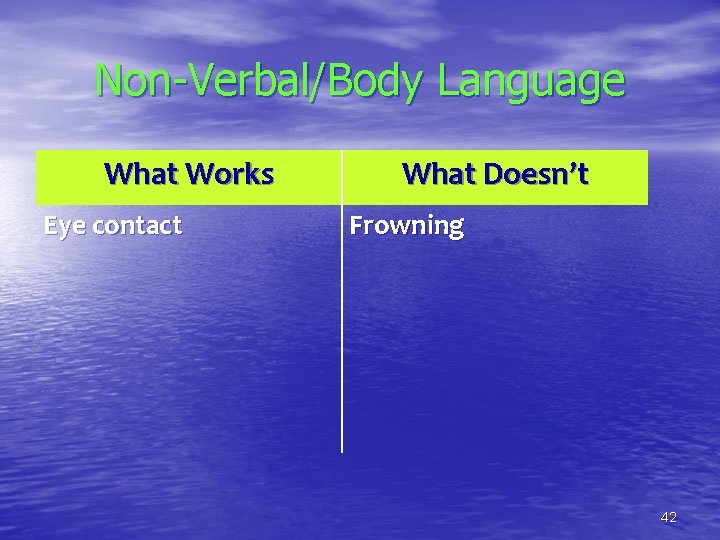
Non-Verbal/Body Language What Works Eye contact What Doesn’t Frowning 42
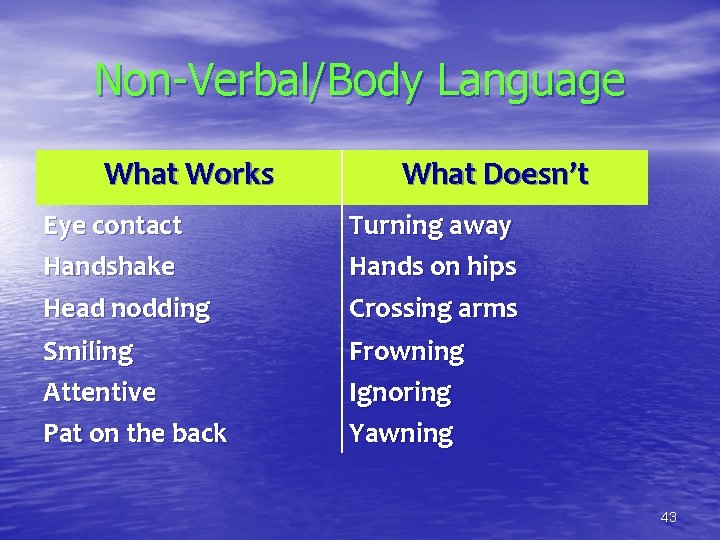
Non-Verbal/Body Language What Works What Doesn’t Eye contact Handshake Turning away Hands on hips Head nodding Crossing arms Smiling Attentive Pat on the back Frowning Ignoring Yawning 43
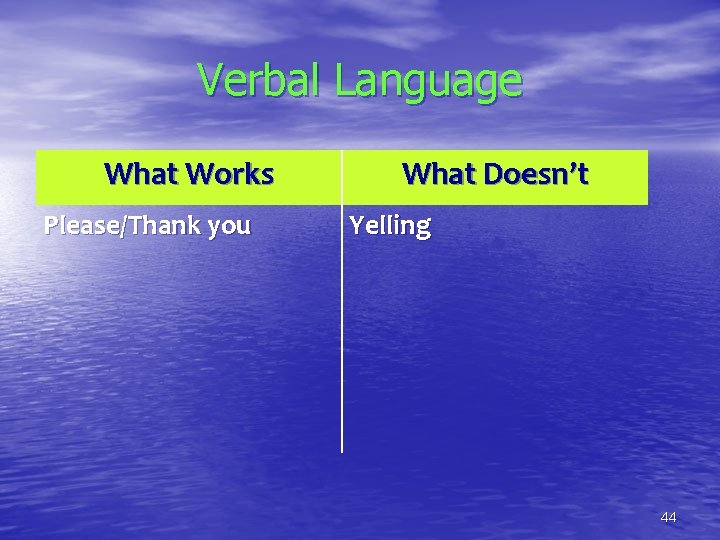
Verbal Language What Works Please/Thank you What Doesn’t Yelling 44
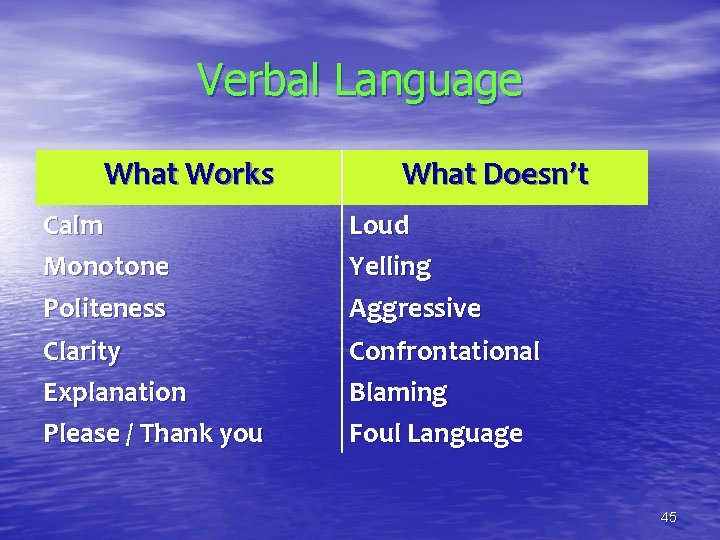
Verbal Language What Works What Doesn’t Calm Monotone Loud Yelling Politeness Aggressive Clarity Explanation Please / Thank you Confrontational Blaming Foul Language 45
Listening “Listening is a rare happening among human beings. You can not listen to the word another is speaking if you are preoccupied with your appearance or with impressing the other, or are trying to decide what you are going to say when the other stops talking, or are debating about whether what is being said is true or relevant or agreeable. Such matters have their place, but only after listening to the word as the word is being uttered. Listening is a primitive art of love in which a person gives him or herself to another’s word, making him or herself accessible and vulnerable to that word. ” William Stringfellow 46
Listening • Ask Yourself: –How do I listen? –What do I listen for? 47
Attitude “The longer I live, the more I realize the impact of attitude on life. Attitude, to me, is more important than facts. It is more important than the past, than education, than money, than circumstances, than failures, than successes, than what other people think or say or do. It is more important than appearance, giftedness or skill. It will make or break a company. . . a church. . . a home. The remarkable thing is we have a choice every day regarding the attitude we will embrace for that day. We cannot change our past. . . we cannot change the fact that people will act in a certain way. We cannot change the inevitable. The only thing we can do is play on the one string we have, and that is our attitude. . . I am convinced that life is 10% what happens to me and 90% how I react to it. And so it is with you. . . we are in charge of our attitudes. ” by Charles Swindoll 48
Issue Dispute Resolution Process “All of the stakeholders in Mutual Self-Help should recognize that honest differences will arise during construction, and that this issue dispute resolution process will provide a satisfying way to address these differences without destroying the partnership. ” Donald E. Pierce Housing Program Director - CO USDA/Rural Development 49
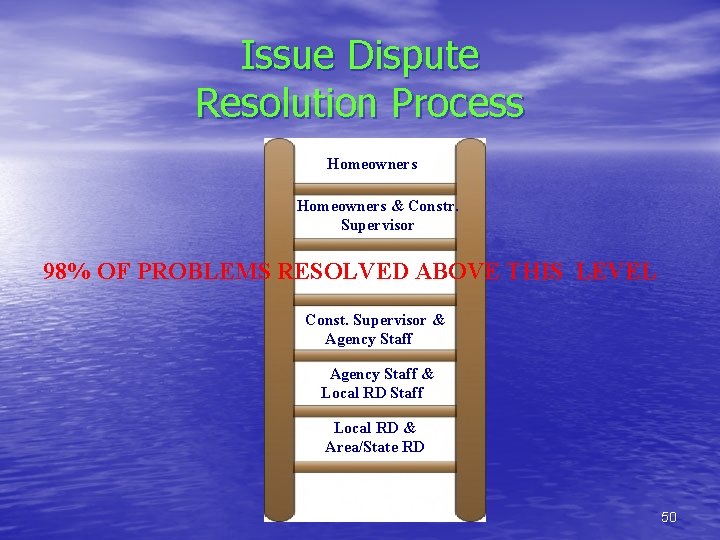
Issue Dispute Resolution Process Homeowners & Constr. Supervisor 98% OF PROBLEMS RESOLVED ABOVE THIS LEVEL Const. Supervisor & Agency Staff & Local RD Staff Local RD & Area/State RD 50
How to Have Difficult Conversations and Create Win-Win Solutions • Stay focused on the problem…NOT the person. • Own your part of the conflict. Do not blame the other person. • Clearly state what you want/need from the other person. • Ask what the other person wants/needs from you. • Seek options. Put away your first choice if necessary and look for new ideas. Brainstorm, writing down all ideas. 51
How to Have Difficult Conversations and Create Win-Win Solutions • Ask clarifying questions. Try to really hear the other’s point of view, not “sell” yours. • Evaluate all options with a plus or minus. Discuss only those options you both agree would be acceptable. • Choose an option and put a new agreement in place. ACT as though you trust the other person. • Set a date to check with the other person to see if the agreed upon solution is working. Used with permission of: The Conflict Center, 4140 Tejon Street, Denver, CO 80211, (303) 43304983, (303) 433 -6166 FAX, email: 52 conflictct@aol. com
Using “I” Messages This is a good technique for defusing anger. Express your concerns in terms of how they affect you…. • I feel. . . – Explain how it makes you feel. • When. . . – Describe what offending behavior makes you feel this way. – when offending behavior makes you feel this way – where offending behavior makes you feel this way • Because. . . – Explain why the offending behavior makes you feel this way. 53
Using “I” Messages By using the following steps, you invite the other party to help you problem solve: 1. Ask the person for their time. Ex. “Do you have a few minutes so that we can talk? Thanks, I appreciate it. ” 2. Describe the offending behavior to them. Ex. “Often you seem to be arriving late at the job site. ” 54
Using “I” Messages 3. Tell them how it makes you feel. Ex. “When you are late to the job site it makes me feel that you aren’t concerned about the rest of us and it makes me angry. ” 4. Ask for a change and brainstorm ideas. ( SOLUTION) Ex. “I think it would be better for all of us if you were to arrive at the agreed upon time. Is there anything I can do to help you make it here on time? What changes could you make in your schedule to make that happen? ” 55
The Home-Building Process • Address homeowner Concerns (very important) • Safety – – Be careful on site and be aware of others Keep the site clean Proper use of tools Wear proper clothing • Work hours, scheduling, and tracking hours worked – Volunteers – Family members, ages • Protect and return unused materials for credit 56
The Home-Building Process • Bill paying process – – Inspect all materials for damage Review bills for accuracy Schedule time to sign checks Don’t sign checks without agreement for purchase • No changes/no upgrades to plans and specs (very important) – Not custom homes • Choices you have to individualize - Floor plan - Paint colors - Floor covering - Cabinets - Light fixtures - Siding - Plumbing fixtures - Countertops - Landscaping 57
The Home-Building Process • Role of the Construction Supervisor – – – Teacher Counselor Problem solver - Mentor - Scheduler - Advisor to contain costs • Subcontractors/Suppliers – Construction Supervisor deals with subcontractors, not the homeowners – Family labor must be accomplished timely so subcontractors are not delayed…. this costs you money • Contingency Fund – Does it go back on the loan, other work? – What if we are over budget? 58
The Home-Building Process • Non-Performance of Mutual Self Help Agreement – – Loss of contingency money, flexibility Asked to leave the program Sell to someone else Liquidation • Moving In – All families move in together, NO exceptions. • Rural Development’s role in the process – – – Review budgets - Dispute resolution Co-sign checks - Loan issues, other than construction Inspections • Testimonies of previous Mutual Self- Help Homeowners (a highlight of Self-Help) 59
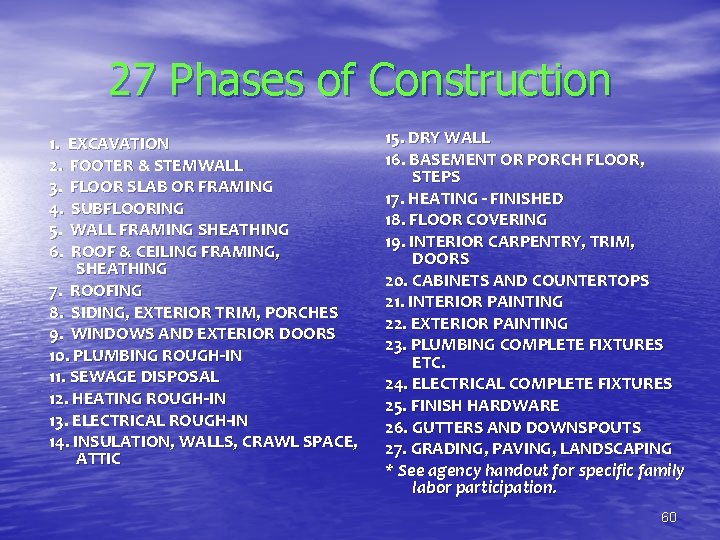
27 Phases of Construction 1. EXCAVATION 2. FOOTER & STEMWALL 3. FLOOR SLAB OR FRAMING 4. SUBFLOORING 5. WALL FRAMING SHEATHING 6. ROOF & CEILING FRAMING, SHEATHING 7. ROOFING 8. SIDING, EXTERIOR TRIM, PORCHES 9. WINDOWS AND EXTERIOR DOORS 10. PLUMBING ROUGH-IN 11. SEWAGE DISPOSAL 12. HEATING ROUGH-IN 13. ELECTRICAL ROUGH-IN 14. INSULATION, WALLS, CRAWL SPACE, ATTIC 15. DRY WALL 16. BASEMENT OR PORCH FLOOR, STEPS 17. HEATING - FINISHED 18. FLOOR COVERING 19. INTERIOR CARPENTRY, TRIM, DOORS 20. CABINETS AND COUNTERTOPS 21. INTERIOR PAINTING 22. EXTERIOR PAINTING 23. PLUMBING COMPLETE FIXTURES ETC. 24. ELECTRICAL COMPLETE FIXTURES 25. FINISH HARDWARE 26. GUTTERS AND DOWNSPOUTS 27. GRADING, PAVING, LANDSCAPING * See agency handout for specific family labor participation. 60
Formalizing the Partnership
Partnering Charter • Creation of a Charter is one of the cornerstones of partnering • It’s a mission statement, a common future, a collaborative formation of mutual goals and objectives created by all stakeholders in a project • Includes a commitment statement for the team to cooperate in all matters affecting the project 62
Partnering Charter • Supported by a series of measurable milestones for success that address teamwork, communication, conflict resolution, performance and results • Outlines the process the team will follow to accomplish building their homes • The Charter’s power stems from the fact that all the stakeholders have signed it as a demonstration of their commitment to the common goals of the partnering team and that they have GIVEN THEIR WORD that they are committed to those goals 63
Partnering Charter * * * * We the partners of the ______Mutual Self-Help Housing Program commit to: Quality construction 64
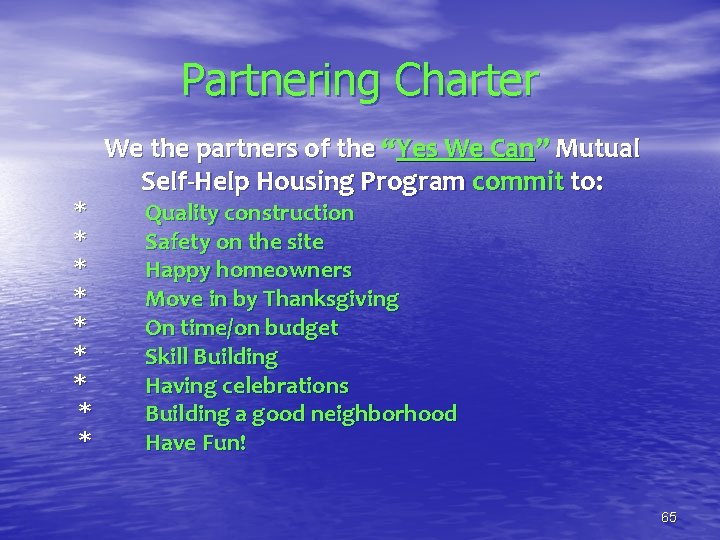
Partnering Charter * * * * * We the partners of the “Yes We Can” Mutual Self-Help Housing Program commit to: Quality construction Safety on the site Happy homeowners Move in by Thanksgiving On time/on budget Skill Building Having celebrations Building a good neighborhood Have Fun! 65
Commitment COMMITMENTS & DECLARATIONS ARE PROMISES THAT…. 1. You intend to keep 2. Are publicly presented 3. Can be stated in specifics (who, what, when, where, and how) ---------------------------------------- • What I Learned Today…. • What I Appreciate About My New Neighbors…. • I Commit To…. 66
Commitment “Commitment is what transforms a promise into reality. It is the words that speak boldly of your intention and the actions which speak louder than the words. It is making time when there is none. Commitment is the stuff character is made of. The power to change the face of things. It is the daily triumph of integrity over skepticism. Coming through time after time. Year after year. Home after home. ” 67
WE ARE A THUNDERSTORM INDIVIDUALLY, WE ARE SINGLE DROPS OF RAIN FALLING SILENTLY INTO THE DUST OFFERING SCANT PROMISE OF MOISTURE TO THE THIRSTY LAND BUT TOGETHER, WE CAN NOURISH THE EARTH AND REVIVE ITS HOPE AND DREAMS TOGETHER WE ARE A THUNDERSTORM Amity Gaige, Copyright, Amity Gaige From the published book, We Are a Thunderstorm Presented to: ___________________ For participation in the Mutual Self-Help Partnering Session ___________ Mutual Self-Help Organization ____________ Rural Development 68
- Slides: 68