
Building Good Will Business Communication Create Goodwill Goodwill

Building Good. Will Business Communication

Create Goodwill � “Goodwill involve showing your audience that you understand care about their needs, concerns, and problems”

Chapter Outline � You-Attitude How to Create You-Attitude Ø You-Attitude Beyond the Sentence Level � Positive Emphasis Ø How to Create Positive Emphasis Ø How to Check Positive Emphasis � Tone, Power, and Politeness � Reducing Bias in Business Communication Ø Making Language Nonsexist Ø Making Language Nonracist and Nonagist Ø Talking about People with Disabilities and Diseases Ø Choosing Bias-Free Photos and Illustrations Ø
You-Attitude � Putting what you want to say in you-attitude is a crucial step both in thinking about your audience’s needs and in communicating your concern to your audience
How to Create You-Attitude � You-attitude is a style of communication that looks at things from the audience’s point of view, emphasizing what the audience wants to know, respecting the audience’s intelligence, and protecting the audience’s ego
To apply you-attitude, use the following five techniques 1. Talk about the audience, not about yourself. 2. Refer to the audience’s request or order specifically. 3. Don’t talk about feelings, except to congratulate or offer sympathy. 4. In positive situations, use you more often than I. Use we when it includes the audience. 5. In negative situations, avoid the word you. Protect the audience’s ego. � Use passive verbs and impersonal expressions to avoid assigning blame.
1. Talk about the audience, not about yourself. � Your audience wants to know how they benefit or are affected. When you provide this information, you make your message more complete and more interesting.
2. Refer to the customer’s request or order specifically � Refer to the customer’s request, order, or policy specifically, not as a generic your order or your policy. � If your customer is an individual or a small business, it’s friendly to specify the content of the order. � If you’re dealing with a company with which you do a great deal of business, give the invoice or purchase order number.
3. Don’t talk about feelings, except to congratulate or offer sympathy. � In most business situations, your feelings are irrelevant and should be omitted. � Your audience doesn’t care whether you’re happy, bored stiff at granting a routine application, or worried about granting so much to someone who barely qualifies. � All your audience cares about is the situation from their point of view.
4. In positive situations, use you more often than I � Talk about the audience, not you or your company. � Most readers are tolerant of the word I in e-mail messages, which seem like conversation. But edit paper documents to use I rarely if at all. I suggests that you’re concerned about personal issues, not about the organization’s problems, needs, and opportunities. � We works well when it includes the reader. Avoid we if it excludes the reader (as it would in a letter to a customer or supplier or as it might in a memo about what we in management want you to do).
5. In negative situations, avoid the word you. � Protect your audience’s ego. � Use passive verbs and impersonal expressions to avoid assigning blame. � When you report bad news or limitations, use a noun for a group of which your audience is a part instead of you so people don’t feel that they’re singled out for bad news.
5. In negative situations, avoid the word you(contd. ) � Use passive verbs and impersonal expressions to avoid blaming people. � Passive verbs describe the action performed on something, without necessarily saying who did it. � Impersonal expressions omit people and talk only about things. In most cases, active verbs are better. But when your audience is at fault, passive verbs may be useful to avoid assigning blame.
Positive Emphasis � Some negatives are necessary. When you have bad news to give—announcements of layoffs, product defects and recalls, price increases— straightforward negatives build credibility � Sometimes negatives are needed to make people take a problem seriously � In some messages, such as disciplinary notices and negative performance appraisals, one of your purposes is to make the problem clear.

Positive Emphasis(contd. ) � Even here, avoid insults or attacks on your audience’s integrity or sanity. Being honest about the drawbacks of a job reduces turnover.
How to Create Positive Emphasis � Create positive emphasis by using the following five techniques: 1. Avoid negative words and words with negative connotations. 2. Focus on what the audience can do rather than on limitations. 3. Justify negative information by giving a reason or linking it to an audience benefit. 4. If the negative is truly unimportant, omit it. 5. Put the negative information in the middle and present it compactly. � Choose the technique that produces the clearest, most accurate sentence.
1. Avoid negative words and words with negative connotations. � There is list of some common negative words. If you find one of these words in a draft, try to substitute a more positive word. � When you must use a negative, use the least negative term that will convey your meaning.
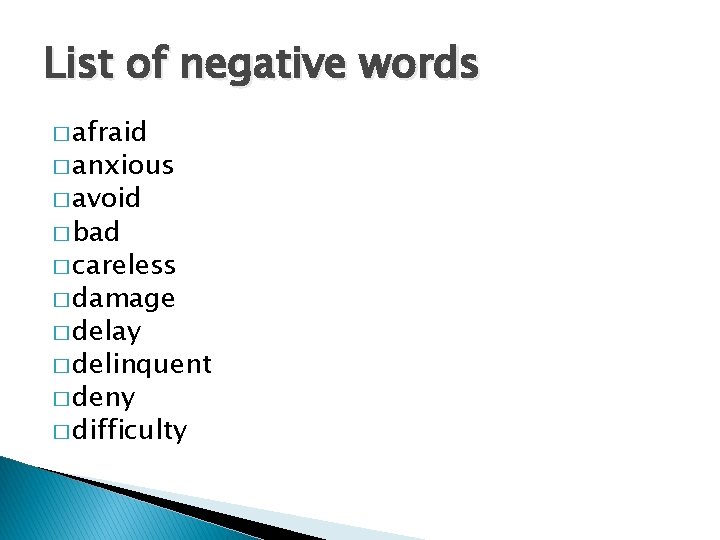
List of negative words � afraid � anxious � avoid � bad � careless � damage � delay � delinquent � deny � difficulty
2. Focus on what the audience can do rather than on limitations. � When there are limits, or some options are closed, focus on the alternatives that remain. � When you have a benefit and a requirement the audience must meet to get the benefit, the sentence is usually more positive if you put the benefit first.
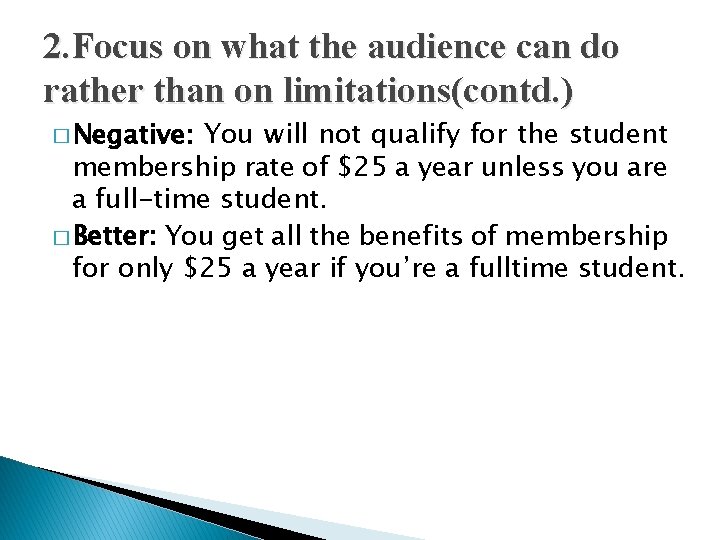
2. Focus on what the audience can do rather than on limitations(contd. ) � Negative: You will not qualify for the student membership rate of $25 a year unless you are a full-time student. � Better: You get all the benefits of membership for only $25 a year if you’re a fulltime student.
3. Justify negative information by giving a reason �A reason can help your audience see that the information is necessary; a benefit can suggest that the negative aspect is outweighed by positive factors. � Be careful, however, to make the logic behind your reason clear and to leave no loopholes
4. If the negative is truly unimportant, omit it � Omit negatives only when • The audience does not need the information to make a decision. • You have already given the audience the information and they have access to the previous communication. • The information is trivial.
5. Put the negative information in the middle and present it compactly � Put negatives at the beginning or end only if you want to emphasize the negative. � To deemphasize a written negative, put it in the middle of a paragraph rather than in the first or last sentence and in the middle of the message rather than in the first or last paragraphs.

Tone, Power, and Politeness � Tone is the implied attitude of the communicator toward the audience. � If the words of a document seem rude, tone is a problem. � Norms(ways of behaving) for politeness are cultural and generational; they also vary from office to office.
Tone, Power, and Politeness(contd. ) � Tone is tricky because it interacts with power. Language that is acceptable within one group may be unacceptable if used by someone outside the group. � Words that might seem friendly from a superior to a subordinate may seem uppity if used by the subordinate to the superior. � Similarly, words that may be neutral among peers may be seen as negative if sent by a superior to subordinate.
Guidelines to achieve the tone you want � Use courtesy titles for people outside your organization whom you don’t know well � Be aware of the power implications of the words you use. Ø “Thank you for your cooperation” is generous coming from a superior to a subordinate; it’s not appropriate in a message to your superior.
Guidelines to achieve the tone you want(contd. ) � When you must give bad news, consider hedging(a way of protecting oneself against financial loss) your statement � When you give bad news to your supervisor, display self-confidence and competency while respecting and being sensitive to your supervisor
Reducing Bias in Business Communication � Bias-free language is language that does not discriminate against people on the basis of sex, physical condition, age, religion or any other category. It includes all readers, helps to sustain goodwill, is fair and friendly, and complies with the law.
Making Language Nonracist and Nonagist � Language is nonracist and nonagist when it treats all races and ages fairly, avoiding negative stereotypes of any group. � Use these guidelines to check for bias in documents you write or edit
Making Language Nonracist and Nonagist(contd. ) � Give someone’s race or age only if it is relevant to your story. � When you do mention these characteristics, give them for everyone in your story—not just the non-Caucasian, non-young-to-middleaged adults you mention
Choosing Bias-Free Photos and Illustrations � When you produce a document with photographs or illustrations, check the visuals for possible bias. � Do they show people of both sexes and all races? � Is there a sprinkling of various kinds of people (younger and older, people using wheelchairs, etc. )? � The photos as a whole do not need to show exactly 50% men and 50% women. But the general impression should suggest that diversity is welcome and normal.
- Slides: 30