
Building foundations in philosophy and getting to know

Building foundations in philosophy and getting to know the lingo.
Lesson objectives l To start to get to grips with the terminology for this chapter. l To understand the basics of the Design / Teleological argument.
Can we prove that God exists? l Can you think of any arguments?
Watch the following clip l What does it suggest about God’s existence?
Philosophy and language l Philosophical arguments are slightly different from ethical arguments (even though, strictly speaking, ethics is a type of philosophy) l Philosophy uses a lot of concepts. These can be difficult to get your head round at first. The words used to describe the concepts can be even trickier.

Key concepts… For this module, here are some concepts you will need to understand: l Inductive/deductive l. A arguments priori/a posteriori knowledge
You will also need to understand… l The use of analogies in philosophical arguments l The meaning of the word telos l What is meant by the terms ‘qua purpose’ & ‘qua regularity’ l What we mean when we talk about a ‘God of the gaps’

Inductive/deductive arguments l. A philosophical argument is not a slanging match, that happens to be about philosophy l Actually it is a sophisticated method used to prove a point l Most arguments use either inductive logic or deductive logic l Here is the difference…
Inductive arguments 1 l These start with known premises (e. g. the world has design features, the world cannot design itself) l By agreeing that the premises are true, a conclusion can be drawn which has new information in it (e. g. God must have designed the world)
Inductive arguments 2 l An inductive argument is one in which the premises are supposed to support the conclusion in such a way that if the premises are true, it is improbable that the conclusion would be false. l Thus, the conclusion follows probably from the premises.
Deductive arguments 1 l These also start with known premises (e. g. all bachelors are male, Colin is a bachelor) l By agreeing that the premises are true, a certain conclusion must follow (e. g. Colin is a male)
Deductive arguments 2 l As you can see, if the premises are true (and they are), then it simply isn't possible for the conclusion to be false. l If you have a deductive argument and you accept the truth of the premises, then you must also accept the truth of the conclusion; if you reject it, then you are rejecting logic itself.
l. A deductive argument is therefore one in which it is impossible for the premises to be true but the conclusion false. l In an inductive argument, the premises may be true, but the conclusion still false. l As you will see, the design argument is an inductive argument.
A priori/a posteriori l. A priori knowledge is what can we can know without any experience of the world l Some argue that maths is a priori. Deductive arguments are definitely a priori. l Some philosophers go as far as to say that God’s existence can be known a priori (i. e. you need never ‘experience’ God to know that he exists)

A priori/a posteriori A posteriori knowledge is what can we can know only by experiencing the world l That snow is white, is something we can only know by experiencing snow and is therefore a posteriori knowledge. That Australia is hot is also a posteriori (you couldn’t know that unless someone had experience of Australia at some point) l Some philosophers go as far as to say that a posteriori knowledge is the only useful knowledge. l

The design argument is inductive and a posteriori l The design argument is a posteriori. It is built on our experiences of the world around us (i. e. that there is evidence of ‘design’ in nature etc) l It is also inductive. The premises that the world seems designed could be true, but it may still be false that God designed it.
The use of analogies in philosophical arguments l An analogy is when you suggest that one thing has a likeness to something else Some analogies could be: l School is like prison. l Miss Ephgrave is like a dragon. You are not saying that the first thing is the same as the second thing, merely that there are strong similarities.
Analogies in the design argument Analogies are useful because they help us to understand concepts or ideas that are otherwise too difficult to describe on their own l Both Aquinas and Paley use analogies in their design arguments. l Aquinas’ analogy is of an archer and an arrow. l Paley’s analogy (that God is like a watchmaker) is perhaps more famous. l
The meaning of the word telos l Telos means ‘goal’, ‘aim’ or ‘purpose’ l The design arguments put forward by philosophers refer to the sense of purpose we can find in nature and biology l They then argue that this purpose must have been put there by God l For this reason, design arguments are also called teleological arguments
What is meant by the terms ‘qua purpose’ & ‘qua regularity’ l Paley argued that God designed the world. l He said the proof was in the sense of purpose or ‘telos’ we discussed earlier, but also in the regularity of nature l By regularity, he meant nature’s ability to order itself with the different aspects of our world working together seamlessly
He therefore argued for l Design qua purpose and l Design qua regularity l This means that the evidence of God designing the world is in both the purposeful nature of the world, and the regularity with which it meets that purpose l Aquinas had also argued for design qua purpose.
What we mean when we talk about a ‘God of the gaps’ l Philosophers of the teleological argument argue that there can be no other explanation for the evidence of design and purpose in the world we live in l They argue that God’s existence must be the only logical conclusion l Critics of the teleological argument say that there may well be gaps in our knowledge of the world but…
God of the gaps l we shouldn’t fill them with GOD! l Some scientists (such as Richard Dawkins) say that using God to plug in the gaps in our knowledge is lazy and unscientific l Instead, we should improve our knowledge through science, not being content to ‘claim’ answers until these answers can be proven empirically*
Is this a God of the gaps? Is using God to explain what we don’t know or understand the best way to move forward? l Many religious believers- and philosophers- take a different point of view. l They argue that the idea of a God is not being ‘used’ for this purpose, but rather, it is the only logical explanation for the phenomena we are trying to explain l In this way, it can be argued that the only gaps that exist are scientific ones, because of science’s refusal to accept alternative explanations for what is beyond human knowledge. l
To conclude l The argument that God designed the world is called the _____ argument or the ________ argument. l As there is more than one version, these are often referred to as design _______ not the design argument.
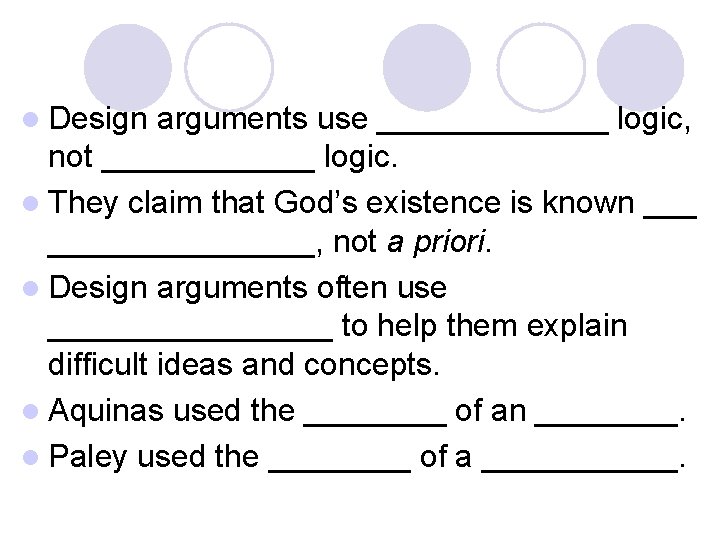
l Design arguments use _______ logic, not ______ logic. l They claim that God’s existence is known _________, not a priori. l Design arguments often use ________ to help them explain difficult ideas and concepts. l Aquinas used the ____ of an ____. l Paley used the ____ of a ______.
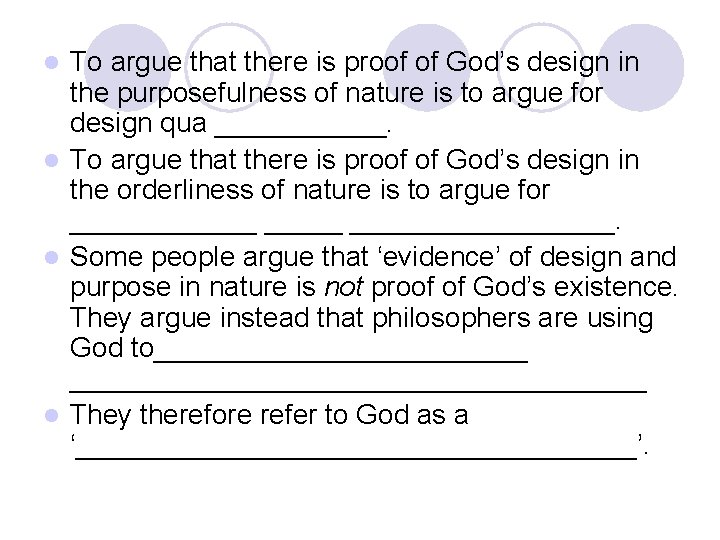
To argue that there is proof of God’s design in the purposefulness of nature is to argue for design qua ______. l To argue that there is proof of God’s design in the orderliness of nature is to argue for ___________. l Some people argue that ‘evidence’ of design and purpose in nature is not proof of God’s existence. They argue instead that philosophers are using God to___________________ l They therefore refer to God as a ‘__________________’. l
- Slides: 27