
Building FiniteState Machines 600 465 Intro to NLP
Building Finite-State Machines 600. 465 - Intro to NLP - J. Eisner 1
Xerox Finite-State Tool § You’ll use it for homework … § Commercial (we have license; open-source clone is Foma) § One of several finite-state toolkits available § This one is easiest to use but doesn’t have probabilities § Usage: § Enter a regular expression; it builds FSA or FST § Now type in input string § FSA: It tells you whether it’s accepted § FST: It tells you all the output strings (if any) § Can also invert FST to let you map outputs to inputs § Could hook it up to other NLP tools that need finitestate processing of their input or output 600. 465 - Intro to NLP - J. Eisner 3
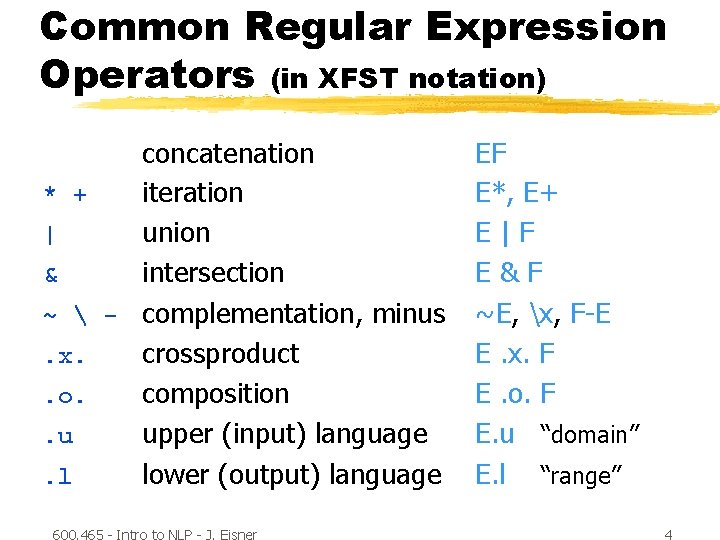
Common Regular Expression Operators (in XFST notation) concatenation * + iteration | union & intersection ~ - complementation, minus. x. crossproduct. o. composition. u upper (input) language. l lower (output) language 600. 465 - Intro to NLP - J. Eisner EF E*, E+ E|F E&F ~E, x, F-E E. x. F E. o. F E. u “domain” E. l “range” 4

Common Regular Expression Operators (in XFST notation) concatenation EF EF = {ef: e E, f F} ef denotes the concatenation of 2 strings. EF denotes the concatenation of 2 languages. § To pick a string in EF, pick e E and f F and concatenate them. § To find out whether w EF, look for at least one way to split w into two “halves, ” w = ef, such that e E and f F. A language is a set of strings. It is a regular language if there exists an FSA that accepts all the strings in the language, and no other strings. If E and F denote regular languages, than so does EF. (We will have to prove this by finding the FSA for EF!) 600. 465 - Intro to NLP - J. Eisner 5
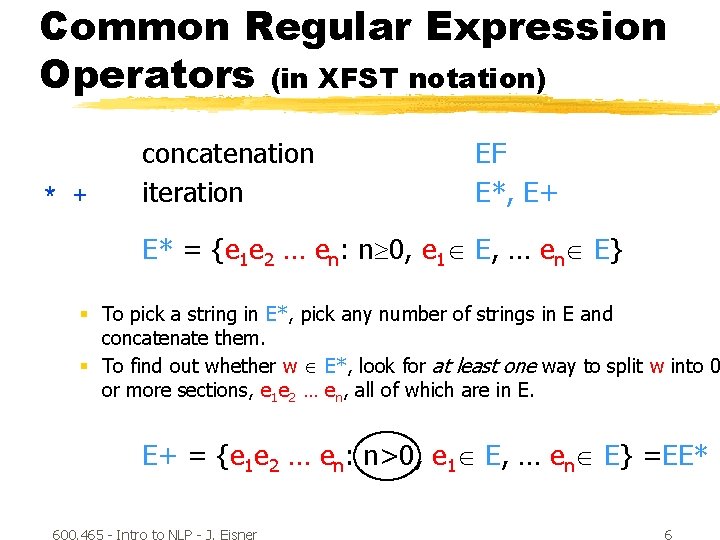
Common Regular Expression Operators (in XFST notation) * + concatenation iteration EF E*, E+ E* = {e 1 e 2 … en: n 0, e 1 E, … en E} § To pick a string in E*, pick any number of strings in E and concatenate them. § To find out whether w E*, look for at least one way to split w into 0 or more sections, e 1 e 2 … en, all of which are in E. E+ = {e 1 e 2 … en: n>0, e 1 E, … en E} =EE* 600. 465 - Intro to NLP - J. Eisner 6
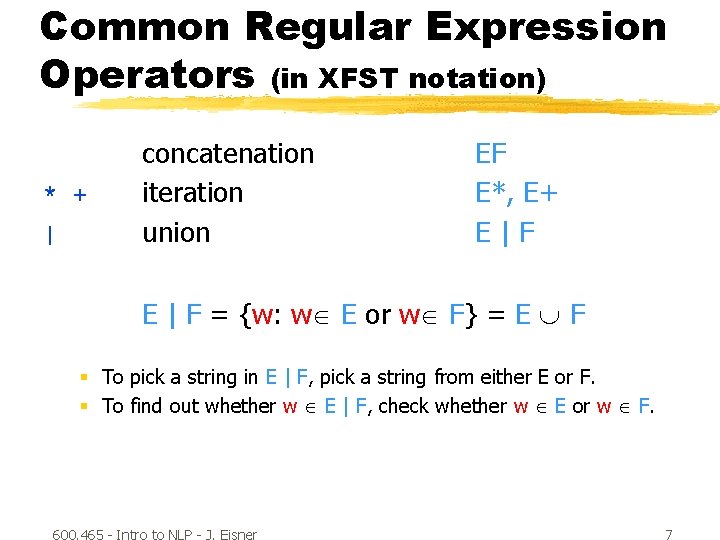
Common Regular Expression Operators (in XFST notation) * + | concatenation iteration union EF E*, E+ E|F E | F = {w: w E or w F} = E F § To pick a string in E | F, pick a string from either E or F. § To find out whether w E | F, check whether w E or w F. 600. 465 - Intro to NLP - J. Eisner 7
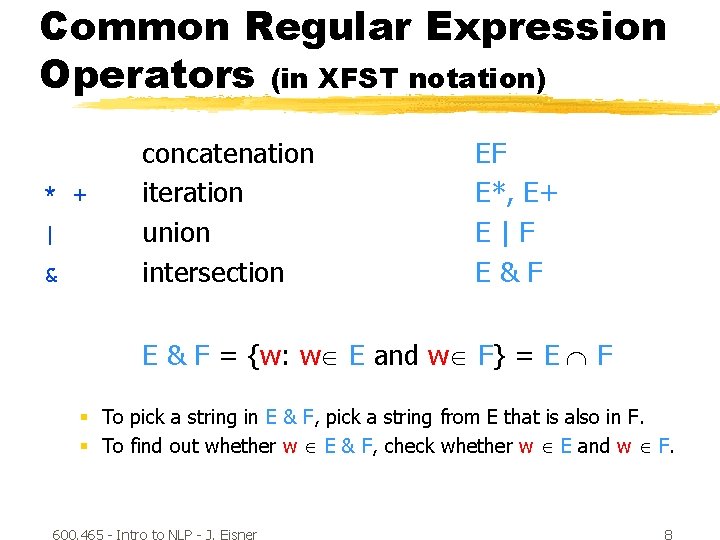
Common Regular Expression Operators (in XFST notation) * + | & concatenation iteration union intersection EF E*, E+ E|F E&F E & F = {w: w E and w F} = E F § To pick a string in E & F, pick a string from E that is also in F. § To find out whether w E & F, check whether w E and w F. 600. 465 - Intro to NLP - J. Eisner 8
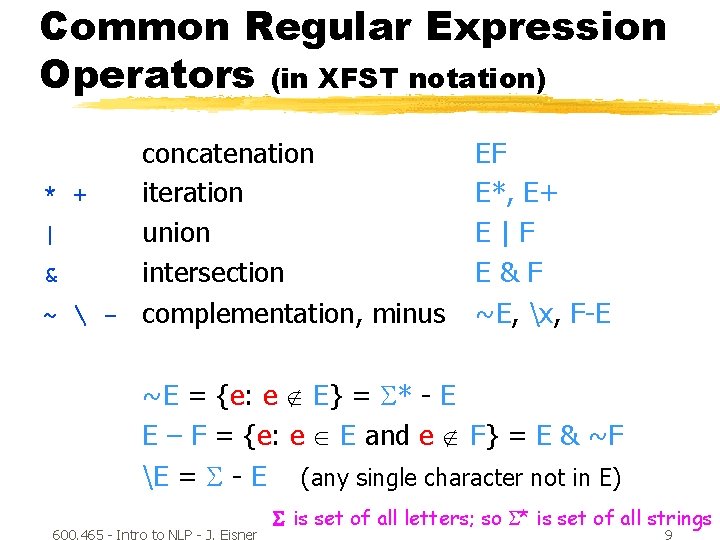
Common Regular Expression Operators (in XFST notation) concatenation * + iteration | union & intersection ~ - complementation, minus EF E*, E+ E|F E&F ~E, x, F-E ~E = {e: e E} = * - E E – F = {e: e E and e F} = E & ~F E = - E (any single character not in E) 600. 465 - Intro to NLP - J. Eisner is set of all letters; so * is set of all strings 9
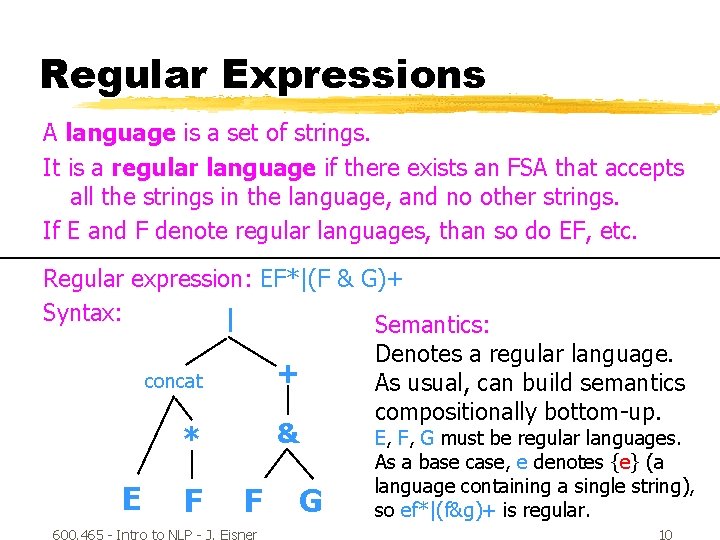
Regular Expressions A language is a set of strings. It is a regular language if there exists an FSA that accepts all the strings in the language, and no other strings. If E and F denote regular languages, than so do EF, etc. Regular expression: EF*|(F & G)+ Syntax: | Semantics: Denotes a regular language. + concat As usual, can build semantics compositionally bottom-up. & * E F F 600. 465 - Intro to NLP - J. Eisner G E, F, G must be regular languages. As a base case, e denotes {e} (a language containing a single string), so ef*|(f&g)+ is regular. 10
Regular Expressions for Regular Relations A language is a set of strings. It is a regular language if there exists an FSA that accepts all the strings in the language, and no other strings. If E and F denote regular languages, than so do EF, etc. A relation is a set of pairs – here, pairs of strings. It is a regular relation if there exists an FST that accepts all the pairs in the language, and no other pairs. If E and F denote regular relations, then so do EF, etc. EF = {(ef, e’f’): (e, e’) E, (f, f’) F} Can you guess the definitions for E*, E+, E | F, E & F when E and F are regular relations? Surprise: E & F isn’t necessarily regular in the case of relations; so not supported. 600. 465 - Intro to NLP - J. Eisner 11
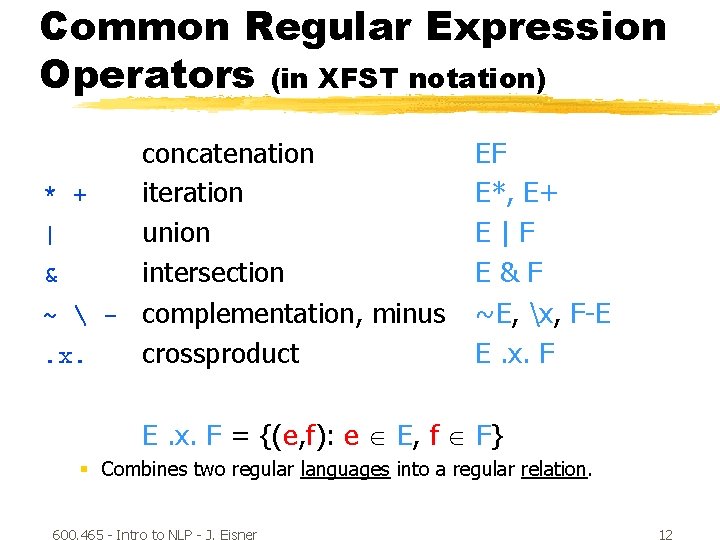
Common Regular Expression Operators (in XFST notation) concatenation * + iteration | union & intersection ~ - complementation, minus. x. crossproduct EF E*, E+ E|F E&F ~E, x, F-E E. x. F = {(e, f): e E, f F} § Combines two regular languages into a regular relation. 600. 465 - Intro to NLP - J. Eisner 12
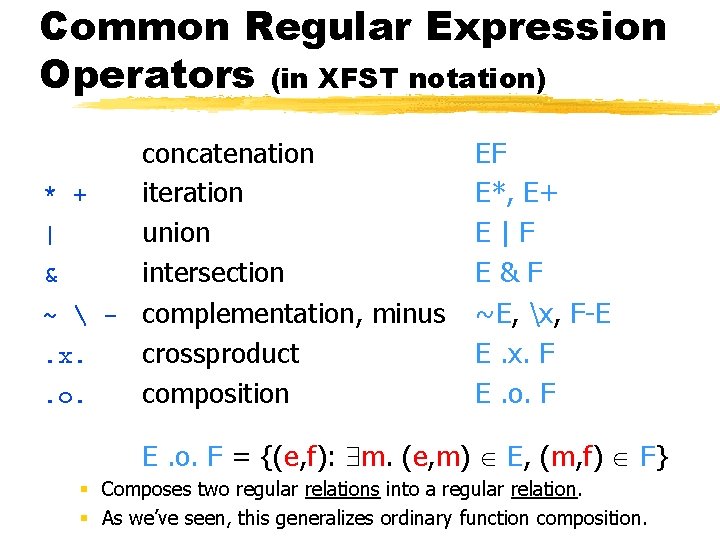
Common Regular Expression Operators (in XFST notation) concatenation * + iteration | union & intersection ~ - complementation, minus. x. crossproduct. o. composition EF E*, E+ E|F E&F ~E, x, F-E E. x. F E. o. F = {(e, f): m. (e, m) E, (m, f) F} § Composes two regular relations into a regular relation. § As we’ve seen, this generalizes ordinary function composition. 600. 465 - Intro to NLP - J. Eisner 13
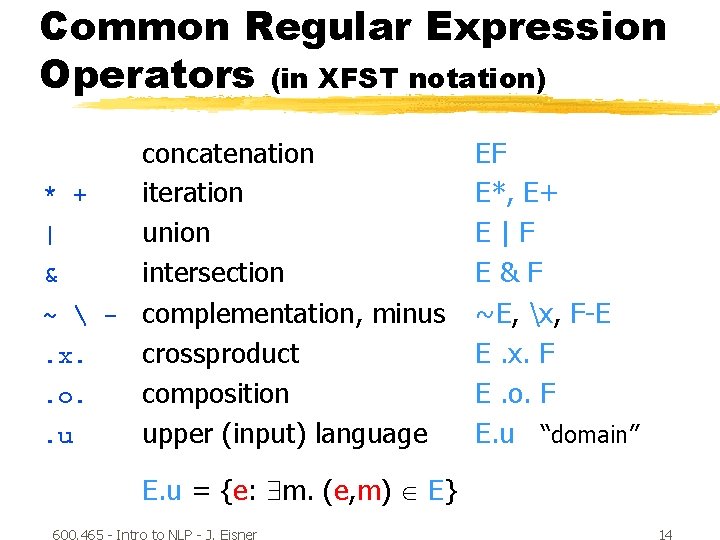
Common Regular Expression Operators (in XFST notation) concatenation * + iteration | union & intersection ~ - complementation, minus. x. crossproduct. o. composition. u upper (input) language EF E*, E+ E|F E&F ~E, x, F-E E. x. F E. o. F E. u “domain” E. u = {e: m. (e, m) E} 600. 465 - Intro to NLP - J. Eisner 14
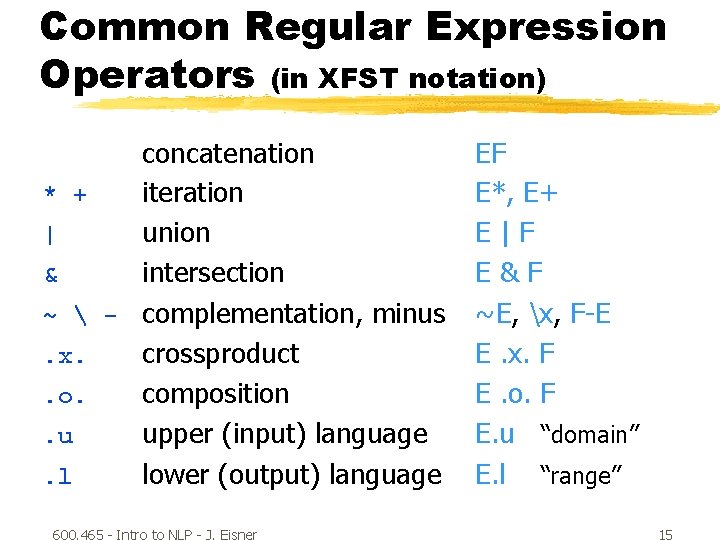
Common Regular Expression Operators (in XFST notation) concatenation * + iteration | union & intersection ~ - complementation, minus. x. crossproduct. o. composition. u upper (input) language. l lower (output) language 600. 465 - Intro to NLP - J. Eisner EF E*, E+ E|F E&F ~E, x, F-E E. x. F E. o. F E. u “domain” E. l “range” 15
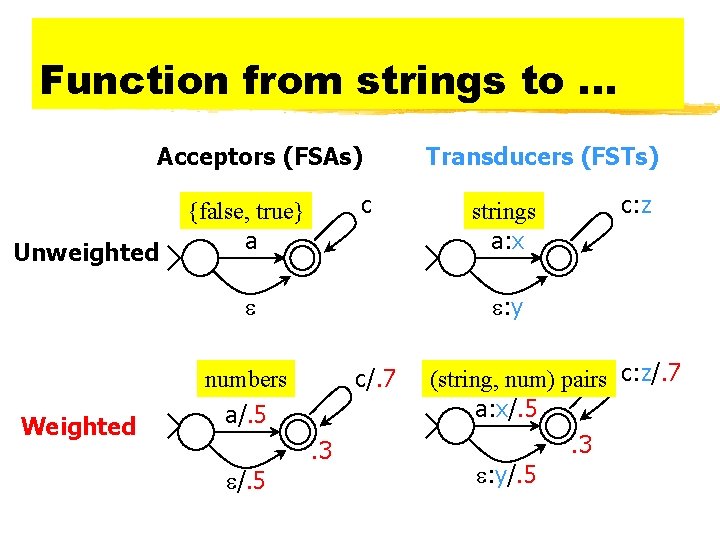
Function from strings to. . . Acceptors (FSAs) Unweighted c {false, true} a c/. 7 a/. 5. 3 /. 5 c: z strings a: x : y numbers Weighted Transducers (FSTs) (string, num) pairs c: z/. 7 a: x/. 5. 3 : y/. 5
![Weighted Relations § If we have a language [or relation], we can ask it:](http://slidetodoc.com/presentation_image_h2/ce6f465150fc23fe1c9500af45f99ecb/image-16.jpg "Weighted Relations § If we have a language [or relation], we can ask it:")
Weighted Relations § If we have a language [or relation], we can ask it: Do you contain this string [or string pair]? § If we have a weighted language [or relation], we ask: What weight do you assign to this string [or string pair]? § Pick a semiring: all our weights will be in that semiring. Just as for parsing, this makes our formalism & algorithms general. The unweighted case is the boolean semring {true, false}. If a string is not in the language, it has weight . If an FST or regular expression can choose among multiple ways to match, use to combine the weights of the different choices. § If an FST or regular expression matches by matching multiple substrings, use to combine those different matches. § Remember, is like “or” and is like “and”! § §
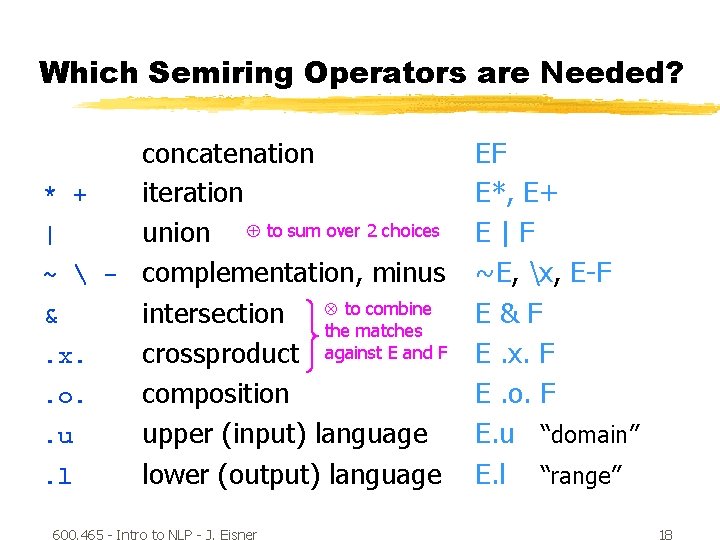
Which Semiring Operators are Needed? concatenation * + iteration | union to sum over 2 choices ~ - complementation, minus & intersection to combine the matches. x. crossproduct against E and F. o. composition. u upper (input) language. l lower (output) language 600. 465 - Intro to NLP - J. Eisner EF E*, E+ E|F ~E, x, E-F E&F E. x. F E. o. F E. u “domain” E. l “range” 18
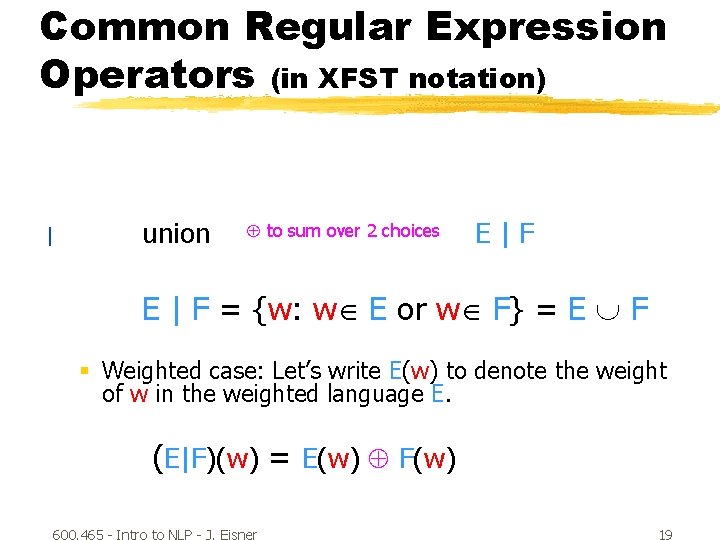
Common Regular Expression Operators (in XFST notation) | union to sum over 2 choices E|F E | F = {w: w E or w F} = E F § Weighted case: Let’s write E(w) to denote the weight of w in the weighted language E. (E|F)(w) = E(w) F(w) 600. 465 - Intro to NLP - J. Eisner 19
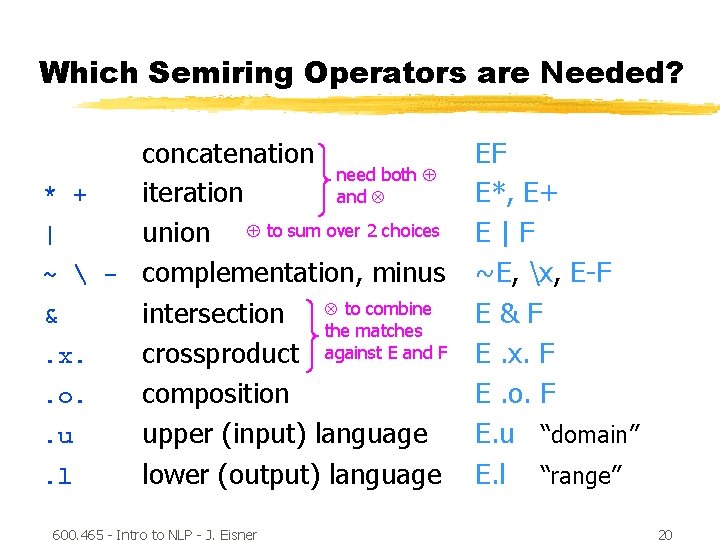
Which Semiring Operators are Needed? concatenation need both * + iteration and | union to sum over 2 choices ~ - complementation, minus & intersection to combine the matches. x. crossproduct against E and F. o. composition. u upper (input) language. l lower (output) language 600. 465 - Intro to NLP - J. Eisner EF E*, E+ E|F ~E, x, E-F E&F E. x. F E. o. F E. u “domain” E. l “range” 20
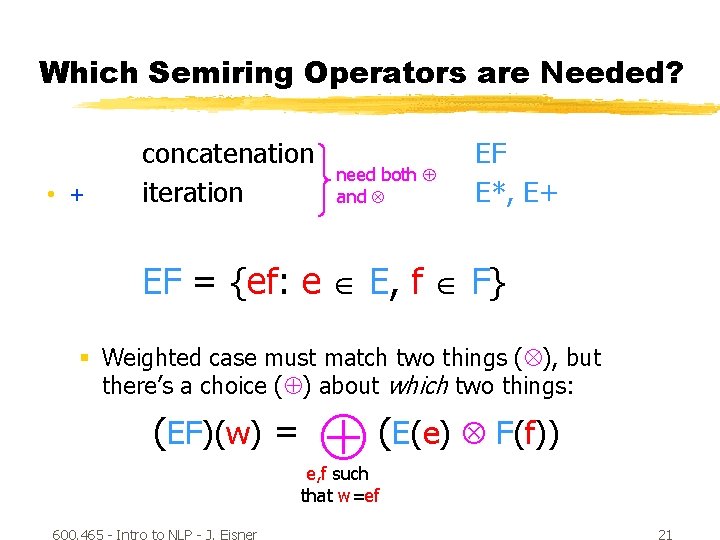
Which Semiring Operators are Needed? • + concatenation iteration need both and EF E*, E+ EF = {ef: e E, f F} § Weighted case must match two things ( ), but there’s a choice ( ) about which two things: (EF)(w) = (E(e) F(f)) e, f such that w=ef 600. 465 - Intro to NLP - J. Eisner 21
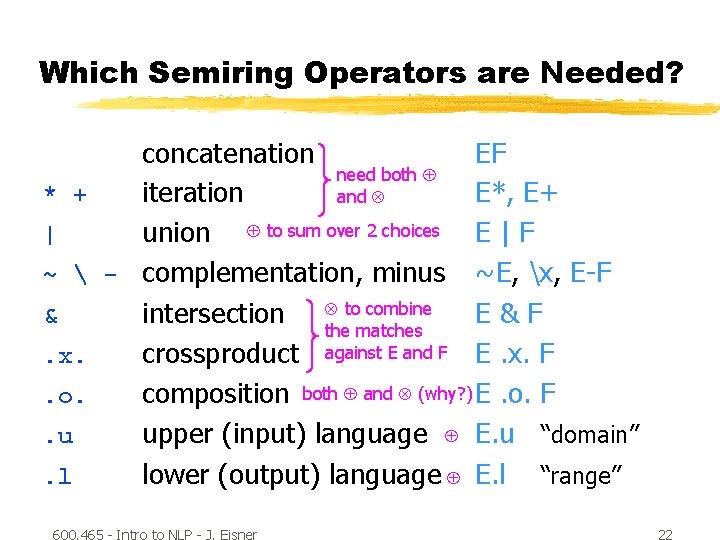
Which Semiring Operators are Needed? concatenation EF need both * + iteration E*, E+ and | union to sum over 2 choices E | F ~ - complementation, minus ~E, x, E-F & intersection to combine E&F the matches. x. crossproduct against E and F E. x. F. o. composition both and (why? ) E. o. F. u upper (input) language E. u “domain”. l lower (output) language E. l “range” 600. 465 - Intro to NLP - J. Eisner 22
![Definition of FSTs § [Red material shows differences from FSAs. ] § Simple view:](http://slidetodoc.com/presentation_image_h2/ce6f465150fc23fe1c9500af45f99ecb/image-22.jpg "Definition of FSTs § [Red material shows differences from FSAs. ] § Simple view:")
Definition of FSTs § [Red material shows differences from FSAs. ] § Simple view: § § § An FST is simply a finite directed graph, with some labels. It has a designated initial state and a set of final states. Each edge is labeled with an “upper string” (in *). Each edge is also labeled with a “lower string” (in *). [Upper/lower are sometimes regarded as input/output. ] Each edge and final state is also labeled with a semiring weight. § § § § a state set Q initial state i set of final states F input alphabet (also define *, +, ? ) output alphabet transition function d: Q x ? --> 2 Q output function s: Q x ? x Q --> ? § More traditional definition specifies an FST via these: 600. 465 - Intro to NLP - J. Eisner 23
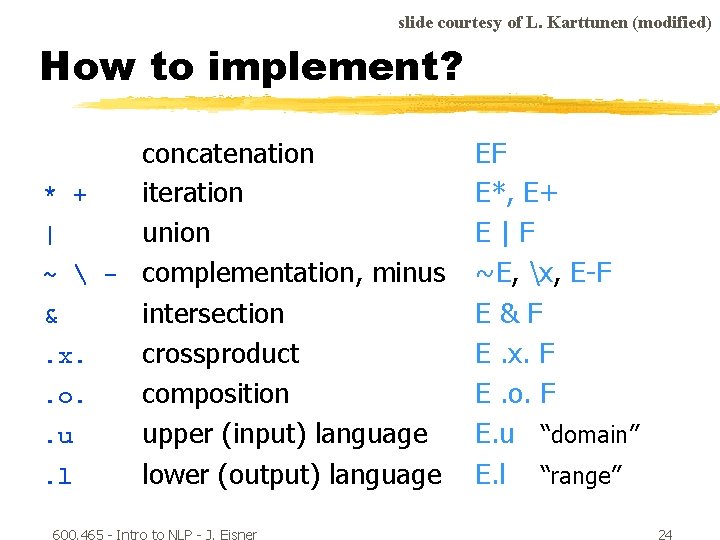
slide courtesy of L. Karttunen (modified) How to implement? concatenation * + iteration | union ~ - complementation, minus & intersection. x. crossproduct. o. composition. u upper (input) language. l lower (output) language 600. 465 - Intro to NLP - J. Eisner EF E*, E+ E|F ~E, x, E-F E&F E. x. F E. o. F E. u “domain” E. l “range” 24
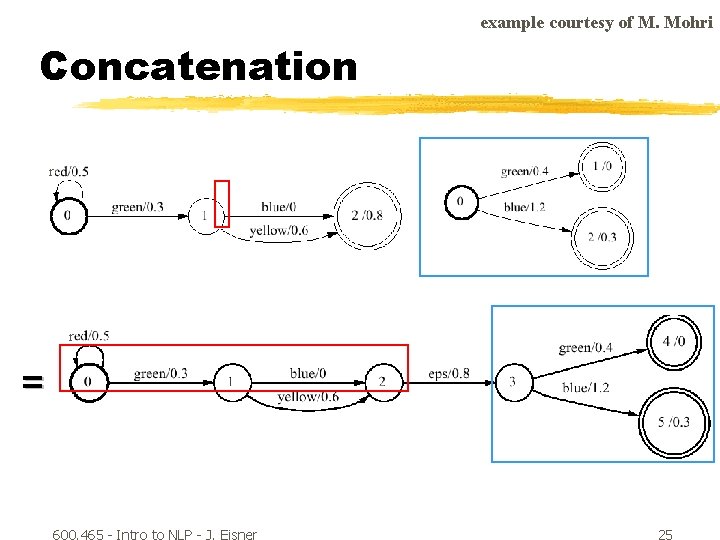
example courtesy of M. Mohri Concatenation r r = 600. 465 - Intro to NLP - J. Eisner 25
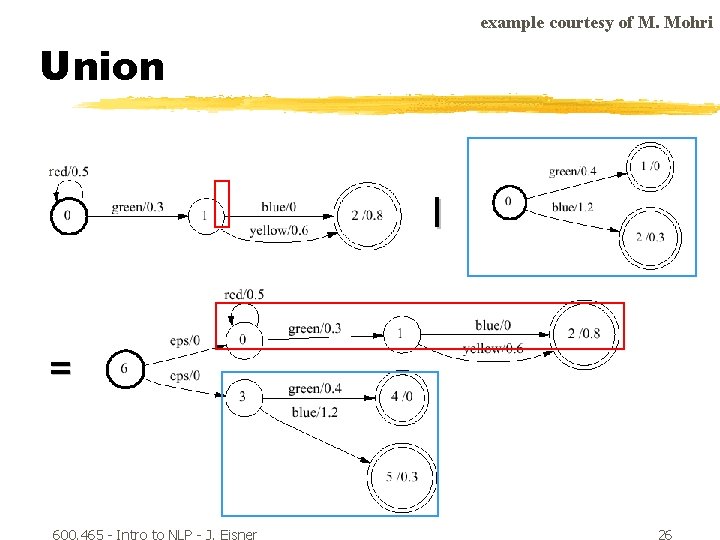
example courtesy of M. Mohri Union r | = 600. 465 - Intro to NLP - J. Eisner 26
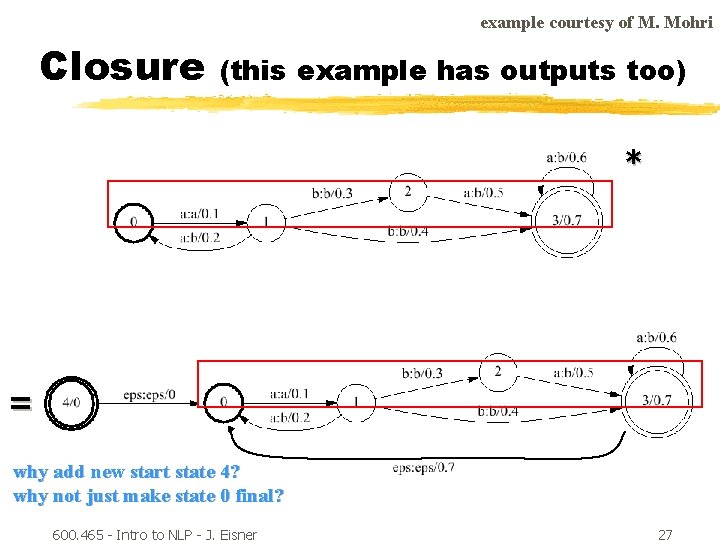
example courtesy of M. Mohri Closure (this example has outputs too) * = why add new start state 4? why not just make state 0 final? 600. 465 - Intro to NLP - J. Eisner 27
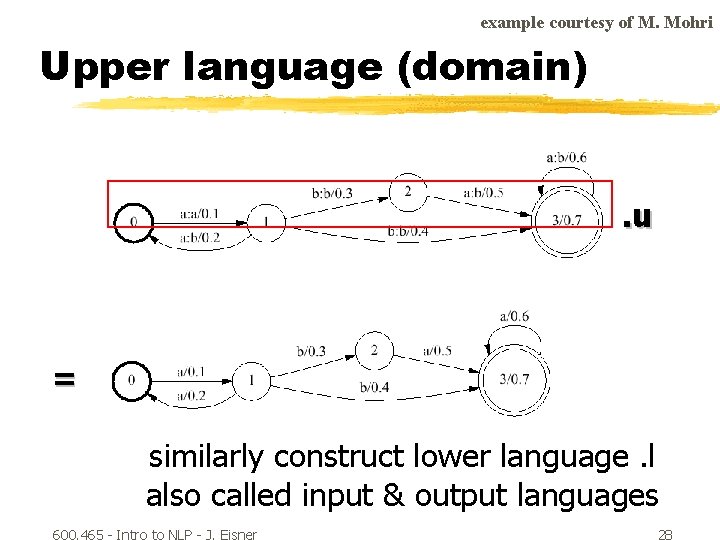
example courtesy of M. Mohri Upper language (domain) . u = similarly construct lower language. l also called input & output languages 600. 465 - Intro to NLP - J. Eisner 28
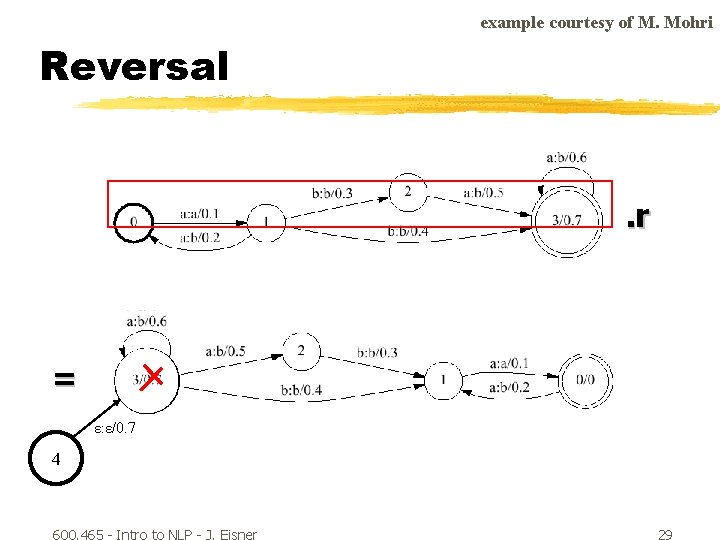
example courtesy of M. Mohri Reversal . r = ε: ε/0. 7 4 600. 465 - Intro to NLP - J. Eisner 29
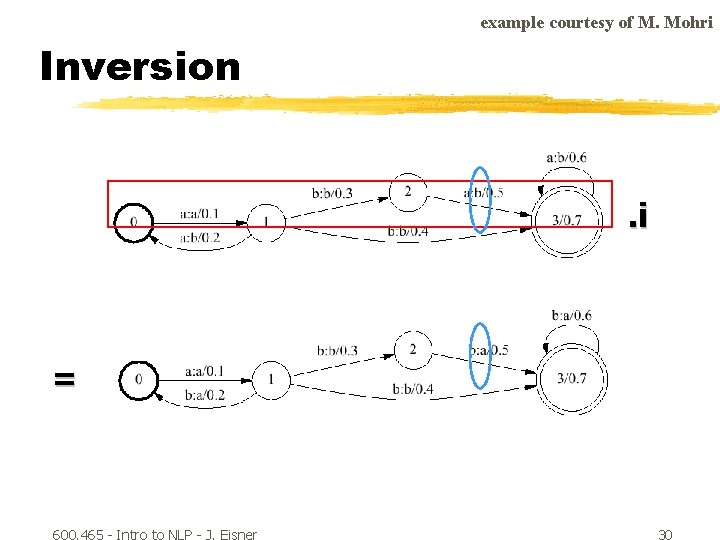
example courtesy of M. Mohri Inversion . i = 600. 465 - Intro to NLP - J. Eisner 30
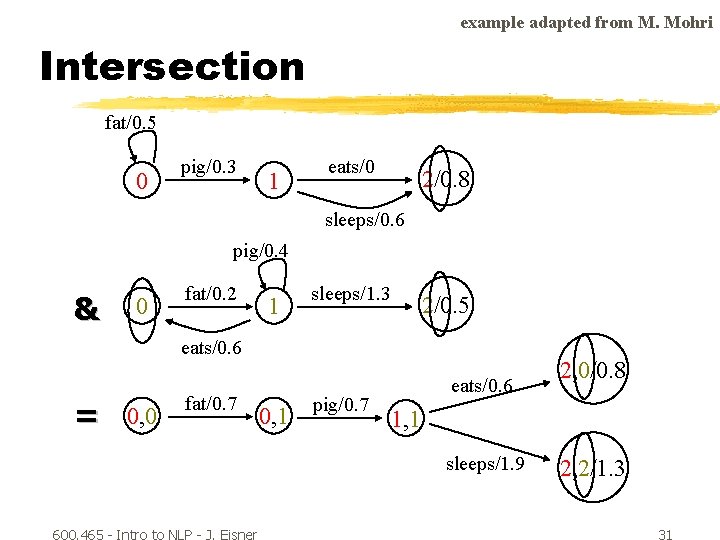
example adapted from M. Mohri Intersection fat/0. 5 0 pig/0. 3 1 eats/0 2/0. 8 sleeps/0. 6 pig/0. 4 & 0 fat/0. 2 1 sleeps/1. 3 2/0. 5 eats/0. 6 = 0, 0 fat/0. 7 0, 1 pig/0. 7 eats/0. 6 1, 1 sleeps/1. 9 600. 465 - Intro to NLP - J. Eisner 2, 0/0. 8 2, 2/1. 3 31
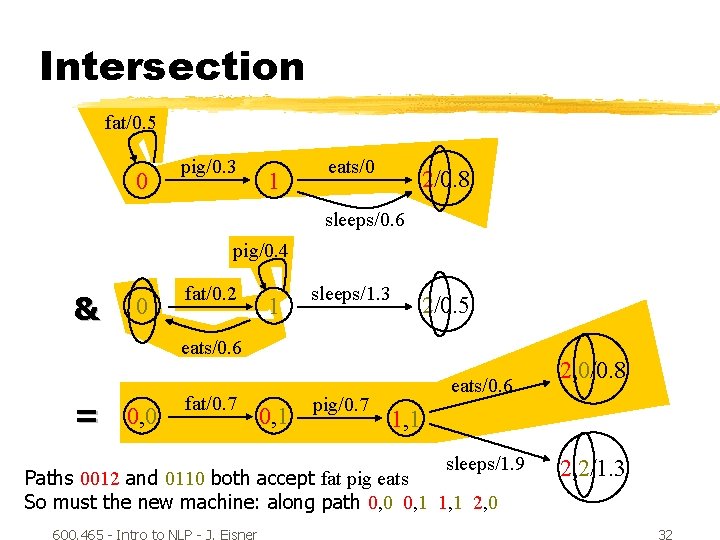
Intersection fat/0. 5 0 pig/0. 3 1 eats/0 2/0. 8 sleeps/0. 6 pig/0. 4 & 0 fat/0. 2 1 sleeps/1. 3 2/0. 5 eats/0. 6 = 0, 0 fat/0. 7 0, 1 pig/0. 7 eats/0. 6 1, 1 sleeps/1. 9 Paths 0012 and 0110 both accept fat pig eats So must the new machine: along path 0, 0 0, 1 1, 1 2, 0 600. 465 - Intro to NLP - J. Eisner 2, 0/0. 8 2, 2/1. 3 32
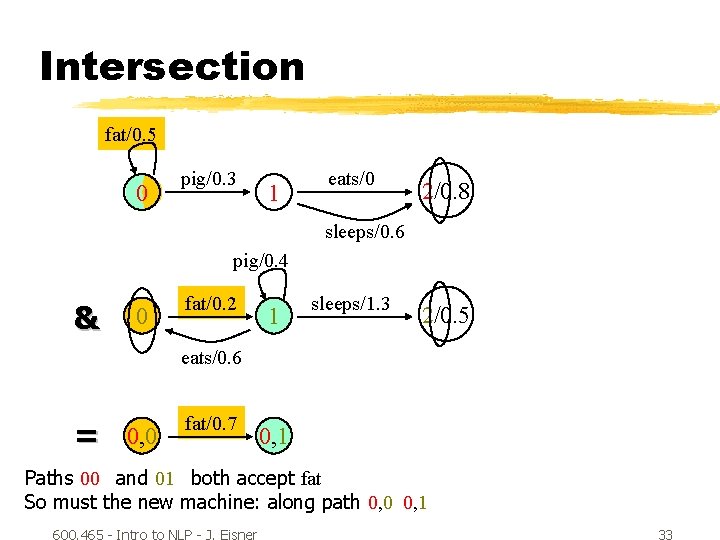
Intersection fat/0. 5 0 pig/0. 3 1 eats/0 2/0. 8 sleeps/0. 6 pig/0. 4 & 0 fat/0. 2 1 sleeps/1. 3 2/0. 5 eats/0. 6 = 0, 0 fat/0. 7 0, 1 Paths 00 and 01 both accept fat So must the new machine: along path 0, 0 0, 1 600. 465 - Intro to NLP - J. Eisner 33
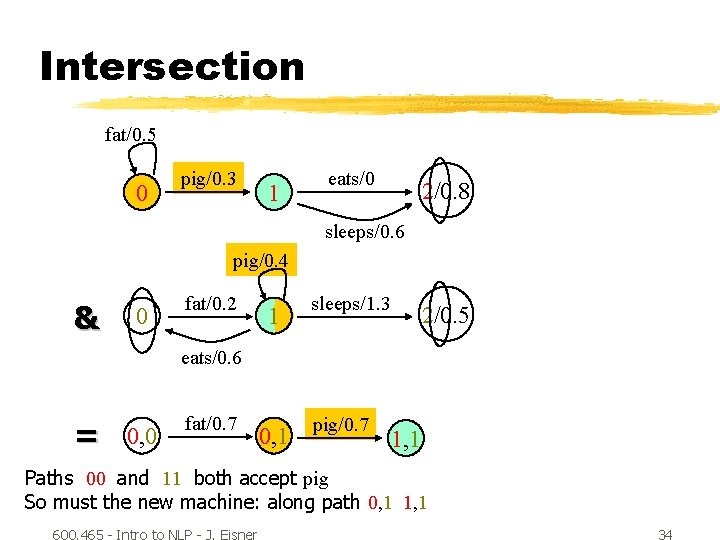
Intersection fat/0. 5 0 pig/0. 3 1 eats/0 2/0. 8 sleeps/0. 6 pig/0. 4 & 0 fat/0. 2 1 sleeps/1. 3 2/0. 5 eats/0. 6 = 0, 0 fat/0. 7 0, 1 pig/0. 7 1, 1 Paths 00 and 11 both accept pig So must the new machine: along path 0, 1 1, 1 600. 465 - Intro to NLP - J. Eisner 34
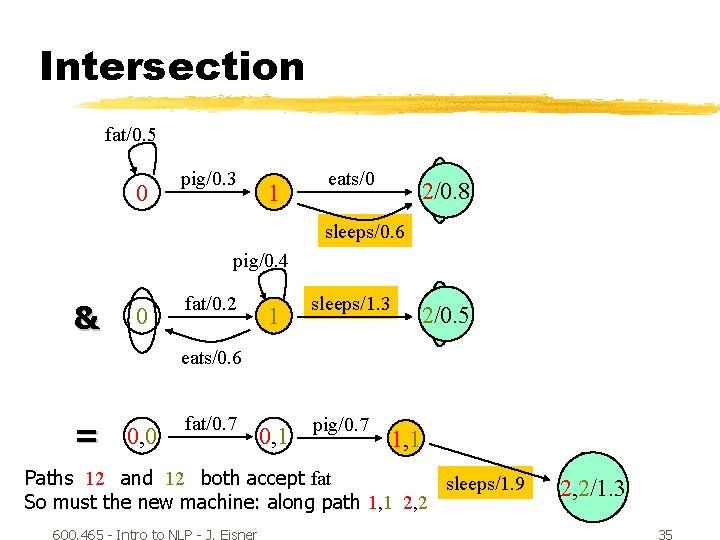
Intersection fat/0. 5 0 pig/0. 3 1 eats/0 2/0. 8 sleeps/0. 6 pig/0. 4 & 0 fat/0. 2 1 sleeps/1. 3 2/0. 5 eats/0. 6 = 0, 0 fat/0. 7 0, 1 pig/0. 7 1, 1 Paths 12 and 12 both accept fat sleeps/1. 9 So must the new machine: along path 1, 1 2, 2 600. 465 - Intro to NLP - J. Eisner 2, 2/1. 3 35
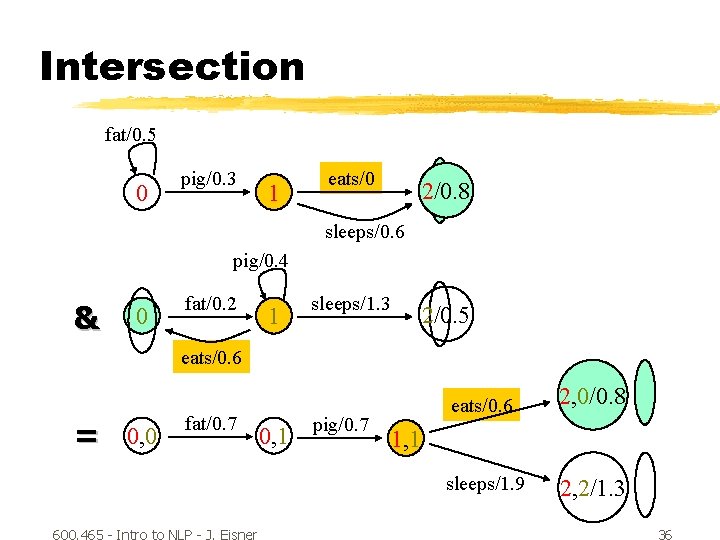
Intersection fat/0. 5 0 pig/0. 3 1 eats/0 2/0. 8 sleeps/0. 6 pig/0. 4 & 0 fat/0. 2 1 sleeps/1. 3 2/0. 5 eats/0. 6 = 0, 0 fat/0. 7 600. 465 - Intro to NLP - J. Eisner 0, 1 pig/0. 7 eats/0. 6 2, 0/0. 8 sleeps/1. 9 2, 2/1. 3 1, 1 36
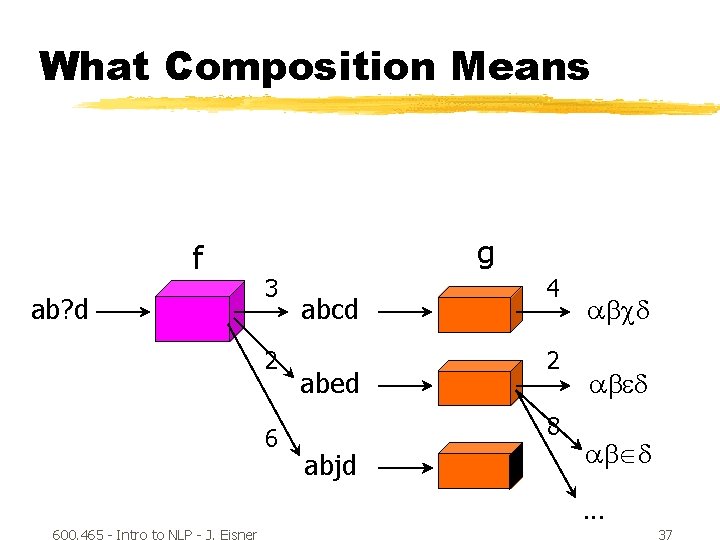
What Composition Means f ab? d g 3 2 6 abcd abed 4 2 8 abjd abcd ab d. . . 600. 465 - Intro to NLP - J. Eisner 37
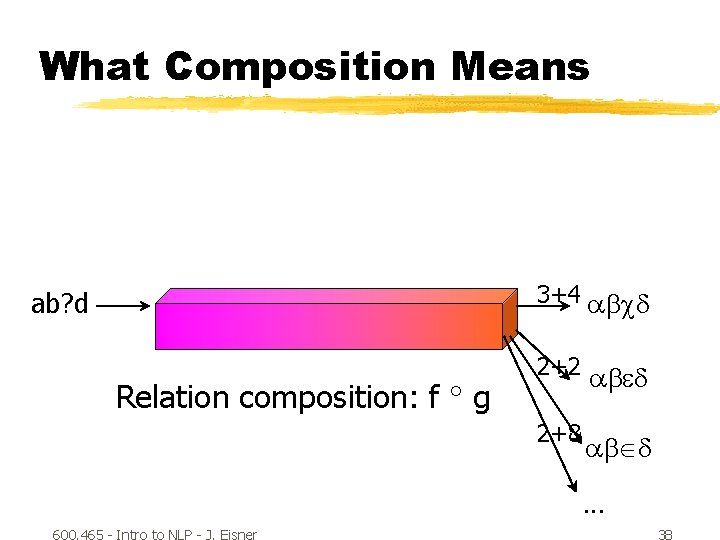
What Composition Means 3+4 abcd ab? d Relation composition: f g 2+2 ab d 2+8 ab d. . . 600. 465 - Intro to NLP - J. Eisner 38
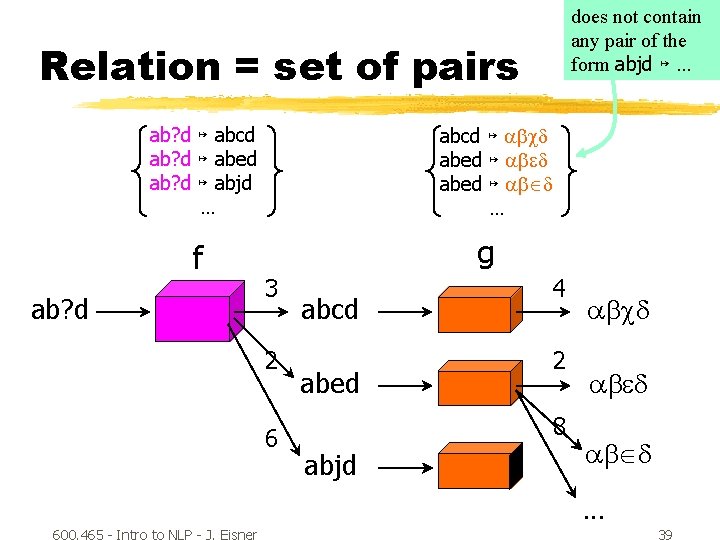
does not contain any pair of the form abjd ↦ … Relation = set of pairs ab? d ↦ abcd ab? d ↦ abed ab? d ↦ abjd … f ab? d abcd ↦ abcd abed ↦ ab d … g 3 2 6 abcd abed 4 2 8 abjd abcd ab d. . . 600. 465 - Intro to NLP - J. Eisner 39
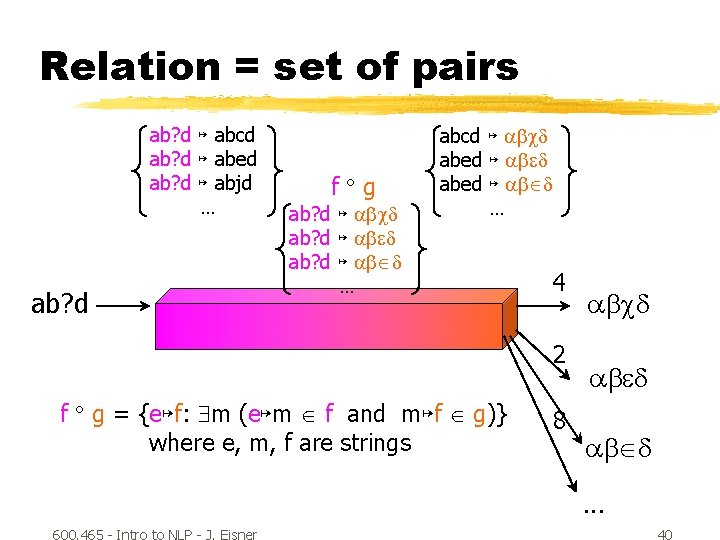
Relation = set of pairs ab? d ↦ abcd ab? d ↦ abed ab? d ↦ abjd … ab? d f g ab? d ↦ abcd ab? d ↦ ab d … abcd ↦ abcd abed ↦ ab d … 4 2 f g = {e↦f: m (e↦m f and m↦f g)} where e, m, f are strings 8 abcd ab d. . . 600. 465 - Intro to NLP - J. Eisner 40
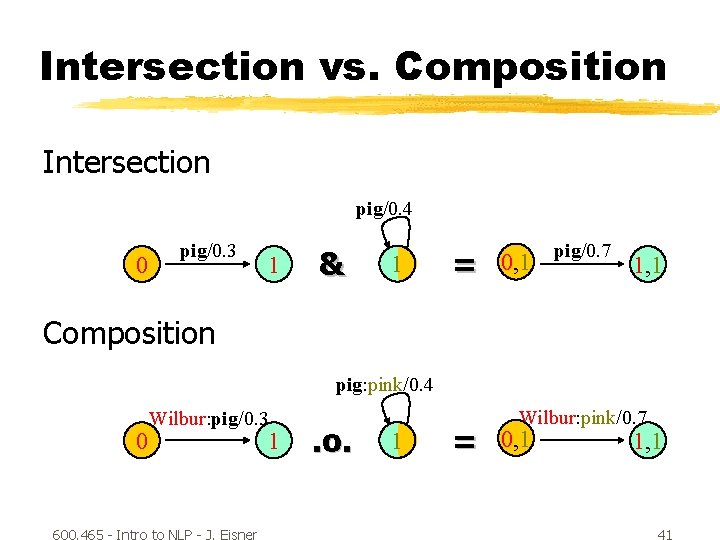
Intersection vs. Composition Intersection pig/0. 4 0 pig/0. 3 1 & 1 = 0, 1 pig/0. 7 1, 1 Composition pig: pink/0. 4 0 Wilbur: pig/0. 3 600. 465 - Intro to NLP - J. Eisner 1 . o. 1 = Wilbur: pink/0. 7 0, 1 1, 1 41
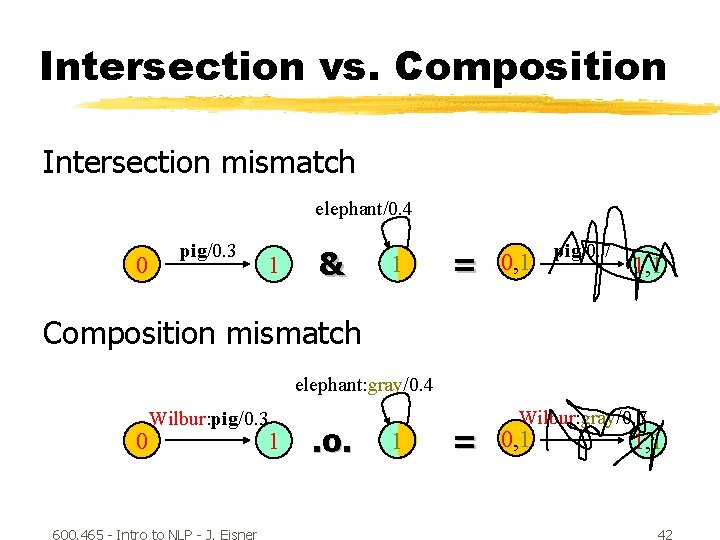
Intersection vs. Composition Intersection mismatch elephant/0. 4 0 pig/0. 3 1 & 1 = 0, 1 pig/0. 7 1, 1 Composition mismatch elephant: gray/0. 4 0 Wilbur: pig/0. 3 600. 465 - Intro to NLP - J. Eisner 1 . o. 1 = Wilbur: gray/0. 7 0, 1 1, 1 42
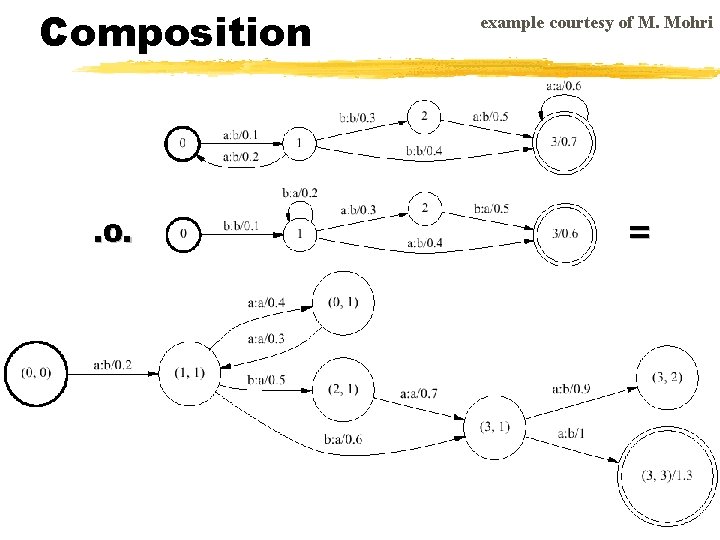
Composition . o. example courtesy of M. Mohri =
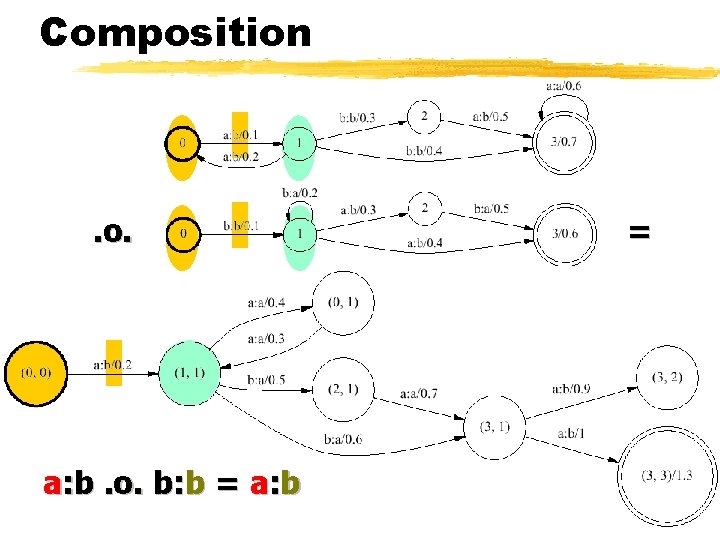
Composition . o. a: b. o. b: b = a: b =
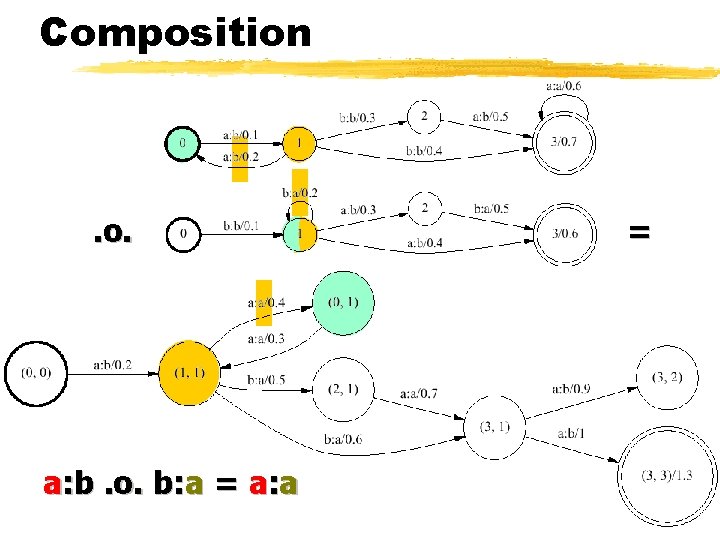
Composition . o. a: b. o. b: a = a: a =
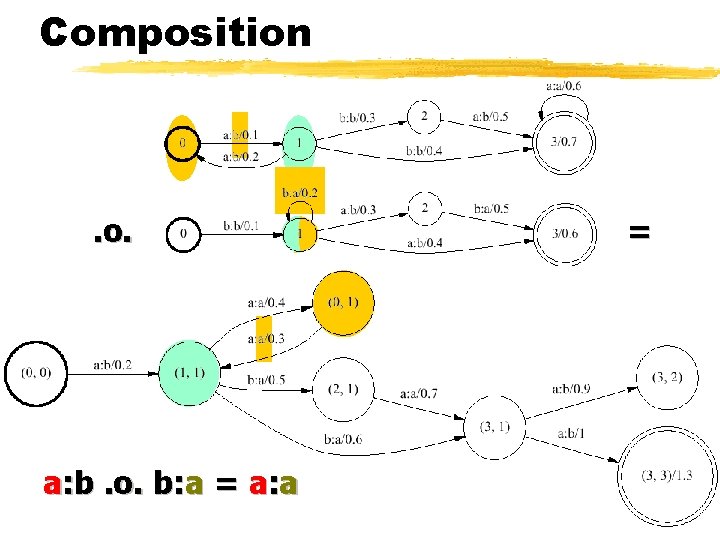
Composition . o. a: b. o. b: a = a: a =
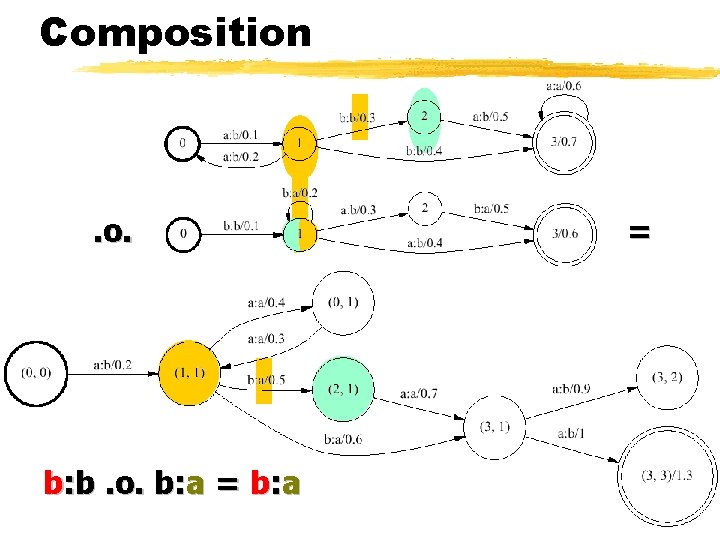
Composition . o. b: b. o. b: a =
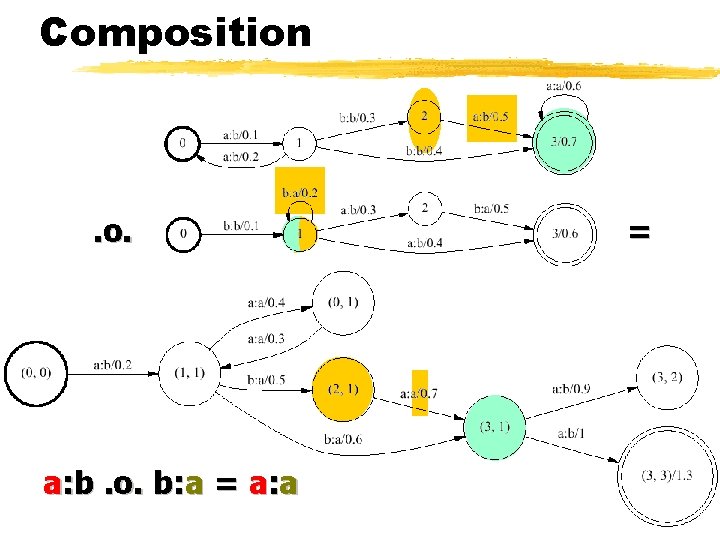
Composition . o. a: b. o. b: a = a: a =
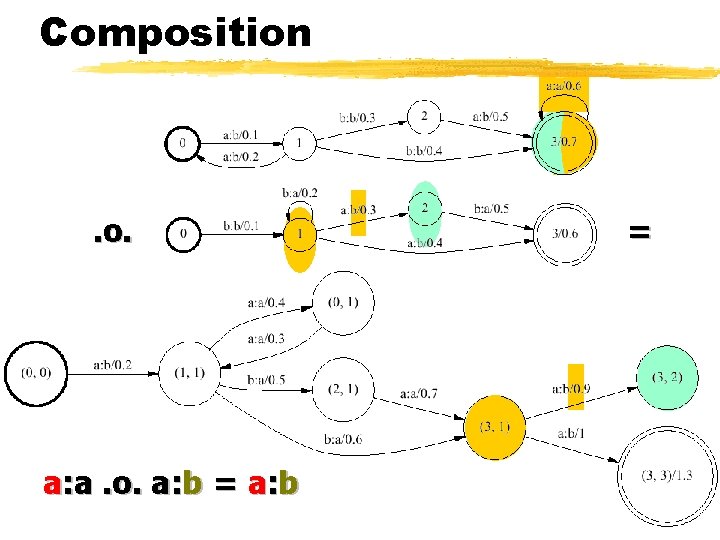
Composition . o. a: a. o. a: b =
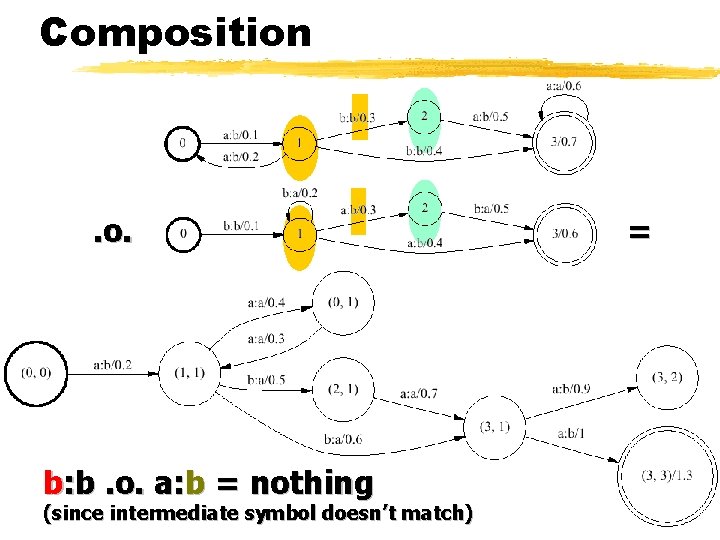
Composition . o. b: b. o. a: b = nothing (since intermediate symbol doesn’t match) =
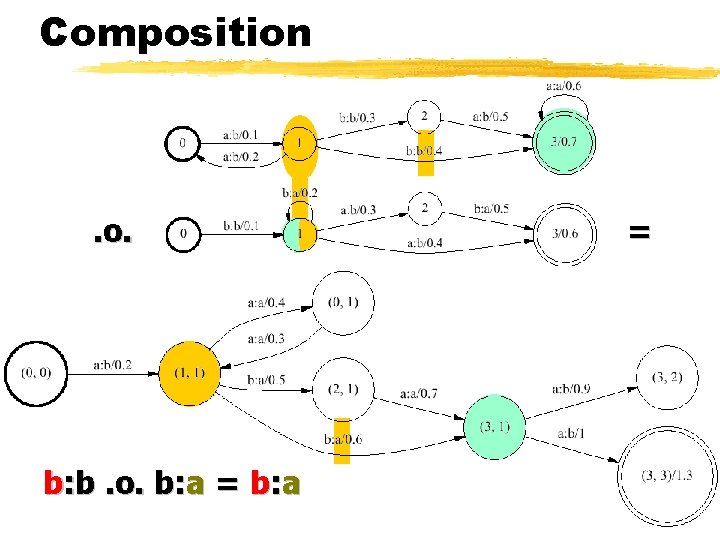
Composition . o. b: b. o. b: a =
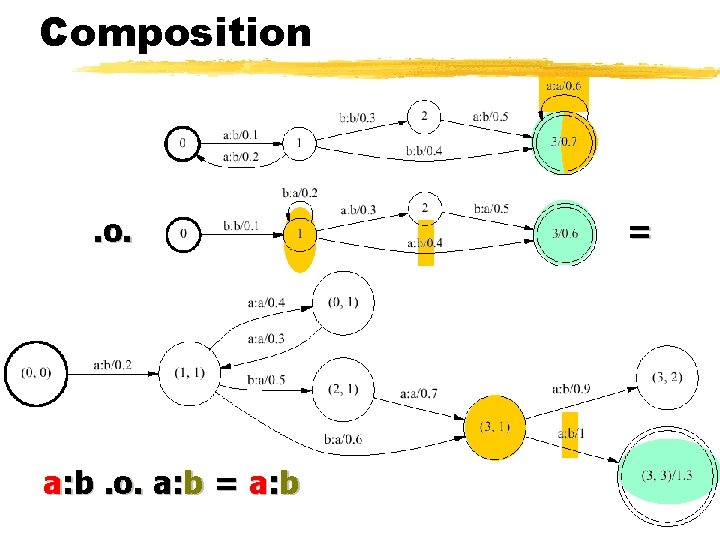
Composition . o. a: b. o. a: b =
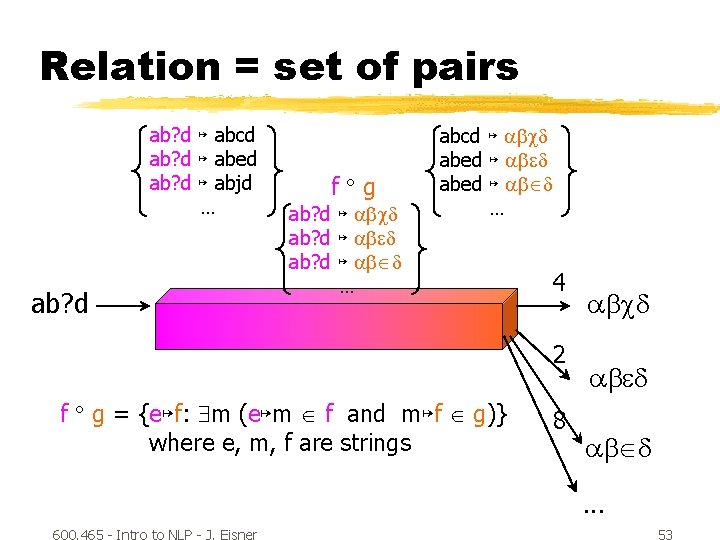
Relation = set of pairs ab? d ↦ abcd ab? d ↦ abed ab? d ↦ abjd … ab? d f g ab? d ↦ abcd ab? d ↦ ab d … abcd ↦ abcd abed ↦ ab d … 4 2 f g = {e↦f: m (e↦m f and m↦f g)} where e, m, f are strings 8 abcd ab d. . . 600. 465 - Intro to NLP - J. Eisner 53
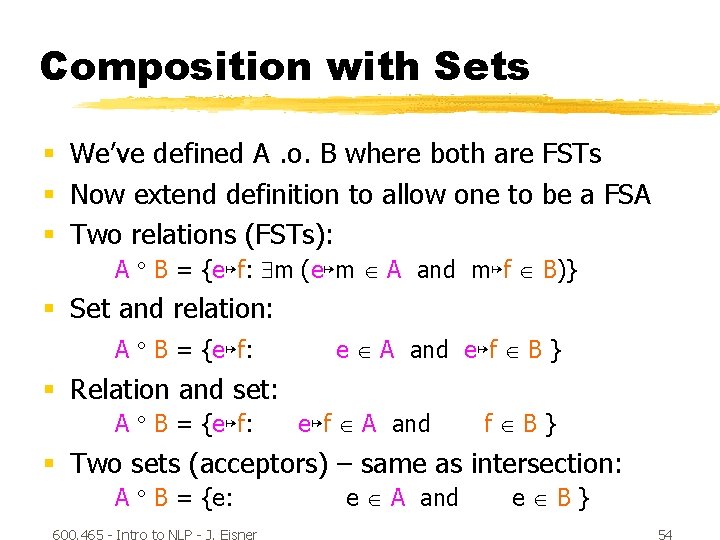
Composition with Sets § We’ve defined A. o. B where both are FSTs § Now extend definition to allow one to be a FSA § Two relations (FSTs): A B = {e↦f: m (e↦m A and m↦f B)} § Set and relation: A B = {e↦f: e A and e↦f B } § Relation and set: A B = {e↦f: e↦f A and f B} § Two sets (acceptors) – same as intersection: A B = {e: 600. 465 - Intro to NLP - J. Eisner e A and e B} 54
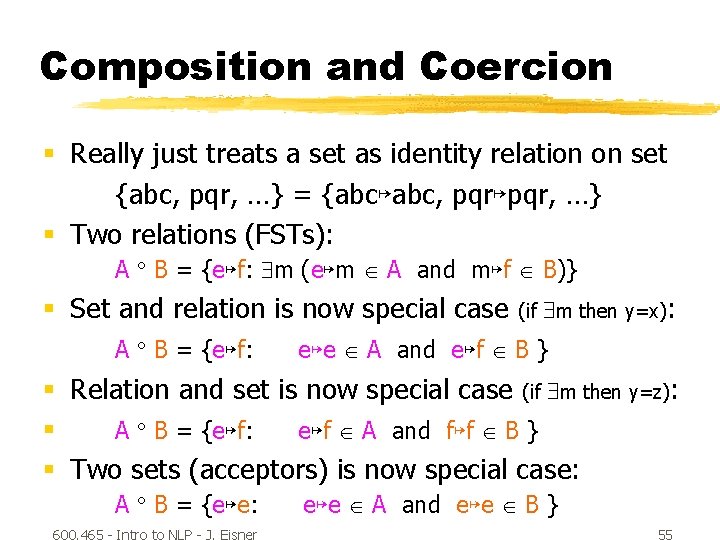
Composition and Coercion § Really just treats a set as identity relation on set {abc, pqr, …} = {abc↦abc, pqr↦pqr, …} § Two relations (FSTs): A B = {e↦f: m (e↦m A and m↦f B)} § Set and relation is now special case A B = {e↦f: (if m then y=x): e↦e A and e↦f B } § Relation and set is now special case (if m then y=z): § A B = {e↦f: e↦f A and f↦f B } § Two sets (acceptors) is now special case: A B = {e↦e: 600. 465 - Intro to NLP - J. Eisner e↦e A and e↦e B } 55
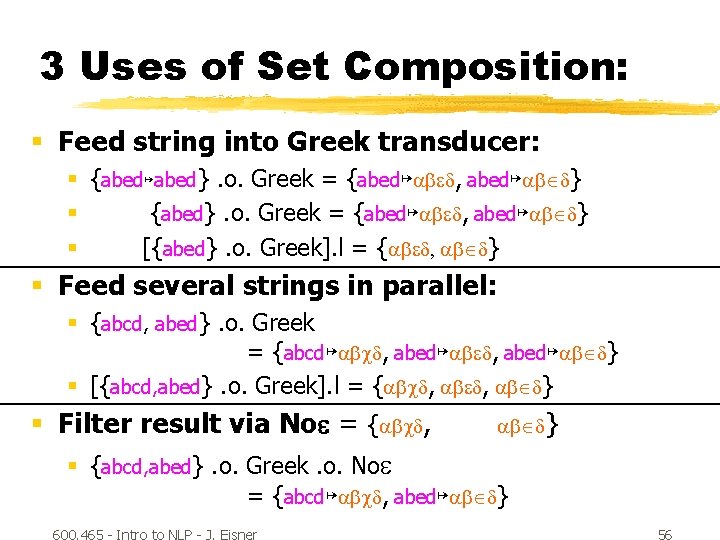
3 Uses of Set Composition: § Feed string into Greek transducer: § {abed↦abed}. o. Greek = {abed↦ab d, abed↦ab d} § {abed}. o. Greek = {abed↦ab d, abed↦ab d} § [{abed}. o. Greek]. l = {ab d, ab d} § Feed several strings in parallel: § {abcd, abed}. o. Greek = {abcd↦abcd, abed↦ab d} § [{abcd, abed}. o. Greek]. l = {abcd, ab d} § Filter result via No = {abcd, ab d} § {abcd, abed}. o. Greek. o. No = {abcd↦abcd, abed↦ab d} 600. 465 - Intro to NLP - J. Eisner 56
Complementation § Given a machine M, represent all strings not accepted by M § Just change final states to non-final and vice-versa § Works only if machine has been determinized and completed first (why? ) 600. 465 - Intro to NLP - J. Eisner 57
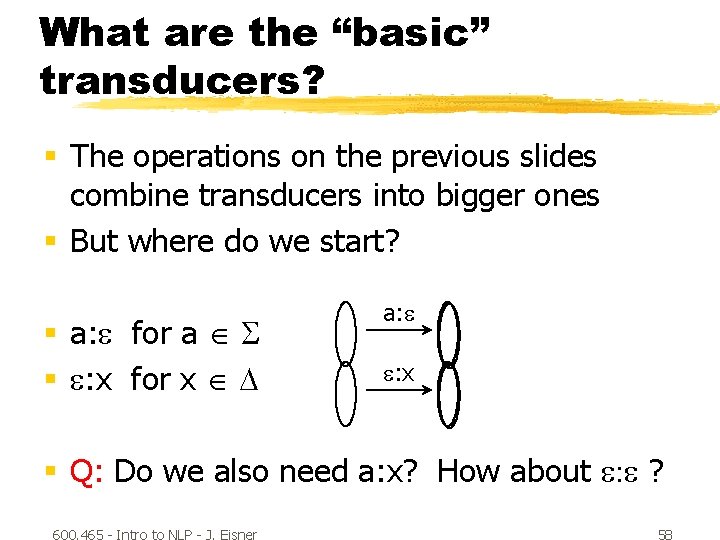
What are the “basic” transducers? § The operations on the previous slides combine transducers into bigger ones § But where do we start? § a: for a § : x for x a: : x § Q: Do we also need a: x? How about : ? 600. 465 - Intro to NLP - J. Eisner 58
- Slides: 57