
Building Evaluation Capacity Through Research Partnerships REL Central
Building Evaluation Capacity Through Research Partnerships REL Central at Marzano Research and Colorado Department of Education November 13, 2019 RELCentral@marzanoresearch. com COLORADO KANSAS MISSOURI NEBRASKA NORTH DAKOTA SOUTH DAKOTA WYOMING
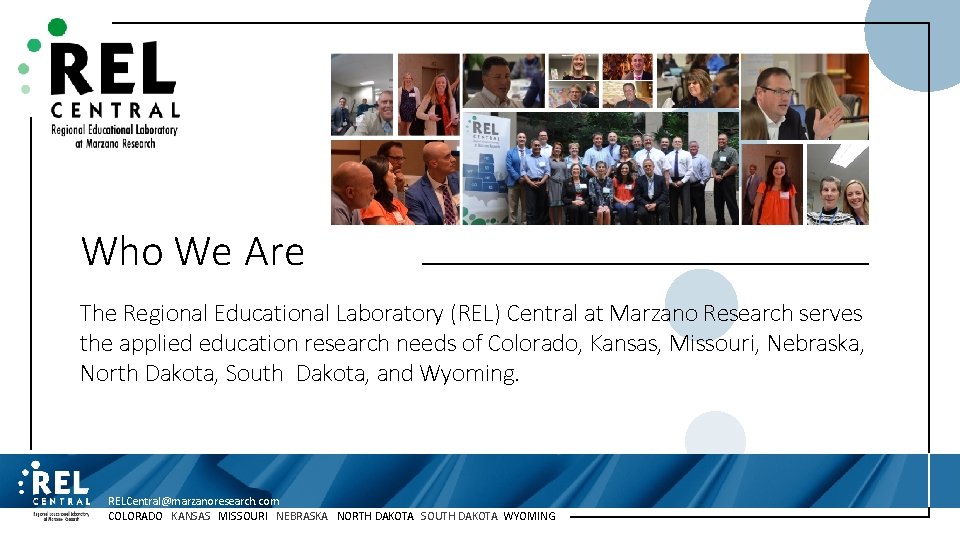
Who We Are The Regional Educational Laboratory (REL) Central at Marzano Research serves the applied education research needs of Colorado, Kansas, Missouri, Nebraska, North Dakota, South Dakota, and Wyoming. RELCentral@marzanoresearch. com COLORADO KANSAS MISSOURI NEBRASKA NORTH DAKOTA SOUTH DAKOTA WYOMING
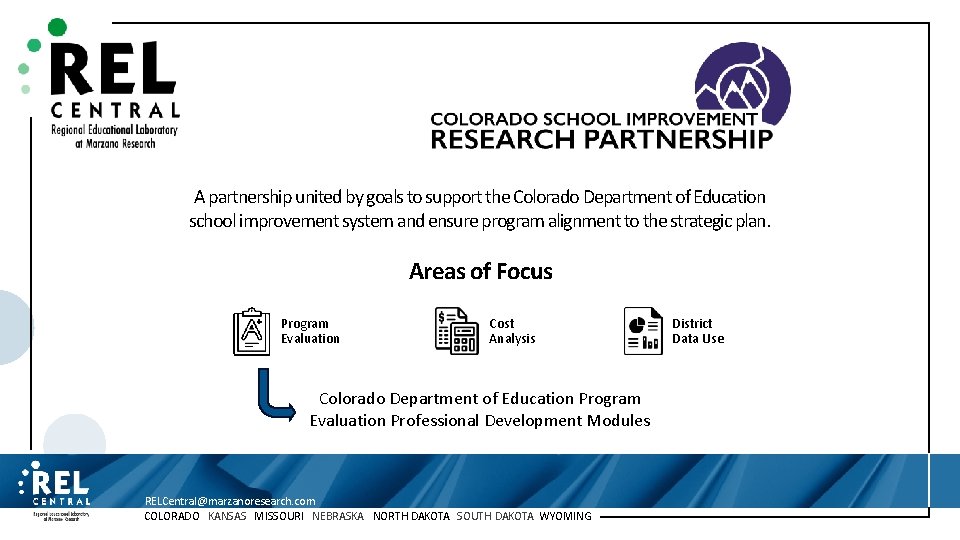
A partnership united by goals to support the Colorado Department of Education school improvement system and ensure program alignment to the strategic plan. Areas of Focus Program Evaluation Cost Analysis Colorado Department of Education Program Evaluation Professional Development Modules RELCentral@marzanoresearch. com COLORADO KANSAS MISSOURI NEBRASKA NORTH DAKOTA SOUTH DAKOTA WYOMING District Data Use
Introductions Colorado Department of Education (CDE) Unit of Federal Programs Administration Regional Educational Laboratory (REL) Central at Marzano Research Nazanin Mohajeri-Nelson Jeanette Joyce • Director, Office of Elementary and Secondary Education Act (ESEA) Programs • Researcher Tina Negley • Coordinator, Data, Accountability, Reporting and Evaluation (DARE) Jeremy Meredith Mckenzie Haines • Research Associate Joshua Stewart • Senior Researcher • Senior Consultant, Title II Specialist, ESEA Programs Team RELCentral@marzanoresearch. com COLORADO KANSAS MISSOURI NEBRASKA NORTH DAKOTA SOUTH DAKOTA WYOMING
Goals • To introduce the need for, and the collaborative partnership that led to, the development of the program evaluation modules. • To introduce each of the five modules. • To share how CDE currently uses the modules, including lessons learned. • To invite questions. • To discuss the utility of the modules in other contexts. RELCentral@marzanoresearch. com COLORADO KANSAS MISSOURI NEBRASKA NORTH DAKOTA SOUTH DAKOTA WYOMING
Partnership and Collaboration Working with CDE RELCentral@marzanoresearch. com COLORADO KANSAS MISSOURI NEBRASKA NORTH DAKOTA SOUTH DAKOTA WYOMING
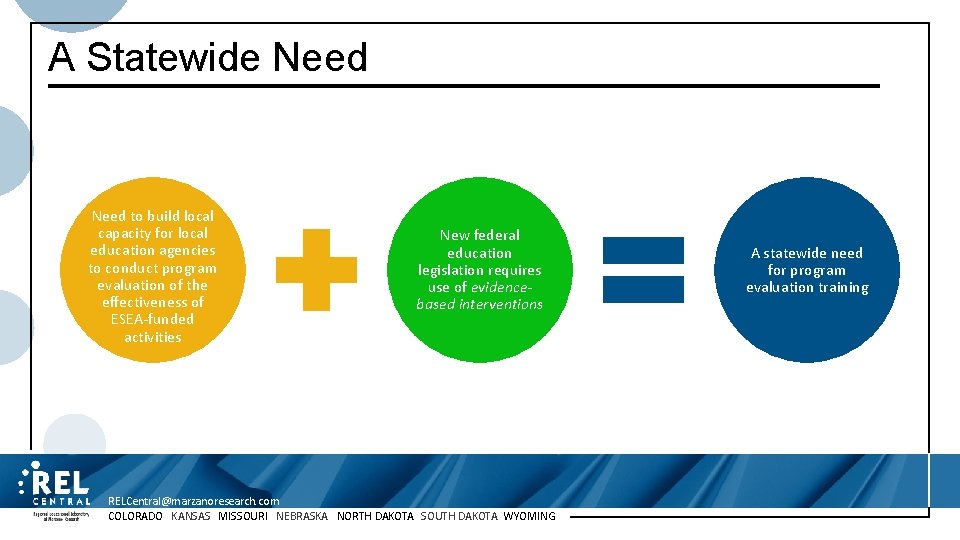
A Statewide Need to build local capacity for local education agencies to conduct program evaluation of the effectiveness of ESEA-funded activities New federal education legislation requires use of evidencebased interventions RELCentral@marzanoresearch. com COLORADO KANSAS MISSOURI NEBRASKA NORTH DAKOTA SOUTH DAKOTA WYOMING A statewide need for program evaluation training
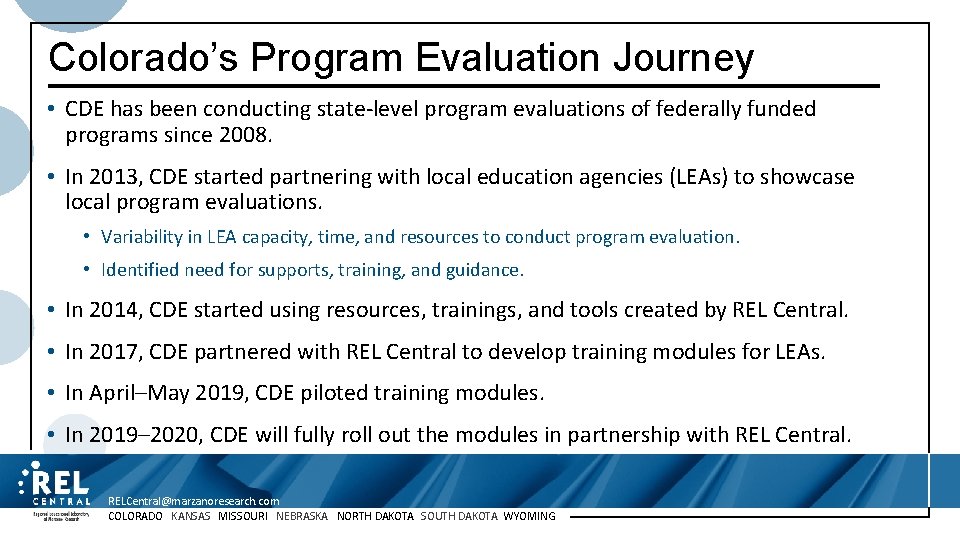
Colorado’s Program Evaluation Journey • CDE has been conducting state-level program evaluations of federally funded programs since 2008. • In 2013, CDE started partnering with local education agencies (LEAs) to showcase local program evaluations. • Variability in LEA capacity, time, and resources to conduct program evaluation. • Identified need for supports, training, and guidance. • In 2014, CDE started using resources, trainings, and tools created by REL Central. • In 2017, CDE partnered with REL Central to develop training modules for LEAs. • In April–May 2019, CDE piloted training modules. • In 2019– 2020, CDE will fully roll out the modules in partnership with REL Central. RELCentral@marzanoresearch. com COLORADO KANSAS MISSOURI NEBRASKA NORTH DAKOTA SOUTH DAKOTA WYOMING
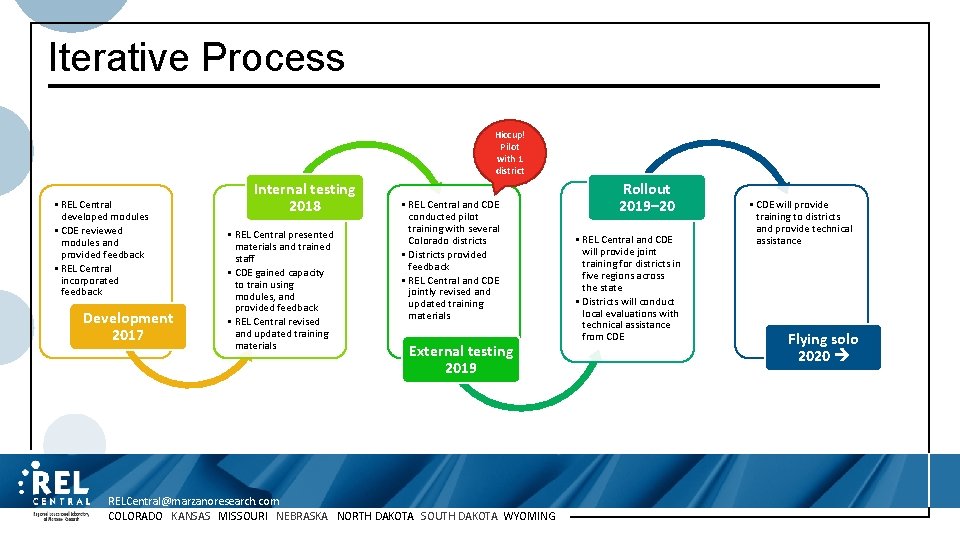
Iterative Process Hiccup! Pilot with 1 district • REL Central developed modules • CDE reviewed modules and provided feedback • REL Central incorporated feedback Development 2017 Internal testing 2018 • REL Central presented materials and trained staff • CDE gained capacity to train using modules, and provided feedback • REL Central revised and updated training materials • REL Central and CDE conducted pilot training with several Colorado districts • Districts provided feedback • REL Central and CDE jointly revised and updated training materials External testing 2019 RELCentral@marzanoresearch. com COLORADO KANSAS MISSOURI NEBRASKA NORTH DAKOTA SOUTH DAKOTA WYOMING Rollout 2019– 20 • REL Central and CDE will provide joint training for districts in five regions across the state • Districts will conduct local evaluations with technical assistance from CDE • CDE will provide training to districts and provide technical assistance Flying solo 2020
Logic Models Module 1 RELCentral@marzanoresearch. com COLORADO KANSAS MISSOURI NEBRASKA NORTH DAKOTA SOUTH DAKOTA WYOMING
What Is a Logic Model? • It is a framework for understanding how resources may lead to desired outcomes. • It is the center of evaluation. RELCentral@marzanoresearch. com COLORADO KANSAS MISSOURI NEBRASKA NORTH DAKOTA SOUTH DAKOTA WYOMING
Why Create a Logic Model? • To capture intents and processes that are valued but may not be readily observable. RELCentral@marzanoresearch. com COLORADO KANSAS MISSOURI NEBRASKA NORTH DAKOTA SOUTH DAKOTA WYOMING
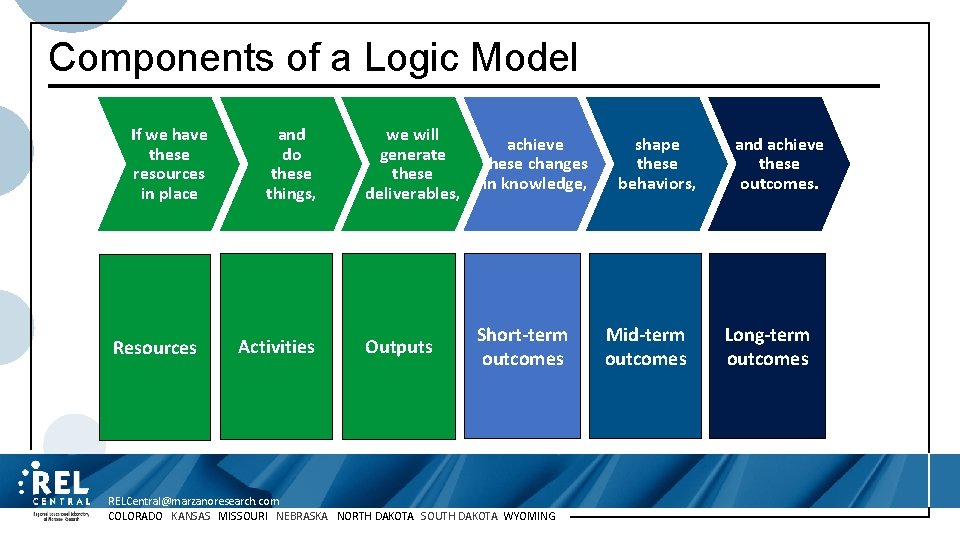
Components of a Logic Model If we have these resources in place Resources and do these things, Activities we will achieve generate these changes these in knowledge, deliverables, Outputs Short-term outcomes RELCentral@marzanoresearch. com COLORADO KANSAS MISSOURI NEBRASKA NORTH DAKOTA SOUTH DAKOTA WYOMING shape these behaviors, Mid-term outcomes and achieve these outcomes. Long-term outcomes
After-School Math Program • A middle school has been experiencing issues with low rates of math homework completion, resulting in low math scores. • The middle school received a grant for a program to provide students with math tutoring after school. RELCentral@marzanoresearch. com COLORADO KANSAS MISSOURI NEBRASKA NORTH DAKOTA SOUTH DAKOTA WYOMING
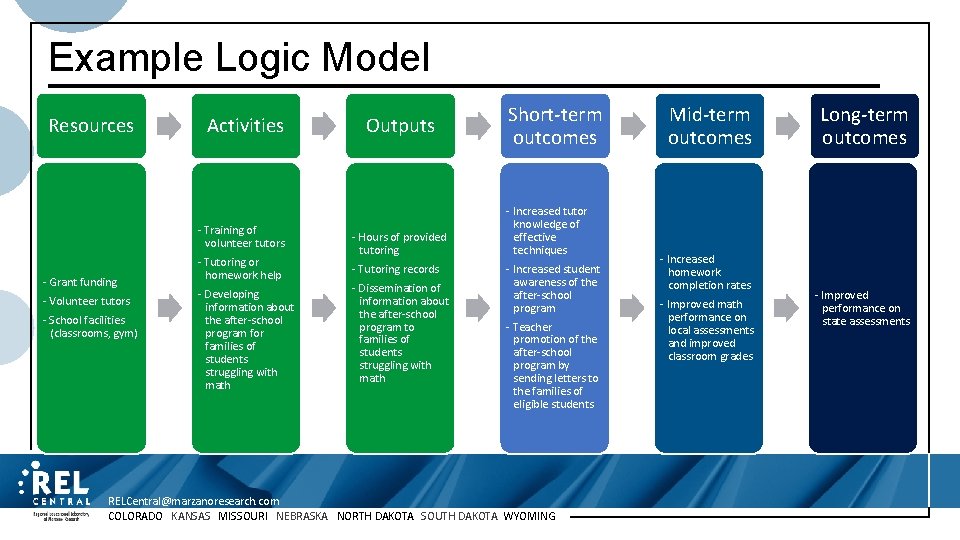
Example Logic Model Resources Activities - Training of volunteer tutors - Grant funding - Volunteer tutors - School facilities (classrooms, gym) - Tutoring or homework help - Developing information about the after-school program for families of students struggling with math Outputs - Hours of provided tutoring - Tutoring records - Dissemination of information about the after-school program to families of students struggling with math Short-term outcomes - Increased tutor knowledge of effective techniques - Increased student awareness of the after-school program - Teacher promotion of the after-school program by sending letters to the families of eligible students RELCentral@marzanoresearch. com COLORADO KANSAS MISSOURI NEBRASKA NORTH DAKOTA SOUTH DAKOTA WYOMING Mid-term outcomes - Increased homework completion rates - Improved math performance on local assessments and improved classroom grades Long-term outcomes - Improved performance on state assessments
Discuss Outcomes Handout A • Sort the outcomes at your table into short-, mid-, and long-term outcomes. RELCentral@marzanoresearch. com COLORADO KANSAS MISSOURI NEBRASKA NORTH DAKOTA SOUTH DAKOTA WYOMING
Evaluation Questions Module 2 RELCentral@marzanoresearch. com COLORADO KANSAS MISSOURI NEBRASKA NORTH DAKOTA SOUTH DAKOTA WYOMING
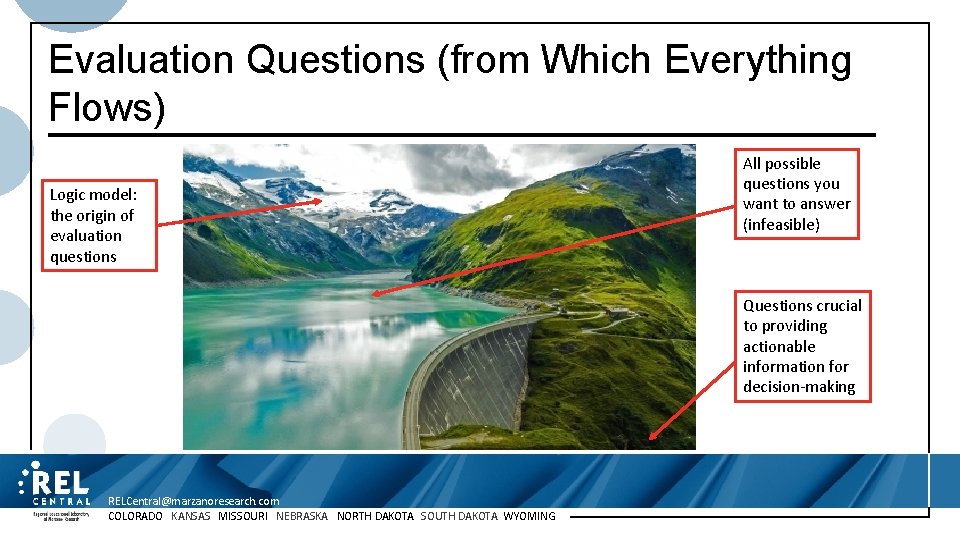
Evaluation Questions (from Which Everything Flows) Logic model: the origin of evaluation questions All possible questions you want to answer (infeasible) Questions crucial to providing actionable information for decision-making RELCentral@marzanoresearch. com COLORADO KANSAS MISSOURI NEBRASKA NORTH DAKOTA SOUTH DAKOTA WYOMING
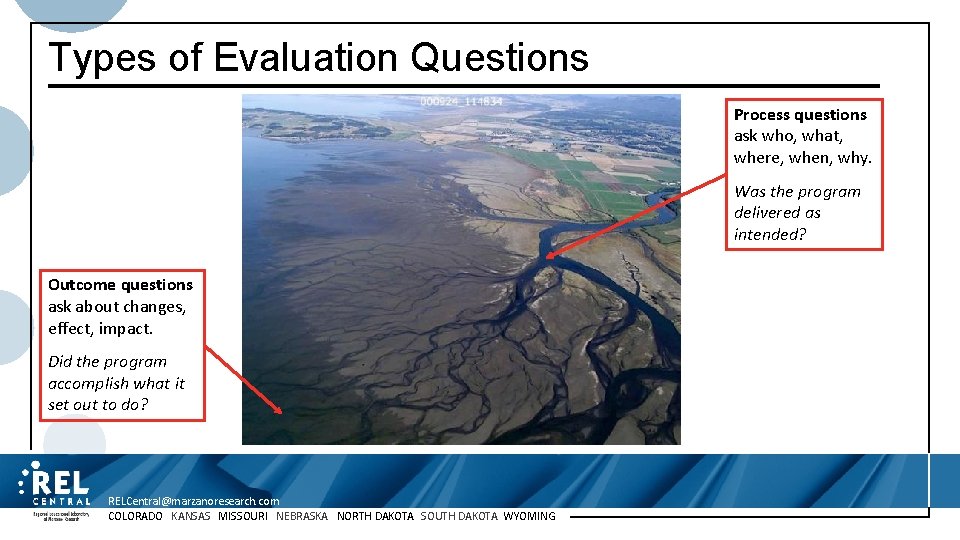
Types of Evaluation Questions Process questions ask who, what, where, when, why. Was the program delivered as intended? Outcome questions ask about changes, effect, impact. Did the program accomplish what it set out to do? RELCentral@marzanoresearch. com COLORADO KANSAS MISSOURI NEBRASKA NORTH DAKOTA SOUTH DAKOTA WYOMING
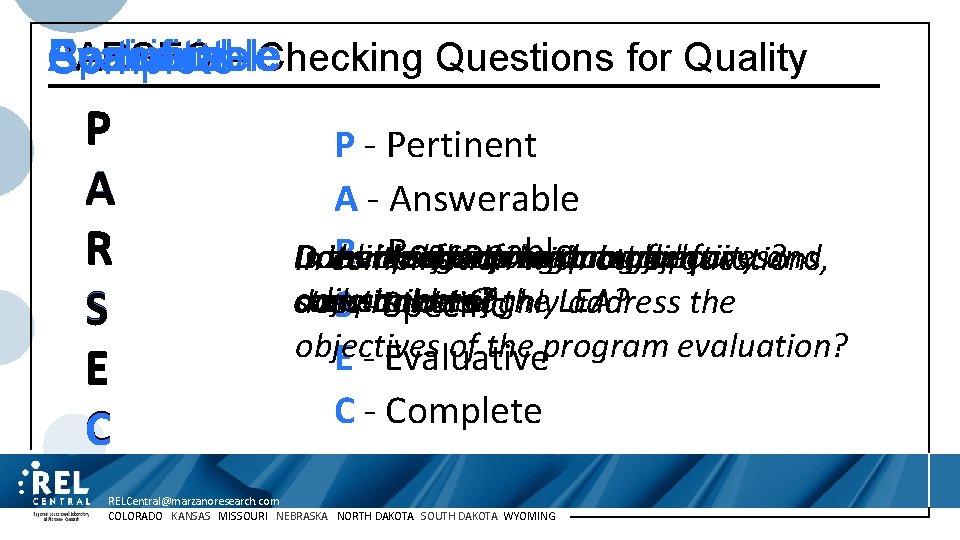
Specific – Checking Questions for Quality Answerable Pertinent Reasonable PARSEC Evaluative Complete P A R S E C P - Pertinent A - Answerable Rable -itquestion Reasonable Is totoinform program Does align to logic model linked program objectives? the reflect the meaningful data capacity for and In it combination with other questions, adjustments? components? stakeholders? constraints of the LEA? does thoroughly address the S -it. Specific objectives of the program evaluation? E - Evaluative C - Complete RELCentral@marzanoresearch. com COLORADO KANSAS MISSOURI NEBRASKA NORTH DAKOTA SOUTH DAKOTA WYOMING
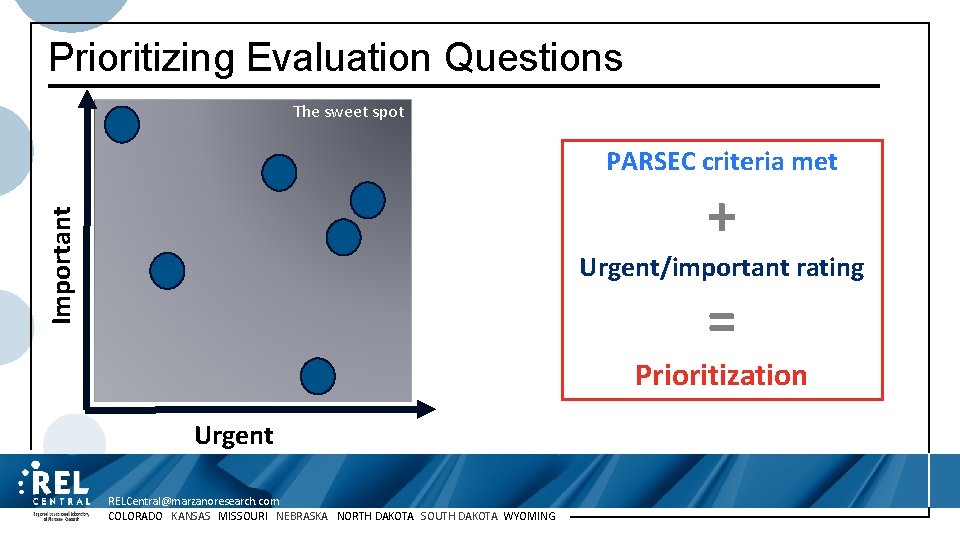
Prioritizing Evaluation Questions The sweet spot PARSEC criteria met Important + Urgent/important rating = Prioritization Urgent RELCentral@marzanoresearch. com COLORADO KANSAS MISSOURI NEBRASKA NORTH DAKOTA SOUTH DAKOTA WYOMING
Revising Example Evaluation Questions Handout B • Choose one evaluation question below, assess it using the criteria in Handout B, and revise it so that it meets those criteria. • Did students report having more math homework? • Did tutors enjoy receiving professional development? • How much did students’ test scores increase three years after the program was implemented? RELCentral@marzanoresearch. com COLORADO KANSAS MISSOURI NEBRASKA NORTH DAKOTA SOUTH DAKOTA WYOMING
Data Quality Module 3 RELCentral@marzanoresearch. com COLORADO KANSAS MISSOURI NEBRASKA NORTH DAKOTA SOUTH DAKOTA WYOMING
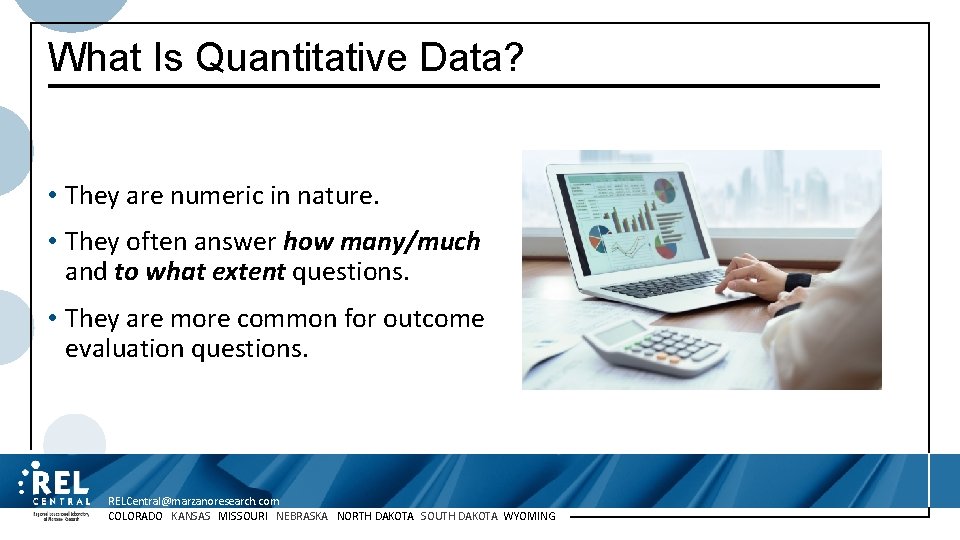
What Is Quantitative Data? • They are numeric in nature. • They often answer how many/much and to what extent questions. • They are more common for outcome evaluation questions. RELCentral@marzanoresearch. com COLORADO KANSAS MISSOURI NEBRASKA NORTH DAKOTA SOUTH DAKOTA WYOMING
What Is Qualitative Data? • They are non-numeric in nature. • They often answer why and how questions. • They are more common for process evaluation questions. RELCentral@marzanoresearch. com COLORADO KANSAS MISSOURI NEBRASKA NORTH DAKOTA SOUTH DAKOTA WYOMING
What Is Data Quality? • The extent to which the collected information accurately represents program activities, outputs, and outcomes. RELCentral@marzanoresearch. com COLORADO KANSAS MISSOURI NEBRASKA NORTH DAKOTA SOUTH DAKOTA WYOMING
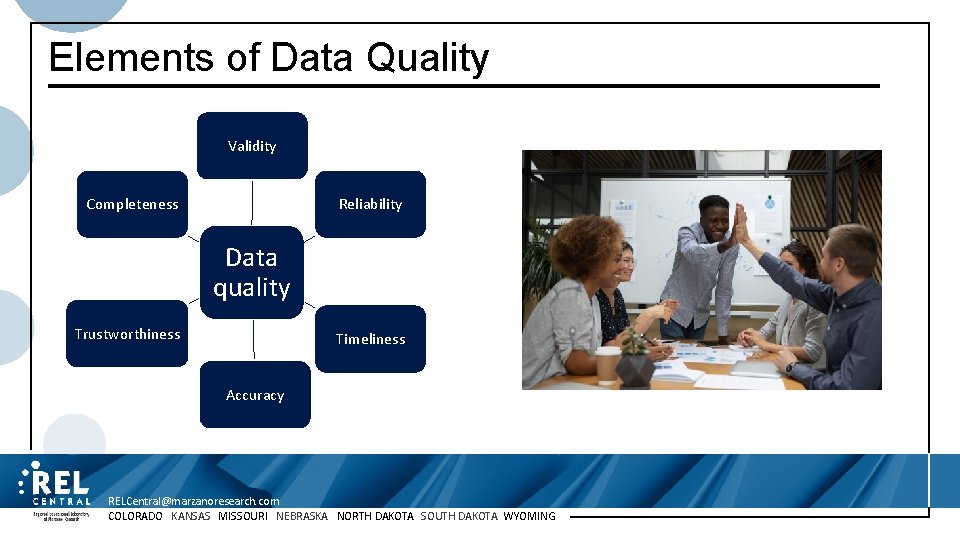
Elements of Data Quality Validity Completeness Reliability Data quality Trustworthiness Timeliness Accuracy RELCentral@marzanoresearch. com COLORADO KANSAS MISSOURI NEBRASKA NORTH DAKOTA SOUTH DAKOTA WYOMING
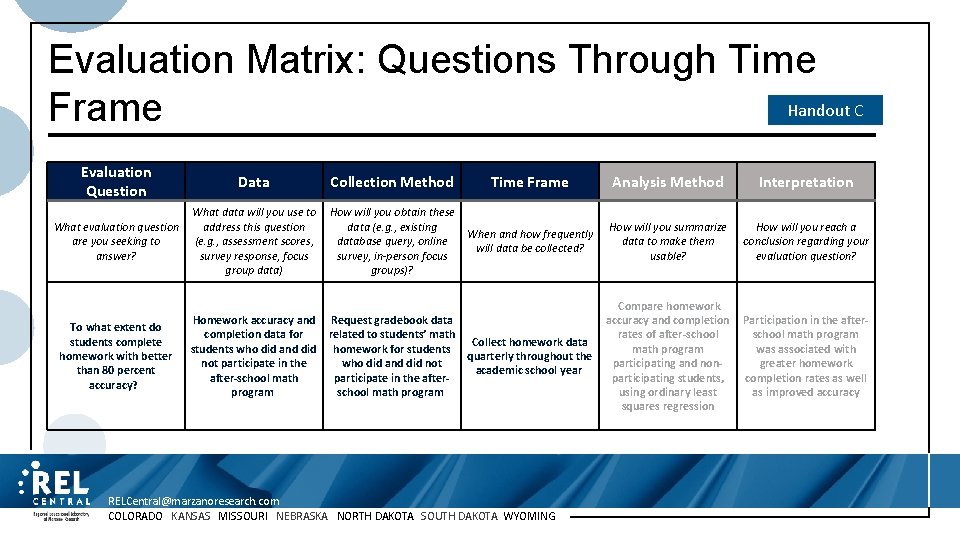
Evaluation Matrix: Questions Through Time Handout C Frame Evaluation Question Data Collection Method Time Frame Analysis Method Interpretation What evaluation question are you seeking to answer? What data will you use to address this question (e. g. , assessment scores, survey response, focus group data) How will you obtain these data (e. g. , existing database query, online survey, in-person focus groups)? When and how frequently will data be collected? How will you summarize data to make them usable? How will you reach a conclusion regarding your evaluation question? To what extent do students complete homework with better than 80 percent accuracy? Compare homework Homework accuracy and Request gradebook data accuracy and completion Participation in the afterrates of after-school completion data for related to students’ math school math program Collect homework data students who did and did homework for students math program was associated with quarterly throughout the not participate in the who did and did not participating and nongreater homework academic school year after-school math participate in the afterparticipating students, completion rates as well program school math program using ordinary least as improved accuracy squares regression RELCentral@marzanoresearch. com COLORADO KANSAS MISSOURI NEBRASKA NORTH DAKOTA SOUTH DAKOTA WYOMING
Data Collection Module 4 RELCentral@marzanoresearch. com COLORADO KANSAS MISSOURI NEBRASKA NORTH DAKOTA SOUTH DAKOTA WYOMING
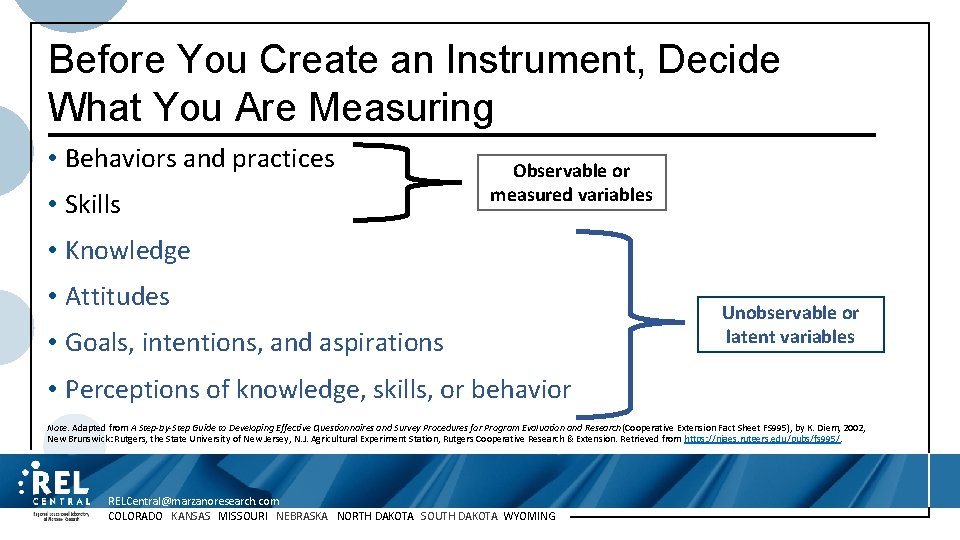
Before You Create an Instrument, Decide What You Are Measuring • Behaviors and practices • Skills Observable or measured variables • Knowledge • Attitudes • Goals, intentions, and aspirations Unobservable or latent variables • Perceptions of knowledge, skills, or behavior Note. Adapted from A Step-by-Step Guide to Developing Effective Questionnaires and Survey Procedures for Program Evaluation and Research (Cooperative Extension Fact Sheet FS 995), by K. Diem, 2002, New Brunswick: Rutgers, the State University of New Jersey, N. J. Agricultural Experiment Station, Rutgers Cooperative Research & Extension. Retrieved from https: //njaes. rutgers. edu/pubs/fs 995/. RELCentral@marzanoresearch. com COLORADO KANSAS MISSOURI NEBRASKA NORTH DAKOTA SOUTH DAKOTA WYOMING
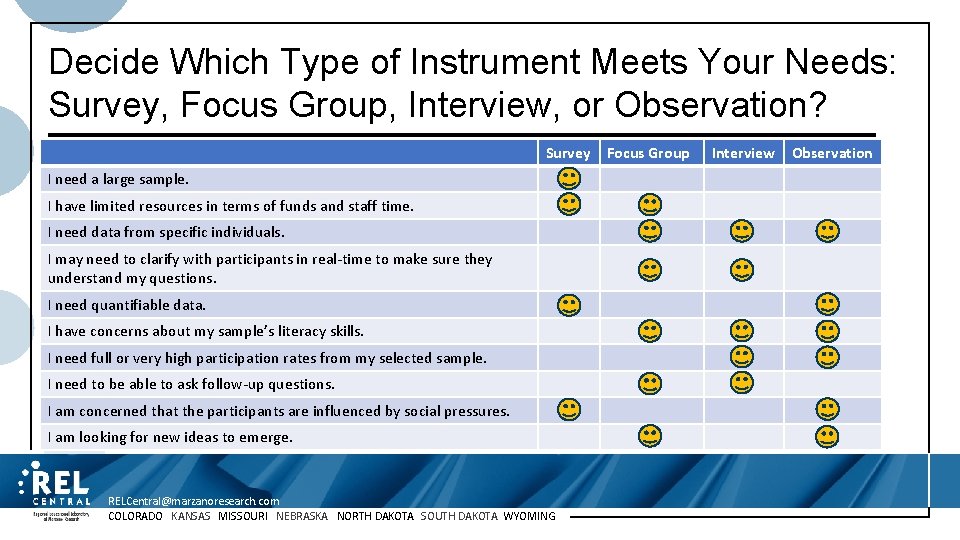
Decide Which Type of Instrument Meets Your Needs: Survey, Focus Group, Interview, or Observation? Survey I need a large sample. I have limited resources in terms of funds and staff time. I need data from specific individuals. I may need to clarify with participants in real-time to make sure they understand my questions. I need quantifiable data. I have concerns about my sample’s literacy skills. I need full or very high participation rates from my selected sample. I need to be able to ask follow-up questions. I am concerned that the participants are influenced by social pressures. I am looking for new ideas to emerge. RELCentral@marzanoresearch. com COLORADO KANSAS MISSOURI NEBRASKA NORTH DAKOTA SOUTH DAKOTA WYOMING Focus Group Interview Observation
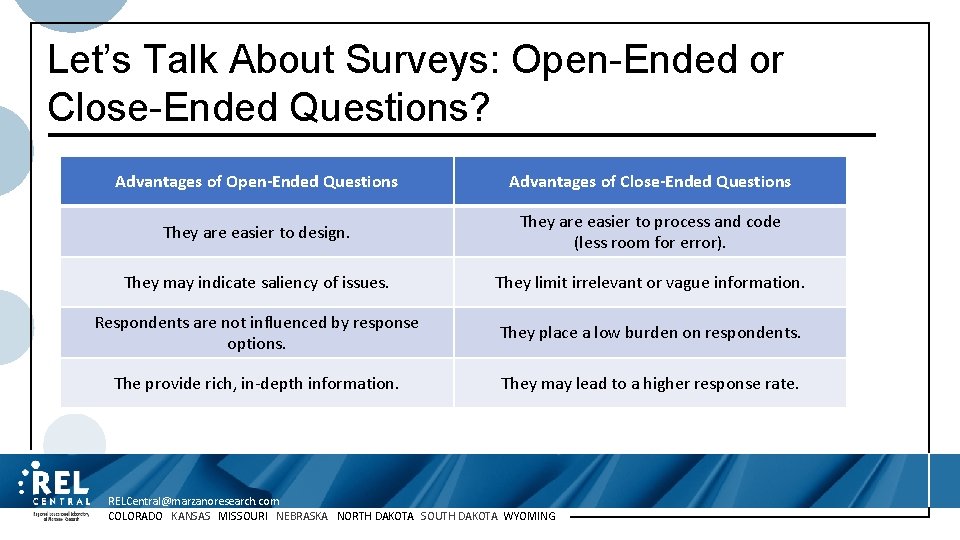
Let’s Talk About Surveys: Open-Ended or Close-Ended Questions? Advantages of Open-Ended Questions Advantages of Close-Ended Questions They are easier to design. They are easier to process and code (less room for error). They may indicate saliency of issues. They limit irrelevant or vague information. Respondents are not influenced by response options. They place a low burden on respondents. The provide rich, in-depth information. They may lead to a higher response rate. RELCentral@marzanoresearch. com COLORADO KANSAS MISSOURI NEBRASKA NORTH DAKOTA SOUTH DAKOTA WYOMING
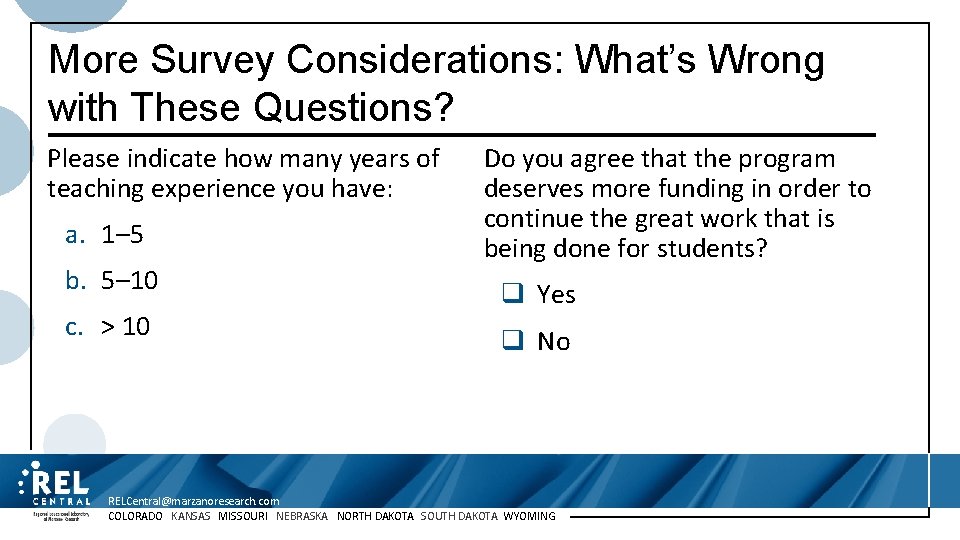
More Survey Considerations: What’s Wrong with These Questions? Please indicate how many years of teaching experience you have: a. 1– 5 b. 5– 10 c. > 10 Do you agree that the program deserves more funding in order to continue the great work that is being done for students? q Yes q No RELCentral@marzanoresearch. com COLORADO KANSAS MISSOURI NEBRASKA NORTH DAKOTA SOUTH DAKOTA WYOMING
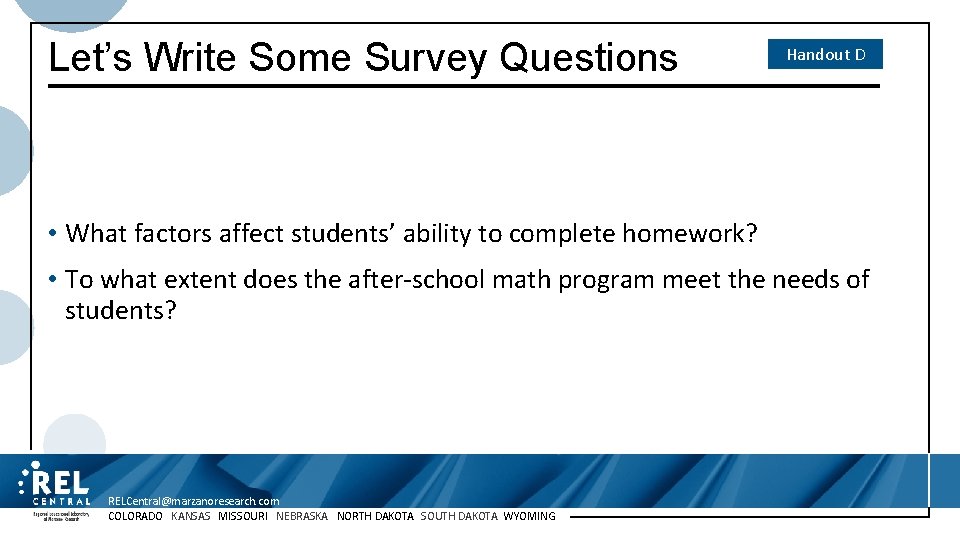
Let’s Write Some Survey Questions Handout D • What factors affect students’ ability to complete homework? • To what extent does the after-school math program meet the needs of students? RELCentral@marzanoresearch. com COLORADO KANSAS MISSOURI NEBRASKA NORTH DAKOTA SOUTH DAKOTA WYOMING
Data Analysis Module 5 RELCentral@marzanoresearch. com COLORADO KANSAS MISSOURI NEBRASKA NORTH DAKOTA SOUTH DAKOTA WYOMING
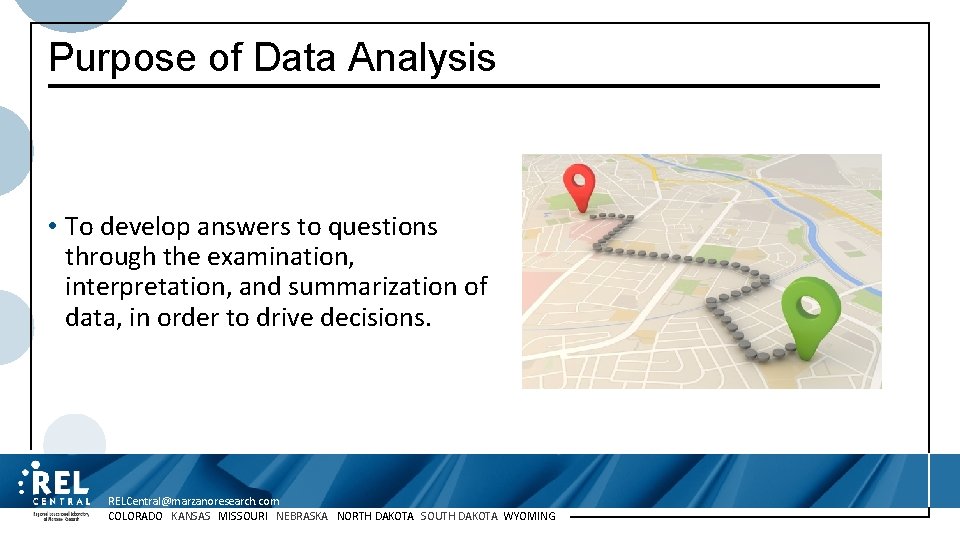
Purpose of Data Analysis • To develop answers to questions through the examination, interpretation, and summarization of data, in order to drive decisions. RELCentral@marzanoresearch. com COLORADO KANSAS MISSOURI NEBRASKA NORTH DAKOTA SOUTH DAKOTA WYOMING
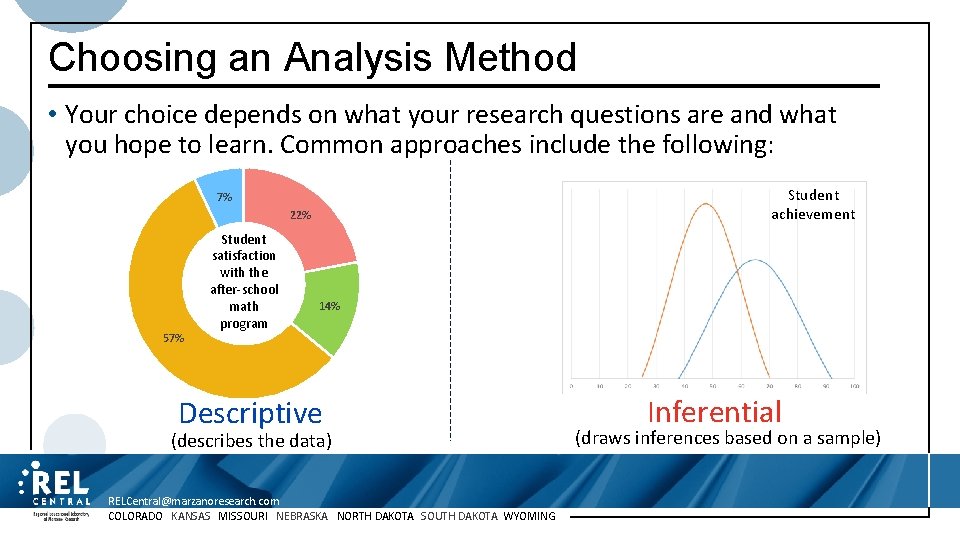
Choosing an Analysis Method • Your choice depends on what your research questions are and what you hope to learn. Common approaches include the following: Student achievement 7% 22% 57% Student satisfaction with the after-school math program 14% Descriptive (describes the data) RELCentral@marzanoresearch. com COLORADO KANSAS MISSOURI NEBRASKA NORTH DAKOTA SOUTH DAKOTA WYOMING Inferential (draws inferences based on a sample)
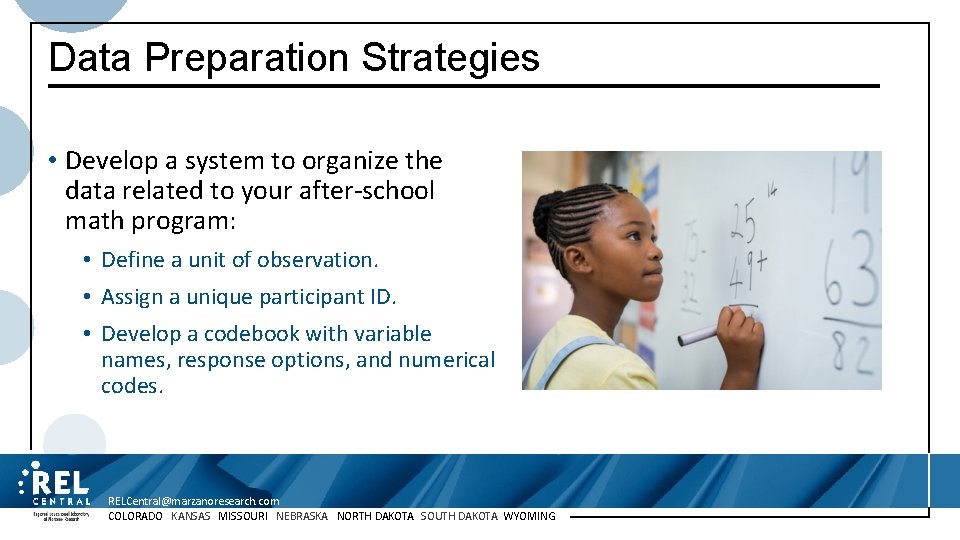
Data Preparation Strategies • Develop a system to organize the data related to your after-school math program: • Define a unit of observation. • Assign a unique participant ID. • Develop a codebook with variable names, response options, and numerical codes. RELCentral@marzanoresearch. com COLORADO KANSAS MISSOURI NEBRASKA NORTH DAKOTA SOUTH DAKOTA WYOMING
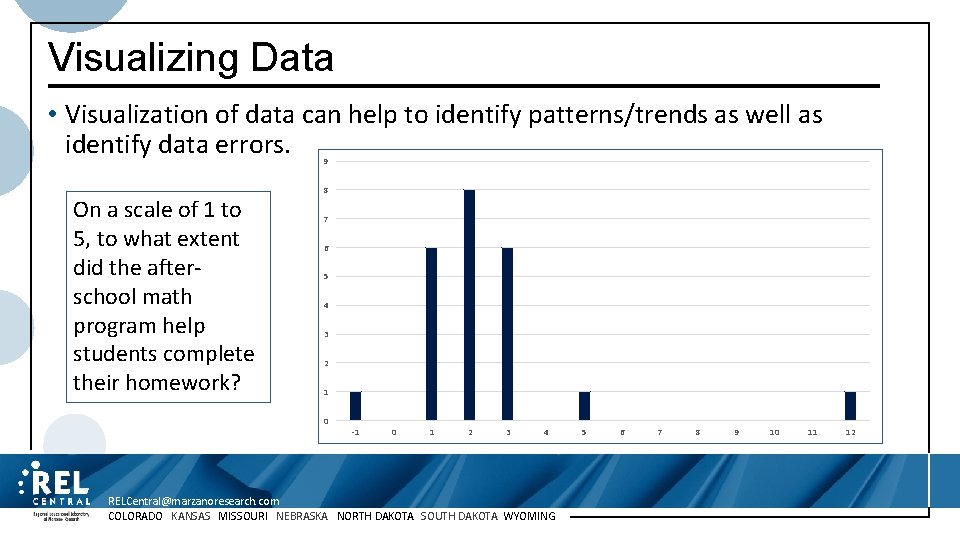
Visualizing Data • Visualization of data can help to identify patterns/trends as well as identify data errors. 9 On a scale of 1 to 5, to what extent did the afterschool math program help students complete their homework? 8 7 6 5 4 3 2 1 0 -1 0 1 2 3 4 RELCentral@marzanoresearch. com COLORADO KANSAS MISSOURI NEBRASKA NORTH DAKOTA SOUTH DAKOTA WYOMING 5 6 7 8 9 10 11 12
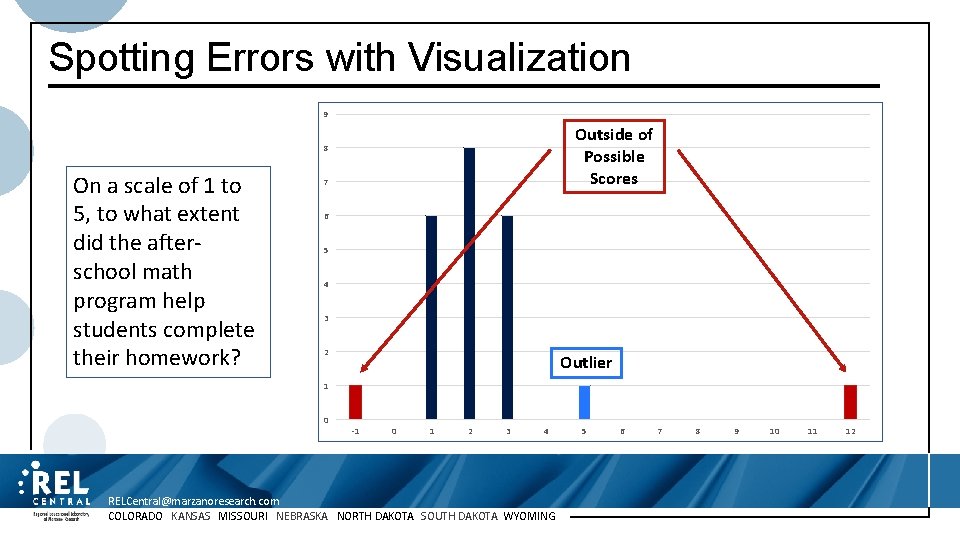
Spotting Errors with Visualization 9 Outside of Possible Scores 8 On a scale of 1 to 5, to what extent did the afterschool math program help students complete their homework? 7 6 5 4 3 2 Outlier 1 0 -1 0 1 2 3 4 RELCentral@marzanoresearch. com COLORADO KANSAS MISSOURI NEBRASKA NORTH DAKOTA SOUTH DAKOTA WYOMING 5 6 7 8 9 10 11 12
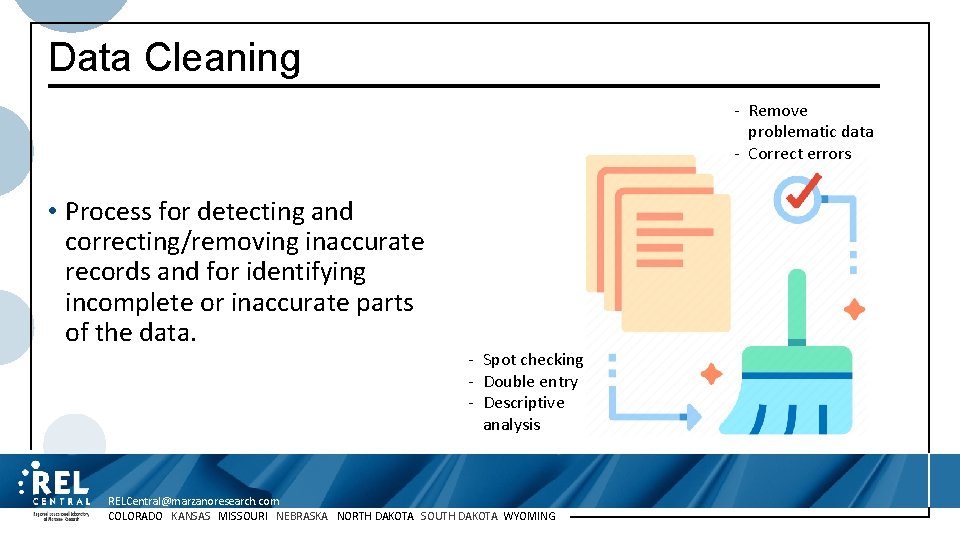
Data Cleaning - Remove problematic data - Correct errors • Process for detecting and correcting/removing inaccurate records and for identifying incomplete or inaccurate parts of the data. - Spot checking - Double entry - Descriptive analysis RELCentral@marzanoresearch. com COLORADO KANSAS MISSOURI NEBRASKA NORTH DAKOTA SOUTH DAKOTA WYOMING
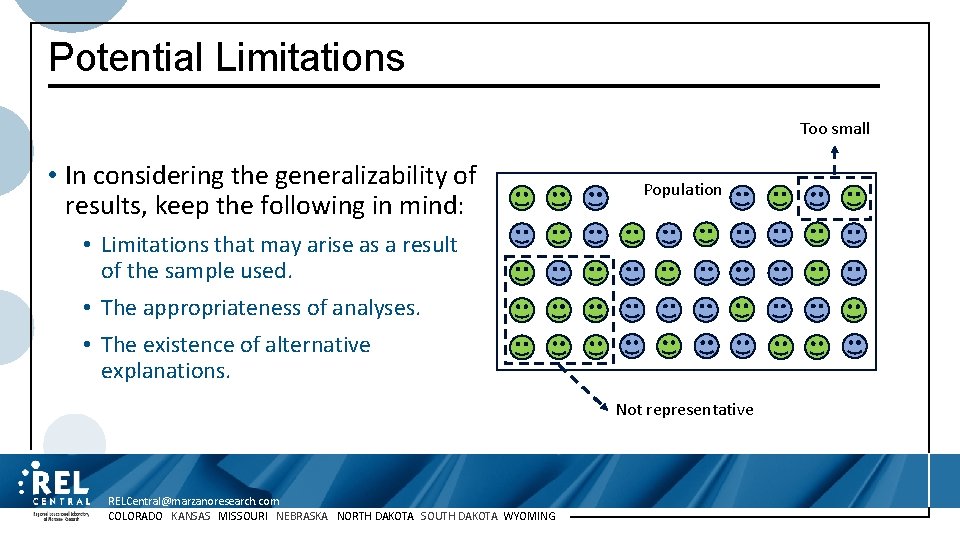
Potential Limitations Too small • In considering the generalizability of results, keep the following in mind: Population • Limitations that may arise as a result of the sample used. • The appropriateness of analyses. • The existence of alternative explanations. Not representative RELCentral@marzanoresearch. com COLORADO KANSAS MISSOURI NEBRASKA NORTH DAKOTA SOUTH DAKOTA WYOMING
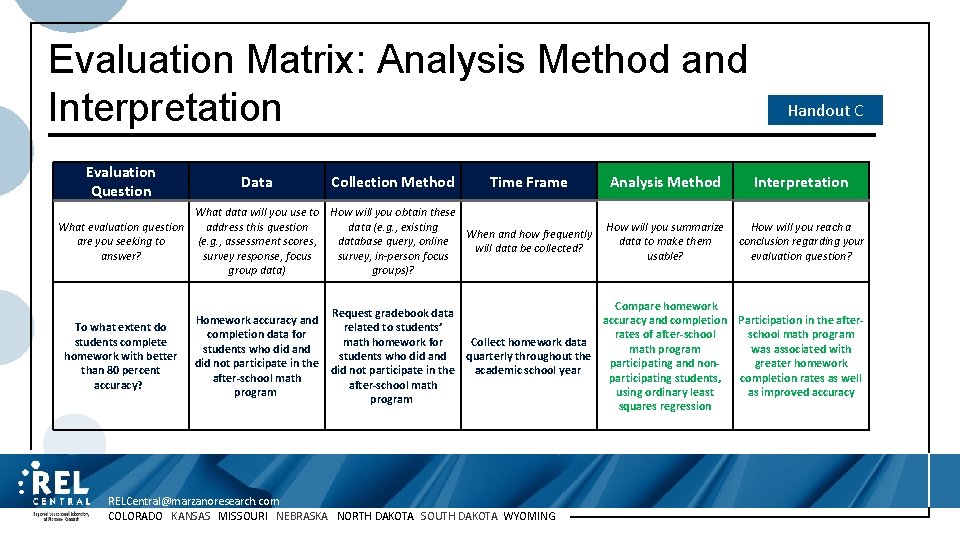
Evaluation Matrix: Analysis Method and Interpretation Evaluation Question What evaluation question are you seeking to answer? To what extent do students complete homework with better than 80 percent accuracy? Data Collection Method Time Frame What data will you use to How will you obtain these address this question data (e. g. , existing When and how frequently (e. g. , assessment scores, database query, online will data be collected? survey response, focus survey, in-person focus group data) groups)? Handout C Analysis Method Interpretation How will you summarize data to make them usable? How will you reach a conclusion regarding your evaluation question? Compare homework Request gradebook data Homework accuracy and completion Participation in the afterrelated to students’ rates of after-school completion data for school math program math homework for Collect homework data students who did and math program was associated with students who did and quarterly throughout the did not participate in the participating and nongreater homework did not participate in the academic school year after-school math participating students, completion rates as well after-school math program using ordinary least as improved accuracy program squares regression RELCentral@marzanoresearch. com COLORADO KANSAS MISSOURI NEBRASKA NORTH DAKOTA SOUTH DAKOTA WYOMING
Next Steps Launching the Training RELCentral@marzanoresearch. com COLORADO KANSAS MISSOURI NEBRASKA NORTH DAKOTA SOUTH DAKOTA WYOMING
Lessons Learned CDE: • REL Central partners have greater skills, capacity, and resources to build training modules. • Needed for years and could not find time and resources to make it happen. REL Central: • Identified need for online training modules. • Access to districts and programmatic information. • External support has had many added benefits: • Objectivity • Blending and enhancing expertise and knowledge • Has made work a priority • Divide and conquer the work RELCentral@marzanoresearch. com COLORADO KANSAS MISSOURI NEBRASKA NORTH DAKOTA SOUTH DAKOTA WYOMING
Next Steps • Training series will begin in December 2019 with modules 1– 2 in person in five regions in Colorado. • Modules 3– 4 will be online during January and February 2020. • Modules 5– 6 will be in-person workshops in March 2020 in five regions in the state • After one year of trainings, we will review, revise, and finalize. • REL Central will publish materials on our website for other states to use. • We will disseminate online training modules for districts and other states to access. • CDE will continue to provide training and technical assistance. RELCentral@marzanoresearch. com COLORADO KANSAS MISSOURI NEBRASKA NORTH DAKOTA SOUTH DAKOTA WYOMING
Wrap Up Questions RELCentral@marzanoresearch. com COLORADO KANSAS MISSOURI NEBRASKA NORTH DAKOTA SOUTH DAKOTA WYOMING
Questions • Discuss how the modules might be helpful in your context. • Do you have any questions? RELCentral@marzanoresearch. com COLORADO KANSAS MISSOURI NEBRASKA NORTH DAKOTA SOUTH DAKOTA WYOMING Handout E
Thank You Please visit our website and follow us on Twitter for information about our events, priorities, and research alliances, and for access to our many free resources. ies. ed. gov/ncee/edlabs/regions/central/index. asp @RELCentral or contact us at RELCentral@marzanoresearch. com This presentation was prepared under Contract ED-IES-17 -C-0005 by Regional Educational Laboratory Central, administered by Marzano Research. The content does not necessarily reflect the views or policies of IES or the U. S. of Department of Education, nor does mention of trade names, commercial products, or organizations imply endorsement by the U. S. Government. RELCentral@marzanoresearch. com COLORADO KANSAS MISSOURI NEBRASKA NORTH DAKOTA SOUTH DAKOTA WYOMING
- Slides: 49