
Building Episodes of Care Gregory H Partridge Focused
Building Episodes of Care Gregory H. Partridge Focused Medical Analytics PAI Seminar – Understanding Episodes of Care Chicago, June 22, 2007
Episode of Care – Definition • All clinically related services for one patient for a discrete diagnostic condition from the onset of symptoms until treatment is complete. • One episode only pertains to one patient, but one patient can be in multiple episodes at once. 2

Your Inputs Build Episodes Diagnosis Codes Drug Codes ICD-9 CM NDC Procedure Codes CPT- 4, HCPCS Level II, NUBC revenue codes User Defined For example: • User Defined Hospital Confinements • User Defined Emergency Visits 3
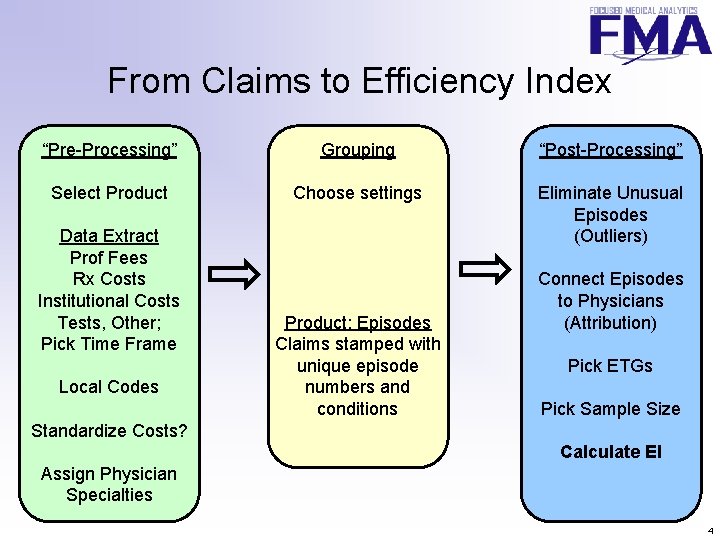
From Claims to Efficiency Index “Pre-Processing” Grouping “Post-Processing” Select Product Choose settings Eliminate Unusual Episodes (Outliers) Data Extract Prof Fees Rx Costs Institutional Costs Tests, Other; Pick Time Frame Local Codes Product: Episodes Claims stamped with unique episode numbers and conditions Connect Episodes to Physicians (Attribution) Pick ETGs Pick Sample Size Standardize Costs? Calculate EI Assign Physician Specialties 4

Episode Treatment Group (ETG) Must evaluate both diagnosis and procedure codes simultaneously Procedure Code xxxxx ETG List ETG xxx Generic Episode Diagnosis Code xxx. x 5
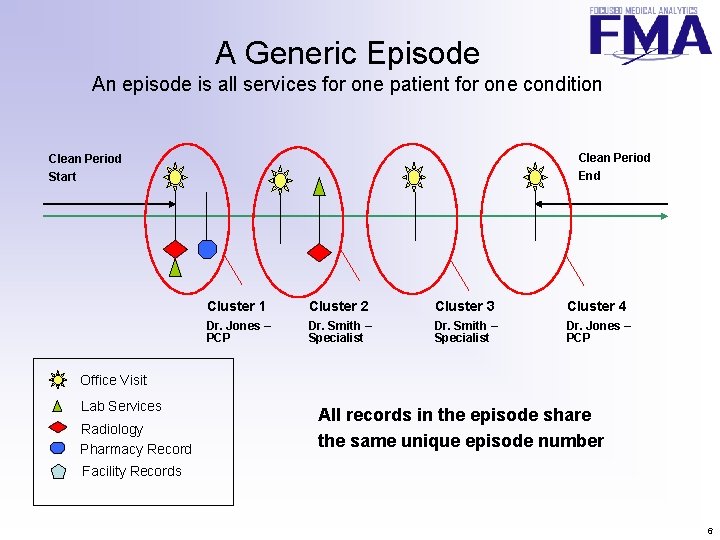
A Generic Episode An episode is all services for one patient for one condition Clean Period End Clean Period Start Cluster 1 Cluster 2 Cluster 3 Cluster 4 Dr. Jones – PCP Dr. Smith – Specialist Dr. Jones – PCP Office Visit Lab Services Radiology Pharmacy Record All records in the episode share the same unique episode number Facility Records 6
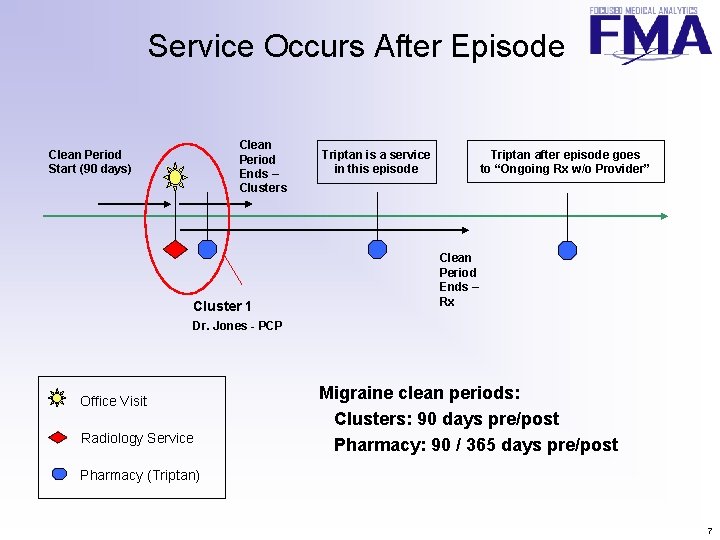
Service Occurs After Episode Clean Period Ends – Clusters Clean Period Start (90 days) Cluster 1 Triptan after episode goes to “Ongoing Rx w/o Provider” Triptan is a service in this episode Clean Period Ends – Rx Dr. Jones - PCP Office Visit Radiology Service Migraine clean periods: Clusters: 90 days pre/post Pharmacy: 90 / 365 days pre/post Pharmacy (Triptan) 7
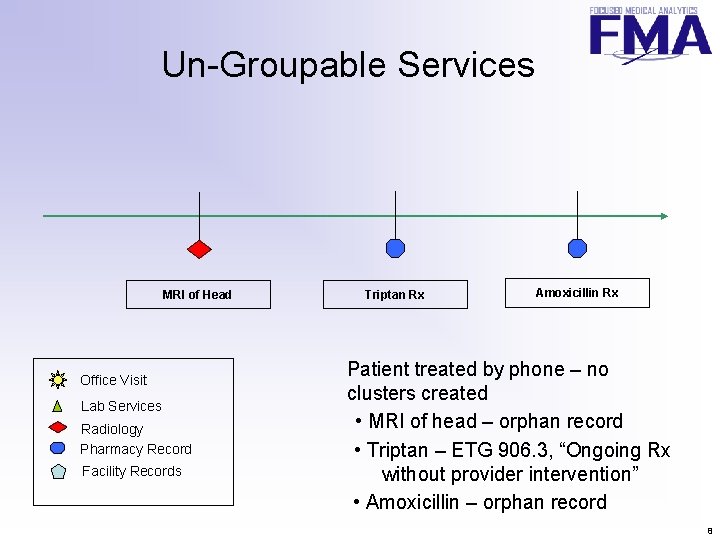
Un-Groupable Services MRI of Head Office Visit Lab Services Radiology Pharmacy Record Facility Records Triptan Rx Amoxicillin Rx Patient treated by phone – no clusters created • MRI of head – orphan record • Triptan – ETG 906. 3, “Ongoing Rx without provider intervention” • Amoxicillin – orphan record 8
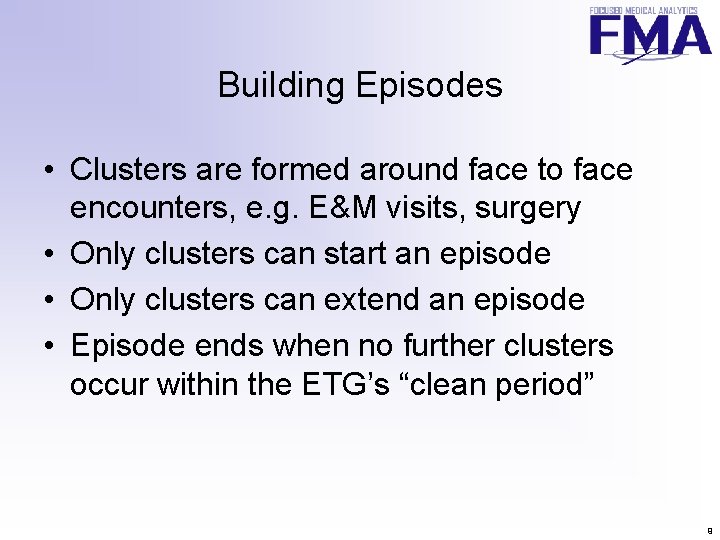
Building Episodes • Clusters are formed around face to face encounters, e. g. E&M visits, surgery • Only clusters can start an episode • Only clusters can extend an episode • Episode ends when no further clusters occur within the ETG’s “clean period” 9
Building Episode (continued) • Non-face to face services are considered incidental to the evaluation, management, or treatment of the patient. – X-rays, lab tests, facility, and pharmaceuticals. • Non-face to face services do not extend the date range of an episode. 10
How Long is an Episode? • An episode is complete in absence of a new cluster for the condition’s clean period. • The more chronic a condition, the longer the clean period for an ETG – Sinusitis, acute – Sinusitis, chronic 60 days 180 days • For chronic diseases Symmetry episodes are 365 days. – Benign Hypertension without comorbidity – 365 days 11
ICD-9 Diagnosis Codes For each ETG, the grouper identifies diagnosis codes as: • Primary • Incidental • Comorbid • Complicating 12
Diagnosis Codes • Primary – Will begin an episode with this ETG if no clinically appropriate episode is open – Could continue an episode – E. g. Office visit for sinusitis • Incidental – May group to an episode with this ETG if within the respective clean period – E. g. office visit with Dx code of “cough” groups to sinusitis if sinusitis episode is open 13
Diagnosis Codes (continued) • Comorbidity – Based on claims data outside the episode – Will shift an ETG, but record does not belong to the episode • e. g. , Benign hypertension w/o comorbidity (ETG 281) to Benign hypertension w/ comorbidity (ETG 280) • Complication – More severe ETG – May shift an ETG, but no new episode opens • Chronic Bronchitis w/o Complication (ETG 392) • Chronic Bronchitis w/ Complication (ETG 390) 14
CPT-4 Procedure Codes • Can be a defining surgery – Shifts from “without” to “with surgery” ETG • For each ETG, Symmetry ranks procedure codes as: – High – best match – Medium – Low 15
Methodology Constructs • Clinically homogenous • Intuitive conditions • Manageable number 16
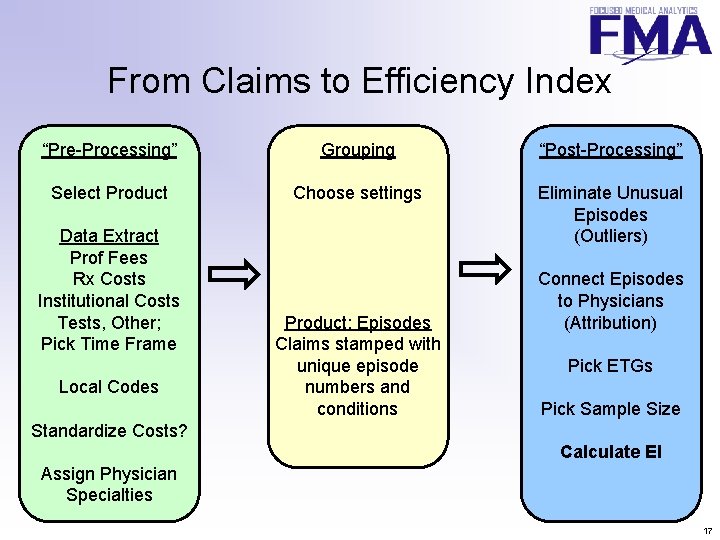
From Claims to Efficiency Index “Pre-Processing” Grouping “Post-Processing” Select Product Choose settings Eliminate Unusual Episodes (Outliers) Data Extract Prof Fees Rx Costs Institutional Costs Tests, Other; Pick Time Frame Local Codes Product: Episodes Claims stamped with unique episode numbers and conditions Connect Episodes to Physicians (Attribution) Pick ETGs Pick Sample Size Standardize Costs? Calculate EI Assign Physician Specialties 17
Conclusion – Episodes of Care • All clinically related services for one patient for a discrete diagnostic condition from the onset of symptoms until treatment is complete. • One episode pertains only to one patient • But patients can be in multiple episodes • Grouping is just one part of the process • Important work occurs both before and after the actual grouping process 18

Questions? 19
Where Do Ungrouped Services Go? • Medications the grouper knows about go to “Ongoing Rx without provider intervention” – – Migraine Hyperlipidemia Pain treatment And a few dozen others • Other services the grouper knows about go to an ETG but not an episode – Example: Stress thallium tests assigned to ETG 311, Cardiology signs and symptoms • Orphan drug records: ETG 991 • Orphan services: ETG 999 • Error code ETGs 20
- Slides: 20