
Building Envelope Subprogram Buildings XIII Conference DOE Workshop
Building Envelope Subprogram Buildings XIII Conference, DOE Workshop, December 8 Sven Mumme Technology Manager, Emerging Technologies Building Technologies Office
2014 Building Energy Use – U. S. ~76% of all electricity ~40% of all primary energy In 2050, 75% of the existing building stock will still be in service. 2
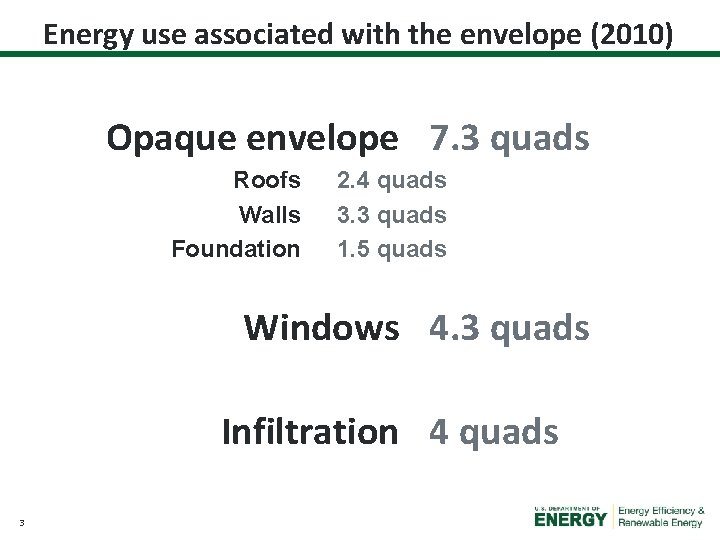
Energy use associated with the envelope (2010) Opaque envelope 7. 3 quads Roofs Walls Foundation 2. 4 quads 3. 3 quads 1. 5 quads Windows 4. 3 quads Infiltration 4 quads 3
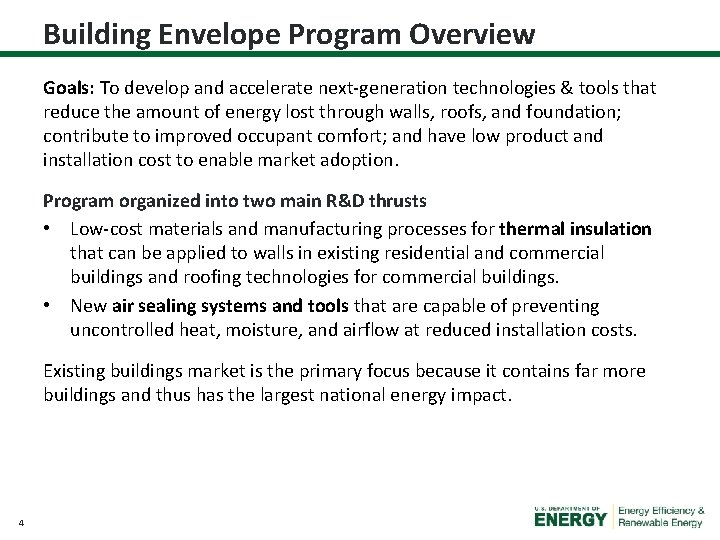
Building Envelope Program Overview Goals: To develop and accelerate next-generation technologies & tools that reduce the amount of energy lost through walls, roofs, and foundation; contribute to improved occupant comfort; and have low product and installation cost to enable market adoption. Program organized into two main R&D thrusts • Low-cost materials and manufacturing processes for thermal insulation that can be applied to walls in existing residential and commercial buildings and roofing technologies for commercial buildings. • New air sealing systems and tools that are capable of preventing uncontrolled heat, moisture, and airflow at reduced installation costs. Existing buildings market is the primary focus because it contains far more buildings and thus has the largest national energy impact. 4
Insulating Materials R&D Strategy – develop new insulation materials and manufacturing processes, with a focus on retrofit suitability, that offer improvements in key areas: • Improved energy performance (R-value/inch) with exceptional moisture and mold control • Reduced installed cost and payback period • Improved tolerance for installation error; reduction in installation effort 5
Air Sealing R&D Strategy – improve air sealing materials and performance verification methods with a focus on existing buildings: • Develop cost-effective air sealing systems that regulate heat, air, and moisture flows • Reduce the installation costs of high-performance air sealing technologies (new & retrofit) • Develop methods to detect infiltration and credibly estimate the potential energy savings and other metrics (for e. g. , durability, comfort, and infiltration/exfiltration) from remediation • Readily communicate the benefits to consumers to accelerate market penetration 6
Active R&D Projects Insulating materials projects • R 10 insulated vinyl siding w/ MAI panels (ORNL & Royal Building Products) • R 25 polyiso & MAI panel composite board (ORNL & Firestone & Nano. Pore) • R-12/inch insulation using nanoparticles (LBNL & ORNL) Air-sealing projects • Analysis of the performance of air barrier systems (ORNL) • Development and validation of an attic thermal model (Fraunhofer) • Evaluations of air barriers for commercial buildings (ORNL & 3 M) • Acoustic building infiltration measurement system (Argonne / Sonic. LQ) • Infiltration diagnostics tool using laser line heating & IR (Iowa State Univ. ) 7
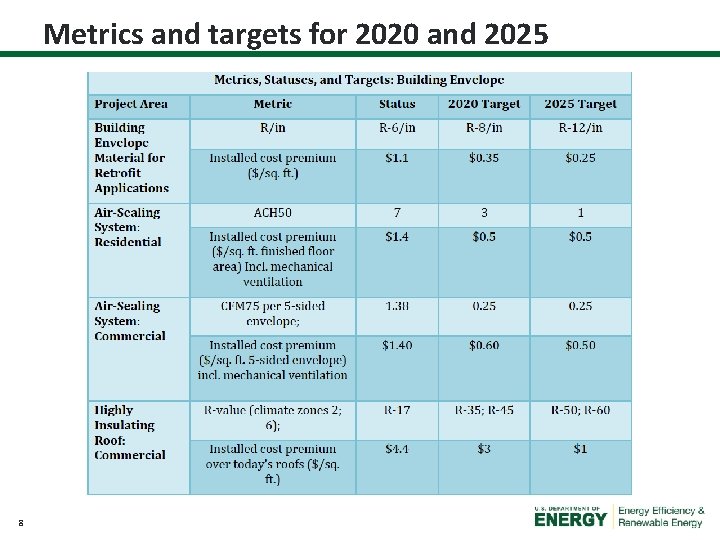
Metrics and targets for 2020 and 2025 8
2016 BENEFIT envelope topics • Infiltration Diagnostic Technologies – Seeking novel approaches for measuring envelope infiltration • • • Suitable for all building types and sizes Usable in occupied buildings Accurate regardless of outdoor weather conditions Low effort for setup and teardown Able to quantify both location and extent of infiltration • Advanced Air-Sealing Technologies for Existing Buildings – Seeking cost-effective air-sealing technologies that are well-suited to retrofit applications • • • 9 Manages air and moisture in/exfiltration Minimal disassembly of the envelope Reduced installation complexity and improved quality assurance Minimal disruption to building occupants during retrofit (incl. rapid) Building indoor air quality needs to be considered
Future opportunities for the program • Quick and easy building envelope retrofit solutions that reduce cost and complexity – High-quality standardized construction subcomponents / customizable retrofit solutions (e. g. , plug-and-play panels) – Non-intrusive and non-destructive installation approaches – Materials and products with a high tolerance for error in installation • “Seamless” interfaces/transitions between functional areas (e. g. , roof-walls, walls-windows) – Eliminate thermal bridges in the envelope system – E. g. , new envelope materials that can function for both walls and roofs to produce affordable air seals between the roof and the walls. 10
Future opportunities for the program • Credible quantification of the benefits of highperformance envelope technologies for buyers • Determination of performance metrics or measurement techniques for building envelope – Measurement techniques and metrics related to durability, comfort, and infiltration/exfiltration for commercial buildings – Low- or no-cost uncontrolled heat and mass-flow diagnostics 11
Thank You Questions? Contact Info Sven Mumme Building Envelope Technology Manager Building Technologies Office U. S. Department of Energy Sven. Mumme@ee. doe. gov 12
- Slides: 12