
BUILDING ENERGY CODES PROGRAM ANSIASHRAEIES Standard 90 1

BUILDING ENERGY CODES PROGRAM ANSI/ASHRAE/IES Standard 90. 1 -2016: Envelope Prepared by Pacific Northwest National Laboratory for the U. S. Department of Energy 1 March 2017 – PNNL-SA-124574 BUILDING ENERGY CODES PROGRAM www. energycodes. gov
Acknowledgements PNNL and DOE would like to thank ASHRAE Standing Standard Project Committee 90. 1 for their contributions to the development of this presentation and their technical review of the content. 2 BUILDING ENERGY CODES PROGRAM www. energycodes. gov
Summary of Changes • Comprehensive update to the fenestration prescriptive requirements in Tables 5 -5 -0 through 5 -5 -8 • Orientation requirements for vertical fenestration were tightened • SHGC credit for shading by permanent projections was modified to correct how it addressed north-facing fenestration • Whole building air leakage testing added as an option • Thresholds for conditioned space were lowered 3 BUILDING ENERGY CODES PROGRAM www. energycodes. gov
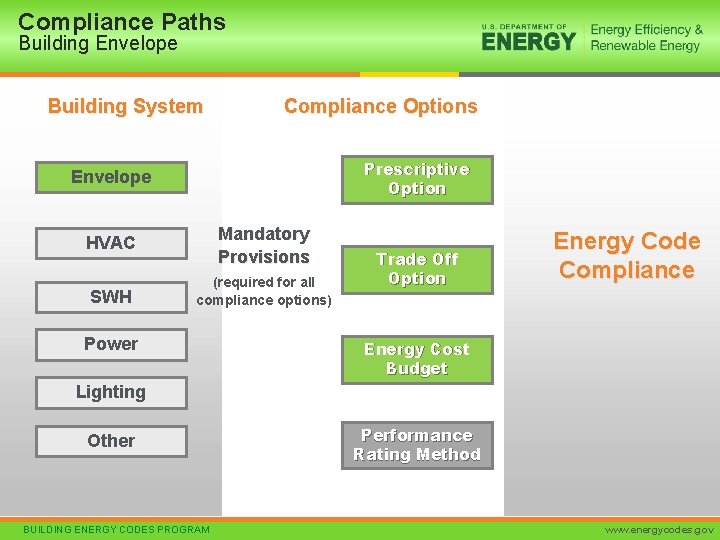
Compliance Paths Building Envelope Building System Compliance Options Prescriptive Option Envelope HVAC Mandatory Provisions SWH (required for all compliance options) Power Trade Off Option Energy Code Compliance Energy Cost Budget Lighting Other Performance Rating Method 4 BUILDING ENERGY CODES PROGRAM www. energycodes. gov
Section 5 Building Envelope Overview 5. 1 – 5. 4 Section 5. 1 General – – Scope Space-Conditioning Categories Envelope Alterations Climate Section 5. 2 Definition of Compliance Paths Section 5. 3 Simplified Building (Not Used) Section 5. 4 Mandatory Provisions – – – Insulation Fenestration and Doors Air Leakage Loading Dock Weatherseals Vestibules 5 BUILDING ENERGY CODES PROGRAM www. energycodes. gov
Section 5 Building Envelope Overview (cont’d) Prescriptive Building Envelope Option (Section 5. 5) • Opaque Areas • Fenestration Building Envelope Trade-Off Option (Section 5. 6) Submittals (Section 5. 7) Product Information and Installation Requirements (Section 5. 8) Inspection and Verification (Section 5. 9) 6 BUILDING ENERGY CODES PROGRAM www. energycodes. gov
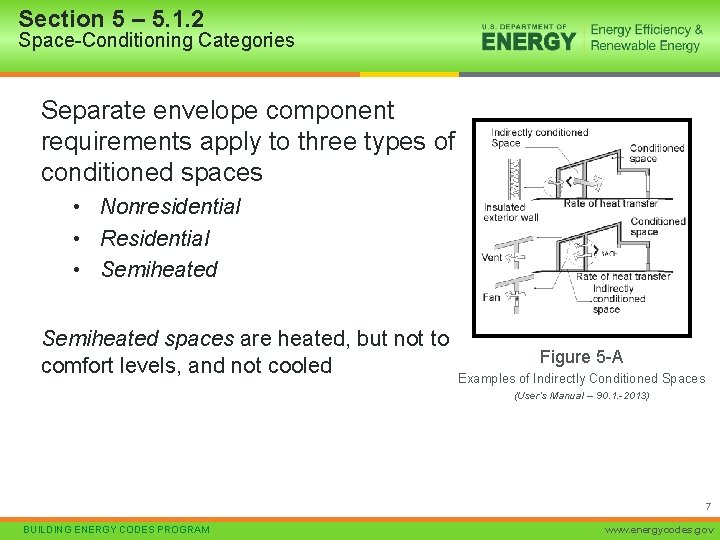
Section 5 – 5. 1. 2 Space-Conditioning Categories Separate envelope component requirements apply to three types of conditioned spaces • Nonresidential • Residential • Semiheated spaces are heated, but not to comfort levels, and not cooled Figure 5 -A Examples of Indirectly Conditioned Spaces (User’s Manual – 90. 1. -2013) 7 BUILDING ENERGY CODES PROGRAM www. energycodes. gov
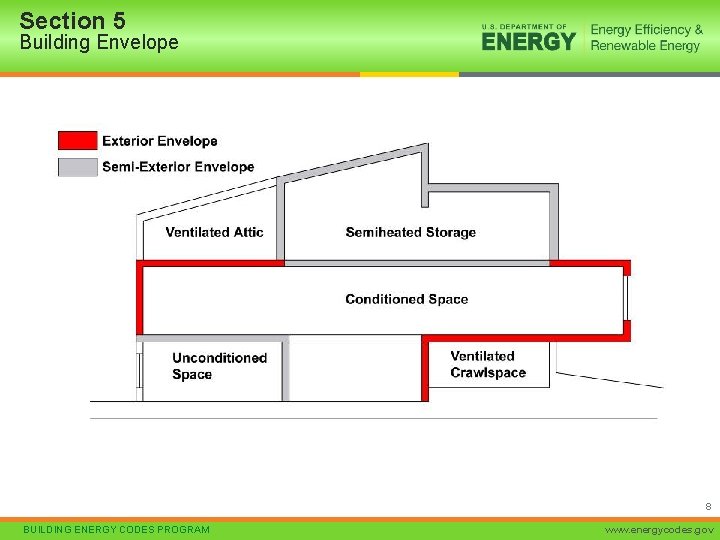
Section 5 Building Envelope 8 BUILDING ENERGY CODES PROGRAM www. energycodes. gov
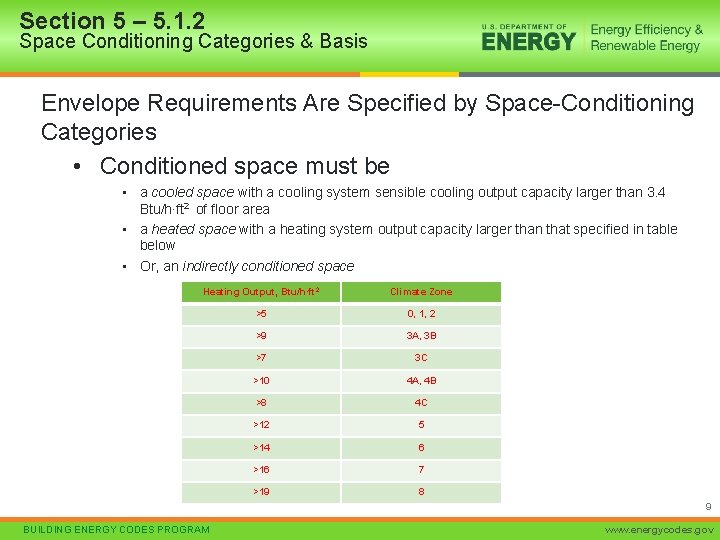
Section 5 – 5. 1. 2 Space Conditioning Categories & Basis Envelope Requirements Are Specified by Space-Conditioning Categories • Conditioned space must be • a cooled space with a cooling system sensible cooling output capacity larger than 3. 4 Btu/h∙ft 2 of floor area • a heated space with a heating system output capacity larger than that specified in table below • Or, an indirectly conditioned space Heating Output, Btu/h∙ft 2 Climate Zone >5 0, 1, 2 >9 3 A, 3 B >7 3 C >10 4 A, 4 B >8 4 C >12 5 >14 6 >16 7 >19 8 9 BUILDING ENERGY CODES PROGRAM www. energycodes. gov
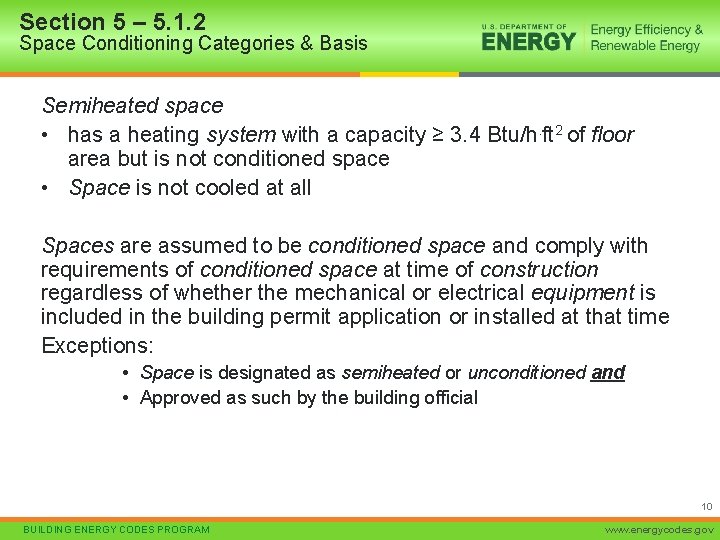
Section 5 – 5. 1. 2 Space Conditioning Categories & Basis Semiheated space • has a heating system with a capacity ≥ 3. 4 Btu/h. ft 2 of floor area but is not conditioned space • Space is not cooled at all Spaces are assumed to be conditioned space and comply with requirements of conditioned space at time of construction regardless of whether the mechanical or electrical equipment is included in the building permit application or installed at that time Exceptions: • Space is designated as semiheated or unconditioned and • Approved as such by the building official 10 BUILDING ENERGY CODES PROGRAM www. energycodes. gov
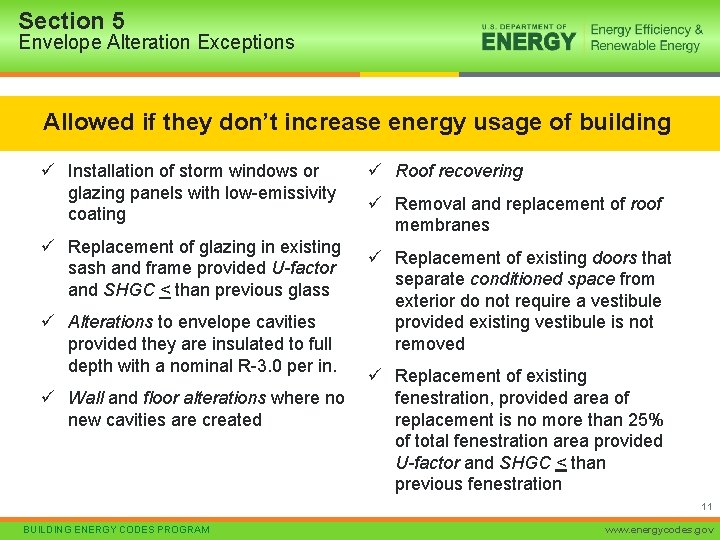
Section 5 Envelope Alteration Exceptions Allowed if they don’t increase energy usage of building ü Installation of storm windows or glazing panels with low-emissivity coating ü Replacement of glazing in existing sash and frame provided U-factor and SHGC < than previous glass ü Alterations to envelope cavities provided they are insulated to full depth with a nominal R-3. 0 per in. ü Wall and floor alterations where no new cavities are created ü Roof recovering ü Removal and replacement of roof membranes ü Replacement of existing doors that separate conditioned space from exterior do not require a vestibule provided existing vestibule is not removed ü Replacement of existing fenestration, provided area of replacement is no more than 25% of total fenestration area provided U-factor and SHGC < than previous fenestration 11 BUILDING ENERGY CODES PROGRAM www. energycodes. gov
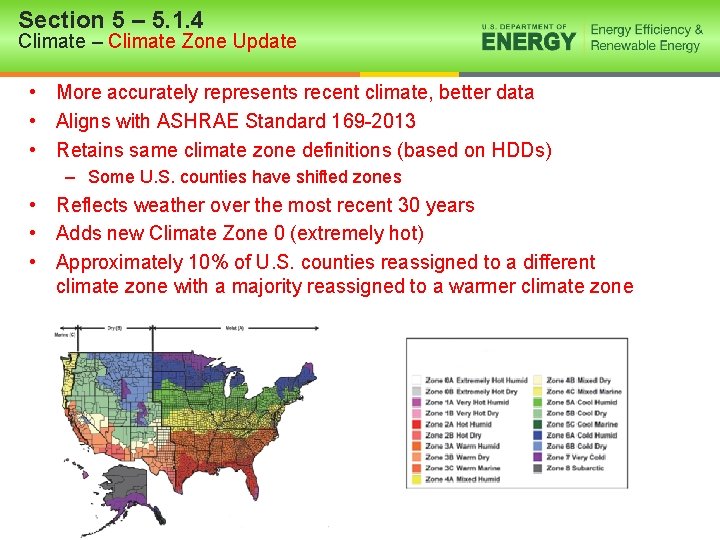
Section 5 – 5. 1. 4 Climate – Climate Zone Update • More accurately represents recent climate, better data • Aligns with ASHRAE Standard 169 -2013 • Retains same climate zone definitions (based on HDDs) – Some U. S. counties have shifted zones • Reflects weather over the most recent 30 years • Adds new Climate Zone 0 (extremely hot) • Approximately 10% of U. S. counties reassigned to a different climate zone with a majority reassigned to a warmer climate zone BUILDING ENERGY CODES PROGRAM 12 12 www. energycodes. gov
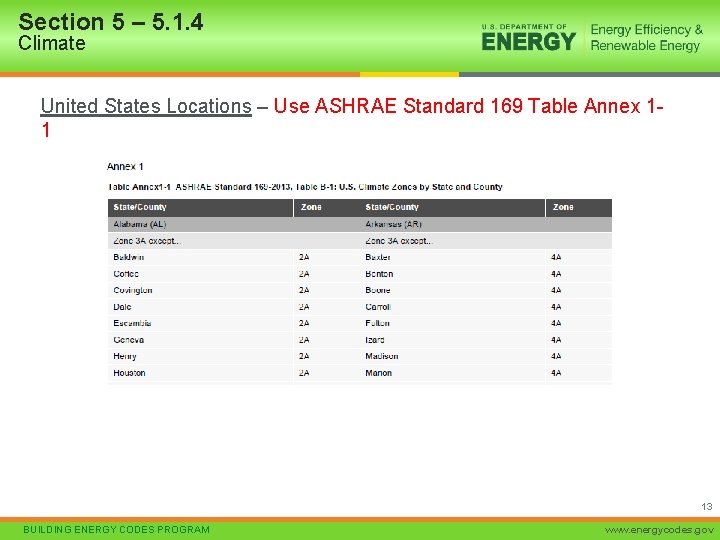
Section 5 – 5. 1. 4 Climate United States Locations – Use ASHRAE Standard 169 Table Annex 11 13 BUILDING ENERGY CODES PROGRAM www. energycodes. gov
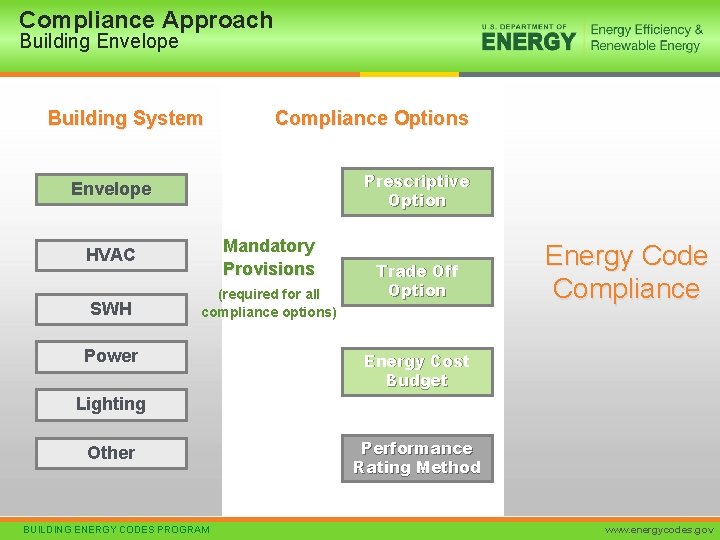
Compliance Approach Building Envelope Building System Compliance Options Prescriptive Option Envelope HVAC Mandatory Provisions SWH (required for all compliance options) Power Trade Off Option Energy Code Compliance Energy Cost Budget Lighting Other Performance Rating Method 14 BUILDING ENERGY CODES PROGRAM www. energycodes. gov
Section 5 – 5. 4 Mandatory Provisions Insulation (Section 5. 4. 1 refers to 5. 8. 1. through 5. 8. 1. 10) ü Labeling (Section 5. 8. 1. 1) ü Compliance with Manufacturers’ Requirements (Section 5. 8. 1. 2) ü Loose-Fill Insulation Limitation (Section 5. 8. 1. 3) ü Baffles (Section 5. 8. 1. 4) ü Substantial Contact (Section 5. 8. 1. 5) ü Recessed Equipment (Section 5. 8. 1. 6) ü Insulation Protection (Section 5. 8. 1. 7) ü Location of roof insulation (Section 5. 8. 1. 8) ü Extent of Insulation (Section 5. 8. 1. 9) ü Joints in Rigid Insulation (Section 5. 8. 1. 10) 15 BUILDING ENERGY CODES PROGRAM www. energycodes. gov
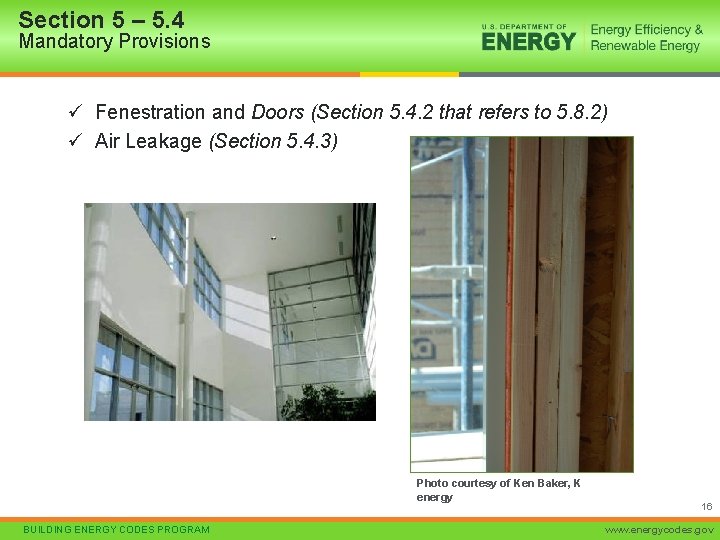
Section 5 – 5. 4 Mandatory Provisions ü Fenestration and Doors (Section 5. 4. 2 that refers to 5. 8. 2) ü Air Leakage (Section 5. 4. 3) Photo courtesy of Ken Baker, K energy BUILDING ENERGY CODES PROGRAM 16 www. energycodes. gov
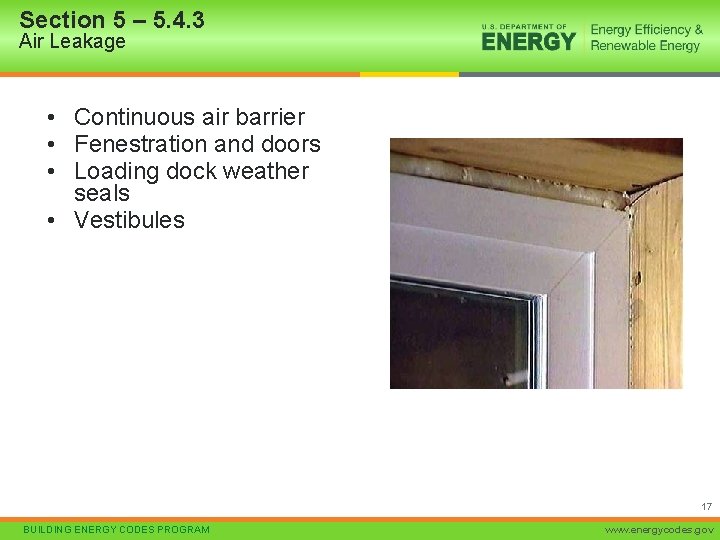
Section 5 – 5. 4. 3 Air Leakage • Continuous air barrier • Fenestration and doors • Loading dock weather seals • Vestibules 17 BUILDING ENERGY CODES PROGRAM www. energycodes. gov
Section 5 – 5. 4. 3. 1 Air Leakage – Continuous Air Barrier • Continuous air barrier required except in: – Semiheated spaces in climate zones 0 -6 – Single wythe concrete masonry buildings in climate zone 2 B • Plans – Air barrier components identified or noted in construction documents – Joints, intersections, and penetrations of air barrier components (incl. lighting fixtures) detailed – To extend over all surfaces of building envelope at lowest floor, exterior walls, and ceiling or roof – Designed to resist positive and negative pressures from wind, stack effect, and mechanical ventilation 18 BUILDING ENERGY CODES PROGRAM www. energycodes. gov
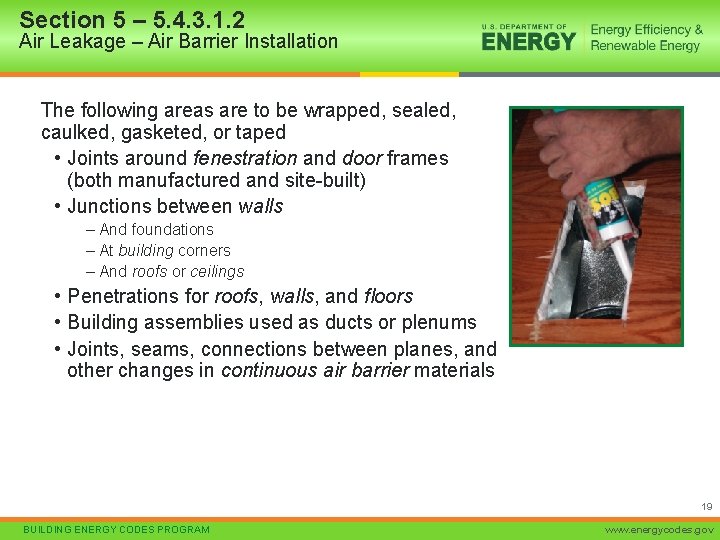
Section 5 – 5. 4. 3. 1. 2 Air Leakage – Air Barrier Installation The following areas are to be wrapped, sealed, caulked, gasketed, or taped • Joints around fenestration and door frames (both manufactured and site-built) • Junctions between walls – And foundations – At building corners – And roofs or ceilings • Penetrations for roofs, walls, and floors • Building assemblies used as ducts or plenums • Joints, seams, connections between planes, and other changes in continuous air barrier materials 19 BUILDING ENERGY CODES PROGRAM www. energycodes. gov
Section 5 – 5. 4. 3. 1. 3 Air Leakage – Testing, Acceptable Materials, and Assemblies New Whole-Building Testing Option 3 Options to Comply (a, b, or c): Whole-Building Testing Materials Testing Assemblies of Materials Testing 20 BUILDING ENERGY CODES PROGRAM www. energycodes. gov
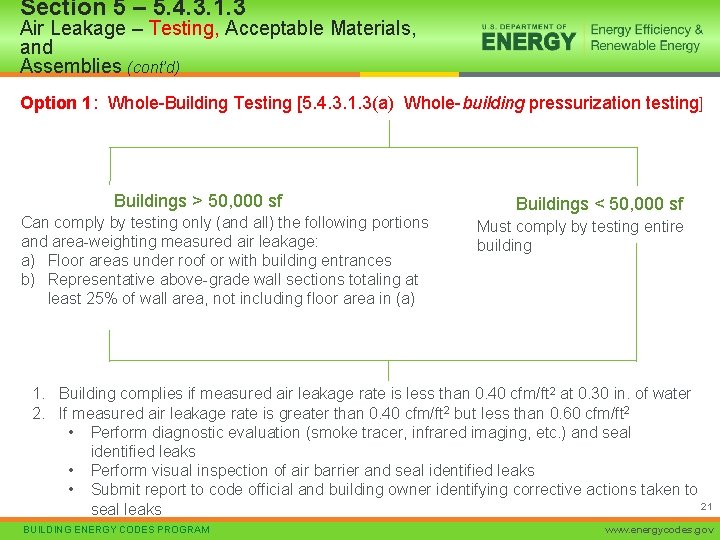
Section 5 – 5. 4. 3. 1. 3 Air Leakage – Testing, Acceptable Materials, and Assemblies (cont’d) Option 1: Whole-Building Testing [5. 4. 3. 1. 3(a) Whole-building pressurization testing] Buildings > 50, 000 sf Can comply by testing only (and all) the following portions and area-weighting measured air leakage: a) Floor areas under roof or with building entrances b) Representative above-grade wall sections totaling at least 25% of wall area, not including floor area in (a) Buildings < 50, 000 sf Must comply by testing entire building 1. Building complies if measured air leakage rate is less than 0. 40 cfm/ft 2 at 0. 30 in. of water 2. If measured air leakage rate is greater than 0. 40 cfm/ft 2 but less than 0. 60 cfm/ft 2 • Perform diagnostic evaluation (smoke tracer, infrared imaging, etc. ) and seal identified leaks • Perform visual inspection of air barrier and seal identified leaks • Submit report to code official and building owner identifying corrective actions taken to 21 seal leaks BUILDING ENERGY CODES PROGRAM www. energycodes. gov
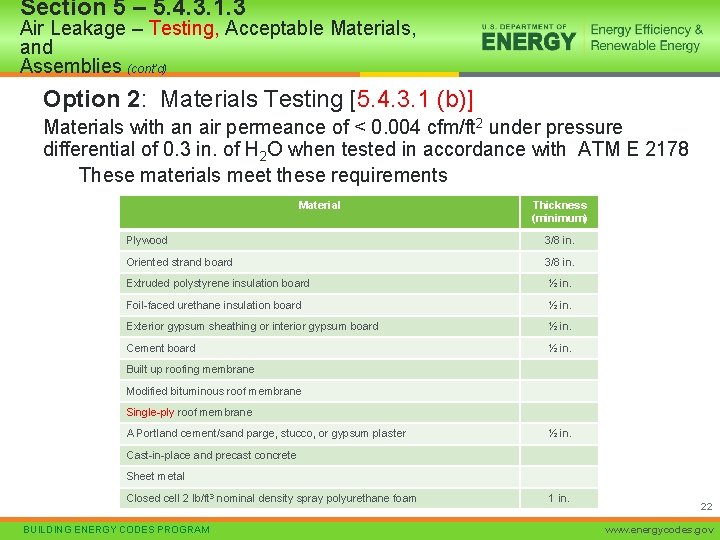
Section 5 – 5. 4. 3. 1. 3 Air Leakage – Testing, Acceptable Materials, and Assemblies (cont’d) Option 2: Materials Testing [5. 4. 3. 1 (b)] Materials with an air permeance of < 0. 004 cfm/ft 2 under pressure differential of 0. 3 in. of H 2 O when tested in accordance with ATM E 2178 These materials meet these requirements Material Thickness (minimum) Plywood 3/8 in. Oriented strand board 3/8 in. Extruded polystyrene insulation board ½ in. Foil-faced urethane insulation board ½ in. Exterior gypsum sheathing or interior gypsum board ½ in. Cement board ½ in. Built up roofing membrane Modified bituminous roof membrane Single-ply roof membrane A Portland cement/sand parge, stucco, or gypsum plaster ½ in. Cast-in-place and precast concrete Sheet metal Closed cell 2 lb/ft 3 nominal density spray polyurethane foam BUILDING ENERGY CODES PROGRAM 1 in. 22 www. energycodes. gov
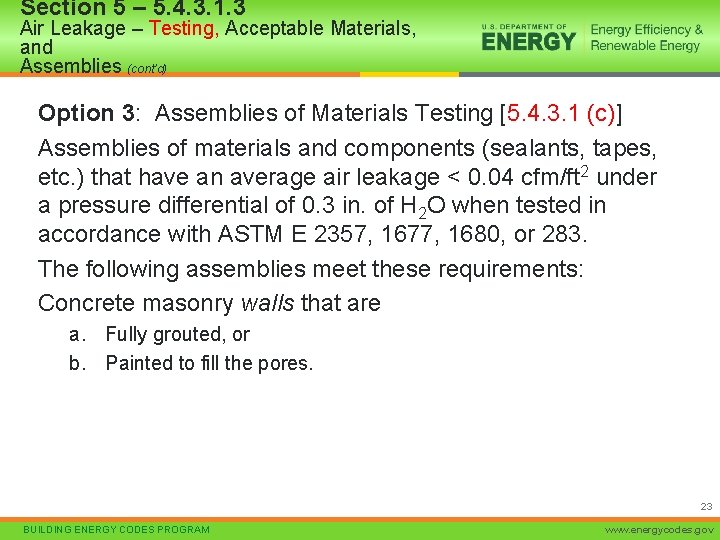
Section 5 – 5. 4. 3. 1. 3 Air Leakage – Testing, Acceptable Materials, and Assemblies (cont’d) Option 3: Assemblies of Materials Testing [5. 4. 3. 1 (c)] Assemblies of materials and components (sealants, tapes, etc. ) that have an average air leakage < 0. 04 cfm/ft 2 under a pressure differential of 0. 3 in. of H 2 O when tested in accordance with ASTM E 2357, 1677, 1680, or 283. The following assemblies meet these requirements: Concrete masonry walls that are a. Fully grouted, or b. Painted to fill the pores. 23 BUILDING ENERGY CODES PROGRAM www. energycodes. gov
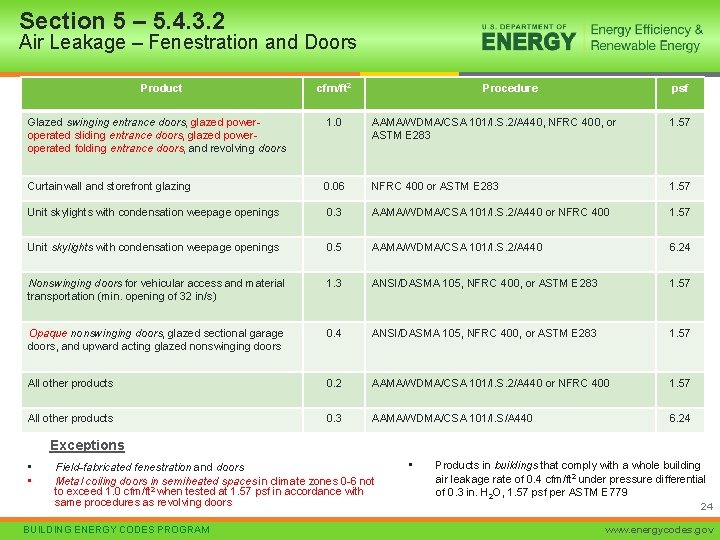
Section 5 – 5. 4. 3. 2 Air Leakage – Fenestration and Doors Product cfm/ft 2 Procedure psf Glazed swinging entrance doors, glazed poweroperated sliding entrance doors, glazed poweroperated folding entrance doors, and revolving doors 1. 0 AAMA/WDMA/CSA 101/I. S. 2/A 440, NFRC 400, or ASTM E 283 1. 57 Curtainwall and storefront glazing 0. 06 NFRC 400 or ASTM E 283 1. 57 Unit skylights with condensation weepage openings 0. 3 AAMA/WDMA/CSA 101/I. S. 2/A 440 or NFRC 400 1. 57 Unit skylights with condensation weepage openings 0. 5 AAMA/WDMA/CSA 101/I. S. 2/A 440 6. 24 Nonswinging doors for vehicular access and material transportation (min. opening of 32 in/s) 1. 3 ANSI/DASMA 105, NFRC 400, or ASTM E 283 1. 57 Opaque nonswinging doors, glazed sectional garage doors, and upward acting glazed nonswinging doors 0. 4 ANSI/DASMA 105, NFRC 400, or ASTM E 283 1. 57 All other products 0. 2 AAMA/WDMA/CSA 101/I. S. 2/A 440 or NFRC 400 1. 57 All other products 0. 3 AAMA/WDMA/CSA 101/I. S/A 440 6. 24 Exceptions • • Field-fabricated fenestration and doors Metal coiling doors in semiheated spaces in climate zones 0 -6 not to exceed 1. 0 cfm/ft 2 when tested at 1. 57 psf in accordance with same procedures as revolving doors BUILDING ENERGY CODES PROGRAM • Products in buildings that comply with a whole building air leakage rate of 0. 4 cfm/ft 2 under pressure differential of 0. 3 in. H 2 O, 1. 57 psf per ASTM E 779 24 www. energycodes. gov
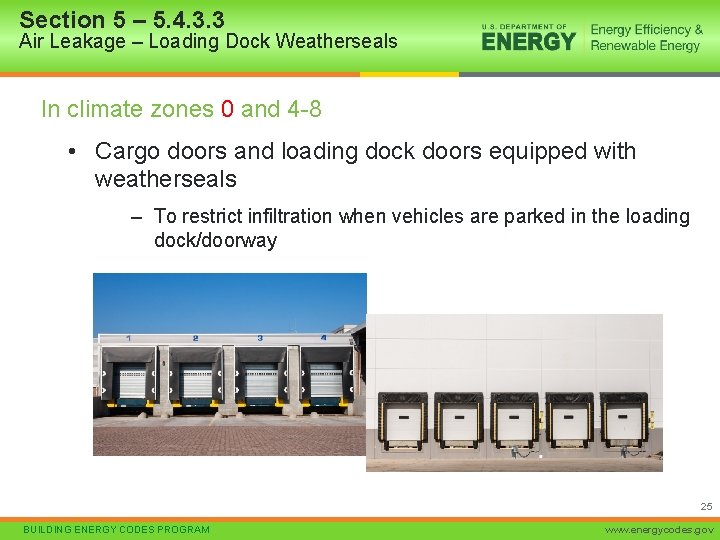
Section 5 – 5. 4. 3. 3 Air Leakage – Loading Dock Weatherseals In climate zones 0 and 4 -8 • Cargo doors and loading dock doors equipped with weatherseals – To restrict infiltration when vehicles are parked in the loading dock/doorway 25 BUILDING ENERGY CODES PROGRAM www. energycodes. gov
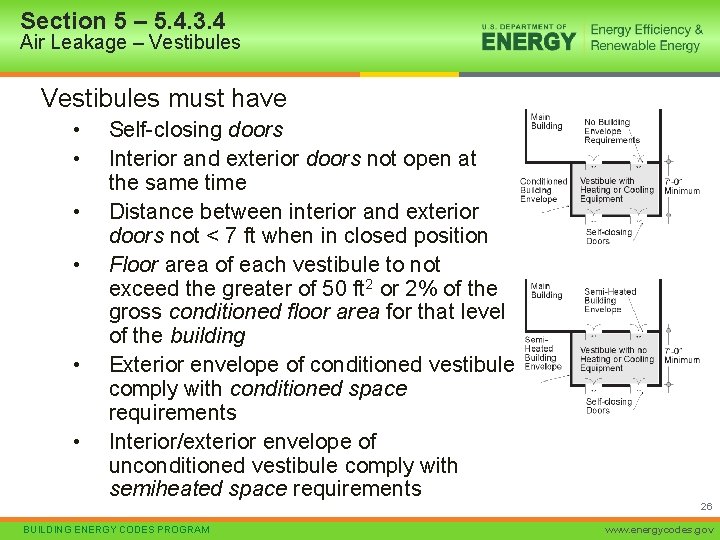
Section 5 – 5. 4. 3. 4 Air Leakage – Vestibules must have • • • Self-closing doors Interior and exterior doors not open at the same time Distance between interior and exterior doors not < 7 ft when in closed position Floor area of each vestibule to not exceed the greater of 50 ft 2 or 2% of the gross conditioned floor area for that level of the building Exterior envelope of conditioned vestibule comply with conditioned space requirements Interior/exterior envelope of unconditioned vestibule comply with semiheated space requirements 26 BUILDING ENERGY CODES PROGRAM www. energycodes. gov
Section 5 Air Leakage – Vestibules Exceptions • Non-entrance doors or doors opening from dwelling unit • Building entrances with revolving doors • All building entrances in climate zones 1 and 2 OR in buildings < 4 stories and < 10, 000 ft 2 in gross conditioned floor area in climate zone 3 OR in buildings < 1000 ft 2 in gross conditioned floor area in climate zones 0 and 4 -8 • All doors that open from spaces < 3000 ft 2 and separate from building entrance • Semiheated spaces • Enclosed elevator lobbies for building entrances directly from parking garages 27 BUILDING ENERGY CODES PROGRAM www. energycodes. gov
Section 5 – 5. 4. 3. 4 Air Leakage – Vestibules opening into large conditioned spaces (large retail) • spaces having a gross conditioned floor area for that level of the building of 40, 000 ft 2 and greater, • and when the doors opening into and out of the vestibule are equipped with automatic, electrically driven, self-closing devices, the interior and exterior doors shall have a minimum distance between them of not less than 16 ft. 28 BUILDING ENERGY CODES PROGRAM www. energycodes. gov
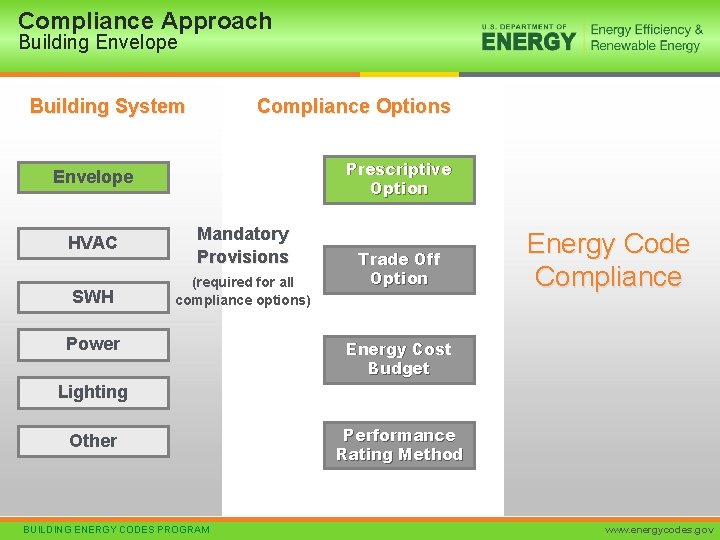
Compliance Approach Building Envelope Building System Compliance Options Prescriptive Option Envelope HVAC Mandatory Provisions SWH (required for all compliance options) Power Trade Off Option Energy Code Compliance Energy Cost Budget Lighting Other Performance Rating Method 29 BUILDING ENERGY CODES PROGRAM www. energycodes. gov
Section 5 – 5. 5 Prescriptive Building Envelope Option Each envelope component must separately meet designated space conditioning requirements: (Nonresidential, Residential, and/or Semiheated) Opaque Areas (5. 5. 3) Fenestration (5. 5. 4) • • WWR ≤ 40% of gross wall area Skylight-roof ratio ≤ 3% of roof area Prescriptive requirements for each component specified by climate zone and space conditioning category (Tables 5. 5 -0 through 5. 5 -8) • • Insulation levels for roofs, walls, floors and doors Fenestration criteria for windows, glazed doors and skylights 30 BUILDING ENERGY CODES PROGRAM www. energycodes. gov
Section 5 – 5. 5. 3 Opaque Areas Compliance ü Meet or exceed minimum R-values in table – Only R-value of insulation, not to include air films, etc. OR ü Meet maximum U-factor, C-factor, or F-factor for the entire assembly (typical construction assemblies described in Appendix A) OR ü Perform area-weighted average U-factor, C-factor, or F-factor – Only if there are multiple assemblies within a single class of construction for a single space-conditioning category 31 BUILDING ENERGY CODES PROGRAM www. energycodes. gov
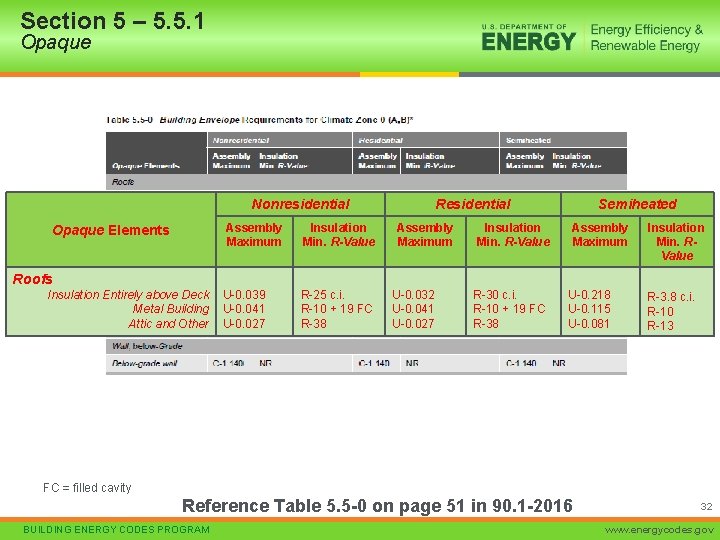
Section 5 – 5. 5. 1 Opaque Nonresidential Opaque Elements Assembly Maximum Insulation Min. R-Value U-0. 039 U-0. 041 U-0. 027 R-25 c. i. R-10 + 19 FC R-38 Residential Assembly Maximum Insulation Min. R-Value Semiheated Assembly Maximum Insulation Min. RValue Roofs Insulation Entirely above Deck Metal Building Attic and Other U-0. 032 U-0. 041 U-0. 027 R-30 c. i. R-10 + 19 FC R-38 U-0. 218 U-0. 115 U-0. 081 R-3. 8 c. i. R-10 R-13 FC = filled cavity Reference Table 5. 5 -0 on page 51 in 90. 1 -2016 BUILDING ENERGY CODES PROGRAM 32 www. energycodes. gov
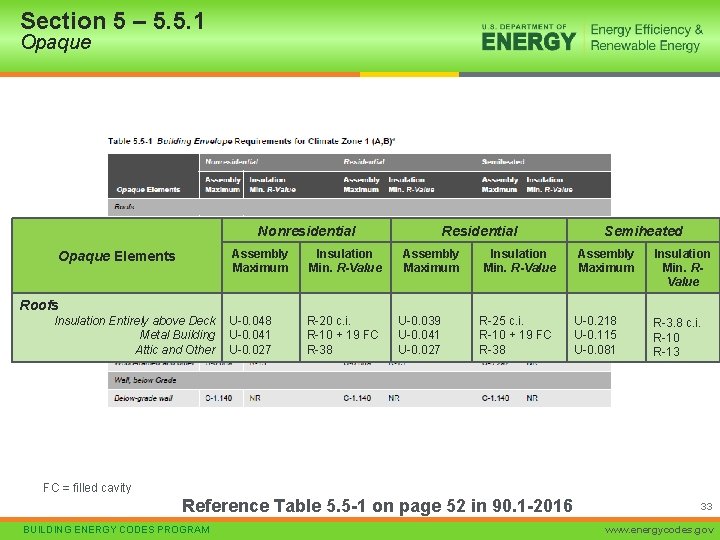
Section 5 – 5. 5. 1 Opaque Nonresidential Opaque Elements Assembly Maximum Insulation Min. R-Value U-0. 048 U-0. 041 U-0. 027 R-20 c. i. R-10 + 19 FC R-38 Residential Assembly Maximum Insulation Min. R-Value Semiheated Assembly Maximum Insulation Min. RValue Roofs Insulation Entirely above Deck Metal Building Attic and Other U-0. 039 U-0. 041 U-0. 027 R-25 c. i. R-10 + 19 FC R-38 U-0. 218 U-0. 115 U-0. 081 R-3. 8 c. i. R-10 R-13 FC = filled cavity Reference Table 5. 5 -1 on page 52 in 90. 1 -2016 BUILDING ENERGY CODES PROGRAM 33 www. energycodes. gov
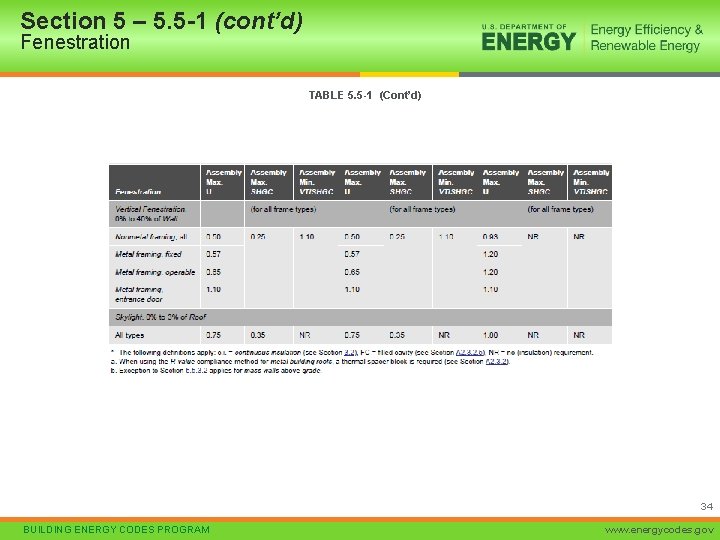
Section 5 – 5. 5 -1 (cont’d) Fenestration TABLE 5. 5 -1 (Cont’d) 34 BUILDING ENERGY CODES PROGRAM www. energycodes. gov
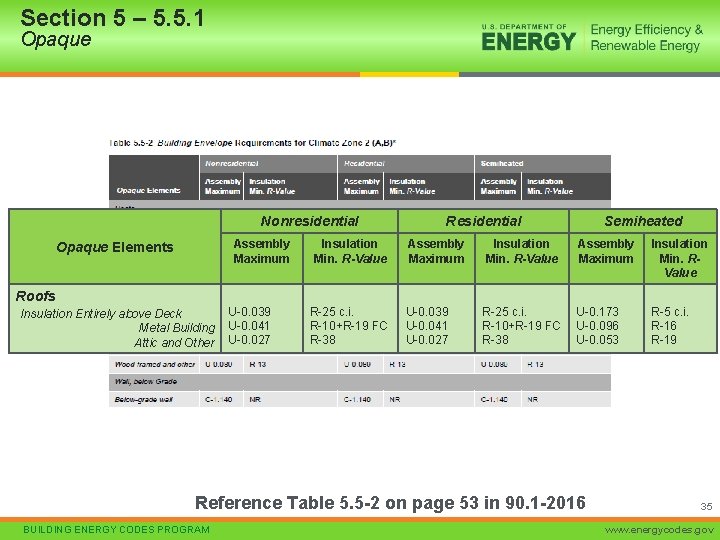
Section 5 – 5. 5. 1 Opaque Nonresidential Assembly Maximum Opaque Elements Insulation Min. R-Value Residential Assembly Maximum Insulation Min. R-Value Semiheated Assembly Maximum Insulation Min. RValue U-0. 173 U-0. 096 U-0. 053 R-5 c. i. R-16 R-19 Roofs Insulation Entirely above Deck Metal Building Attic and Other U-0. 039 U-0. 041 U-0. 027 R-25 c. i. R-10+R-19 FC R-38 Reference Table 5. 5 -2 on page 53 in 90. 1 -2016 BUILDING ENERGY CODES PROGRAM 35 www. energycodes. gov
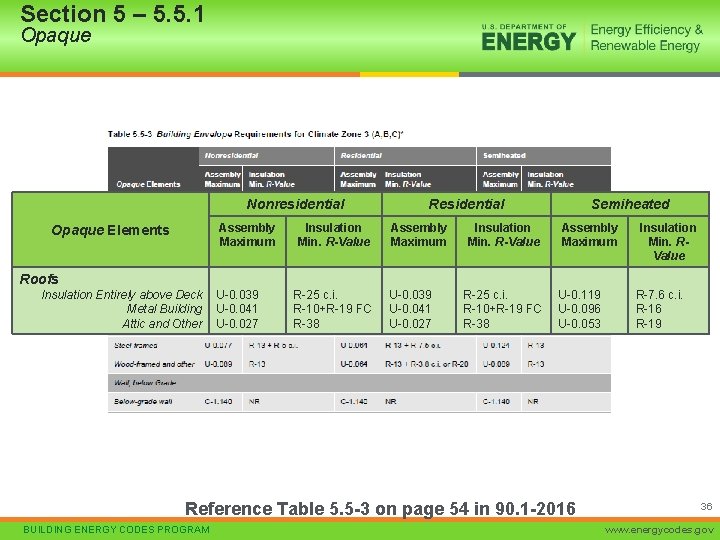
Section 5 – 5. 5. 1 Opaque Nonresidential Assembly Maximum Opaque Elements Insulation Min. R-Value Residential Assembly Maximum Insulation Min. R-Value Semiheated Assembly Maximum Insulation Min. RValue Roofs Insulation Entirely above Deck Metal Building Attic and Other U-0. 039 U-0. 041 U-0. 027 R-25 c. i. R-10+R-19 FC R-38 U-0. 119 U-0. 096 U-0. 053 Reference Table 5. 5 -3 on page 54 in 90. 1 -2016 BUILDING ENERGY CODES PROGRAM R-7. 6 c. i. R-16 R-19 36 www. energycodes. gov
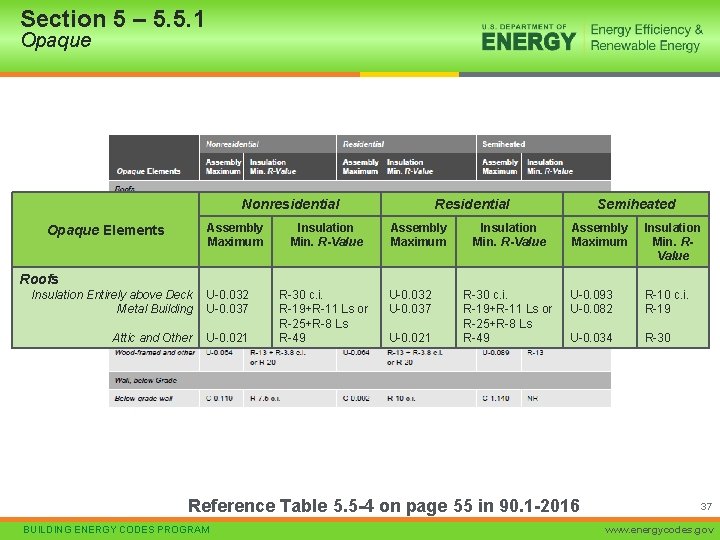
Section 5 – 5. 5. 1 Opaque Nonresidential Assembly Maximum Opaque Elements Insulation Min. R-Value Residential Assembly Maximum Insulation Min. R-Value Semiheated Assembly Maximum Insulation Min. RValue U-0. 093 U-0. 082 R-10 c. i. R-19 U-0. 034 R-30 Roofs Insulation Entirely above Deck Metal Building U-0. 032 U-0. 037 Attic and Other U-0. 021 R-30 c. i. R-19+R-11 Ls or R-25+R-8 Ls R-49 U-0. 032 U-0. 037 U-0. 021 R-30 c. i. R-19+R-11 Ls or R-25+R-8 Ls R-49 Reference Table 5. 5 -4 on page 55 in 90. 1 -2016 BUILDING ENERGY CODES PROGRAM 37 www. energycodes. gov
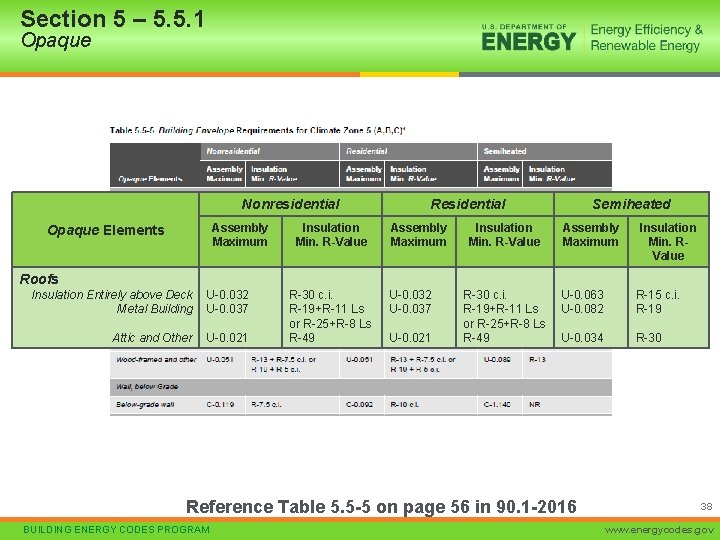
Section 5 – 5. 5. 1 Opaque Nonresidential Assembly Maximum Opaque Elements Insulation Min. R-Value Residential Assembly Maximum Insulation Min. R-Value Semiheated Assembly Maximum Insulation Min. RValue Roofs Insulation Entirely above Deck Metal Building U-0. 032 U-0. 037 Attic and Other U-0. 021 R-30 c. i. R-19+R-11 Ls or R-25+R-8 Ls R-49 U-0. 032 U-0. 037 U-0. 021 R-30 c. i. R-19+R-11 Ls or R-25+R-8 Ls R-49 U-0. 063 U-0. 082 R-15 c. i. R-19 U-0. 034 R-30 Reference Table 5. 5 -5 on page 56 in 90. 1 -2016 BUILDING ENERGY CODES PROGRAM 38 www. energycodes. gov
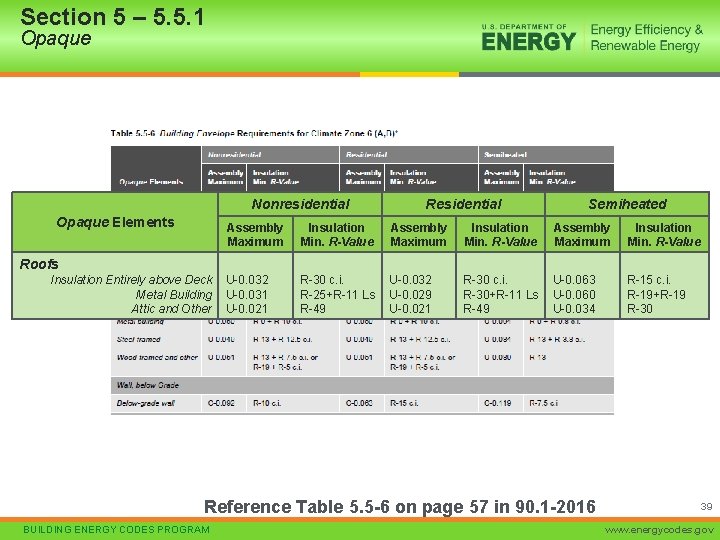
Section 5 – 5. 5. 1 Opaque Nonresidential Opaque Elements Residential Semiheated Assembly Maximum Insulation Min. R-Value U-0. 032 U-0. 031 U-0. 021 R-30 c. i. R-25+R-11 Ls R-49 U-0. 032 U-0. 029 U-0. 021 R-30 c. i. R-30+R-11 Ls R-49 U-0. 063 U-0. 060 U-0. 034 R-15 c. i. R-19+R-19 R-30 Roofs Insulation Entirely above Deck Metal Building Attic and Other Reference Table 5. 5 -6 on page 57 in 90. 1 -2016 BUILDING ENERGY CODES PROGRAM 39 www. energycodes. gov

Section 5 – 5. 5. 1 Opaque Nonresidential Opaque Elements Residential Semiheated Assembly Maximum Insulation Min. R-Value Assembly Maximum Insulation Entirely above Deck Metal Building U-0. 028 U-0. 029 R-35 c. i. R-30+R-11 Ls U-0. 039 U-0. 037 Attic and Other U-0. 017 R-60 U-0. 027 Insulation Min. R-Value Roofs Reference Table 5. 5 -7 on page 58 in 90. 1 -2016 BUILDING ENERGY CODES PROGRAM R-25 c. i. R-19+R-11 Ls or R-25+R-8 Ls R-38 40 www. energycodes. gov
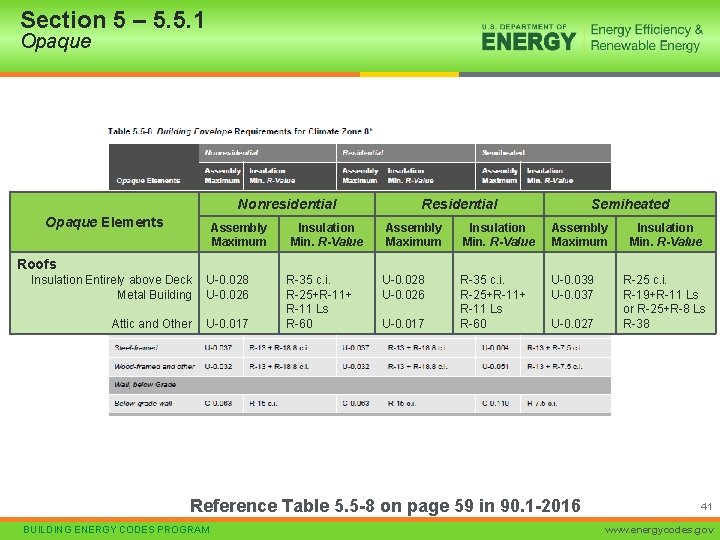
Section 5 – 5. 5. 1 Opaque Nonresidential Opaque Elements Assembly Maximum Insulation Min. R-Value Residential Assembly Maximum Semiheated Insulation Min. R-Value Assembly Maximum R-35 c. i. R-25+R-11+ R-11 Ls R-60 U-0. 039 U-0. 037 Insulation Min. R-Value Roofs Insulation Entirely above Deck Metal Building U-0. 028 U-0. 026 Attic and Other U-0. 017 R-35 c. i. R-25+R-11+ R-11 Ls R-60 U-0. 028 U-0. 026 U-0. 017 U-0. 027 Reference Table 5. 5 -8 on page 59 in 90. 1 -2016 BUILDING ENERGY CODES PROGRAM R-25 c. i. R-19+R-11 Ls or R-25+R-8 Ls R-38 41 www. energycodes. gov
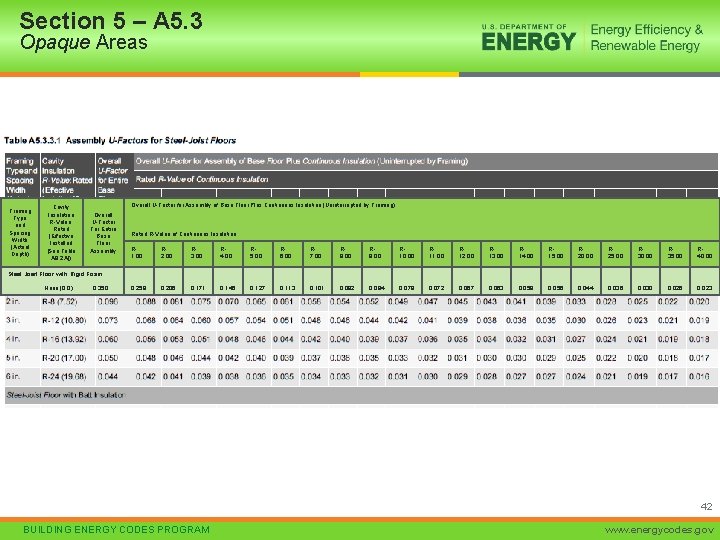
Section 5 – A 5. 3 Opaque Areas Framing Type and Spacing Width (Actual Depth) Cavity Insulation R-Value: Rated (Effective Installed [See Table A 9. 2 A]) Overall U-Factor for Assembly of Base Floor Plus Continuous Insulation (Uninterrupted by Framing) Overall U-Factor For Entire Base Floor Assembly Rated R-Value of Continuous Insulation R 1. 00 R 2. 00 R 3. 00 R 4: 00 R 5. 00 R 6. 00 R 7. 00 R 8. 00 R 9. 00 R 10. 00 R 11. 00 R 12. 00 R 13. 00 R 14. 00 R 15. 00 R 20. 00 R 25. 00 R 30. 00 R 35. 00 R 40. 00 0. 259 0. 206 0. 171 0. 146 0. 127 0. 113 0. 101 0. 092 0. 084 0. 078 0. 072 0. 067 0. 063 0. 059 0. 056 0. 044 0. 036 0. 030 0. 026 0. 023 Steel Joist Floor with Rigid Foam None (0. 0) 0. 350 42 BUILDING ENERGY CODES PROGRAM www. energycodes. gov
Section 5 – 5. 5. 3. 1 Roof Insulation Meet or exceed minimum R-value in table for climate zone Skylight curbs insulated to level of roofs with insulation entirely above deck or R-5, whichever is less 43 BUILDING ENERGY CODES PROGRAM www. energycodes. gov
Section 5 – 5. 5. 3. 1 Roof Insulation (cont’d) Three types of roofs are defined ü Roofs with insulation entirely above deck – R-value is for continuous insulation – Exception: Interruptions for framing and pads for mechanical equipment ≤ 1% of surface of the total roof area ü Metal building roofs – First value is for insulation – draped over purlins and then compressed when metal spanning members attached or – hung between purlins provided there’s a min. of 1” thermal break between purlins and metal spanning members – Second value is for double-layer installations with insulation installed parallel to the purlins ü Attics and other roofs – R-value is for insulation installed both inside and outside the roof or entirely inside the roof cavity 44 BUILDING ENERGY CODES PROGRAM www. energycodes. gov
Section 5 – 5. 8. 1 Insulation Installation ü Rated R-value clearly identified by an identification mark applied by manufacturer to each piece of building envelope insulation ü Exception- provide documentation ü Per manufacturer’s instructions ü Achieve rated R-value ü No open-blown or poured loose-fill insulation when ceiling slope is > 3/12 ü If eave vents installed – Provide baffling of air vents to deflect incoming air above the surface of the insulation – Metal buildings Exception • if roof and wall insulation is compressed between roof or wall skin and the structure 45 BUILDING ENERGY CODES PROGRAM www. energycodes. gov
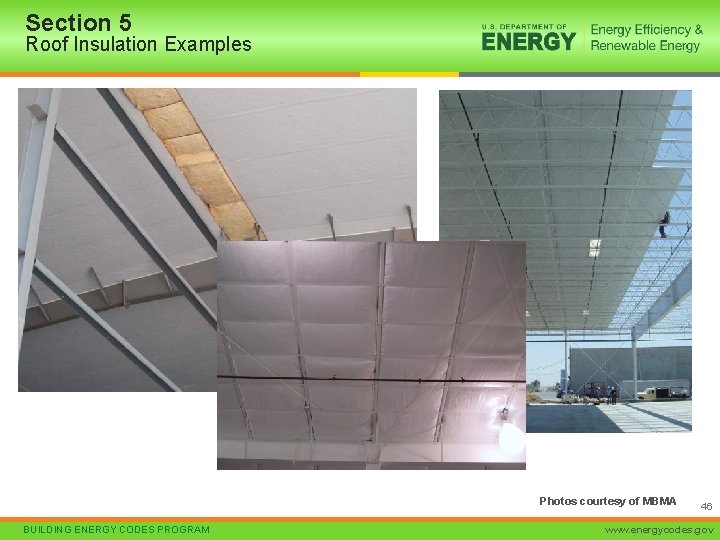
Section 5 Roof Insulation Examples Photos courtesy of MBMA BUILDING ENERGY CODES PROGRAM 46 www. energycodes. gov
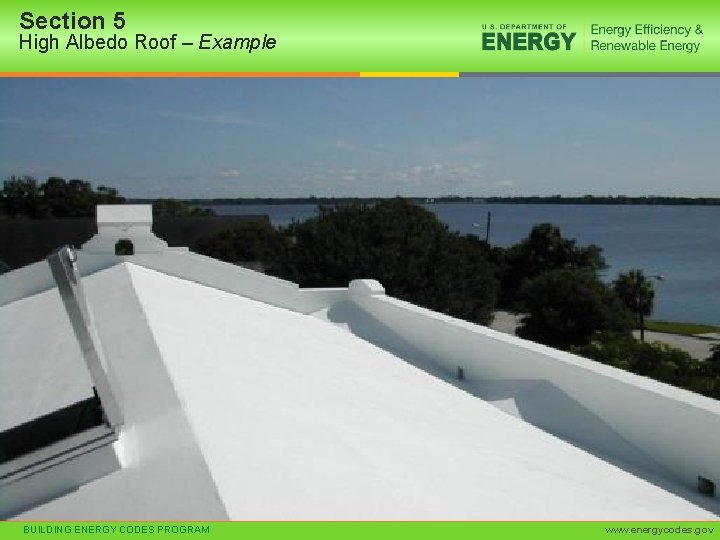
Section 5 – 5. 5. 3. 1. 1 High Albedo Roofs Required in climate zones 0 -3 Minimum three-year aged solar reflectance of 0. 55 and minimum threeyear aged thermal emittance of 0. 75 (tested in accordance with CRRC 1 Standard) OR Minimum Solar Reflectance Index of 64, based on • Three-year aged solar reflectance • Three-year aged thermal emittance – Tested in accordance with CRRC-1 Standard OR Increase roof insulation levels in Table 5. 5. 3. 1. 1 47 BUILDING ENERGY CODES PROGRAM www. energycodes. gov
Section 5 – 5. 5. 3. 1 High Albedo Roofs – Exceptions • Ballasted roofs with minimum stone ballast of 17 lb/ft 2 or 23 lb/ft 2 pavers • Vegetated roof systems containing minimum thickness of 2. 5 in. of growing medium that covers minimum of 75% of roof area with durable plantings • Roofs, where a minimum of 75% of the roof area is: 1. 2. 3. shaded during peak sun angle on June 21 by permanent components or features of the building covered by off-set PV arrays, building-integrated PV arrays, or solar air or water collectors OR permitted to be interpolated using a combination of 1 and 2 above • Steep-sloped roofs • Low-sloped metal building roofs in climate zones 2 -3 • Roofs over: ventilated attics, semiheated spaces, or conditioned spaces that aren’t cooled spaces • Asphaltic membranes in climate zones 2 -3 48 BUILDING ENERGY CODES PROGRAM www. energycodes. gov
Section 5 High Albedo Roof – Example 49 BUILDING ENERGY CODES PROGRAM www. energycodes. gov
Section 5 – 5. 5. 3. 2 Above-Grade Wall Insulation Meet or exceed R-value specified for climate zone in appropriate table When wall consists of both above-grade and below-grade portion, entire wall to be insulated on either exterior or interior or be integral If insulated on interior – above-grade wall insulation requirements apply If insulated on exterior or integral – below-grade wall portion to be insulated to the below-grade wall requirements and – above-grade to above-grade wall requirements 50 BUILDING ENERGY CODES PROGRAM www. energycodes. gov
Section 5 – 5. 5. 3. 2 Above-Grade Wall Insulation (cont’d) • Above-grade wall in Climate Zone 0 to meet one of the following: A. East and west walls, minimum of 75% of the opaque wall area to have a minimum SRI 29 – glass sprandrel areas a minimum solar reflectance of 29% determined in accordance with NFRC 300 or ISO 9050 is permitted – Each wall is allowed to be considered separately B. East and west walls, minimum of 30% of the above-grade wall area be shaded through the use of shade-providing plants, manmade structures, existing buildings, hillsides, permanent building projections, on-site renewable energy systems, or combination – Shade coverage calculated at 10 a. m. for east walls and 3 p. m. for west walls on summer solstice The building is allowed to be rotated up to 45 degrees to the nearest cardinal orientation for compliance calculation purposes 51 BUILDING ENERGY CODES PROGRAM www. energycodes. gov
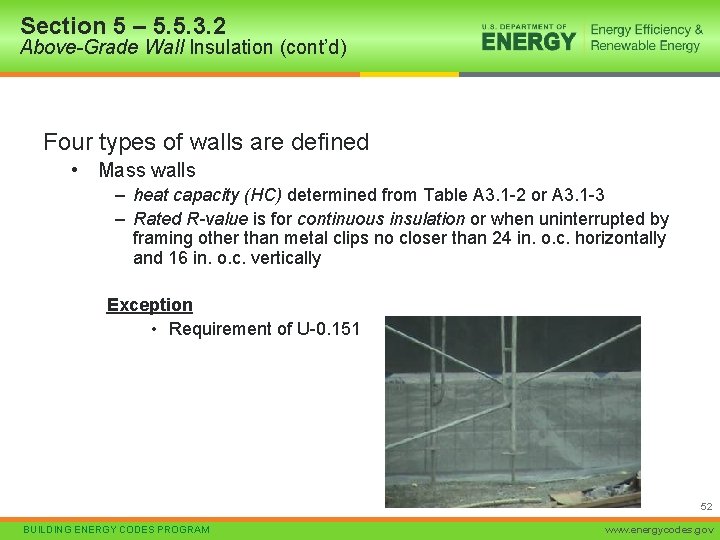
Section 5 – 5. 5. 3. 2 Above-Grade Wall Insulation (cont’d) Four types of walls are defined • Mass walls – heat capacity (HC) determined from Table A 3. 1 -2 or A 3. 1 -3 – Rated R-value is for continuous insulation or when uninterrupted by framing other than metal clips no closer than 24 in. o. c. horizontally and 16 in. o. c. vertically Exception • Requirement of U-0. 151 52 BUILDING ENERGY CODES PROGRAM www. energycodes. gov
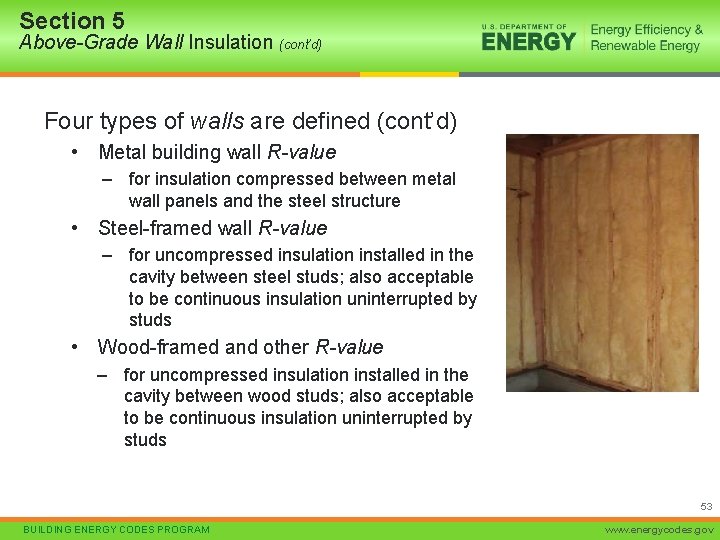
Section 5 Above-Grade Wall Insulation (cont’d) Four types of walls are defined (cont’d) • Metal building wall R-value – for insulation compressed between metal wall panels and the steel structure • Steel-framed wall R-value – for uncompressed insulation installed in the cavity between steel studs; also acceptable to be continuous insulation uninterrupted by studs • Wood-framed and other R-value – for uncompressed insulation installed in the cavity between wood studs; also acceptable to be continuous insulation uninterrupted by studs 53 BUILDING ENERGY CODES PROGRAM www. energycodes. gov
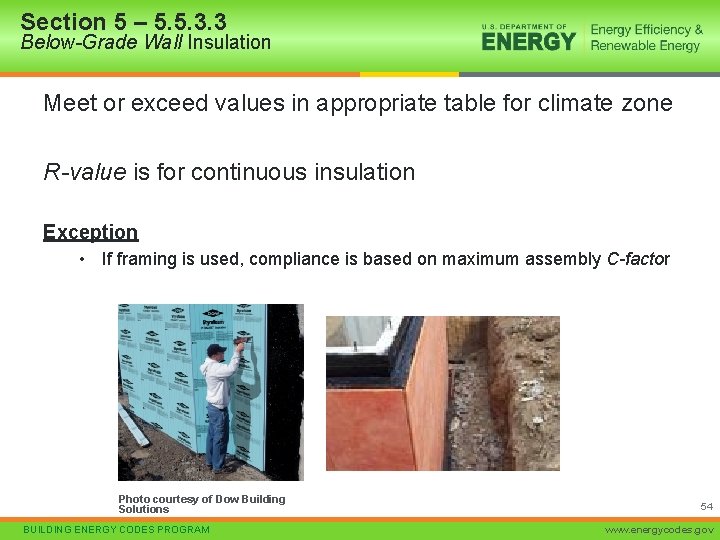
Section 5 – 5. 5. 3. 3 Below-Grade Wall Insulation Meet or exceed values in appropriate table for climate zone R-value is for continuous insulation Exception • If framing is used, compliance is based on maximum assembly C-factor Photo courtesy of Dow Building Solutions BUILDING ENERGY CODES PROGRAM 54 www. energycodes. gov
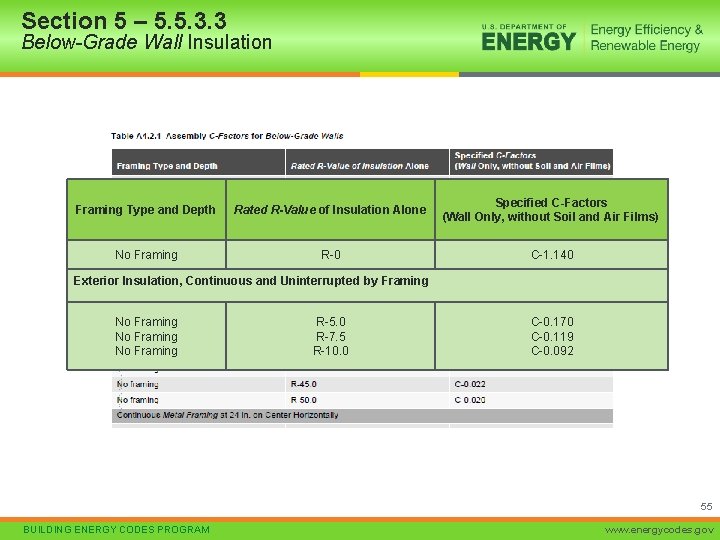
Section 5 – 5. 5. 3. 3 Below-Grade Wall Insulation Framing Type and Depth Rated R-Value of Insulation Alone Specified C-Factors (Wall Only, without Soil and Air Films) No Framing R-0 C-1. 140 Exterior Insulation, Continuous and Uninterrupted by Framing No Framing R-5. 0 R-7. 5 R-10. 0 C-0. 170 C-0. 119 C-0. 092 55 BUILDING ENERGY CODES PROGRAM www. energycodes. gov
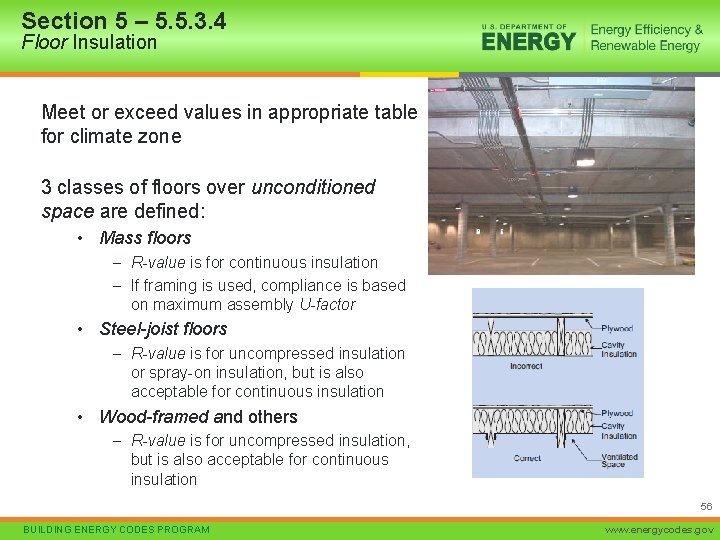
Section 5 – 5. 5. 3. 4 Floor Insulation Meet or exceed values in appropriate table for climate zone 3 classes of floors over unconditioned space are defined: • Mass floors – R-value is for continuous insulation – If framing is used, compliance is based on maximum assembly U-factor • Steel-joist floors – R-value is for uncompressed insulation or spray-on insulation, but is also acceptable for continuous insulation • Wood-framed and others – R-value is for uncompressed insulation, but is also acceptable for continuous insulation 56 BUILDING ENERGY CODES PROGRAM www. energycodes. gov
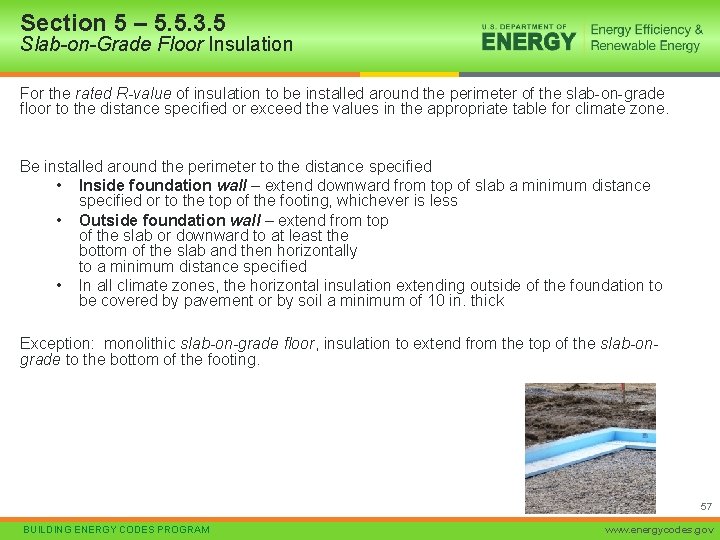
Section 5 – 5. 5. 3. 5 Slab-on-Grade Floor Insulation For the rated R-value of insulation to be installed around the perimeter of the slab-on-grade floor to the distance specified or exceed the values in the appropriate table for climate zone. Be installed around the perimeter to the distance specified • Inside foundation wall – extend downward from top of slab a minimum distance specified or to the top of the footing, whichever is less • Outside foundation wall – extend from top of the slab or downward to at least the bottom of the slab and then horizontally to a minimum distance specified • In all climate zones, the horizontal insulation extending outside of the foundation to be covered by pavement or by soil a minimum of 10 in. thick Exception: monolithic slab-on-grade floor, insulation to extend from the top of the slab-ongrade to the bottom of the footing. 57 BUILDING ENERGY CODES PROGRAM www. energycodes. gov
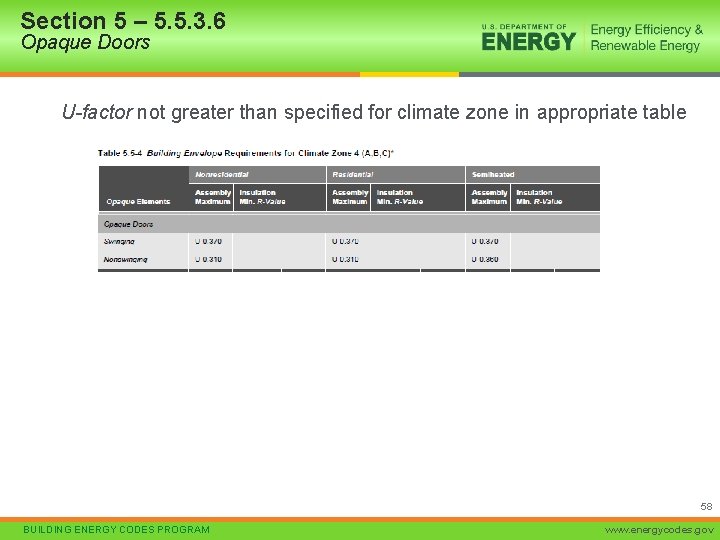
Section 5 – 5. 5. 3. 6 Opaque Doors U-factor not greater than specified for climate zone in appropriate table 58 BUILDING ENERGY CODES PROGRAM www. energycodes. gov
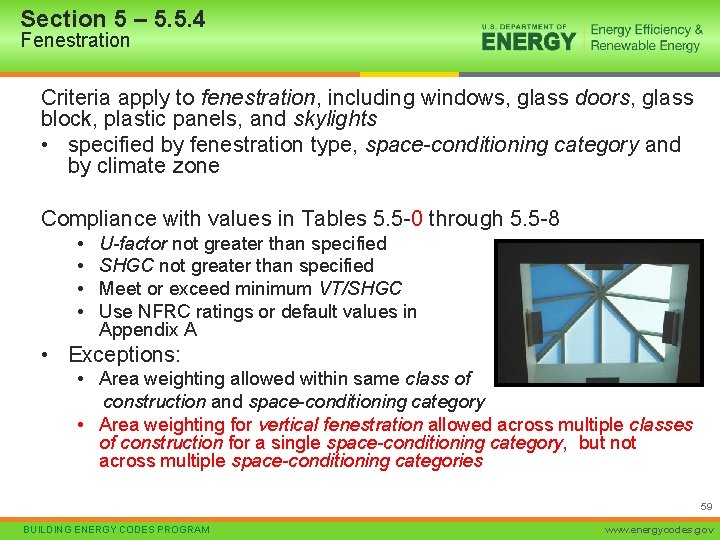
Section 5 – 5. 5. 4 Fenestration Criteria apply to fenestration, including windows, glass doors, glass block, plastic panels, and skylights • specified by fenestration type, space-conditioning category and by climate zone Compliance with values in Tables 5. 5 -0 through 5. 5 -8 • • U-factor not greater than specified SHGC not greater than specified Meet or exceed minimum VT/SHGC Use NFRC ratings or default values in Appendix A • Exceptions: • Area weighting allowed within same class of construction and space-conditioning category • Area weighting for vertical fenestration allowed across multiple classes of construction for a single space-conditioning category, but not across multiple space-conditioning categories 59 BUILDING ENERGY CODES PROGRAM www. energycodes. gov
Section 5 – 5. 5. 4. 2 Fenestration Area Total vertical fenestration area to be smaller than specified values in Tables 5. 5 -0 through 5. 5 -8 (40% for all climate zones) • Including both fixed and operable vertical fenestration • Exception: street-level vertical fenestration (5. 5. 4. 4. 1) Total skylight area smaller than specified in Tables 5. 5 -0 through 5. 5 -8 (3% of roof area for all climate zones) • Permitted to be no greater than 6% of gross roof area provided criteria in exception 1 to skylight SHGC requirements are met (5. 5. 4. 4. 2) and daylight area under skylights is more than or equal to half the floor area of the space 60 BUILDING ENERGY CODES PROGRAM www. energycodes. gov
Section 5 – 5. 5. 4. 2. 3 Minimum Skylight Fenestration Area Minimum skylight area must be provided in enclosed spaces that are • ≥ 2, 500 ft 2 • In spaces with ceiling height > 15 ft and • Space types • • Office Lobby Atrium Concourse Corridor Storage (incl. nonrefrigerated warehouse) Gymnasium/fitness /exercise area Playing area • • • Gymnasium seating area Convention exhibit/event space Courtroom Automotive service Fire station engine room Manufacturing • • Corridor/transition and bay areas Retail Library reading and stack areas Distribution/sorting area Transportation Baggage and seating areas Workshop 61 BUILDING ENERGY CODES PROGRAM www. energycodes. gov
Section 5 – 5. 5. 4. 2. 3 Minimum Skylight Fenestration Area The skylight area must daylight a minimum of half the floor area and provided • Minimum ratio of 3% of skylight area to daylight area with a skylight VLT at least 0. 40 OR • a minimum skylight effective aperture of at least 1% Exceptions • Enclosed spaces in Climate Zones 6 -8 • Enclosed spaces under shaded roofs (beam sunlight blocked for more than 1500 daytime hours between 8 a. m. and 4 p. m. ) • Daylight area under rooftop monitors is > 50% of floor area • Documented that 90% of skylight area is shaded on June 21 (Northern Hemisphere)/December 21 (Southern Hemisphere) at noon by permanent features • Where total space area minus the primary and secondary sidelighted area(s) is < 2, 500 ft and where lighting is controlled according to sidelighting requirements of Section 9. 4. 1 62 BUILDING ENERGY CODES PROGRAM www. energycodes. gov
Section 5 – 5. 5. 4. 3 and 5. 8. 2. 3 Fenestration U-Factor U-factor not greater than specified in Tables 5. 5 -0 through 5. 5 -8 – Exception: U-factor for skylights allowed to be increased no greater than • 0. 90 Btu/h • ft 2 °F in Climate Zone 0 -3 • 0. 75 Btu/h • ft 2 °F in Climate Zone 4 -8 Provided they have a glazing material or diffuser with a measured haze value greater than 90% when tested in accordance with ASTM D 1003 Have a skylight VT greater than 0. 40 and All general lighting in the daylight area under skylights controlled by multilevel photocontrols in accordance with Section 9. 4. 1. 1 (f) Determined in accordance with NFRC 100 Skylights – determine for a slope of 20° above the horizontal Exceptions • A 8. 1 acceptable for skylights, A 8. 2 acceptable for other vertical fenestration, and A 7 acceptable for opaque doors • ANSI/DASMA 105 acceptable for sectional garage doors and metal coiling doors BUILDING ENERGY CODES PROGRAM 63 www. energycodes. gov
Section 5 – 5. 5. 4. 4 Fenestration SHGC Vertical fenestration (5. 5. 4. 4. 1) • SHGC values < Table value for appropriate total vertical fenestration area Exceptions • For south, east, or west-oriented vertical fenestration only, the SHGC in the proposed building can be reduced by using the multipliers in Table 5. 5. 4. 4. 1 for fenestration shaded by permanent projections that will last as long as the building itself • For south, east, or west-oriented vertical fenestration shaded by partially opaque permanent projections that will last as long as the building itself, can reduce the PF by multiplying by values in Table 5. 5. 4. 4. 1 • Street-level exception only applies when using the prescriptive compliance option • Dynamic glazing cannot be area-weighted with other fenestration and minimum SHGC of dynamic glazing shall be used to show compliance for dynamic glazing • North-oriented vertical fenestration allowed to have SHGC equal to or less than the area-weighted average SHGC of the south, east, and westoriented vertical fenestration before any reductions made for permanent projections in Exception 1 and 2 of Section 5. 5. 4. 4. 1 64 BUILDING ENERGY CODES PROGRAM www. energycodes. gov
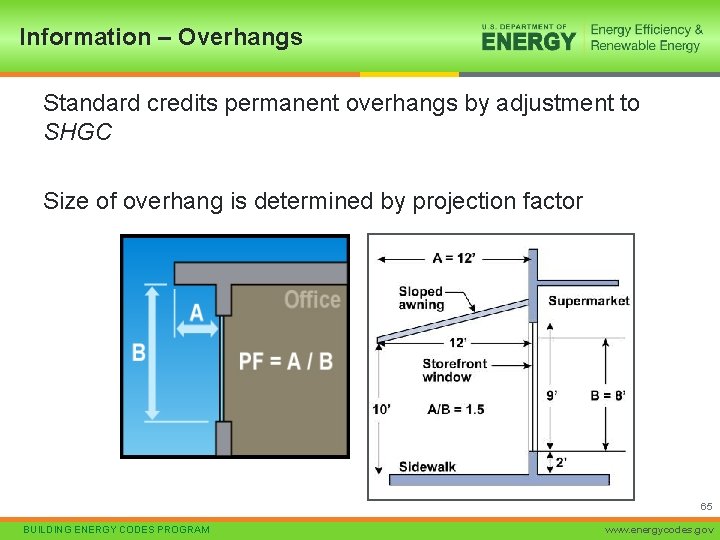
Information – Overhangs Standard credits permanent overhangs by adjustment to SHGC Size of overhang is determined by projection factor 65 BUILDING ENERGY CODES PROGRAM www. energycodes. gov
Section 5 – 5. 8. 2. 4 Solar Heat Gain Coefficient (SHGC) Determined in accordance with NFRC 200 Exceptions • Shading Coefficient (SC) x 0. 86 is acceptable for overall fenestration area (NFRC 300) • SHGC of center-of-glass is acceptable (NFRC 300) for overall fenestration area • SHGC from A 8. 1 for skylights is an acceptable alternative for determining compliance • SHGC from A 8. 2 for vertical fenestration is an acceptable alternative for determining compliance 66 BUILDING ENERGY CODES PROGRAM www. energycodes. gov
Section 5 – 5. 5. 4. 4. 2 Skylight SHGC Skylights • SHGC values < Table value for appropriate total skylight area Exceptions: 1. If skylights • Have a glazing material or diffuser with measured haze value > 90% when tested according to ASTM D 1003, and • Have a skylight VT > 0. 40, and • Have all general lighting in daylight area under skylights controlled by multilevel photocontrols per Section 9. 4. 1. 1 (f) 2. Dynamic Glazing • Minimum SHGC is used to demonstrate compliance • Considered separately from other vertical fenestration • Area-weighted averaging with other vertical fenestration that isn’t dynamic glazing isn’t allowed 67 BUILDING ENERGY CODES PROGRAM www. energycodes. gov
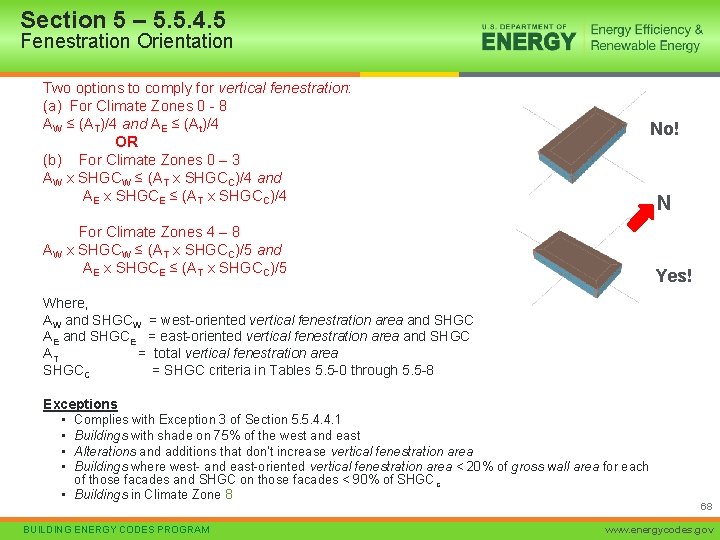
Section 5 – 5. 5. 4. 5 Fenestration Orientation Two options to comply for vertical fenestration: (a) For Climate Zones 0 - 8 AW ≤ (AT)/4 and AE ≤ (At)/4 OR (b) For Climate Zones 0 – 3 AW x SHGCW ≤ (AT x SHGCC)/4 and AE x SHGCE ≤ (AT x SHGCC)/4 No! N For Climate Zones 4 – 8 AW x SHGCW ≤ (AT x SHGCC)/5 and AE x SHGCE ≤ (AT x SHGCC)/5 Yes! Where, AW and SHGCW = west-oriented vertical fenestration area and SHGC AE and SHGCE = east-oriented vertical fenestration area and SHGC AT = total vertical fenestration area SHGCC = SHGC criteria in Tables 5. 5 -0 through 5. 5 -8 Exceptions • Complies with Exception 3 of Section 5. 5. 4. 4. 1 • Buildings with shade on 75% of the west and east • Alterations and additions that don’t increase vertical fenestration area • Buildings where west- and east-oriented vertical fenestration area < 20% of gross wall area for each of those facades and SHGC on those facades < 90% of SHGC c • Buildings in Climate Zone 8 BUILDING ENERGY CODES PROGRAM 68 www. energycodes. gov
Section 5 – 5. 5. 4. 6 Visible Transmittance/SHGC Ratio When automatic daylighting controls are required per 9. 4. 1. 1 (e) or (f) • fenestration to have a ratio of VT/SHGC not less than listed in Tables 5. 5 -0 through 5. 5 -8 (>1. 1 for all climate zones) Exceptions • Can have a light-to-solar-gain ratio (LSG) of not less than 1. 25 – center-of-glass SHGC and VT determined per NFRC 300 and NFRC 301 by independent lab or included in a database published by a government agency and certified by a manufacturer • Fenestration not covered in scope of NFRC 200 • Enclosed spaces – where daylight area under rooftop monitors is > 50% of enclosed space floor area – with skylights complying with 5. 5. 4. 2. 3 – where sidelighting effective aperture is ≥ 0. 15 • Dynamic glazing – VT/SHGC ratio and LSG determined using maximum VT and maximum SHGC – Considered separately from other fenestration; cannot include dynamic glazing with other fenestration for area-weighted averaging 69 BUILDING ENERGY CODES PROGRAM www. energycodes. gov
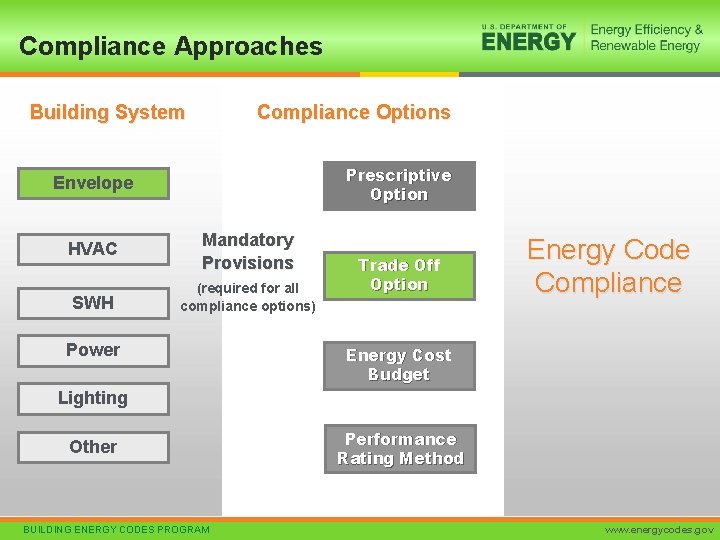
Compliance Approaches Building System Compliance Options Prescriptive Option Envelope HVAC Mandatory Provisions SWH (required for all compliance options) Power Trade Off Option Energy Code Compliance Energy Cost Budget Lighting Other Performance Rating Method 70 BUILDING ENERGY CODES PROGRAM www. energycodes. gov
Section 5 – 5. 6. 1 Building Envelope Trade-Off Option “Rules” Proposed design must comply with Sections 5. 1, 5. 4, 5. 7, 5. 8, and 5. 9 Proposed envelope performance factor (EPF) of proposed design is less than or equal to the proposed envelope performance factor of the base design • All building envelope components shown on drawings or installed in existing buildings to be included in proposed building design • Fenestration and opaque envelope types and area used in simulation model to be consistent with design documents • Don’t need to separately describe any envelope assembly covering < 5% of total area of that assembly – – as long as it’s similar to an assembly being modeled if not separately described, add the area of that assembly to an assembly with same orientation and thermal properties 71 BUILDING ENERGY CODES PROGRAM www. energycodes. gov
Section 5 – 5. 6. 1. 2 Trade-Offs Limited to Building Permit • If building permit will apply to less than the whole building – Parameters relating to unmodified existing conditions or future building components to be identical for both proposed EPF and base EPF • Future components meet prescriptive requirements of Section 5. 5 72 BUILDING ENERGY CODES PROGRAM www. energycodes. gov
Section 5 – 5. 7 Submittal Document Labeling of Space-Conditioning Categories • General – AHJ can require compliance documentation and supplemental information per 4. 2. 2 • Space Conditioning Categories – if building has semiheated or unconditioned spaces and compliance is sought using semiheated criteria, spaces to be clearly indicated on floor plans • Visible Transmittance – include test results for skylight glazing or diffusers (per 5. 8. 2. 5) • Daylight Areas – documentation to identify daylight areas on floor plans, including – – Primary sidelighted areas Secondary sidelighted areas Daylight area under skylights Daylight areas under roof monitor 73 BUILDING ENERGY CODES PROGRAM www. energycodes. gov
Section 5 – 5. 8 Product Information and Installation Requirements ü Labeling of Building Envelope Insulation (Section 5. 8. 1. 1) ü Compliance with Manufacturers’ Requirements (Section 5. 8. 1. 2) ü ü ü ü Loose-Fill Insulation Limitation (Section 5. 8. 1. 3) Baffles (Section 5. 8. 1. 4) Substantial Contact (Section 5. 8. 1. 5) Recessed Equipment (Section 5. 8. 1. 6) Insulation Protection (Section 5. 8. 1. 7) Location of Roof Insulation (Section 5. 8. 1. 8) Extent of Insulation (Section 5. 8. 1. 9) Joints in Rigid Insulation (Section 5. 8. 1. 10) 74 BUILDING ENERGY CODES PROGRAM www. energycodes. gov
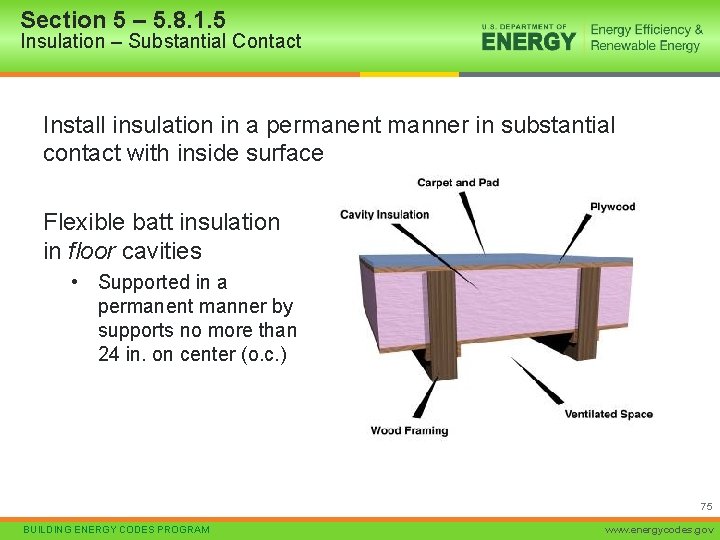
Section 5 – 5. 8. 1. 5 Insulation – Substantial Contact Install insulation in a permanent manner in substantial contact with inside surface Flexible batt insulation in floor cavities • Supported in a permanent manner by supports no more than 24 in. on center (o. c. ) 75 BUILDING ENERGY CODES PROGRAM www. energycodes. gov
Section 5 – 5. 8. 1. 6 Recessed Equipment Recessed equipment should not affect insulation thickness • Lighting fixtures • HVAC equipment (includes wall heaters, ducts, and plenums) • Other Except when • Total combined area affected (include necessary clearances) is < 1% of opaque area of the assembly, OR • Entire roof, wall, or floor is covered with insulation to the full depth required, OR • Effects of reduced insulation are included in area-weighted calculations and compressed insulation values from Table A 9. 4. 3 In all cases, air leakage to be limited through or around recessed equipment to the conditioned space in accordance with Section 5. 4. 3 (Air leakage) 76 BUILDING ENERGY CODES PROGRAM www. energycodes. gov
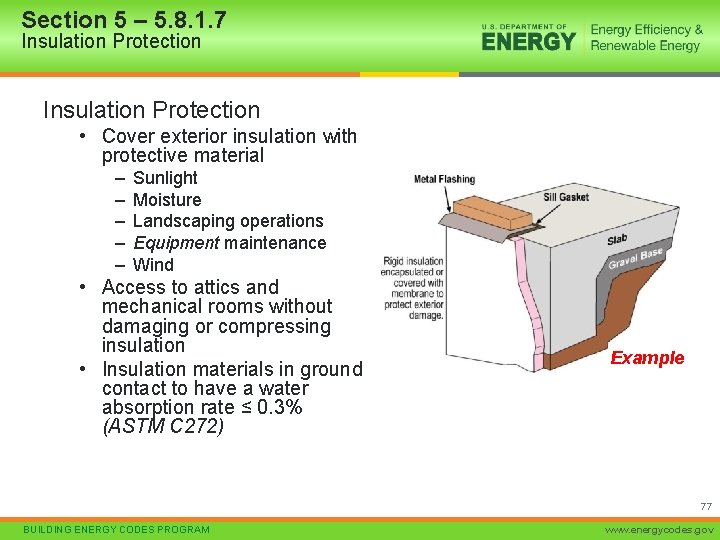
Section 5 – 5. 8. 1. 7 Insulation Protection • Cover exterior insulation with protective material – – – Sunlight Moisture Landscaping operations Equipment maintenance Wind • Access to attics and mechanical rooms without damaging or compressing insulation • Insulation materials in ground contact to have a water absorption rate ≤ 0. 3% (ASTM C 272) Example 77 BUILDING ENERGY CODES PROGRAM www. energycodes. gov
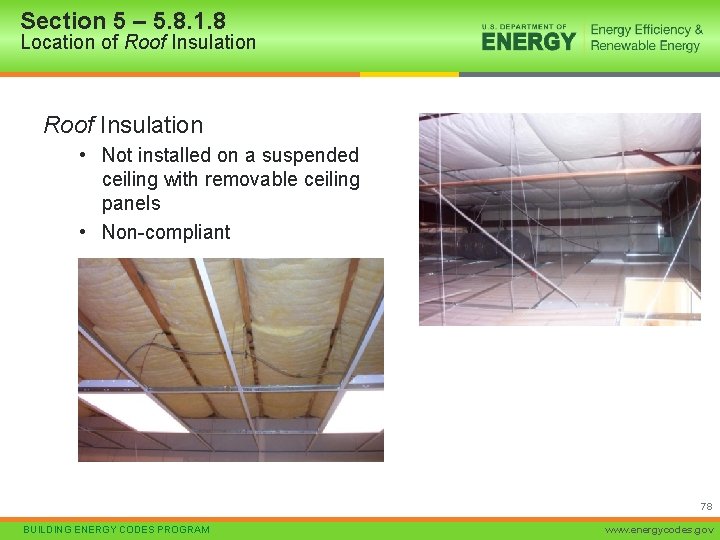
Section 5 – 5. 8. 1. 8 Location of Roof Insulation • Not installed on a suspended ceiling with removable ceiling panels • Non-compliant 78 BUILDING ENERGY CODES PROGRAM www. energycodes. gov
Section 5 – 5. 8. 1. 9 Extent of Insulation • Insulation should extend over the full component area to the required rated R-value of insulation – U-factor – C-factor OR – F-factor Unless otherwise allowed in Section 5. 8. 1 79 BUILDING ENERGY CODES PROGRAM www. energycodes. gov
Section 5 – 5. 8. 1. 10 Joints in Rigid Insulation Where 2 or more layers of rigid insulation board are used in a construction assembly • the edge joints between each layer of boards to be staggered 80 BUILDING ENERGY CODES PROGRAM www. energycodes. gov
Section 5 – 5. 9 Inspection Required Inspections: • Fenestration and doors – Air leakage testing where applicable conducted by independent third party – Operation of door and closer or operating mechanism inspected for conformance with the manufacturer’s instructions – Seals or gaskets installed per manufacturer’s instructions • Loading dock weatherseals – Ensure that the seals are in good condition 81 BUILDING ENERGY CODES PROGRAM www. energycodes. gov
Section 5 – 5. 9 Inspection (cont’d) • Opaque building envelope air tightness – Opaque roof, above-grade walls, and below-grade walls, and floors subject to the following inspections: • Use of compliant materials and assemblies per Section 5. 4. 3. 1. 3 • Integration with adjoining fenestration and continuous air barrier elements • Fenestration – Skylights size and location in relation to designed primary sidelighted area and secondary lighted area below – Roof monitor size and location in relation to designed primary sidelighted area and secondary lighted area below – Dynamic glazing with SHGC and U-factor per Section 5. 5. 4. 4. 1 and 5. 5. 4. 4. 2 and testing of the operation of conformance per manufacturer’s instructions. – Permanent fenestration projections installation and performance per Section 5. 5. 4. 4. 1 and construction documents. 82 BUILDING ENERGY CODES PROGRAM www. energycodes. gov
Section 5 – 5. 9 Verification • Building Envelope Performance – Verified per Section 4. 2. 5 • Air Leakage – In accordance with one of the following methods: a. An air barrier design and installation program implemented to include: 1. Design review conducted to assess compliance with requirements in Sections 5. 4. 3. 1. 1, 5. 4. 3. 1. 2 and applicable portions of 5. 4. 3. 1. 3 2. Periodic field inspection of continuous air barrier components and assemblies conducted during construction while the air barrier is still accessible for inspection and repair to verify compliance with Sections 5. 4. 3. 1. 1, 5. 4. 3. 1. 2 and applicable portions of 5. 4. 3. 1. 3 3. Reporting in compliance with Section 4. 2. 5 83 BUILDING ENERGY CODES PROGRAM www. energycodes. gov
Section 5 – 5. 9 Verification (cont’d) • Air Leakage cont’d b. A whole-building air leakage verification program implemented to include the following elements: 1. whole-building pressurization testing performed in accordance with Section 5. 4. 3. 1. 3(a) and use of any exceptions documented 2. Reporting in compliance with Section 4. 2. 5 84 BUILDING ENERGY CODES PROGRAM www. energycodes. gov
- Slides: 84