
Building Emergency Evacuation Plan BEEP Training for Building
Building Emergency Evacuation Plan (BEEP) Training for Building Occupants
Introduction • A variety of situations may create the need to evacuate a University building including fires, natural disasters, and alarm activations. • A Building Emergency Evacuation Plan, or BEEP, organizes employee actions during workplace emergencies. These plans will dramatically reduce the potential for injuries, property damage, and confusion during an emergency evacuation. • The purpose of this training is to review BEEP information relevant to those employees who have no specific plan responsibilities, but are building occupants.
Training Objectives • Provide an overview of the BEEP concept • Show an example of an evacuation map • Review general guidance relating to building evacuations
BEEP Overview • BEEP = Building Emergency Evacuation Plan • Developed for all University buildings which are occupied by ten or more employees • Plans are based on a common template, but contain information specific to each building • Each BEEP consists of a written plan and corresponding evacuation maps
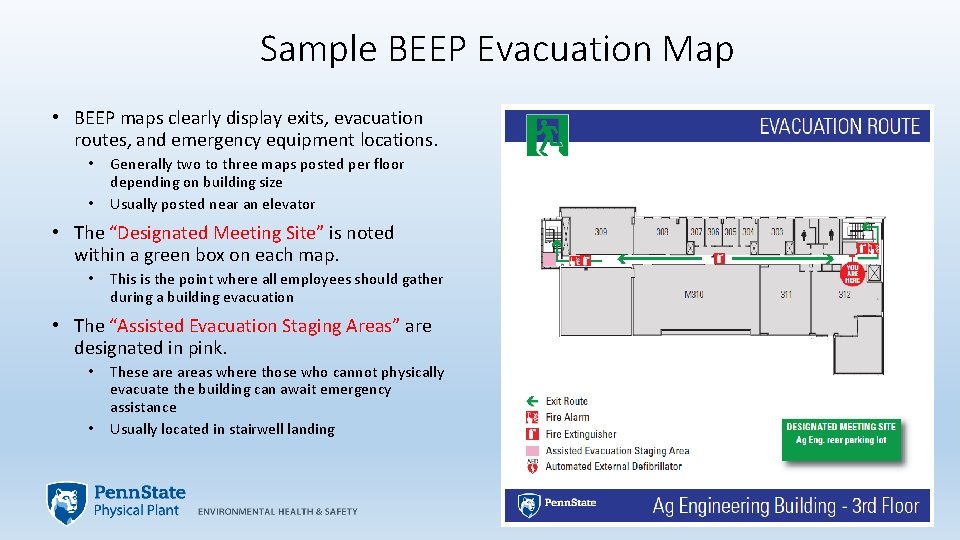
Sample BEEP Evacuation Map • BEEP maps clearly display exits, evacuation routes, and emergency equipment locations. • • Generally two to three maps posted per floor depending on building size Usually posted near an elevator • The “Designated Meeting Site” is noted within a green box on each map. • This is the point where all employees should gather during a building evacuation • The “Assisted Evacuation Staging Areas” are designated in pink. • • These areas where those who cannot physically evacuate the building can await emergency assistance Usually located in stairwell landing
BEEP Overview • Employees have been designated to serve specific roles within the BEEP for each building: • Building Emergency Coordinators (BEC) • One per building with alternate also assigned • Serve as liaison between emergency responders (police or fire) and building occupants • Safety Monitors • At least two assigned per building floor • Ensure occupants evacuate building during an emergency • All other individuals are considered “building occupants” • Building occupants have no designated responsibilities in the BEEP.
General Evacuation Guidance • Circumstances that may require a building evacuation include: Fire or fire alarm activation, Detection of a toxic gas, Discovery of a suspicious object, Unexpected release of a hazardous material, • Adverse weather conditions, or • Verbal announcement or text message. • • • All University personnel should be aware of general evacuation steps: • Immediately evacuate the building when prompted (*) • Know the location of at least two exits from your area • Be familiar with the evacuation routes shown on your building evacuation map • Always remain calm and follow directions given by emergency responders • In any emergency situation, call 911 * Only exception is when alarm testing is being done (notification will be posted on entry doors)
Summary • The BEEP consists of a written plan and corresponding evacuation maps. • Building Emergency Coordinators (BEC) and Safety Monitors (SM) have been assigned within each BEEP. • All employees should be familiar with the general guidance for evacuating buildings during an emergency.

QUESTIONS? CONTACT: ENVIRONMENTAL HEALTH AND SAFETY PHONE: 814 -865 -6391 EMAIL: PSUEHS@PSU. EDU WEBSITE: WWW. EHS. PSU. EDU
- Slides: 9