
Building Effective and Rewarding Classroom Experiences Secondary School
Building Effective and Rewarding Classroom Experiences Secondary School Classroom Management and Co-teaching pp. 153
Objective/ Schedule Objective: To provide participants with SSCM* and co-teaching methodology along with strategies that can be adapted to your classroom situation. • Introductions • SSCM lecture and discussion • Break • Co-teaching lecture and discussion • Questions/ Closing * SSCM- Secondary School Classroom Management
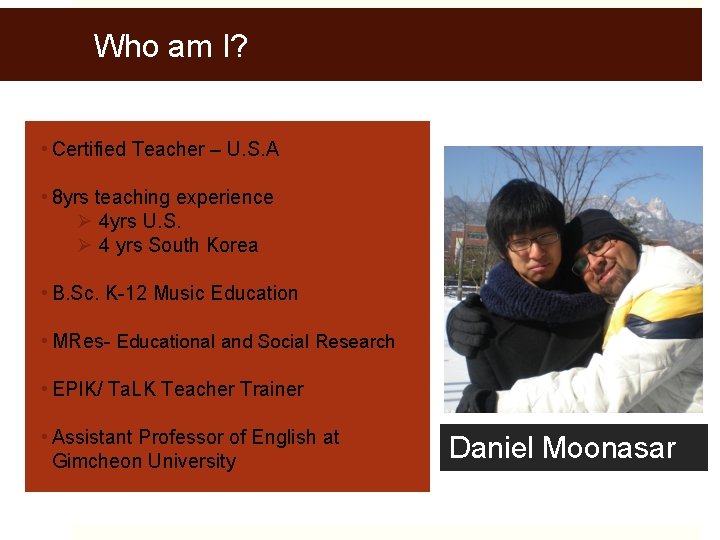
Who am I? • Certified Teacher – U. S. A • 8 yrs teaching experience Ø 4 yrs U. S. Ø 4 yrs South Korea • B. Sc. K-12 Music Education • MRes- Educational and Social Research • EPIK/ Ta. LK Teacher Trainer • Assistant Professor of English at Gimcheon University Daniel Moonasar
Who are you? • Certified Teachers? • Education major undergraduates? • Other major undergraduates • Teaching experience? • Visited South Korea before? • Lived in South Korea before?

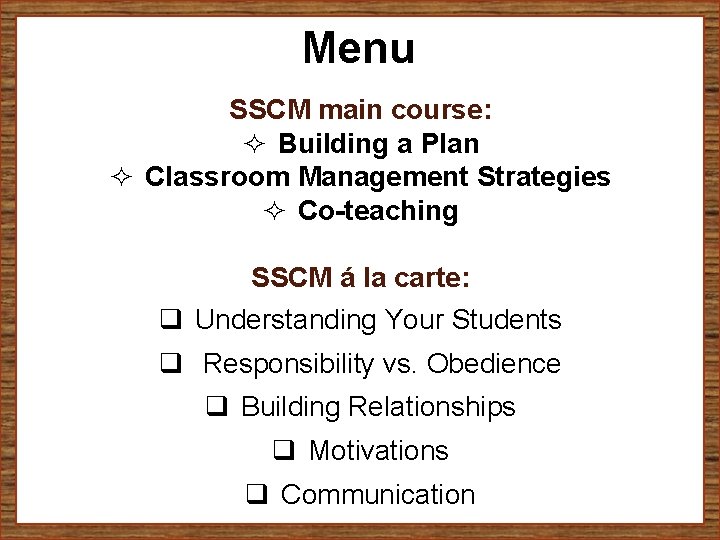
Menu SSCM main course: ² Building a Plan ² Classroom Management Strategies ² Co-teaching SSCM á la carte: q Understanding Your Students q Responsibility vs. Obedience q Building Relationships q Motivations q Communication
Group Discussion pp. 153 Directions: 1. In your group discuss and answer Task 1 question. 2. Choose one reason you want to share. 3. When finished, we’ll share answers to the class. 5 minu tes
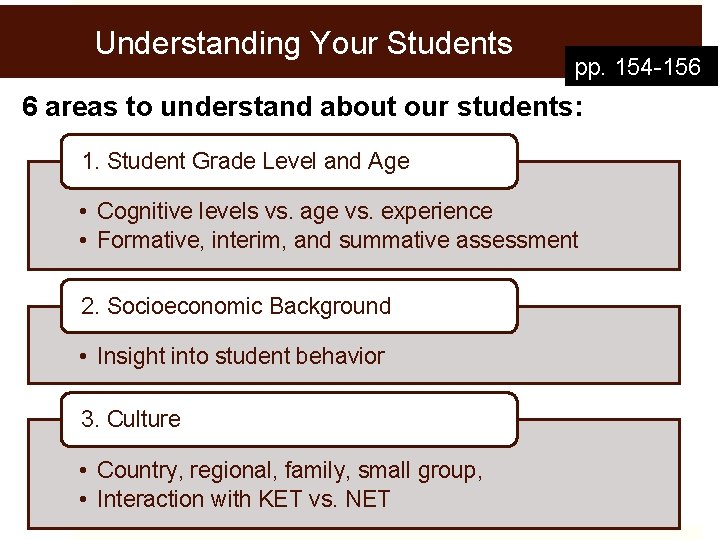
Understanding Your Students pp. 154 -156 6 areas to understand about our students: 1. Student Grade Level and Age • Cognitive levels vs. age vs. experience • Formative, interim, and summative assessment 2. Socioeconomic Background • Insight into student behavior 3. Culture • Country, regional, family, small group, • Interaction with KET vs. NET
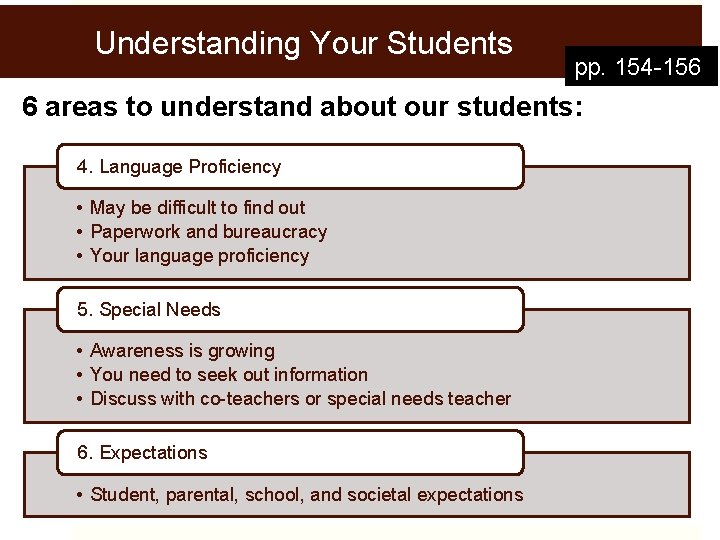
Understanding Your Students pp. 154 -156 6 areas to understand about our students: 4. Language Proficiency • May be difficult to find out • Paperwork and bureaucracy • Your language proficiency 5. Special Needs • Awareness is growing • You need to seek out information • Discuss with co-teachers or special needs teacher 6. Expectations • Student, parental, school, and societal expectations
Building Relationships pp. 156 -157 Directions: 1. Individually answer Task 3 on p. 156 2. In your groups discuss, “How did this affect your experience in class? ” 3. When finished, we’ll share answers. 5 minu tes
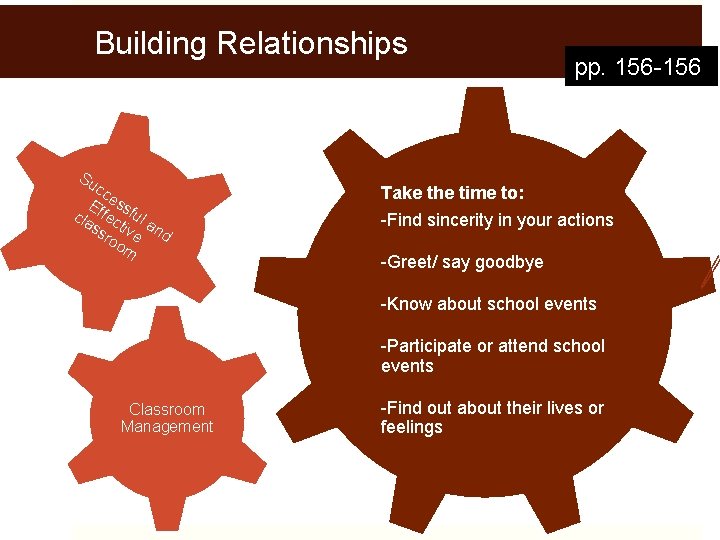
Building Relationships Su cc Ef essf cla fec ul a ss tive nd ro om pp. 156 -156 Take the time to: -Find sincerity in your actions -Greet/ say goodbye -Know about school events -Participate or attend school events Classroom Management -Find out about their lives or feelings

Obedience vs. Responsibility Obedience Taught behavior Induced by fear of extrinsic punishment Convenient and easy but can inhibit personal growth, creativity, and critical thinking pp. 157 -158 Responsibility Learned behavior Induced by the intrinsic motivation to succeed or gain acceptance. Extensive time is needed to learn but promotes personal growth, creativity, and critical thinking,
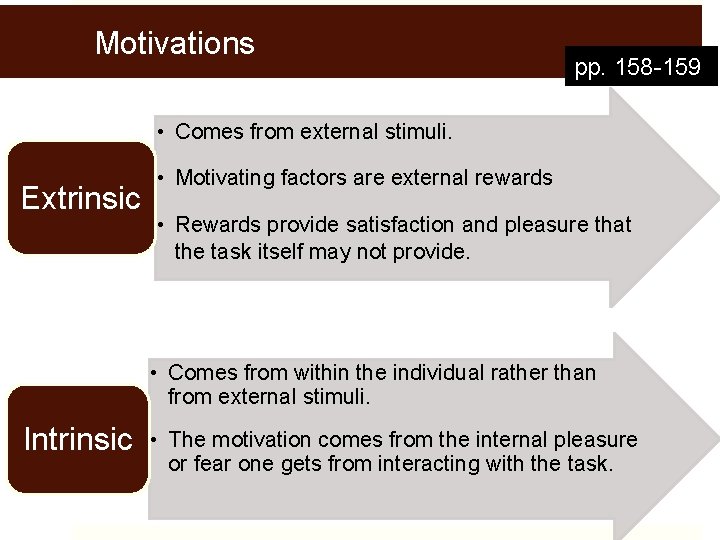
Motivations pp. 158 -159 • Comes from external stimuli. Extrinsic • Motivating factors are external rewards • Rewards provide satisfaction and pleasure that the task itself may not provide. • Comes from within the individual rather than from external stimuli. Intrinsic • The motivation comes from the internal pleasure or fear one gets from interacting with the task.
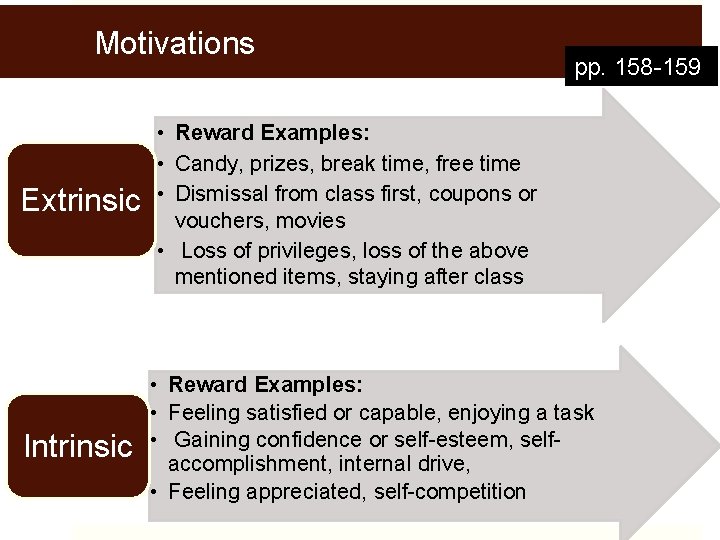
Motivations pp. 158 -159 Extrinsic • Reward Examples: • Candy, prizes, break time, free time • Dismissal from class first, coupons or vouchers, movies • Loss of privileges, loss of the above mentioned items, staying after class Intrinsic • Reward Examples: • Feeling satisfied or capable, enjoying a task • Gaining confidence or self-esteem, selfaccomplishment, internal drive, • Feeling appreciated, self-competition
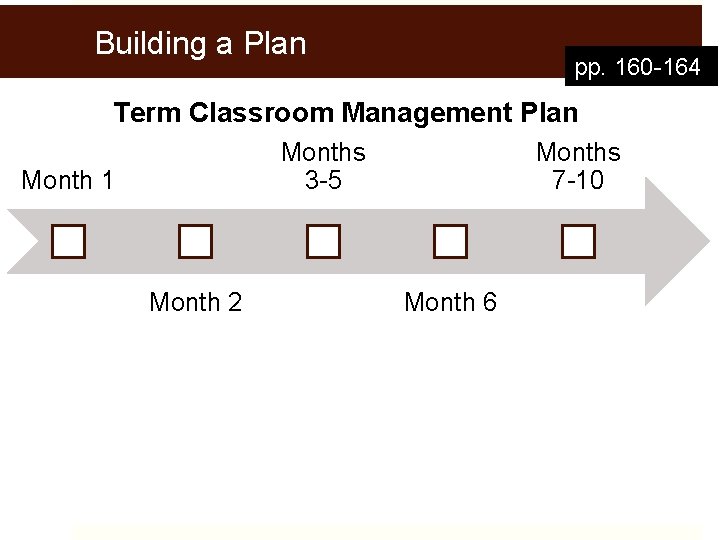
Building a Plan pp. 160 -164 Term Classroom Management Plan Months 3 -5 Month 1 Month 2 Months 7 -10 Month 6
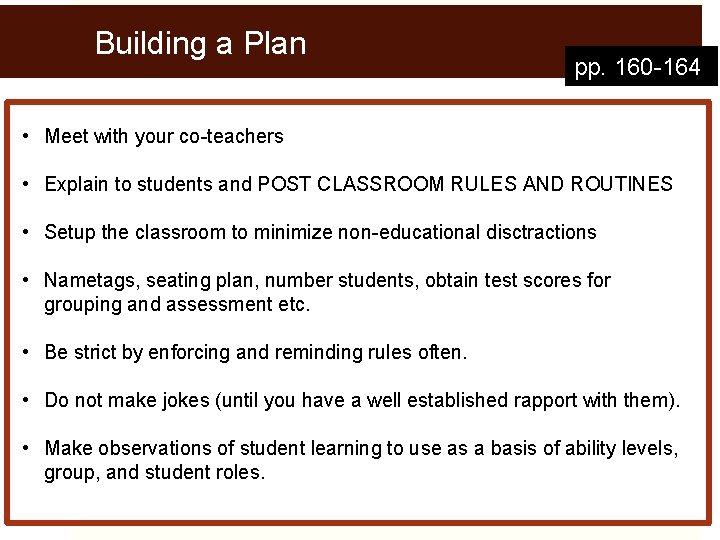
Building a Plan pp. 160 -164 Term Classroom Management Plan • Meet with your co-teachers Months Month 1 3 -5 7 -10 • Explain to students and POST CLASSROOM RULES AND ROUTINES • Setup the classroom to minimize non-educational disctractions • Nametags, seating plan, number students, obtain test scores for Month 2 Month 6 grouping and assessment etc. • Be strict by enforcing and reminding rules often. • Do not make jokes (until you have a well established rapport with them). • Make observations of student learning to use as a basis of ability levels, group, and student roles.
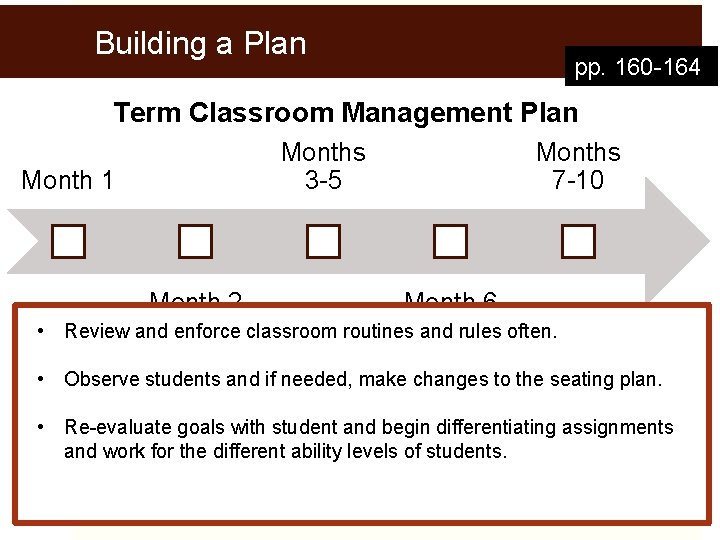
Building a Plan pp. 160 -164 Term Classroom Management Plan Months 3 -5 Month 1 Month 2 Months 7 -10 Month 6 • Review and enforce classroom routines and rules often. • Observe students and if needed, make changes to the seating plan. • Re-evaluate goals with student and begin differentiating assignments and work for the different ability levels of students.
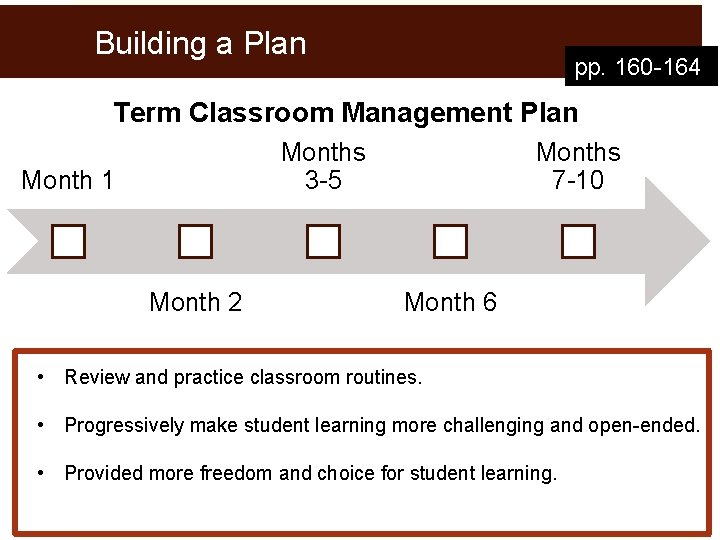
Building a Plan pp. 160 -164 Term Classroom Management Plan Months 3 -5 Month 1 Month 2 Months 7 -10 Month 6 • Review and practice classroom routines. • Progressively make student learning more challenging and open-ended. • Provided more freedom and choice for student learning.
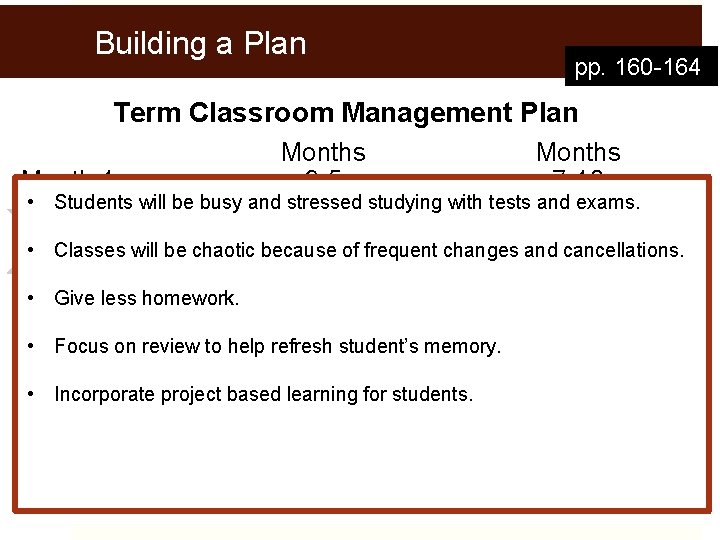
Building a Plan pp. 160 -164 Term Classroom Management Plan Month 1 Months 3 -5 Months 7 -10 • Students will be busy and stressed studying with tests and exams. • Classes will be chaotic because of frequent changes and cancellations. • Give less homework. Month 2 Month 6 • Focus on review to help refresh student’s memory. • Incorporate project based learning for students.
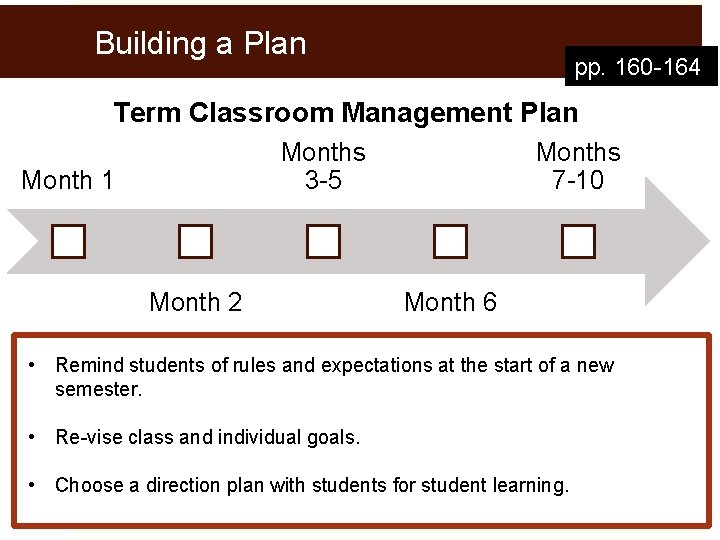
Building a Plan pp. 160 -164 Term Classroom Management Plan Months 3 -5 Month 1 Month 2 Months 7 -10 Month 6 • Remind students of rules and expectations at the start of a new semester. • Re-vise class and individual goals. • Choose a direction plan with students for student learning.
Classroom Management Strategies pp. 162 -165 The following strategies are framework for your own methods. • Rules and Protocol • Classroom Arrangement • Assigned Seating • Grouping Students and Roles • Communication
Classroom Management Strategies pp. 162 -165 Rules and Protocol • Foundations for encouraging classroom behavior • Review regularly • Make them concise, unambiguous, and encompassing • Check with your co-teacher and school’s discipline plan before making.
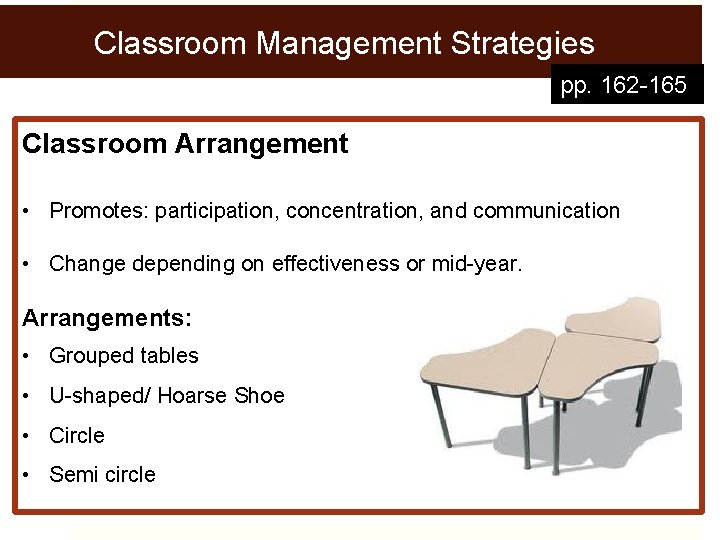
Classroom Management Strategies pp. 162 -165 Classroom Arrangement • Promotes: participation, concentration, and communication • Change depending on effectiveness or mid-year. Arrangements: • Grouped tables • U-shaped/ Hoarse Shoe • Circle • Semi circle
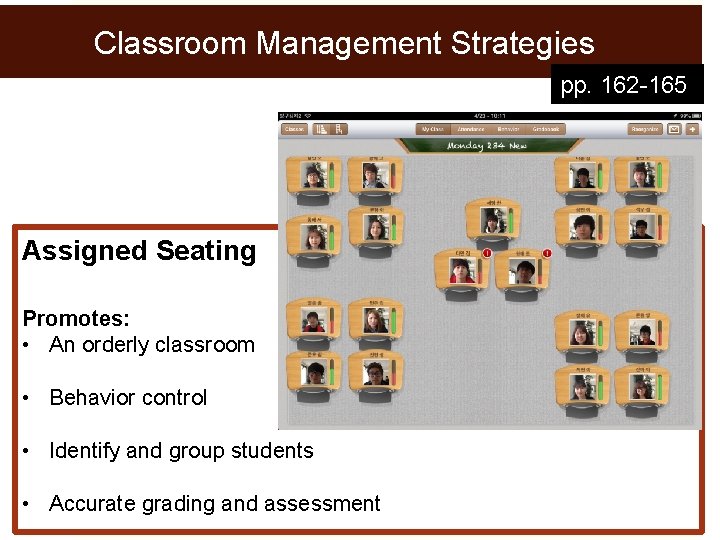
Classroom Management Strategies pp. 162 -165 Assigned Seating Promotes: • An orderly classroom • Behavior control • Identify and group students • Accurate grading and assessment
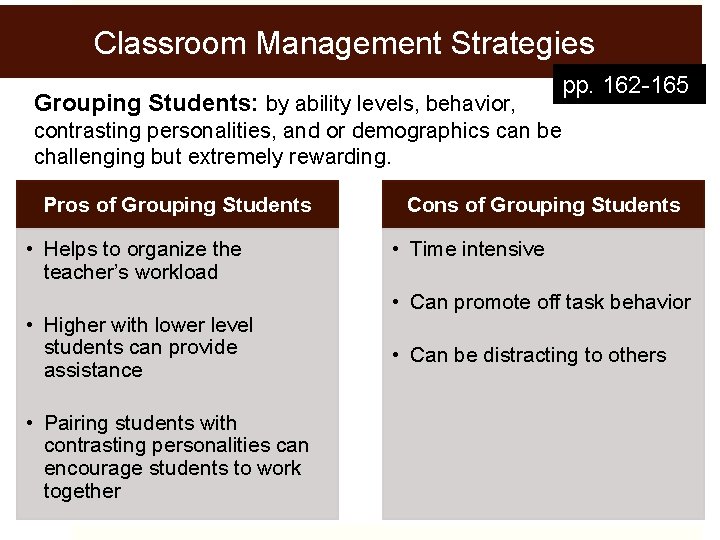
Classroom Management Strategies Grouping Students: by ability levels, behavior, pp. 162 -165 contrasting personalities, and or demographics can be challenging but extremely rewarding. Pros of Grouping Students • Helps to organize the teacher’s workload • Higher with lower level students can provide assistance • Pairing students with contrasting personalities can encourage students to work together Cons of Grouping Students • Time intensive • Can promote off task behavior • Can be distracting to others
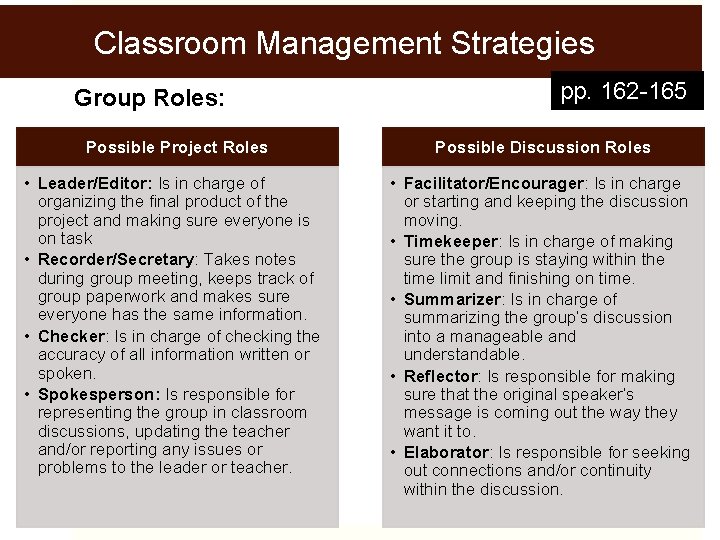
Classroom Management Strategies Group Roles: pp. 162 -165 Possible Project Roles Possible Discussion Roles • Leader/Editor: Is in charge of organizing the final product of the project and making sure everyone is on task • Recorder/Secretary: Takes notes during group meeting, keeps track of group paperwork and makes sure everyone has the same information. • Checker: Is in charge of checking the accuracy of all information written or spoken. • Spokesperson: Is responsible for representing the group in classroom discussions, updating the teacher and/or reporting any issues or problems to the leader or teacher. • Facilitator/Encourager: Is in charge or starting and keeping the discussion moving. • Timekeeper: Is in charge of making sure the group is staying within the time limit and finishing on time. • Summarizer: Is in charge of summarizing the group’s discussion into a manageable and understandable. • Reflector: Is responsible for making sure that the original speaker’s message is coming out the way they want it to. • Elaborator: Is responsible for seeking out connections and/or continuity within the discussion.
Classroom Management Strategies pp. 162 -165 Communication • Most overlooked classroom management strategies • Students who don’t understand or do not receive clear instructions are more likely to have behavioral issues or create commotion as they attempt to figure out what is going on. • Both verbal and non-verbal
Classroom Management Strategies pp. 162 -165 Communication • Speak slowly • Using clear, simple, and concise English • Using consistent repetitive classroom language • Not using idioms, jokes, or verbal crutches i. e. “uh, oh, like, hmm, ok, etc. ” • Gesturing while speaking (controlled and intentional gesturing) • Non-verbal communication, i. e. using your eyes, facial expressions, body gesturing, proximity and cueing • Using names • Using assertive language- “I want you to…” “I need you to…”
Co-teaching p. 166 In South Korea, EFL co-teaching serves two primary functions. • By law a Korean teacher must be in the classroom • It delivers instruction through the utilization of two or more instructors.
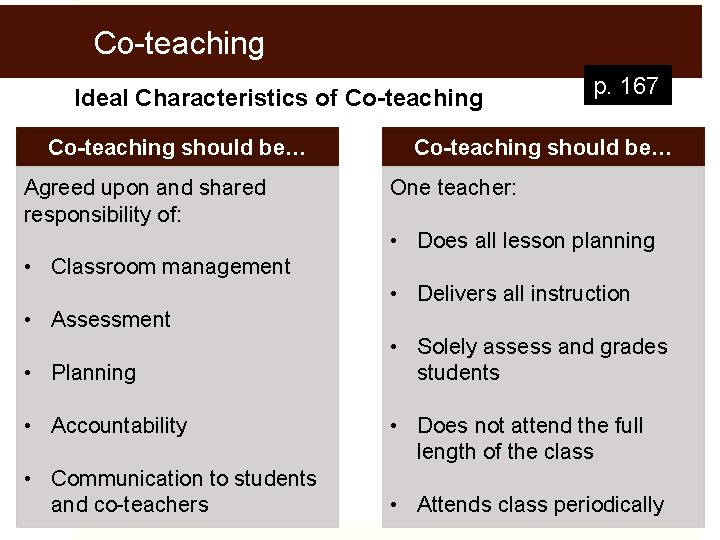
Co-teaching Ideal Characteristics of Co-teaching should be… Agreed upon and shared responsibility of: p. 167 Co-teaching should be… One teacher: • Does all lesson planning • Classroom management • Delivers all instruction • Assessment • Planning • Accountability • Communication to students and co-teachers • Solely assess and grades students • Does not attend the full length of the class • Attends class periodically
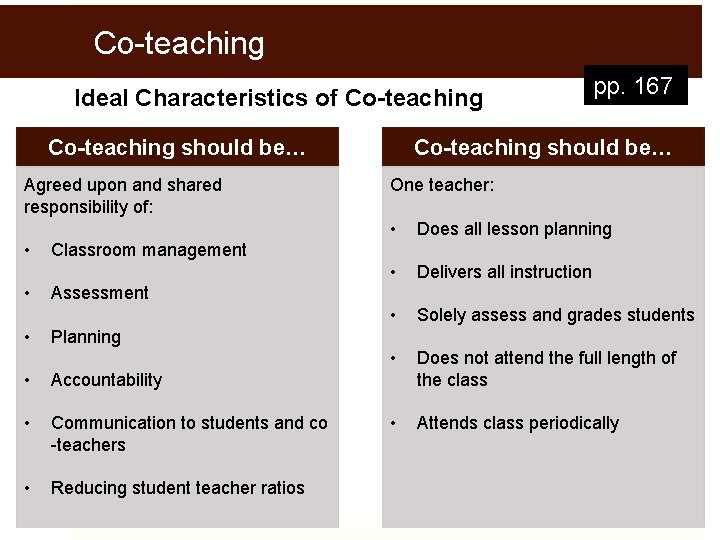
Co-teaching Ideal Characteristics of Co-teaching should be… Agreed upon and shared responsibility of: • • • pp. 167 Co-teaching should be… One teacher: • Does all lesson planning • Delivers all instruction • Solely assess and grades students • Does not attend the full length of the class • Attends class periodically Classroom management Assessment Planning • Accountability • Communication to students and co -teachers • Reducing student teacher ratios
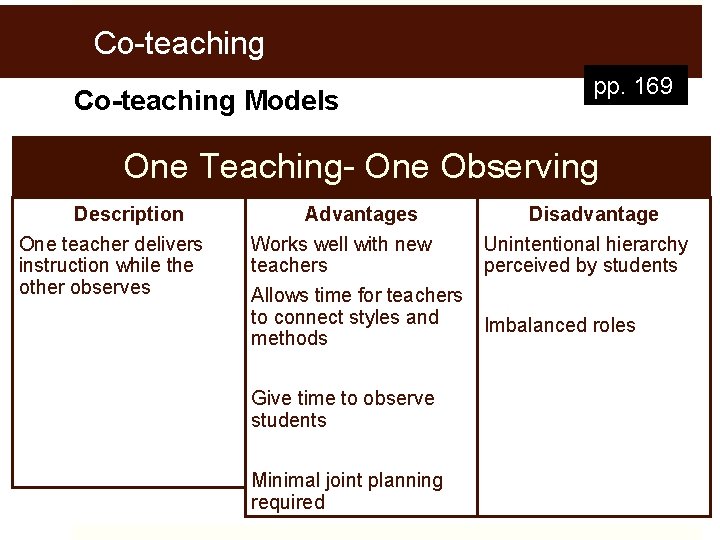
Co-teaching Models pp. 169 One Teaching- One Observing Description One teacher delivers instruction while the other observes Advantages Disadvantage Works well with new Unintentional hierarchy teachers perceived by students Allows time for teachers to connect styles and Imbalanced roles methods Give time to observe students Minimal joint planning required
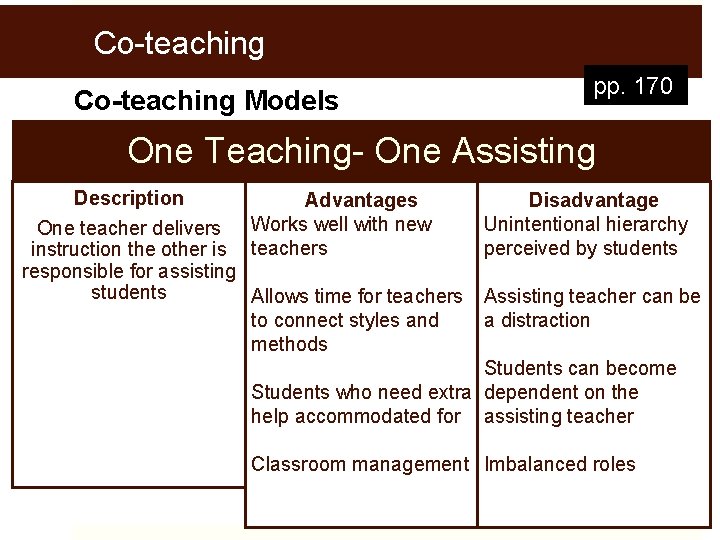
Co-teaching Models pp. 170 One Teaching- One Assisting Description One teacher delivers instruction the other is responsible for assisting students Advantages Disadvantage Works well with new Unintentional hierarchy teachers perceived by students Allows time for teachers Assisting teacher can be to connect styles and a distraction methods Students can become Students who need extra dependent on the help accommodated for assisting teacher Classroom management Imbalanced roles
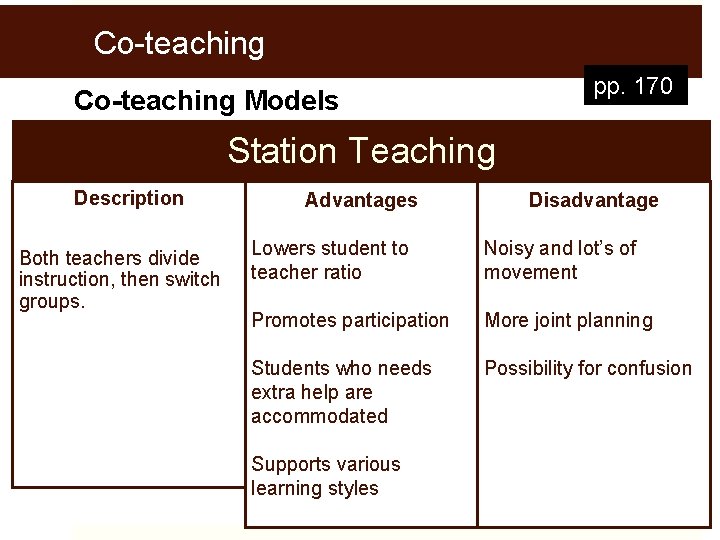
Co-teaching pp. 170 Co-teaching Models Station Teaching Description Both teachers divide instruction, then switch groups. Advantages Disadvantage Lowers student to teacher ratio Noisy and lot’s of movement Promotes participation More joint planning Students who needs extra help are accommodated Possibility for confusion Supports various learning styles
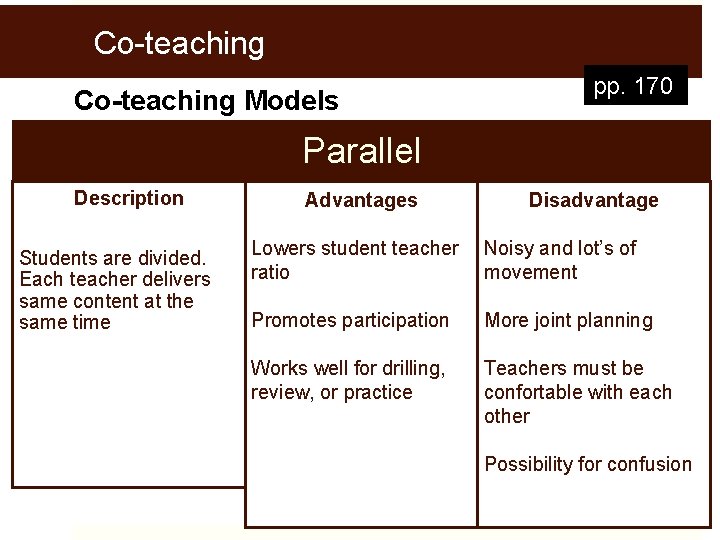
Co-teaching pp. 170 Co-teaching Models Parallel Description Students are divided. Each teacher delivers same content at the same time Advantages Disadvantage Lowers student teacher Noisy and lot’s of ratio movement Promotes participation More joint planning Works well for drilling, review, or practice Teachers must be confortable with each other Possibility for confusion
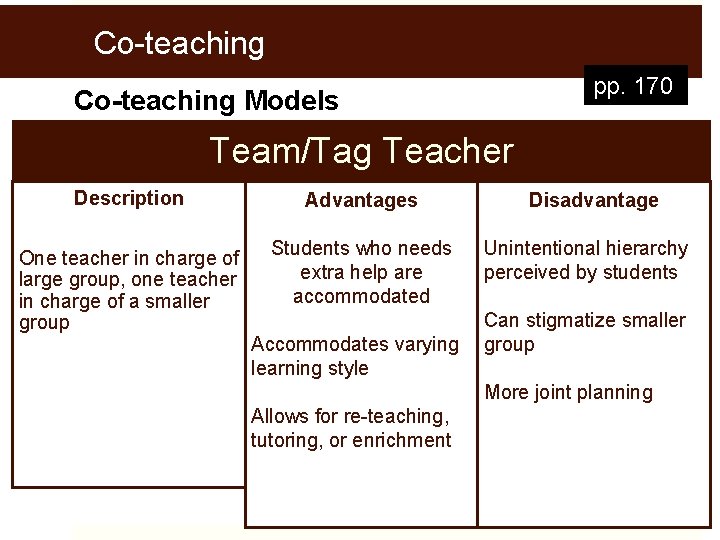
Co-teaching pp. 170 Co-teaching Models Team/Tag Teacher Description One teacher in charge of large group, one teacher in charge of a smaller group Advantages Disadvantage Students who needs extra help are accommodated Unintentional hierarchy perceived by students Can stigmatize smaller Accommodates varying group learning style More joint planning Allows for re-teaching, tutoring, or enrichment
Feedback and Questions http: //www. waygook. org/ http: //www. eflclassroom. com My email address: moonasard@gmail. com
- Slides: 37