
Building Drawing N 1 Module 1 Basic drawing
Building Drawing N 1
Module 1: Basic drawing skills and information BUILDING INSTRUMENTS Instruments necessary for doing building drawings include: • Graphic pencils; • Erasers; • T-squares; • Protractors; and • Compasses. www. futuremanagers. com
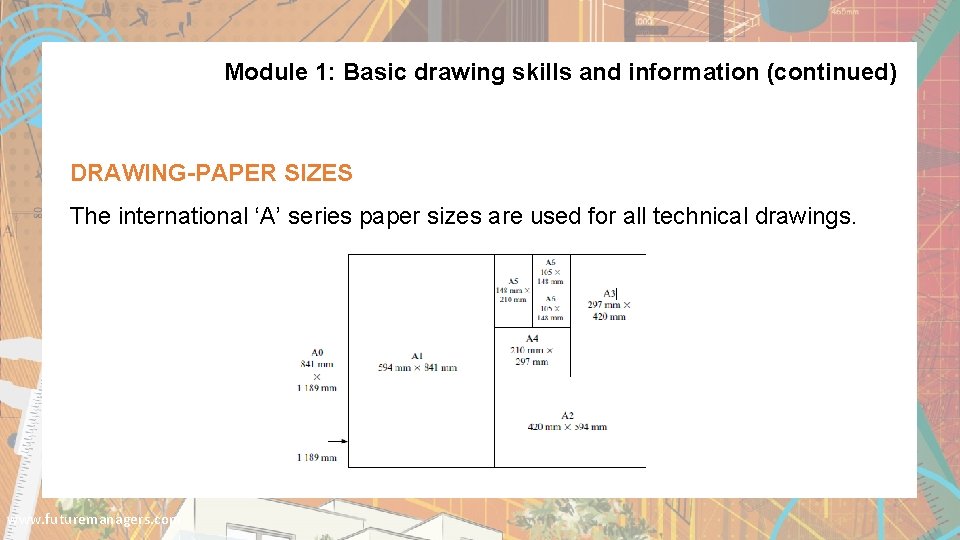
Module 1: Basic drawing skills and information (continued) DRAWING-PAPER SIZES The international ‘A’ series paper sizes are used for all technical drawings. www. futuremanagers. com
Module 1: Basic drawing skills and information (continued) LETTERING AND ANNOTATION • The letter characters must be legible and capable of being produced by hand at a reasonable speed. • Letter characters should be open form and all embellishments must be avoided for the sake of clarity. • Vertical or sloping characters are suitable but should not be mixed on any one drawing. www. futuremanagers. com
Module 1: Basic drawing skills and information (continued) DIMENSIONING • A dimension stipulates the distance that two points are apart. • Relate all dimensions to faces, structural materials or centre lines. • Do not duplicate dimensions on the same drawing. • Do not take physical measurements from a drawing. • Always draw dimension lines in such a position that they are not confused with the subject. • Clearly show the points to which dimension lines relate. www. futuremanagers. com
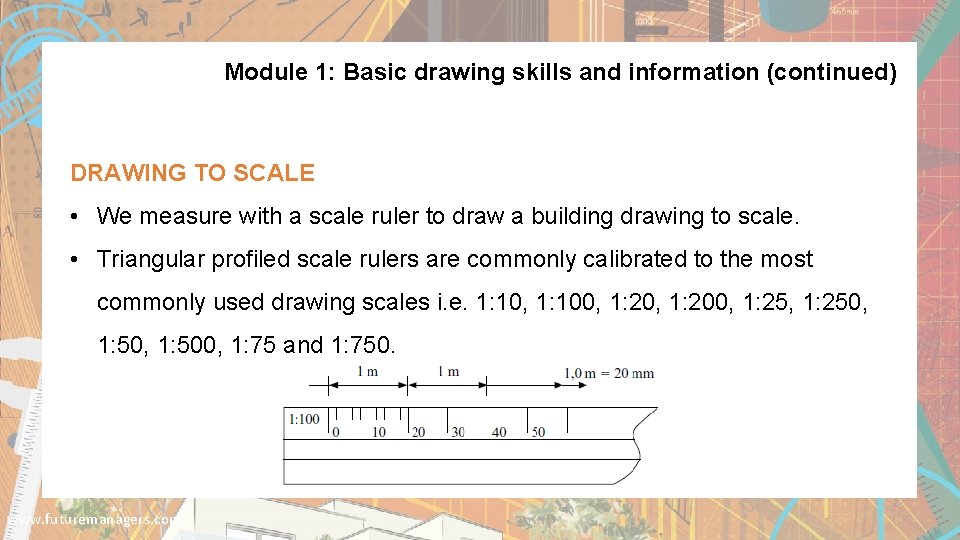
Module 1: Basic drawing skills and information (continued) DRAWING TO SCALE • We measure with a scale ruler to draw a building drawing to scale. • Triangular profiled scale rulers are commonly calibrated to the most commonly used drawing scales i. e. 1: 10, 1: 100, 1: 200, 1: 250, 1: 500, 1: 75 and 1: 750. www. futuremanagers. com
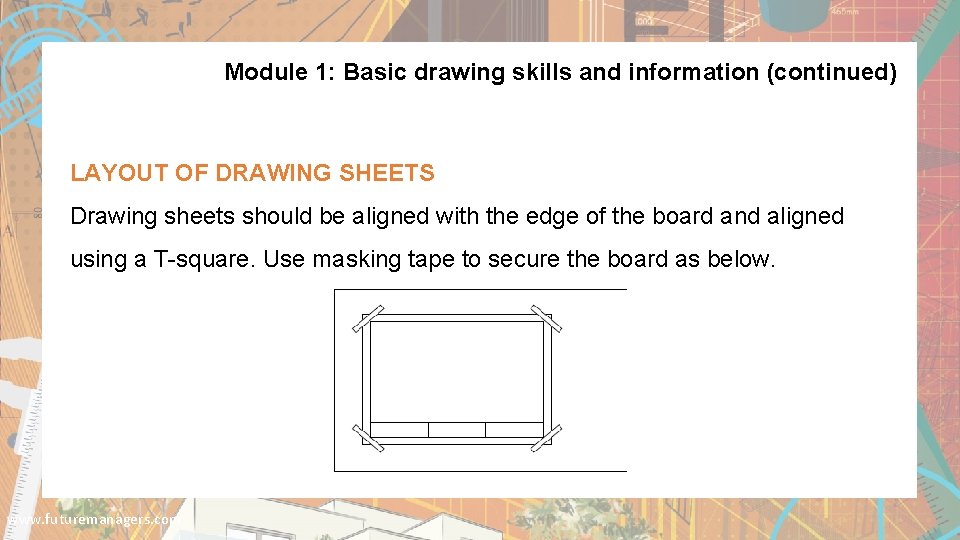
Module 1: Basic drawing skills and information (continued) LAYOUT OF DRAWING SHEETS Drawing sheets should be aligned with the edge of the board and aligned using a T-square. Use masking tape to secure the board as below. www. futuremanagers. com
Module 2: Basic geometrical drawing INTRODUCTION The word geometry is derived from two Greek words. The first part of the word geometry is taken from the Greek word ge, which means earth, and the second part is taken from the Greek word metron, which means measure. Thus, early geometry had to do with earth measurement. www. futuremanagers. com
Module 3: Orthographic projection PRINCIPLES OF PROJECTION When making any orthographic projection, the projection lines (eye lines) are parallel to each other and always perpendicular (at right angles) to the projection plane. www. futuremanagers. com
Module 4: First angle orthographic projections of geometric solids INTRODUCTION Making first angle orthographic projections of front, top and left views of basic geometric solids shown in pictorial view. www. futuremanagers. com
Module 4: First angle orthographic projections of geometric solids (continued) STEP 1 • Draw centre lines through the centre of your drawing sheet. • Draw a line at 45° from the origin in the 3 rd quarter as shown. • Draw a horizontal construction line 20 mm from the horizontal centre line in quarter 4 to intersect the 45° line. • From this intersection, draw a construction line parallel to the vertical centre line. www. futuremanagers. com
Module 4: First angle orthographic projections of geometric solids (continued) STEP 2 • From the horizontal centre line, measure the height of the figure. • From the vertical centre line, measure the width of the figure to the left. • From the 20 mm line below the horizontal centre line, measure the depth of the figure. • Draw a construction line from this measurement to the right to intersect the 45° line and then vertically to show the depth in the 2 nd quadrant. www. futuremanagers. com
Module 4: First angle orthographic projections of geometric solids (continued) STEP 3 • Measure the front view subsections and project these to the top view. • Measure the top view subsections and project them across to the 45° line. • From the intersection on the 45° line, project these measurements vertically upwards to show them in the 2 nd quadrant. • Finally, dimension and label the views and complete the page border and title block. www. futuremanagers. com
Module 5: Isometric and oblique projection ISOMETRIC PROJECTION An isometric projection of an object gives a pictorial view of the object which shows the three major views simultaneously. It shows a three-dimensional drawing of the object. An isometric projection only shows the shape of the object. Unlike orthographic views, isometric views are not normally used to manufacture objects because the elements of this view are not true to real size. www. futuremanagers. com
Module 5: Isometric and oblique projection (continued) BRICKS The process of brick manufacture varies according to the type of clay and the machinery used. Bricks are moulded either by machinery or by hand. Bricks are made mostly by machinery today. Machine-made bricks: The various processes are preparation of the earth, moulding, drying and burning. www. futuremanagers. com
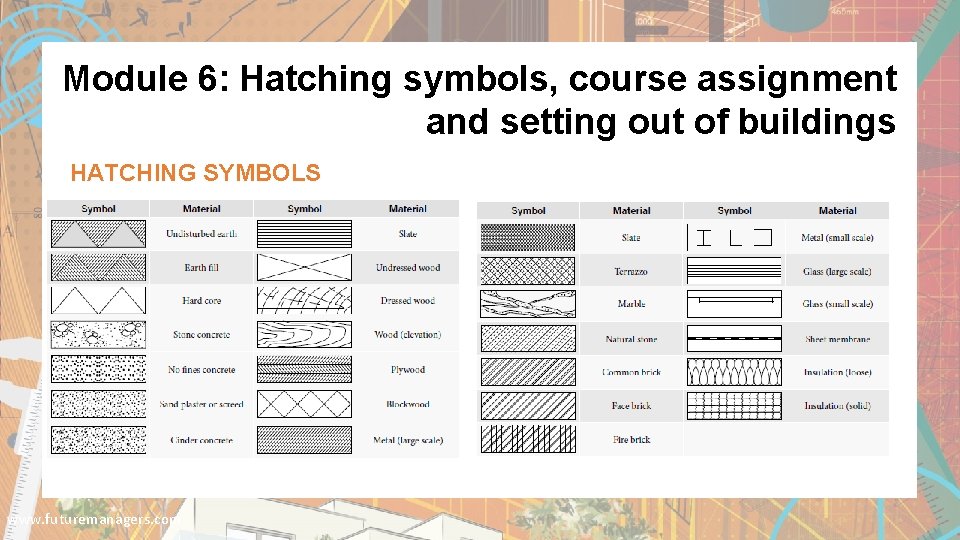
Module 6: Hatching symbols, course assignment and setting out of buildings HATCHING SYMBOLS www. futuremanagers. com
Module 6: Hatching symbols, course assignment and setting out of buildings (continued) THE SETTING-OUT OF A BUILDING Before a new building can be set-out, the following needs to be done: • The land must be surveyed with an instrument called a dumpy level to determine differences in ground level. On sloping sites, it may be necessary to level the surface before setting-out can start. This is done by excavating the higher parts and removing the soil to the lower parts. • The foundation trenches must be set out or pegged out before they can be excavated. www. futuremanagers. com
Module 7: Foundations CONCRETE STRIP FOUNDATIONS The natural of a house is the ground on which the house is built. And an artificial foundation is the extended bases which are constructed of concrete and bricks. Artificial foundations for dwellings are constructed of a concrete bed. This type of foundation is the most common and is known as a strip foundation. The main purpose of the foundation is to distribute the weight of the building over a larger area. www. futuremanagers. com
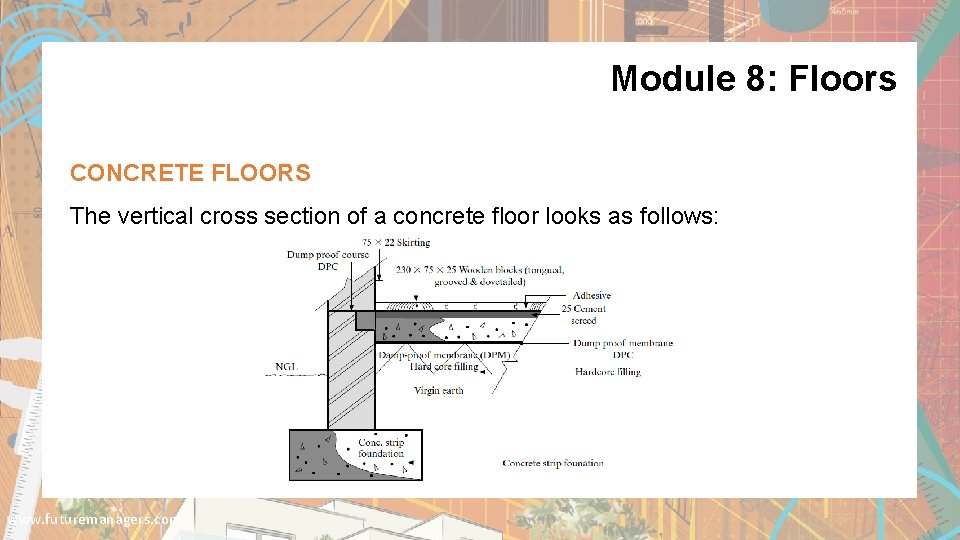
Module 8: Floors CONCRETE FLOORS The vertical cross section of a concrete floor looks as follows: www. futuremanagers. com
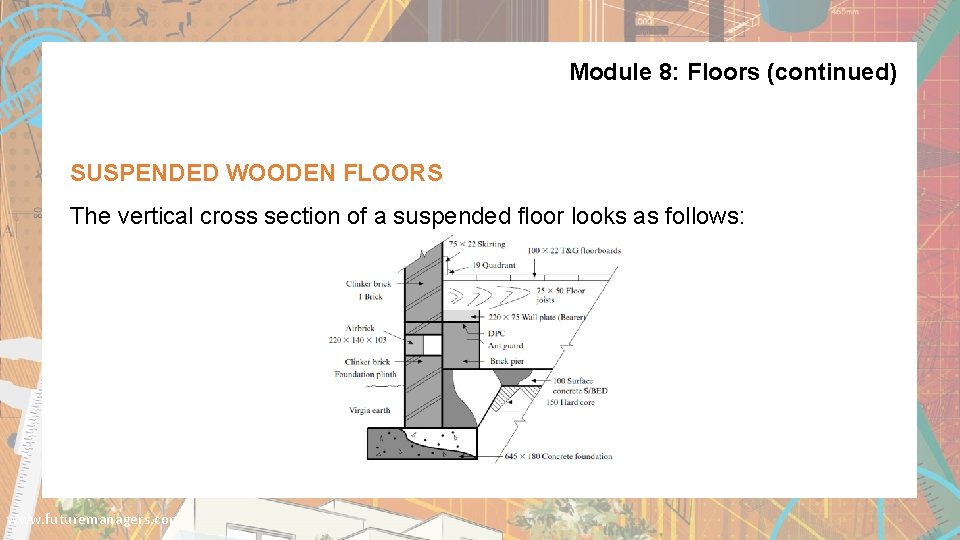
Module 8: Floors (continued) SUSPENDED WOODEN FLOORS The vertical cross section of a suspended floor looks as follows: www. futuremanagers. com
Module 9: Brick bonding BRICK BONDING PATTERNS To build a wall, bricks are embedded in mortar and are arranged in a certain pattern for strength and appearance. The strength depends on the brick bonding pattern that is used. A brick bond is the interlacement formed when the bricks overlap those immediately below and above them. There are many types of bonds, but we will confine ourselves to the stretching bond and the English bond. www. futuremanagers. com
Module 10: Lintels INTRODUCTION A lintel is a horizontally fixed member of wood, brick or concrete to support the structure above an opening like a door or a window. Most lintels used today are made of reinforced concrete. www. futuremanagers. com
Module 10: Lintels (continued) BRICK LINTELS • These are horizontal members built of bricks on end or on edge to support the structure above doors and windows. • This type of lintel is not suited to support heavy loads and is quite a weak form of construction. • They are only used to span small openings with a span less than 900 mm. • Brick lintels are commonly built with pressed bricks having frogs which are filled with mortar. This type is known as a joggled brick lintel. www. futuremanagers. com
Module 10: Lintels (continued) REINFORCED CONCRETE LINTELS • The concrete must be strengthened by mild steel bars if the above span is to be exceeded. • The number and the size of the steel rods depend upon the span and width of the lintel, as well as the load that is to be supported. • The height of the lintel will increase as the span increases. • The ends of the steel rods are curved and sometimes hooked for wider spans. www. futuremanagers. com
Module 11: Arches BRICK ARCHES • Relatively small units, such as bricks or masonry blocks, make up the structure of an arch. • These brick or masonry units are wedge shaped, and join together by mortar to span the opening to support the load above. • The units support each other because of their wedge shape. • The units are made compact by the weight above, enabling them to transmit the pressure downwards to the supporting wall. www. futuremanagers. com
Module 11: Arches (continued) HOW ARCHES ARE CLASSIFIED • Arches are classified according to their shape and the materials used. • Common forms of arches are: flat, segmental or semi-circular. Rarely used arches are elliptical or pointed. • The brick units (voussoirs) may consist of rubber bricks, purpose-made bricks or standard bricks. www. futuremanagers. com
Module 12: Windows STEEL CASEMENT WINDOWS A steel casement window refers to a steel window sash that is hinged to a steel window frame. They include fixed lights, side and top hung casements and pivoted casements. A casement has a sash which is attached to the window frame by hinges while a fixed light consists of a frame only. www. futuremanagers. com
Module 12: Windows (continued) WOODEN CASEMENT WINDOW This consists of a wooden glazed sash which fits snuggly into the rebates (jambs) of a solid wooden window frame. The sash is hinged to the frame by two hinges and is normally opens outward to avoid interference with the curtains and also to prevent rainwater from dripping onto the floor when the window is opened. A sash is either top hung, bottom hung or side hung. The sash could also be installed to pivot in the centre of the frame. www. futuremanagers. com
Module 13: Timber doors TIMBER OUTSIDE DOORS Different types of outside doors include: • Ledged and battened doors; • Ledged, braced and battened doors; • Framed, ledged, braced and battened doors; • Flush doors; and • Panelled doors. www. futuremanagers. com
Module 14: Roof trusses INTRODUCTION • To build roof trusses, planed stress graded timbers are gang-nailed or bolted together. • These trusses are erected commonly in the shape of triangles. • The rafters and the tie-beam are also joined together by a timber web of struts and ties which forms a secondary set of triangles. • Roof trusses are placed at relatively close distances to form the support frame of the roof. www. futuremanagers. com
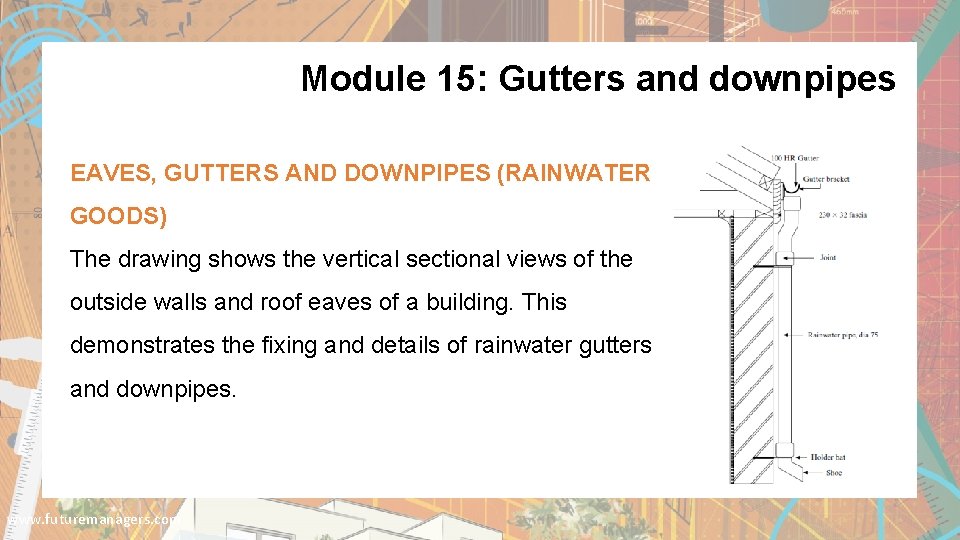
Module 15: Gutters and downpipes EAVES, GUTTERS AND DOWNPIPES (RAINWATER GOODS) The drawing shows the vertical sectional views of the outside walls and roof eaves of a building. This demonstrates the fixing and details of rainwater gutters and downpipes. www. futuremanagers. com
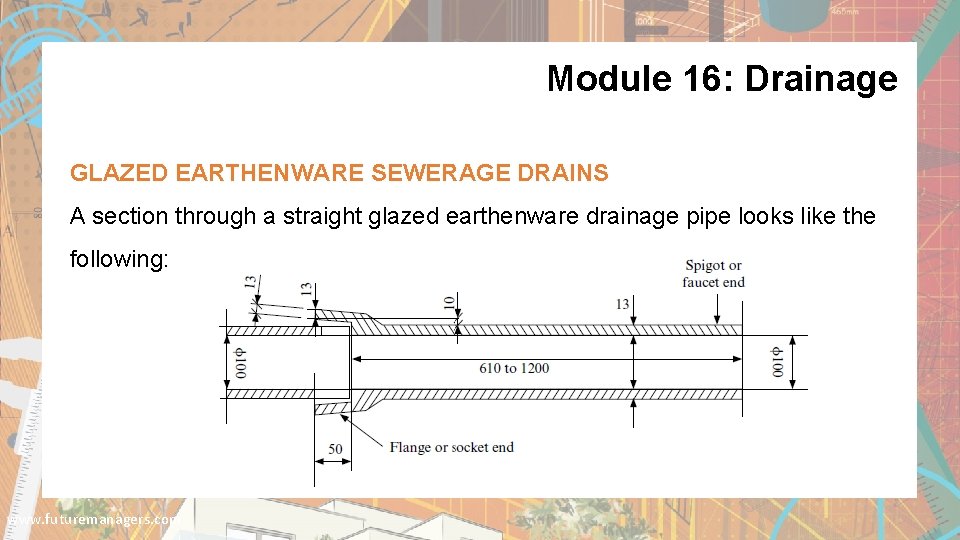
Module 16: Drainage GLAZED EARTHENWARE SEWERAGE DRAINS A section through a straight glazed earthenware drainage pipe looks like the following: www. futuremanagers. com
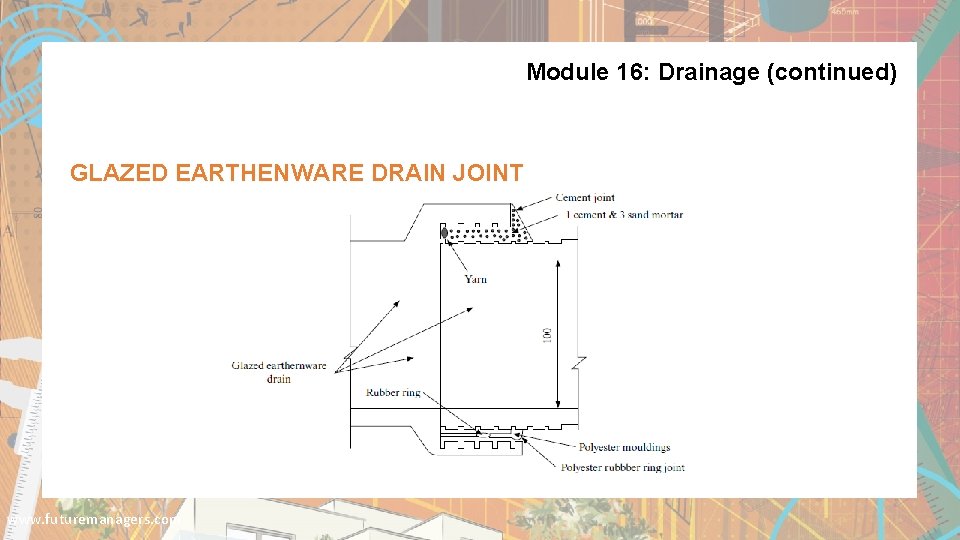
Module 16: Drainage (continued) GLAZED EARTHENWARE DRAIN JOINT www. futuremanagers. com
- Slides: 33