
Building Decarbonization and the CPUC Low Income Oversight
Building Decarbonization and the CPUC Low Income Oversight Board March 6, 2020 Rory Cox, Analyst, CPUC 1
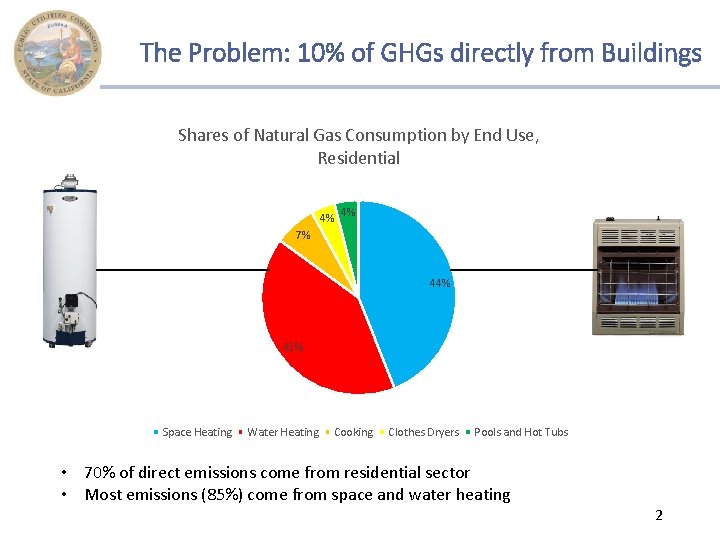
The Problem: 10% of GHGs directly from Buildings Shares of Natural Gas Consumption by End Use, Residential 4% 4% 7% 44% 41% Space Heating Water Heating Cooking Clothes Dryers Pools and Hot Tubs • 70% of direct emissions come from residential sector • Most emissions (85%) come from space and water heating 2
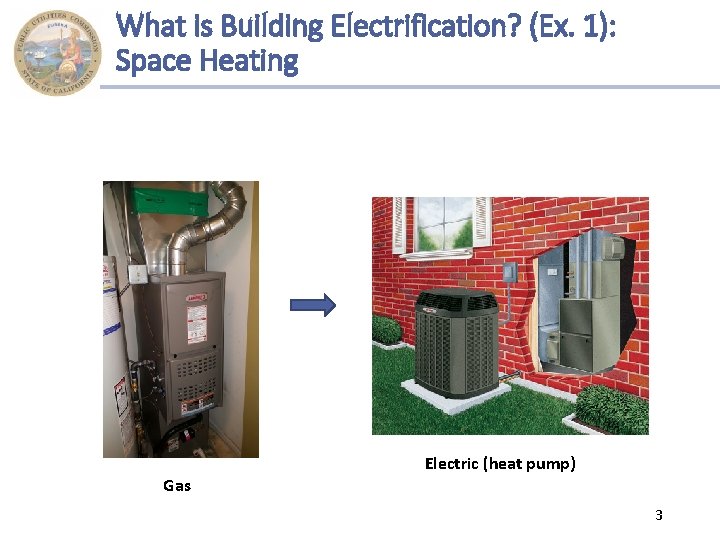
What is Building Electrification? (Ex. 1): Space Heating Gas Electric (heat pump) 3
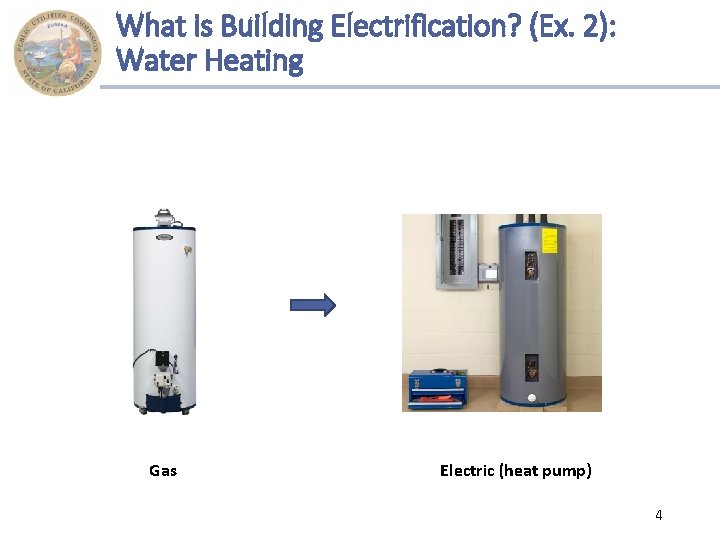
What is Building Electrification? (Ex. 2): Water Heating Gas Electric (heat pump) 4
Building Decarbonization Policy Context: Legislation Summary • SB 100 (De Leon) – 60% of electricity must come from renewable sources by 2030, carbon free by 2045. • AB 3232 (Friedman): Requires CEC to produce plans (with CPUC) to reduce buildings emissions by 40% by 2030. • SB 1477 (Stern): Allocates $50 million/year for BUILD and TECH programs, 30% for low income customers. Administered by CPUC. • SB 1013 (Lara): Puts state on path to low GWP refrigerants. • SB 49 (Skinner): Encourages development of “smart” appliances for load management 5
Building Decarbonization Proceedings CPUC Proceedings - Highlights • R. 15 -03 -010 – $56 million for Disadvantaged Communities in San Joaquin Valley. • R. 19 -01 -011 – • $120 million for space and water heating in existing homes (TECH). • $80 million for low income new construction (BUILD). • R. 12 -11 -005 – Funding from the Self Generation Incentive Program of $41 million available for elec. heat pump water heaters, with an additional $4 million for low income customers • R. 13 -11 -005 • Revised rules so energy efficiency funding could be used for “fuel substitution”, allowing access to $600 million budget. • Approved $250 million for Market Transformation Activities. • There’s more—a minimum of $381 million has been authorized for building decarbonization 6
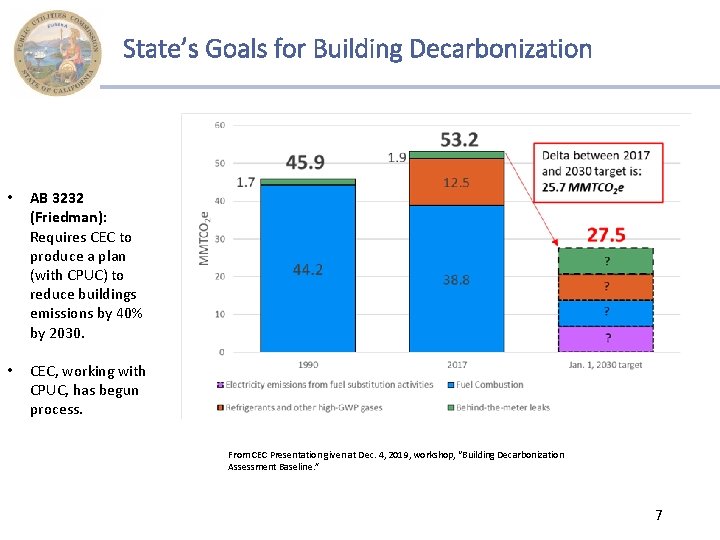
State’s Goals for Building Decarbonization • AB 3232 (Friedman): Requires CEC to produce a plan (with CPUC) to reduce buildings emissions by 40% by 2030. • CEC, working with CPUC, has begun process. From CEC Presentation given at Dec. 4, 2019, workshop, “Building Decarbonization Assessment Baseline. ” 7
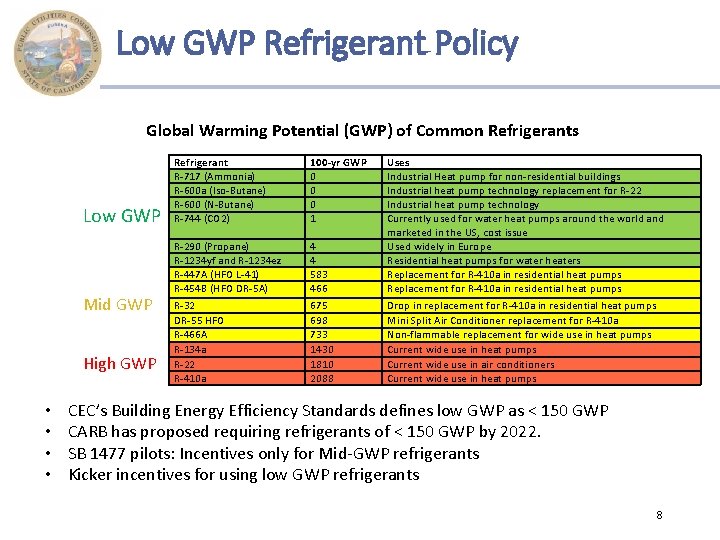
Low GWP Refrigerant Policy Global Warming Potential (GWP) of Common Refrigerants Low GWP Mid GWP High GWP • • Refrigerant R-717 (Ammonia) R-600 a (Iso-Butane) R-600 (N-Butane) R-744 (CO 2) 100 -yr GWP 0 0 0 1 R-290 (Propane) R-1234 yf and R-1234 ez R-447 A (HFO L-41) R-454 B (HFO DR-5 A) R-32 DR-55 HFO R-466 A R-134 a R-22 R-410 a 4 4 583 466 675 698 733 1430 1810 2088 Uses Industrial Heat pump for non-residential buildings Industrial heat pump technology replacement for R-22 Industrial heat pump technology Currently used for water heat pumps around the world and marketed in the US, cost issue Used widely in Europe Residential heat pumps for water heaters Replacement for R-410 a in residential heat pumps Drop in replacement for R-410 a in residential heat pumps Mini Split Air Conditioner replacement for R-410 a Non-flammable replacement for wide use in heat pumps Current wide use in air conditioners Current wide use in heat pumps CEC’s Building Energy Efficiency Standards defines low GWP as < 150 GWP CARB has proposed requiring refrigerants of < 150 GWP by 2022. SB 1477 pilots: Incentives only for Mid-GWP refrigerants Kicker incentives for using low GWP refrigerants 8
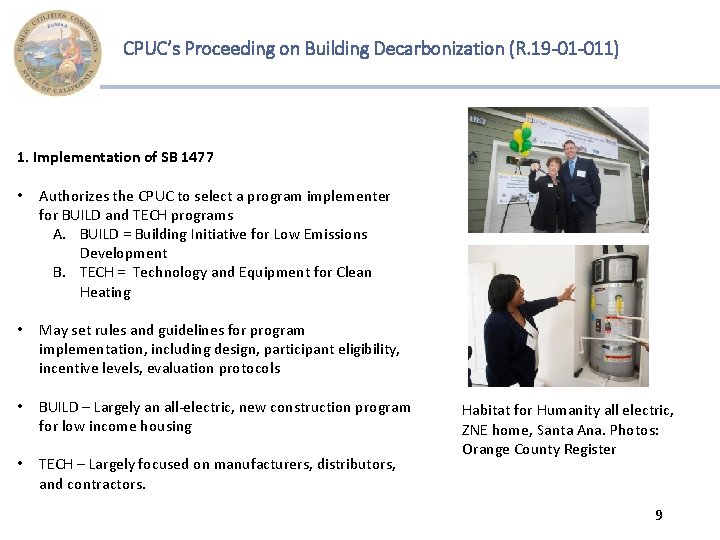
CPUC’s Proceeding on Building Decarbonization (R. 19 -01 -011) 1. Implementation of SB 1477 • Authorizes the CPUC to select a program implementer for BUILD and TECH programs A. BUILD = Building Initiative for Low Emissions Development B. TECH = Technology and Equipment for Clean Heating • May set rules and guidelines for program implementation, including design, participant eligibility, incentive levels, evaluation protocols • BUILD – Largely an all-electric, new construction program for low income housing • TECH – Largely focused on manufacturers, distributors, and contractors. Habitat for Humanity all electric, ZNE home, Santa Ana. Photos: Orange County Register 9

CPUC’s Proceeding on Building Decarbonization 2. Pilot programs for post-fire rebuilding • Considers consistent, unified statewide approach for fire victims to rebuild homes all electric • CPUC approved a PG&E program in Northern California, with Sonoma Clean Power as a partner. • CPUC approved similar program for SCE’s territory. Photo: Sonoma Magazine 10

CPUC’s Proceeding on Building Decarbonization 3. Building and Appliance codes and standards • CPUC will consider specific program policies, procedures, and rules to incent builders to choose Title 24 compliance pathways that maximize GHG reductions. 4. Develop a Building Decarbonization Policy Framework • Development of a coherent and comprehensive set of Commission rules, policies, and procedures to accelerate the reduction of GHG from buildings. • Draw on lessons learned from the smaller-scale programs authorized by SB 1477 to scale up, including rate design. • Possible topics: Rate design and financing 11

Metrics: GHG Reductions and Bill Savings for BUILD and TECH • SB 1477 requirements • Cost per metric ton of avoided GHG emissions • Projected annual and lifetime utility bill savings • Number of low-emission systems installed (BUILD) • Market share for eligible technologies (TECH) • Cap-and-Trade fund requirements: • Total avoided GHG emissions from each year’s expenditures • Total expenditures • Itemization of administration and outreach expenditures 12
Questions? Rory Cox 415 -703 -1093 rory. cox@cpuc. ca. gov Image: https: //www. thefctre. com/en/ 13
- Slides: 13