
Building Dataverse Communities that follow RDA Best Practices
Building Dataverse Communities that follow RDA Best Practices for Data Sharing and Management Gustavo Durand, Jon Crabtree, Philipp Conzett, Slava Tykhonov

http: //bit. ly/RDABOFDV

Introduction to Dataverse

Overview ● An open-source platform to publish, cite, and archive research data ● Built to support multiple types of data, users, and workflows ● Developed at Harvard’s Institute for Quantitative Social Science (IQSS) since 2006 ● Development funded by IQSS and with grants, in collaboration with institutions around the world ● 12 on the core team - developers, designers, UI/UX, metadata specialists, curation team, leadership team

Dataverse Technology Glassfish Server 4. 1 Java SE 8 Java EE 7 - Presentation: JSF (Prime. Faces), RESTful API - Business: EJB, Transactions, Asynchronous, Timers - Storage: JPA (Entities), Bean Validation Storage: Postgres, Solr, File System / Swift / S 3

Dataverse Features - Data ● Persistent IDs / URLs ○ Data. Cite ○ Handle ● Automatically Generated Citations with attribution ● Compliant with FAIR and data citation principles ● Domain-specific Metadata ● Versioning ● File Storage ○ Local ○ Swift (Open. Stack) ○ S 3 (Amazon) ● Data. Tags for Sensitive Data
Dataverse Features - Users ● Multiple Sign In options ○ Native ○ Shibboleth ○ OAuth (ORCID, Github, Google, Microsoft) ● Dataverses within Dataverses ● Branding ● Widgets
Dataverse Features - Workflows ● ● ● Permissions Access Controls and Terms of Use Publishing Workflows Private URLs Upload / Download Workflows ○ Browser ○ Dropbox ○ Rsync (for big data “packages”) ○ Remote Storage (TRSAs)

Dataverse Features - Interoperability ● APIs ○ SWORD ○ Native ○ Metrics ● Harvesting (OAI-PMH) ○ Client ○ Server ● Modular External Tools ○ Explore vs Configure ○ Scope: Dataset / Datafile

Dataverse Roadmap https: //www. iq. harvard. edu/roadmap-dataverse-project ● Strategic Goals ● Implementation, Planning, Future

Dataverse Community

Dataverse Community ● 50 installations around the world

The Data (dataverse. org/metrics) ● 50 installations ● 5, 500 Dataverses* ● 124, 000 Datasets* ● 507, 000 Files* ● 10, 200, 000 File Downloads* * metrics collected from 26 installations

Dataverse Community ● 100+ Contributors ● Hundreds of members of the Dataverse Community developers, researchers, librarians, data scientists ○ Dataverse Google Group ○ Dataverse Community Calls ○ Dataverse Community Meeting ○ Workshops & Trainings ○ UI/UX Testing & Interviews ○ Global Dataverse Community Consortium

The Dataverse Cup ��

Community Development

Dataverse Ecosystem Core Plugins (via SPIs) External Systems (via APIs)

Core - Contributing Code to the Dataverse Repo ● Let’s talk early and often! ○ Preview vs Review ● We like small batches, but we’ll follow your lead ● References ○ Developer’s Guide ○ Style Guide ○ API Guide
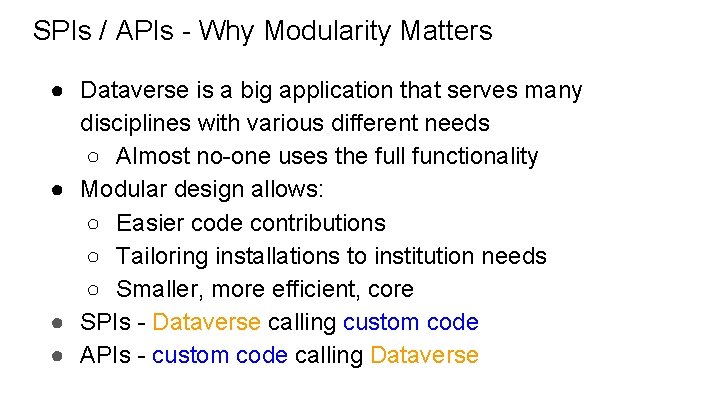
SPIs / APIs - Why Modularity Matters ● Dataverse is a big application that serves many disciplines with various different needs ○ Almost no-one uses the full functionality ● Modular design allows: ○ Easier code contributions ○ Tailoring installations to institution needs ○ Smaller, more efficient, core ● SPIs - Dataverse calling custom code ● APIs - custom code calling Dataverse
Example Collaborations (Core) ● SBGrid Data ○ Large Data and Support ● Massachusetts Open Cloud ○ Big Data Storage and Compute Access (Open. Stack) ● Provenance ○ W 3 C PROV ● Australian Data Archive (ADA) ○ Use Guestbook for Request Access
Example Collaborations (SPIs) ● SBGrid Data ○ Pre Publish Workflows ● DANS/CIMMYT/GESIS ○ Handles ○ da|ra
Example Collaborations (APIs) ● File Access APIs (External Tools) ○ Harvard SEAS - Two. Ravens ○ Scholars Portal - Data Explorer, Data Curation Tool ○ QDR - File Previewers for pdfs, images, videos ● Deposit APIs ○ Open Journal Systems - OJS Plugin ● Client Libraries ○ Research. Space - Java ○ AUSSDA - python - py. Dataverse

Odum Institute
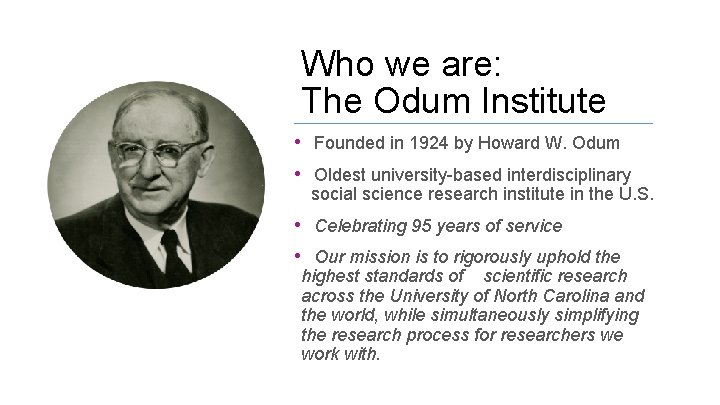
Who we are: The Odum Institute • Founded in 1924 by Howard W. Odum • Oldest university-based interdisciplinary social science research institute in the U. S. • Celebrating 95 years of service • Our mission is to rigorously uphold the highest standards of scientific research across the University of North Carolina and the world, while simultaneously simplifying the research process for researchers we work with.
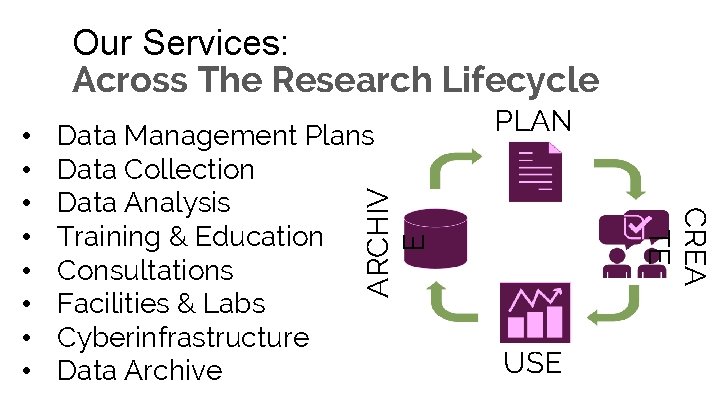
Our Services: Across The Research Lifecycle ARCHIV E Data Management Plans Data Collection Data Analysis Training & Education Consultations Facilities & Labs Cyberinfrastructure Data Archive CREA TE • • PLAN USE
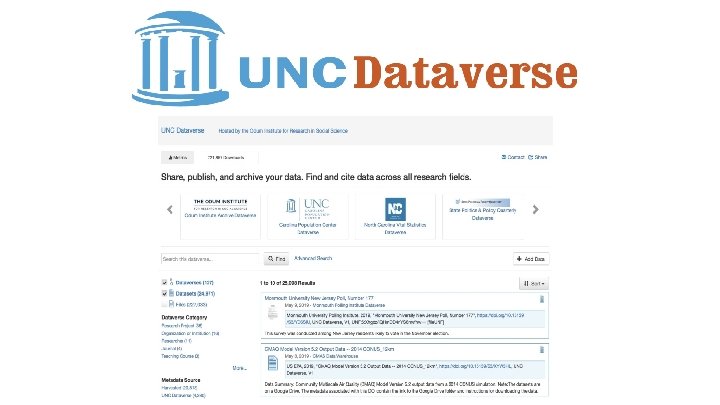
Dataverse. NO
What is Dataverse. NO? ● A national, generic repository for open research data ● For researchers from Norwegian research institutions ● Some collections within Dataverse. NO also accept data from researchers from other institutions. ● Aligned with the FAIR Guiding Principles for scientific data management and stewardship ● Owned and operated by Ui. T The Arctic University of Norway (https: //en. uit. no/) ● Repository: dataverse. no | Info: info. dataverse. no
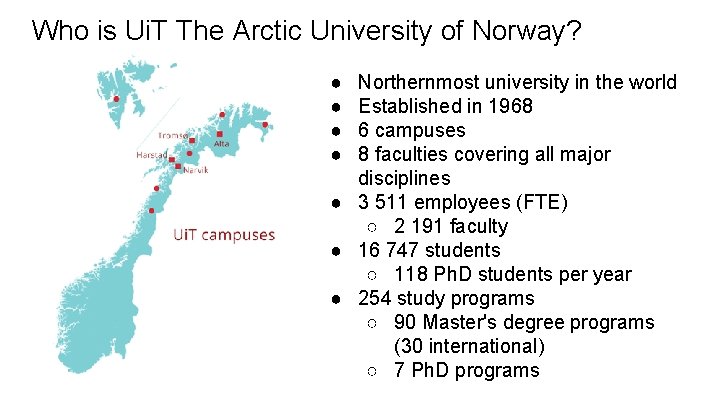
Who is Ui. T The Arctic University of Norway? ● ● Northernmost university in the world Established in 1968 6 campuses 8 faculties covering all major disciplines ● 3 511 employees (FTE) ○ 2 191 faculty ● 16 747 students ○ 118 Ph. D students per year ● 254 study programs ○ 90 Master's degree programs (30 international) ○ 7 Ph. D programs
How does Dataverse. NO work?

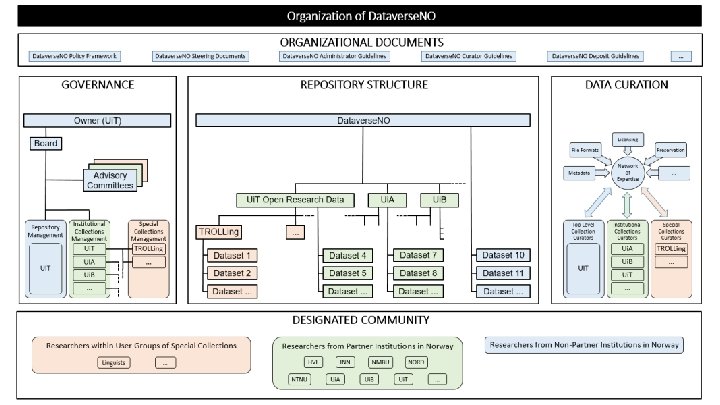
● 8 partner institutions, all of them Norwegian universities ● Each partner institution has its own institutional collection ● All data is curated by research data support staff at partner institutions ● Common policies and guidelines apply for the entire repository (info. dataverse. no) ● Applied for Core. Trust. Seal certification
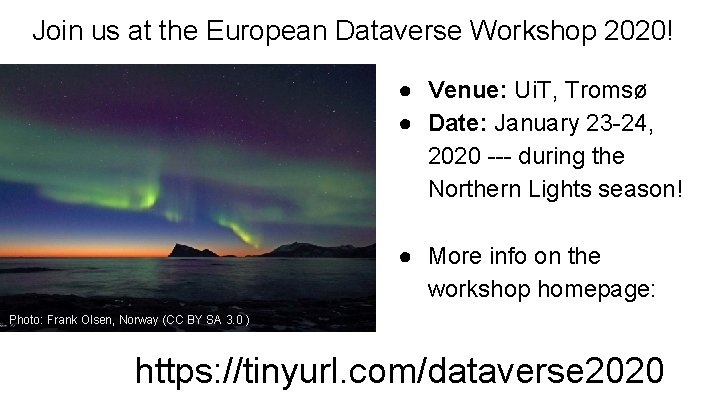
Join us at the European Dataverse Workshop 2020! ● Venue: Ui. T, Tromsø ● Date: January 23 -24, 2020 --- during the Northern Lights season! ● More info on the workshop homepage: Photo: Frank Olsen, Norway (CC BY SA 3. 0 ) https: //tinyurl. com/dataverse 2020
Dataverse in EU
SSHOC is EU Social Sciences and Humanities Open Cloud ● ● DANS-KNAW (Netherlands) established Dataverse as a service for Dutch Universities in May, 2014. The goal of SSHOC Dataverse project (CESSDA, DARIAH and CLARIN) is to create a reliable and production ready Open Source data infrastructure that everybody can install and reuse for their own needs and requirements. We’re developing multilingual web interface and localizing metadata fields and developed data standardization technique based on APIs for CESSDA CVs, Topic Classification and CESSDA CV Manager services.

Production ready Dataverse infrastructure ● ● ● reliable and scalable Cloud service that can be deployed in Kubernetes out of the box installation on Google Cloud, Amazon AWS and Microsoft Azure can be connected to any research infrastructure by APIs distributed multilingual data infrastructure consisting of connected Dataverse nodes and forming a federated data portal repository already integrated with data previewers, external applications and VREs external controlled vocabulary support is the interoperability solution
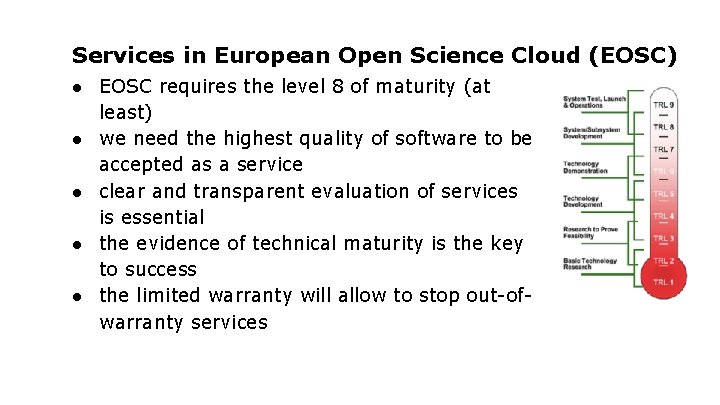
Services in European Open Science Cloud (EOSC) ● EOSC requires the level 8 of maturity (at least) ● we need the highest quality of software to be accepted as a service ● clear and transparent evaluation of services is essential ● the evidence of technical maturity is the key to success ● the limited warranty will allow to stop out-ofwarranty services

Dataverse App Store Let’s build different services out of tools! Data preview: DDI Explorer, Spreadsheet/CSV, PDF, Text files, HTML, Images, video render, audio, JSON, Geo. JSON/Shapefiles/Map, XML Interoperability: external controlled vocabularies (CESSDA CV Manager) Data processing: NESSTAR DDI migration tool Linked Data: RDF compliance including SPARQL endpoint Federated login as a service (OAuth/Shibboleth in the same installation)
Multilingual support Dataverse. EUwill run Weblate as a service for the user interface, metadata schema and SOLR translation. We’re developing an experimental but adjustable pipeline for multilingual support that allows to download and synchronize all translations available in Dataverse Consortium github and provides easy access for translators to keep all properties up-to-date.

Weblate as a Dataverse service

Global Dataverse Community Consortium

Global Dataverse Community Consortium ●Supporting Dataverse repositories around the world The Global Dataverse Community Consortium (GDCC) is dedicated to providing international organization to existing Dataverse community efforts, and will provide a collaborative venue for institutions to leverage economies of scale in support of Dataverse repositories around the world. http: //Dataverse. Community. Global

Global Dataverse Community Consortium
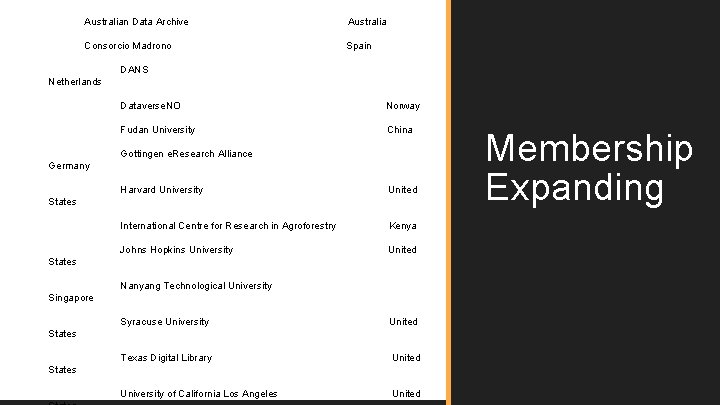
Australian Data Archive Australia Consorcio Madrono Spain DANS Netherlands Dataverse. NO Norway Fudan University China Gottingen e. Research Alliance Germany Harvard University United International Centre for Research in Agroforestry Kenya Johns Hopkins University United States Nanyang Technological University Singapore Syracuse University United Texas Digital Library United University of California Los Angeles United States Membership Expanding
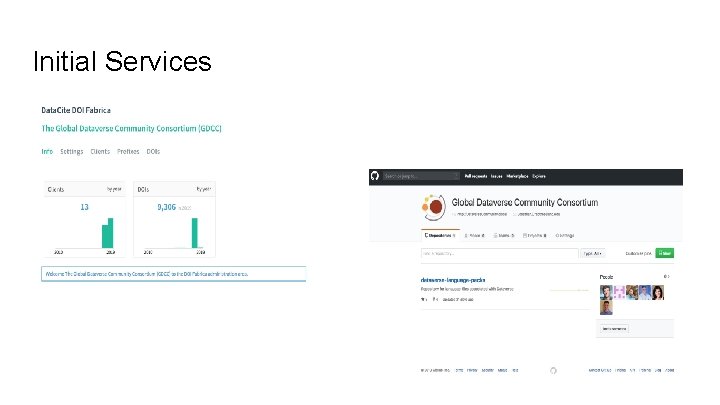
Initial Services
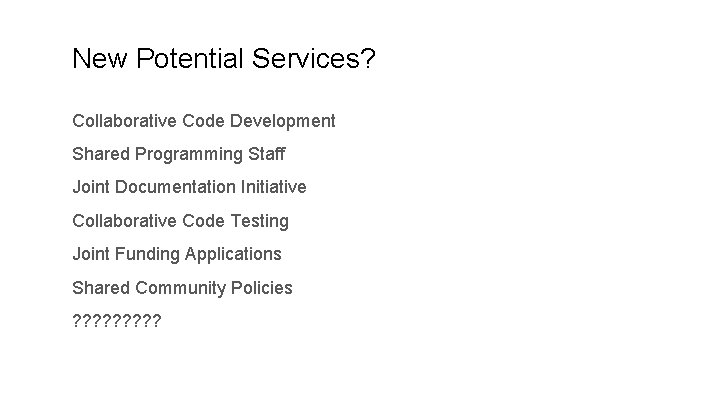
New Potential Services? Collaborative Code Development Shared Programming Staff Joint Documentation Initiative Collaborative Code Testing Joint Funding Applications Shared Community Policies ? ? ? ? ?
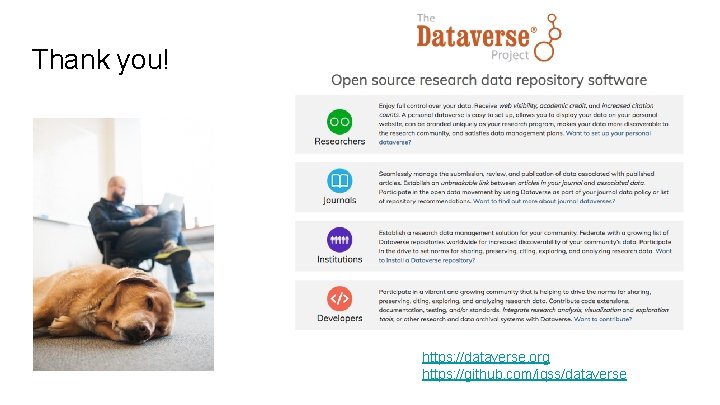
Thank you! https: //dataverse. org https: //github. com/iqss/dataverse
- Slides: 47