
Building Commissioning Cx 101 Brock Graham Gilbane Building
Building Commissioning: Cx 101 Brock Graham, Gilbane Building Co. Michael Gannon, BVH Integrated Services November 15, 2010
Building Commissioning… Where did it come from ? ASHRAE ? LEED ? Federal Gov’t ? USGBC ? ASME/ANSI ?
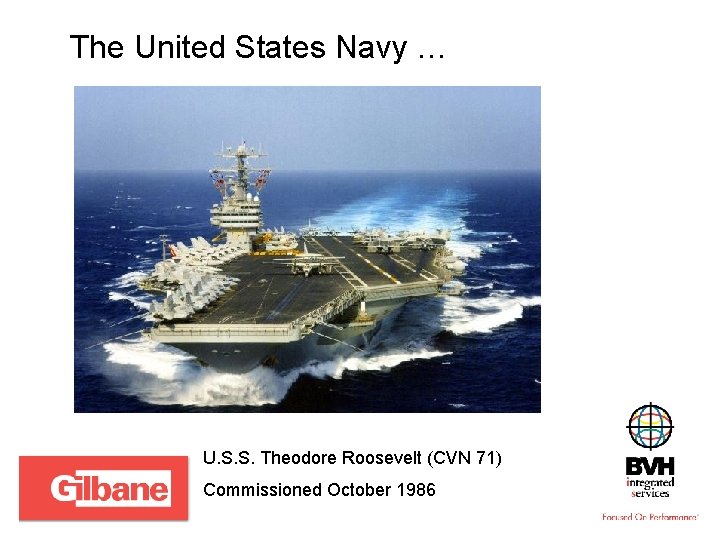
The United States Navy … U. S. S. Theodore Roosevelt (CVN 71) Commissioned October 1986

Building Commissioning… What is it? Retro-commissioning (existing buildings) Re-commissioning (existing buildings) Commissioning (new construction)
Building Commissioning… What is it? The short answer: Building commissioning (new construction) is construction quality assurance
Building Commissioning… Different ‘levels’ of Cx (and cost)… Minimal: Start-up & troubleshooting Typical: LEED Cx on Steroids: HPB & ASHRAE Guideline 0
Commissioning: Why do it? • High performance building standards require…buildings to perform. • Commissioning provides the assurance that buildings are built and perform as intended.

Commissioning Process Overview: • Design Phase • Construction Phase • Acceptance Phase • Occupancy Phase
Design Phase: • Review or assist in development of OPR and BOD • Peer review ØSometimes at many stages (SD, DD, CDs) • Initial schedule development (CM) • Commissioning Specification ØVery important!
Construction Phase: • Submittal reviews • Develop Cx Plan • Kick-off with installing contractors • Installation observation • Contractors fill out pre-functional checklists
Construction Phase (cont. ): • Further develop schedule with GC / CM • Pre-balancing meeting • Proactive Field Quality Control ØInstallation observation ØWitness some testing • O&Ms submitted and reviewed
Construction Phase (cont. ): • Prefunctional checklists – developed by Cx. A, filled out by contractors • Not to be confused with functional test sheets • Manufacturer’s start-up of equipment
Acceptance Phase: • Functional testing begins (when systems are complete!) • A ‘test case’ system can be commissioned to let contractors know what to expect • This should be coordinated and witnessed by Cx. A, not installing contractors. • Deficiencies recorded and tracked by Cx. A
Acceptance Phase (cont. ): • Contractors correct deficiencies and notify Cx. A of correction • Cx. A retests and records results • Contractor-provided Owner training is organized and verified • Validation (if called for) follows functional testing
Occupancy Phase: • Functional testing continues (realistically) • Cx. A develops Systems Training Manual (aka the Recommissioning Manual) • Owner personnel trained by Cx. A • Final commissioning report produced
Occupancy Phase: • Deferred (seasonal) testing • End-of-Warranty Review • Post-occupancy performance verification ØNeeds to be addressed in design phase (e. g. are enough ATC points and / or energy meters specified to capture all usage)
Commissioning Scoping • Identify Cx Scope clearly • Typical systems include: • All HVAC (some sampling possible) • Plumbing (DHW, CA, Pumps, etc) • Electrical (lighting controls, E-power and E-lighting, etc) • Other systems: • Fire alarm, fire protection • Security, data, PA, envelope, elevators…
Commissioning Scoping • Peer Reviews • Early docs (SD, DD) don’t have as much to review • Allow time in schedule for reviews and doc updates by EOR
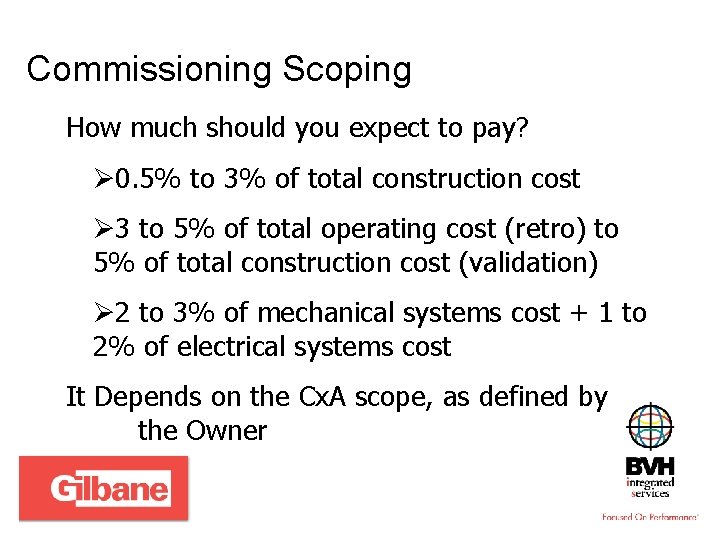
Commissioning Scoping How much should you expect to pay? Ø 0. 5% to 3% of total construction cost Ø 3 to 5% of total operating cost (retro) to 5% of total construction cost (validation) Ø 2 to 3% of mechanical systems cost + 1 to 2% of electrical systems cost It Depends on the Cx. A scope, as defined by the Owner

Questions?
- Slides: 20