
Building Capability Capacity for RTI within the Pyramid
Building Capability & Capacity for RTI within the Pyramid of Interventions Summer GAEL July 2008 Paula Freer, Patrick Kennedy, Iva King, Lynn Pennington, Jennifer Schau, and Frank Smith 1
SSTAGE STATS & Promos First Year (2007 -08) ü 3 Conferences = 1000+ participants (SOLD OUT!) ü 9 Symposia = 580+ participants ü 5 Regional meetings Second Year (2008 -09) • Sept. 9 th & 10 th Conference (Interventions) Dublin • Jan. 14 th & 15 th Conference (Best Practices) Athens 2
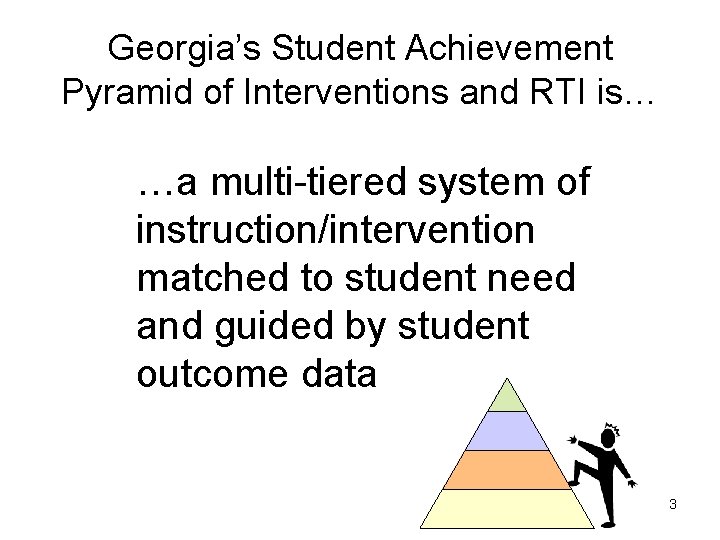
Georgia’s Student Achievement Pyramid of Interventions and RTI is… …a multi-tiered system of instruction/intervention matched to student need and guided by student outcome data 3
RTI capability & capacity begins with building… Consensus • Common understanding • Answering the ‘why’ • Concepts communicated 4
…and continues with building… Infrastructure for implementation 5
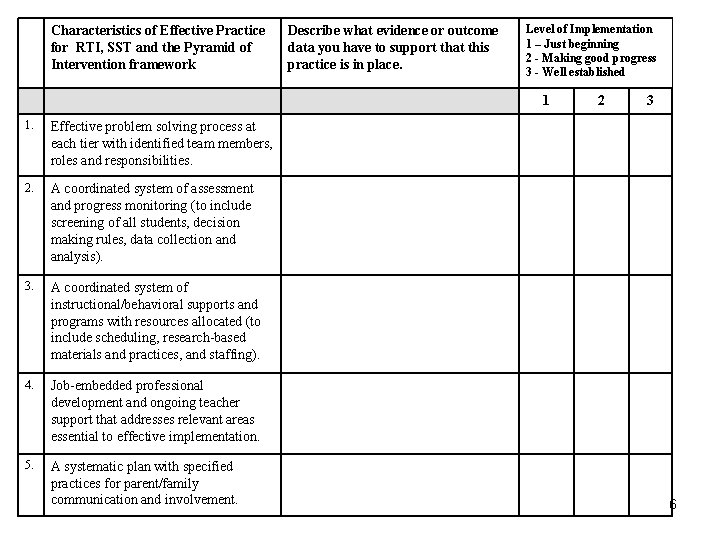
Characteristics of Effective Practice for RTI, SST and the Pyramid of Intervention framework Describe what evidence or outcome data you have to support that this practice is in place. Level of Implementation 1 – Just beginning 2 - Making good progress 3 - Well established 1 1. Effective problem solving process at each tier with identified team members, roles and responsibilities. 2. A coordinated system of assessment and progress monitoring (to include screening of all students, decision making rules, data collection and analysis). 3. A coordinated system of instructional/behavioral supports and programs with resources allocated (to include scheduling, research-based materials and practices, and staffing). 4. Job-embedded professional development and ongoing teacher support that addresses relevant areas essential to effective implementation. 5. A systematic plan with specified practices for parent/family communication and involvement. 2 3 6
Building Capability and Capacity 1. Effective problem solving process at each tier with identified team members, roles and responsibilities. 7
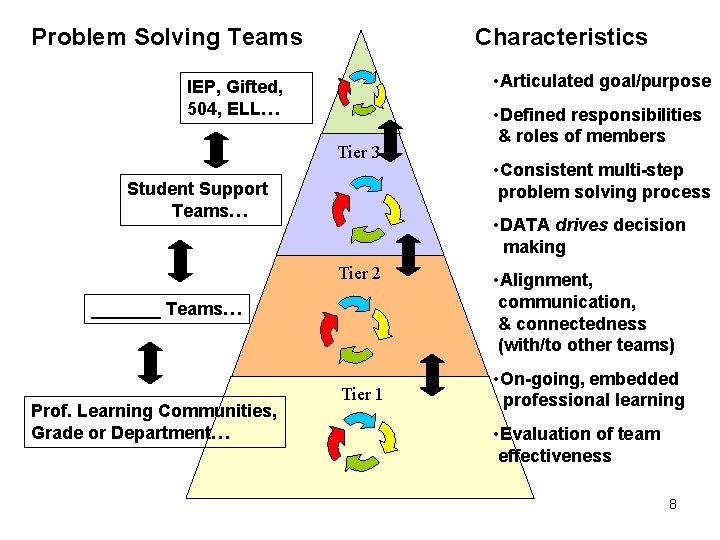
Problem Solving Teams Characteristics • Articulated goal/purpose IEP, Gifted, 504, ELL… Tier 3 Student Support Teams… • Consistent multi-step problem solving process • DATA drives decision making Tier 2 _______ Teams… Prof. Learning Communities, Grade or Department… • Defined responsibilities & roles of members Tier 1 • Alignment, communication, & connectedness (with/to other teams) • On-going, embedded professional learning • Evaluation of team effectiveness 8
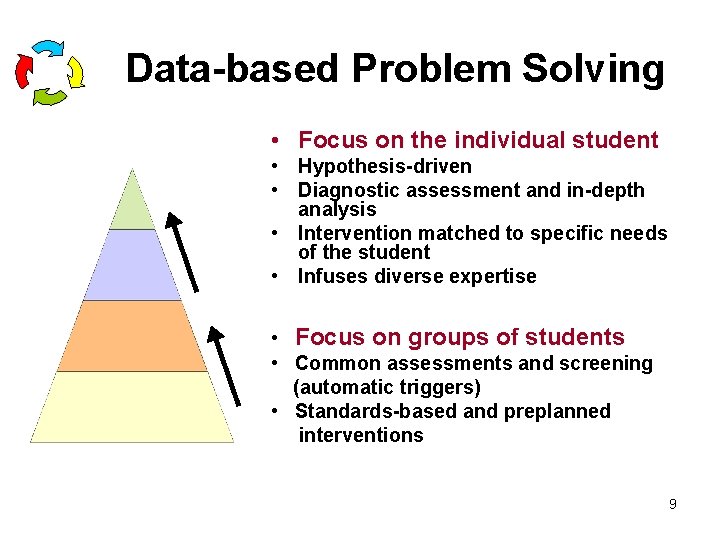
Data-based Problem Solving • Focus on the individual student • Hypothesis-driven • Diagnostic assessment and in-depth analysis • Intervention matched to specific needs of the student • Infuses diverse expertise • Focus on groups of students • Common assessments and screening (automatic triggers) • Standards-based and preplanned interventions 9
Building Capability and Capacity 2. A coordinated system of assessment and progress monitoring (to include screening of all students, decision making rules, data collection, data analysis, measures of fidelity 10
A coordinated system of assessment and progress monitoring What data do you have that already exists at Tier 1? The next step is Universal or Targeted Screening – to identify students that lack basic skills 11
Definition of terms • Universal Screening (or targeted screening) Designed as a first step in identifying children who may be at risk for difficulties and/or need additional services and supports. • Benchmarks*: Activities required of all students at key points in their education to ensure that they are mastering designated performance standards in order to confirm their ongoing achievement of designated content standards (e. g. , quarterly writing prompts; annual reading assessments). *Ga. DOE’s GPS Training (Day 3) 12
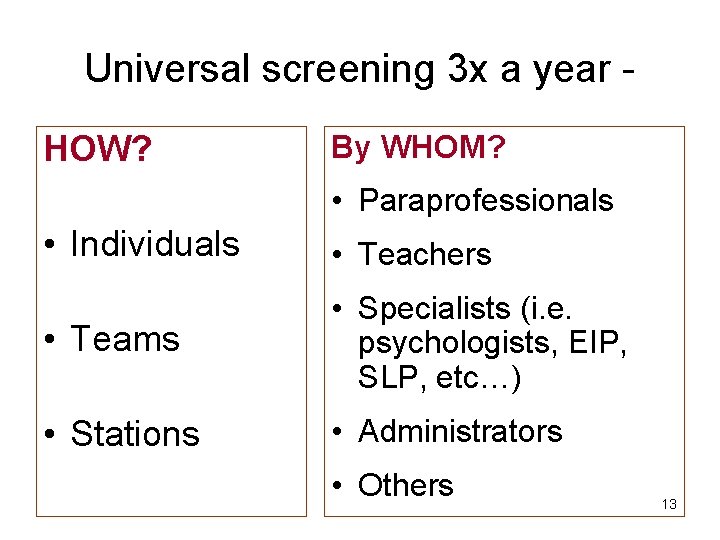
Universal screening 3 x a year HOW? By WHOM? • Paraprofessionals • Individuals • Teachers • Teams • Specialists (i. e. psychologists, EIP, SLP, etc…) • Stations • Administrators • Others 13
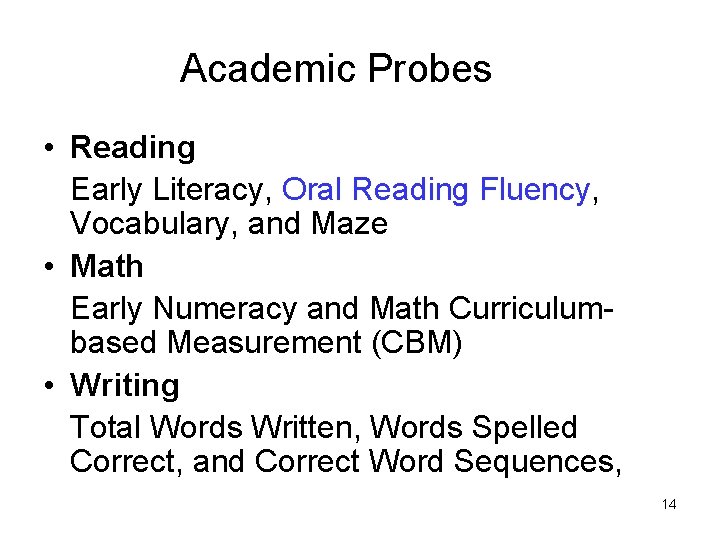
Academic Probes • Reading Early Literacy, Oral Reading Fluency, Vocabulary, and Maze • Math Early Numeracy and Math Curriculumbased Measurement (CBM) • Writing Total Words Written, Words Spelled Correct, and Correct Word Sequences, 14
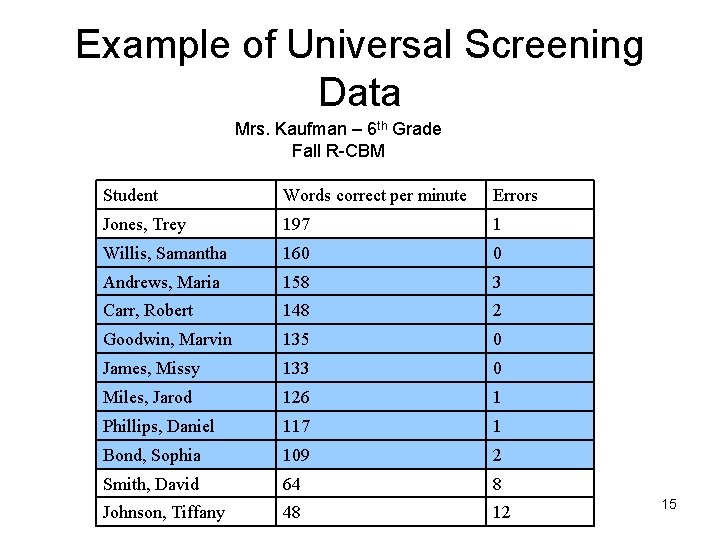
Example of Universal Screening Data Mrs. Kaufman – 6 th Grade Fall R-CBM Student Words correct per minute Errors Jones, Trey 197 1 Willis, Samantha 160 0 Andrews, Maria 158 3 Carr, Robert 148 2 Goodwin, Marvin 135 0 James, Missy 133 0 Miles, Jarod 126 1 Phillips, Daniel 117 1 Bond, Sophia 109 2 Smith, David 64 8 Johnson, Tiffany 48 12 15
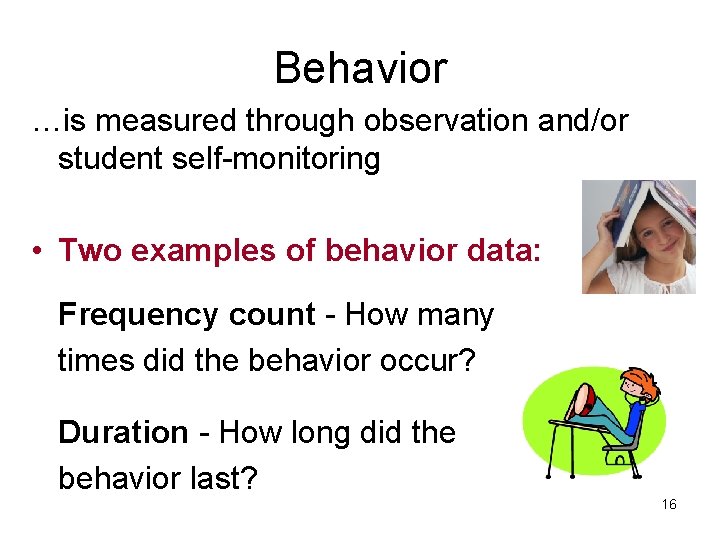
Behavior …is measured through observation and/or student self-monitoring • Two examples of behavior data: Frequency count - How many times did the behavior occur? Duration - How long did the behavior last? 16
Assessment at Tiers 2, 3 and 4 Progress Monitoring is a scientifically-based practice that is used to assess students’ academic and behavioral performance to evaluate the effectiveness of instruction. Progress Monitoring assesses the SAME basic skills over time to measure progress 17
Advantages of Using CBM • Quick to administer, simple, easy, and cost-efficient. • Performance is graphed analyzed over time • Sensitive to even small improvements in performance This is KEY—as most standardized/norm-referenced tests do NOT show small, incremental gains. • Can have many forms — most standardized tests have a maximum of two forms. • Monitoring frequently enables staff to see trends in individual and group performance—and compare 18 those trends with targets set for their students.
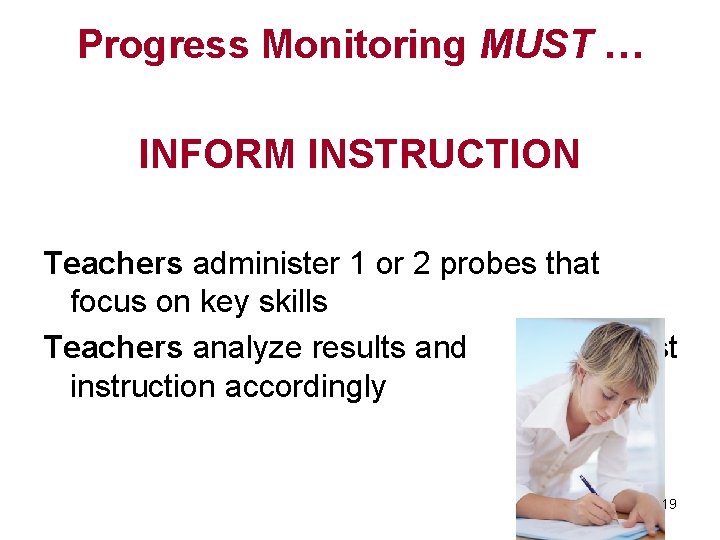
Progress Monitoring MUST … INFORM INSTRUCTION Teachers administer 1 or 2 probes that focus on key skills Teachers analyze results and adjust instruction accordingly 19
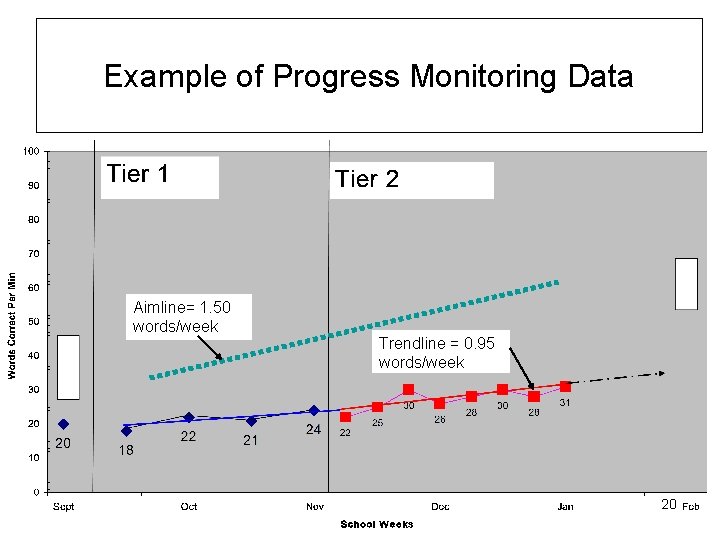
Example of Progress Monitoring Data Aimline= 1. 50 words/week Trendline = 0. 95 words/week 20
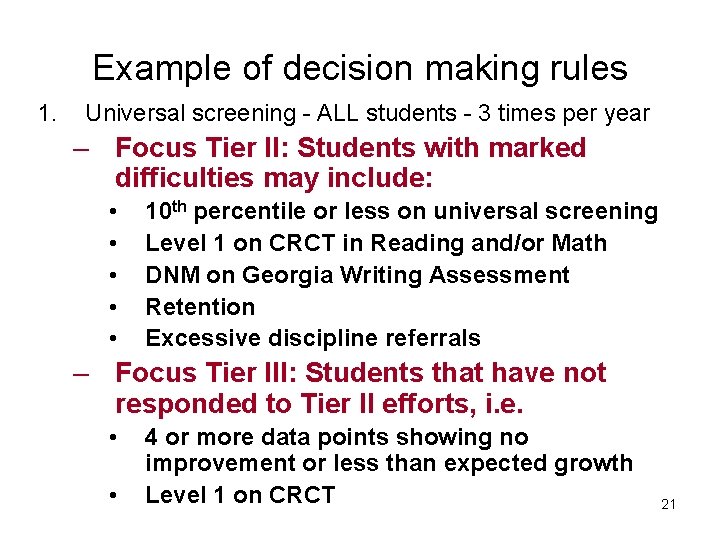
Example of decision making rules 1. Universal screening - ALL students - 3 times per year – Focus Tier II: Students with marked difficulties may include: • • • 10 th percentile or less on universal screening Level 1 on CRCT in Reading and/or Math DNM on Georgia Writing Assessment Retention Excessive discipline referrals – Focus Tier III: Students that have not responded to Tier II efforts, i. e. • • 4 or more data points showing no improvement or less than expected growth Level 1 on CRCT 21
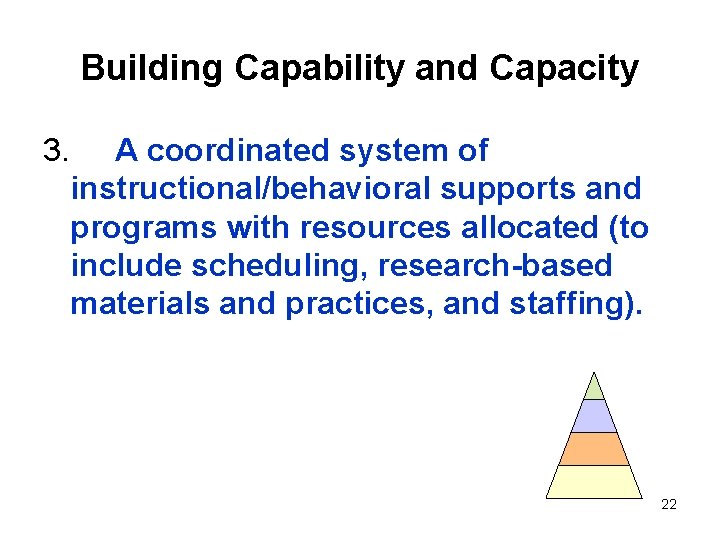
Building Capability and Capacity 3. A coordinated system of instructional/behavioral supports and programs with resources allocated (to include scheduling, research-based materials and practices, and staffing). 22
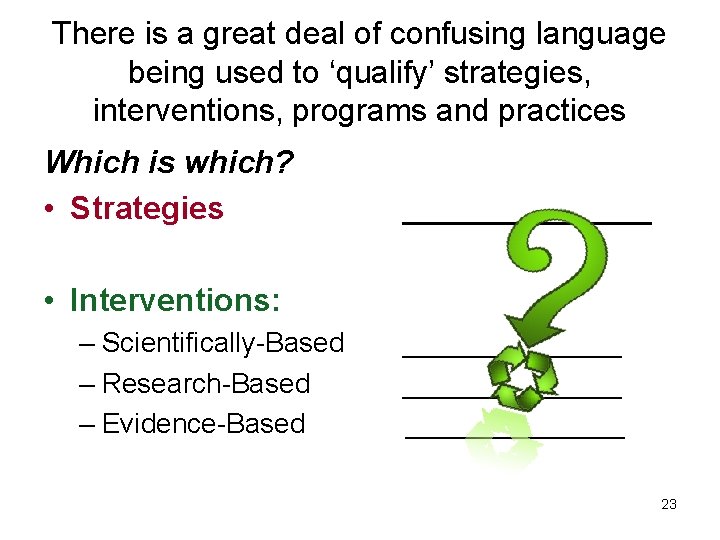
There is a great deal of confusing language being used to ‘qualify’ strategies, interventions, programs and practices Which is which? • Strategies _______ • Interventions: – Scientifically-Based – Research-Based – Evidence-Based ______________ 23
Strategies Strategy - “ a careful plan or method; the art of devising or employing plans or stratagems toward a goal. ” Webster's dictionary Usually we hear strategy used in the context of a “teaching strategy”…. . Let’s look at some examples…. . 24
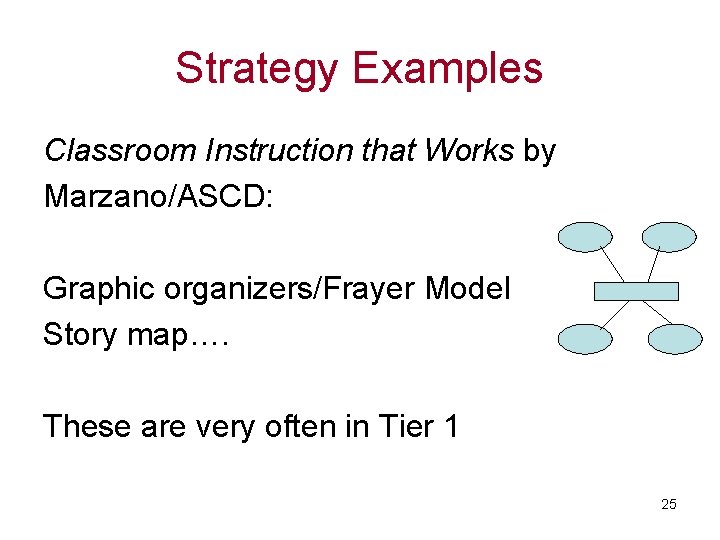
Strategy Examples Classroom Instruction that Works by Marzano/ASCD: Graphic organizers/Frayer Model Story map…. These are very often in Tier 1 25
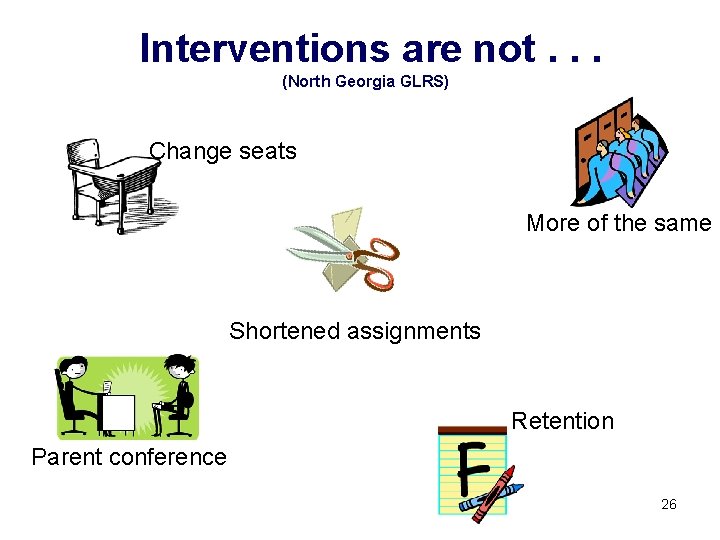
Interventions are not. . . (North Georgia GLRS) Change seats More of the same Shortened assignments Retention Parent conference 26
Scientifically-Based Interventions (NASP-Harn, 2007) • Programs can be categorized into two groups: Scientifically proven —meaning scientific results have already been published in peer-reviewed journals using the previously described scientific rigor Only 5% of the available research on school reform strategies have demonstrated effects (National Clearinghouse for CSR, 2003) Research-based —meaning the methods, content, materials, etc. were developed in guidance from the collective research and scientific community “There is an abundance of promotional literature that is often presented as “evidence. ” Buyer beware! Work to the highest standard possible. ” (National Clearinghouse for CSR, 2003) Educators must examine and look for evidence before the money is spent and programs 27 imposed on children.
Evidence-Based Interventions… …Do not meet the rigor or standards of scientificallyor research-based interventions. …Do include specific interventions supported by welldesigned, independent research studies. There is evidence that they improve student outcomes (Effective School Interventions Rathvon, 1999). See examples of evidence-based interventions at: www. interventioncentral. org (interventions and strategies) 28
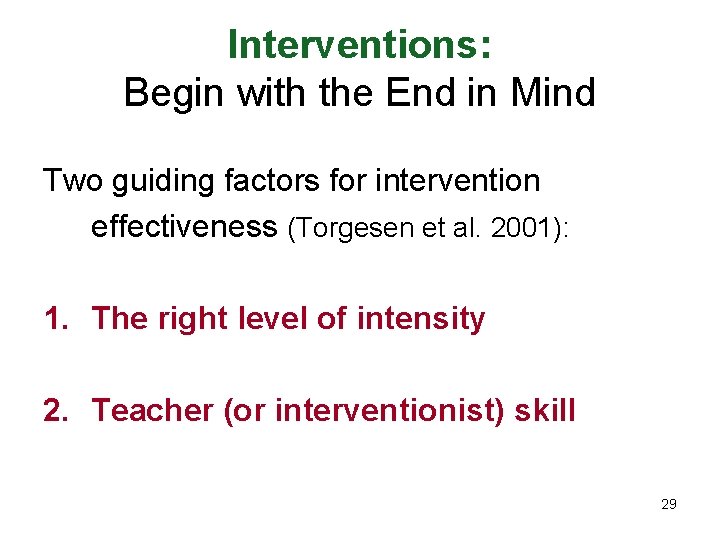
Interventions: Begin with the End in Mind Two guiding factors for intervention effectiveness (Torgesen et al. 2001): 1. The right level of intensity 2. Teacher (or interventionist) skill 29
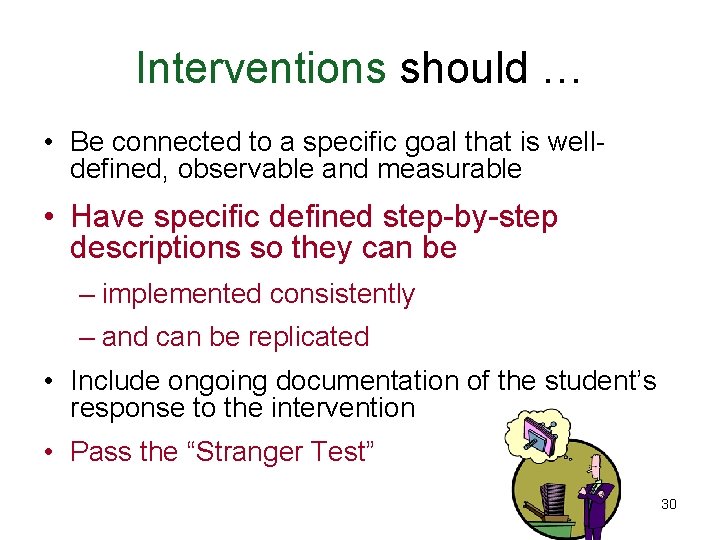
Interventions should … • Be connected to a specific goal that is welldefined, observable and measurable • Have specific defined step-by-step descriptions so they can be – implemented consistently – and can be replicated • Include ongoing documentation of the student’s response to the intervention • Pass the “Stranger Test” 30
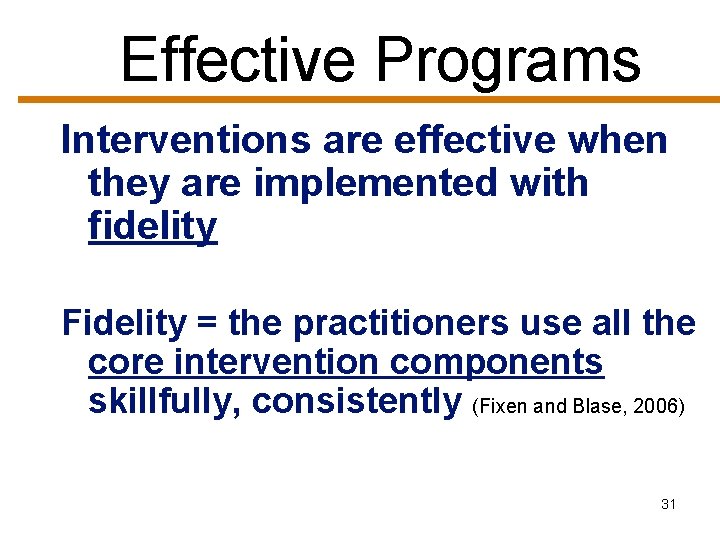
Effective Programs Interventions are effective when they are implemented with fidelity Fidelity = the practitioners use all the core intervention components skillfully, consistently (Fixen and Blase, 2006) 31
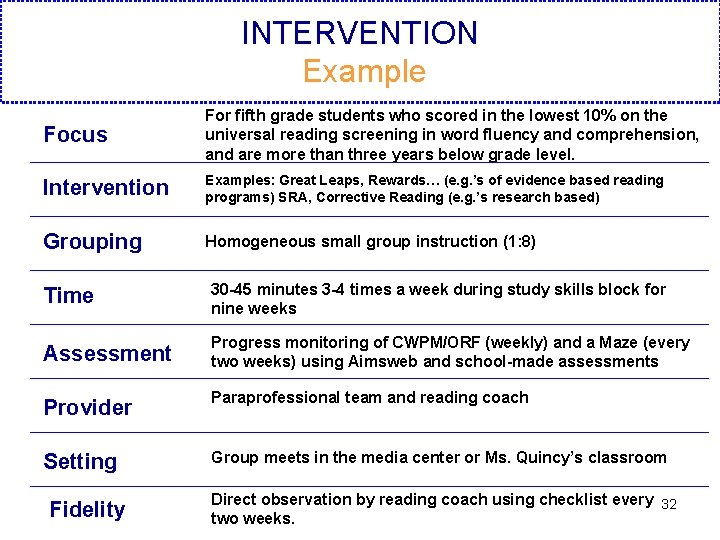
INTERVENTION Example Focus For fifth grade students who scored in the lowest 10% on the universal reading screening in word fluency and comprehension, and are more than three years below grade level. Intervention Examples: Great Leaps, Rewards… (e. g. ’s of evidence based reading programs) SRA, Corrective Reading (e. g. ’s research based) Grouping Homogeneous small group instruction (1: 8) Time 30 -45 minutes 3 -4 times a week during study skills block for nine weeks Assessment Progress monitoring of CWPM/ORF (weekly) and a Maze (every two weeks) using Aimsweb and school-made assessments Provider Paraprofessional team and reading coach Setting Group meets in the media center or Ms. Quincy’s classroom Fidelity Direct observation by reading coach using checklist every 32 two weeks.
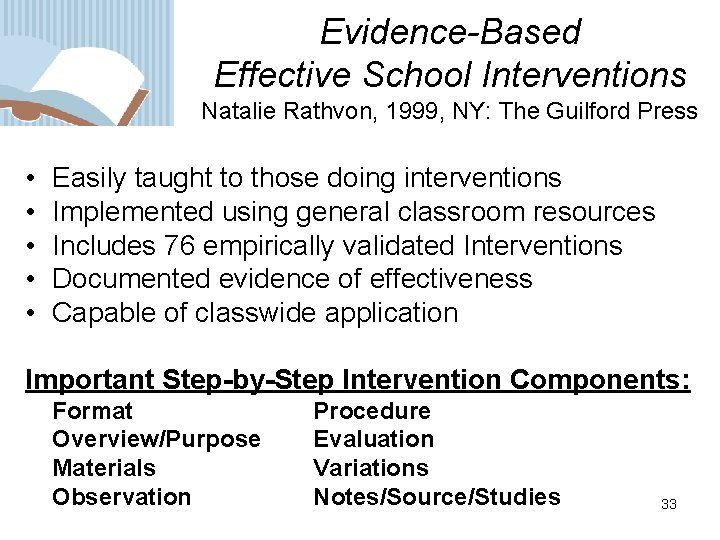
Evidence-Based Effective School Interventions Natalie Rathvon, 1999, NY: The Guilford Press • • • Easily taught to those doing interventions Implemented using general classroom resources Includes 76 empirically validated Interventions Documented evidence of effectiveness Capable of classwide application Important Step-by-Step Intervention Components: Format Overview/Purpose Materials Observation Procedure Evaluation Variations Notes/Source/Studies 33
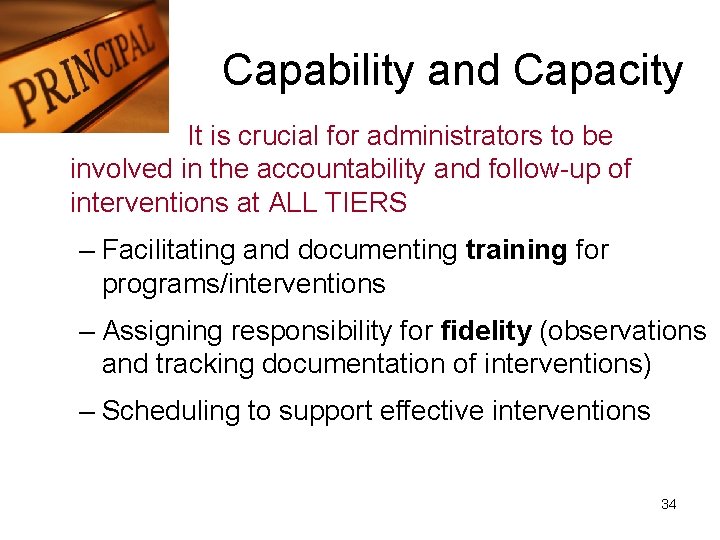
Capability and Capacity It is crucial for administrators to be involved in the accountability and follow-up of interventions at ALL TIERS – Facilitating and documenting training for programs/interventions – Assigning responsibility for fidelity (observations and tracking documentation of interventions) – Scheduling to support effective interventions 34
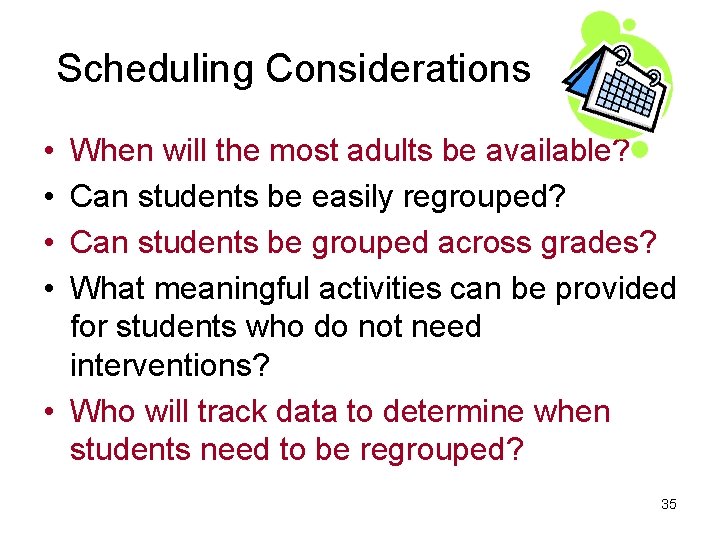
Scheduling Considerations • • When will the most adults be available? Can students be easily regrouped? Can students be grouped across grades? What meaningful activities can be provided for students who do not need interventions? • Who will track data to determine when students need to be regrouped? 35
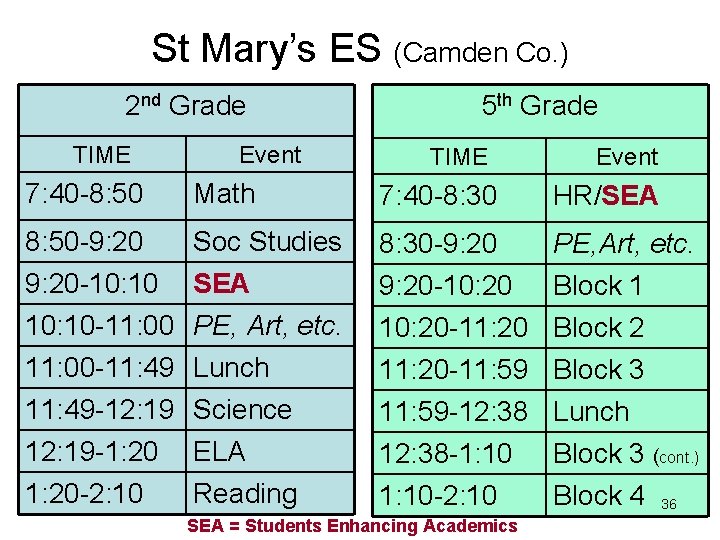
St Mary’s ES (Camden Co. ) 2 nd Grade TIME Event 5 th Grade TIME Event 7: 40 -8: 50 Math 7: 40 -8: 30 HR/SEA 8: 50 -9: 20 Soc Studies 8: 30 -9: 20 PE, Art, etc. 9: 20 -10: 10 -11: 00 -11: 49 -12: 19 -1: 20 -2: 10 SEA PE, Art, etc. Lunch Science ELA Reading 9: 20 -10: 20 -11: 20 -11: 59 -12: 38 -1: 10 -2: 10 Block 1 Block 2 Block 3 Lunch Block 3 (cont. ) Block 4 36 SEA = Students Enhancing Academics
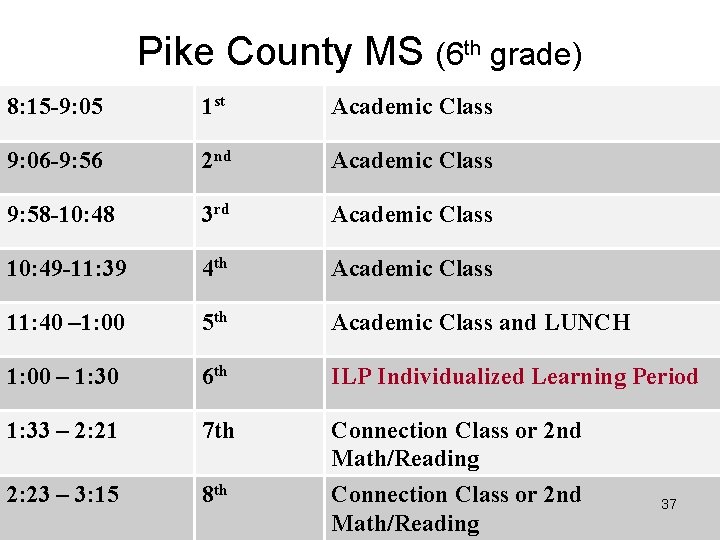
Pike County MS (6 th grade) 8: 15 -9: 05 1 st Academic Class 9: 06 -9: 56 2 nd Academic Class 9: 58 -10: 48 3 rd Academic Class 10: 49 -11: 39 4 th Academic Class 11: 40 – 1: 00 5 th Academic Class and LUNCH 1: 00 – 1: 30 6 th ILP Individualized Learning Period 1: 33 – 2: 21 7 th 2: 23 – 3: 15 8 th Connection Class or 2 nd Math/Reading 37
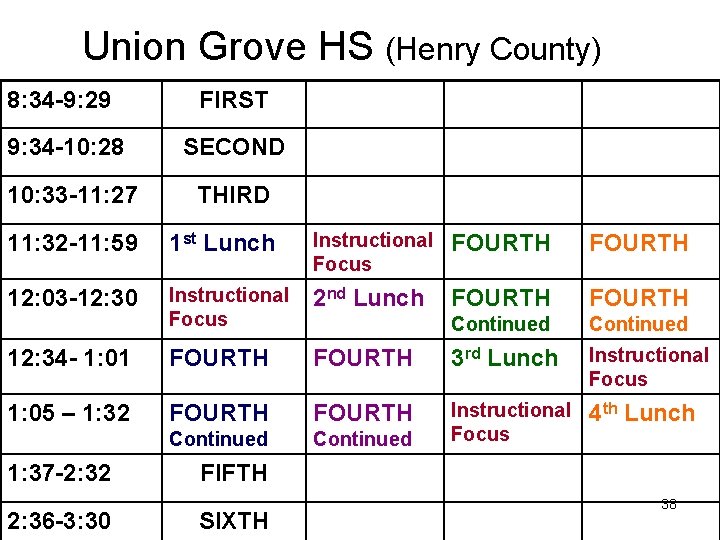
Union Grove HS (Henry County) 8: 34 -9: 29 FIRST 9: 34 -10: 28 SECOND 10: 33 -11: 27 THIRD 11: 32 -11: 59 1 st Lunch Instructional Focus FOURTH 12: 03 -12: 30 Instructional Focus 2 nd Lunch FOURTH Continued 12: 34 - 1: 01 FOURTH 3 rd Lunch Instructional Focus 1: 05 – 1: 32 FOURTH 4 th Lunch Continued Instructional Focus 1: 37 -2: 32 2: 36 -3: 30 FIFTH SIXTH 38
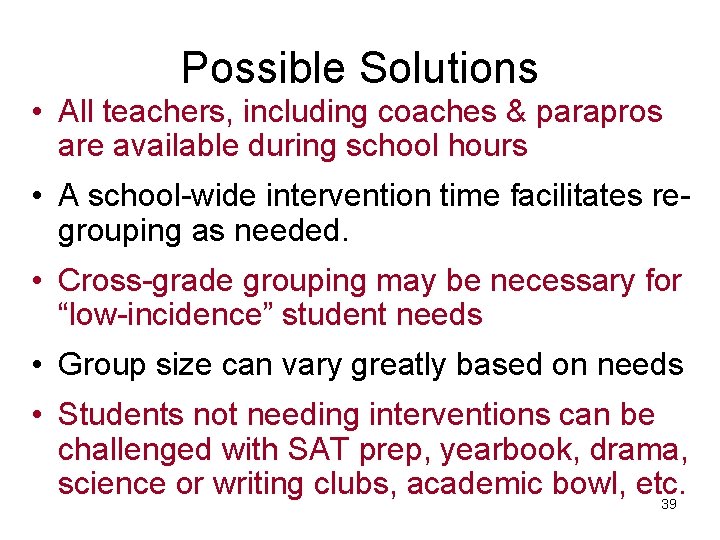
Possible Solutions • All teachers, including coaches & parapros are available during school hours • A school-wide intervention time facilitates regrouping as needed. • Cross-grade grouping may be necessary for “low-incidence” student needs • Group size can vary greatly based on needs • Students not needing interventions can be challenged with SAT prep, yearbook, drama, science or writing clubs, academic bowl, etc. 39
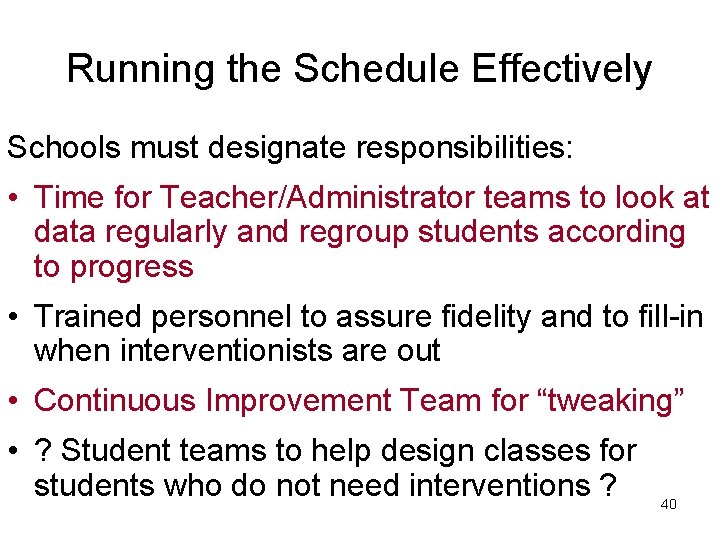
Running the Schedule Effectively Schools must designate responsibilities: • Time for Teacher/Administrator teams to look at data regularly and regroup students according to progress • Trained personnel to assure fidelity and to fill-in when interventionists are out • Continuous Improvement Team for “tweaking” • ? Student teams to help design classes for students who do not need interventions ? 40
Building Capability and Capacity 4. Job-embedded professional development and ongoing teacher support that addresses relevant areas essential to effective implementation 41
RTI Pyramid Training Issues 42
What do we need today? • Random Acts of Improvement … – Squeezing in RTI where it’s possible? OR • Aligned Acts …. – Thoughtfully designed and planned? 43
How do these approaches differ? Random Acts: Aligned Acts: • Subjective data collection • Use of a data driven problem-solving process at ALL Tiers (vs. only at Tiers 3 & 4 in the past) • Analyzing school data to target needs • Inconsistent management of data • Inconsistent use of teaching, learning and intervention • Documenting instructional practices which are defined and measured • Consistent and ongoing evaluation of instructional 44 practices
Inserting RTI? • It is unreasonable to believe that RTI will fit neatly into you’re your existing system. • Expectations and beliefs about accountability must change. 45
Expectations for Educators • Tier I - owning all the students • Differentiated Instruction • Data Collection • Progress Monitoring 46
Training Priorities • Solid Understanding of the Tiered Intervention Process • Available Interventions • Oversight of the Process 47
Training Strategy 1. Develop a sequence of training issues that makes sense… 2. Be realistic about how much change can occur in a given time – mindset is the biggest issue 3. Become creative about reaching the primary training target – teachers 4. In addition to formal training, frequent informal consultation and follow-up is key 48
Finally… • Building leaders • Central Office staff • Parents 49
Building Capability and Capacity 5. A systematic plan with specified practices for parent/family communication and involvement. 50
PARENT ENGAGEMENT An INFORMED parent can be a VITAL supporter 51
National PTA Standards for Parent/Family Involvement (Epstein) Effective parent involvement programs include activities that are addressed by the following six standards: I. Communicating — Communication between home and school is regular, two-way, and meaningful. II. Parenting — Parenting skills are promoted and supported. III. Student learning — Parents play an integral role in assisting student learning. IV. Volunteering — Parents are welcome in the school, and their support and assistance are sought. V. School decision making and advocacy — Parents are full partners in the decisions that affect children and families. VI. Collaborating with community — Community resources strengthen schools, families, and student learning. Now translate to Georgia Standards 52
Georgia School Keys (School Standards) pp. 41 -48 for Parent Involvement STUDENT, FAMILY, AND COMMUNITY INVOLVEMENT AND SUPPORT The school as a community of learning involves parents and community members as active participants. There is consistent and growing evidence of parental involvement and volunteerism, participation in workshops and enrichment activities, and a process of two-way communication. Everyone collaborates to help the school achieve its continuous improvement targets and short- and long-range goals. 53
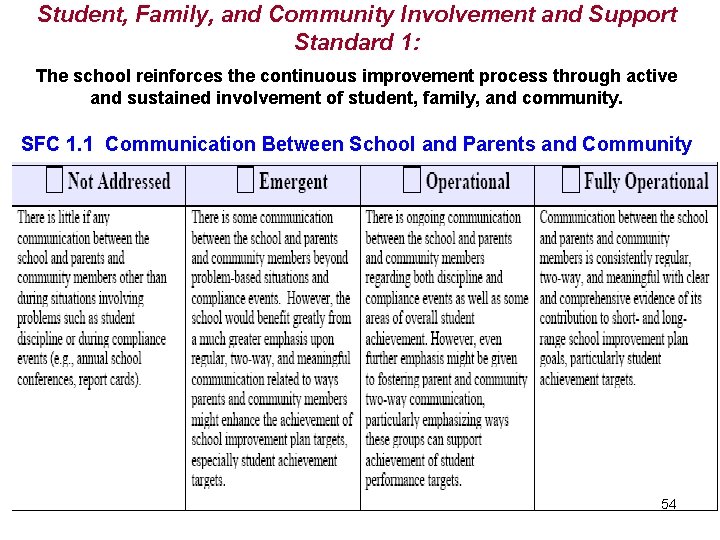
Student, Family, and Community Involvement and Support Standard 1: The school reinforces the continuous improvement process through active and sustained involvement of student, family, and community. SFC 1. 1 Communication Between School and Parents and Community 54
Student, Family, and Community Support Standard 2: The school has organizational structures and processes to ensure that students, families, and community members play an active and sustained role in school governance, decision-making, and problem-solving. 55
Student, Family, and Community Support Standard 3: The school addresses student, family, and community needs through appropriate services and cross-institutional partnerships. See www. gadoe. org then “School Improvement” page, then “School Keys” link. 56
57
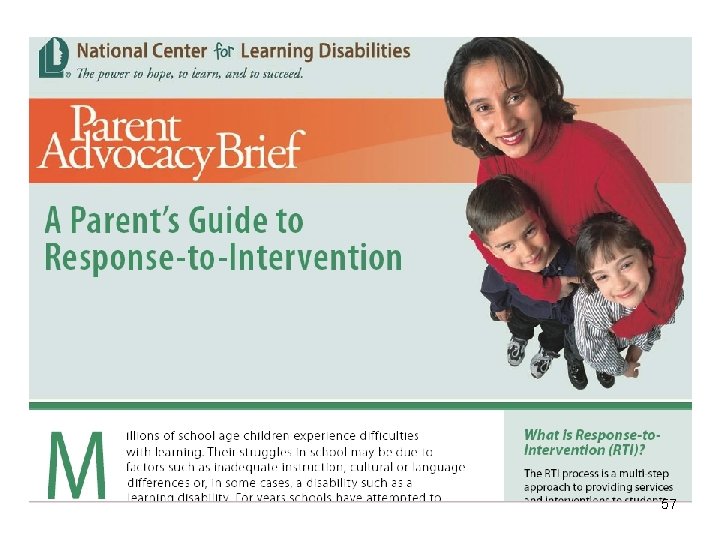
RTI Resources for Parents Response to Intervention: A Primer for Parents (from NASP) www. nasponline. org/resources/handouts/rtiprimer. pdf A Parent's Guide to Response-to-Intervention (from NCLD) www. rtinetwork. org/images/stories/Downloads/parents guidetorti-ncld. pdf Parents and Families Resources (from RTI Action Network) www. rtinetwork. org/Parents-and-Families 58
PARENT ENGAGEMENT RESOURCES Georgia Family Connection Partnership www. gafcp. org Dr. Marian Gamble: “permanent loan” from DOE marian@gafcp. org ______________________________________________________________________ Parent Mentors for Special Education Patti Solomon psolomon@doe. k 12. ga. us ______________________________________________________________________ Title I, Part A: Parental Involvement Andrea Moore amoore@doe. k 12. ga. us 59
PARENT WEBSITES • http: //www. dpi. state. nd. us/title 1/targeted/requi re/parent/index. shtm (Title I Website) • http: //www. parentmentors. org (Parent Mentor Partnership) • http: //www. ed. gov/pubs/Reach. Fam/spp. html (Reaching All Families: Creating-Family Friendly Schools) • www. ncrel. org North Central Regional Educational Laboratory 60
PARENT WEBSITES (cont’d) • www. ncpie. org (National Coalition for Parent Involvement in Education) • www. pta. org/programs (National P. T. A. Standards for Parent/Family Involvement Programs) • http: //www. par-inst. com (Parent Institute) • http: //pfie. ed. gov/ (Partnership for Family Involvement in Education) • http: //eric-web. tc. columbia. edu/families/strong (Strong Families, Strong Schools: Building Partnerships for Learning) 61
RTI Websites and Resources Response to Intervention Blueprints for Implementation: http: //www. nasdse. org/Portals/0/DISTRICT. pdf http: //www. nasdse. org/Portals/0/SCHOOL. pdf Essential: • www. interventioncentral. org • http: //ies. ed. gov/ncee/wwc/ (What Works Clearinghouse) • www. rtinetwork. org (RTI Action Network) 62
RTI Assessment Resources Investigate and compare commercial products: • www. studentprogress. org Websites with free materials and links: • www. interventioncentral. org • https: //dibels. uoregon. edu • http: //ggg. umn. edu/siteindex. html • http: //iris. peabody. vanderbilt. edu/browsebytopic 04. html Graph data using: • Excel • Chartdog on www. interventioncentral. org 63 • www. easycbm. com
References • Harn, B. , NASP Presentation 2007 • NASDE Presentation/Online 2008 • Powers, K. , Hagans, K. , & Olaya, C. , NASP Presentation 2007 • Shinn, M. , March, R. , & Phillips, M. , NASP Presentation 2008 • SSTAGE Conference Presentations, Sept. 2007, January 2008, and March 2008 • Torgesen et al. 2001 cited in Skinner et al. 2005 64
Presenters: Paula Freer, Program Specialist, Metro West GLRS Patrick Kennedy, Director of Except. Student Services & Pupil Services, Decatur City Schools Iva King, Consultant, West Central GLRS - West Georgia RESA Lynn Le. Loup Pennington, Education Consultant, President of SSTAGE Jennifer Schau, Intervention Specialist, Forsyth County Schools Frank Smith, Ga. DOE, Psychological Services & 65 SST
- Slides: 65