
Building better reading comprehension Rowena Mathew www rmitenglishworldwide
Building better reading comprehension Rowena Mathew www. rmitenglishworldwide. com
Context first! • This workshop resulted from a previous workplace project on investigating L 2 reading • Project focus: building better (deeper and more accurate) comprehension across different EAP levels – intensive reading • My focus today: Advanced level (CEFR B 2; IELTS BAND 5. 5; TOEFL i. BT 71); published opinion texts (‘Op. Ed. ’ texts) • We’ll only work with one text
Gauging your prior knowledge of L 2 reading processes Please talk to your partner for 2 minutes about what you know about ‘top-down’ and ‘bottomup’ L 2 reading processes
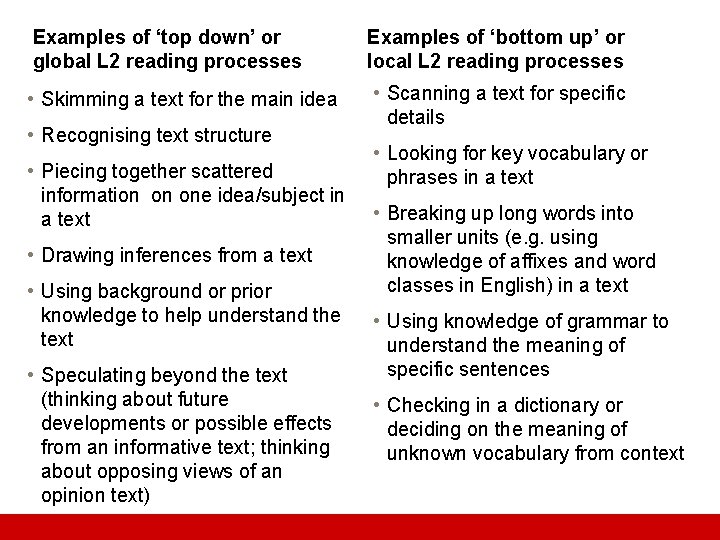
Examples of ‘top down’ or global L 2 reading processes Examples of ‘bottom up’ or local L 2 reading processes • Skimming a text for the main idea • Scanning a text for specific details • Recognising text structure • Piecing together scattered information on one idea/subject in a text • Drawing inferences from a text • Using background or prior knowledge to help understand the text • Speculating beyond the text (thinking about future developments or possible effects from an informative text; thinking about opposing views of an opinion text) • Looking for key vocabulary or phrases in a text • Breaking up long words into smaller units (e. g. using knowledge of affixes and word classes in English) in a text • Using knowledge of grammar to understand the meaning of specific sentences • Checking in a dictionary or deciding on the meaning of unknown vocabulary from context

Today’s example text and reading activities pre/before reading activities while/during reading activities post/after reading activities
Pre-reading activity Usual activities: • teaching predicted important, difficult vocabulary before reading (low frequency words which are key to understanding the text) • discussion questions about the topic of the text to activate prior knowledge of the topic • discussion questions about the type of text to activate prior knowledge of the text type ? Critical Q. Rather than ‘activate prior’ background knowledge, what about ‘build/develop future’ knowledge? E. g. English Op Ed text genres in news media? ?


2/10/2020 RMIT Training Pty Ltd 8
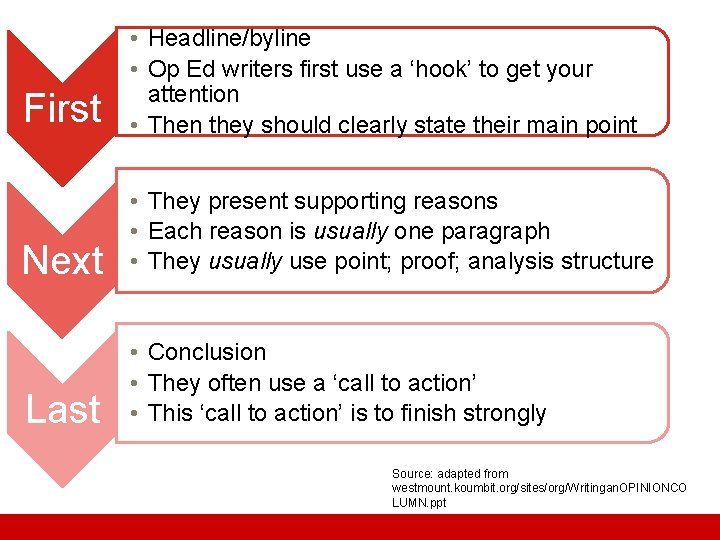
First • Headline/byline • Op Ed writers first use a ‘hook’ to get your attention • Then they should clearly state their main point Next • They present supporting reasons • Each reason is usually one paragraph • They usually use point; proof; analysis structure Last • Conclusion • They often use a ‘call to action’ • This ‘call to action’ is to finish strongly Source: adapted from westmount. koumbit. org/sites/org/Writingan. OPINIONCO LUMN. ppt
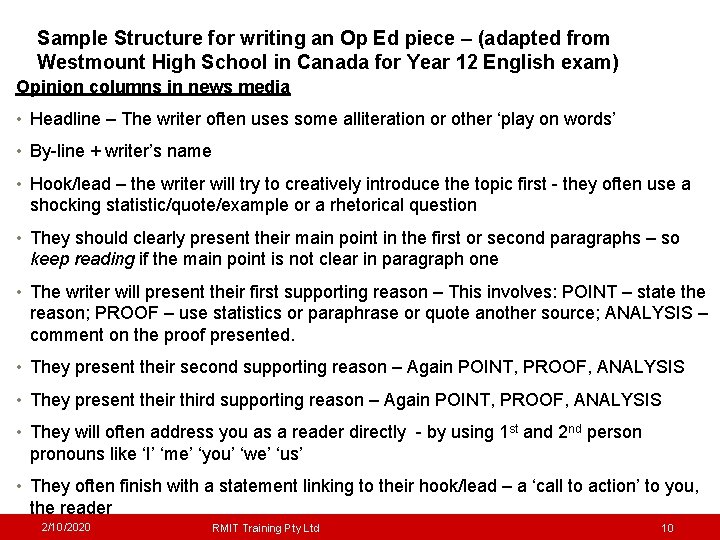
Sample Structure for writing an Op Ed piece – (adapted from Westmount High School in Canada for Year 12 English exam) Opinion columns in news media • Headline – The writer often uses some alliteration or other ‘play on words’ • By-line + writer’s name • Hook/lead – the writer will try to creatively introduce the topic first - they often use a shocking statistic/quote/example or a rhetorical question • They should clearly present their main point in the first or second paragraphs – so keep reading if the main point is not clear in paragraph one • The writer will present their first supporting reason – This involves: POINT – state the reason; PROOF – use statistics or paraphrase or quote another source; ANALYSIS – comment on the proof presented. • They present their second supporting reason – Again POINT, PROOF, ANALYSIS • They present their third supporting reason – Again POINT, PROOF, ANALYSIS • They will often address you as a reader directly - by using 1 st and 2 nd person pronouns like ‘I’ ‘me’ ‘you’ ‘we’ ‘us’ • They often finish with a statement linking to their hook/lead – a ‘call to action’ to you, the reader 2/10/2020 RMIT Training Pty Ltd 10
While/during reading activity Usual activities: • identify main idea and supporting ideas – can be done with a graphic organiser • Write a one line summary of each paragraph as you read it • comprehension questions – but these may also involve summarising ideas post reading ? Q. Could give students guided questions which they can check AS THEY READ?
Ex. ‘Guide-o-rama’ (as cited in Hedgcock and Ferris 2009) for this text • You can make a simple handout like my example (with your prepared answers on another handout) and give this to sts • You can put sts in pairs to check their answers with each other as they go along • You can use a ICT based format for certain texts and question types – perhaps not this text 2/10/2020 RMIT Training Pty Ltd 12
Also while reading: • Can use ‘Think alouds’ for sts to monitor their comprehension as they read • Clarify meaning of any other unknown vocabulary that individual sts ask for help with e. g. ‘welcome with open arms’; ‘make no mistake’; ‘at a local level’ • Look more closely at grammar e. g. ‘would be’ in Para 1 vs ‘would you want’ in Para 5 2/10/2020 RMIT Training Pty Ltd 13
After/post reading • Give some complex/specific noun phrases to pairs of sts to demonstrate meaning to the rest of the class e. g. ‘short term financial costs’ • Get sts to write a summary of the text in pairs • Get sts to reread the text and annotate their reactions to supporting ideas 2/10/2020 RMIT Training Pty Ltd 14

Example of both summary notes, reader reactions and graphic organiser 2/10/2020 RMIT Training Pty Ltd 15
To finish: • L 2 reading is a process of utilising both top-down and bottom-up strategies interactively but not automatically/seamlessly • Sts need help building schema for unfamiliar reading text genres • Sts need for us to show them that pre-reading, while reading and post-reading activities are all useful for comprehension (and explain why) • Sts need time to reread texts – skimming and scanning can be overused strategies! • Sts need time to do grammar and vocabulary work from reading texts 2/10/2020 RMIT Training Pty Ltd 16
References Abbott M, 2006, ESL Reading Strategies: Differences in Arabic and Mandarin Speaker Test Performance. Language Learning, 56(4), 633 -670 Alderson J. C. , 2000, Assessing Reading. Cambridge University Press, Cambridge Anderson N, 1999, Exploring second language reading, Heinle and Heinle, Boston Grabe W and Jiang X, 2014 Assessing Reading The Companion to Language Assessment, 1 st ed. , 185 -200, John Wiley and Sons Inc. , New Jersey Hedgcock J and Ferris D, 2009, Teaching readers of English, Routledge, Taylor and Francis, New York Nation I. S. P. 2009 Teaching ESL/EFL Reading and Writing, Routledge Taylor and Francis, New York Westmount High School English language arts department westmount. koumbit. org/sites/org/Writingan. OPINIONCOLUMN. ppt, Quebec, Canada 2/10/2020 RMIT Training Pty Ltd 17
- Slides: 17