
Building Awareness of Archival Value Working With Record
Building Awareness of Archival Value: Working With Record Creators Sesily Resch Karolina Lewandowska Mid-Atlantic Regional Archives Conference Spring 2019 Morgantown, WV
Disclaimer The opinions expressed in this presentation are the authors’ own and do not reflect the view of the Department of the Navy, the Department of Defense, or the United States Government.
Overview of NHHC The Naval History and Heritage Command (NHHC) is headquartered in Washington, DC. The history of the NHHC can be traced back to 1800 with the founding of the Navy Department Library. Mission: To preserve and present an accurate history of the U. S. Navy Specialties: – – – – Archives Histories Navy Department Library Navy Art Collection Underwater Archeology Curator Branch Official Navy Museums Communications & Outreach (Public Affairs)
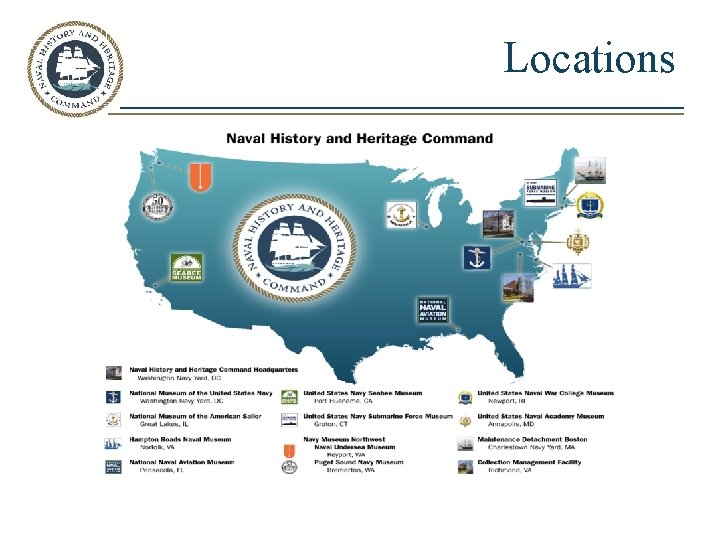
Locations
History, Mission & Staff History: Traces history back to 1882 with formation of Office of Naval Records and Library within the Office of Naval Intelligence Mission: Collect, organize, preserve, protect, and make available select permanent official records and other historically significant documents of the Navy such as personal papers, oral histories, and photographs Staff: 25 archivists and 2 FOIA specialists organized into Processing and Reference/FOIA sections + contractors for special projects Part of the Histories and Archives Division that includes the Navy Department Library and the Histories Branch
Collection Overview Largest repository of permanent Navy records outside the National Archives – Almost 40, 000 cu. Ft. of textual and special media records and donated archival material – 1 million+ photographs – 4 TB+ of electronic records Approximately 85% to 90% of textual and electronic holdings are official records – Transferred to the Navy Archives in accordance with Navy record schedules – Retained up to 50 years depending on the record series before transfer to National Archives Collecting Areas – – – Operational records Ships History Collections Aviation History Collections Personal Papers Office of the Chief of Naval Operations
US Navy NAVY PERSONNEL Active Duty: 329, 867 Officers: 54, 621 Enlisted: 270, 811 Midshipmen: 4, 435 Ready Reserve: 100, 495 as of Dec 2018 Selected Reserves: 50, 080 Individual Ready Reserve: 42, 415 https: //www. instagram. com/p/Bt. HTn. Lzhx. Rm/ Navy Department Civilian Employees: 274, 300 SHIPS AND SUBMARINES Deployable Battle Force Ships: 288 https: //www. navy. mil/navydata/nav_legacy. asp? id=146

Glossary Archival Value - for our purposes, the record has validity Validity – accurately represents reality OPNAVINST - is a formally documented lawful order that is issued by the Chief of Naval Operations. These instructions are typically used to establish United States Navy policy, procedures, and requirements. Fleet consists of 288 vessels Naval Commands over 3, 000 (land, sea, and reserve units) History – for our purposes, it’s anything that happened ‘yesterday’. COR are annual reports submitted by commands Deck Log monthly reports of Naval commissioned vessels NCDU- Naval Combat Documentation Unit is a reservist unit which works with commands to document the Navy’s active history
COR and Deck Logs Record Series – document a specific kind of transaction or function https: //commons. lbl. gov/display/aro/Record+Series+Definition In our case, either monthly or yearly ‘reports’. Again, these record series are governed by the OPNAVINST
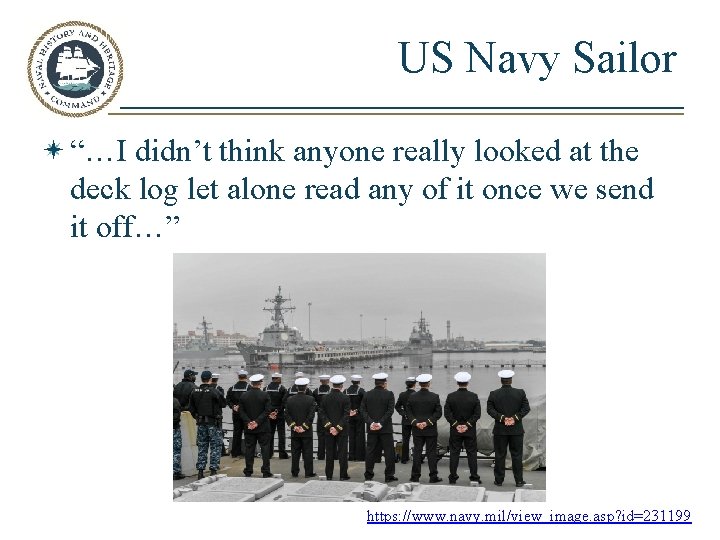
US Navy Sailor “…I didn’t think anyone really looked at the deck log let alone read any of it once we send it off…” https: //www. navy. mil/view_image. asp? id=231199
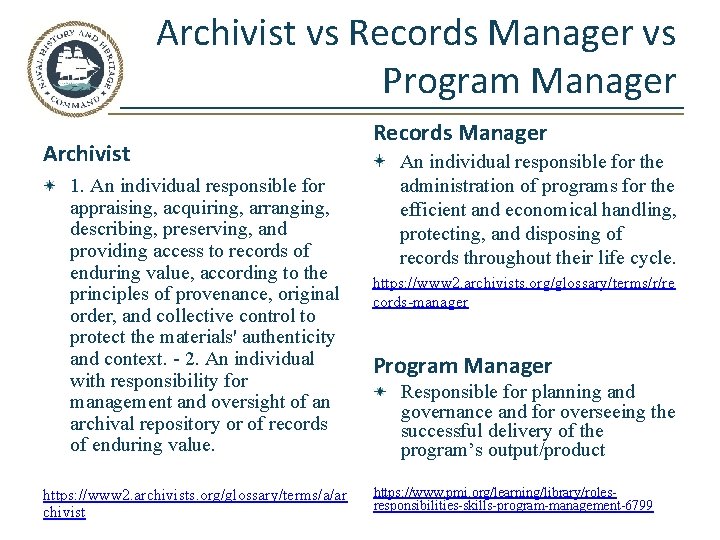
Archivist vs Records Manager vs Program Manager Archivist 1. An individual responsible for appraising, acquiring, arranging, describing, preserving, and providing access to records of enduring value, according to the principles of provenance, original order, and collective control to protect the materials' authenticity and context. - 2. An individual with responsibility for management and oversight of an archival repository or of records of enduring value. https: //www 2. archivists. org/glossary/terms/a/ar chivist Records Manager An individual responsible for the administration of programs for the efficient and economical handling, protecting, and disposing of records throughout their life cycle. https: //www 2. archivists. org/glossary/terms/r/re cords-manager Program Manager Responsible for planning and governance and for overseeing the successful delivery of the program’s output/product https: //www. pmi. org/learning/library/rolesresponsibilities-skills-program-management-6799
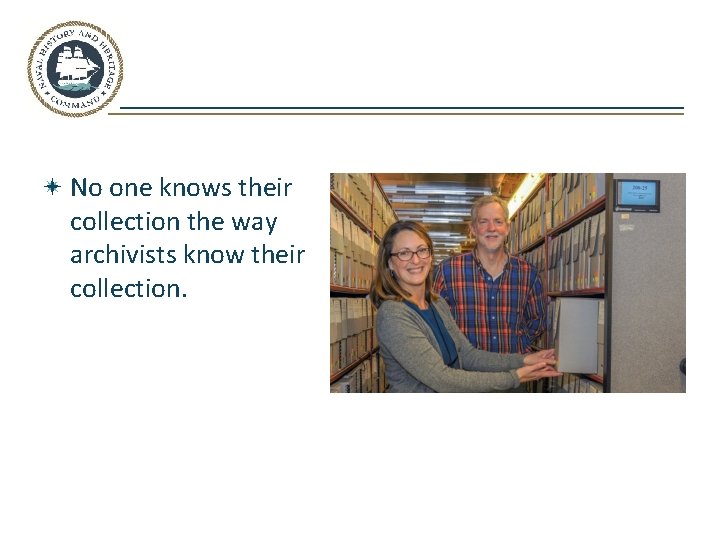
No one knows their collection the way archivists know their collection.
Archivist vs Records Manager Trepidation about ‘changing’ history
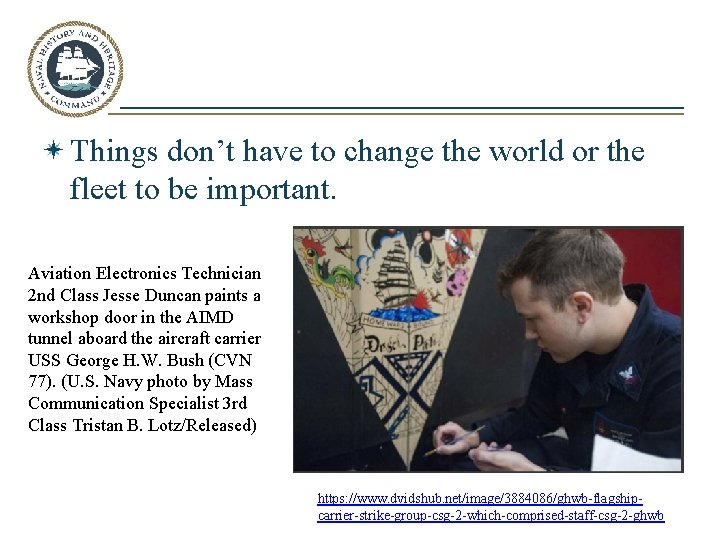
Things don’t have to change the world or the fleet to be important. Aviation Electronics Technician 2 nd Class Jesse Duncan paints a workshop door in the AIMD tunnel aboard the aircraft carrier USS George H. W. Bush (CVN 77). (U. S. Navy photo by Mass Communication Specialist 3 rd Class Tristan B. Lotz/Released) https: //www. dvidshub. net/image/3884086/ghwb-flagshipcarrier-strike-group-csg-2 -which-comprised-staff-csg-2 -ghwb
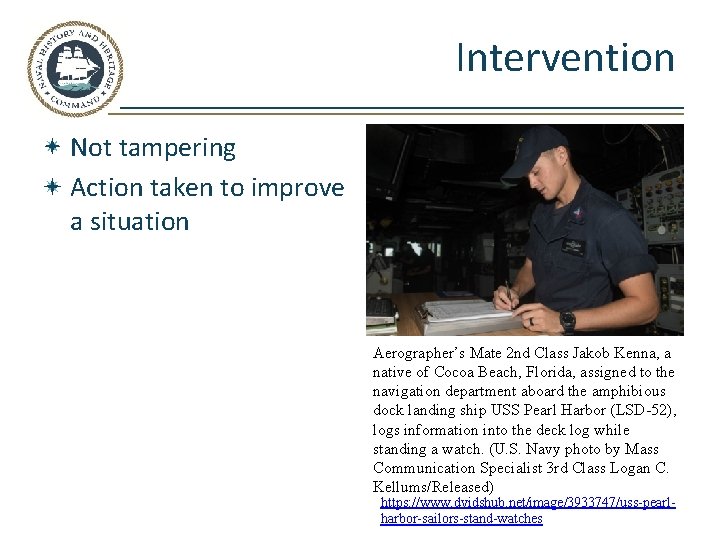
Intervention Not tampering Action taken to improve a situation Aerographer’s Mate 2 nd Class Jakob Kenna, a native of Cocoa Beach, Florida, assigned to the navigation department aboard the amphibious dock landing ship USS Pearl Harbor (LSD-52), logs information into the deck log while standing a watch. (U. S. Navy photo by Mass Communication Specialist 3 rd Class Logan C. Kellums/Released) https: //www. dvidshub. net/image/3933747/uss-pearlharbor-sailors-stand-watches
The Need for Intervention Turnover No Archival Training No Records Management Training OPNAVIST = standard guidance https: //www. instagram. com/p/Bs. B 9 E 4 ch. VIs/
Deep Learning We are thinking about the long term Teaching – Value vs non-value Creating / showing examples
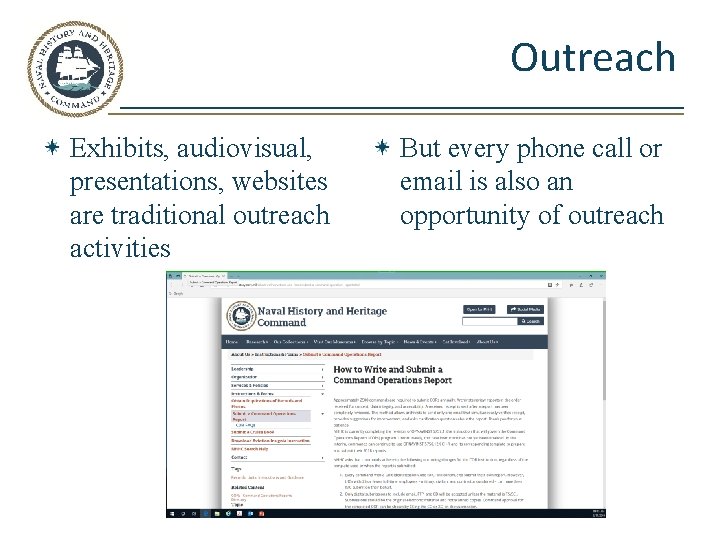
Outreach Exhibits, audiovisual, presentations, websites are traditional outreach activities But every phone call or email is also an opportunity of outreach
Fleet Historian Training/Outreach Training reservist who visit with commands throughout the year – Similar to an appraisal archivist Two way street – Learning more about the commands from sailors
Outreach With any outreach, you need to ask: – Are these activities effective? – Are they worth my time?
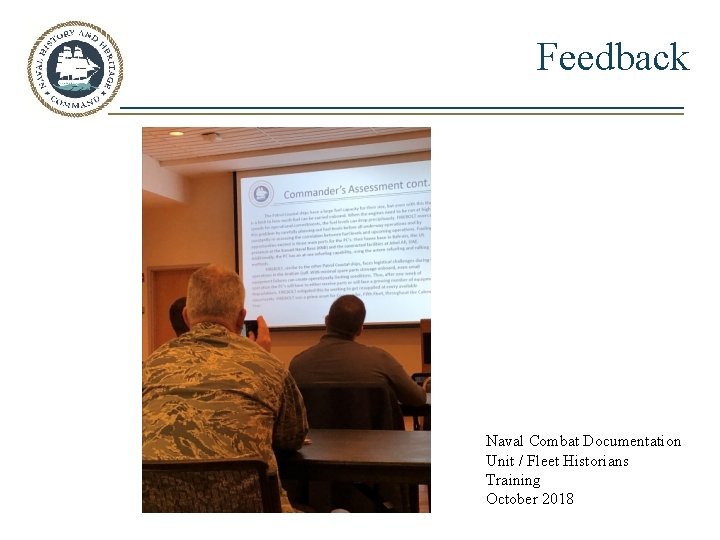
Feedback Naval Combat Documentation Unit / Fleet Historians Training October 2018
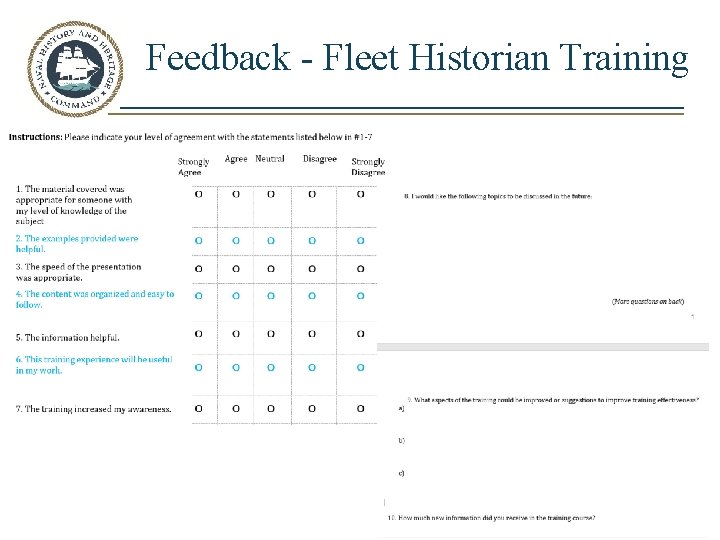
Feedback - Fleet Historian Training
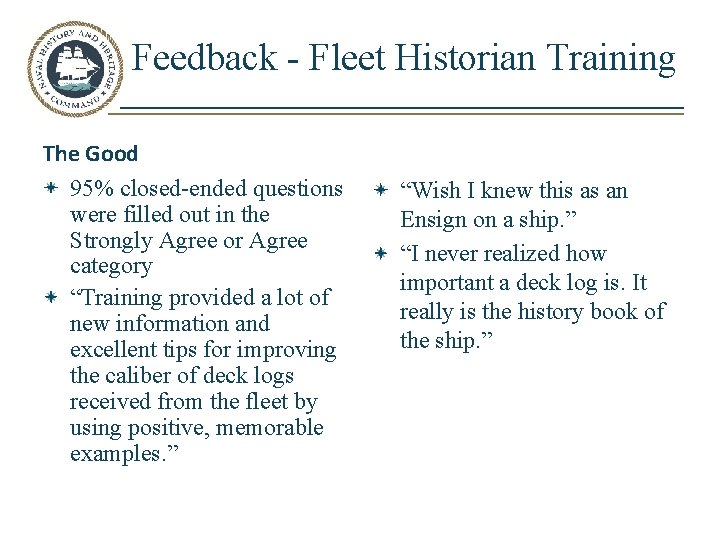
Feedback - Fleet Historian Training The Good 95% closed-ended questions were filled out in the Strongly Agree or Agree category “Training provided a lot of new information and excellent tips for improving the caliber of deck logs received from the fleet by using positive, memorable examples. ” “Wish I knew this as an Ensign on a ship. ” “I never realized how important a deck log is. It really is the history book of the ship. ”
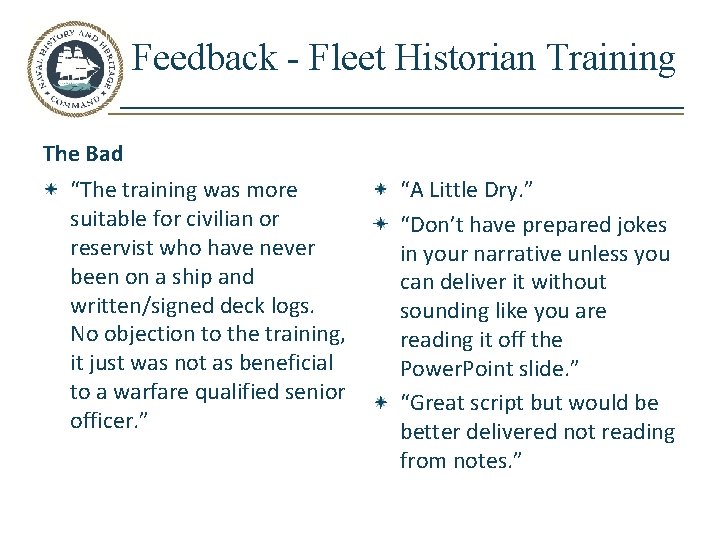
Feedback - Fleet Historian Training The Bad “The training was more suitable for civilian or reservist who have never been on a ship and written/signed deck logs. No objection to the training, it just was not as beneficial to a warfare qualified senior officer. ” “A Little Dry. ” “Don’t have prepared jokes in your narrative unless you can deliver it without sounding like you are reading it off the Power. Point slide. ” “Great script but would be better delivered not reading from notes. ”
Additional Knowledge and Skills Public Speaking Skills Learning the lingo and culture of your organization Learn to establish rapport with members of diverse groups
Traditional Archival Competencies Ability to write correspondence. Ability to write recommendations in a clear and concise manner. Ability to evaluate archival collections. Ability to accessioned the receipt of new collection materials daily.
Additional Guidance Google is your friend
QUESTIONS? Sesily Resch sesily. resch@navy. mil Karolina Lewandowska Karolina. Lewandowska@navy. mil
- Slides: 28