
Building and Supporting Effective Self Management Referral Systems
Building and Supporting Effective Self. Management Referral Systems
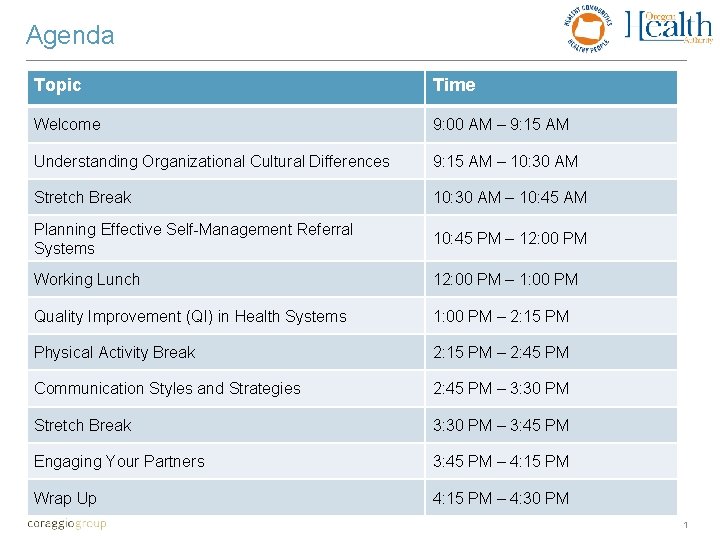
Agenda Topic Time Welcome 9: 00 AM – 9: 15 AM Understanding Organizational Cultural Differences 9: 15 AM – 10: 30 AM Stretch Break 10: 30 AM – 10: 45 AM Planning Effective Self-Management Referral Systems 10: 45 PM – 12: 00 PM Working Lunch 12: 00 PM – 1: 00 PM Quality Improvement (QI) in Health Systems 1: 00 PM – 2: 15 PM Physical Activity Break 2: 15 PM – 2: 45 PM Communication Styles and Strategies 2: 45 PM – 3: 30 PM Stretch Break 3: 30 PM – 3: 45 PM Engaging Your Partners 3: 45 PM – 4: 15 PM Wrap Up 4: 15 PM – 4: 30 PM 1
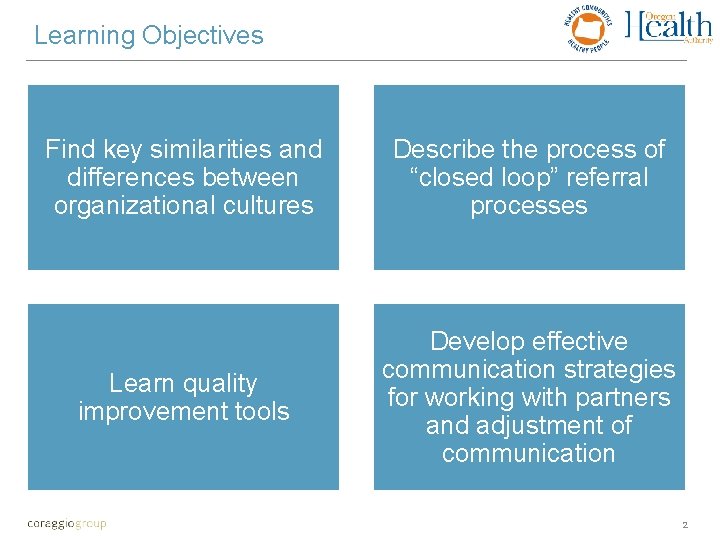
Learning Objectives Find key similarities and differences between organizational cultures Describe the process of “closed loop” referral processes Learn quality improvement tools Develop effective communication strategies for working with partners and adjustment of communication 2
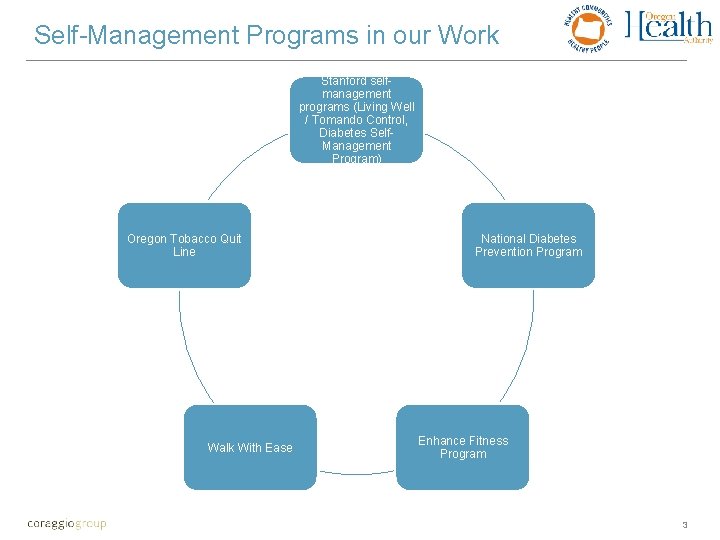
Self-Management Programs in our Work Stanford selfmanagement programs (Living Well / Tomando Control, Diabetes Self. Management Program) Oregon Tobacco Quit Line Walk With Ease National Diabetes Prevention Program Enhance Fitness Program 3
Welcome - Introductions YOUR NAME YOUR ORGANIZATION YOUR ROLE 4
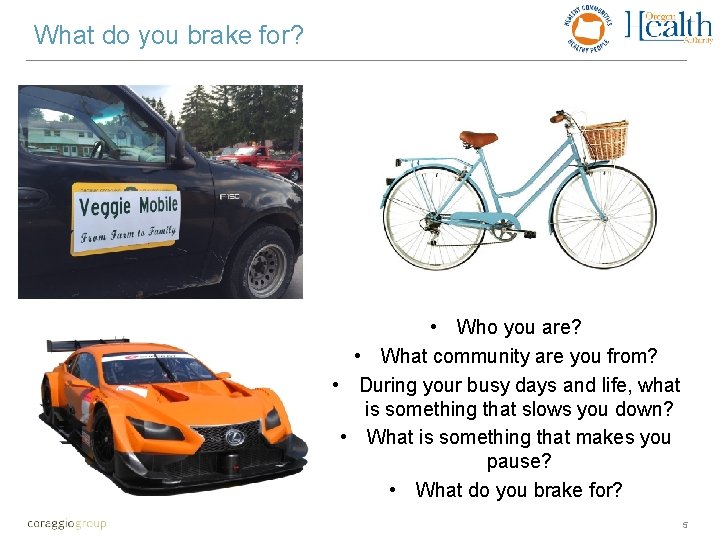
What do you brake for? • Who you are? • What community are you from? • During your busy days and life, what is something that slows you down? • What is something that makes you pause? • What do you brake for? 5
UNDERSTANDING ORGANIZATIONAL CULTURAL DIFFERENCES 6
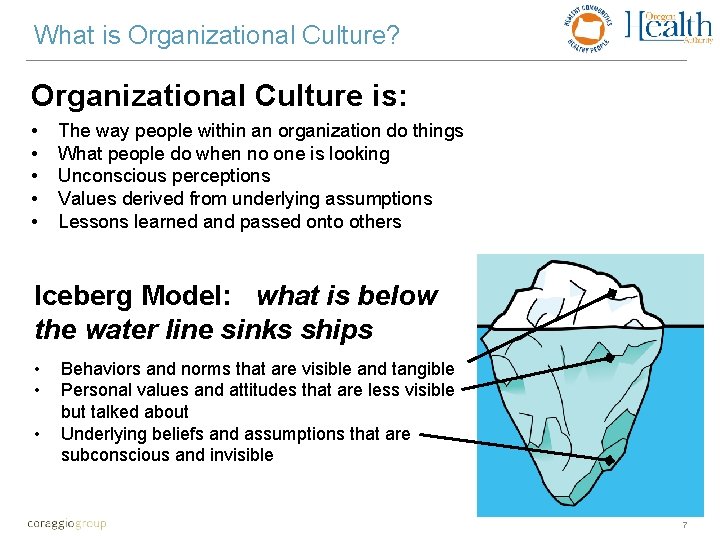
What is Organizational Culture? Organizational Culture is: • • • The way people within an organization do things What people do when no one is looking Unconscious perceptions Values derived from underlying assumptions Lessons learned and passed onto others Iceberg Model: what is below the water line sinks ships • • • Behaviors and norms that are visible and tangible Personal values and attitudes that are less visible but talked about Underlying beliefs and assumptions that are subconscious and invisible 7
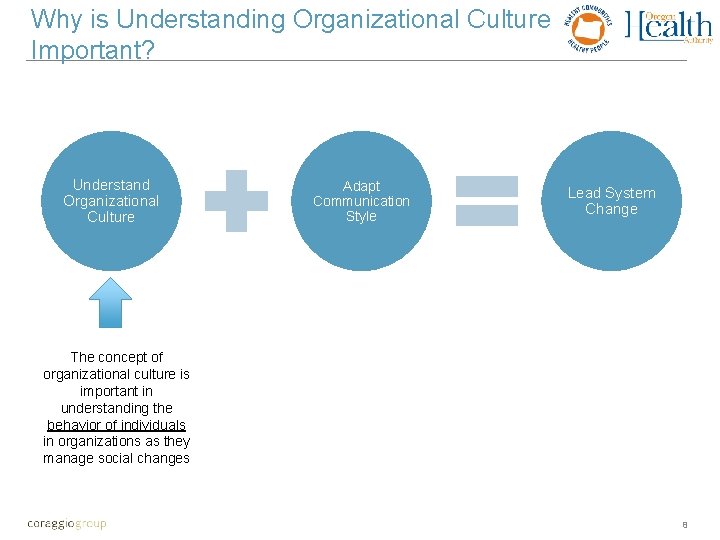
Why is Understanding Organizational Culture Important? Understand Organizational Culture Adapt Communication Style Lead System Change The concept of organizational culture is important in understanding the behavior of individuals in organizations as they manage social changes 8
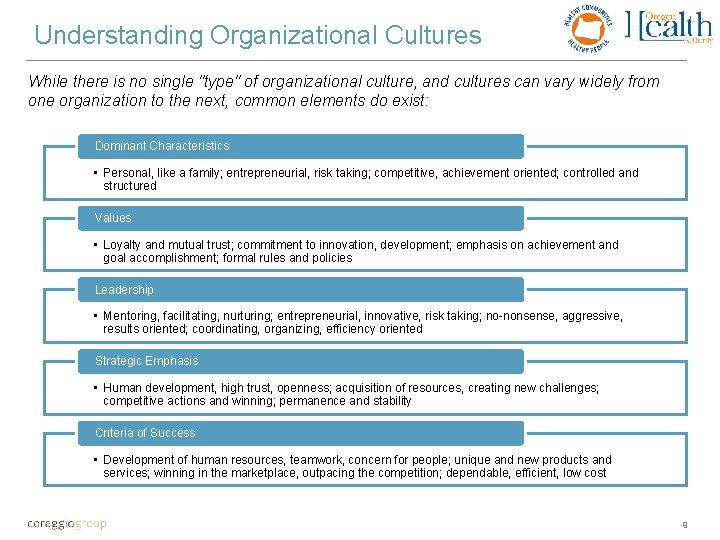
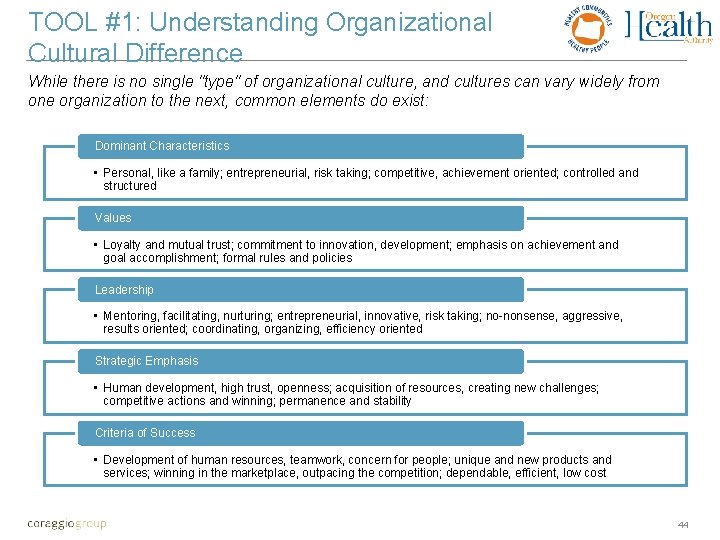
Understanding Organizational Cultures While there is no single "type" of organizational culture, and cultures can vary widely from one organization to the next, common elements do exist: Dominant Characteristics • Personal, like a family; entrepreneurial, risk taking; competitive, achievement oriented; controlled and structured Values • Loyalty and mutual trust; commitment to innovation, development; emphasis on achievement and goal accomplishment; formal rules and policies Leadership • Mentoring, facilitating, nurturing; entrepreneurial, innovative, risk taking; no-nonsense, aggressive, results oriented; coordinating, organizing, efficiency oriented Strategic Emphasis • Human development, high trust, openness; acquisition of resources, creating new challenges; competitive actions and winning; permanence and stability Criteria of Success • Development of human resources, teamwork, concern for people; unique and new products and services; winning in the marketplace, outpacing the competition; dependable, efficient, low cost 9
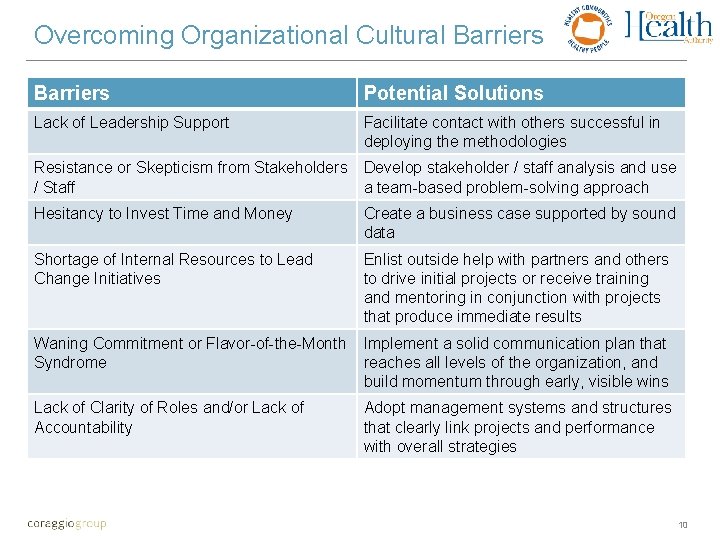
Overcoming Organizational Cultural Barriers Potential Solutions Lack of Leadership Support Facilitate contact with others successful in deploying the methodologies Resistance or Skepticism from Stakeholders / Staff Develop stakeholder / staff analysis and use a team-based problem-solving approach Hesitancy to Invest Time and Money Create a business case supported by sound data Shortage of Internal Resources to Lead Change Initiatives Enlist outside help with partners and others to drive initial projects or receive training and mentoring in conjunction with projects that produce immediate results Waning Commitment or Flavor-of-the-Month Syndrome Implement a solid communication plan that reaches all levels of the organization, and build momentum through early, visible wins Lack of Clarity of Roles and/or Lack of Accountability Adopt management systems and structures that clearly link projects and performance with overall strategies 10
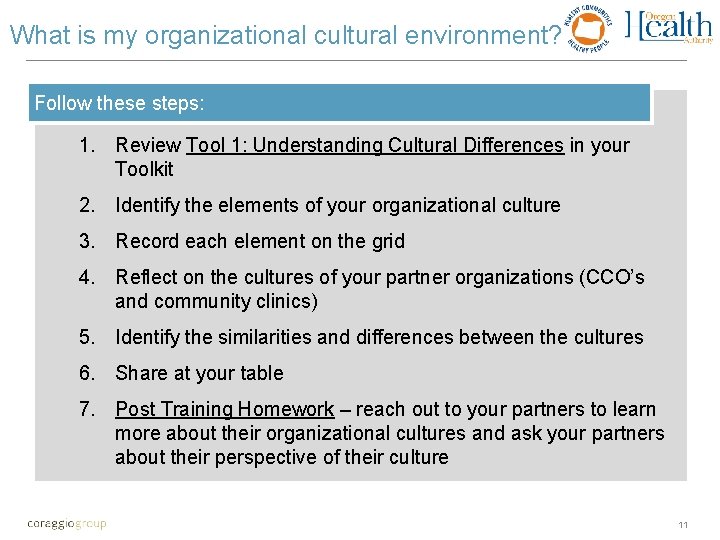
What is my organizational cultural environment? Follow these steps: 1. Review Tool 1: Understanding Cultural Differences in your Toolkit 2. Identify the elements of your organizational culture 3. Record each element on the grid 4. Reflect on the cultures of your partner organizations (CCO’s and community clinics) 5. Identify the similarities and differences between the cultures 6. Share at your table 7. Post Training Homework – reach out to your partners to learn more about their organizational cultures and ask your partners about their perspective of their culture 11
PLANNING EFFECTIVE SELF-MANAGEMENT REFERRAL SYSTEMS 12
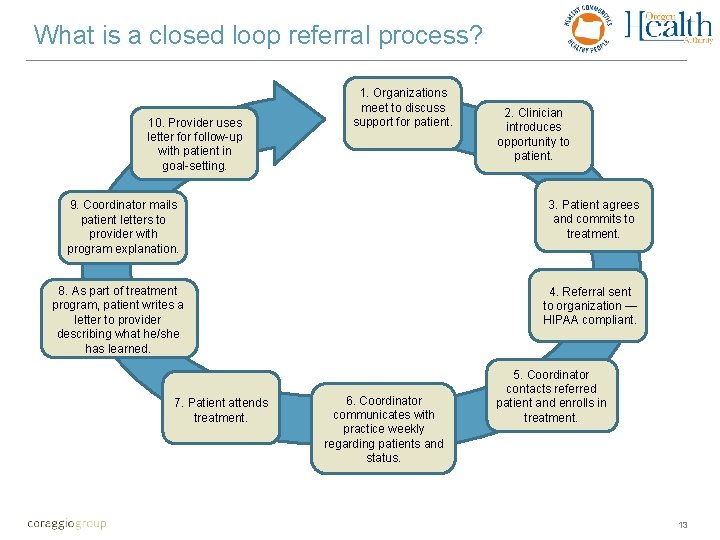
What is a closed loop referral process? 10. Provider uses letter follow-up with patient in goal-setting. 1. Organizations meet to discuss support for patient. 3. Patient agrees and commits to treatment. 9. Coordinator mails patient letters to provider with program explanation. 8. As part of treatment program, patient writes a letter to provider describing what he/she has learned. 7. Patient attends treatment. 2. Clinician introduces opportunity to patient. 4. Referral sent to organization — HIPAA compliant. 6. Coordinator communicates with practice weekly regarding patients and status. 5. Coordinator contacts referred patient and enrolls in treatment. 13
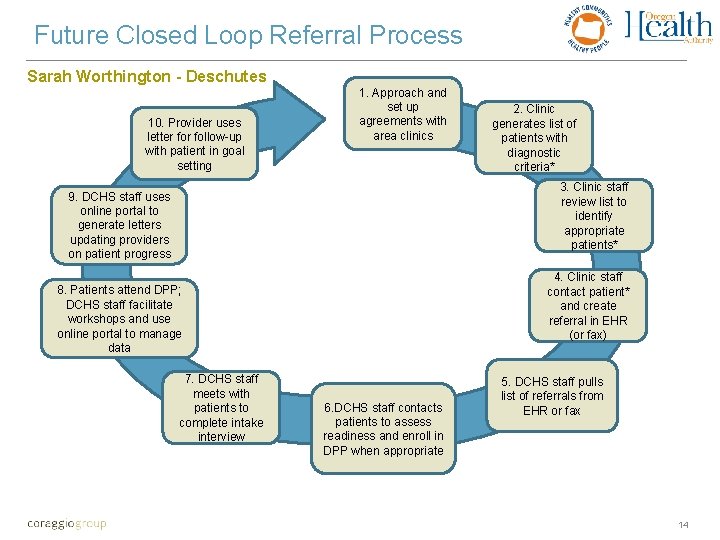
Future Closed Loop Referral Process Sarah Worthington - Deschutes 10. Provider uses letter follow-up with patient in goal setting 1. Approach and set up agreements with area clinics 2. Clinic generates list of patients with diagnostic criteria* 3. Clinic staff review list to identify appropriate patients* 9. DCHS staff uses online portal to generate letters updating providers on patient progress 4. Clinic staff contact patient* and create referral in EHR (or fax) 8. Patients attend DPP; DCHS staff facilitate workshops and use online portal to manage data 7. DCHS staff meets with patients to complete intake interview 6. DCHS staff contacts patients to assess readiness and enroll in DPP when appropriate 5. DCHS staff pulls list of referrals from EHR or fax 14
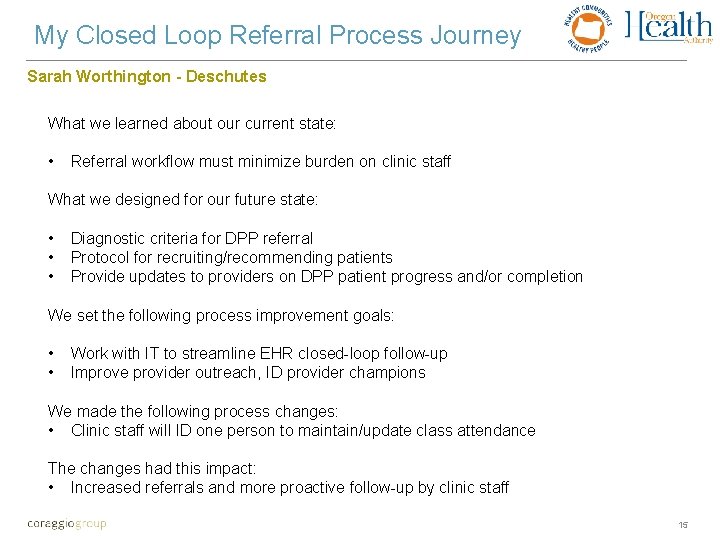
My Closed Loop Referral Process Journey Sarah Worthington - Deschutes What we learned about our current state: • Referral workflow must minimize burden on clinic staff What we designed for our future state: • • • Diagnostic criteria for DPP referral Protocol for recruiting/recommending patients Provide updates to providers on DPP patient progress and/or completion We set the following process improvement goals: • • Work with IT to streamline EHR closed-loop follow-up Improve provider outreach, ID provider champions We made the following process changes: • Clinic staff will ID one person to maintain/update class attendance The changes had this impact: • Increased referrals and more proactive follow-up by clinic staff 15
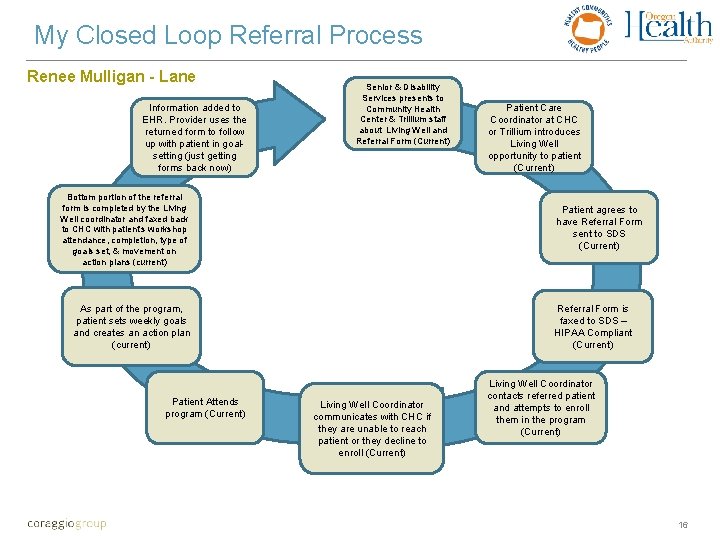
My Closed Loop Referral Process Renee Mulligan - Lane Information added to EHR. Provider uses the returned form to follow up with patient in goalsetting (just getting forms back now) Senior & Disability Services presents to Community Health Center & Trillium staff about Living Well and Referral Form (Current) Bottom portion of the referral form is completed by the Living Well coordinator and faxed back to CHC with patient’s workshop attendance, completion, type of goals set, & movement on action plans (current) Patient agrees to have Referral Form sent to SDS (Current) Referral Form is faxed to SDS – HIPAA Compliant (Current) As part of the program, patient sets weekly goals and creates an action plan (current) Patient Attends program (Current) Patient Care Coordinator at CHC or Trillium introduces Living Well opportunity to patient (Current) Living Well Coordinator communicates with CHC if they are unable to reach patient or they decline to enroll (Current) Living Well Coordinator contacts referred patient and attempts to enroll them in the program (Current) 16
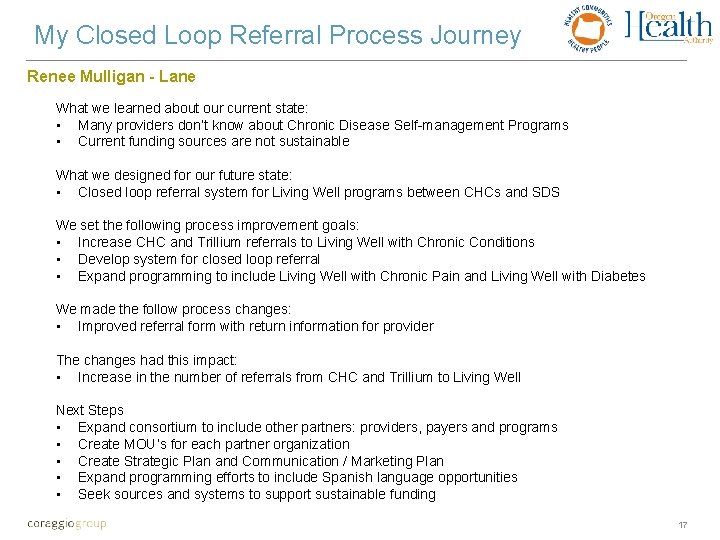
My Closed Loop Referral Process Journey Renee Mulligan - Lane What we learned about our current state: • Many providers don’t know about Chronic Disease Self-management Programs • Current funding sources are not sustainable What we designed for our future state: • Closed loop referral system for Living Well programs between CHCs and SDS We set the following process improvement goals: • Increase CHC and Trillium referrals to Living Well with Chronic Conditions • Develop system for closed loop referral • Expand programming to include Living Well with Chronic Pain and Living Well with Diabetes We made the follow process changes: • Improved referral form with return information for provider The changes had this impact: • Increase in the number of referrals from CHC and Trillium to Living Well Next Steps • Expand consortium to include other partners: providers, payers and programs • Create MOU’s for each partner organization • Create Strategic Plan and Communication / Marketing Plan • Expand programming efforts to include Spanish language opportunities • Seek sources and systems to support sustainable funding 17
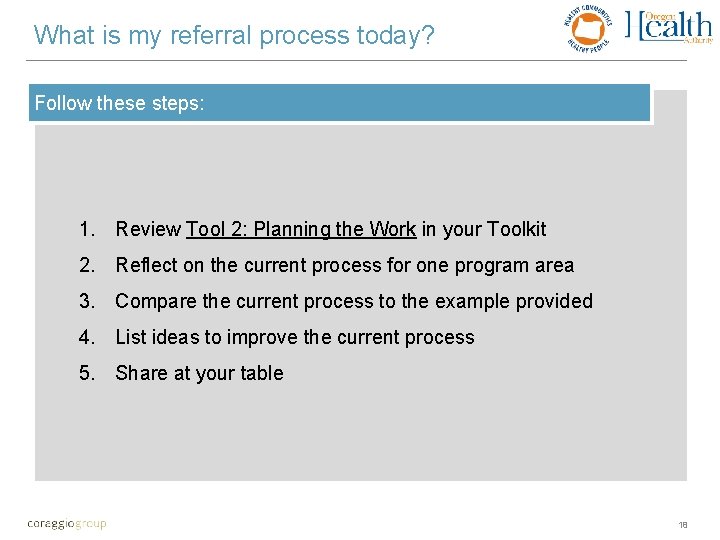
What is my referral process today? Follow these steps: 1. Review Tool 2: Planning the Work in your Toolkit 2. Reflect on the current process for one program area 3. Compare the current process to the example provided 4. List ideas to improve the current process 5. Share at your table 18
LUNCH TABLE QUESTIONS 19
IMPROVING QUALITY IN HEALTH SYSTEMS 20
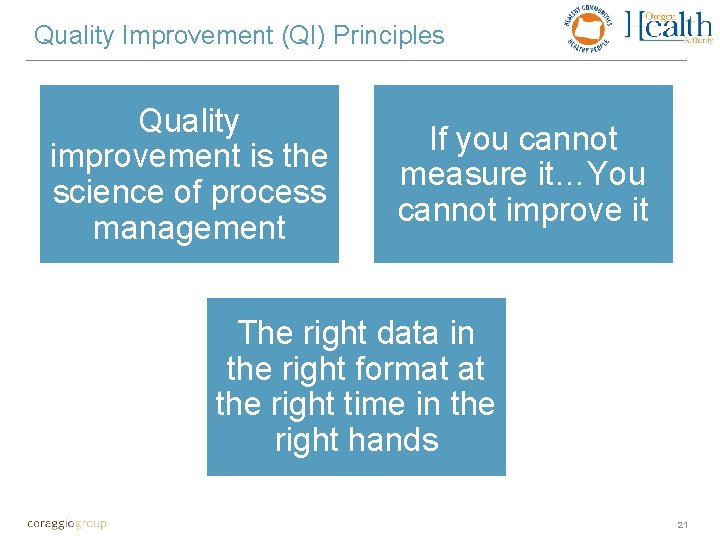
Quality Improvement (QI) Principles Quality improvement is the science of process management If you cannot measure it…You cannot improve it The right data in the right format at the right time in the right hands 21
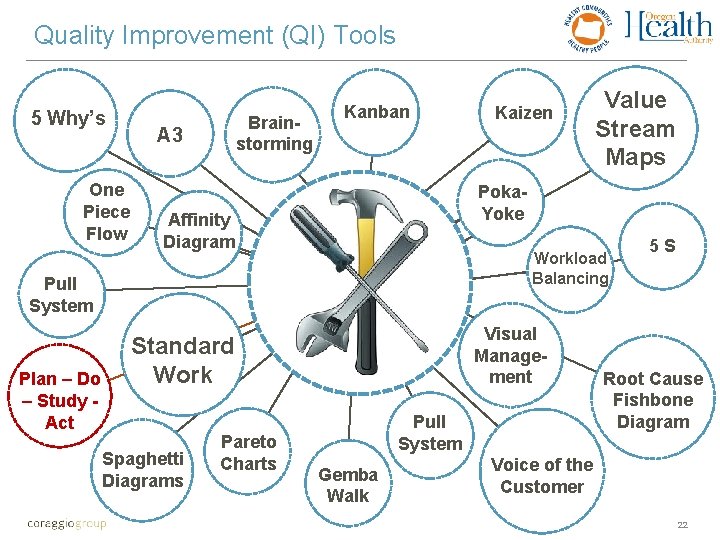
Quality Improvement (QI) Tools 5 Why’s One Piece Flow Brainstorming A 3 Kanban Affinity Diagram Workload Balancing Visual Management Standard Work Spaghetti Diagrams Pareto Charts Value Stream Maps Poka. Yoke Pull System Plan – Do – Study Act Kaizen Pull System Gemba Walk 5 S Root Cause Fishbone Diagram Voice of the Customer 22
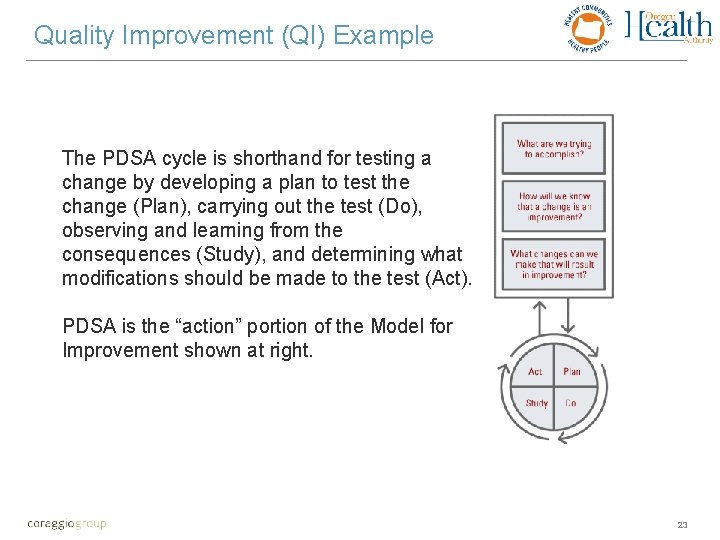
Quality Improvement (QI) Example The PDSA cycle is shorthand for testing a change by developing a plan to test the change (Plan), carrying out the test (Do), observing and learning from the consequences (Study), and determining what modifications should be made to the test (Act). PDSA is the “action” portion of the Model for Improvement shown at right. 23
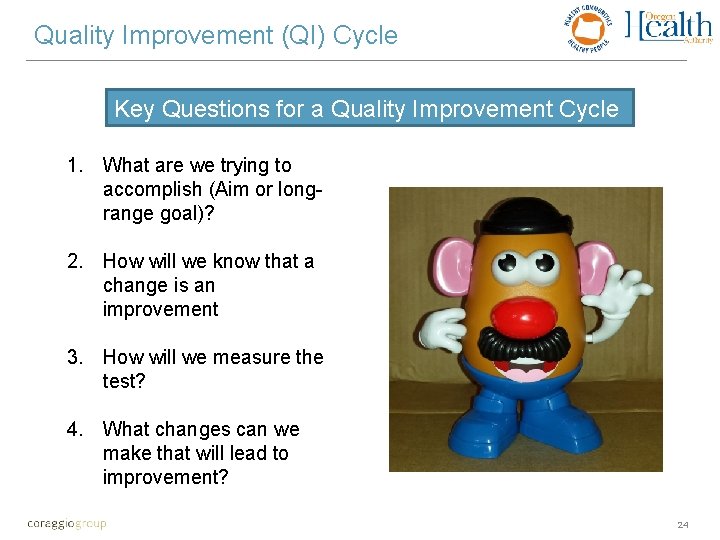
Quality Improvement (QI) Cycle Key Questions for a Quality Improvement Cycle 1. What are we trying to accomplish (Aim or longrange goal)? 2. How will we know that a change is an improvement 3. How will we measure the test? 4. What changes can we make that will lead to improvement? 24
Mr. Potato Head Key Concepts • Rapid, small scale PDSA testing builds profound knowledge quickly. • Planning a test, including prediction and measurement, increases learning. • Planning and measurement are easy to do efficiently and routinely. • Collaboration aids knowledge building and speeds learning for improvement. • Testing creates knowledge faster than discussion and planning. 25
Mr. Potato Head Objectives • Understand rapid cycle PDSA testing • Understand how theory and prediction aid learning • See how to collect real-time measurement • Appreciate the opportunity for collaborative learning 26
Mr. Potato Head Roles Builder: Construct Mr. Potato Head to reflect the photo exactly. Timekeeper: Clock starts when the tester touches Mr. Potato Head. Clock stops when tester stops touching Mr. Potato Head AND says, “Time!” PDSA Scribe: Scribe track team’s data on PDSA tracker form. Inspector: Inspectors assigns a score of one (1) – three (3). Score of 1 - One or more of the required pieces are not on Mr. Potato Head. Score of 2 – All pieces are on Mr. Potato Head, but one or more pieces is grossly out of place. Score of 3 - All pieces are on Mr. Potato Head and positioned correctly. For each cycle, make a “plan” to test a change idea and capture the time and accuracy scores predicted for the test. Tables may “do” their test and complete the “study” and “act” phases including documentation. Teams will wait for the facilitator’s instructions before initiating another test. 27
Mr. Potato Head Instructions: 1. Pick team name. 2. Assign roles to team members (Builder, Timekeeper, PDSA scribe, Inspector) 3. Build Mr. Potato Head as fast and accurately as possible 4. Record your results and pass to “runner” 5. Teams stop after each test to study results by comparing their actual time and accuracy score with their predictions. Additionally, discuss any observations. 6. Based on your test, should you adapt the change idea for another test, adopt it, or abandon it. 7. After third improvement loop consider: Why is assembling something such as a Mr. Potato Head with a team a valuable way to learn about iterative tests of change? Why is measurement a critical component of PDSA cycles? 28
What is PDSA? Follow these steps: 1. Review Tool 3: Improving The Quality in your Toolkit 2. Follow the instructions as just described for the Mr. Potato Head Exercise: 3. After each improvement loop consider: • Why is assembling something such as a Mr. Potato Head with a team a valuable way to learn about iterative tests of change? • Why is measurement a critical component of PDSA cycles? 4. Share your results with the group 29
COMMUNICATION STYLES AND STRATEGIES 30
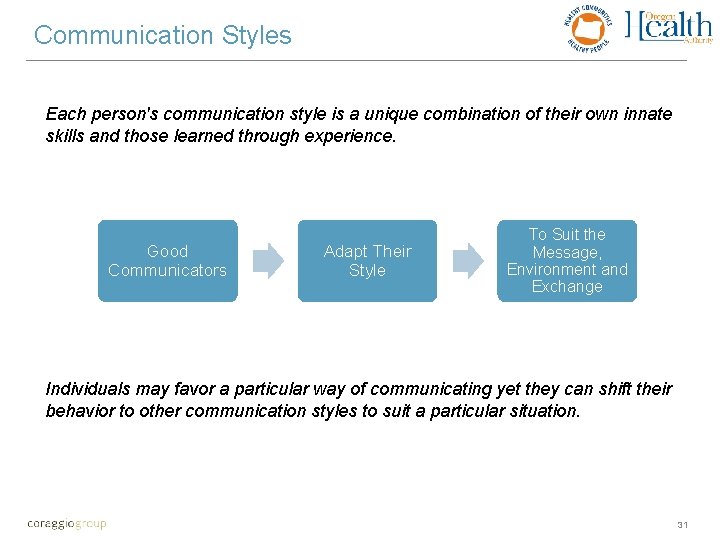
Communication Styles Each person's communication style is a unique combination of their own innate skills and those learned through experience. Good Communicators Adapt Their Style To Suit the Message, Environment and Exchange Individuals may favor a particular way of communicating yet they can shift their behavior to other communication styles to suit a particular situation. 31
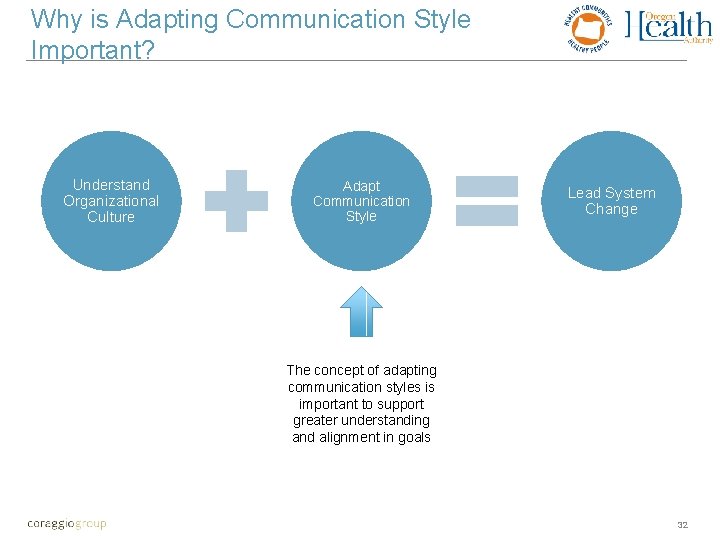
Why is Adapting Communication Style Important? Understand Organizational Culture Adapt Communication Style Lead System Change The concept of adapting communication styles is important to support greater understanding and alignment in goals 32
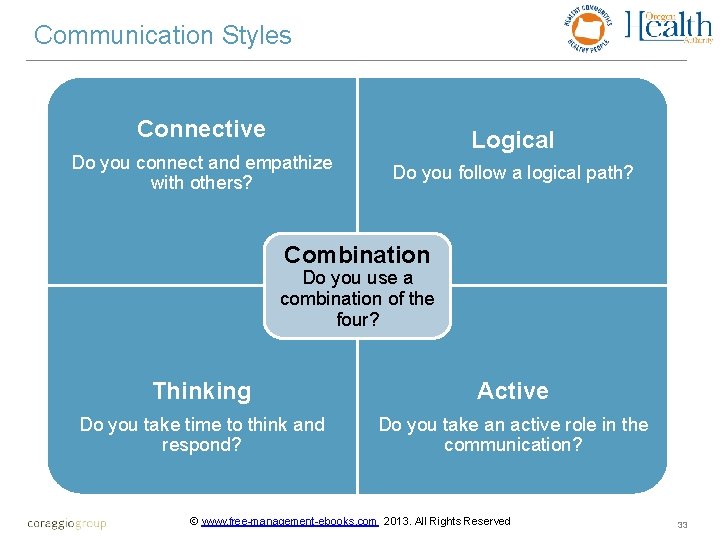
Communication Styles Connective Do you connect and empathize with others? Logical Do you follow a logical path? Combination Do you use a combination of the four? Thinking Active Do you take time to think and respond? Do you take an active role in the communication? www. free-management-ebooks. com 2013. All Rights Reserved 33
What is my communication style? Follow these steps: 1. Review Tool 4: Making the Connection in your Toolkit 2. Read the following statements – check the boxes for those that you feel best describes how you like to behave when communicating with others 3. Once you have read through all the statements look at the number of checks you have in each section 4. Reflect on the natural communication style of your organization 5. Share at your table 34
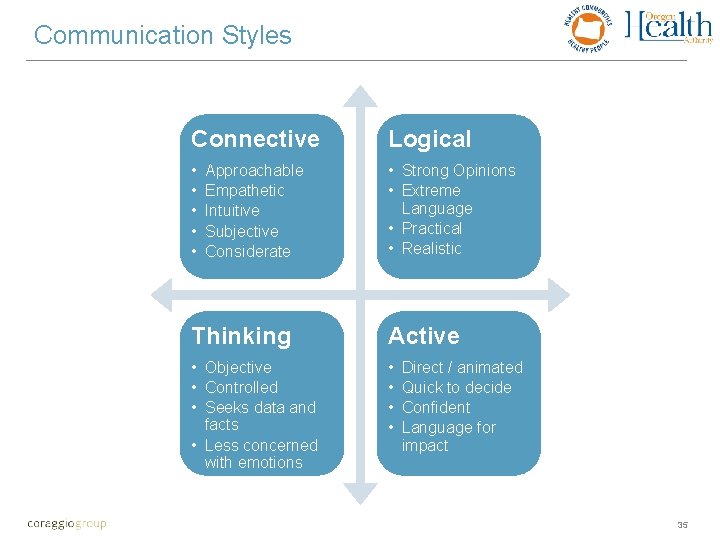
Communication Styles Connective Logical • • • Strong Opinions • Extreme Language • Practical • Realistic Approachable Empathetic Intuitive Subjective Considerate Thinking Active • Objective • Controlled • Seeks data and facts • Less concerned with emotions • • Direct / animated Quick to decide Confident Language for impact 35
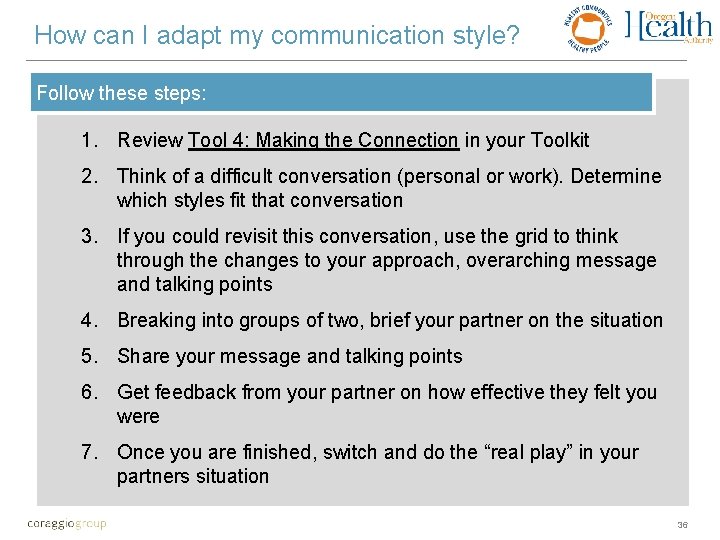
How can I adapt my communication style? Follow these steps: 1. Review Tool 4: Making the Connection in your Toolkit 2. Think of a difficult conversation (personal or work). Determine which styles fit that conversation 3. If you could revisit this conversation, use the grid to think through the changes to your approach, overarching message and talking points 4. Breaking into groups of two, brief your partner on the situation 5. Share your message and talking points 6. Get feedback from your partner on how effective they felt you were 7. Once you are finished, switch and do the “real play” in your partners situation 36
TOOL #4: Making the Connection 1. Adapting your communication style, how was this experience different? 2. What were the challenges or difficulties adapting your communication style? 1. Any insights or possible future applications related to adapting your communication style? 37
ACTION PLANNING 38
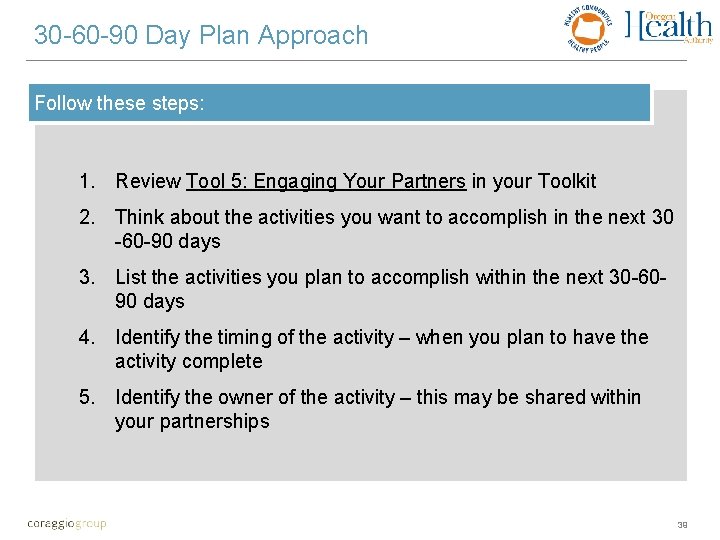
30 -60 -90 Day Plan Approach Follow these steps: 1. Review Tool 5: Engaging Your Partners in your Toolkit 2. Think about the activities you want to accomplish in the next 30 -60 -90 days 3. List the activities you plan to accomplish within the next 30 -6090 days 4. Identify the timing of the activity – when you plan to have the activity complete 5. Identify the owner of the activity – this may be shared within your partnerships 39

WRAP UP 40
3 -2 -1 REFLECTION Reflections on what I learned today 3 2 1 Specific things I learned from the day Specific new strategies / tools I can use New thing I will try in the next month 41
Thank you. For letting us help you take your next leap forward.
APPENDIX: HANDOUTS FOR EXERCISES 43
TOOL #1: Understanding Organizational Cultural Difference While there is no single "type" of organizational culture, and cultures can vary widely from one organization to the next, common elements do exist: Dominant Characteristics • Personal, like a family; entrepreneurial, risk taking; competitive, achievement oriented; controlled and structured Values • Loyalty and mutual trust; commitment to innovation, development; emphasis on achievement and goal accomplishment; formal rules and policies Leadership • Mentoring, facilitating, nurturing; entrepreneurial, innovative, risk taking; no-nonsense, aggressive, results oriented; coordinating, organizing, efficiency oriented Strategic Emphasis • Human development, high trust, openness; acquisition of resources, creating new challenges; competitive actions and winning; permanence and stability Criteria of Success • Development of human resources, teamwork, concern for people; unique and new products and services; winning in the marketplace, outpacing the competition; dependable, efficient, low cost 44
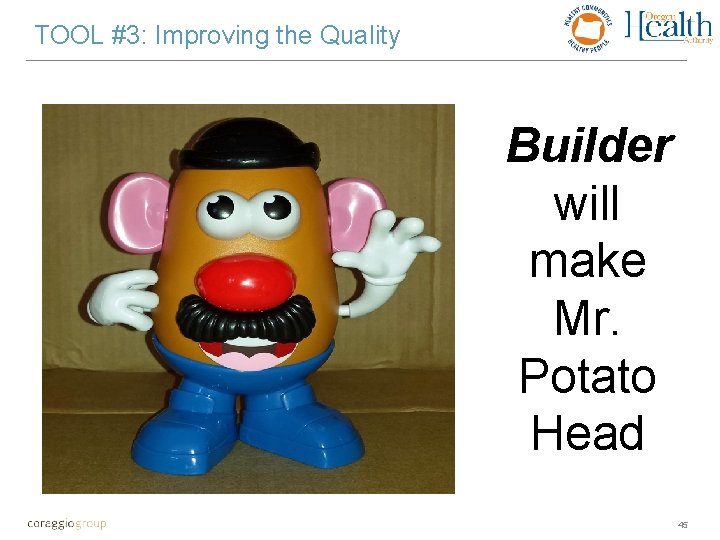
TOOL #3: Improving the Quality Builder will make Mr. Potato Head 45
TOOL #3: Improving the Quality PDSA scribe will fill out this Table 46
TOOL #3: Improving the Quality Timekeeper will time the build and record the results for each PDSA test Good 47
TOOL #3: Improving the Quality Inspector will judge the build and record the results for each PDSA test 48
- Slides: 49