
Building and Managing Successful Teams Team Decision Making

Building and Managing Successful Teams – Team Decision Making Karl A. Smith Engineering Education – Purdue University Civil Engineering - University of Minnesota ksmith@umn. edu - http: //www. ce. umn. edu/~smith/ Michigan State University College of Natural Science Workshop September 2009
Teamwork Skills • Communication • Listening and Persuading • Decision Making • Conflict Management • Leadership • Trust and Loyalty

Decision-Making Approaches Deterministic Stochastic Objective Multiple Single Ranking AHP SMART B/C LP Optimization MAUT Decision Tree (EV) Simulation

Team Decision Making – Ranking Tasks • Typically “survival” tasks – First was Moon Survival, “Lost on the moon” developed by Jay Hall for NASA in 1967 – Many survival tasks available – desert survival, lost at sea, winter survival, … • Individual followed by team ranking • Different decision-making conditions in each team
Team Member Roles • Observer/ Process Recorder • Task Recorder • Skeptic/Prober 5
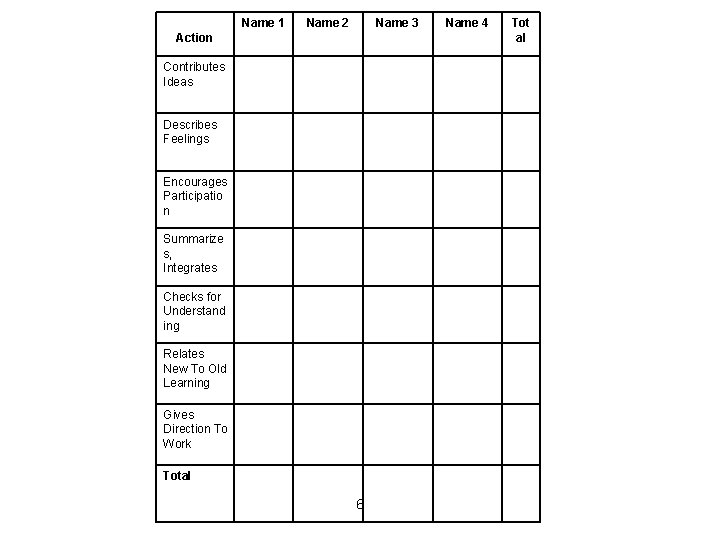
Name 1 Name 2 Name 3 Action Contributes Ideas Describes Feelings Encourages Participatio n Summarize s, Integrates Checks for Understand ing Relates New To Old Learning Gives Direction To Work Total 6 Name 4 Tot al
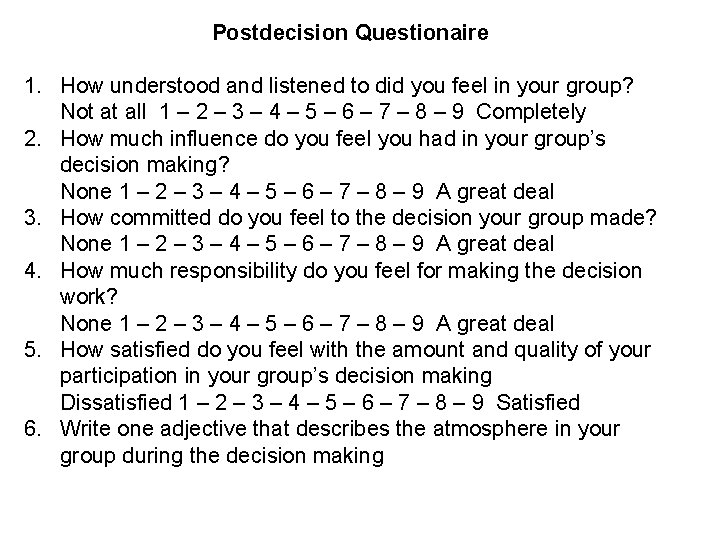
Postdecision Questionaire 1. How understood and listened to did you feel in your group? Not at all 1 – 2 – 3 – 4 – 5 – 6 – 7 – 8 – 9 Completely 2. How much influence do you feel you had in your group’s decision making? None 1 – 2 – 3 – 4 – 5 – 6 – 7 – 8 – 9 A great deal 3. How committed do you feel to the decision your group made? None 1 – 2 – 3 – 4 – 5 – 6 – 7 – 8 – 9 A great deal 4. How much responsibility do you feel for making the decision work? None 1 – 2 – 3 – 4 – 5 – 6 – 7 – 8 – 9 A great deal 5. How satisfied do you feel with the amount and quality of your participation in your group’s decision making Dissatisfied 1 – 2 – 3 – 4 – 5 – 6 – 7 – 8 – 9 Satisfied 6. Write one adjective that describes the atmosphere in your group during the decision making
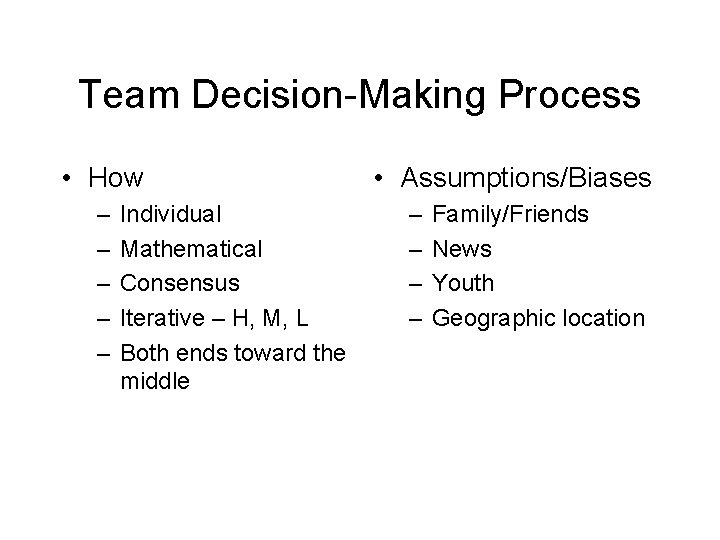
Team Decision-Making Process • How – – – Individual Mathematical Consensus Iterative – H, M, L Both ends toward the middle • Assumptions/Biases – – Family/Friends News Youth Geographic location
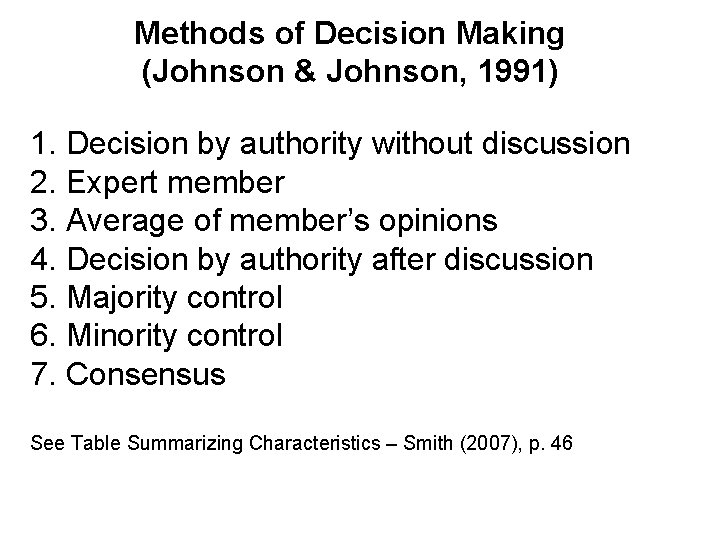
Methods of Decision Making (Johnson & Johnson, 1991) 1. Decision by authority without discussion 2. Expert member 3. Average of member’s opinions 4. Decision by authority after discussion 5. Majority control 6. Minority control 7. Consensus See Table Summarizing Characteristics – Smith (2007), p. 46
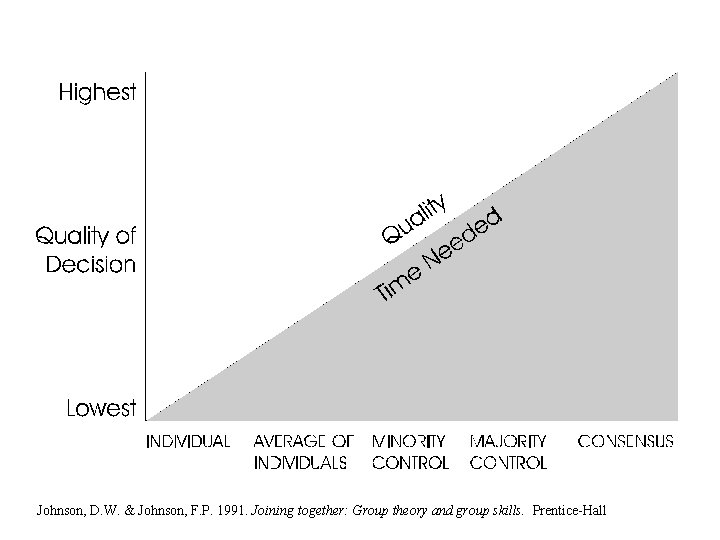
Johnson, D. W. & Johnson, F. P. 1991. Joining together: Group theory and group skills. Prentice-Hall
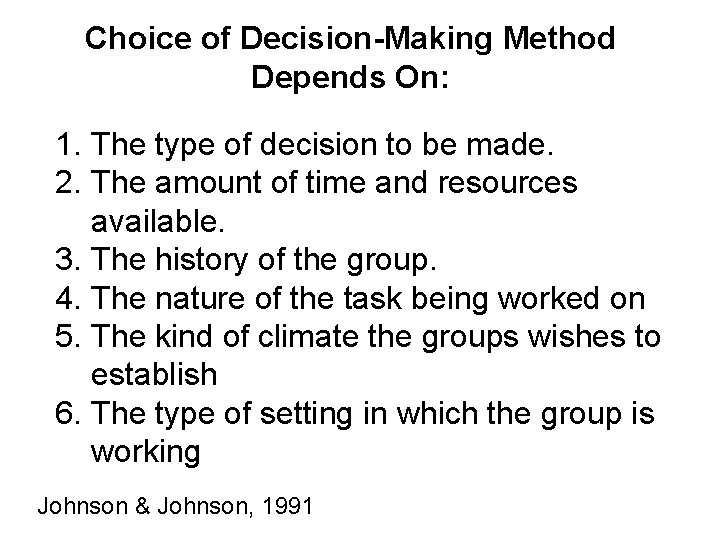
Choice of Decision-Making Method Depends On: 1. The type of decision to be made. 2. The amount of time and resources available. 3. The history of the group. 4. The nature of the task being worked on 5. The kind of climate the groups wishes to establish 6. The type of setting in which the group is working Johnson & Johnson, 1991
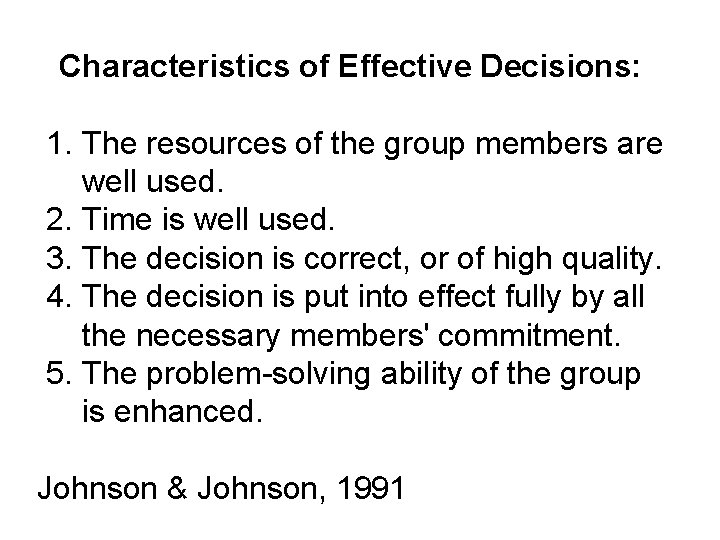
Characteristics of Effective Decisions: 1. The resources of the group members are well used. 2. Time is well used. 3. The decision is correct, or of high quality. 4. The decision is put into effect fully by all the necessary members' commitment. 5. The problem-solving ability of the group is enhanced. Johnson & Johnson, 1991

Two Approaches to Decision Making Garvin & Roberto, 2001. Harvard Business Review, 79(8), 108 -116. Advocacy Inquiry Concept of decision making A contest Collaborative problem solving Purpose of discussion Persuasion and lobbying Testing and evaluation Participants’ role Spokespeople Critical thinkers Pattern of behavior Strive to persuade others Defend your position Downplay weaknesses Present balanced arguments Remain open to alternatives Accept constructive criticism Minority views Discouraged or dismissed Cultivated and valued Outcome Winners and losers Collective ownership
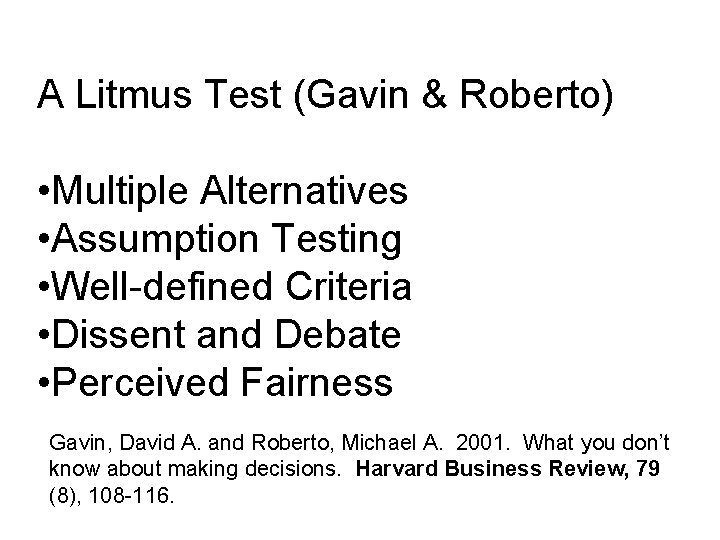
A Litmus Test (Gavin & Roberto) • Multiple Alternatives • Assumption Testing • Well-defined Criteria • Dissent and Debate • Perceived Fairness Gavin, David A. and Roberto, Michael A. 2001. What you don’t know about making decisions. Harvard Business Review, 79 (8), 108 -116.
- Slides: 14