
Building an Open Knowledge Graphs for and from
Building an Open Knowledge Graphs for and from Open Data Axel Polleres Joint work with: Sebastian Neumaier, Jürgen Umbrich Institute for Information Business. data. wu. ac. at
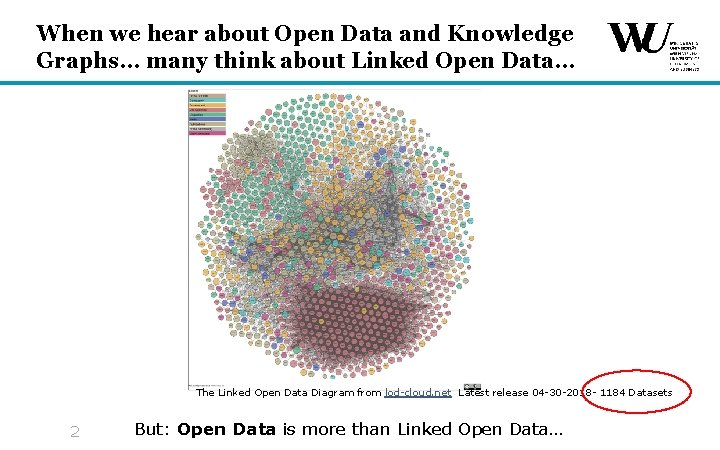
When we hear about Open Data and Knowledge Graphs… many think about Linked Open Data… The Linked Open Data Diagram from lod-cloud. net Latest release 04 -30 -2018 - 1184 Datasets 2 But: Open Data is more than Linked Open Data…
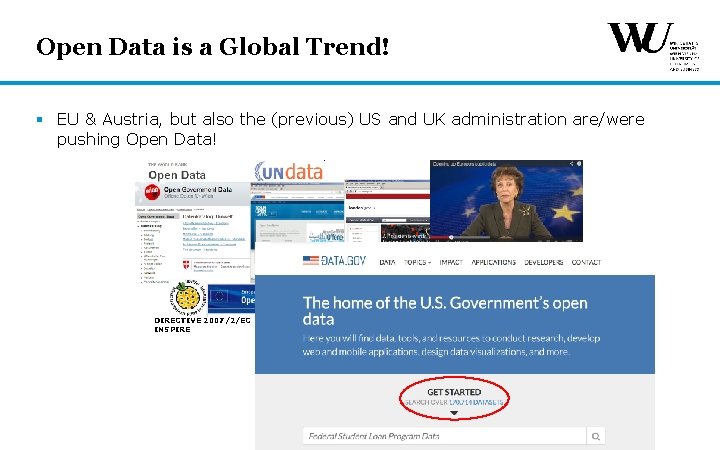
Open Data is a Global Trend! § EU & Austria, but also the (previous) US and UK administration are/were pushing Open Data! DIRECTIVE 2007/2/EC INSPIRE
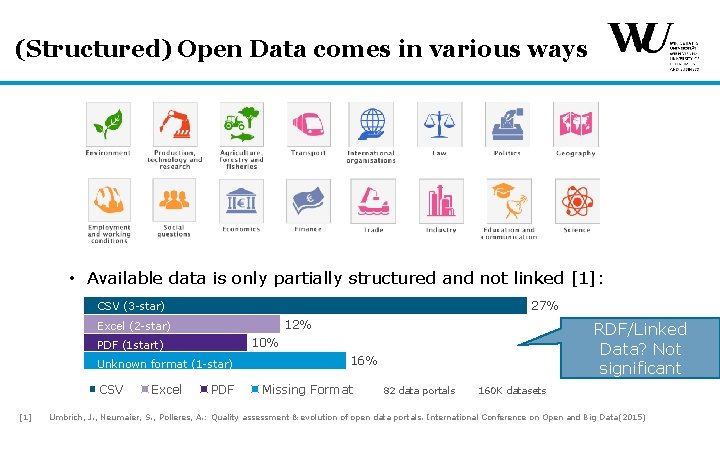
(Structured) Open Data comes in various ways • Available data is only partially structured and not linked [1]: 27% CSV (3 -star) 12% Excel (2 -star) PDF (1 start) Unknown format (1 -star) CSV [1] Excel RDF/Linked Data? Not significant 10% PDF 16% Missing Format 82 data portals 160 K datasets Umbrich, J. , Neumaier, S. , Polleres, A. : Quality assessment & evolution of open data portals. International Conference on Open and Big Data(2015)
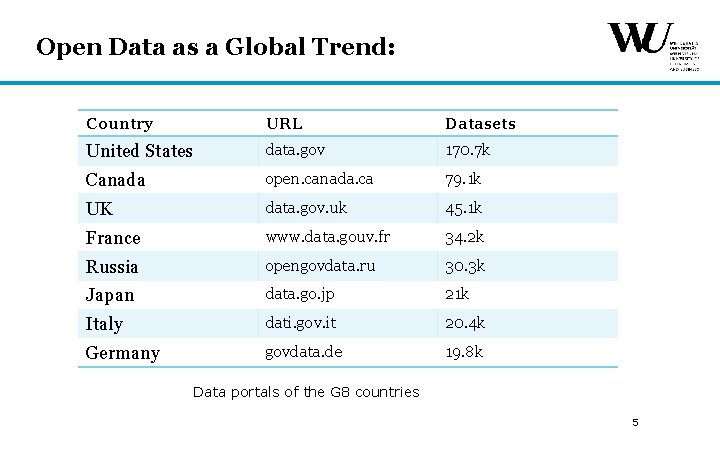
Open Data as a Global Trend: Country URL Datasets United States data. gov 170. 7 k Canada open. canada. ca 79. 1 k UK data. gov. uk 45. 1 k France www. data. gouv. fr 34. 2 k Russia opengovdata. ru 30. 3 k Japan data. go. jp 21 k Italy dati. gov. it 20. 4 k Germany govdata. de 19. 8 k Data portals of the G 8 countries 5
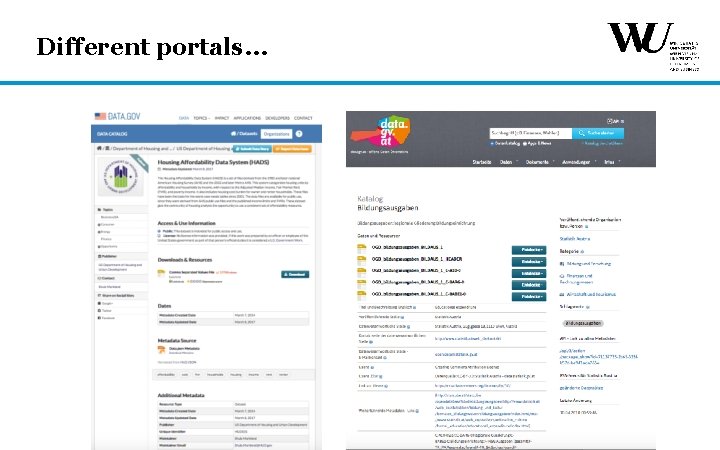
Different portals…
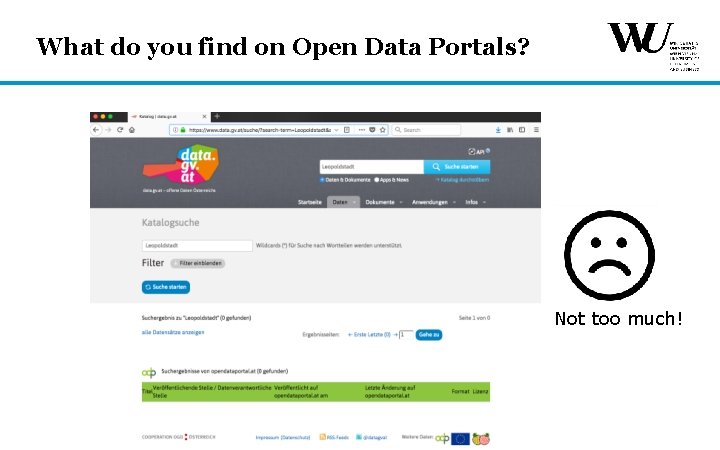
What do you find on Open Data Portals? Not too much!
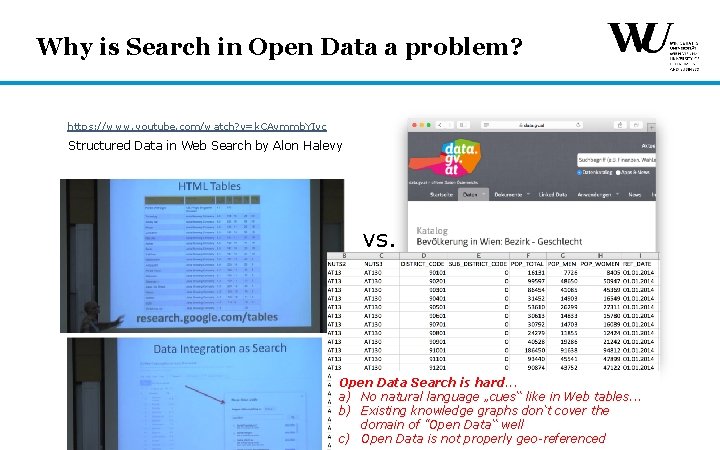
Why is Search in Open Data a problem? https: //www. youtube. com/watch? v=k. CAymmb. YIvc Structured Data in Web Search by Alon Halevy vs. Open Data Search is hard. . . a) No natural language „cues“ like in Web tables. . . b) Existing knowledge graphs don‘t cover the domain of "Open Data“ well c) Open Data is not properly geo-referenced
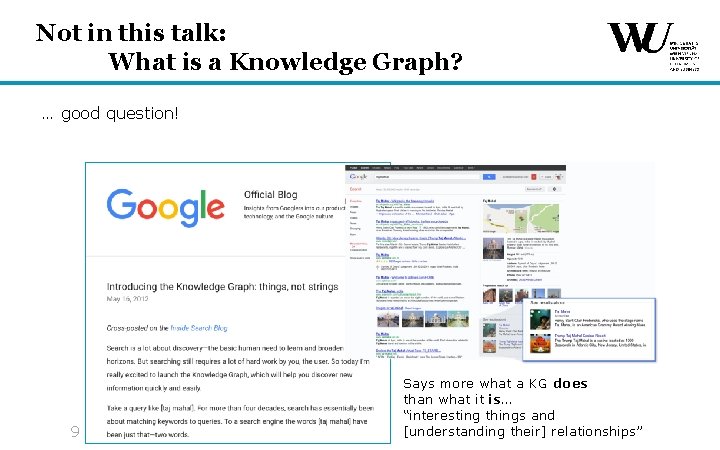
Not in this talk: What is a Knowledge Graph? … good question! 9 Says more what a KG does than what it is… “interesting things and [understanding their] relationships”
In this talk: 2 applications for Knowledge Graphs for Open Data Search! § What we do: 2 approaches how knowledge graphs could help to solve the Open Data search problem (aside the obvious): 1. Hierarchical labelling of Labeling of numeric data 2. Hierarchical labelling of Spatio-Temporal entities 10
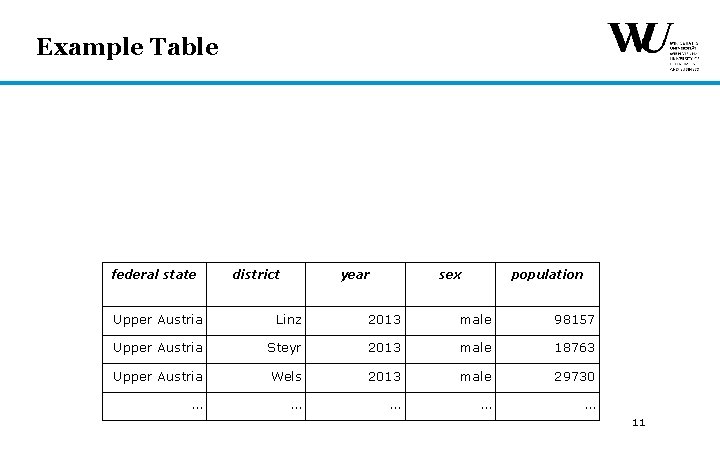
Example Table federal state district year sex population Upper Austria Linz 2013 male 98157 Upper Austria Steyr 2013 male 18763 Upper Austria Wels 2013 male 29730 … … … 11
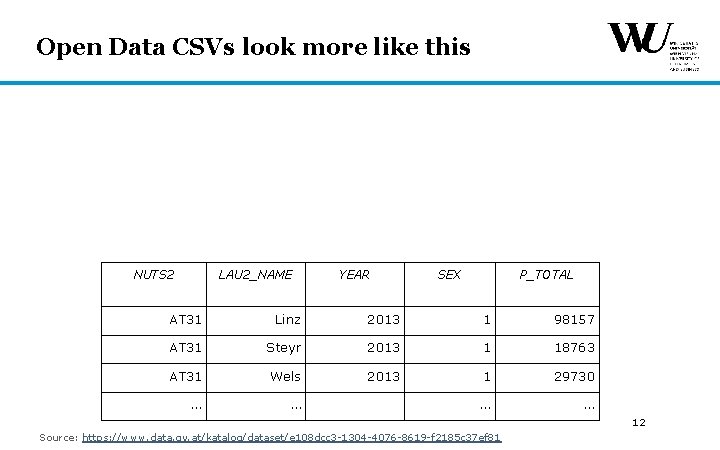
Open Data CSVs look more like this NUTS 2 LAU 2_NAME YEAR SEX P_TOTAL AT 31 Linz 2013 1 98157 AT 31 Steyr 2013 1 18763 AT 31 Wels 2013 1 29730 … … 12 Source: https: //www. data. gv. at/katalog/dataset/e 108 dcc 3 -1304 -4076 -8619 -f 2185 c 37 ef 81
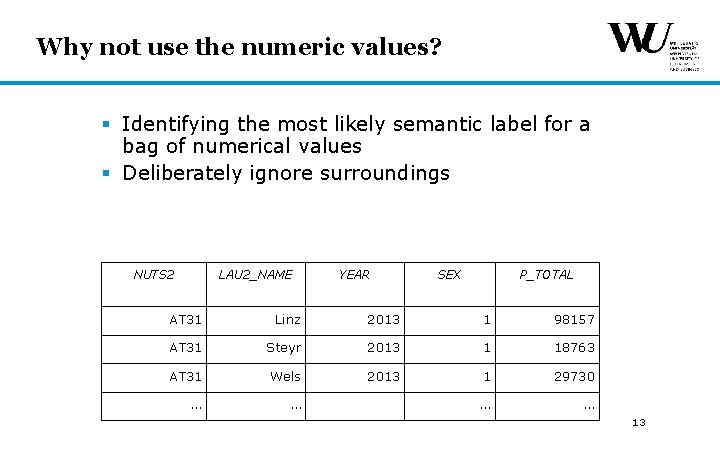
Why not use the numeric values? § Identifying the most likely semantic label for a bag of numerical values § Deliberately ignore surroundings NUTS 2 LAU 2_NAME YEAR SEX P_TOTAL AT 31 Linz 2013 1 98157 AT 31 Steyr 2013 1 18763 AT 31 Wels 2013 1 29730 … … 13
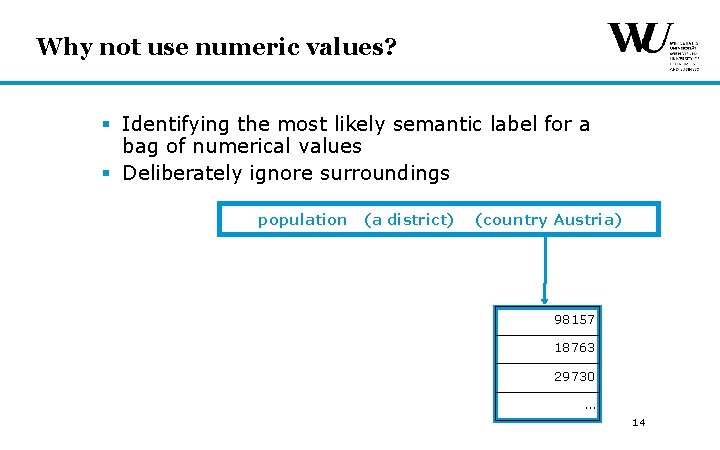
Why not use numeric values? § Identifying the most likely semantic label for a bag of numerical values § Deliberately ignore surroundings population (a district) (country Austria) 98157 18763 29730 … 14
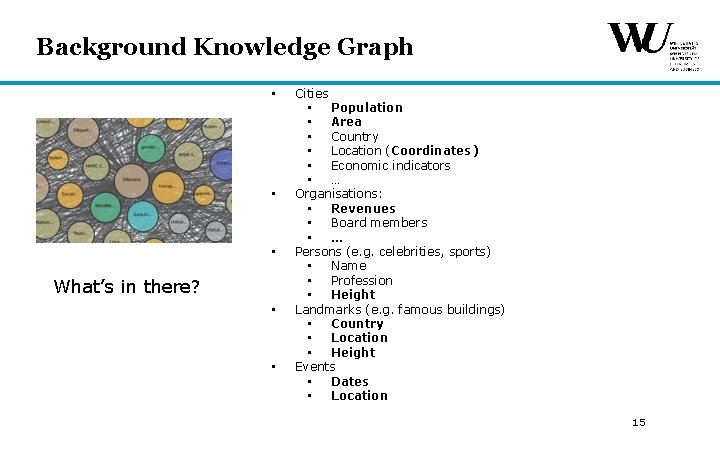
Background Knowledge Graph • • • What’s in there? • • Cities • Population • Area • Country • Location (Coordinates) • Economic indicators • … Organisations: • Revenues • Board members • … Persons (e. g. celebrities, sports) • Name • Profession • Height Landmarks (e. g. famous buildings) • Country • Location • Height Events • Dates • Location 15
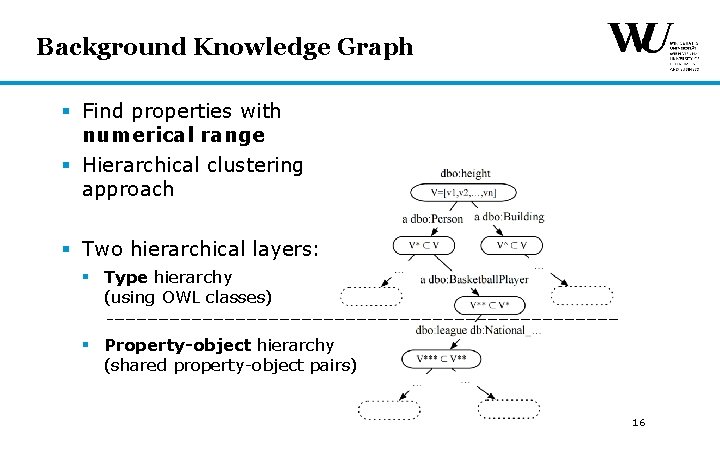
Background Knowledge Graph § Find properties with numerical range § Hierarchical clustering approach § Two hierarchical layers: § Type hierarchy (using OWL classes) § Property-object hierarchy (shared property-object pairs) 16
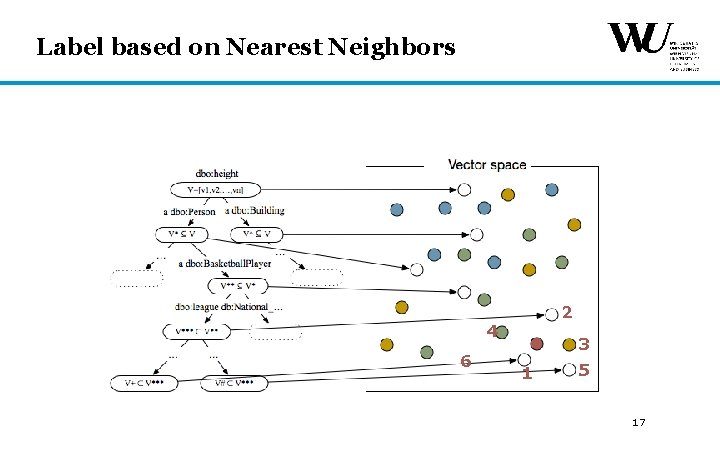
Label based on Nearest Neighbors 2 4 6 1 3 5 17
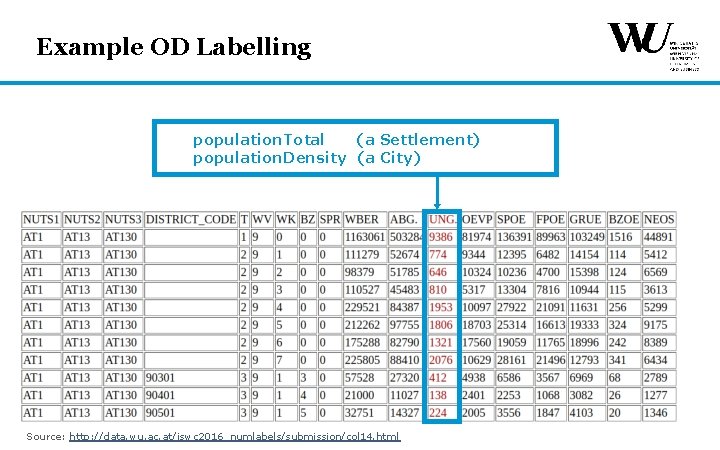
Example OD Labelling population. Total (a Settlement) population. Density (a City) 18 Source: http: //data. wu. ac. at/iswc 2016_numlabels/submission/col 14. html
Lessons learned § We can assign fine-grained semantic labels § If there is enough evidence in BK § However: Missing domain knowledge for labelling OD Future work: § Complementary to existing approaches (column header labeling, entity linking and relation extraction) § Combined approaches may improve results § Focusing on core dimensions of specific domains e. g. city data, maye more promising than “general” value labeling. 19
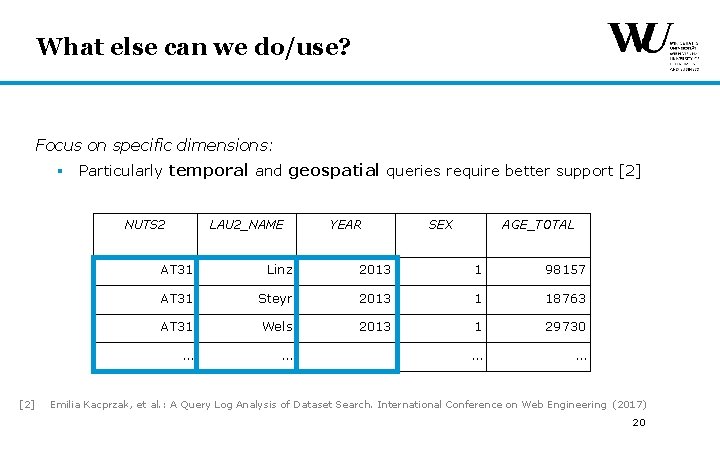
What else can we do/use? Focus on specific dimensions: § Particularly temporal and geospatial queries require better support [2] NUTS 2 [2] LAU 2_NAME YEAR SEX AGE_TOTAL AT 31 Linz 2013 1 98157 AT 31 Steyr 2013 1 18763 AT 31 Wels 2013 1 29730 … … Emilia Kacprzak, et al. : A Query Log Analysis of Dataset Search. International Conference on Web Engineering (2017) 20
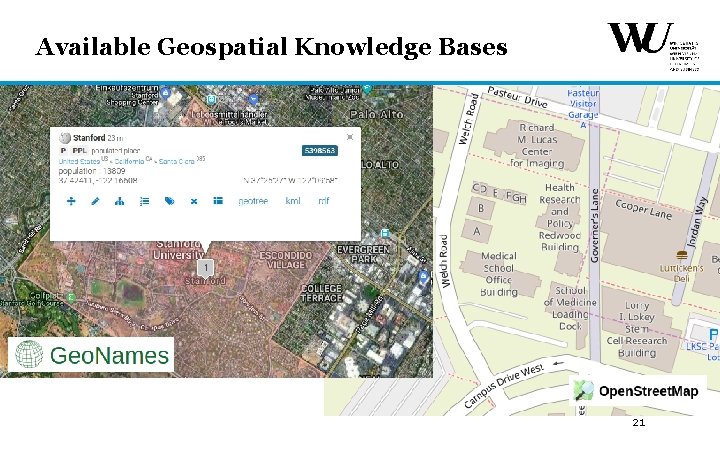
Available Geospatial Knowledge Bases 21
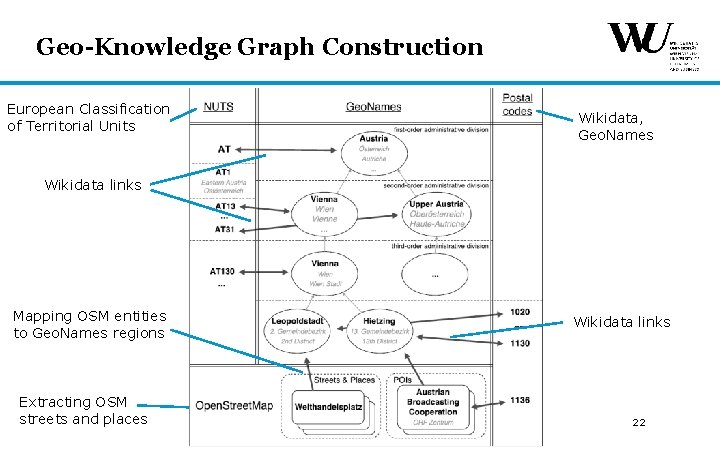
Geo-Knowledge Graph Construction European Classification of Territorial Units Wikidata, Geo. Names Wikidata links Mapping OSM entities to Geo. Names regions Extracting OSM streets and places Wikidata links 22
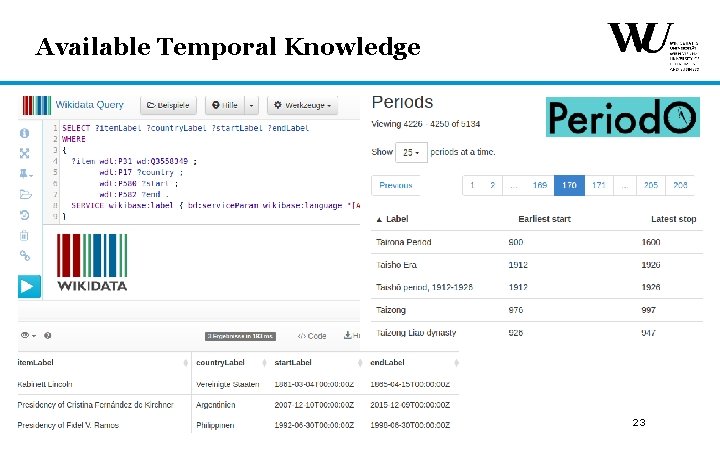
Available Temporal Knowledge 23
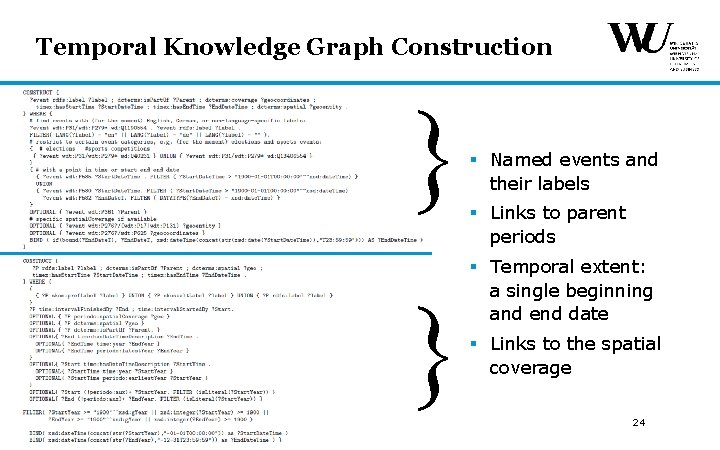
Temporal Knowledge Graph Construction § Named events and their labels § Links to parent periods § Temporal extent: a single beginning and end date § Links to the spatial coverage 24
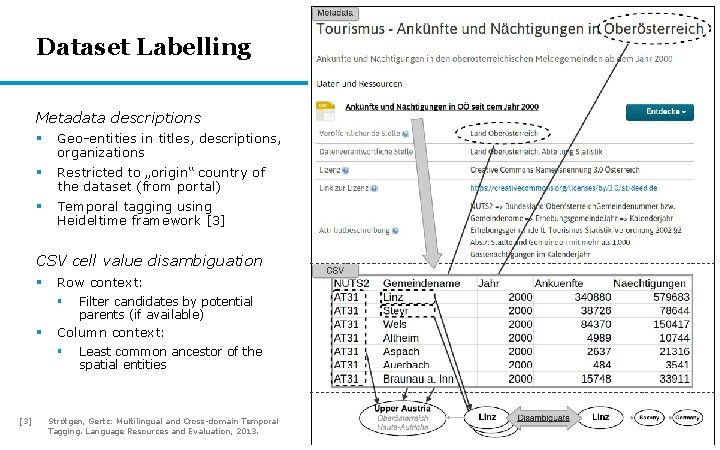
Dataset Labelling Metadata descriptions § Geo-entities in titles, descriptions, organizations § Restricted to „origin“ country of the dataset (from portal) § Temporal tagging using Heideltime framework [3] CSV cell value disambiguation § Row context: § Filter candidates by potential parents (if available) § Column context: § Least common ancestor of the spatial entities [3] Strötgen, Gertz: Multilingual and Cross-domain Temporal Tagging. Language Resources and Evaluation, 2013. 25
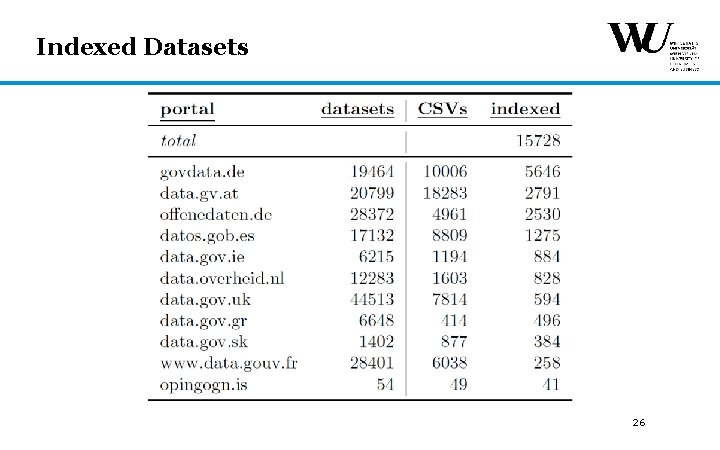
Indexed Datasets 26
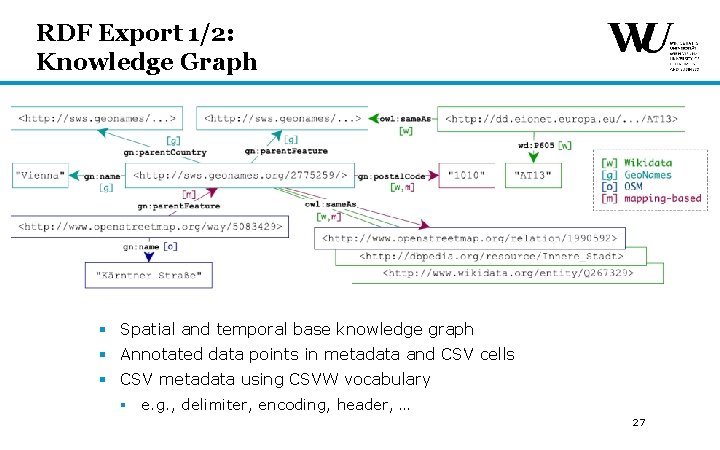
RDF Export 1/2: Knowledge Graph § Spatial and temporal base knowledge graph § Annotated data points in metadata and CSV cells § CSV metadata using CSVW vocabulary § e. g. , delimiter, encoding, header, … 27
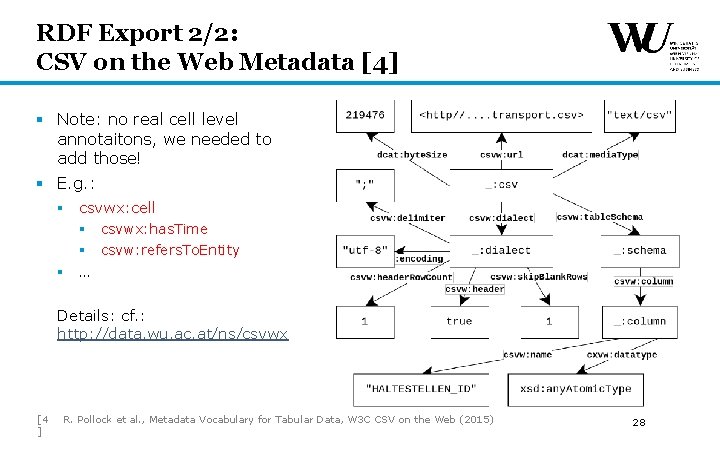
RDF Export 2/2: CSV on the Web Metadata [4] § Note: no real cell level annotaitons, we needed to add those! § E. g. : § csvwx: cell § § csvwx: has. Time csvw: refers. To. Entity § … Details: cf. : http: //data. wu. ac. at/ns/csvwx [4 ] R. Pollock et al. , Metadata Vocabulary for Tabular Data, W 3 C CSV on the Web (2015) 28
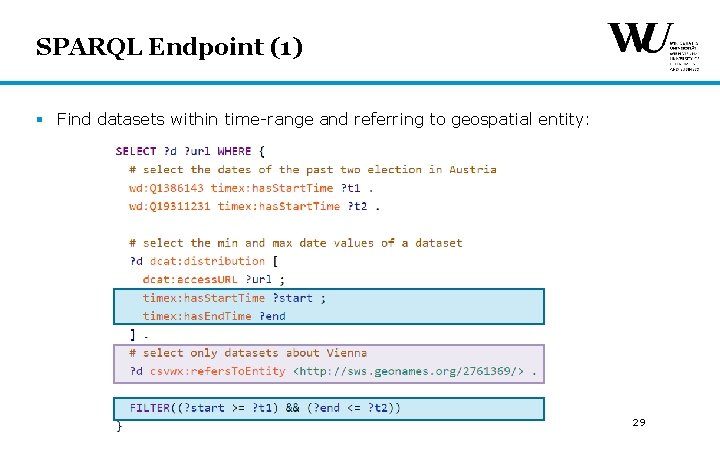
SPARQL Endpoint (1) § Find datasets within time-range and referring to geospatial entity: 29
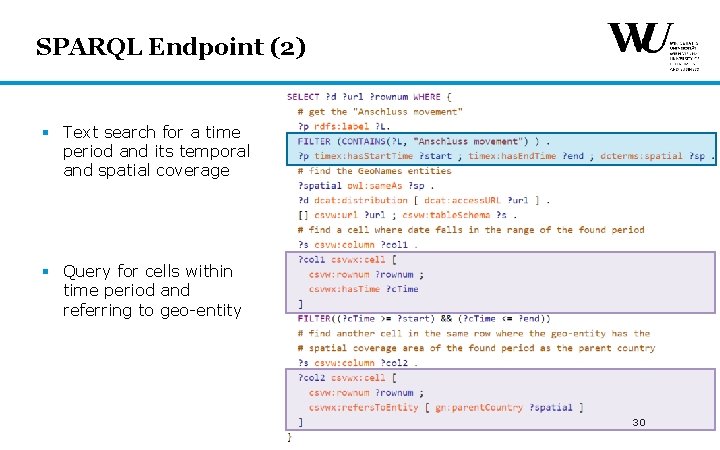
SPARQL Endpoint (2) § Text search for a time period and its temporal and spatial coverage § Query for cells within time period and referring to geo-entity 30
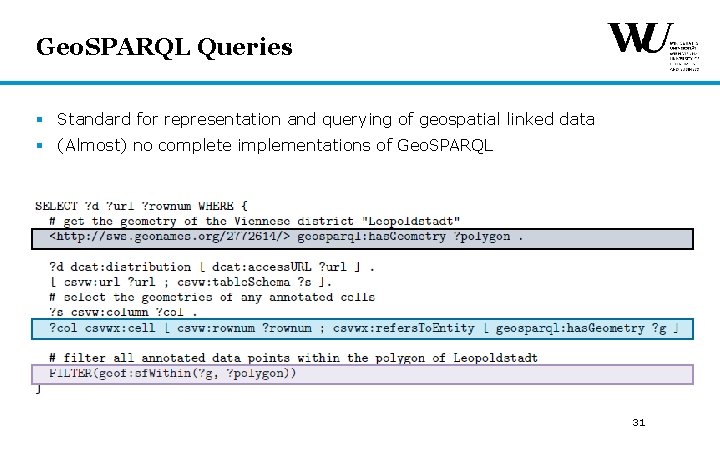
Geo. SPARQL Queries § Standard for representation and querying of geospatial linked data § (Almost) no complete implementations of Geo. SPARQL 31
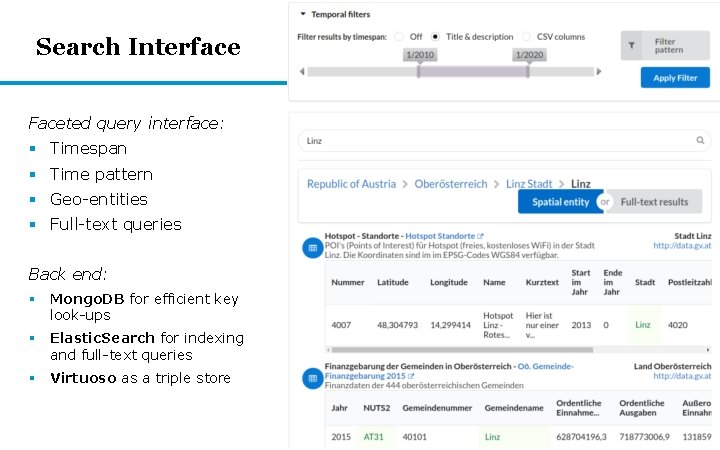
Search Interface Faceted query interface: § Timespan § Time pattern § Geo-entities § Full-text queries Back end: § Mongo. DB for efficient key look-ups § Elastic. Search for indexing and full-text queries § Virtuoso as a triple store 32
Conclusions & Outlook § Open (Structured) Data is a rich source of Knowledge worthwhile to tap into § Most of it is not (yet) Linked Data. What we did: § Hierarchical knowledge graph of spatial and temporal entities § Algorithms to annotate CSV tables and their metadata descriptions What‘s next: § Enable Geo. SPARQL (or an alternative geospatial-query language) § Parsing coordinates in datasets § Parse other file fomats, e. g. , XML, PDF, … § Test other domains such as tweets or web pages (e. g. , newspaper articles) 33
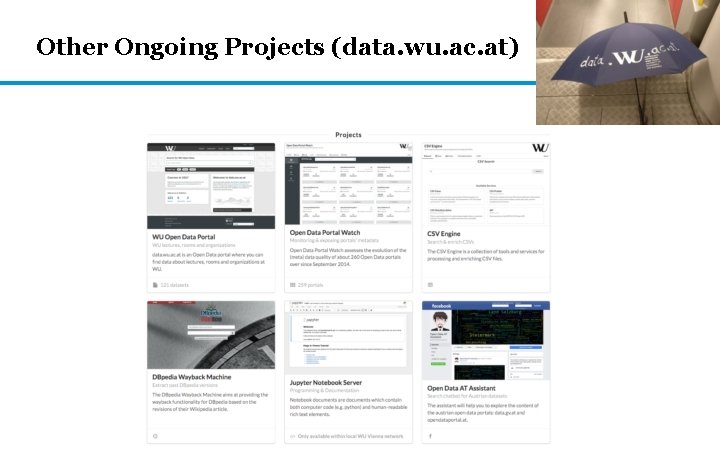
Other Ongoing Projects (data. wu. ac. at)
What else are we working on? § Open Data Portalwatch § 1) Monitoring Metadata quality § 2) Mapping to standard vocabularies § 3) Enriching Metadata to improve search (talked about that already)
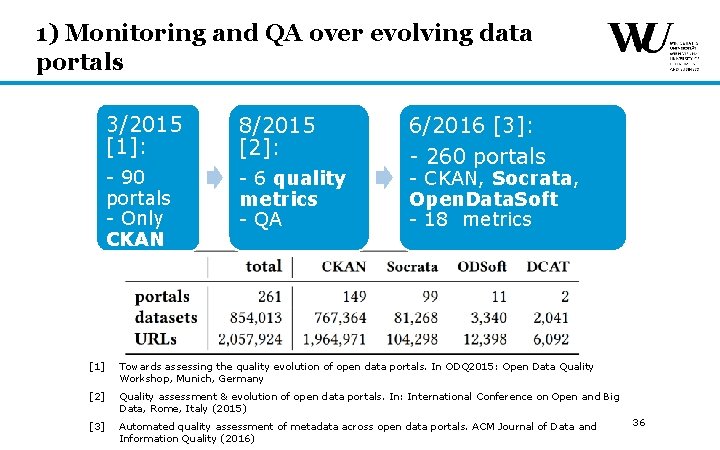
1) Monitoring and QA over evolving data portals 3/2015 [1]: 8/2015 [2]: 6/2016 [3]: - 90 portals - Only CKAN - 6 quality metrics - QA - CKAN, Socrata, Open. Data. Soft - 18 metrics - 260 portals [1] Towards assessing the quality evolution of open data portals. In ODQ 2015: Open Data Quality Workshop, Munich, Germany [2] Quality assessment & evolution of open data portals. In: International Conference on Open and Big Data, Rome, Italy (2015) [3] Automated quality assessment of metadata across open data portals. ACM Journal of Data and Information Quality (2016) 36
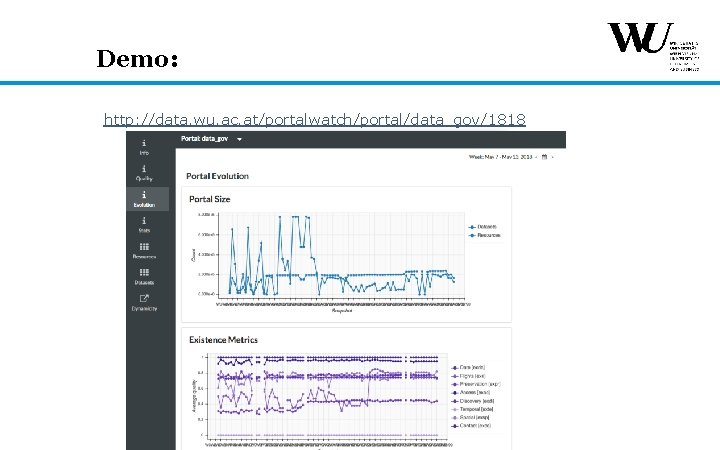
Demo: http: //data. wu. ac. at/portalwatch/portal/data_gov/1818
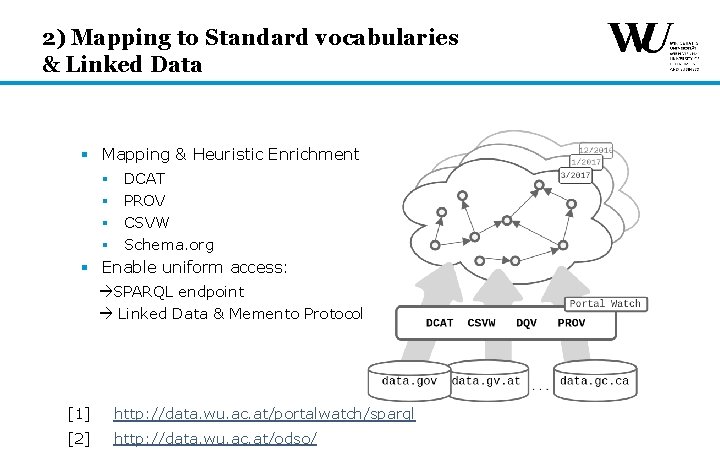
2) Mapping to Standard vocabularies & Linked Data § Mapping & Heuristic Enrichment § DCAT § PROV § CSVW § Schema. org § Enable uniform access: SPARQL endpoint Linked Data & Memento Protocol [1] http: //data. wu. ac. at/portalwatch/sparql [2] http: //data. wu. ac. at/odso/
Backup Slides 39
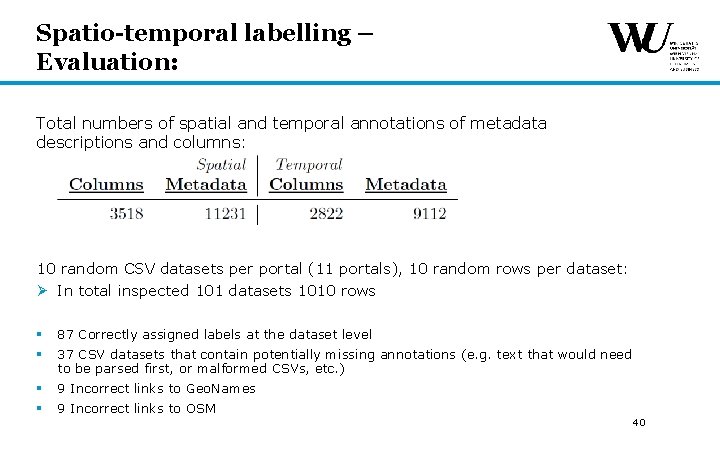
Spatio-temporal labelling – Evaluation: Total numbers of spatial and temporal annotations of metadata descriptions and columns: 10 random CSV datasets per portal (11 portals), 10 random rows per dataset: Ø In total inspected 101 datasets 1010 rows § § 87 Correctly assigned labels at the dataset level § § 9 Incorrect links to Geo. Names 37 CSV datasets that contain potentially missing annotations (e. g. text that would need to be parsed first, or malformed CSVs, etc. ) 9 Incorrect links to OSM 40
- Slides: 40