
Building an Effective Team Reference B OKeefe TEAMWORKS
Building an Effective Team Reference: B. O’Keefe, TEAMWORKS: Skills for Collaborative Work, University of Illinois, http: //www. vta. spcomm. uiuc. edu/ (etc)
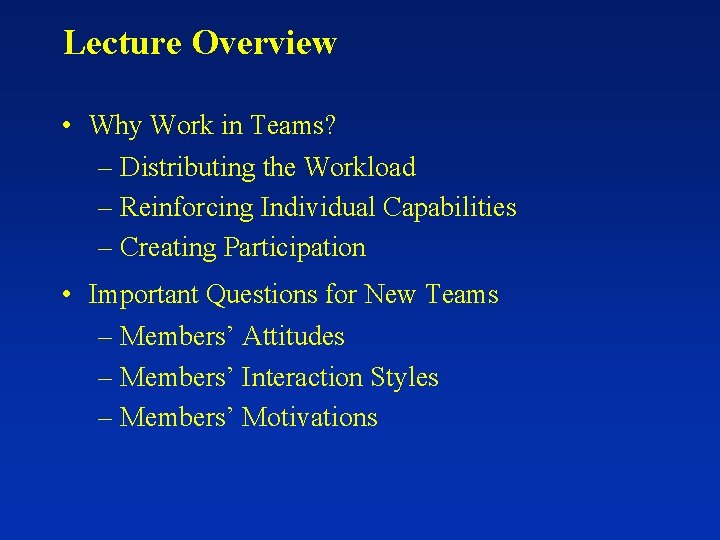
Lecture Overview • Why Work in Teams? – Distributing the Workload – Reinforcing Individual Capabilities – Creating Participation • Important Questions for New Teams – Members’ Attitudes – Members’ Interaction Styles – Members’ Motivations

Why Work in Teams? • 1 - Distributing the Workload – Project is too big for one person – Need simple numbers of people • 2 - Reinforcing Individual Capabilities – Project is too complex for one person – Need a wider range of skills than one person has • 3 - Creating Involvement – Project is too important for one person – Need a whole group to be committed to the result
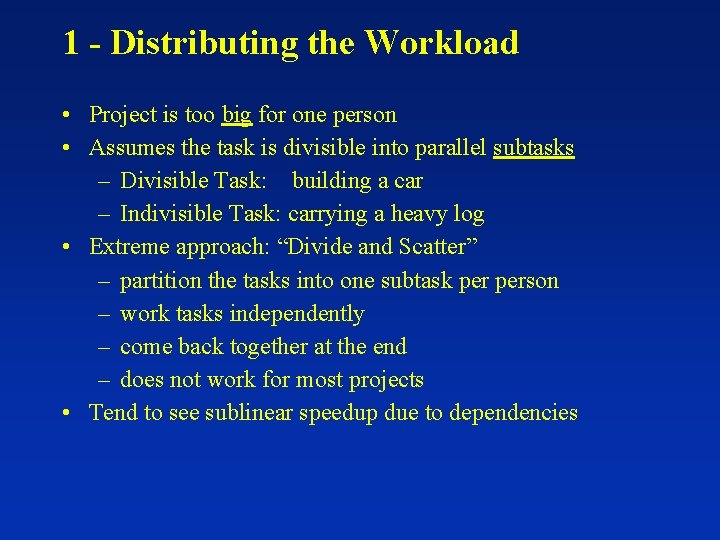
1 - Distributing the Workload • Project is too big for one person • Assumes the task is divisible into parallel subtasks – Divisible Task: building a car – Indivisible Task: carrying a heavy log • Extreme approach: “Divide and Scatter” – partition the tasks into one subtask person – work tasks independently – come back together at the end – does not work for most projects • Tend to see sublinear speedup due to dependencies
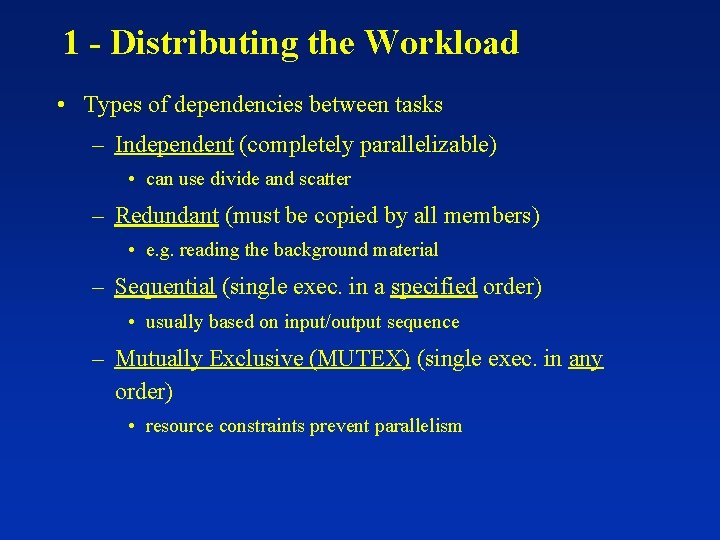
1 - Distributing the Workload • Types of dependencies between tasks – Independent (completely parallelizable) • can use divide and scatter – Redundant (must be copied by all members) • e. g. reading the background material – Sequential (single exec. in a specified order) • usually based on input/output sequence – Mutually Exclusive (MUTEX) (single exec. in any order) • resource constraints prevent parallelism
1 - Distributing the Workload • Precedence Graphs – Independent – Redundant – Sequential – MUTEX – Hierarchical Dependencies
Team Building Activity: Divisible & Independent Tasks

2 - Reinforcing Individual Capabilities • Task is too complex for one person’s skill set – Requires diversity in abilities – Different members contribute different strengths – True multidisciplinary team = team in which no one person can accomplish the task alone (ABET) • Relevant skills may be personal as well as technical – writing skill – speaking skill – analytical vs. practical skills
2 - Reinforcing Individual Capabilities • Need to Identify and State Goals – team goals – individual goals • Inventory of Resources – individual strengths & interests – individual weaknesses & disinterests • Comment on diversity – Your best friend may make a lousy team member – The two of you are too much alike
Team Building Exercise : Clarifying Project Expectations
3. Creating Participation • Sometimes group “ownership” is important • Get group involved in a decision – even though a single person decision may be easier • If choice is obvious, then it will probably be the same • If not obvious, then contributions will be valuable • Either way: – Members all understand the thought behind decision – They are less likely to complain later
Important Questions for New Teams • What is each members’ attitude toward teaming? – Maybe some dislike teams completely? • How do members’ Interaction styles differ? – What is their individual focus? – How do they react to a group? • What motivates each individual? – What does this person really want? – What motivation will he/she respond to?
Attitude Toward Teams • Read The Statements Below • Rate Each item as: – 4 = strongly agree – 3 = agree – 2 = undecided or 50/50 – 1 = disagree – 0 = strongly disagree
Attitude Toward Teams – I enjoy working in teams – I often do work in teams – Group decision making is important to organizations – I prefer to work in a group rather than alone – I am comfortable in leadership roles – When working in a group I usually participate actively – I like being evaluated based on the group’s work – I am good at reading other people – I have important things to say when I am in a group

Interaction Styles • Two different ways of interacting – 1. Is the person more: • task oriented - focused on the job and the results? • People oriented - focused on relationships? – 2. Is the person more of a: • Thinker - always thinking of the big picture • Doer - wants to be given a task to accomplish • Team needs some of each to complement each other

What Motivates an Individual? • Everybody is motivated by different things – some are self-motivated – some need a kick in the pants (figuratively) • It helps to identify what motivates each individual – no one technique works for everyone – need several different carrots – and several different sticks
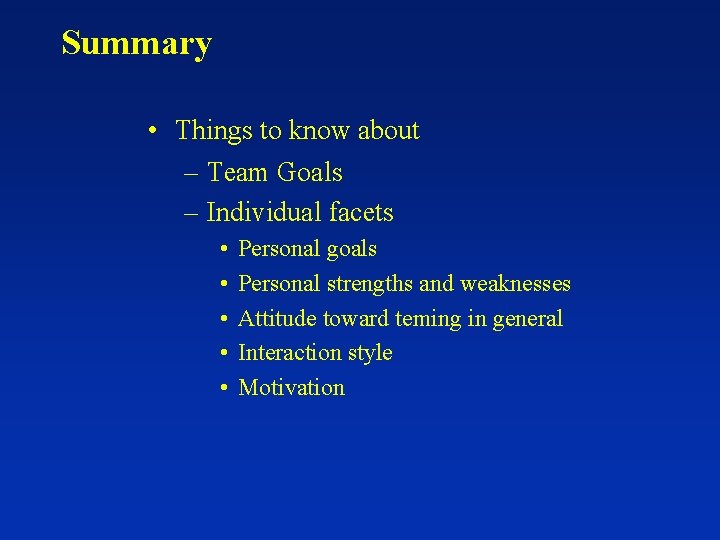
Summary • Things to know about – Team Goals – Individual facets • • • Personal goals Personal strengths and weaknesses Attitude toward teming in general Interaction style Motivation
- Slides: 17