
Building a world class careers system in Norway

Building a world class careers system in Norway Professor Tristram Hooley Inland Norway University of Applied Sciences Presentation in Bergen 02/01/2018 & 03/01/2018
This presentation will offer • A summary of the international evidence, policy and practice around career development. • Ideas that can be employed in the development of the Norwegian system. • A discussion of how we have implemented this in England.
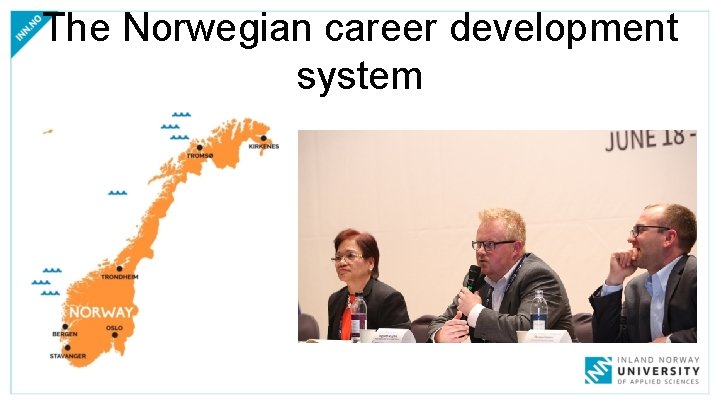
The Norwegian career development system

Career deals with complexity We are always changing. The world and the labour market are always changing. Career the relationship between the two.
Defining career guidance “Career guidance supports individuals and groups to discover more about work, leisure and learning and to consider their place in the world and plan for their futures… Career guidance can take a wide range of forms and draws on diverse theoretical traditions. But at its heart it is a purposeful learning opportunity which supports individuals and groups to consider and reconsider work, leisure and learning in the light of new information and experiences and to take both individual and collective action as a result of this. ”
An international policy area • • 55 national reviews of career guidance systems. Policy and practice exist in many more countries. During the late 1990 s and early 2000 s there were a number of large scale cross national studies conducted by OECD, EU, World Bank, ILO etc. which drew out key themes in policy and practice.
Themes in the international reviews Career guidance is strongest in Europe and the English speaking world. It is weakest in the developing world and in countries with weak democratic structures and large informal labour markets. Career guidance is best organised as a lifelong system, but in most places it mainly exists in silos within the education system. While a small private sector exists in many of these countries – the majority of funding comes from the public sector. Responsibility for career guidance is typically spread across a range of ministries. This weakens it as a policy area.
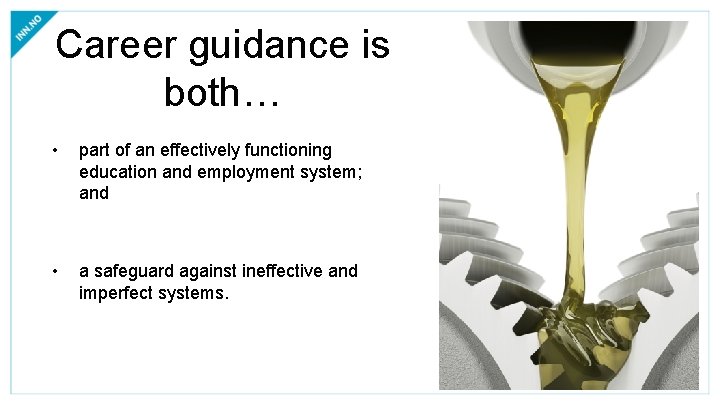
Career guidance is both… • part of an effectively functioning education and employment system; and • a safeguard against ineffective and imperfect systems.
Career guidance as a ‘nudging’ intervention
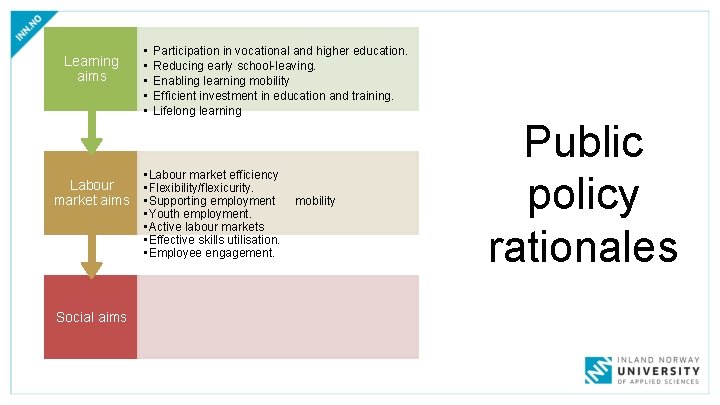
Learning aims Labour market aims Social aims • • • Participation in vocational and higher education. Reducing early school-leaving. Enabling learning mobility Efficient investment in education and training. Lifelong learning • Labour market efficiency • Flexibility/flexicurity. • Supporting employment • Youth employment. • Active labour markets • Effective skills utilisation. • Employee engagement. mobility Public policy rationales
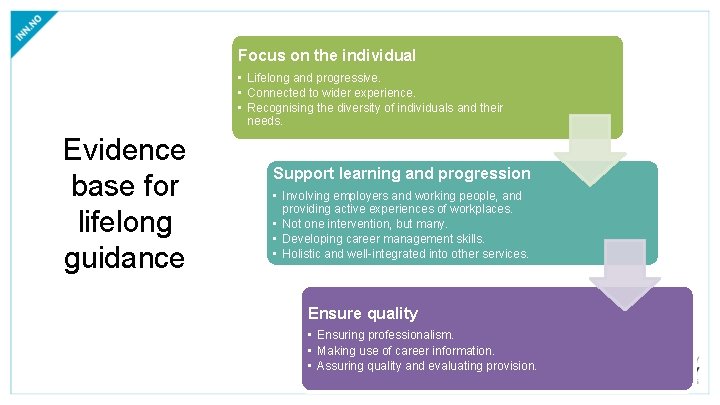
Focus on the individual • Lifelong and progressive. • Connected to wider experience. • Recognising the diversity of individuals and their needs. Evidence base for lifelong guidance Support learning and progression • Involving employers and working people, and providing active experiences of workplaces. • Not one intervention, but many. • Developing career management skills. • Holistic and well-integrated into other services. Ensure quality • Ensuring professionalism. • Making use of career information. • Assuring quality and evaluating provision.
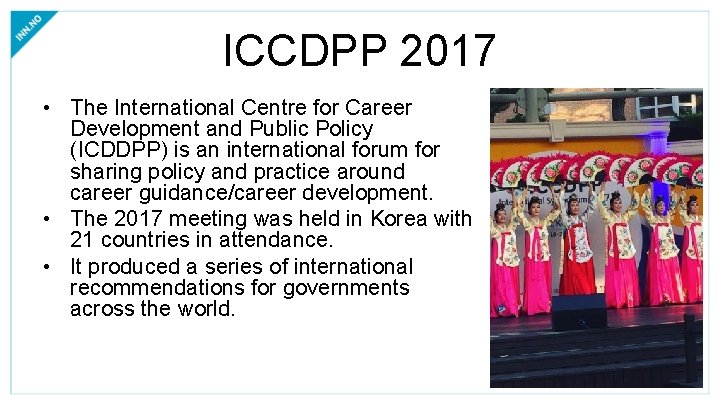
ICCDPP 2017 • The International Centre for Career Development and Public Policy (ICDDPP) is an international forum for sharing policy and practice around career guidance/career development. • The 2017 meeting was held in Korea with 21 countries in attendance. • It produced a series of international recommendations for governments across the world.
The way that work is organised is changing, so… Build a national, cross-sectoral, career development strategy. Recognise that individuals’ careers pass through the jurisdictions of a range of government departments. Involve employers in building career development systems. Widen access to career development services. Organise career development on a lifelong basis.
To make sure that your careers programmes are relevant and effective… Involve key stakeholders (parents, employers, educators and citizens) in the design and delivery of career development programmes and services. Ensure individuals have access to work experience and workrelated learning. Provide good quality labour market information (LMI). Make use of technology. Support employers to provide career development services for their staff. Base policies and practice in evidence.
Career development is dependent on professionalism, so… Involve stakeholders in the design and delivery of career professional training and development. Actively support professionalism. Develop approaches for effective inter-professional working. Ensure high quality initial training. Support the development of professional associations. Recognise the need for ongoing professional development.
Build career development skills through engagement with career guidance, so… • Clearly define career development skills. • Create a common conversation around career development skills. • Integrate career development skills into the education and employment systems. • Actively support advocacy by career professionals for the use of career development skills.
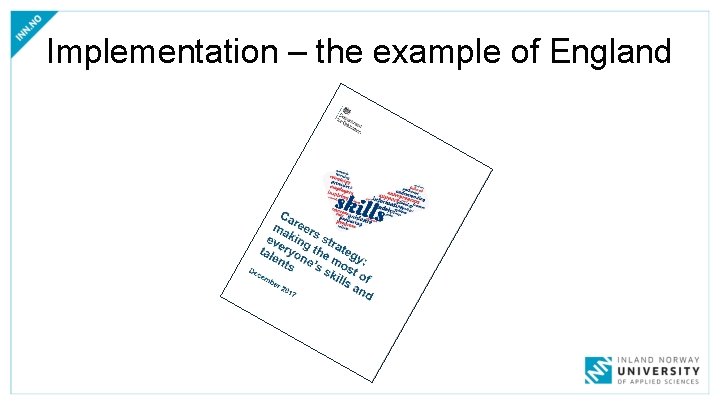
Implementation – the example of England
Good career guidance • Summarises existing evidence and frames them as eight benchmarks. • Presents it in a way that can be understood by policy makers and acted on by school leaders. • Has achieved wide support amongst policy actors and practitioners alike.
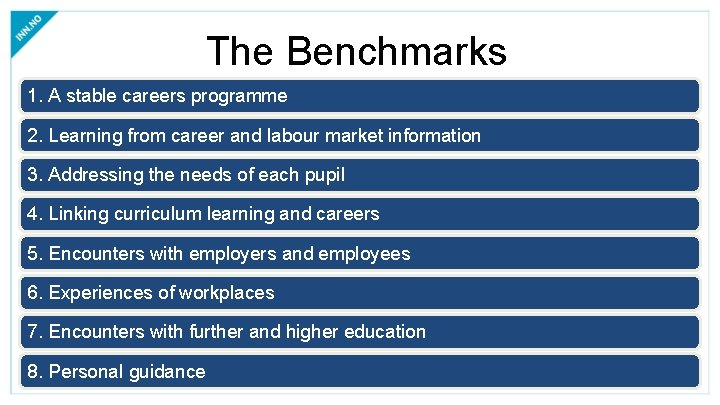
The Benchmarks 1. A stable careers programme 2. Learning from career and labour market information 3. Addressing the needs of each pupil 4. Linking curriculum learning and careers 5. Encounters with employers and employees 6. Experiences of workplaces 7. Encounters with further and higher education 8. Personal guidance
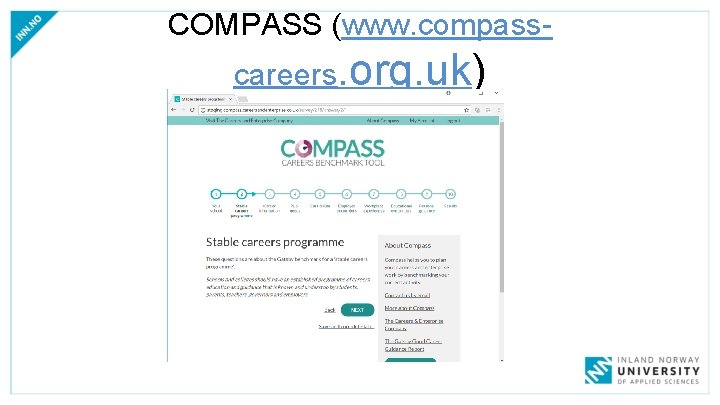
COMPASS (www. compasscareers. org. uk)
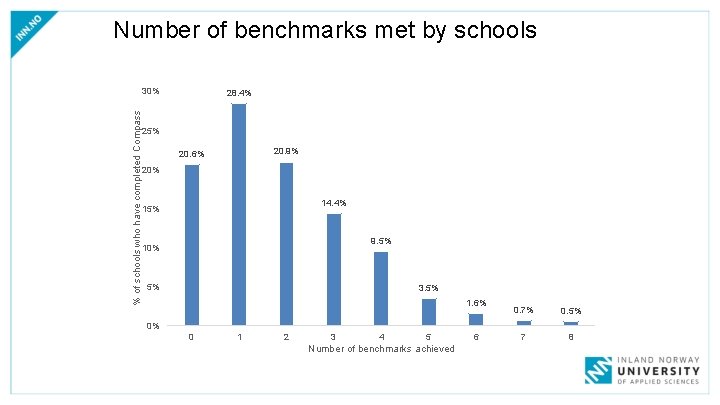
Number of benchmarks met by schools % of schools who have completed Compass 30% 28. 4% 25% 20. 9% 20. 6% 20% 14. 4% 15% 9. 5% 10% 5% 3. 5% 1. 6% 0. 7% 0. 5% 7 8 0% 0 1 2 3 4 5 Number of benchmarks achieved 6
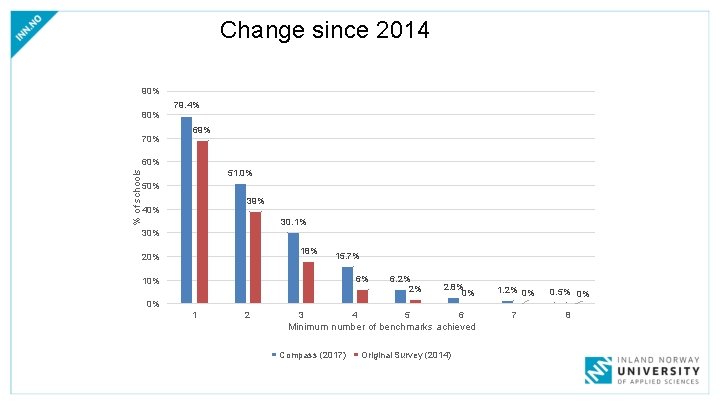
Change since 2014 90% 80% 79. 4% 69% % of schools 60% 51. 0% 50% 39% 40% 30. 1% 30% 18% 20% 15. 7% 6% 10% 6. 2% 2% 2. 8% 0% 1. 2% 0% 0. 5% 0% 6 7 8 0% 1 2 3 4 5 Minimum number of benchmarks achieved Compass (2017) Original Survey (2014)
What works?
References • • • Department for Education. (2017). Careers Strategy: Making the Most of Everyone’s Skills and Talents. London: Department for Education. Hooley, T. (2014). The Evidence Base on Lifelong Guidance. Jyväskylä, Finland: European Lifelong Guidance Policy Network. Hooley, T. , Sultana, R. G. and Thomsen, R. (2017). The neoliberal challenge to career guidance mobilising research, policy and practice around social justice. In Hooley, T. , Sultana, R. G. and Thomsen, R. (Eds. ) Career guidance for social justice: Contesting neoliberalism. London: Routledge. International Centre for Career Development and Public Policy. (2017). Communique 2017. Seoul: Krivet. Gatsby Charitable Foundation. (2014). Good Career Guidance. London: Gatsby Charitable Foundation. • The Careers & Enterprise Company. (2017). State of the Nation 2017. London: The Careers & Enterprise Company. • What works and other research publications are available from https: //www. careersandenterprise. co. uk/research/publications
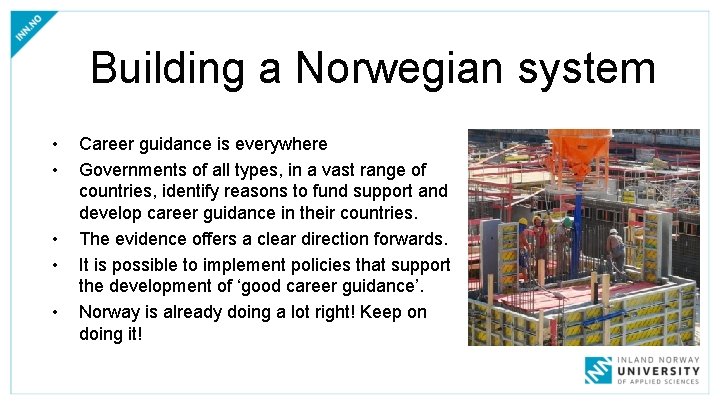
Building a Norwegian system • • • Career guidance is everywhere Governments of all types, in a vast range of countries, identify reasons to fund support and develop career guidance in their countries. The evidence offers a clear direction forwards. It is possible to implement policies that support the development of ‘good career guidance’. Norway is already doing a lot right! Keep on doing it!
Tristram Hooley Director of Research, The Careers & Enterprise Company /Professor of Career Education, University of Derby / Professor II, Inland Norway University of Applied Sciences Email: thooley@careersandenterprise. co. uk Twitter: @pigironjoe Blog: http: //adventuresincareerdevelopment. wordpress. com
- Slides: 27