
Building a Sustainable Web of Community Networks through
Building a Sustainable Web of Community Networks through Service-Learning Initiatives: A Conceptual Framework Leigh Gilchrist, Ed. D. Vanderbilt University Liz Aleman, M. Ed. Monroe Carell Jr. Children’s Hospital at Vanderbilt University Sharon Shields, Ph. D. Vanderbilt University
Agenda Are you hanging by a thread or creating a web? The Thread: Traditional University-Community Partnerships Case Example: Community Food Audits Service-Learning Project The Spinner: Theoretical Foundations The Web: Case Example – HOD 2510 Health & Human Services in Diverse Populations Service-Learning Project Evolution Discussion The Weaver: Creating Your Community Web Community Replication Future Research & Practice Recommendations
THE THREAD Traditional University-Community Partnerships
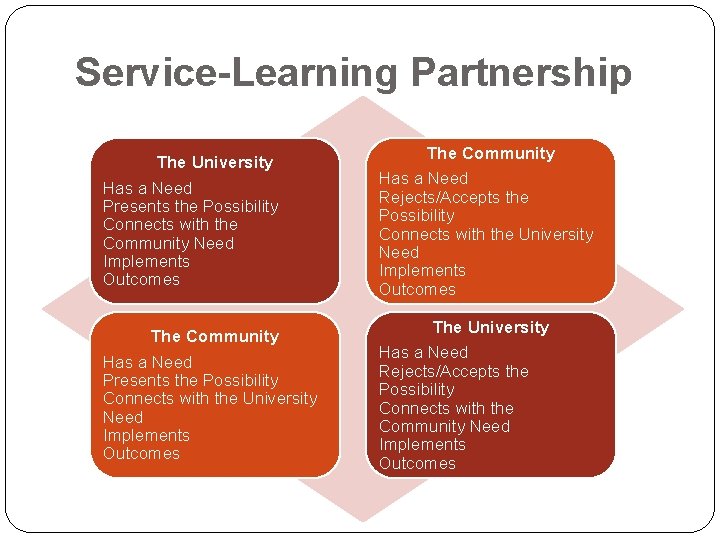
Service-Learning Partnership The University Has a Need Presents the Possibility Connects with the Community Need Implements Outcomes The Community Has a Need Rejects/Accepts the Possibility Connects with the University Need Implements Outcomes The Community Has a Need Presents the Possibility Connects with the University Need Implements Outcomes The University Has a Need Rejects/Accepts the Possibility Connects with the Community Need Implements Outcomes
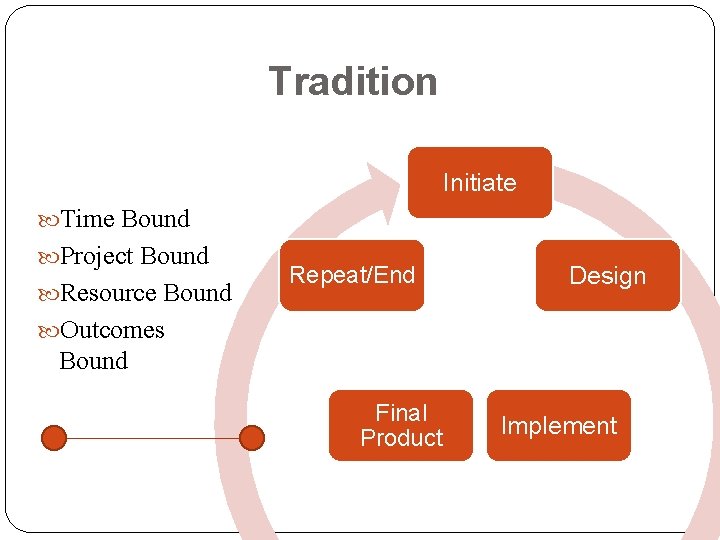
Tradition Initiate Time Bound Project Bound Resource Bound Repeat/End Design Outcomes Bound Final Product Implement
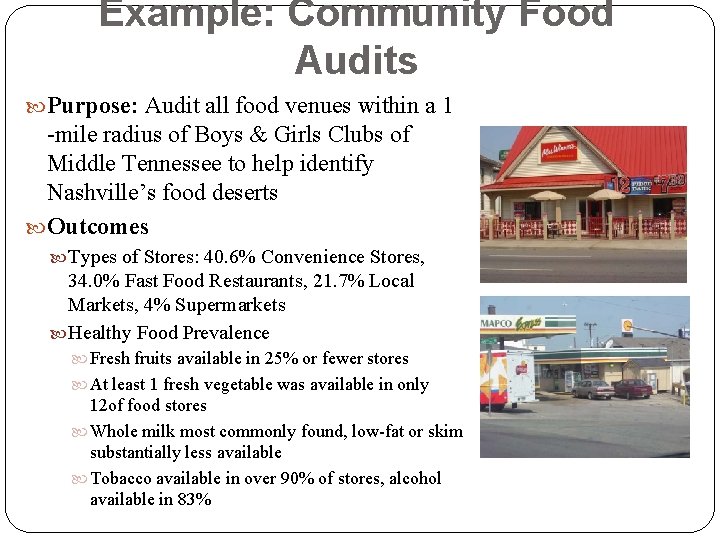
Example: Community Food Audits Purpose: Audit all food venues within a 1 -mile radius of Boys & Girls Clubs of Middle Tennessee to help identify Nashville’s food deserts Outcomes Types of Stores: 40. 6% Convenience Stores, 34. 0% Fast Food Restaurants, 21. 7% Local Markets, 4% Supermarkets Healthy Food Prevalence Fresh fruits available in 25% or fewer stores At least 1 fresh vegetable was available in only 12 of food stores Whole milk most commonly found, low-fat or skim substantially less available Tobacco available in over 90% of stores, alcohol available in 83%
The Spinner Theoretical Foundations
Sustainability, Partnership, and Service-Learning Sustainability: Programs with the community that are consistent, flexibly structured, and rewarding for all stakeholders (i. e. , community members, teachers, scholars, and students). Cushman, 2002 Building relationships with agency and school representatives is critical in sustaining college service learning programs” (Robinson, 2000, p. 5). Professor needs to understand the working of the organization… “the repositioning of the professor in service learning demands ‘a commitment to a relationship’ that’s defined by ongoing projects and inquiry rather than ‘a one-semester project’ assigned to the students” (Cushman, 2002, p. 43).
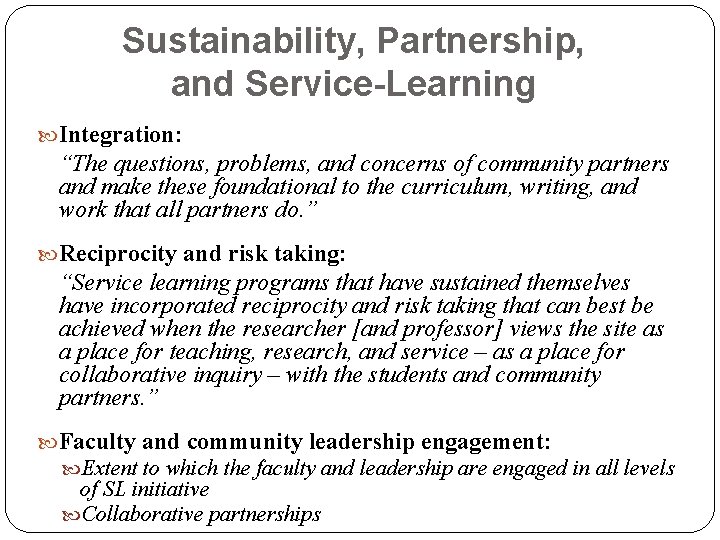
Sustainability, Partnership, and Service-Learning Integration: “The questions, problems, and concerns of community partners and make these foundational to the curriculum, writing, and work that all partners do. ” Reciprocity and risk taking: “Service learning programs that have sustained themselves have incorporated reciprocity and risk taking that can best be achieved when the researcher [and professor] views the site as a place for teaching, research, and service – as a place for collaborative inquiry – with the students and community partners. ” Faculty and community leadership engagement: Extent to which the faculty and leadership are engaged in all levels of SL initiative Collaborative partnerships
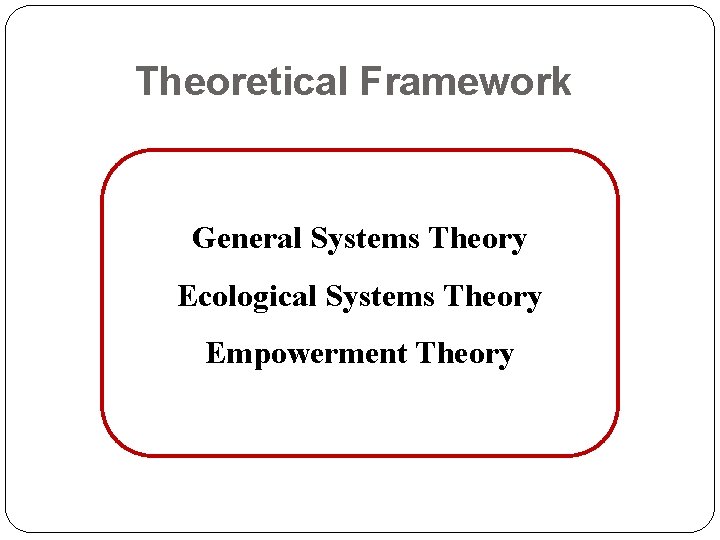
Theoretical Framework General Systems Theory Ecological Systems Theory Empowerment Theory

General Systems Theory (GST) Basic Tenets: A system is characterized by: Interactions of its components Non linearity of those interactions. Changes need to be conceptualized in the context of the total system. All systems: Share certain characteristics that allow them to function as systems, regardless of their type or level of organization. Nothing can be understood in isolation but must be seen as a part of a system. Self-organizing and even directing behavior. Interconnected and Interdependent. Everyone functionally interconnected with each other. Ludwig von Bertalanffy: General Systems Theory
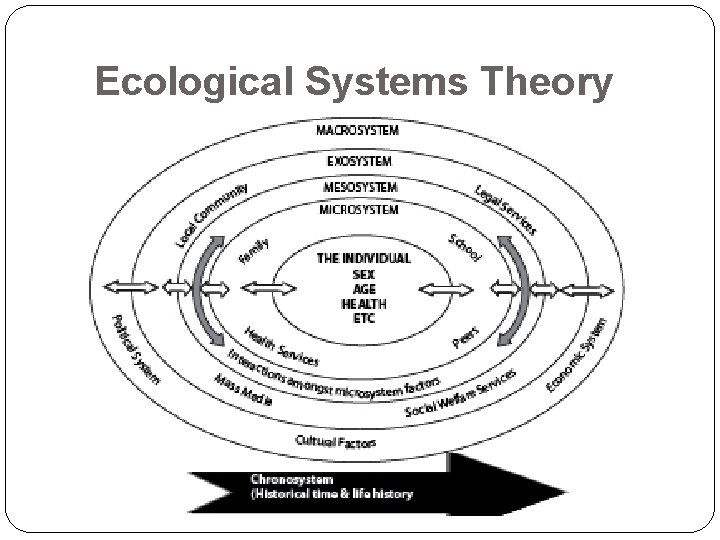
Ecological Systems Theory
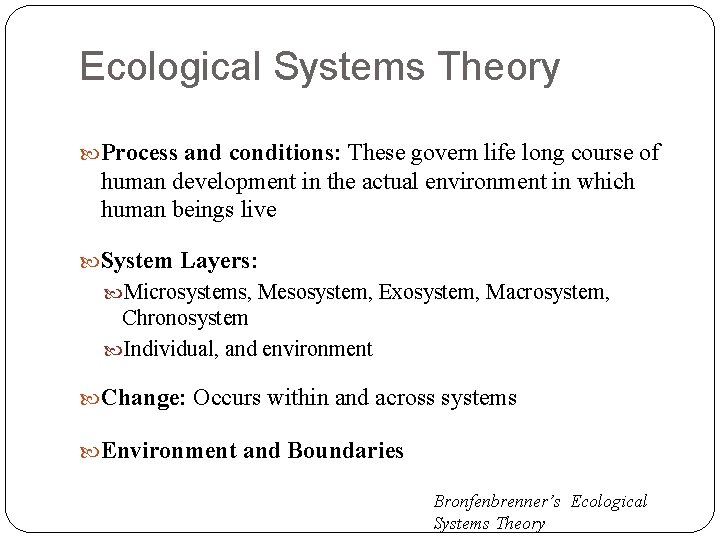
Ecological Systems Theory Process and conditions: These govern life long course of human development in the actual environment in which human beings live System Layers: Microsystems, Mesosystem, Exosystem, Macrosystem, Chronosystem Individual, and environment Change: Occurs within and across systems Environment and Boundaries Bronfenbrenner’s Ecological Systems Theory
Empowerment Theory Empowerment: The process of gaining influence over events and outcomes of importance Process unfolds at multiple and interconnected levels Responsive, collaborative, network supportive Enhancing experience and competence Collaborative Partnerships, Planning, Sharing (resources, risks, responsibility) Model of Community Empowerment: Interactive process in which people who share common neighborhoods, workplaces, experiences, or concerns gain influence over conditions that matter to them. Multiparty alliances Community partnerships: serve as catalysts Members take action to effect changes in programs, policies, and practice. (Fawcett et al. , 1995; Himmelman, 1992, Mc. Carthy & Zald, 1977)
Theory to Practice Multilevel interactions Process, structures, and experience Systems and sub systems Human, community, and environment interaction and reciprocal influences Power and influence Collaborative partnerships within system and subsystems Change, energy, and influence exchange Sustainability of community partnerships Redefining community partnerships Partnerships within a systems – not limited to linear vision
The Web Case Example: HOD 2510 Health & Human Services to Diverse Populations
Course Description This course focuses on the complexities of health service delivery to diverse populations using social-ecological models to provide a deeper understanding of the impacts of health policy, social justice, structural inequities, and the value systems of diverse groups, as well as variables related to gender, age, lifestyle, religion, culture, social class, race, geography, and developmental level and how this relates to health status and health service needs. This course will provide students with a basic knowledge and deeper understanding of the connection between health issues, health delivery strategies, compassion, diversity, advocacy, and social justice so that they may be more effective in serving the needs of all people.
Course Objectives 1. 2. 3. 4. 5. 6. To contribute to students understanding of those health & health policy issues that affect diverse populations. To present to the student a myriad of issues related to developing a deeper understanding of issues of social justice as it relates to health issues affecting diverse populations. To create and maintain an open learning environment in which students can examine their ethical and civic values. To enhance student’s knowledge of self, their immediate community and their extended community by utilizing the pedagogy of servicelearning. To facilitate the development of effective and engaged community participants (an effective community participants would be defined as self-reflective, culturally aware and responsive through reciprocal service and learning). To introduce and explore a different perspective of leadership – servant leader.
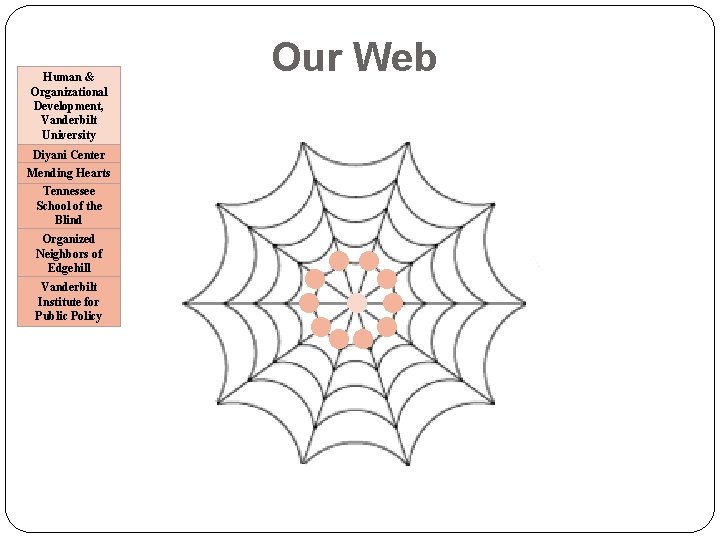
Human & Organizational Development, Vanderbilt University Diyani Center Mending Hearts Tennessee School of the Blind Organized Neighbors of Edgehill Vanderbilt Institute for Public Policy Our Web
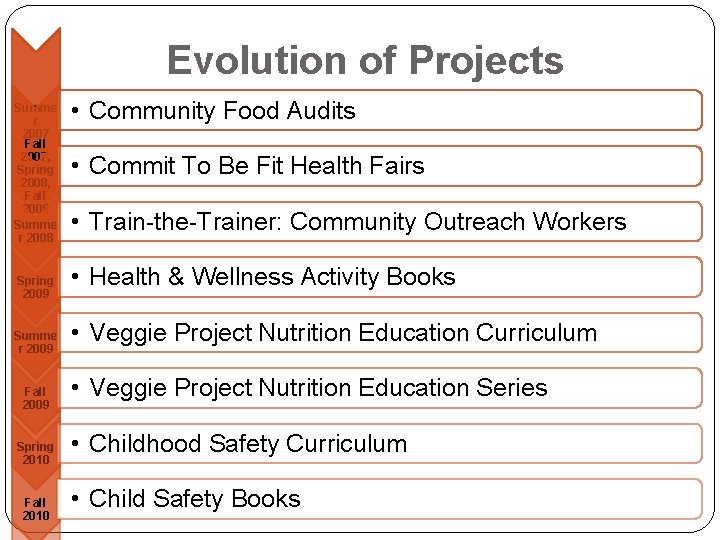
Evolution of Projects Summe r 2007 Fall 2007, Spring 2008, Fall 2008 Summe r 2008 Spring 2009 Summe r 2009 Fall 2009 Spring 2010 Fall 2010 • Community Food Audits • Commit To Be Fit Health Fairs • Train-the-Trainer: Community Outreach Workers • Health & Wellness Activity Books • Veggie Project Nutrition Education Curriculum • Veggie Project Nutrition Education Series • Childhood Safety Curriculum • Child Safety Books
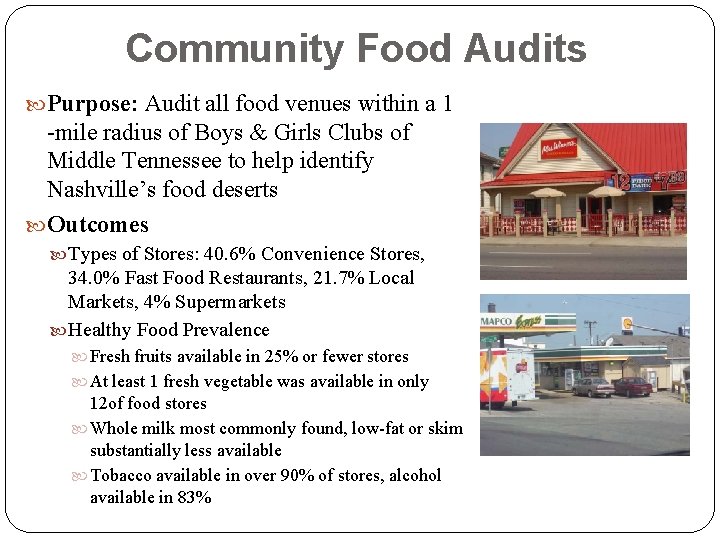
Community Food Audits Purpose: Audit all food venues within a 1 -mile radius of Boys & Girls Clubs of Middle Tennessee to help identify Nashville’s food deserts Outcomes Types of Stores: 40. 6% Convenience Stores, 34. 0% Fast Food Restaurants, 21. 7% Local Markets, 4% Supermarkets Healthy Food Prevalence Fresh fruits available in 25% or fewer stores At least 1 fresh vegetable was available in only 12 of food stores Whole milk most commonly found, low-fat or skim substantially less available Tobacco available in over 90% of stores, alcohol available in 83%
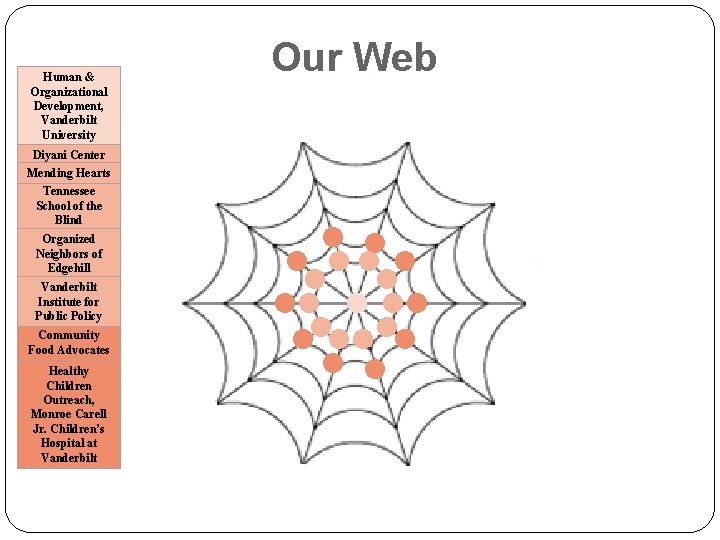
Human & Organizational Development, Vanderbilt University Diyani Center Mending Hearts Tennessee School of the Blind Organized Neighbors of Edgehill Vanderbilt Institute for Public Policy Community Food Advocates Healthy Children Outreach, Monroe Carell Jr. Children’s Hospital at Vanderbilt Our Web
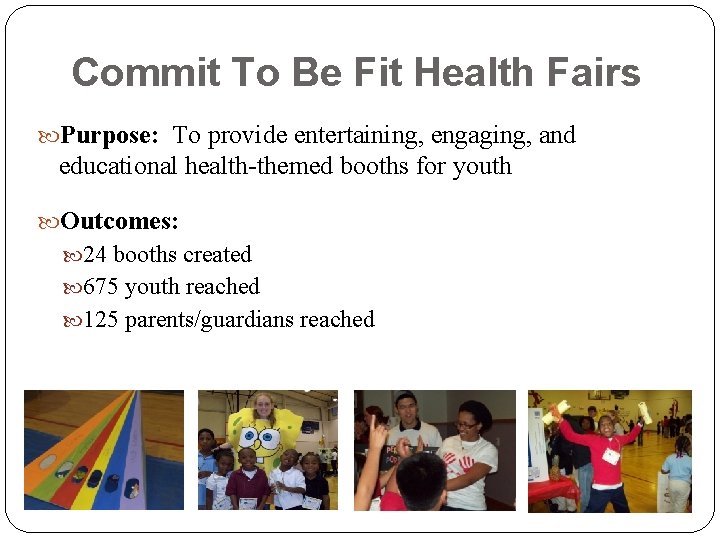
Commit To Be Fit Health Fairs Purpose: To provide entertaining, engaging, and educational health-themed booths for youth Outcomes: 24 booths created 675 youth reached 125 parents/guardians reached
Train-the-Trainer: Community Outreach Workers Purpose: To provide materials related to nutrition and grocery shopping experiences to train women of the Sudanese community to train other women to improve the nutritional sustainability of their families Outcomes: Created 5 training programs including curriculums and materials Training programs were successfully implemented and sustained within the partner organization
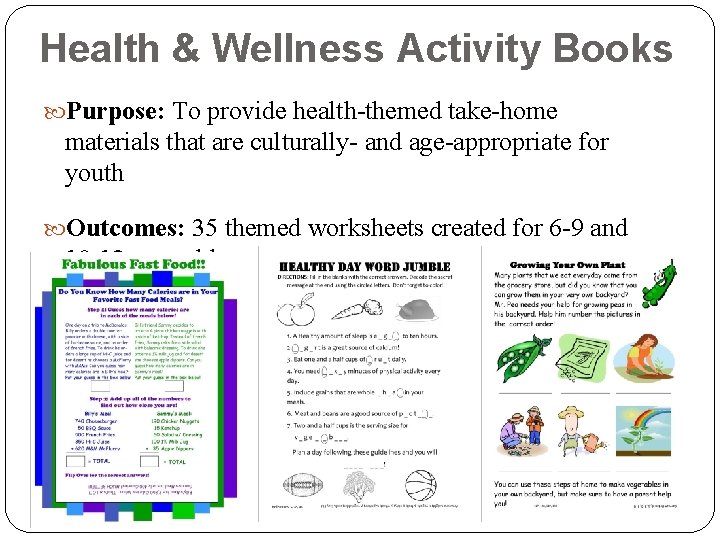
Health & Wellness Activity Books Purpose: To provide health-themed take-home materials that are culturally- and age-appropriate for youth Outcomes: 35 themed worksheets created for 6 -9 and 10 -12 year olds
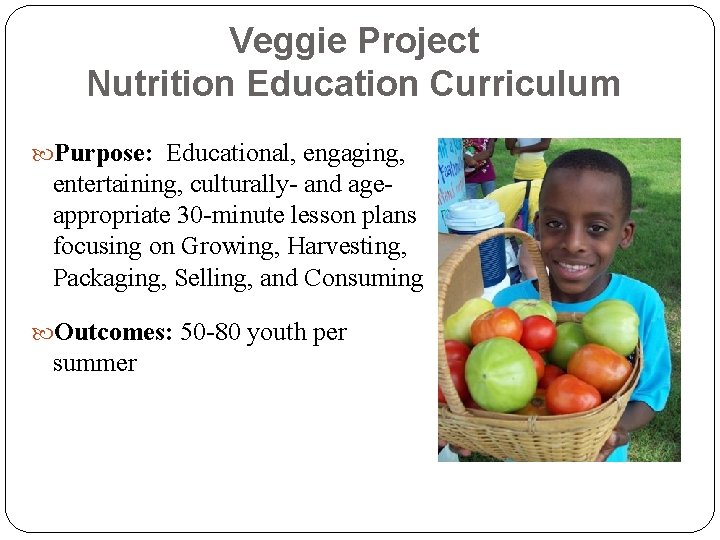
Veggie Project Nutrition Education Curriculum Purpose: Educational, engaging, entertaining, culturally- and ageappropriate 30 -minute lesson plans focusing on Growing, Harvesting, Packaging, Selling, and Consuming Outcomes: 50 -80 youth per summer
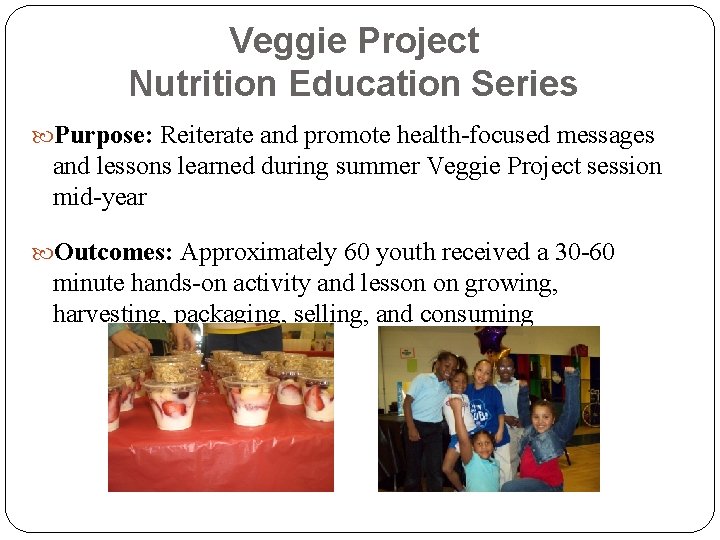
Veggie Project Nutrition Education Series Purpose: Reiterate and promote health-focused messages and lessons learned during summer Veggie Project session mid-year Outcomes: Approximately 60 youth received a 30 -60 minute hands-on activity and lesson on growing, harvesting, packaging, selling, and consuming
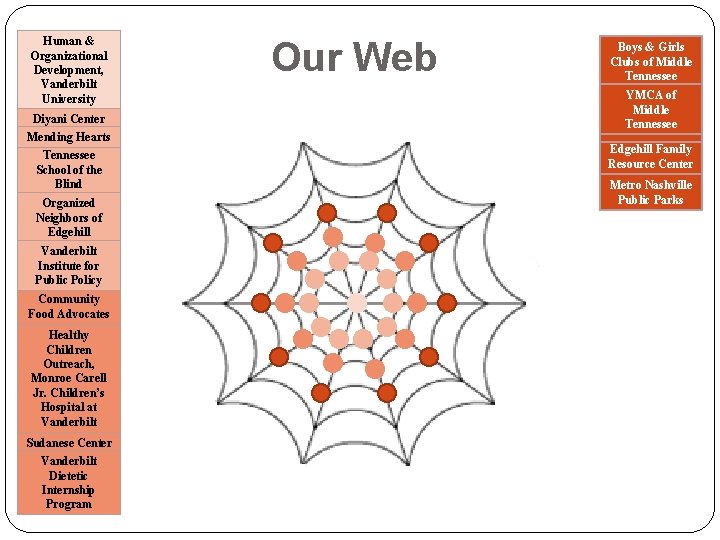
Human & Organizational Development, Vanderbilt University Diyani Center Mending Hearts Tennessee School of the Blind Organized Neighbors of Edgehill Vanderbilt Institute for Public Policy Community Food Advocates Healthy Children Outreach, Monroe Carell Jr. Children’s Hospital at Vanderbilt Sudanese Center Vanderbilt Dietetic Internship Program Our Web Boys & Girls Clubs of Middle Tennessee YMCA of Middle Tennessee Harvest Hands Edgehill Family Resource Center Metro Nashville Public Parks
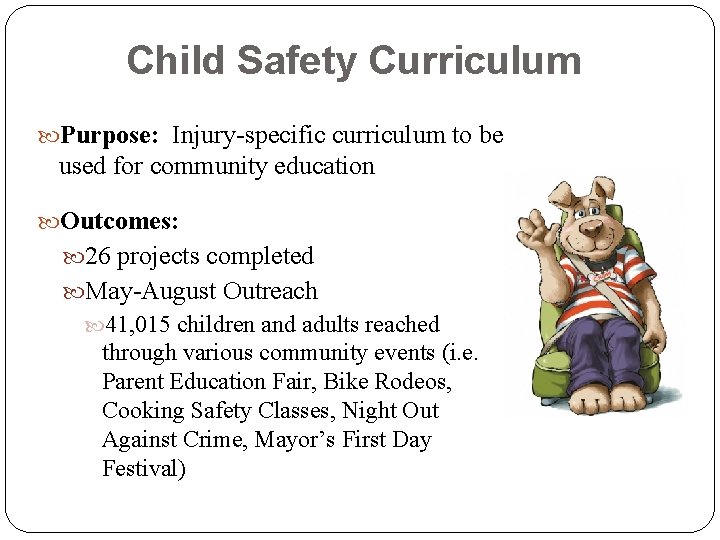
Child Safety Curriculum Purpose: Injury-specific curriculum to be used for community education Outcomes: 26 projects completed May-August Outreach 41, 015 children and adults reached through various community events (i. e. Parent Education Fair, Bike Rodeos, Cooking Safety Classes, Night Out Against Crime, Mayor’s First Day Festival)
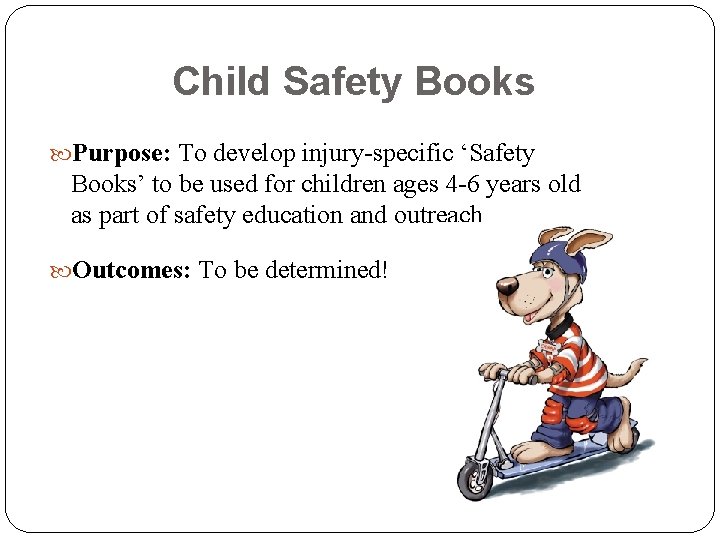
Child Safety Books Purpose: To develop injury-specific ‘Safety Books’ to be used for children ages 4 -6 years old as part of safety education and outreach Outcomes: To be determined!
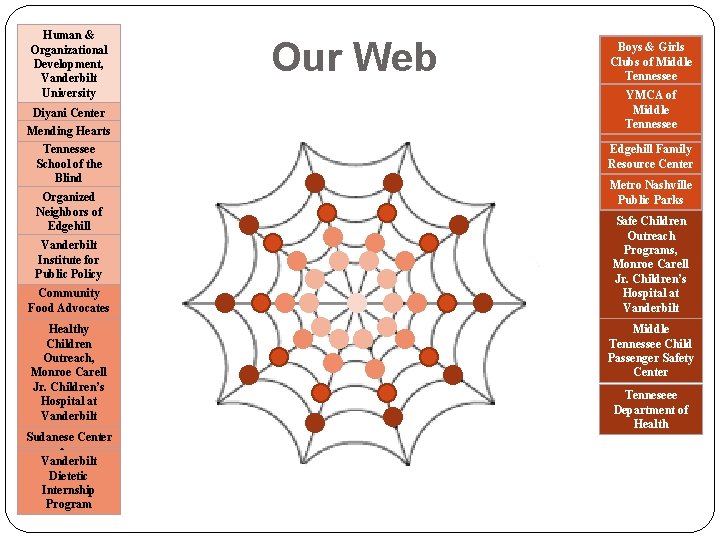
Human & Organizational Development, Human & Vanderbilt Organizational University Development, Diyani Center Vanderbilt Mending Hearts University Tennessee Diyani Center School of the Mending Hearts Blind Tennessee Organized School of the Neighbors of Blind Edgehill Organized Vanderbilt Neighbors of Institute for Edgehill Public Policy Vanderbilt Community Institute for Food Advocates Public Policy Healthy Community Children Food Advocates Outreach, Healthy Monroe Carell Jr. Children’s Outreach, Hospital at Monroe Carell Vanderbilt Jr. Children’s Sudanese Center Hospital at Vanderbilt Dietetic Sudanese Center Internship Program Our Web Boys & Girls Clubs of Middle Tennessee YMCA of Middle Tennessee Harvest Hands Edgehill Family Resource Center Metro Nashville Public Parks Safe Children Outreach Programs, Monroe Carell Jr. Children’s Hospital at Vanderbilt Middle Tennessee Child Passenger Safety Center Tenneseee Department of Health
Growing Opportunities HOD 2690 Health Promotion Delivery Internships Independent Study Volunteer Opportunities Professional Outcomes
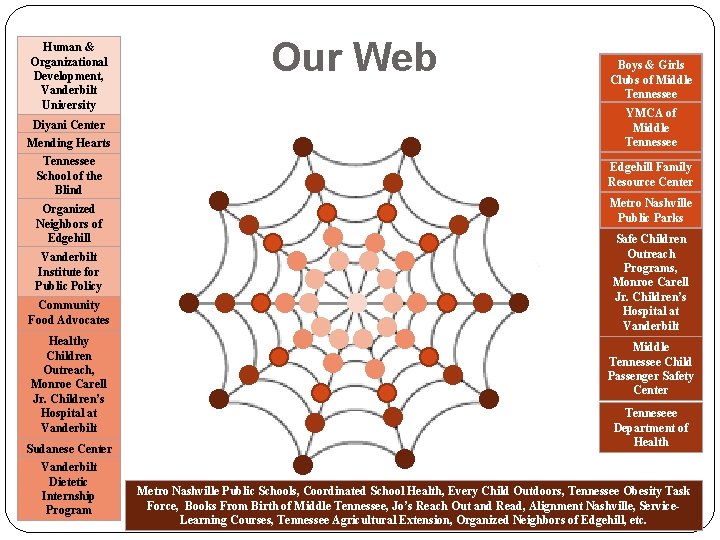
Human & Organizational Development, Vanderbilt University Diyani Center Mending Hearts Tennessee School of the Blind Organized Neighbors of Edgehill Vanderbilt Institute for Public Policy Community Food Advocates Healthy Children Outreach, Monroe Carell Jr. Children’s Hospital at Vanderbilt Sudanese Center Vanderbilt Dietetic Internship Program Our Web Boys & Girls Clubs of Middle Tennessee YMCA of Middle Tennessee Harvest Hands Edgehill Family Resource Center Metro Nashville Public Parks Safe Children Outreach Programs, Monroe Carell Jr. Children’s Hospital at Vanderbilt Middle Tennessee Child Passenger Safety Center Tenneseee Department of Health Metro Nashville Public Schools, Coordinated School Health, Every Child Outdoors, Tennessee Obesity Task Force, Books From Birth of Middle Tennessee, Jo’s Reach Out and Read, Alignment Nashville, Service. Learning Courses, Tennessee Agricultural Extension, Organized Neighbors of Edgehill, etc.
Service-Learning: Key Considerations Leadership Capacity Assessment Communication of goals & objectives Recognizing & respecting strengths, weaknesses, opportunities, and threats Choosing a Project Meeting real community needs Focusing on sustainability Outcome oriented Partnership Responsibilities Shared project development Shared evaluation Partner and faculty involvement throughout Course Responsibilities Framing Time management Multiple opportunities for review and feedback
The Weaver Lessons Learned Future Research & Practice Recommendations
Lessons Learned Vision Changing the role of the community partner as a collaborative colleague and co-teacher Reciprocally blend the needs of the community and the needs of the course Commitment Bridge gap between student’s academic and professional life Expanding student learning with sustained connections Enhancing product outcomes Flexibility & Adaptability: Improvise, Modify, and Adjust
Future Research & Practice Recommendations Possible challenges of research Difficulty & complexities in navigating various domains Student understanding of, competencies in, and success in network development in a service-learning web vs. traditional service-learning project University and community partnerships working within web-based projects vs. thread-based projects Value of project outcomes to community in web-based service-learning Community’s perception of the university in a web model vs. traditional service-learning model
Future Research & Practice Recommendations Community context: The variations in web features based on community factors e. g. , urban vs. rural communities, extent of institutionalization of SL in academy, etc. Faculty involvement: Degree, consistency, duration, and perception by stakeholders sand influence on development and sustainability of community partnership web. Theory Application (General Systems , Ecological Systems , and/or Empowerment Theories): The relationship between level of the community partnership web and the impact on and by other dimensions of the system. Examining the nature of the threads within the web: The exchange on energy, level and degree of responsiveness, capacity to support change, and ability to sustain over time and
Questions Leigh Gilchrist leigh. z. gilchrist@vanderbilt. edu Liz Aleman elizabeth. j. aleman@vanderbilt. edu Sharon Shields sharon. l. shields@vanderbilt. edu THANK YOU!
- Slides: 39